When I moved to Australia to study conservation biology, I thought I knew its animals. Kangaroos, koalas, wombats, a few too many venomous snakes. Then fossils started appearing in my lectures, and the continent got a lot stranger.
Picture a wombat relative heavier than a hippo. Then add a kangaroo that probably walked instead of hopped, and a flightless goose over two metres tall. That was the Australia megafauna, and I couldn’t stop reading about it.
I had already fallen down this rabbit hole with the megalodon, the giant ground sloth and sabre-toothed cats. So I went digging. I explored the Australian Museum while living in Sydney during my master’s in 2022 and 2023. I first visited Melbourne Museum in 2019, and I’m going back in January 2027. This year I even hunted for Australian fossils at the Natural History Museum in London.
Below are 15 extinct giants that roamed prehistoric Australia, plus what palaeontology now says about their disappearance.
What Was the Australia Megafauna?
Palaeontologists usually describe megafauna as land animals heavier than roughly 40 to 45 kilograms. In Australia, that meant oversized marsupials, giant flightless birds and huge reptiles. Dinosaurs don’t count. They vanished about 66 million years before any of these animals appeared.
Most megafauna species thrived during the Pleistocene, the ice age period from about 2.6 million to 11,700 years ago. They did more than look impressive. They pruned vegetation, spread seeds over huge distances and moved nutrients across the landscape in their dung. If you’ve read my guide to ice age animals, you’ll recognise the pattern. Australia simply did it with pouches.
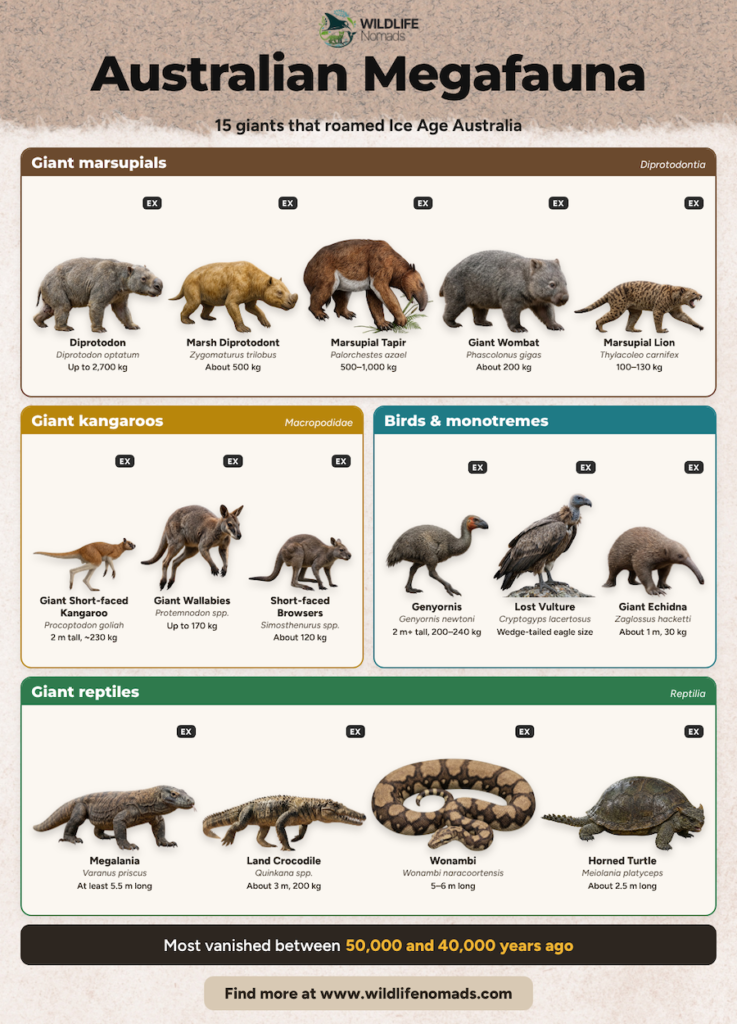
15 Megafauna Species of Prehistoric Australia
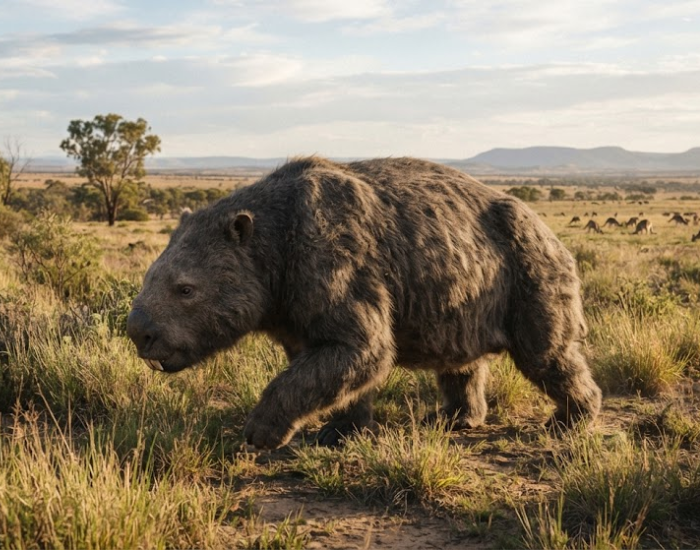
1. Diprotodon (Diprotodon optatum)
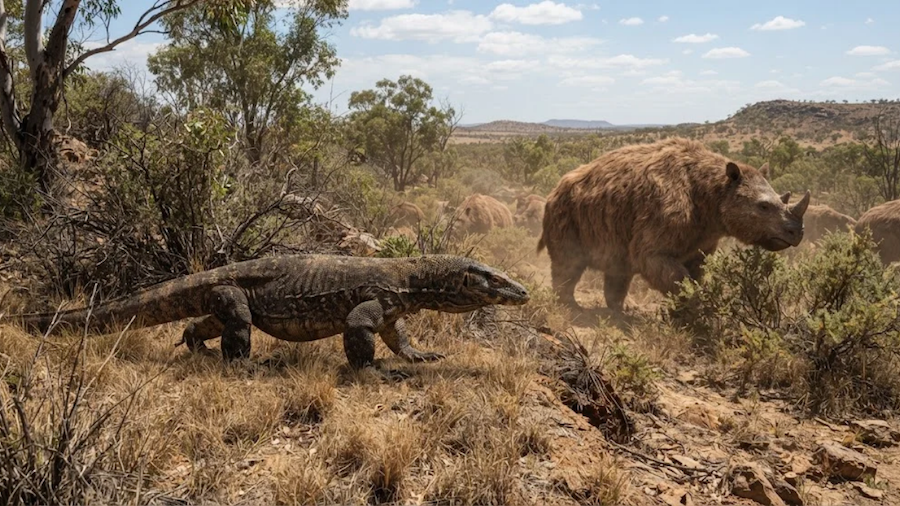
Diprotodon is the largest marsupial that ever lived. It weighed up to about 2,700 kilograms and stretched roughly 3 metres long. Picture a wombat scaled up to rhino size, and you’re close. Unsurprisingly, it is closely related to today’s wombats and koalas.
Its fossils turn up across most of the mainland, so this grazer was clearly widespread. My favourite study came from University of Queensland palaeontologist Gilbert Price and colleagues. The incisors in a diprotodon jaw kept growing for life, recording chemistry like tree rings. Strontium isotopes in one tooth revealed seasonal round trips of up to 200 kilometres. That makes Diprotodon the first marsupial, living or extinct, known to migrate like wildebeest.
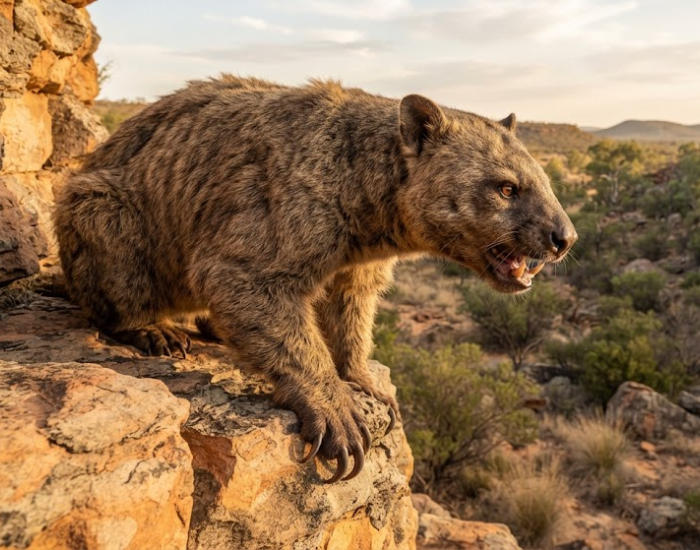
2. Marsupial Lion (Thylacoleo carnifex)
Despite the name, the marsupial lion had nothing to do with the American cave lion or the african lion. Its closest living relatives are, once again, wombats and koalas. Adults weighed around 100 to 130 kilograms, similar to a lioness.
Instead of fangs, Thylacoleo carried huge blade-like premolars that worked like bolt cutters. Biomechanical studies suggest it had the strongest bite for its size of any known mammal. It also had a semi-opposable thumb tipped with a large hooked claw. Claw marks in Western Australian caves show it could climb, and many researchers see it as an ambush hunter. It was the continent’s top mammalian apex predator, and key ice of the megafauna food web.
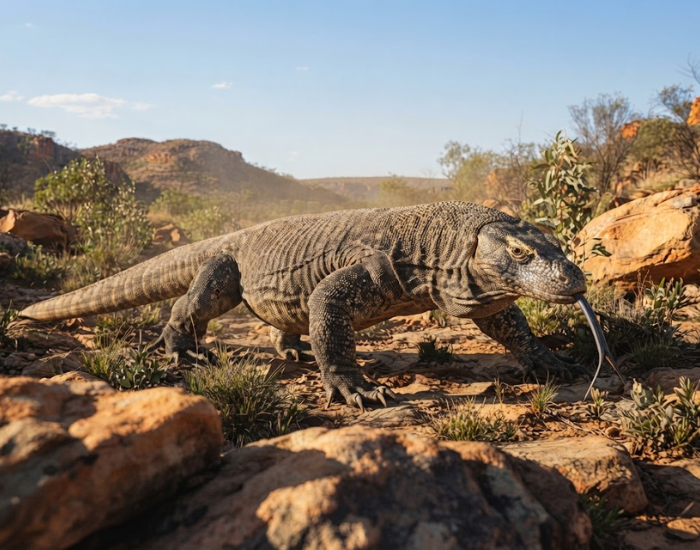
3. Megalania (Varanus priscus)
Megalania was the largest land lizard known to science, a giant cousin of Australia’s living goannas. Nobody has found a complete skeleton, so its size remains hotly debated. Older estimates of 7 metres now look inflated. A 2009 study suggested at least 5.5 metres and about 575 kilograms.
I worked with monitor lizards in a zoo reptile house, and even medium-sized ones commanded respect. In the Philippines, I once watched an endemic Palawan monitor eat fish scraps beside a fisherman cleaning his catch. Like its living relative the Komodo dragon, megalania probably had a venomous bite and tackled large prey.
4. Giant Short-Faced Kangaroo (Procoptodon goliah)
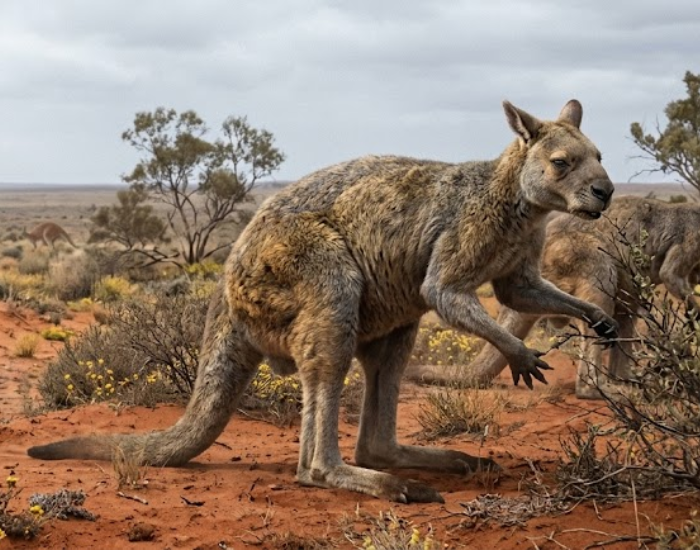
The giant short-faced kangaroo stood about 2 metres tall and weighed around 230 kilograms. That’s more than double a big male red kangaroo. For decades, it held the title of largest kangaroo ever found. Queensland Museum researchers now think an unnamed giant from South Walker Creek may have been bigger.
Its flat face and forward-facing eyes look almost primate-like in reconstructions. Each foot ended in one large hoof-like toe. Its long arms carried two elongated, clawed fingers for hooking branches. One 2014 study argues these short-faced kangaroos walked upright, one foot at a time, rather than hopping at speed.
5. Genyornis (Genyornis newtoni)
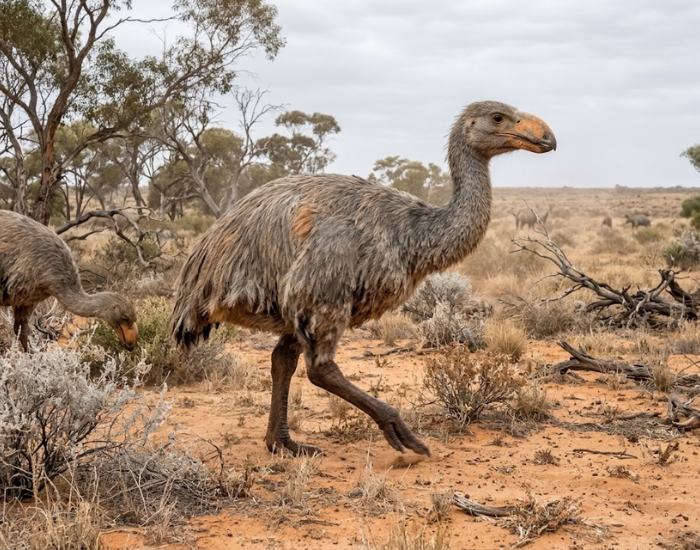
Genyornis belonged to the mihirungs, a family of giant flightless birds nicknamed “thunder birds.” It stood over 2 metres tall and weighed roughly 200 to 240 kilograms. Old drawings make it look like an emu, but it sits closer to ducks and geese.
In 2024, Flinders University researchers described a near-complete skull from Lake Callabonna. It revealed a goose-like face, a tall parrot-like upper jaw and features suited to life around water. The team suggests that freshwater lakes turning salty contributed to its decline. Meanwhile, burnt eggshells dated to roughly 50,000 years ago suggest the first humans cooked giant eggs. A 2022 protein study linked those eggs to Genyornis, although a few palaeontologists still dispute it.
6. Land Crocodile (Quinkana spp.)
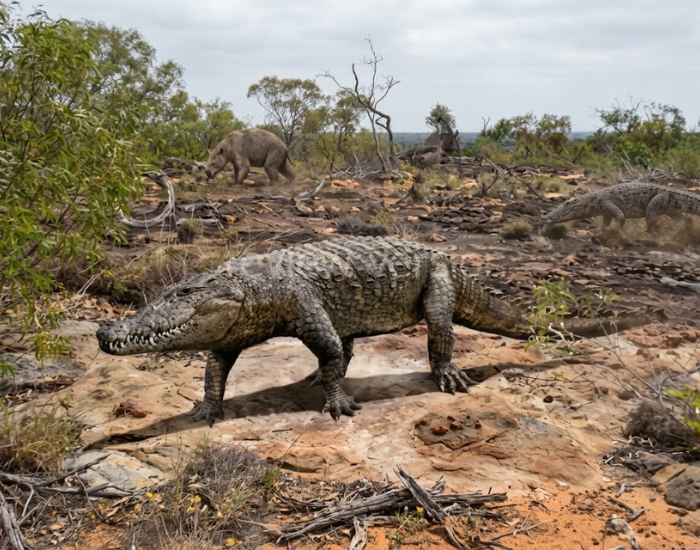
I spent part of my childhood in Villahermosa, Tabasco, living right in front of a crocodile river. Years later, I fed crocodiles whole chickens at a zoo. Yet Quinkana still surprises me. It was a land dwelling crocodile with long, upright legs and serrated, blade-like teeth for slicing. Not as surprising as the giant Deinosuchus, but still impressive!
Most specimens point to an animal around 3 metres long and 200 kilograms. One fragmentary fossil hints at something larger, but palaeontologists treat that estimate cautiously. The genus takes its name from the Quinkans, spirit figures in Gugu-Yalanji Dreamtime stories painted in Cape York rock art. Today, the saltwater crocodile fills the big-croc niche, but it hunts from the water.
7. Giant Wombat (Phascolonus gigas)
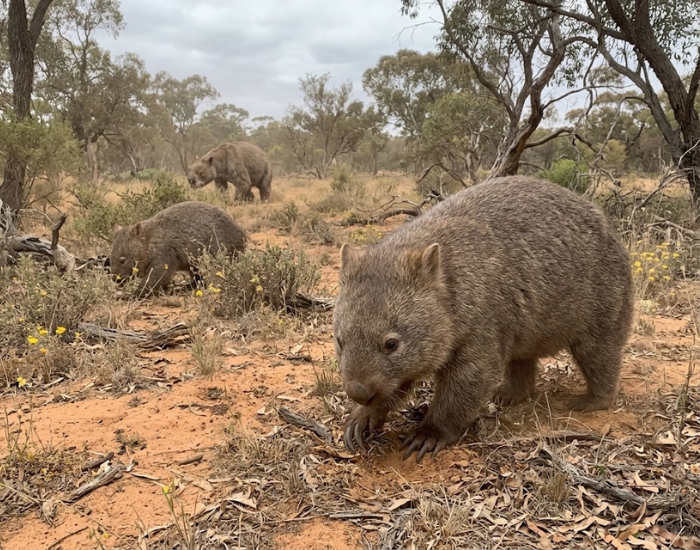
People often call Diprotodon a giant wombat, but Phascolonus gigas was the real thing. This true wombat weighed around 200 kilograms. That’s within the range of the American black bears I’ve seen hiking near Vancouver.
Its upper incisors were broad and flat, more like chisels than the narrow teeth of living wombats. Researchers still debate whether an animal that size could dig burrows. Picture the wombats of Maria Island six times heavier, and you have Phascolonus.
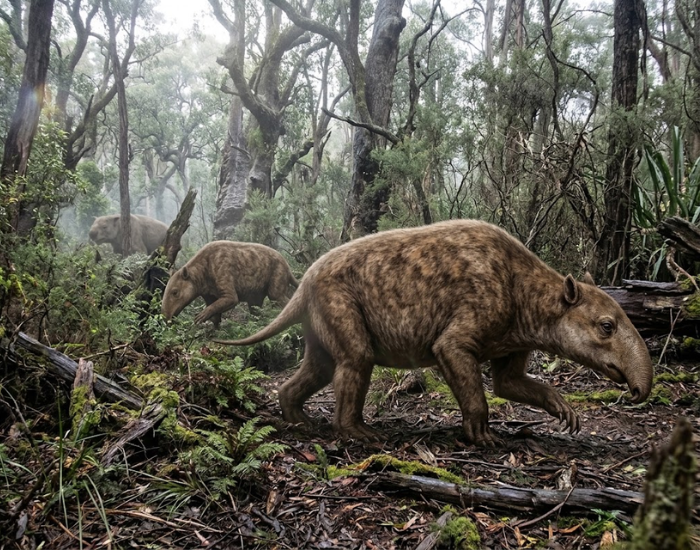
8. Marsupial Tapir (Palorchestes azael)
Palorchestes is the strangest animal on this list. Richard Owen named it from teeth in 1873, believing it was a giant kangaroo. Later finds revealed a bulky browser of perhaps 500 to 1,000 kilograms. It had huge claws, a long tongue and nasal bones suggesting a flexible lip or short trunk.
A 2019 study of its limbs found elbows locked in a permanently bent position. It probably couldn’t walk like a typical four-legged mammal. Instead, it likely used those claws to strip bark and pull down branches, like an American ground sloth.
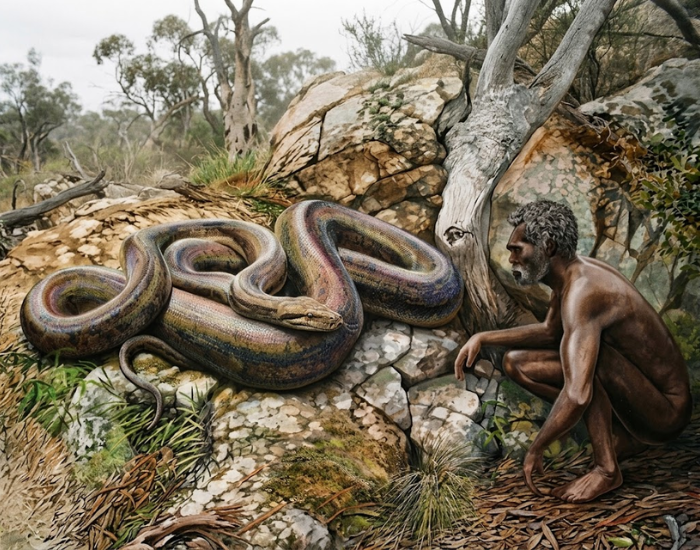
9. Wonambi (Wonambi naracoortensis)
Wonambi was a constrictor that reached 5 to 6 metres long, but it wasn’t a python. It belonged to the madtsoiids, an ancient snake family that disappeared elsewhere millions of years earlier. Palaeontologists named it from fossils found at the Naracoorte Caves in South Australia.
At the zoo, I cared for ball, reticulated and Burmese pythons, so I know how a big constrictor moves. Wonambi likely ambushed kangaroos and wallabies around waterholes in a similar way. Unlike pythons, it couldn’t open its jaws as widely. That probably limited it to small and medium-sized prey.
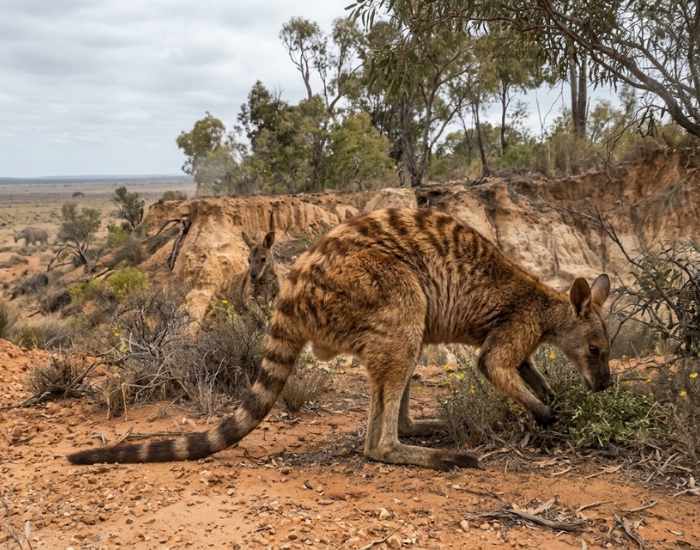
10. Giant Wallabies (Protemnodon spp.)
Protemnodon is a genus of heavy-set giant wallabies, and it recently got far more interesting. In 2024, Flinders University’s Isaac Kerr and colleagues described three new species after studying more than 800 specimens. The biggest, Protemnodon viator, weighed up to 170 kilograms, about twice a large male red kangaroo.
These giant kangaroo relatives varied wildly. P. viator hopped efficiently across arid central Australia. P. mamkurra was thick-boned and may have moved like a giant quokka, sometimes bounding on all fours. Other species lived in the wet, forested mountains of Tasmania and New Guinea. By about 40,000 years ago, every Protemnodon had vanished from the mainland.
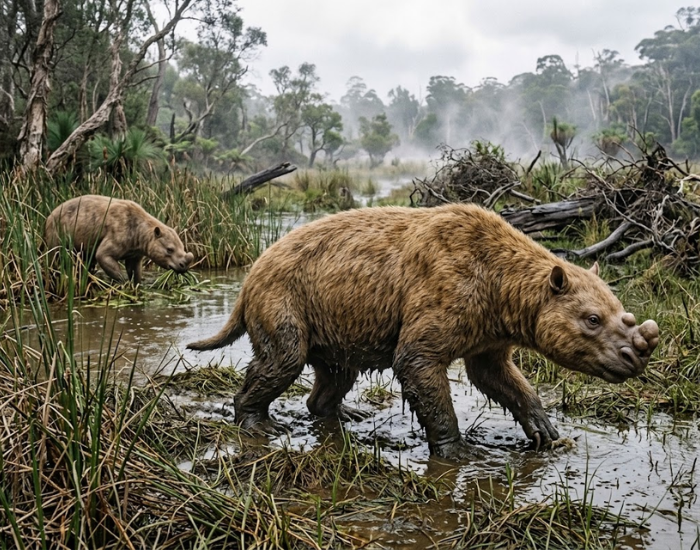
11. Marsh Diprotodont (Zygomaturus trilobus)
Zygomaturus was a diprotodontid about the size of a small rhino, weighing roughly 500 kilograms. It had a short, broad snout and wide, flaring cheekbones. Fossils come mainly from southern and eastern Australia, including New South Wales, Victoria and Tasmania.
Many palaeontologists believe it favoured swamps and riverbanks, feeding on reeds and sedges. Megafauna weren’t only desert animals; they filled wetlands and forests too.
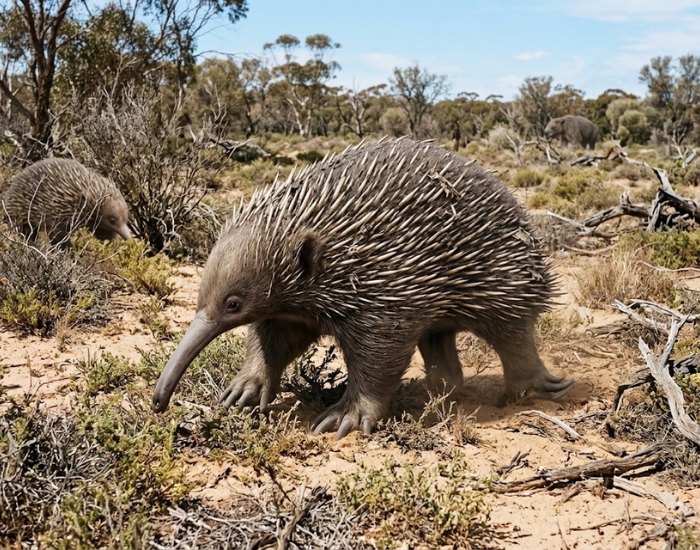
12. Giant Echidna (Zaglossus hacketti)
Zaglossus hacketti is the largest monotreme known, the group that includes echidnas and the platypus. Fossils from Mammoth Cave in Western Australia suggest an animal about 1 metre long and 30 kilograms. Technically, that falls under the 40-kilogram line, but palaeontologists usually group it with the megafauna.
Its long, straight legs hint that it walked through forests, foraging for worms and grubs. Its closest living relatives, the long-beaked echidnas, survive only in New Guinea. All three species are far smaller, and all are threatened.
Nothing like small cut short beaked echidna I encountered at Woody Head on our lap around Australia.
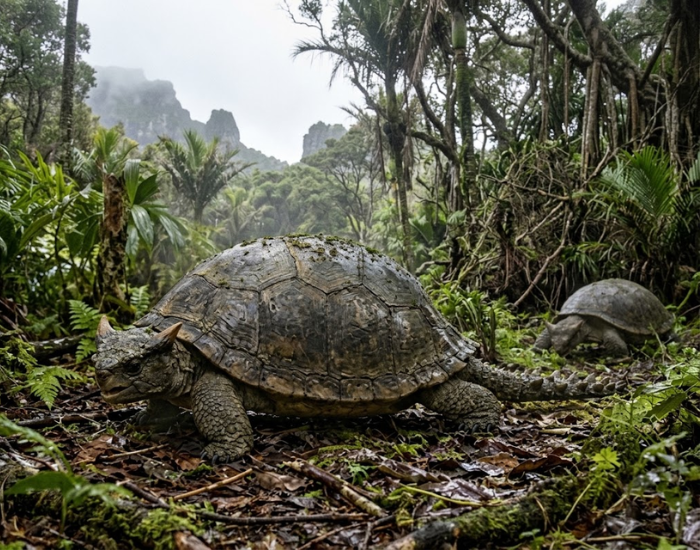
13. Horned Turtle (Meiolania platyceps)
Meiolania platyceps lived on Lord Howe Island, which belongs to New South Wales today. It reached about 2.5 metres long, tail included. Two backward-curving horns sprouted from its skull, and a spiked club armoured its tail. Those horns stopped it from pulling its head into its shell.
I’ve fed Galápagos giant tortoises in a zoo, mostly enormous salads. Meiolania was something else entirely, an ancient stem turtle unrelated to tortoises. Strictly, it was an island giant rather than a mainland one. Its mainland relative, Ninjemys oweni, lived in Queensland, and palaeontologists named it after the Teenage Mutant Ninja Turtles.
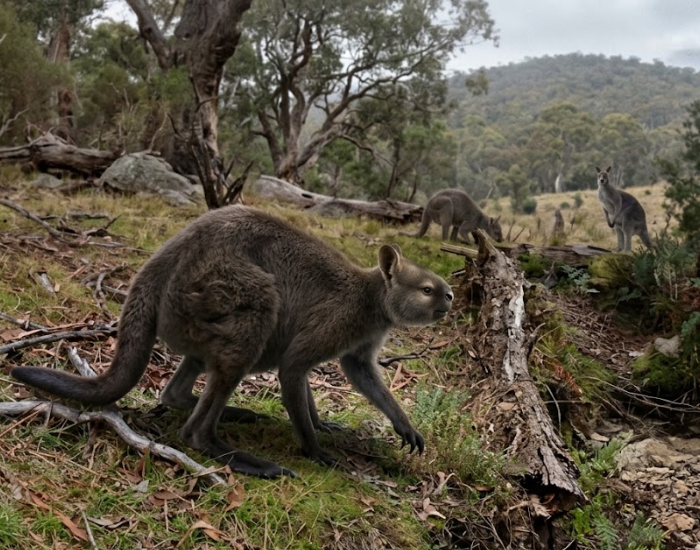
14. Short-Faced Browsing Kangaroos (Simosthenurus spp.)
Simosthenurus belonged to the same short-faced kangaroo group as Procoptodon. Species like Simosthenurus occidentalis weighed around 120 kilograms. Their deep skulls and thick jaws cracked tough leaves, stems and seeds like nutcrackers.
Fossils from the Naracoorte Caves and other sites across southern Australia show how widespread these browsers were. Several species shared woodlands with other megafauna species, probably targeting different plants.
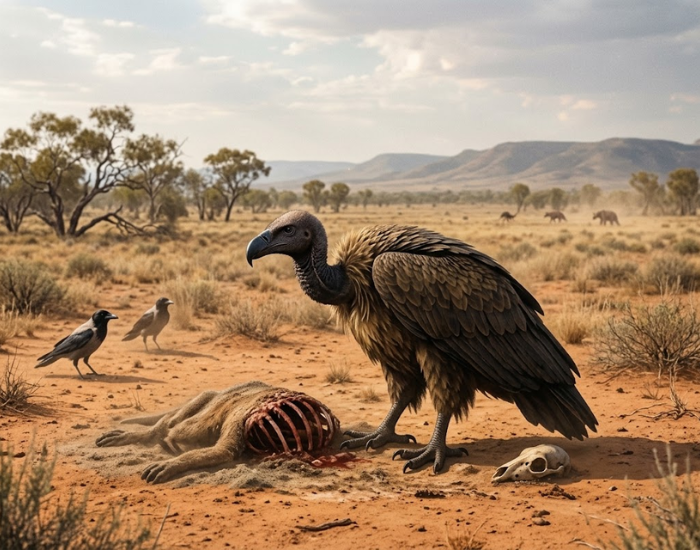
15. Australia’s Lost Vulture (Cryptogyps lacertosus)
Australia has no vultures today, which surprises many visitors. It once had one. Charles de Vis first described Cryptogyps lacertosus as an eagle in 1905. In 2022, Flinders University researchers reclassified it as an Old World vulture, the first known from Australia.
It lived between roughly 500,000 and 50,000 years ago and matched a wedge-tailed eagle in size. Its feet weren’t built for killing, so it likely fed on carcasses. When the giant herbivores disappeared, so did the carrion that sustained it.
Why Did the Australian Megafauna Go Extinct?
The first humans reached Australia at least 50,000 years ago, and some sites suggest even earlier. A landmark 2001 study dated a continent-wide extinction to about 46,000 years ago. In 2016, Frédérik Saltré and colleagues analysed 659 fossil ages. They found the extinctions were broadly synchronous and independent of climate variability. Their model places the disappearance about 13,500 years after human arrival, pointing to hunting and burning as major factors.
Then northern Australia complicated the story. Barada Barna Traditional Owners discovered fossil bones at South Walker Creek, near Mackay. Queensland Museum’s Scott Hocknull and colleagues found tropical megafauna there that survived until about 40,000 years ago. They documented falling water flow, intensifying drought, more fire and vegetation change, but no local evidence of humans. The overlap between people and megafauna there lasted roughly 15,000 to 20,000 years.
The loss also reshaped the environment. Sediment cores from Lynch’s Crater in Queensland show fire and fire-tolerant vegetation increased after megafauna declined. Without giant browsers eating shrubs, fuel built up and the bush burned differently. My honest read is that humans likely tipped the balance, while drying climates made some regions more fragile.
FAQ About the Australia Megafauna
The saltwater crocodile is Australia’s largest living land-based animal, with big males exceeding 5 metres. Among marsupials, the red kangaroo takes the title, with males weighing up to about 90 kilograms. For birds, the southern cassowary and emu are the heaviest.
Yes, a handful. Using the 40-kilogram definition, red and eastern grey kangaroos, emus, southern cassowaries and saltwater crocodiles all qualify. You can still see these survivors at the best places to see wildlife in Australia.
Plenty. Elephants, rhinos, giraffes, hippos, bison and big cats are all living megafauna. Africa and South Asia kept the most large animals, possibly because their wildlife evolved alongside humans for much longer.
Unlike Africa, Australia has no official Big Five. Lists vary between tour operators, but the kangaroo, koala, wombat, platypus and echidna appear often. In the past, a megafauna Big Five would have looked very different.
Yes. The first Australians shared the continent with giants for thousands of years. Burnt Genyornis eggshells are among the best examples of that direct contact.
Where to See Australia’s Megafauna Today
The Australia megafauna shaped this continent’s forests, wetlands and fire regimes, and the first Australians lived among it. Its story is also a warning about how fast ecosystems change when their biggest animals disappear.
You can still meet these giants through bones and teeth. Queensland Museum in Brisbane led the South Walker Creek research. The World Heritage-listed Naracoorte Caves in South Australia preserve an extraordinary fossil record. Mungo National Park holds some of the oldest human history in New South Wales.
I’ll be back at Melbourne Museum in January 2027, checking what’s new on display. Which of these 15 surprised you most? Tell me in the comments. If you’re interested in more lost species, read my list of 13 animals that went extinct recently.
Wildlife Nomads Challenge
Wake the Giants
Fifteen Ice Age giants are buried in the outback. Name each one to bring it back to life. Round 1 is picture ID. Round 2 is trickier: marsupial, reptile, or something else entirely?
Round 1 done
Round 2 digs deeper. Australia’s giants weren’t all marsupials. Sort each one into its group, and watch for the egg-layer hiding among them.
References:
Demarchi, B., Stiller, J., Grealy, A., Mackie, M., Teasdale, M. D., Collins, M. J., Miller, G. H., et al. (2022). Ancient proteins resolve controversy over the identity of Genyornis eggshell. Proceedings of the National Academy of Sciences, 119(43), e2109326119. https://doi.org/10.1073/pnas.2109326119
Hocknull, S. A., Lewis, R., Arnold, L. J., Pietsch, T., Joannes-Boyau, R., Price, G. J., Louys, J., et al. (2020). Extinction of eastern Sahul megafauna coincides with sustained environmental deterioration. Nature Communications, 11, 2250. https://doi.org/10.1038/s41467-020-15785-w
Kerr, I. A. R., Camens, A. B., van Zoelen, J. D., Worthy, T. H., & Prideaux, G. J. (2024). Systematics and palaeobiology of kangaroos of the late Cenozoic genus Protemnodon (Marsupialia, Macropodidae). Megataxa, 11(1). https://doi.org/10.11646/megataxa.11.1.1
McInerney, P. L., Blokland, J. C., & Worthy, T. H. (2024). Skull morphology of the enigmatic Genyornis newtoni Stirling and Zeitz, 1896 (Aves, Dromornithidae), with implications for functional morphology, ecology, and evolution in the context of Galloanserae. Historical Biology, 36, 1093–1165. https://doi.org/10.1080/08912963.2024.2308212
Price, G. J., Ferguson, K. J., Webb, G. E., Feng, Y., Higgins, P., Nguyen, A. D., Zhao, J., Joannes-Boyau, R., & Louys, J. (2017). Seasonal migration of marsupial megafauna in Pleistocene Sahul (Australia–New Guinea). Proceedings of the Royal Society B, 284(1863), 20170785. https://doi.org/10.1098/rspb.2017.0785
Rule, S., Brook, B. W., Haberle, S. G., Turney, C. S. M., Kershaw, A. P., & Johnson, C. N. (2012). The aftermath of megafaunal extinction: Ecosystem transformation in Pleistocene Australia. Science, 335(6075), 1483–1486. https://doi.org/10.1126/science.1214261
Saltré, F., Rodríguez-Rey, M., Brook, B. W., Johnson, C. N., Turney, C. S. M., Alroy, J., Cooper, A., et al. (2016). Climate change not to blame for late Quaternary megafauna extinctions in Australia. Nature Communications, 7, 10511. https://doi.org/10.1038/ncomms10511