The Mystery of Echidna Animals
The first time I saw a bilby in the wild was an unexpected surprise in Lane Cove National Park, right in the middle of Sydney. At the time, I had already explored the three larger national parks surrounding the city, areas you’d assume were more likely to host such elusive wildlife. Yet it was in this urban pocket of bushland, just five minutes’ walk from my place in North Ryde, that I spotted them. I actually saw bilbies there at least four times while out walking, each sighting a reminder that Australia’s most extraordinary animals often show up where you least expect them.
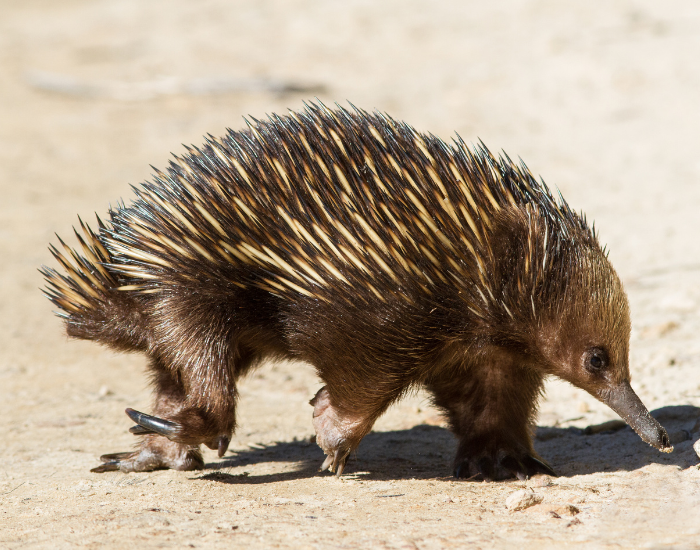
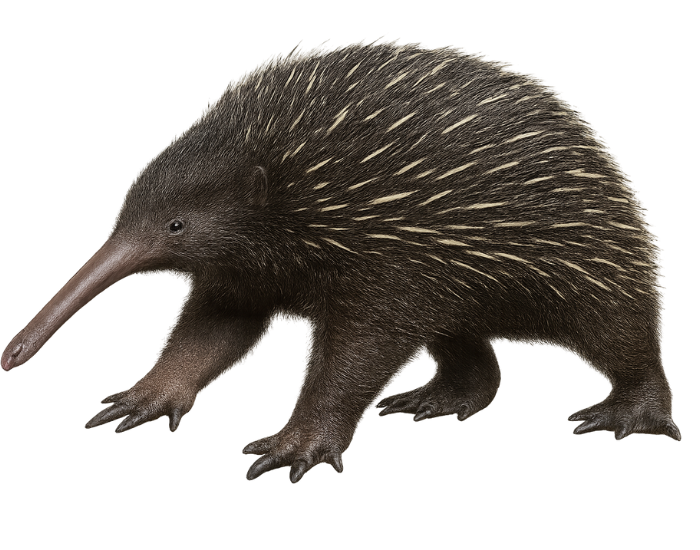
Echidna animals, often called spiny anteaters, are some of the most unusual creatures on Earth. They belong to a rare group of egg-laying mammals called monotremes, making them a unique type of egg laying mammal, alongside their cousin, the platypus species. There are only five monotremes in the world: four species of echidna and one platypus species. With their sharp spines, including distinctive beige and black spines that provide excellent camouflage in their bushy environment, and visible spines that set them apart from other mammals, sticky tongues, leathery eggs, and puggles (yes, that’s the name for a baby echidna), they puzzle researchers and delight anyone lucky enough to see one in the wild.
Echidnas don’t fit neatly into the categories we usually give mammals, which is why they’re often compared to marsupials, Australia’s other unusual mammals. If you’re curious, I’ve written more about them here.
Let’s explore 12 fascinating facts about echidna animals, blending science, storytelling, and conservation.

1. Echidnas Are Ancient Egg-Laying Mammals
Is an echidna a mammal? Yes, but a very unusual one. Echidnas are part of the monotremes, a tiny group of living mammals that lay eggs instead of giving birth to live young. Only two monotreme families exist today: the platypus and the echidna family (Tachyglossidae).
- Echidnas are sometimes confused with hedgehogs or porcupines, but they are not related. This is a classic case of convergent evolution: unrelated animals evolving similar traits like spines.
- As an egg-laying mammal, the female echidna lays a single leathery egg per breeding cycle.
- Their evolutionary history stretches back over 100 million years, making them true survivors from prehistoric times.
Whenever I explain to school groups that echidnas lay eggs but also make milk, I can see the amazement in their faces. Even seasoned wildlife guides admit: echidnas are a mammal that rewrites the rules. Their reproduction is unique, after mating, the female produces a newly laid egg that is small and leathery, about the size of a grape, and carefully rolls it into her pouch for incubation.
2. There Are Four Species of Echidnas
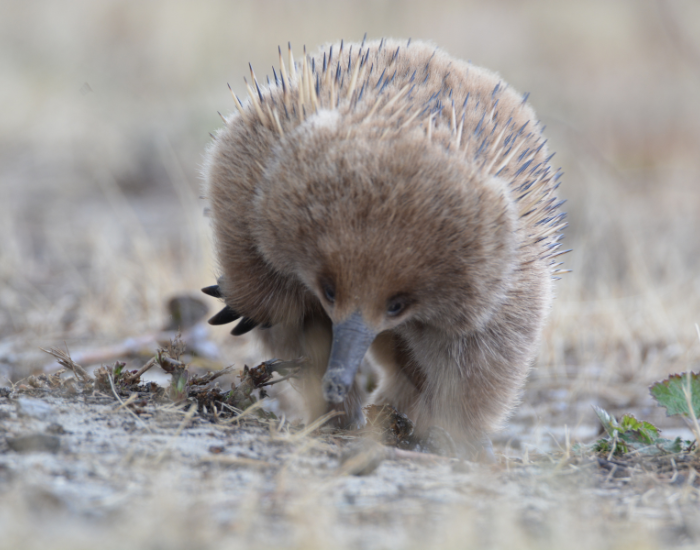
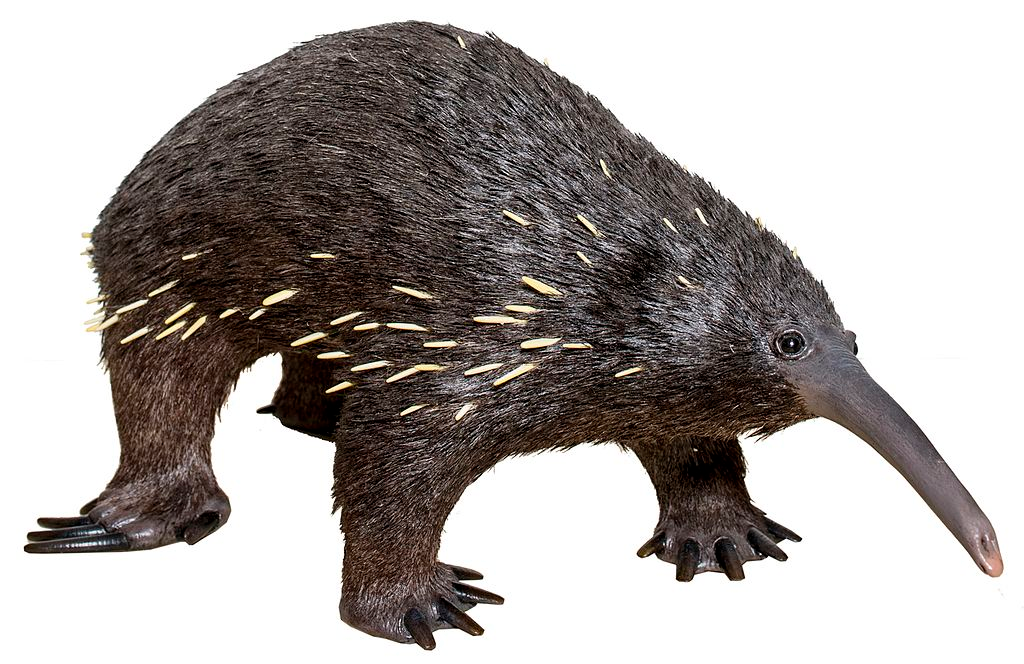
Most Australians are familiar with the short-beaked echidna (Tachyglossus aculeatus). But in the highlands of New Guinea, three species of long-beaked echidnas, known as Zaglossus species, still roam.
- Short-beaked echidna: widespread across Australia, Tasmania, and parts of New Guinea.
- Western long-beaked echidna: critically endangered, found in New Guinea’s mountains.
- Eastern long-beaked echidna: another threatened species in New Guinea.
- Sir David’s long-beaked echidna: thought extinct, but rediscovered in remote forests.
This diversity often surprises people. On Kangaroo Island, where I’ve watched short-beaked echidnas amble through sandy tracks, it’s easy to forget that their cousins, other echidnas in the Zaglossus genus, are hanging on precariously in far-off rainforests.

3. They’re Known as Spiny Anteaters
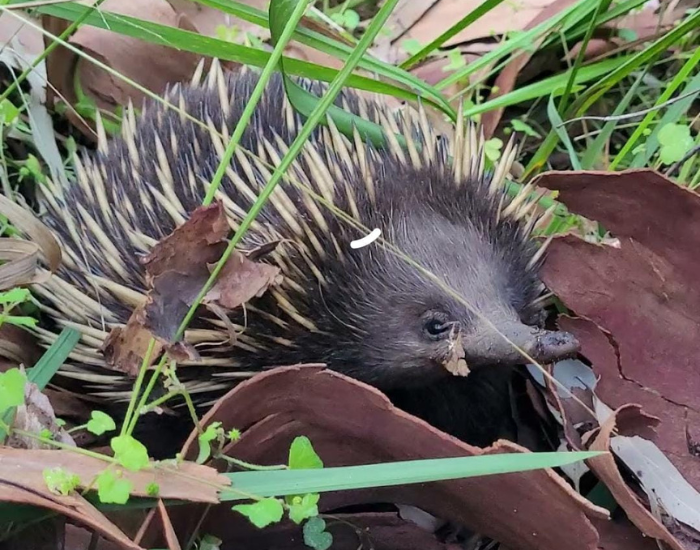
The nickname spiny anteater says it all: echidnas are covered in sharp spines (modified hairs) called spines, which serve as a key defense adaptation, with a coat of dark fur beneath. These spines act like armour, deterring predators such as dingoes and birds of prey.
- Defence tactics: Echidnas can curl into a tight ball, wedge themselves into hollow logs, or dig rapidly into soil, leaving only spines visible. These spines are the echidna’s main line of defense against predators.
- Barbless quills: Unlike porcupines, their spines don’t detach easily.
Once in Tasmania, I nearly stepped on one hiding under leaf litter. It froze completely still, spines sticking out, waiting for me to pass. When predators strike, echidnas rely on their spines for protection. Echidnas trust their camouflage and spiky armour more than speed.
4. Echidnas Use Sticky Tongues to Eat Insect Larvae
Echidnas don’t have teeth. Instead, they rely on their long, sticky tongues to slurp up insect larvae, termites, ants, and small invertebrates. Their sticky tongue is highly adhesive, allowing them to catch prey whole and efficiently extract invertebrates from tight spaces.
- Their tongue can flick in and out up to 100 times per minute.
- It’s coated in sticky mucus, perfect for scooping prey from crevices.
- Their claws, along with their short legs and stout limbs, are adapted for digging into termite mounds, leaf litter, or rotting logs before the tongue gets to work. The hind feet have elongated, backward-curved claws that help with grooming between spines and digging. The hind leg features a unique spur, which in echidnas is used for communication rather than as a weapon.
The family name Tachyglossus literally means “fast tongue.” It’s well deserved, I once watched an echidna demolish an ant nest in minutes, tongue darting like a pink whip.

5. Echidnas Lay a Single Leathery Egg
Unlike marsupials, the adult female echidna doesn’t give birth to live young. Instead, the female echidna lays a single leathery egg, about the size of a grape, after a short gestation period of around 23 days.
- The egg is placed into the mother’s pouch (a temporary deep pocket) by the female echidna.
- After about 10 days, a tiny baby echidna, called a puggle, mhatches. Baby echidnas use their see through claws to grip hairs inside the mother’s pouch.
- The puggle stays in the pouch for several weeks, feeding on milk that the mother’s body secretes from specialized glands. Female echidnas provide maternal care during this period.
I once held a puggle in a wildlife rehab centre. It was pink, wrinkly, and barely recognisable as the spiky animal it would become. Watching it lap milk from the mother’s body secretions was both surreal and beautiful. As the young echidna develops, it gradually grows spines and becomes more independent. Young echidnas spend their early life stages in the safety of the mother’s pouch before venturing out on their own.
6. Puggles Grow Up Slowly and Spiky
As the puggle grows, its modified hairs harden into spines. The spines begin to break through its skin around 53 days old, marking a key milestone in its maturation and transition from the pouch to the burrow. By around 50 days, the mother leaves it in a burrow or hollow log, returning every few days to nurse.
- Unlike most other mammals, echidnas don’t have nipples. Milk oozes from mammary patches, and the puggle laps it up.
- Echidna milk contains unique antimicrobial properties, inspiring medical research.
This unusual strategy, egg laying, pouch rearing, then burrow care, makes echidna reproduction one of the most complex among mammals.
7. Echidnas Have Low Body Temperature and Metabolism
With a body temperature of just 29–32 °C, echidnas are among the coolest-blooded mammals.
- Their metabolism is slow, helping them survive harsh environments.
- They can enter torpor (a temporary hibernation-like state) during cold weather.
- In alpine areas of Australia, echidnas survive winters by burrowing under snow.
This adaptation partly explains their long lifespan, up to 50 years in the wild and even 60 in captivity.
If spotting an echidna is on your bucket list, you’ll want to know the best places to see Australian wildlife in the wild, including Kangaroo Island and beyond. I’ve shared my favourite locations
8. Breeding Season Brings Echidna Trains
During the breeding season, male echidnas compete in unusual ways. Up to ten males may follow a single female in a line, forming what scientists call an “echidna train.”
- When the female is ready, the dominant male mates with her.
- Males have a unique four-headed penis, a detail that always shocks audiences in wildlife talks. During mating, echidnas alternate the use of the heads, using only two at a time, which may help increase reproductive success.
- This behaviour has been observed throughout Australia and New Guinea.
It’s one of nature’s more comical parades, imagine a spiky conga line shuffling through the bush.
9. Echidnas Shape the Environment
By digging for food, echidnas act as ecosystem engineers:
- Their foraging turns over tonnes of soil annually, improving aeration.
- This helps reduce habitat loss effects by supporting healthier soils.
- Burrows provide shelter for reptiles and insects.
In one study, ecologists found that echidnas moved more soil than wombats in certain habitats. Quiet and unassuming, they’re unsung heroes of Australian environments.
10. Some Echidnas Are Critically Endangered
While the short-beaked echidna is common, its long-beaked relatives face extinction:
- The western long-beaked echidna is critically endangered.
- Eastern long-beaked echidnas are also threatened.
- Hunting, logging, and habitat loss in southern and lowland New Guinea are major pressures.
Sir David Attenborough once called the rediscovery of his namesake echidna one of the most exciting finds in zoology. But unless conservation steps up, these species may vanish.
11. Echidnas and Platypus: Close but Different
Are platypus and echidna the same?
Not exactly, but they’re close cousins.
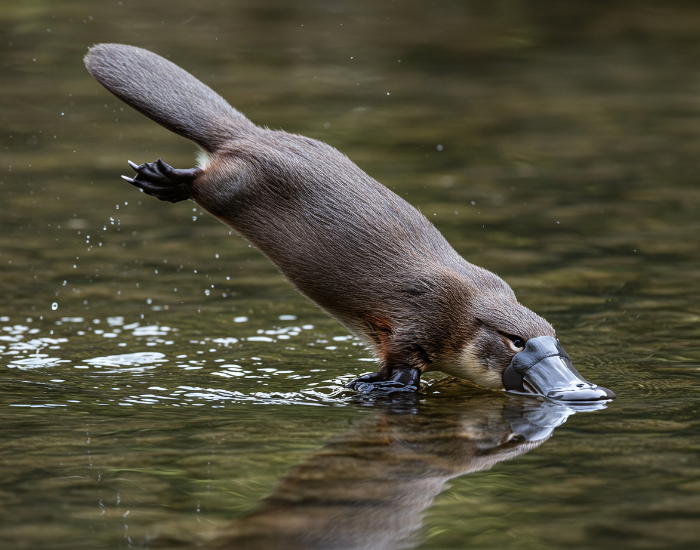
- Both are monotremes, the only two mammal lineages that lay eggs.
- Fossils suggest they diverged from a common ancestor tens of millions of years ago.
- Today, the platypus is semi-aquatic, while echidnas are land specialists.
Their shared oddities remind us that evolution often keeps its strangest experiments alive.
12. Echidna Encounters Are Rare but Special
How rare is it to see an echidna? In throughout Australia, they’re widespread but elusive. Many people live in the bush for years without spotting one, while others encounter them regularly.
If you find an echidna in your yard:
- Don’t pick it up, its sharp claws and spines can cause injury.
- Keep dogs away; while echidnas aren’t poisonous, pets are a threat.
- Let it move on naturally, your backyard has become part of an echidna’s journey.
Every time I see one, I feel like I’ve stumbled on a piece of living history.

Where in the World: Echidna Habitat and Distribution
Echidnas are true wanderers of the Southern Hemisphere, with their spiny forms found throughout Australia, from the sunbaked outback to the cool forests of Tasmania. The short-beaked echidna (Tachyglossus aculeatus) is the most widespread of all echidna species, thriving in a remarkable range of environments, dense forests, open grasslands, arid deserts, and even the leafy suburbs of major cities. Whether you’re hiking through national parks in South Australia or exploring the wilds of Kangaroo Island, you might spot these egg-laying mammals foraging for insect larvae beneath leaf litter or sheltering in hollow logs.
Echidnas of New Guinea: The Long-Beaked Cousins
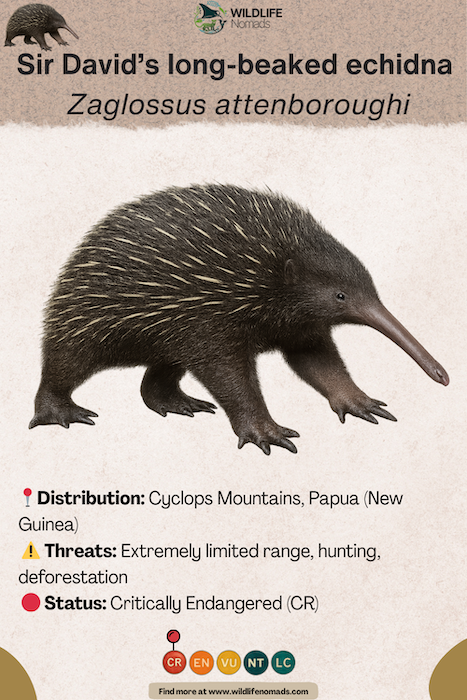
Head north to New Guinea, and you’ll encounter the elusive long-beaked echidnas (Zaglossus genus). These include the critically endangered western long-beaked echidna and the eastern long-beaked echidna, both found in the misty highlands. Sir David’s long-beaked echidna, once thought extinct, was famously rediscovered here, proof of their resilience despite habitat loss and environmental pressures.
All echidnas prefer habitats with workable soil, abundant food, and safe shelter, but their adaptability is astonishing. Belonging to the taxonomic family Tachyglossidae, they represent just two genera, “Tachyglossus and Zaglossus” within the tiny club of monotremes. With only five species of monotremes left on Earth, echidnas remain some of the most extraordinary mammals, shaped by millions of years of evolution across Australia and New Guinea.
Belonging to the taxonomic family Tachyglossidae, echidnas are divided into two genera: Tachyglossus (the short-beaked echidna) and Zaglossus (the long-beaked echidnas). With only five living species of monotremes on Earth, echidnas stand out as some of the most unique and fascinating mammals, their distribution shaped by millions of years of evolution and the ever-changing landscapes of Australia and New Guinea. As researchers continue to study these spiny survivors, one thing is clear: echidnas are masters of adaptation, perfectly at home in some of the world’s most diverse and challenging habitats.
Latest Research on Echidnas
Genome Revelations: Sex Chromosomes & Genetic History
A major leap forward came in early 2025 when researchers published a chromosome-level genome for the short-beaked echidna (Tachyglossus aculeatus).
- They discovered that echidnas have a highly unusual sex determination system: multiple sex chromosomes (more than the simple XX/XY scheme most mammals have), with complex rearrangements from ancestral chromosomes.
- The study also infers what the monotreme ancestor’s genome may have looked like (chromosome count, structural rearrangements), giving insight into how echidnas and platypus diverged.
If you want the full findings, check out “Chromosome-level echidna genome illuminates evolution of multiple sex chromosomes” in GigaScience.
Rediscoveries & Conservation: Sir David’s Long-Beaked Echidna Back on Camera
In another exciting thread of research, the Attenborough’s long-beaked echidna (Zaglossus attenboroughi), not seen by scientists since around 1961, was finally photographed in the Cyclops Mountains of Indonesian New Guinea.
- The team used over 80 camera traps, collaborating with local communities and researchers to confirm the existence of this rare monotreme.
- Beyond rediscovery, this project highlights how Indigenous knowledge and modern field methods can combine to protect critically endangered species, as well as identify habitat use, population density, and threats.
You can check out Found at Last: Bizarre, Egg-laying Mammal Finally Rediscovered After 60 Years by Oxford, and Attenborough’s Long-Beaked Echidna Rediscovered in Science News.

Common FAQ About Echidnas
Echidnas are mammals, not marsupials. They belong to the monotreme group.
They feed on ants, termites, insect larvae, and other small invertebrates.
No. Porcupines are rodents; echidnas are monotremes.
They belong to the taxonomic family Tachyglossidae.
Their mix of reptilian and mammalian traits, like laying eggs but producing milk, still challenges definitions of what it means to be a mammal.
Protecting the Spiny Wanderers
From Kangaroo Island to New Guinea’s misty mountains, echidnas continue to fascinate scientists and nature lovers alike. They are living testaments to resilience, evolution, and ecological balance.
But while the short-beaked echidna may seem secure, its long-beaked cousins teeter on the edge. Protecting their habitats, supporting conservation groups, and spreading awareness is essential if we want future generations to marvel at these extraordinary echidna animals.
Next time you’re walking in the bush, keep an eye out for a slow, spiny wanderer. Seeing one might just be the highlight of your wildlife journey.
chidnas are just one of the many incredible creatures tucked away in Australia’s landscapes. If you’d like to discover more of the country’s hidden wildlife, check out my full guide