Phylum explorer: the interactive tree of life with 3 domains and 6 kingdoms
What is a phylum?
A phylum is a big group of living organisms that share the same basic body plan. In the biological classification system, it is the taxonomic rank just below kingdom and just above class. For example, every animal with a notochord belongs to the same phylum, Chordata. That includes a shark, a frog, a jaguar and you.
The German zoologist Ernst Haeckel coined the word phylum in 1866. He built it from the Greek word phylon, which means tribe or race. The plural is phyla. So, when biologists compare different phyla, they are comparing the great tribes of life.
The ranks of biological classification
Taxonomy sorts life into a hierarchy of nested ranks. In other words, each taxon sits inside a larger one, like a postal address. From the broadest to the narrowest, the ranks are domain, kingdom, phylum, class, order, family, genus and species. To remember them, try Dear King Philip Came Over For Good Soup.
Now compare yourself with a jaguar below. You share every rank down to class, because you are both mammals. After that, the paths split: you are a primate, while the jaguar is a carnivore. Then switch to the sea star or the fly agaric and watch how early those paths part.
Phylum or division?
However, botanists traditionally say division instead of phylum. In 1883, the German botanist August Eichler split the plant kingdom into divisions, and the habit stuck. Today, though, the botanical rules treat both words as the same rank. So a moss phylum and a moss division mean the same thing.
The 3 domains and 6 kingdoms of life
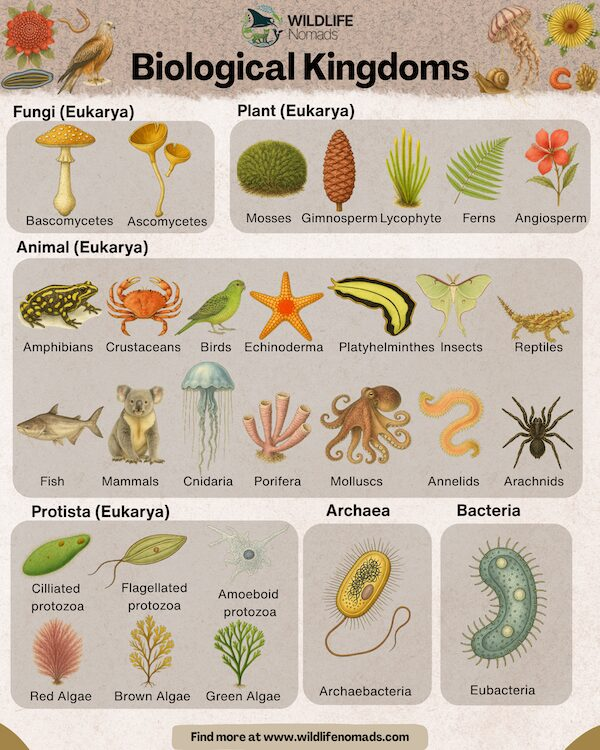
Above the kingdoms sits the broadest rank of all, the domain. In 1990, Carl Woese and his colleagues compared the ribosomal RNA of many living organisms. As a result, they split life into three domains: Bacteria, Archaea and Eukarya (Woese et al., 1990). Bacteria and archaea have no nucleus, whereas eukaryotes keep their DNA inside one.
Most textbooks then divide those domains into six kingdoms. In that system, bacteria and archaea each form a kingdom of their own. Meanwhile, the eukaryotes split into protists, plants, fungi and animals. Tap any card below to flip it and read a surprising fact.
Why the 5 kingdom system is out of date
Many older books still teach five kingdoms. Robert Whittaker proposed that system in 1969. It placed every cell without a nucleus in one kingdom called Monera (Whittaker, 1969). However, the system is no longer up to date. Woese’s genetic work showed that archaea are as different from bacteria as both are from us. Therefore, Monera was split in two, and five kingdoms became six.
How many phyla are there?
The answer depends on the kingdom. The animal kingdom holds about 32 to 35 phyla, depending on the textbook. By comparison, the plant kingdom has five major divisions, and kingdom Fungi is usually split into about eight phyla. Bacteria are trickier still. In fact, DNA surveys keep finding new bacterial phyla that nobody has grown in a lab (Hug et al., 2016).
Biologists also keep moving the lines over time. A phylum is supposed to reflect a real evolutionary relationship, not just a similar look. At first, naturalists grouped animals by morphological or developmental similarity. Today, DNA tests those groups, and some old phyla have been merged or split as a result.
Animal phyla and their body plans
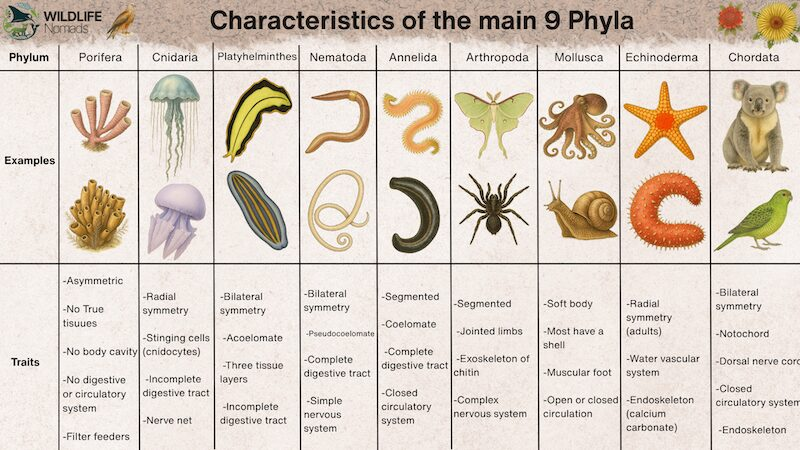
Every animal phylum shares a basic body plan. Biologists read that plan through a few fundamental characteristics. First, they check the symmetry: none, radial or bilateral. Next, they look at the tissue layers and the body cavity, called the coelom. Finally, they ask which opening forms first in the embryo.
That last clue splits the bilateral animals in two. In protostomes, the first opening becomes the mouth. For example, insects, snails and earthworms develop this way. In deuterostomes, on the other hand, the first opening becomes the anus, and the mouth forms second. Sea stars and every chordate, including you, belong to this group.
Use the key below like a field biologist. Pick a symmetry, a body cavity and a first opening, and see which phyla match.
The invertebrate phyla
Most animal phyla are invertebrates, which simply means animals without a backbone. Of these, sponges are the simplest, with no true tissues at all. Next, jellyfish and corals add stinging cells and radial symmetry. Flatworms, roundworms and segmented annelid worms then show three very different ways of building a tube-shaped body.
Arthropods are the biggest phylum on Earth, with more than a million named species. Insects, spiders, crabs and centipedes all wear a jointed exoskeleton that they moult to grow. Molluscs, by contrast, stay soft and often grow a shell instead. Some phyla are tiny, too. For instance, water bears and rotifers are usually under a millimetre long. Meet more of them in my guides to arachnids, crabs and echinoderms.
Phylum Chordata
Phylum Chordata is your own phylum. At some stage of life, every chordate has a notochord and a hollow nerve cord along the back. It also has gill slits and a tail behind the anus. Surprisingly, not every chordate has a backbone. Sea squirts, for example, keep their notochord only as swimming larvae.
Many school books split the vertebrates into seven classes. They are jawless fish, cartilaginous fish, bony fish, amphibians, reptiles, birds and mammals. Explore them in my guides to fish, amphibians, reptiles and birds.

Plant phyla: the divisions of kingdom Plantae
Plant taxonomy follows two big questions. First, does the plant have vascular tissue, the tubes that carry water and food? Second, how does it reproduce: with spores, with naked seeds or with seeds inside a fruit? Those two clues sort the plant kingdom into its five major plant phyla. Climb the staircase below to see each new invention.
Gymnosperm means naked seed. Conifers, for example, carry their seeds on the open scales of a cone. Angiosperms, on the other hand, wrap their seeds inside a fruit and use flowers to reproduce. Because flowers recruit animals, many angiosperms depend on pollinators, and they now make up most of the kingdom Plantae.
Kingdom Fungi and its phyla
Fungi are not plants. For one thing, they cannot make food from sunlight. Instead, they release enzymes, digest their food outside the body and then absorb it. Their cell walls also contain chitin, the same tough material as an insect’s shell. In fact, fungi are closer relatives of animals than of plants.
Kingdom Fungi splits into about eight phyla, and three of them are easy to meet. For example, bread moulds belong to Mucoromycota. Sac fungi, or Ascomycota, include yeasts, morels and most lichen fungi. Finally, club fungi, or Basidiomycota, give us the classic mushrooms and the brackets on dead trees.
Bacteria, archaea and viruses
Single cells ruled the planet for most of its history. The fossil record shows bacterial mats called stromatolites about 3.5 billion years ago. Later, cyanobacteria filled the air with oxygen. Even now, bacteria and archaea outnumber every other form of life.
Viruses, however, sit outside the tree. They are not made of cells, and they cannot copy themselves without hijacking one. So they belong to no domain and no kingdom. Compare all three below.
Play: spot the odd one out
Ready for a challenge? Each round shows four living things, and three of them share a group. Tap the one that does not belong. Then read why, because the answers are often surprising.
Phyla I have met under the microscope
During my degree I took virology, microbiology, molecular biology and evolution. Those courses taught me that the smallest branches of the tree are often the strangest. They also taught me that you can find them almost anywhere.
For one microbiology lab, we bought pulque, a traditional Mexican drink, from a street stall. Under the microscope it was full of Lactobacillus, the same bacteria that sour yoghurt. For another lab, we sampled water around the university, including the lake. Back in class, we watched amoebas creeping along and paramecia spinning past.
My favourite hunt happened in Sweden. While on exchange at Uppsala University, I joined a marine biology course. Then my classmates and I went looking for tardigrades. We found a few and watched them paddle under the microscope. Seeing a whole phylum on a glass slide never gets old. Read more about these water bears.
Cesar Medina, conservation biologist
How teachers can use the tree of life
The interactive above works as a ready-made lesson on classification. First, project the 4 billion years mode and let the class call out each milestone. Next, ask students to classify a mystery creature step by step, from domain down to class. Finally, the How related? mode makes a great discussion starter. Ask the class to guess whether a mushroom is closer to them or to a daisy.
In addition, the quiz changes every round, so it works as a quick exit ticket. For older students, ask them to pick two animals and explain their evolutionary relationship using the tree.
More wildlife interactives
Frequently asked questions
What is phylum and division?
Both words name the same rank, just below kingdom and above class. Zoologists say phylum, while botanists traditionally say division for plants. The botanical rules now accept either word.
What are the 7 classes of phylum Chordata?
Many textbooks list jawless fish (Agnatha), cartilaginous fish (Chondrichthyes), bony fish (Osteichthyes), amphibians, reptiles, birds and mammals. Strictly, these are the classes of vertebrates, and modern classifications divide them a little differently.
What are the 11 phyla in the animal kingdom?
The NCERT biology syllabus lists 11: Porifera, Coelenterata (Cnidaria), Ctenophora, Platyhelminthes, Aschelminthes, Annelida, Arthropoda, Mollusca, Echinodermata, Hemichordata and Chordata. Aschelminthes is an older name that includes the roundworms.
What are the 9 main animal phyla?
Most courses teach Porifera, Cnidaria, Platyhelminthes, Nematoda, Annelida, Arthropoda, Mollusca, Echinodermata and Chordata. Together they include nearly every animal you are likely to meet.
How many phyla are there in total?
Animals have about 32 to 35 phyla. Plants have five major divisions in most school books, and fungi have about eight phyla. Bacteria have many more, and new ones are still being found.
What is the difference between a phylum and a class?
A phylum is the larger group. In turn, each phylum contains one or more classes. For example, phylum Arthropoda includes the classes Insecta and Arachnida.
What does the word phylum mean?
It comes from the Greek word phylon, meaning tribe or race. Ernst Haeckel coined it in 1866.
Are viruses part of the 6 kingdoms?
No. Viruses are not made of cells, so they are left out of the 3 domains and the 6 kingdoms.