Amphibians are among the most fascinating vertebrate animals, living a “double life” both in water and on land. With over 8,000 known amphibian species, this diverse group includes frogs, toads, salamanders, and newts. From colorful poison dart frogs in South America to the strange Hellbender salamander, amphibians highlight the adaptability of life in changing environments.
For me, the wonder of amphibians became personal during an internship in Mexico, working with the critically endangered axolotl. These extraordinary creatures survive in a small lagoon beside a highway, a place more filled with discarded bottles than with signs of care. Pulling up traps, I felt both awe and urgency, realizing that a species so unique could be forgotten in its own home. Until that moment, I dreamed of becoming a biologist to discover new species, but that experience showed me that protecting the ones we already have is just as important.
In this guide, we’ll explore the types of amphibians, their defining features, where they live, and the challenges they face. We’ll also answer some of the most common questions about these remarkable animals.
What Classifies an Amphibian?
The definition of an amphibian goes beyond simply living in water and on land. Amphibians belong to Class Amphibia, a group of cold blooded vertebrates that includes over 8,000 recognized species. The word “amphibian” comes from Greek, meaning “double life,” because most spend their early lives as aquatic larvae and later become land-dwelling adults.
Key Characteristics of Amphibians:
- Cold blooded: Amphibians cannot regulate their body temperature internally; their body heat depends on external conditions.
- Permeable skins: They breathe and absorb water through thin skin, which must remain moist.
- Egg-laying: They lay eggs without shells, usually in water. From these, larvae emerge and later undergo metamorphosis.
- Lack of scales: Unlike reptiles, amphibians have soft skin.
- Vertebrates: All amphibians have a backbone.
Unlike reptiles, amphibians have permeable skin that lacks scales. This skin serves as an additional respiratory organ, allowing them to absorb oxygen directly from water or moist air. However, this also makes them highly sensitive to environmental pollution and changes in water quality.
You can find amphibians, and how they split from the other vertebrates, in my interactive tree of life.

Types of Amphibians
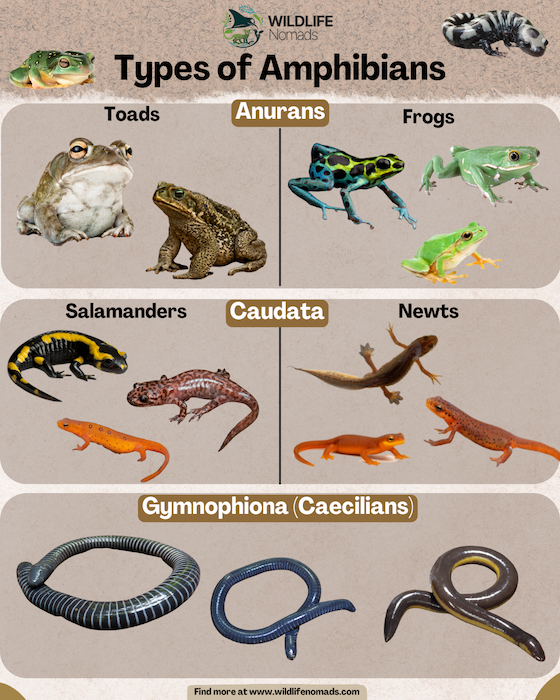
The amphibian world is divided into three primary groups, each with distinct characteristics and lifestyles. Understanding these categories helps us appreciate the incredible diversity within this class of animals.
1. Anurans (Frogs and Toads)
Frogs and toads represent the largest group of amphibians, with over 7,000 species worldwide. These tailless amphibians have adapted to virtually every environment on Earth, from tropical rainforests to desert oases.
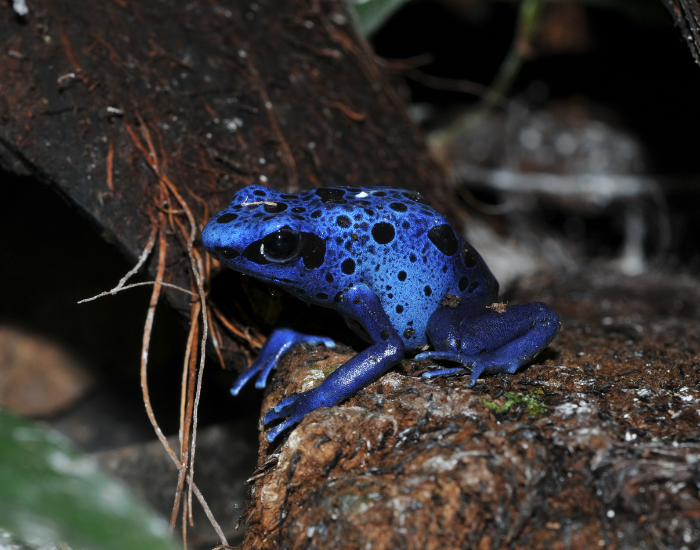
Frogs
Frogs are the most numerous and widely distributed amphibians, with thousands of known species across every continent except Antarctica. They are recognized by long legs for leaping, smooth skin, and aquatic larvae (tadpoles).
- Largest frog: The Conraua goliath, reaching 32 cm in length, found in Cameroon.
- Poison dart frogs: Tiny, colorful small frogs of Central and South America, with toxic skin defenses.
- Rana temporaria: The common frog of Europe and the northern hemisphere, adapted to temperate regions.
Frogs thrive in ponds, forests, and wetlands, but most require water for breeding.
Frog Characteristics:
- Smooth, moist skin
- Long hind legs for jumping
- Most species require water for reproduction
- Highly developed vocal abilities
Toads
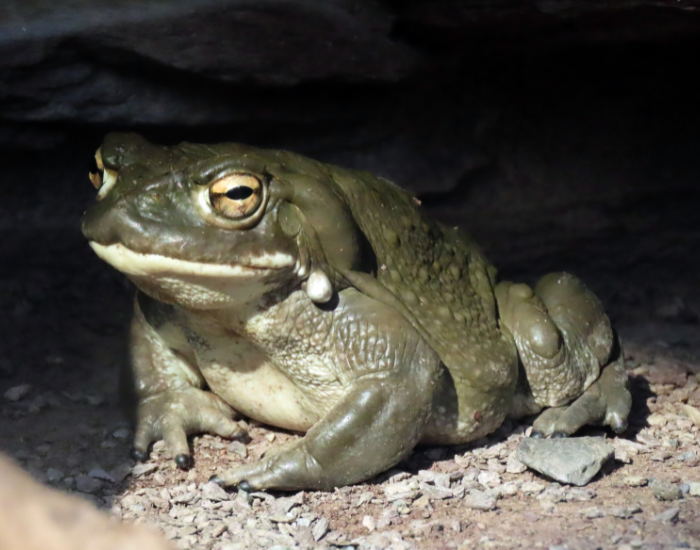
Toads are technically a type of frog but belong to the family Bufonidae. They are distinct for their warty skin, shorter legs, and greater tolerance for dry conditions.
- Common species include the cane toad (Rhinella marina) and Fowler’s toad.
- Known for burrowing and using backward movements to escape heat.
- Like frogs, toads are cold blooded and rely on water for reproduction.
Toad Characteristics:
- Dry, bumpy skin with poison glands
- Shorter legs adapted for walking
- More tolerant of dry conditions
- Often burrow underground during harsh weather
2. Caudata (Salamanders and Newts)
Salamanders represent the second-largest group of amphibians, with their distinctive tails and elongated bodies. These animals are often confused with lizards, but they lack scales and have permeable skin.
Salamanders
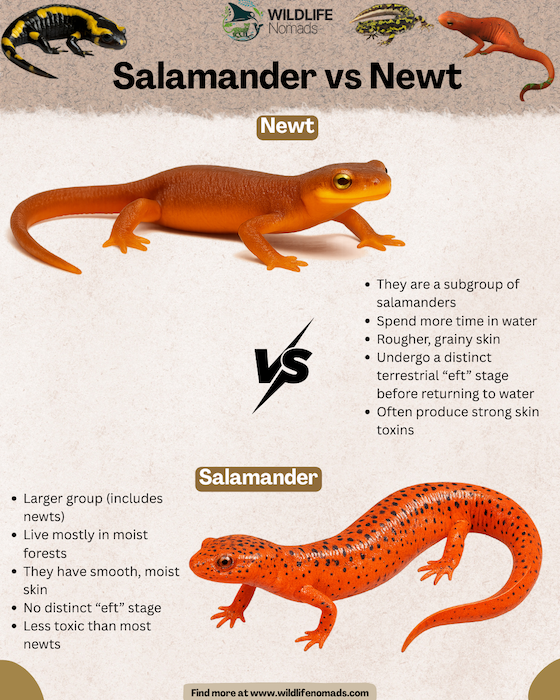
Salamanders look more like lizards but lack scales and have soft, moist skin. They belong to the order Caudata and typically walk rather than hop.
- Chinese giant salamander (Andrias davidianus): The largest amphibian in the world, reaching nearly 1.8 m.
- Lungless salamanders (family Plethodontidae): Breathe entirely through permeable skins.
- Some salamanders remain in the larval stage for extended periods (or even their entire lives).
Salamander Features:
- Retain tails throughout their lives
- Four legs of roughly equal size
- Many species can regenerate lost limbs
- Some species are entirely aquatic, others terrestrial
Newts
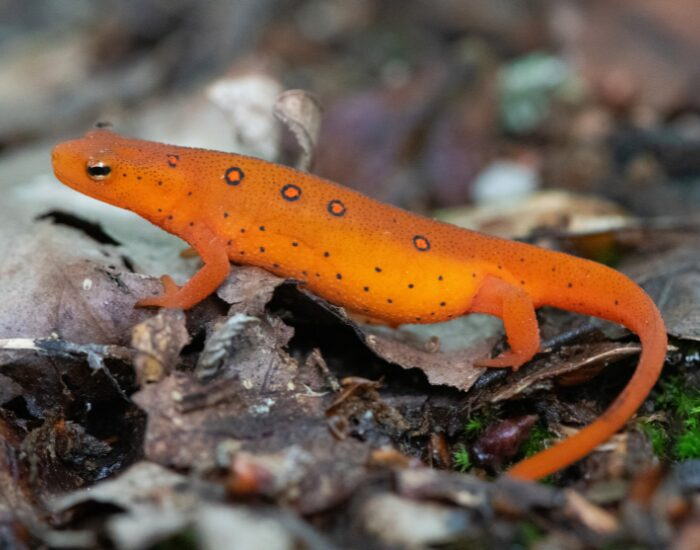
Newts are a subgroup of salamanders, generally more aquatic as adults. They are common in temperate regions of Europe, Asia, and North America, like the California Newt which you can explore more in the article: “12 Fascinating Facts About the Toxic California Newt“
- Many produce toxins as protection against predators.
- They cycle between land and aquatic phases throughout their lives.

3. Gymnophiona (Caecilians)
The least known group of amphibians, caecilians are worm-like creatures that live primarily underground or in water. These unique animals lack limbs entirely and have specialized adaptations for their burrowing lifestyle.
Caecilian Traits:
- Elongated, cylindrical bodies without limbs
- Reduced or absent eyes
- Specialized for digging and burrowing
- Some species give birth to live young

Do Amphibians Have Backbones?
Yes, amphibians have backbones, making them vertebrates just like fish, reptiles, birds, and mammals. This is a common misconception – people sometimes confuse amphibians with invertebrates because of their soft, permeable skin and the fact that many species undergo dramatic metamorphosis.
The backbone in amphibians serves the same fundamental purpose as in other vertebrates: providing structural support and protecting the spinal cord. However, amphibian skeletons are generally lighter and more flexible than those of reptiles or mammals.
Where Do Amphibians Live?
Amphibians are found worldwide, though most thrive in warm, moist regions.
- South America: Home to the richest variety, including poison dart frogs and Surinam toads.
- Central and South America: Rainforests host thousands of amphibian species.
- Northern Hemisphere: Species like Rana temporaria dominate European ponds.
- Papua New Guinea: Isolated forests with unique frog species.
They depend on both land and aquatic habitats but always need water sources for reproduction.
Amphibian Life Cycle
One of the most remarkable features of amphibians is their complex life cycles. Most amphibians undergo metamorphosis, a dramatic transformation that allows them to exploit different ecological niches during different life stages.
Typical Amphibian Life Cycle:
- Egg Stage – Usually laid in water or moist environments
- Larval Stage – Aquatic larvae with gills (tadpoles, efts)
- Metamorphosis – Gradual transformation of body structure
- Adult Stage – Terrestrial or semi-aquatic with lungs
The metamorphosis process involves incredible changes. Tadpoles absorb their tails, develop legs, and switch from gills to lungs. Their digestive systems change from herbivorous to carnivorous, and their entire body structure transforms to support life on land.
Not all amphibians follow this pattern exactly. Some species skip the aquatic larval stage entirely, while others remain aquatic throughout their lives. The axolotl is famous for reaching sexual maturity while retaining juvenile characteristics, a condition called neoteny.

Amphibians and Their Ecosystems
Amphibians play crucial roles in ecosystems as both predators and prey. Their ecological importance extends far beyond their individual species value.
Amphibian Ecological Roles:
- Pest control – Adult amphibians consume vast quantities of insects
- Nutrient cycling – Transport nutrients between aquatic and terrestrial ecosystems
- Food web connections – Serve as prey for numerous predators
- Pollution indicators – Early warning system for environmental problems
A single frog can consume thousands of insects per year, providing natural pest control worth millions of dollars in agricultural savings. Their larvae also play important roles in aquatic ecosystems, filtering water and converting plant matter into animal protein.
Breathing Mechanisms in Amphibians
Amphibians have evolved multiple ways to obtain oxygen, making them incredibly adaptable to different environments. Unlike mammals that rely primarily on lungs, amphibians can breathe through their lungs, skin, and in some cases, gills.
Amphibian Respiratory Methods:
- Cutaneous respiration – Breathing through permeable skin
- Pulmonary respiration – Using lungs like other terrestrial vertebrates
- Branchial respiration – Using gills (mainly in aquatic larvae and some adults)
- Buccal pumping – Using mouth and throat muscles to move air
The skin serves as a major respiratory organ for most amphibians. This is why amphibians must keep their skin moist – dry skin cannot effectively absorb oxygen. Some salamanders have evolved to breathe entirely through their skin and have lost their lungs completely.
The efficiency of skin breathing depends on temperature, humidity, and the animal’s activity level. Cold, moist conditions favor skin respiration, while warm, dry conditions require more reliance on lung breathing.

Major Threats to Amphibians
Sadly, amphibians are one of the most threatened groups of animals.
Major threats include:
- Habitat loss from deforestation, agriculture, and urbanization
- Climate change altering rainfall and temperature
- Pollution contaminating breeding sites
- Invasive predators like monitor lizards
- Diseases like chytrid fungus, which has wiped out many amphibians
Common Misconceptions About Amphibians
Several myths and misconceptions surround amphibians, leading to confusion about these remarkable animals. Let’s address some of the most common misunderstandings.
- Crocodiles are amphibians Truth: Crocodiles are reptiles, not amphibians. They have scales, lay hard-shelled eggs, and are warm-blooded compared to amphibians.
- All amphibians live in water Truth: While most amphibians require water for reproduction, many species spend most of their adult lives on land.
- Touching frogs causes warts Truth: Warts are caused by viruses, not by touching amphibians. However, some amphibians do secrete toxins that can irritate skin.
- Amphibians don’t have backbones Truth: All amphibians are vertebrates with well-developed skeletal systems including backbones.
Common FAQ about Amphibians
Amphibians are cold blooded vertebrate animals that undergo metamorphosis, living part of their lives in water and part on land.
Yes, amphibians are cold blooded animals, meaning their body temperature depends on the environment.
Amphibians lay eggs, usually in water. From these, larvae emerge before metamorphosis
Yes—most amphibians start life breathing with gills. Some, like lungless salamanders, remain fully aquatic and rely on their permeable skins.
Reptiles have scales and lay shelled eggs on land. Amphibians have thin skin, lack scales, and need water to reproduce.
Common frog, American bullfrog, poison dart frog, cane toad, Conraua goliath, Chinese giant salamander, fire salamander, axolotl, eastern newt, and Surinam toad.
Latest Scientific Research on Amphibians
Scientific research on amphibians has expanded rapidly in recent years, revealing both the fragility and resilience of these cold-blooded vertebrates. One major focus is the chytrid fungus (Batrachochytrium dendrobatidis), a major threat to frog species worldwide. A long-term study in Central and South America tracked how temperature and humidity influence the spread of the disease, showing that certain habitats act as refuges where amphibians can stay warm and avoid mass die-offs.
Researchers are also studying lungless salamanders, which rely entirely on their permeable skins for respiration. Findings published in Nature highlight how such adaptations make them highly sensitive to environmental conditions but also excellent indicators of ecosystem health. Meanwhile, projects in Papua New Guinea and the Northern Hemisphere continue to document many species of frogs, newts, and other amphibians, helping us better understand how climate change and habitat loss reshape their ranges.
Another fascinating area of study involves the largest amphibian, the Chinese giant salamander (Andrias davidianus), whose population decline is closely linked to pollution and overharvesting. Protecting this species is critical because it represents millions of years of evolutionary history. At the same time, conservation programs for small frogs, including poison dart frogs, are proving that local communities can play an essential role in safeguarding biodiversity.
Amphibian Challenge: Name & Myth-Buster 🐸
11 questions — identify the species from photos, then bust the myths. Go back and change any answer before you score.
Admiration for Amazing and Rare Animals
Amphibians are an extraordinary class of vertebrate animals, with thousands of species ranging from tiny small frogs to the largest amphibians on Earth. Their ability to live in water and on land, regulate life through metamorphosis, and adapt to diverse habitats shows the resilience of evolution.
But with major threats like habitat loss and disease, many amphibians are at risk of extinction. Protecting them ensures healthier ecosystems for all animals, birds, fish, mammals, reptiles, and invertebrates.
References:
Janes, T. A., Rousseau, J. P., Fournier, S., Kiernan, E. A., Harris, M. B., Taylor, B. E., & Kinkead, R. (2019). Development of central respiratory control in anurans: The role of neurochemicals in the emergence of air-breathing and the hypoxic response. Respiratory Physiology & Neurobiology, 270, Article 103266. https://doi.org/10.1016/j.resp.2019.103266
Lewis, C. H. R., Mei, Y., Voyles, J., Geng, X., Richards-Zawacki, C. L., & Cohen, J. M. (2025). Modelling Batrachochytrium dendrobatidis presence and intensity using high spatial and temporal resolution weather data. Diversity and Distributions, 31(7), Article e70052. https://doi.org/10.1111/ddi.70052
Luedtke, J. A., Chanson, J., Neam, K., Hobin, L., Maciel, A. O., Iserne, A. J., Lacher, I., Das, I., Edwards, S., Tognelli, M. F., Arnell, A., Moreer, M., Binney, G., Garcia, C. L., Field, A. S., Holland, T., Walker, M., Stuart, S. N., & Hilton-Taylor, C. (2023). Ongoing declines for the world’s amphibians in the face of emerging threats. Nature, 622(7982), 308–314. https://doi.org/10.1038/s41586-023-06578-4
Schmidt, R., Zummach, C., Sinai, N., Sabino-Pinto, J., Künzel, S., Dausmann, K. H., & Ruthsatz, K. (2024). Physiological responses to a changing winter climate in an early spring-breeding amphibian. Ecology and Evolution, 14(7), Article e70042. https://doi.org/10.1002/ece3.70042
Tapley, B., Turvey, S. T., Chen, S., Wei, G., Xie, F., Yang, J., Liang, Z., Guan, Z., Pan, Y., Wu, M., Wang, Y., Lu, J., Zhou, J., Zhan, J., Nie, J., Huang, J., Luo, Z., Xu, L., & Cunningham, A. A. (2021). Range-wide decline of Chinese giant salamanders Andrias spp. from suitable habitat. Oryx, 55(3), 373–381. https://doi.org/10.1017/S0030605320000411