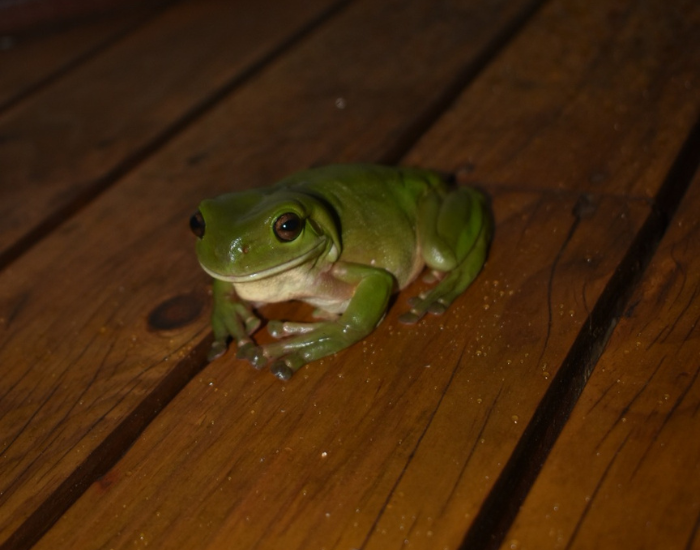
I was recently at a friend’s house in Australia when someone pointed to this green visitor on next to the pool and asked, ‘Hey, you’re the biologist, what kind of frog is this? At that moment, everyone looked at me for a definitive answer. If you are a biologist you know this feeling. That one question sparked a deep dive into a common problem: green frogs are everywhere, but identifying them is much harder than it looks.
If you’re like me, and every time you see a green frog you ask yourself which one specifically it is instead of reacting with disgust, then this article is for you. No matter where you are, there’s almost always a green frog nearby, as long as there’s a pond, stream, or wetland in the area.
If you’ve ever wondered whether the leaper in your backyard was a Northern Green Frog, an invasive Bullfrog, or a native Tree Frog, you aren’t alone. Identifying these emerald amphibians requires more than just looking at color—you have to look at the dorsolateral ridges, the tympanum size, and even the toe pads.
Today, we’re diving deep into the world of green frog species, their behaviors, habitats, and the fascinating biology that makes each one unique. This guide covers 20 of the most common and intriguing varieties you need to know. Whether you’re a seasoned herpetologist or someone who simply loves watching frogs on summer evenings, you’ll discover the key features that set these emerald amphibians apart.

1. The Classic: Northern Green Frog (Lithobates clamitans)
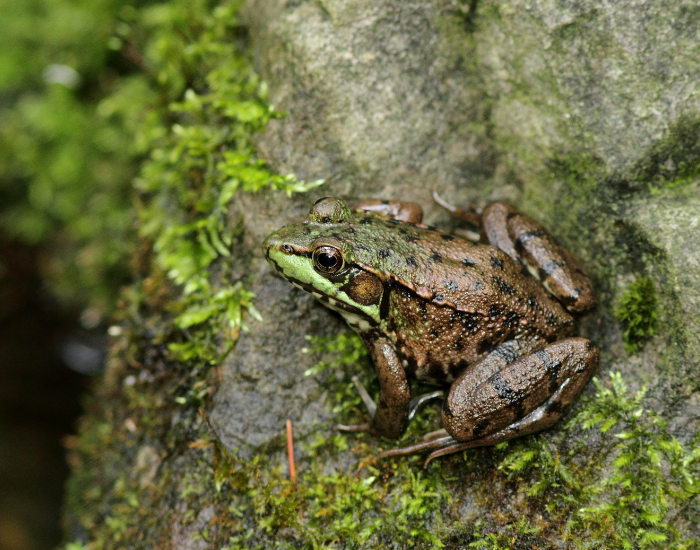
When most people in North America talk about green frogs, they mean Lithobates clamitans. Green frogs are divided into two subspecies: the northern green frog and the bronze frog. This is the “standard” frog of my childhood. Interestingly, green frogs historically belonged to the genus Rana. However, scientists now classify them under green frog Lithobates. Lithobates clamitans belongs to the true frog family (Ranidae), which is characterized by smooth, moist skin, long legs, and a generalized body shape typical of ‘true frogs.’ The distribution green frogs is extensive, as they are a widespread species native to North America, mainly occurring throughout eastern North America from the St. Lawrence River Valley in southeastern Canada to Northern Florida and Eastern Texas.
The Banjo Call
The most iconic thing about male green frogs? Their voice. It sounds exactly like a plucked loose banjo string. Male green frogs use four different types of breeding calls to attract potential female mates, and they exhibit strong mating calls during the breeding season. During the breeding season, which peaks in May and June, territorial males maintain their space with this “gunk!” sound. In fact, resident male frogs don’t just croak when another male gets too close. They create loud splashing noises and may even engage in physical wrestling. These frogs display significant acts of territorial defense, including vocalizations, splashing, and wrestling, to maintain their breeding territories throughout the breeding period.
2. The American Bullfrog (Lithobates catesbeianus)
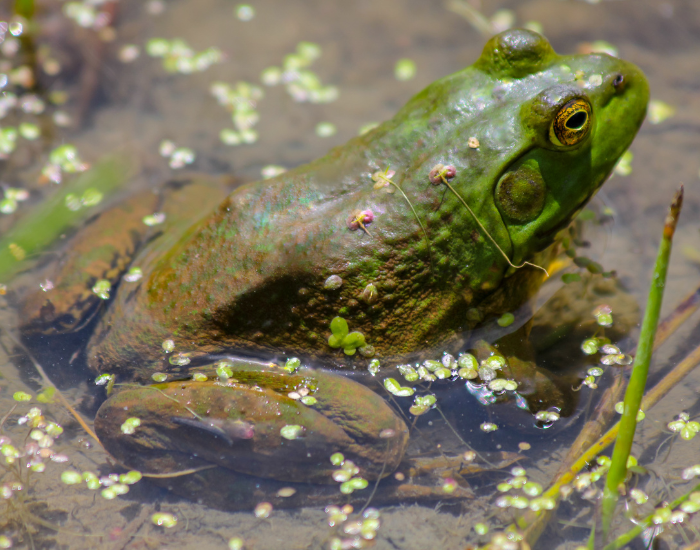
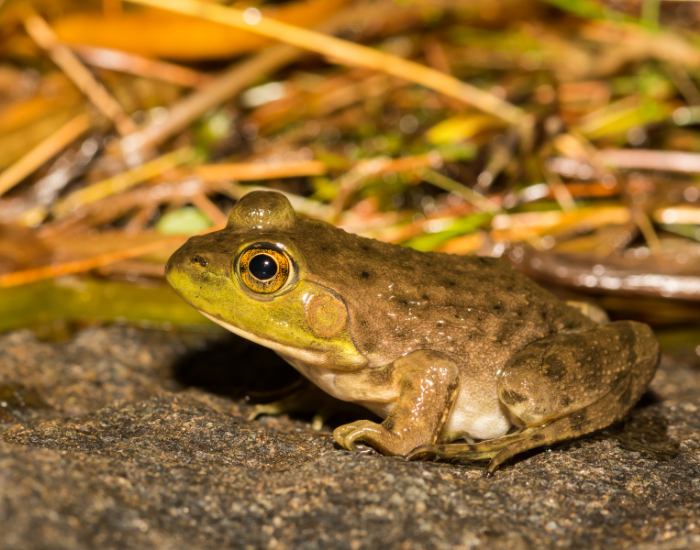
Often confused with adult green frogs, the bullfrog is the heavyweight champion of North American frogs. The easiest way to tell them apart? Look for the dorsolateral folds.
On green frogs, these ridges go partway down the back. In contrast, on a bullfrog, the ridge wraps around the ear and stops. Bullfrogs also grow much larger than adult green frogs, up to 20 cm (8 inches).
Bullfrogs produce a deep “jug-o-rum” call, quite different from the northern green frog’s banjo string. They inhabit similar aquatic habitats but prefer deeper, permanent water bodies. In addition, bullfrogs are more aggressive predators. Adult frogs eat not only insects but also other frogs, small snakes, and even birds.
3. The European Edible Frog (Pelophylax esculentus)
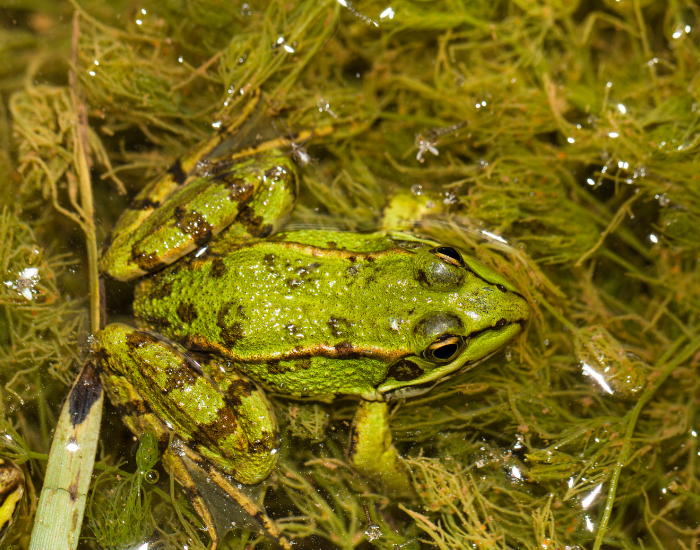
In Europe, this is the green water frog everyone knows. During my travels through France, I noticed these frogs complete metamorphosis faster than North American species when water is warm.
These European green frogs inhabit ponds, lakes, and slow-moving streams. They’re famous in French cuisine. Green frogs, including North American species, have also been harvested for frog legs in some regions. However, overharvesting has led to population declines in some areas.
4. The Red-Eyed Tree Frog (Agalychnis callidryas)
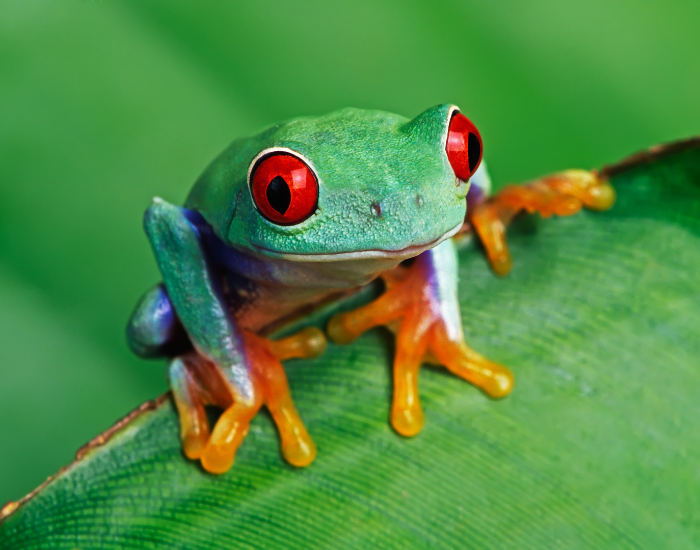
While not a “true frog,” this is the most famous green frog species in the world. Its neon green body displays “startle coloration.”
When sleeping, they hide their blue sides and red eyes. When threatened, they flash these bright colors, giving them a second to escape. These tree frogs inhabit rainforests from southern Mexico to Colombia.
5. The Barking Tree Frog (Hyla gratiosa)
Native to the coastal plains of eastern North America, these are the “chonky” green frogs of the tree world. They have beautiful olive green to bright lime skin, often dotted with dark spots. I used to find these in abundant leaf litter near cypress ponds.
Despite being tree frogs, barking tree frogs spend considerable time on the ground. During breeding season, male green frogs of this species produce a loud barking call. Therefore, they’re named quite appropriately. They inhabit shallow freshwater ponds and swamps. Moreover, they can tolerate slightly brackish water better than most green frog species.

6. The Green Tree Frog (Hyla cinerea)
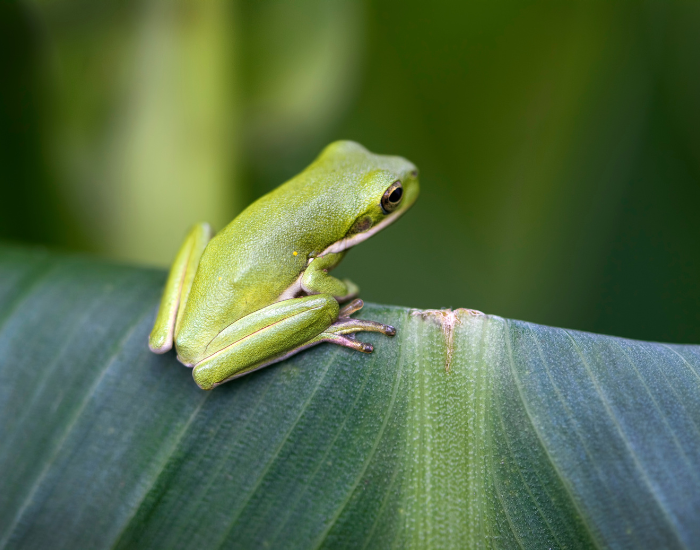
This is the quintessential green-yellow frog. They are slender, bright green, and usually have a crisp white or yellow stripe down their side. Green tree frogs love aquatic habitats. In fact, they’re very common in suburban backyard ponds.
Furthermore, these frogs can even thrive in contaminated suburban backyard ponds where other species struggle. Their adaptability makes them one of the most successful green frog species in North America. Male green frogs produce a distinctive “queenk-queenk-queenk” call during breeding season.
Green tree frogs range throughout the southeastern United States. In addition, they’re popular in the pet trade due to their docile nature and vibrant coloration.
7. The Gray Tree Frog (Hyla versicolor)
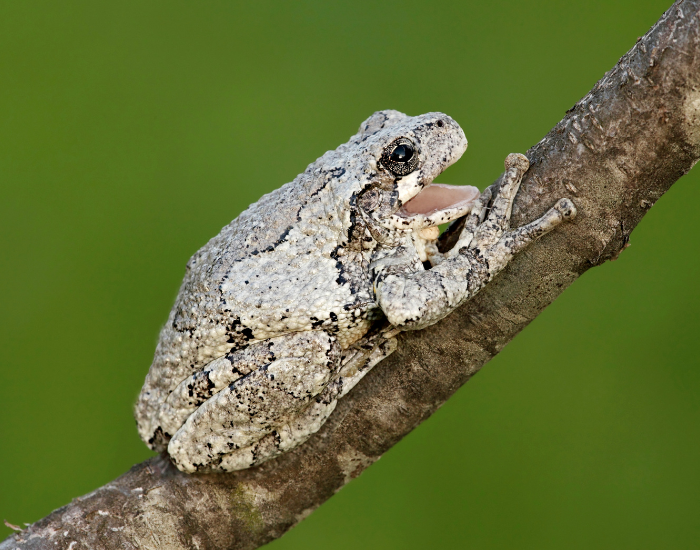
Wait, why is a “gray” frog on this list? Because they are masters of disguise! These frogs can change from mottled gray to a vivid dark green in minutes. This adaptation allows them to match their surroundings.
Moreover, they have bright yellow or orange pigments hidden on their inner thighs. When threatened, they flash these bright colors to startle predators. Gray tree frogs inhabit forests and woodland edges throughout eastern North America. Furthermore, they prefer areas with abundant leaf litter and tree cover.
Green frogs can also exhibit color variations, including blue, due to a genetic mutation called axanthism. This mutation is related to the absence of producing yellow pigments, which normally combine with blue pigments to create their typical green coloration.
8. The Wood Frog (Lithobates sylvaticus)
The wood frog is usually brown. However, in some populations, they can appear quite olive green, but they are mainly brown, tan, or rust-colored with a distinct dark “robber’s mask” across the eyes. These frogs are famous for being “frog-sicles.” They can literally freeze solid in the winter and thaw out in the spring.
Wood frogs are a widespread species native to the colder parts of North America. They range farther north than any other North American amphibian. In addition, they inhabit forests, often far from permanent water. Adult frogs only visit aquatic habitats during breeding period in early spring.
Their incredible freeze tolerance comes from high concentrations of glucose in their blood. This acts as antifreeze, protecting their organs during winter.

9. The Mink Frog (Lithobates septentrionalis)
If you find a frog in the north that looks like a northern green frog but smells like rotten onion when you pick it up—congratulations! You’ve found a mink frog. This distinctive odor is a defense mechanism.
Mink frogs love shallow freshwater ponds with lots of lily pads. In fact, they’re often called “lily pad frogs” because they spend so much time on floating vegetation. These green frog species inhabit northern regions. Therefore, they overlap with northern green frogs in much of their range.
However, mink frogs prefer cooler water and are found farther north. Male green frogs of this species produce a rapid “cut-cut-cut” call during breeding season.
10. The Green Toad (Bufotes viridis)
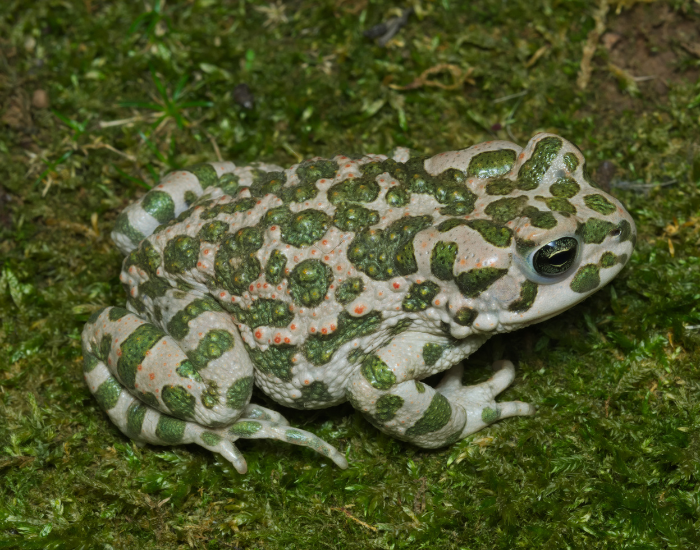
Is a green toad actually a frog? Technically, all toads are frogs, but not all frogs are toads! The green toad is a stunning European species with dark green marbled spots over a cream background.
Moreover, they live in much drier areas than green water frogs. Green toads inhabit steppes, grasslands, and even desert edges. Furthermore, they can tolerate more arid conditions than most amphibians. However, they still need aquatic habitats for breeding.
These toads produce toxic secretions from their parotid glands. Therefore, predators quickly learn to avoid them.
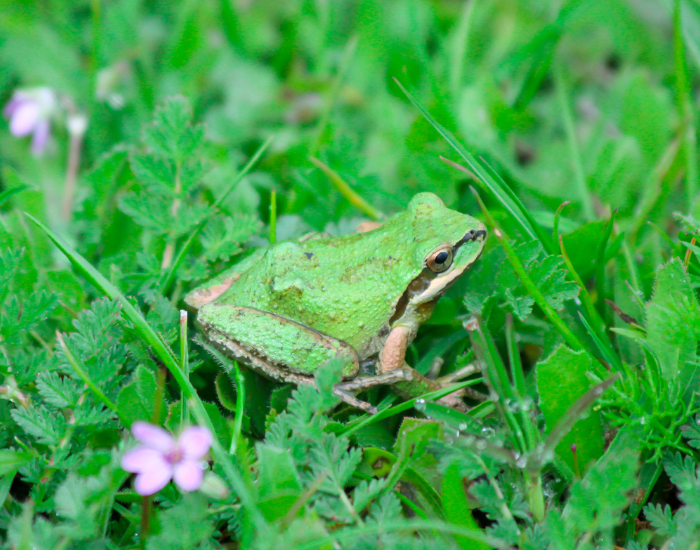
11. The Pacific Tree Frog (Pseudacris regilla)
Commonly found on the West Coast, these little guys come in various shades of green and bronze. They are the ones responsible for the “ribbit” sound you hear in Hollywood movies. In fact, regardless of where a movie is set, this is usually the frog call you hear!
Pacific tree frogs range from British Columbia to Baja California. Moreover, they adapt to various aquatic habitats, from mountain streams to suburban ponds. Adult frogs are quite small, typically 2-5 cm. However, their loud calls make them seem much larger.
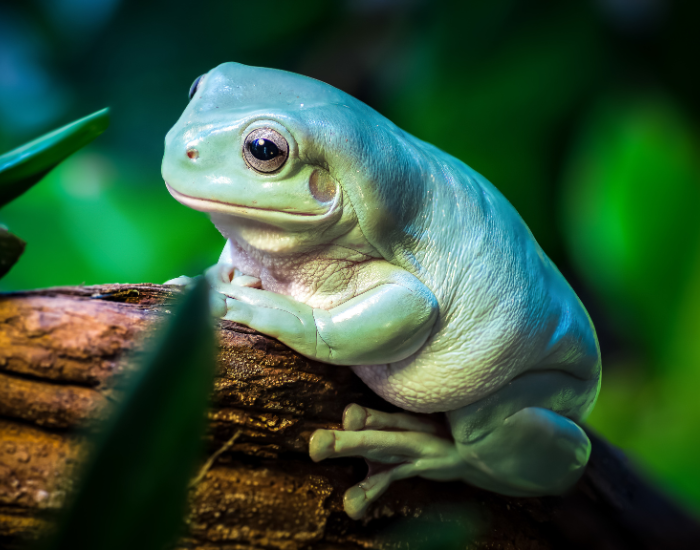
12. The Australian Green Tree Frog (Ranoidea caerulea)
Also known as the “Dumpy Tree Frog,” these are famous in the pet trade. They have a thick, fatty ridge over their eyes and a relaxed temperament. Their skin contains antimicrobial peptides with anti-predator traits.
These large tree frogs reach 10 cm and often live 15-20 years in captivity. They inhabit northern and eastern Australia and frequently enter buildings to hunt insects.
13. The Glass Frog (Centrolenidae)
While mostly green on top, their bellies are transparent! You can literally see their heart beating. Glass frogs demonstrate naturally occurring variation in the amphibian world.
These remarkable frogs inhabit cloud forests in Central and South America. Male green frogs guard eggs on leaves overhanging water. When green frog tadpoles hatch, they drop into streams below.

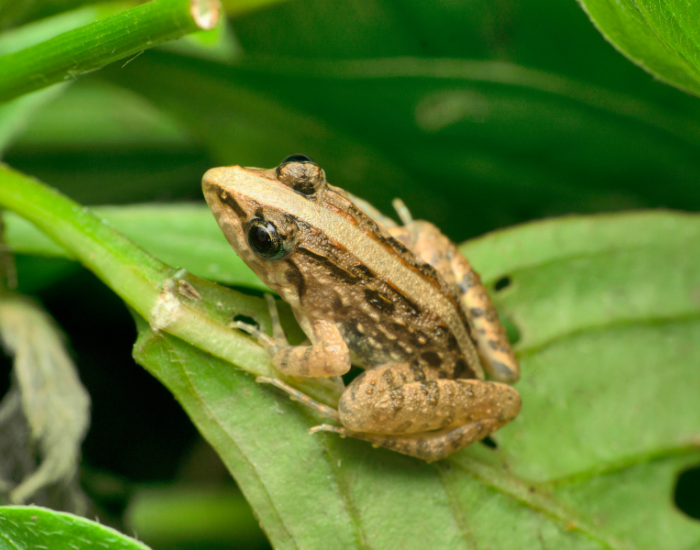
14. The Black-Spotted Pond Frog (Pelophylax nigromaculatus)
Common in East Asia, this green frog species is often found in rice paddies. They are highly territorial, much like our northern green frog. Male green frogs establish territories and defend them vigorously during breeding season.
Black-spotted pond frogs have adapted remarkably well to agricultural landscapes. Furthermore, they help control insect pests in rice fields. However, pesticide use threatens some populations. These frogs range throughout China, Korea, and Japan.
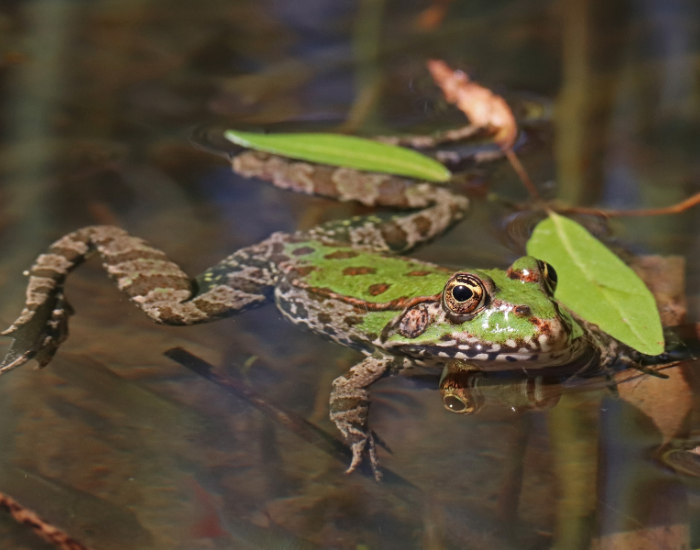
15. Marsh Frog (Pelophylax ridibundus)
Also known as the marsh frog, this is one of the most widespread green frogs in Europe and parts of western Asia. Adult green frogs of this species closely resemble North American green frogs in body shape and olive-green to dark green coloration, but they grow larger and produce a much louder, harsher call during the breeding season.
Marsh frogs inhabit lakes, rivers, shallow freshwater ponds, and agricultural waterways, including irrigation canals and rice fields. Like many green frog species, male frogs maintain territories during the breeding period and rely on strong mating calls to attract potential female mates. Their success in human-altered landscapes has made them a dominant frog across much of their range.
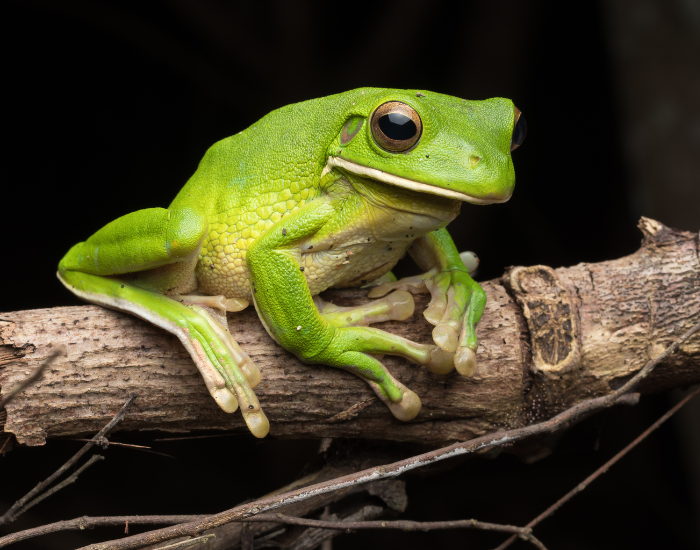
16. The White-Lipped Tree Frog (Litoria infrafrenata)
The world’s largest tree frog, the white-lipped tree frog is a striking bright green species native to Australia and New Guinea. Adult frogs are instantly recognisable by their bold white stripe along the jaw and their smooth, vivid green skin, which can darken or lighten depending on humidity and habitat.
These green frogs inhabit tropical rainforest aquatic habitats, breeding in ponds, forest pools, and slow-moving water during the wet season. Like other green frog males, they exhibit strong mating calls and vocal activity during the breeding period. Despite their size, they are agile climbers and spend much of their time in vegetation near water.
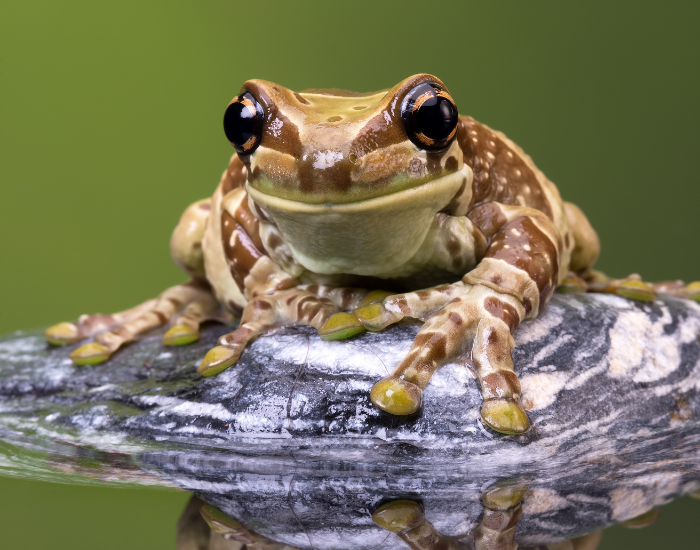
17. The Amazon Milk Frog (Trachycephalus resinifictrix)
The Amazon milk frog is a chunky, vividly green frog with blue-gray patterning and thick skin adapted to life high in the canopy. In the wild, these green frogs inhabit the Amazon rainforest, where adult frogs breed in tree holes filled with rainwater, rather than ground-level ponds.
During the breeding season, resident male frogs guard calling sites and attract females using loud vocalisations. Like many tree frogs, their tadpoles develop in small aquatic habitats, making them sensitive to changes in rainfall and forest structure. Although common in the pet trade, wild populations rely heavily on intact rainforest ecosystems.
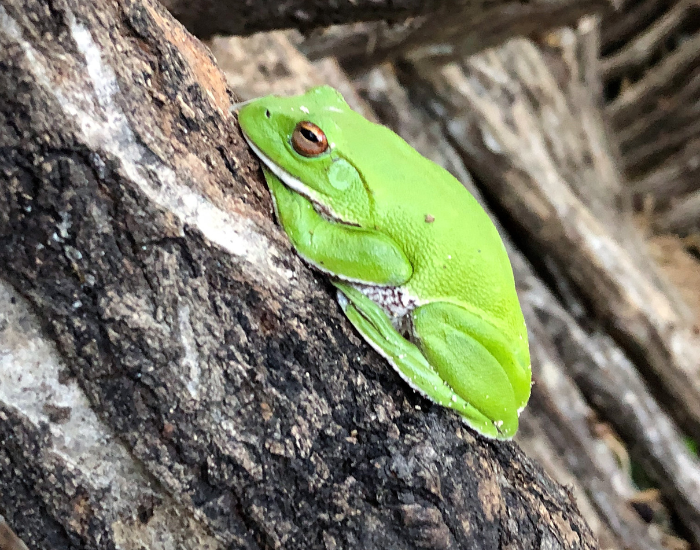
18. The Cuban Tree Frog (Osteopilus septentrionalis)
The Cuban tree frog is a highly adaptable green frog species native to the Caribbean and now widespread as an invasive species across Florida and parts of the southeastern United States. Adult green frogs of this species vary in colour from pale olive green to dark green or brown, often becoming brighter after rain.
These frogs thrive in urban and suburban aquatic habitats, including backyard ponds, drainage systems, and artificial water sources. During the breeding season, male frogs produce loud calls and dominate breeding habitat, often displacing native green frog species. Their success is a reminder that not all abundant green frogs indicate healthy ecosystems.

19. The Asian Green Tree Frog (Zhangixalus arboreus)
Native to Japan, Korea, and parts of China, the Asian green tree frog is a classic bright green canopy-dwelling species commonly encountered near rice paddies and forest pools. These green frogs rely on shallow freshwater ponds and agricultural wetlands for breeding.
During the breeding period, male green frogs establish calling sites and attract females with clear, repetitive vocalisations. Because they thrive in both forested and human-managed landscapes, this species is often one of the most commonly seen adult frogs in East Asia. Their presence highlights the close relationship between amphibians, water quality, and land use.
FAQ: Everything You Wanted to Know About Green Frogs
Yes, green frogs are generally safe to touch. However, you should always wash your hands afterward. Frogs have porous skin and can absorb chemicals from our hands. These include lotions or soaps, which can harm them. Conversely, some frogs secrete mild toxins. These can irritate your eyes or mouth.
While northern green frogs are hardy, I always recommend observing them in the wild. If you do keep one, it requires significant setup. You’ll need aquatic habitats, clean water, and a steady diet. Northern green frogs can live for several years in captivity with proper care. However, they need shallow freshwater ponds or large aquariums that mimic their natural habitat.
Yes, most toads secrete substances from their parotid glands. These can be toxic if ingested by a dog. If your dog licks a toad and starts foaming at the mouth, seek veterinary care immediately. The toxins can cause serious health problems if not treated promptly.
Conservation of Green Frogs
Even though we see wild green frogs everywhere, they’re “canaries in the coal mine” for water quality. The presence of abundant and quality habitat is essential. This includes abundant leaf litter and shallow freshwater ponds.
Threats to green frogs include habitat loss, pollution, disease, and climate change. Chytridiomycosis, a fungal disease, has devastated amphibian populations worldwide. In Kansas, green frogs are listed as a threatened species due to habitat loss and other factors. Therefore, protecting aquatic habitats is crucial for the survival of all green frog species.
Other articles you may like:
- 12 Facts About the Pacman Frog
- 12 Fascinating Facts About Tomato Frog
- Hellbender Habitat: Inside the World of America’s Giant Salamander