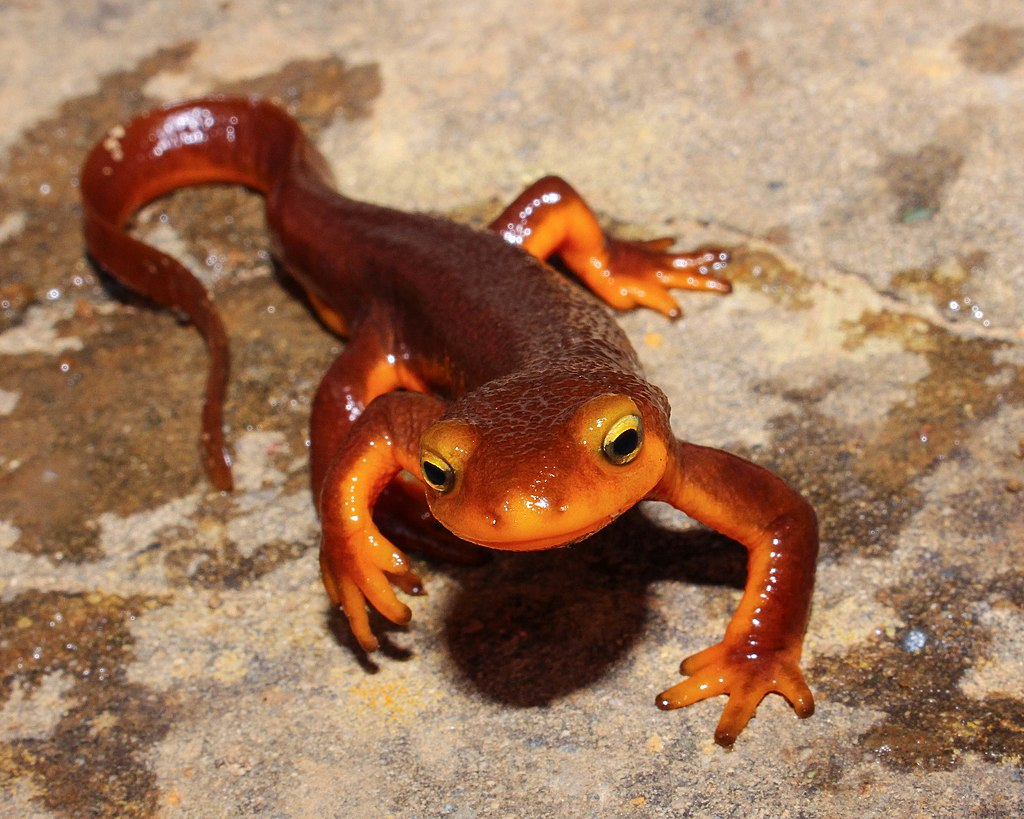
I’ll never forget the first time I encountered a California newt during my field research in Baja California. There I was, carefully lifting a piece of rotting oak bark when this stunning creature with a bright orange belly stared back at me. My field supervisor’s immediate shout of “Don’t touch it!” probably saved me from a very unpleasant, and potentially dangerous, experience.
The California newt (Taricha torosa) isn’t just another salamander crawling around the Golden State. This incredible amphibian packs enough neurotoxin to kill a grown human, yet plays a crucial role in maintaining California’s delicate ecosystem balance.

What Exactly Is a California Newt?
The California newt belongs to the salamander species family, but calling it “just another salamander” would be like calling a cobra “just another snake.” These amphibian species are endemic to California, meaning you won’t find them anywhere else on Earth naturally. Adult newts typically measure 3 to 5 inches in length, they are cold blooded, with their distinctive rough, granular skin that feels like fine sandpaper to the touch, though I strongly advise against finding out firsthand!
Newt vs. Salamander: Understanding the Difference
People maya ask, “What’s the difference between a newt and a salamander?” If there is a difference at all. Here’s the simple answer: all newts are salamanders, but not all salamanders are newts. Newts are actually a subfamily of salamanders that spend part of their life cycle in water and part on land. The California newt exemplifies this perfectly, with aquatic larvae that transform into terrestrial adults, then return to water to breed.
What makes the California newt special among salamander species is their:
- Rough skinned texture (unlike most salamanders’ smooth skin)
- Distinctive orange belly coloration
- Semi-aquatic lifestyle
- Incredibly potent neurotoxin

1. A Salamander With an Orange Belly
The California newt (Taricha torosa) is a type of salamander easily recognized by its rough skinned dark brown to pale yellow coloration on top and a bright orange to yellow underside. This bold coloration acts as a warning to potential predators. Their average length is 5–8 inches, making them one of the larger newt species in North America. Unlike smooth skin salamanders, their rugged texture helps distinguish them in the wild.
During my research in oak forests throughout their range, I’ve observed how this salamander with orange belly uses its adult coloration as a primary defense mechanism. The contrast between their dark brown dorsal surface and vibrant ventral coloration is striking in natural lighting conditions.
2. Endemic to California’s Diverse Habitats
As the name suggests, the California newt is found only in California. Its range stretches from Mendocino County in the north to San Diego County in the south, with populations also found in the southern Sierra Nevada. Coastal populations and mountain groups are genetically distinct, and the Sierra Nevada population is now recognized as a separate species, Taricha sierrae.
The coast range mountains provide ideal terrestrial habitats for these amphibians, while slow moving streams and breeding ponds serve their aquatic needs. I’ve documented populations thriving in wet forests, oak forests, and rolling grasslands throughout their natural range.

3. They Thrive in Dual Habitats
California newts live both on land and in water, making them true amphibian species. Adults migrate and spend most of the year in oak forests, chaparral, and rolling grasslands, hiding under logs, in rock crevices, and animal burrows. In winter and spring, they migrate to slow moving streams, quiet stream pools, and breeding ponds to reproduce.
Their terrestrial habitats include:
- Oak forests and woodlands
- Wet forests in coastal areas
- Rolling grasslands and meadows
- Chaparral and scrubland
- Rock crevices and talus slopes
Their aquatic environments feature:
- Slow moving streams and creeks
- Breeding ponds and seasonal pools
- Quiet stream pools with minimal current
- Stream pools with underwater rocks and vegetation
4. A Fascinating Life Cycle with Distinct Phases
Like all amphibian species, California newts undergo metamorphosis with distinct aquatic phase and terrestrial phase stages. Females lay egg masses of up to 30 single eggs, attached to underwater rocks or submerged vegetation. These spherical egg mass clusters are carefully positioned to maximize survival rates.
The newt larvae hatch with gills and tail fin, feeding on mosquito larvae and other small aquatic invertebrates during their larval stage. After several months, they transform into juveniles with lungs, leave the water, and become terrestrial adults. This larvae transform process highlights why both wetlands and upland terrestrial habitats are essential for their survival.
During the larval stage, young newts develop in natal pond environments, where they feed on decomposing organic matter and various aquatic invertebrates. The larval stage lasts approximately 3-5 months, depending on water temperature and food availability.

5. Breeding Season Brings Mass Migrations
During the rainy season, often between November and March, California newts migrate en masse to breeding ponds. This breeding season coincides with California’s wet season, when stream pools and temporary ponds fill with water. Male newts outnumber females and may form breeding aggregations where several males try to mate with a single female.
Males arrive at breeding ponds first and establish territories. When females arrive, complex courtship behaviors begin. Males perform elaborate underwater dances and release pheromones to attract mates. Females lay their egg masses on submerged vegetation and underwater rocks, ensuring optimal conditions for development.
It’s one of the most remarkable wildlife events in California woodlands. Sadly, these migrations often cross roads, leading to high levels of road mortality. Volunteer groups like the Chileno Valley Newt Brigade help newts cross safely during breeding season.
6. Their Skin Contains a Deadly Poison
California newts secrete tetrodotoxin, one of the most lethal neurotoxins known, also found in pufferfish and rough skinned newt species. This toxin blocks nerve signals, causing paralysis and, if ingested, can be fatal to predators, and humans. One newt contains enough poison to kill several humans, though deaths are extremely rare because the toxin must be swallowed.
The same toxin found in these amphibian species has been the subject of extensive research. Studies show that newt populations in areas with common garter snake predators tend to have higher toxin concentrations, demonstrating an evolutionary arms race.
7. Handle With Caution – Protect Migrating Newts
Another question people often may ask is: “Can I pick up a California newt?” It’s best not to. The toxin is not absorbed easily through intact smooth skin, but it can be dangerous if it contacts the eyes, mouth, or any open cuts. After touching a newt, wash your hands thoroughly. Pet owners should be especially careful, California newt poison is lethal to dogs if ingested.
Conservation efforts to protect migrating newts include public education about proper handling. During breeding season, when adults migrate to breeding ponds, it’s crucial that people understand the risks and avoid disturbing these sensitive amphibian species.

8. Garter Snakes Are Their Primary Predators
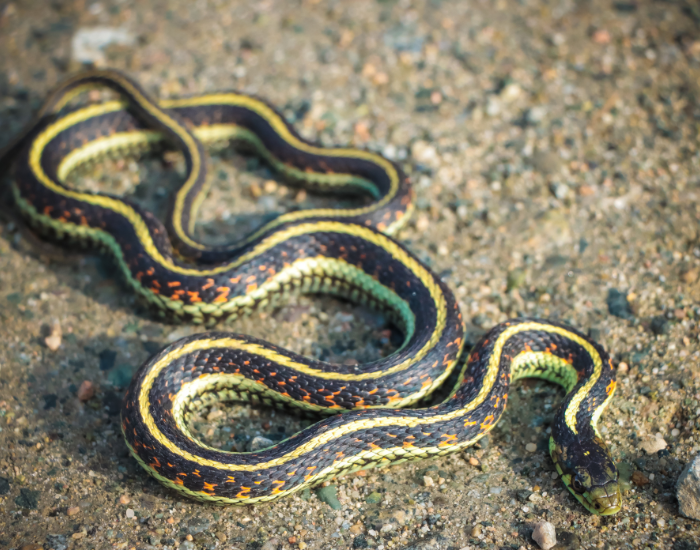
Most predators avoid California newts due to their potent toxin. However, some populations of the common garter snake (Thamnophis sirtalis) have evolved resistance. This has created an evolutionary “arms race,” with snakes developing tolerance and newts evolving even higher toxin levels in response.
This predator-prey relationship is one of the most studied dynamics in evolutionary biology. Gills remaining functional during the aquatic phase makes newt larvae more vulnerable to aquatic predators, while terrestrial adults face fewer natural enemies due to their toxic defenses.
9. Distinguishing California Newts from Related Species
California newts are closely related to the rough skinned newt (Taricha granulosa) found in the Pacific Northwest. Both produce tetrodotoxin and belong to the genus Taricha, but the rough skinned newt has smoother skin and a more northern range. People also confuse them with other salamander species with orange bellies, but the California newt’s rough texture and distribution set it apart.
Key identifying features include:
- Rough skinned texture vs smooth skin of related species
- Dark brown to pale yellow dorsal coloration
- Distinctive orange belly pattern
- Size range of 5-8 inches
- Geographic distribution limited to California
The closely related Taricha granulosa shares the same toxin but inhabits different regions, primarily in the Pacific Northwest rather than California’s coast range mountains.

10. Population Declines Threaten Conservation Status
The California Department of Fish and Wildlife lists the California newt as a Species of Special Concern. Newt populations in southern California have suffered population declines due to multiple factors:
- Habitat loss from urban development in coastal populations areas
- Invasive predators like mosquitofish and crayfish that eat egg masses and larvae
- Drought and climate change, which reduce breeding streams
- Road mortality during migrations
- Habitat loss in critical breeding ponds and terrestrial habitats
Conservation status assessments show that protect migrating newts efforts are essential. Without conservation intervention, localized extinctions are likely, particularly in southern coastal populations where urban development pressure is highest.
11. Conservation Efforts Protect Terrestrial and Aquatic Habitats
Community and government programs are helping protect newt populations. Conservation actions include:
- Road closures during peak migration periods to protect migrating newts
- Habitat restoration and creation of artificial breeding ponds
- Controlling invasive predators that threaten egg masses and larvae
- Protecting terrestrial habitats including oak forests and rolling grasslands
- Public outreach to teach people not to handle or collect wild newts
- Monitoring breeding ponds and stream pools for water quality
- Restoration of wet forests and riparian corridors
Conservation groups stress the importance of protecting both breeding ponds and upland terrestrial habitats, both crucial to the species’ survival. Adults migrate between these habitats seasonally, making corridor protection essential.
12. Ancient Amphibians With Modern Conservation Lessons
Newts belong to an amphibian lineage that has existed for over 200 million years. The survival of the California newt shows the resilience of amphibian species, but their recent population declines remind us how vulnerable even well-adapted species can be to habitat changes.
These ancient amphibian species have survived mass extinctions and climate changes throughout geological history. However, modern threats like habitat loss, invasive predators, and rapid environmental change pose unprecedented challenges.
Protecting them isn’t just about saving a newt animal, it’s about preserving California’s oak forests, streams, and biodiversity for the future. The conservation status of California newts serves as an indicator of ecosystem health across their range from Mendocino County to San Diego County.

FAQ About California Newts
They are poisonous, not venomous. California newts secrete tetrodotoxin through their rough skinned surface.
Numbness, paralysis, and in severe cases, respiratory failure. The same toxin found in pufferfish can be lethal if ingested.
From Mendocino County to San Diego County, in oak forests, rolling grasslands, chaparral, and wet forests. They use both terrestrial habitats and aquatic environments.
No. Their toxin and conservation status concerns make them unsuitable for captivity. Protect migrating newts by observing them in their natural habitat.
All newts are salamander species, but newts are rough skinned and often more toxic. California newts have distinctive rough texture compared to smooth skin salamanders.
Breeding season typically occurs during the rainy season, from November through March, when adults migrate to breeding ponds and stream pools.
Poisonous But Important
The California newt with its distinctive orange belly is a small but extraordinary amphibian species. From its potent poison to its seasonal migrations between terrestrial habitats and breeding ponds, it plays an outsized role in California ecosystems.
These remarkable amphibian species face significant challenges from habitat loss, invasive predators, and climate change. Conservation status assessments show that newt populations, particularly coastal populations, need immediate protection.
Protecting their habitats, breeding ponds, oak forests, wet forests, and migration pathways is vital for maintaining healthy newt populations. Conservation efforts to protect migrating newts during breeding season have shown promising results in areas like Contra Costa County and San Diego County.
For me, seeing one shuffle across a damp trail in the Santa Monica Mountains was a reminder that even the smallest creatures carry big ecological stories, and deserve our respect and protection. From Mendocino County’s coastal redwood forests to San Diego’s chaparral hills, California newts represent the incredible biodiversity that makes California’s ecosystems so unique and worth preserving.