
Years ago I worked the reptile and amphibian house at a zoo. My days ran on crocodiles, boas, anacondas, ball pythons, and a rotating cast of rattlesnakes. We kept exactly one cobra. I fed that animal for months and barely touched it, because nobody hands the new guy an elapid.
That snake taught me something anyway. Cobras do not rush you. They rise, they flare, and they wait for you to leave.
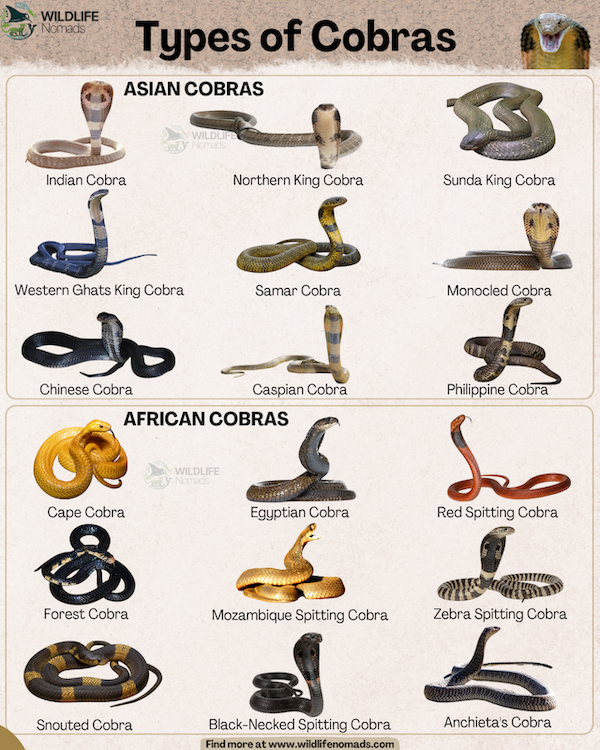
North America has no native cobras, so most of my hands-on elapid work came later in Australia with red-bellied blacks, which aren’t true cobras, but share the same family and a subtle neck flare. Same fixed front fangs, same maddening calm. This guide covers 15 types of cobras across two genera, plus the venom, the hoods, and the myths worth retiring. You will also get straight answers on which cobra is deadliest and how many cobra species actually exist.
What Is a Cobra Snake, Exactly?
The term cobra covers roughly 40 to 45 venomous snakes in the Elapidae family. That family sits inside the Squamata order of scaled reptiles. True cobras belong to the genus Naja, which currently includes around 38 to 40 species following ongoing taxonomic splits over the last two decades (including major revisions to African and Asian populations).
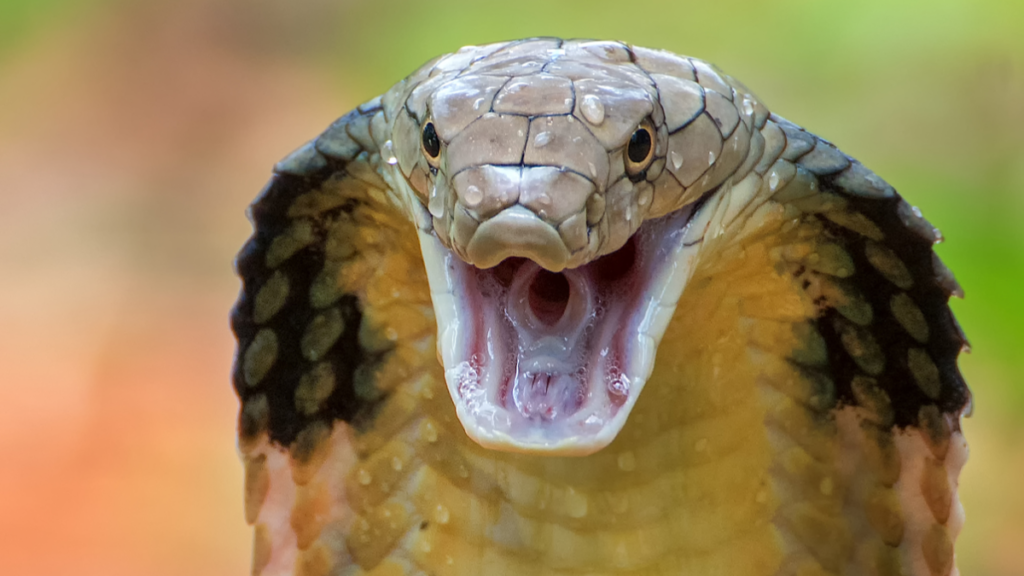
Cobra characteristics start with the hood. Elongated neck ribs swing outward and stretch loose skin into a disc. When a cobra feels threatened, that defensive posture makes the animal look twice its real width.
Short fangs sit fixed at the front of the upper jaw. Cobra venom flows down them into the wound, so a cobra bite is a stab, not a chew. Cobras are venomous, never poisonous, you would have to eat one to be poisoned.
The Four Types of King Cobras (Genus Ophiophagus)
For almost 200 years, science treated the king cobra as a single species. A 2024 revision in the European Journal of Taxonomy ended that. Genetics and scale counts split the genus Ophiophagus into four distinct animal species.
1. Northern King Cobra (Ophiophagus hannah)
This is the original king cobra Ophiophagus hannah, and it holds the famous records. It ranges from eastern Pakistan across northern India and Indo-China into central Thailand. Maximum length reaches about 5.6 metres, and the longest reliably measured individual hit 18 feet 4 inches.
An alarmed king cobra lifts roughly a third of its body clear of the ground. Its hiss drops below the pitch of most snakes and comes out as a low growl. Few dangerous snake displays in the world are less ambiguous.
King cobras eat other snakes almost exclusively, including venomous ones. A big one swallows prey far wider than its own head. After a heavy meal, it can go months without eating again.
One bite delivers up to 420 mg of venom. Those neurotoxins shut down the brain’s respiratory centres. The famous line about killing an elephant in hours traces to anecdote, not controlled study.
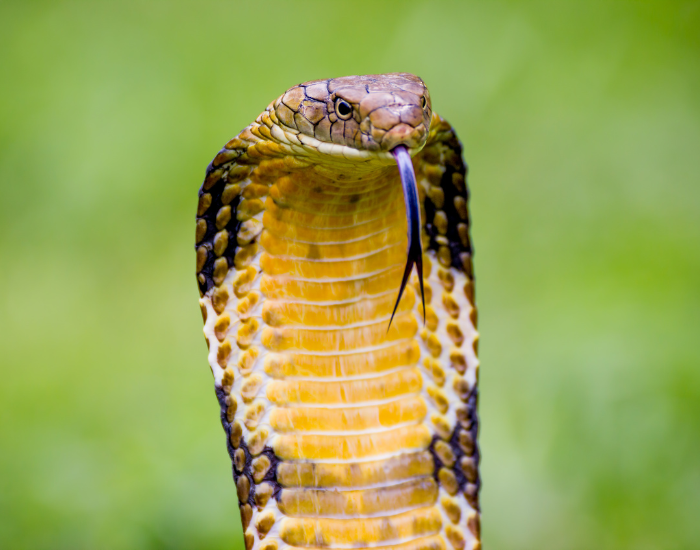
2. Sunda King Cobra (Ophiophagus bungarus)
The Sunda king cobra occupies the Malay Peninsula, the Greater Sunda Islands, and the southern Philippines. Scientists revived an old 1837 name rather than coining a new one. Dark brown to near-black adults dominate, with narrow pale crossbands.
Its habitat runs through lowland rainforest, plantation edges, and mangrove. Southeast Asia’s deforestation hits this species hardest of the four.
3. Western Ghats King Cobra (Ophiophagus kaalinga)
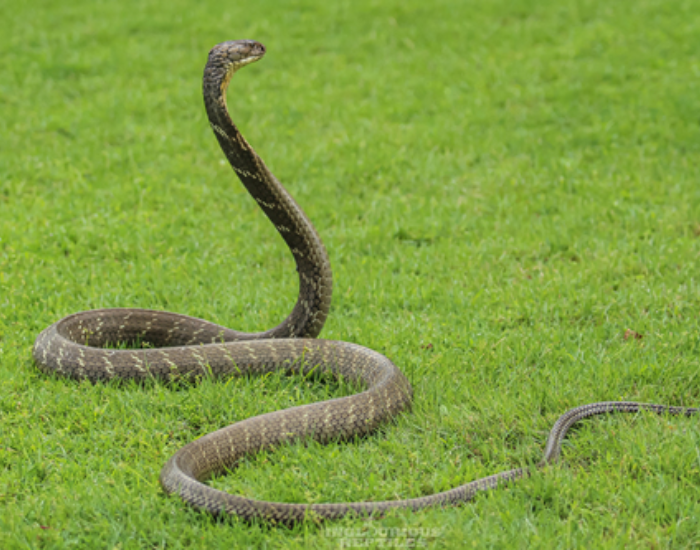
The Western Ghats king cobra is endemic to southwestern India’s mountain forests. Locals in Karnataka have called it kaalinga for generations, and the 2024 paper made that name official. It lives in wet evergreen forest above roughly 500 metres.
I find this one quietly remarkable. A snake this large hid in plain sight for two centuries, inside a famously well-studied biodiversity hotspot.
4. Luzon King Cobra (Ophiophagus salvatana)
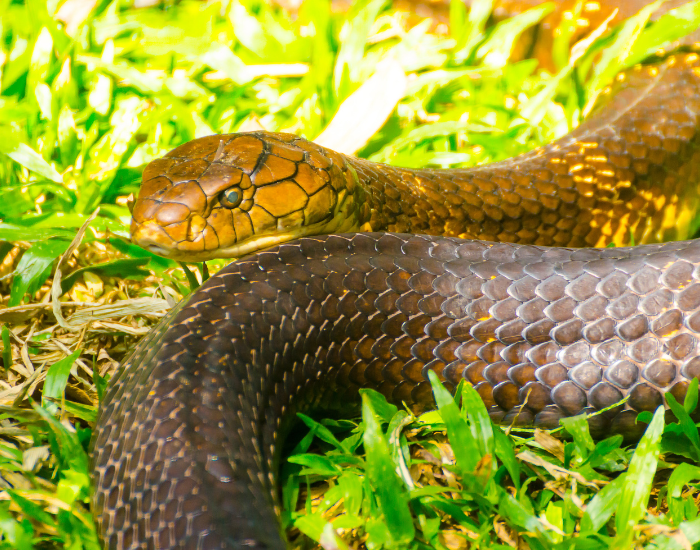
The Luzon king cobra lives only on Luzon in the northern Philippines. It is the most range-restricted of the four and the least studied. Island endemics carry outsized extinction risk. One bad decade of habitat loss can take the entire population.
True Cobras of Asia (Naja Species)
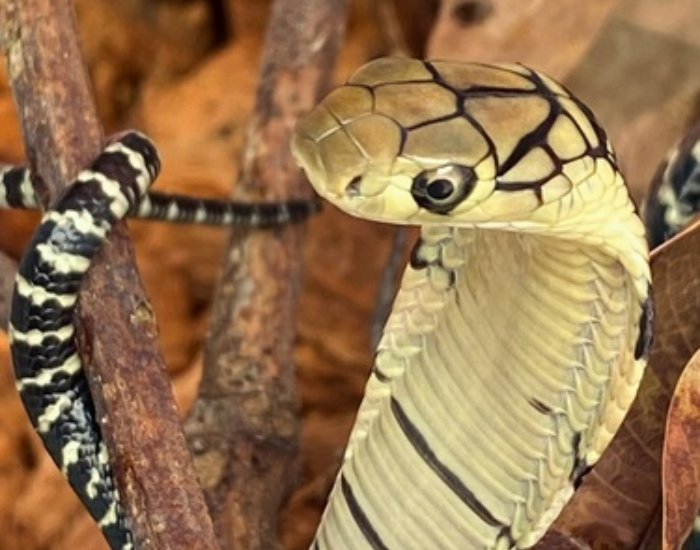
Asia’s Naja species drive most cobra encounters and nearly all cobra-related human deaths. These snakes overlap with farmland, which is precisely where the rodents are.
5. Indian Cobra (Naja naja)
The Indian cobra wears the classic spectacle mark, two pale ovals joined by a curved line across the hood. It occupies the Indian subcontinent from Pakistan to Bangladesh and Sri Lanka. Hindu mythology built temples around this animal, and it still receives offerings during Nag Panchami.
It belongs to India’s “Big Four,” the group responsible for the majority of the country’s snakebite fatalities. Rodents, birds, lizards, and frogs make up the bulk of its diet. Despite the toll, the International Union for Conservation of Nature lists it as Least Concern.
6. Monocled Cobra (Naja kaouthia)
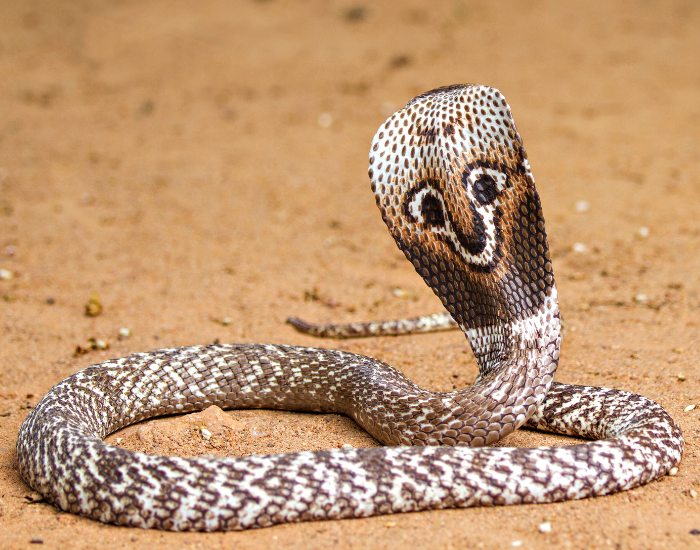
One O-shaped mark, not two, gives the monocled cobra its name. It ranges across eastern India, Bangladesh, Myanmar, and Thailand into southern China. Rice paddies and irrigation ditches suit it perfectly, which is exactly the problem.
This is one of the most heavily traded cobra species in the international pet trade. Wild-caught animals still move through that pipeline in worrying numbers.
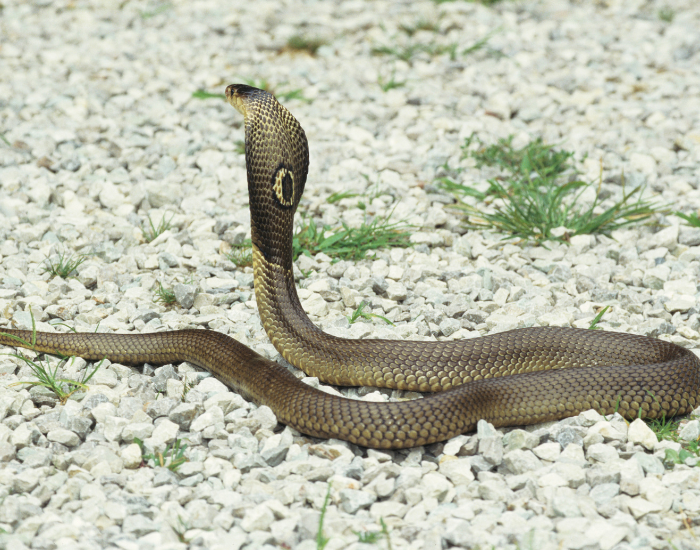
7. Chinese Cobra (Naja atra)
The Chinese cobra occupies southern China, Taiwan, northern Vietnam, and Laos. Dark grey-brown bodies carry thin white crossbands and a wide hood mark. It hunts by day in cooler months and shifts to dusk in summer heat.
Harvesting for food and traditional medicine has cut populations sharply. Surveys now find it far less often than 1980s records suggest.
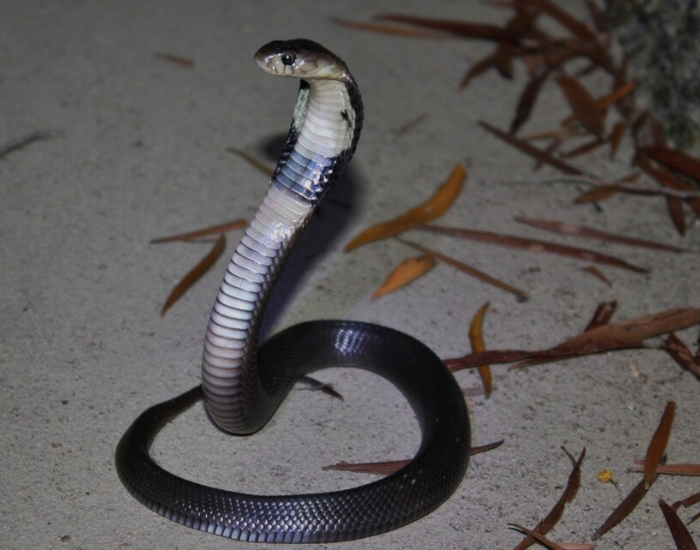
8. Caspian Cobra (Naja oxiana)
Central Asia’s Caspian cobra pushes cobras further north than any other species. It occupies Turkmenistan, Uzbekistan, Iran, Afghanistan, and northern Pakistan. Rocky hillsides, irrigated oases, and high-altitude grassland up to 2,000 metres all support it.
Its venom ranks among the most potent of any Naja species in laboratory assays. Unusually for a cobra, it cannot spit.
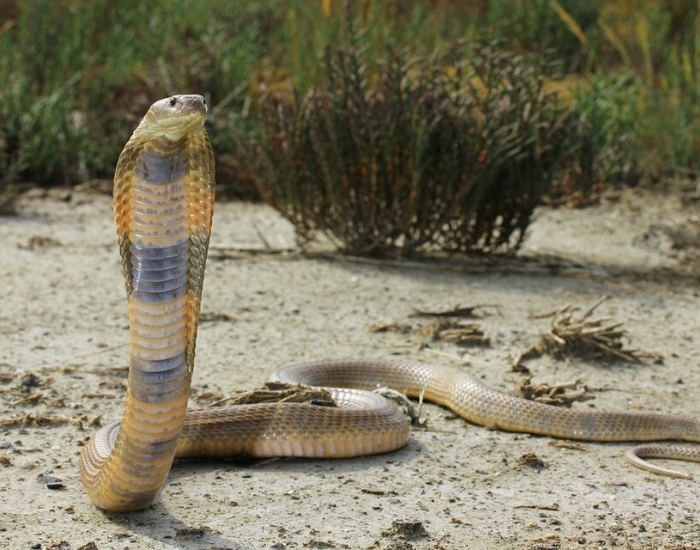
9. Philippine Cobra (Naja philippinensis)
Guinness World Records recognises the Philippine cobra as the most venomous cobra. Its venom carries a subcutaneous LD50 of roughly 0.2 mg/kg, with 90 to 100 mg delivered per bite. That toxicity is almost purely neurotoxic, with minimal tissue damage at the wound.
It can also spray venom, despite lacking the extreme spitting specialisation of African species. Luzon and nearby islands form its entire range.
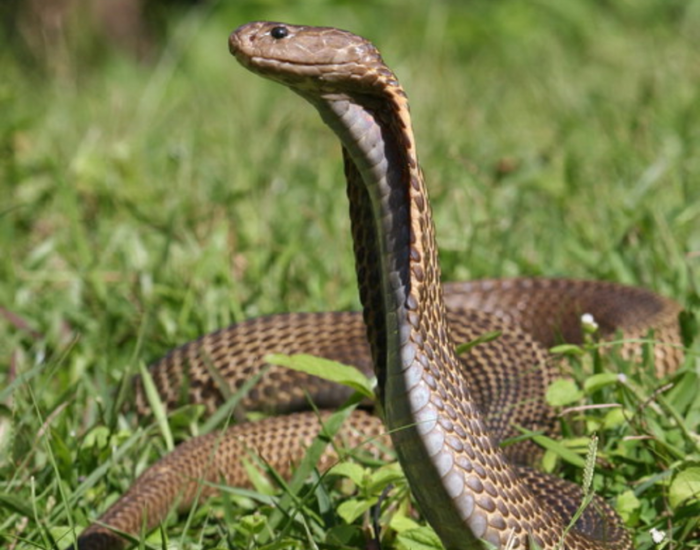
African Cobras, Including the Spitting Specialists
Africa holds the greatest cobra diversity, and the continent produced the spitting habit not once but three separate times. A 2021 Science paper showed each lineage independently evolved venom that hurts immediately.
10. Egyptian Cobra (Naja haje)
The Egyptian cobra is common across North Africa and the Middle East, and it reaches deep into the Sahel. Savannas, open woodlands, and rocky hillsides all suit it. Ancient Egyptians stylised this snake into the uraeus worn on the pharaoh’s brow.
Adults reach about 2.5 metres and take toads, birds, eggs, and small vertebrates. Unlike many of its African relatives, it cannot spit.
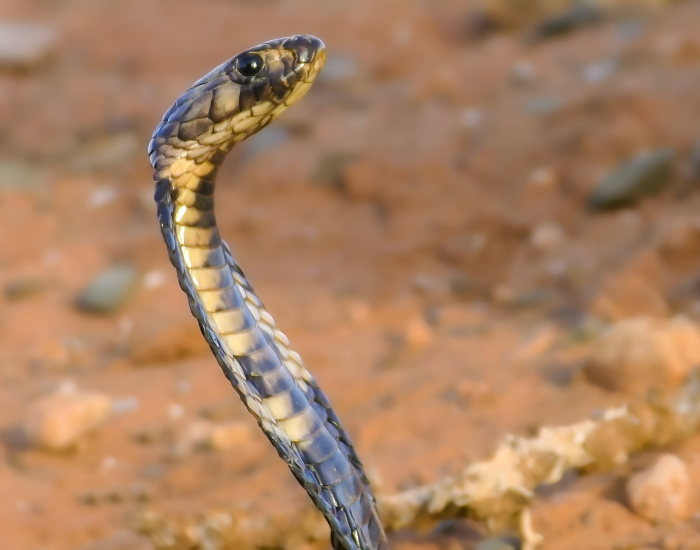
11. Cape Cobra (Naja nivea)
Southern Africa’s Cape cobra ranges from bright yellow through speckled brown to nearly black. That colour variation confuses even experienced handlers. It occupies fynbos, Karoo scrub, and Kalahari sand, and it climbs well enough to raid sociable weaver nests. It also eats other snakes, including its own kind.
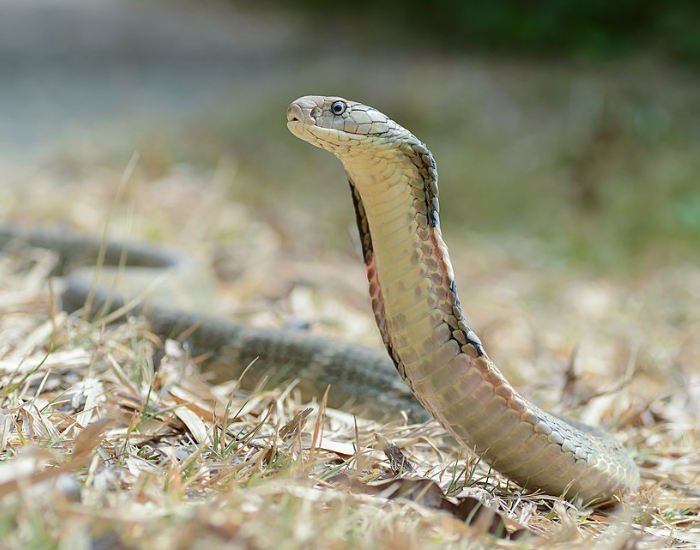
12. Mozambique Spitting Cobra (Naja mossambica)
The Mozambique spitting cobra is southern Africa’s most notorious spitter. It can spray venom accurately from over two metres, aiming at the eyes of anything that looms over it. Untreated, that venom causes searing pain, corneal ulceration, and sometimes permanent blindness.
Research using high-speed video shows these snakes track a moving face and fire predictively. They are not spraying blindly. They are leading the target.
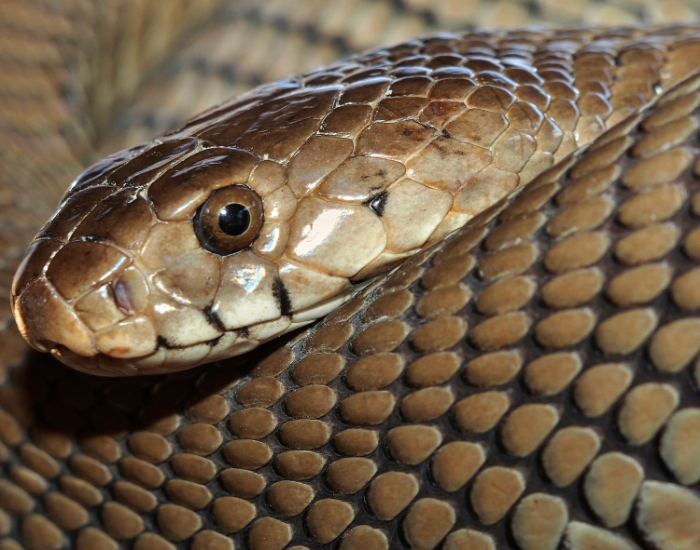
13. Red Spitting Cobra (Naja pallida)
East Africa’s red spitting cobra glows salmon to brick red, with a black throat band. Kenya, Tanzania, Ethiopia, and Somalia all hold populations. It favours dry savanna and shelters in termite mounds and rock cracks.
Its venom glands sit under muscular control. Ridges inside the fang tips deflect the stream forward into a fine, fast spray.
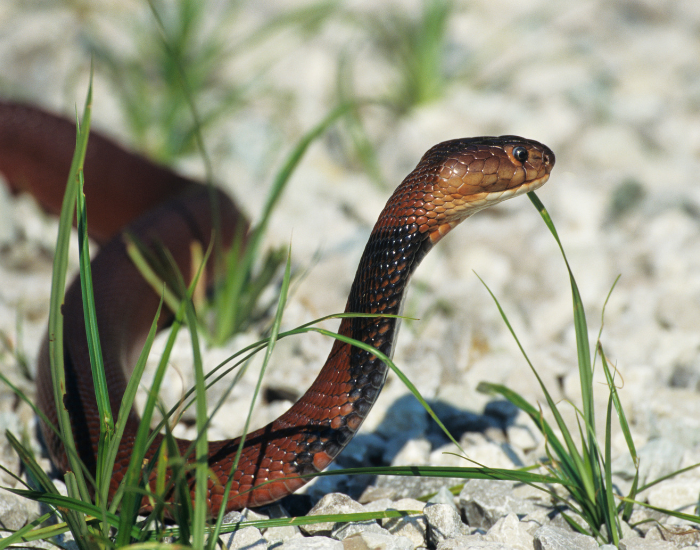
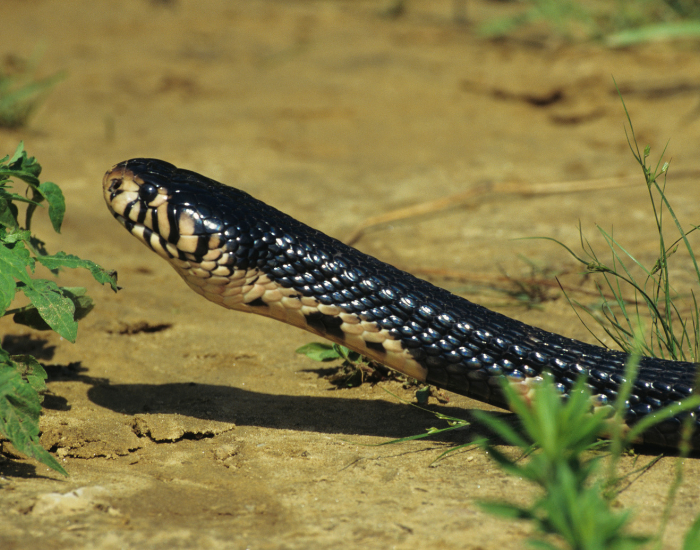
14. Forest Cobra (Naja melanoleuca)
The forest cobra is Africa’s largest true cobra, reaching about 2.7 metres. It swims, climbs, and hunts across rainforest, gallery forest, and wetland margins from Senegal to Kenya. Glossy black scales and a barred cream throat make it unmistakable up close.
Genetic work has since split the old forest cobra concept into several species. Taxonomy keeps moving, and that matters for antivenom coverage.
15. São Tomé Cobra (Naja peroescobari)
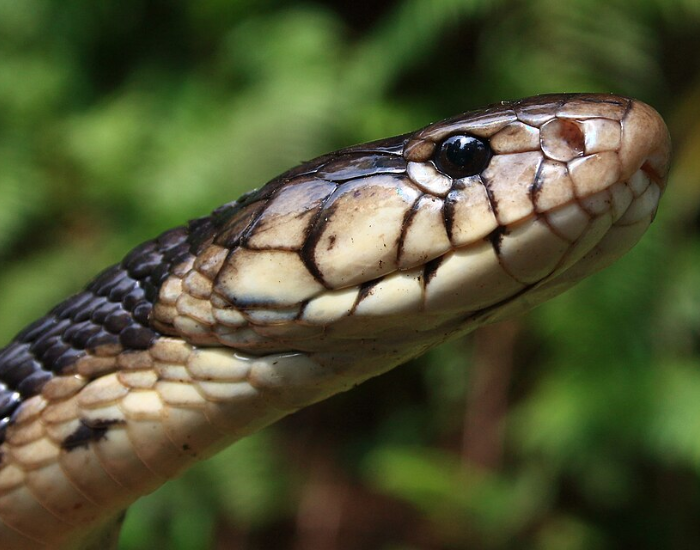
Science described the São Tomé cobra only in 2017. It lives on one small island in the Gulf of Guinea, and researchers had lumped it with the forest cobra for over a century. The IUCN now lists it as Endangered, and its entire world is roughly 850 square kilometres.
It hunts introduced black rats and weasels in forest and plantation. Conservation attention arrived late for this one.
One last naming note. Tree cobras of the genus Pseudohaje and the rinkhals are not true cobras at all. Both sit elsewhere in the Elapidae family. Common names mislead constantly, which is why scientific names earn their keep.
Snake Charming Is a Sad Con Game
Snake charmers do not hypnotise anything. Snakes hear low-frequency vibration but cannot follow a melody. The cobra tracks the moving pungi as a threat and holds its threat display until the lid closes.
The rest is worse. Many charmers pull fangs, sever venom glands, or sew the mouth shut, and the animal starves. What tourists photograph is usually an exhausted cobra running out of options.
India banned the practice under the Wildlife Protection Act, though it persists. Watch cobras in a licensed collection instead, like Smithsonian’s National Zoo or the San Diego Zoo.
Are Cobras Threatened Species?
Several venomous species now sit in trouble. The International Union for Conservation of Nature lists the king cobra as Vulnerable. Habitat destruction across South and Southeast Asia drives that assessment. Logging and farmland strip out the streamside forest and bamboo thickets that define this snake’s habitat.
King cobras carry CITES Appendix II protection, which regulates cross-border trade. Enforcement remains the weak link, and illegal wildlife trade still moves skins and live animals. Cobras also die in huge numbers as roadkill and in retaliatory killings.
Wild predators take their share. Raptors, larger snakes, and mongooses all hunt cobras. The mongoose wins through speed and thick fur, not through immunity to venom.
Cobras FAQ
Around 40 species carry the name cobra. The genus Naja, the true cobras, contains about 38 species, and the genus Ophiophagus holds four king cobras. Other snakes called cobras, such as tree cobras and the rinkhals, sit in separate genera within Elapidae.
A 2024 taxonomic revision recognised the northern king cobra (Ophiophagus hannah), the Sunda king cobra (O. bungarus), the Western Ghats king cobra (O. kaalinga), and the Luzon king cobra (O. salvatana). Before that paper, science treated all of them as a single species. Range and banding patterns separate them.
By venom toxicity, the Philippine cobra ranks highest, with a subcutaneous LD50 near 0.2 mg/kg. By total fatalities, the Indian cobra kills far more people, because it lives alongside dense rural populations. The king cobra delivers the largest volume, up to 420 mg per bite. Untreated, such a bite can kill within 30 minutes.
The Snake Behind the Reputation
Every cobra I have watched spent its energy trying to be left alone. That goes for the zoo animal and for the elapids I later handled in Australia. The hood is a billboard, and the message reads “go around.” A snake that wanted to hurt you would not warn you first.
Read up on the four king cobras before your next trip through South and Southeast Asia. Then look at what shares your own ground, starting with our guides to types of snakes and these snake facts. If you have stood in front of a wild cobra, tell me in the comments. I still want to see one on its own terms.
Can You Name That Cobra? 🐍
A 15-photo identification challenge — the wrong answers are deliberately tricky look-alikes from a similar group. Go back and change any answer before you score.
Which cobra is this?
References:
Ceríaco, L. M. P., Marques, M. P., Schmitz, A., & Bauer, A. M. (2017). The “Cobra-preta” of São Tomé Island, Gulf of Guinea, is a new species of Naja Laurenti, 1768 (Squamata: Elapidae). Zootaxa, 4324(1), 121–141. https://doi.org/10.11646/zootaxa.4324.1.7
Das, I., Gowri Shankar, P., Swamy, P., Williams, R. C., Lalremsanga, H. T., Prashanth, P., Sahoo, G., Vijayakumar, S. P., Höglund, J., Shanker, K., Dutta, S. K., Ganesh, S. R., & Wüster, W. (2024). Taxonomic revision of the king cobra Ophiophagus hannah (Cantor, 1836) species complex (Reptilia: Serpentes: Elapidae), with the description of two new species. European Journal of Taxonomy, 961, 1–51. https://doi.org/10.5852/ejt.2024.961.2681
Gowri Shankar, P., Swamy, P., Williams, R. C., Ganesh, S. R., Moss, M., Höglund, J., Das, I., Sahoo, G., Mohapatra, P. P., Vijayakumar, S. P., Shanker, K., Dutta, S. K., & Wüster, W. (2021). King or royal family? Testing for species boundaries in the King Cobra, Ophiophagus hannah (Cantor, 1836), using morphology and multilocus DNA analyses. Molecular Phylogenetics and Evolution, 165, 107300. https://doi.org/10.1016/j.ympev.2021.107300
Kazandjian, T. D., et al., (2021). Convergent evolution of pain-inducing defensive venom components in spitting cobras. Science, 371(6527), 386–390. https://doi.org/10.1126/science.abb9303
Panagides, N., et al., (2017). How the cobra got its flesh-eating venom: Cytotoxicity as a defensive innovation and its co-evolution with hooding, aposematic marking, and spitting. Toxins, 9(3), 103. https://doi.org/10.3390/toxins9030103
Westhoff, G., Boetig, M., Bleckmann, H., & Young, B. A. (2010). Target tracking during venom “spitting” by cobras. Journal of Experimental Biology, 213(11), 1797–1802. https://doi.org/10.1242/jeb.037135