Wildlife Nomads


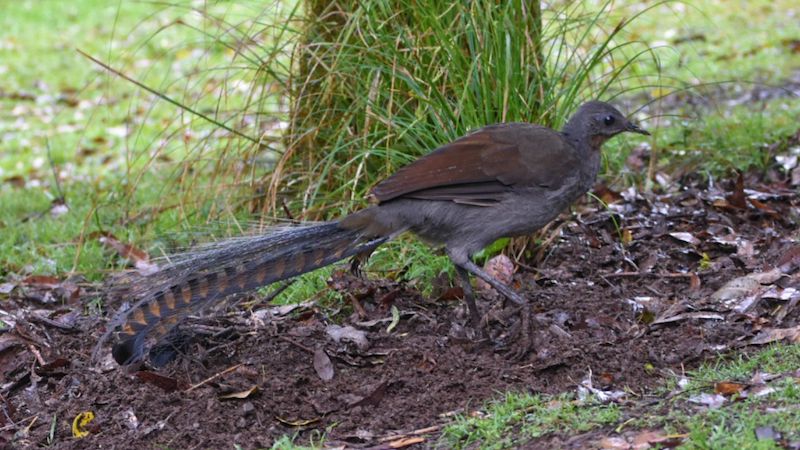
As a kid, I watched David Attenborough film a lyrebird copying camera shutters and chainsaws. I never forgot it. Years later, on our lap around Australia, I finally met one. It was at Gloucester River campground in Barrington Tops National Park.
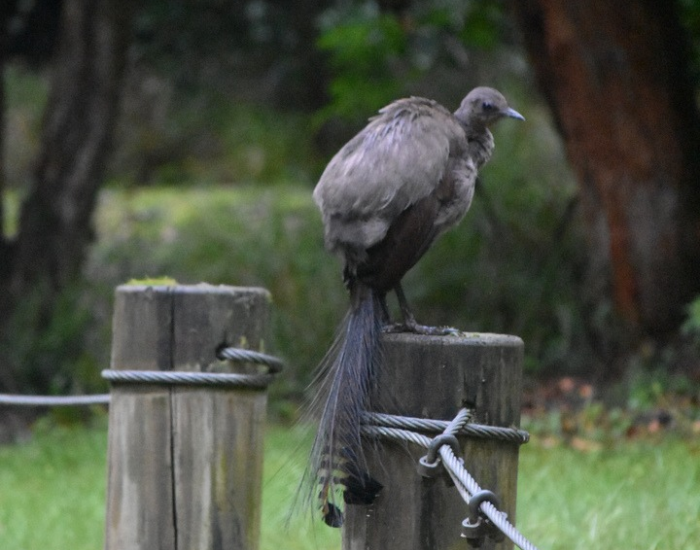
It perched on the fence in front of the toilets. Honestly, it felt like watching a dinosaur. We had already seen one on the drive in, a male chasing a female across the unsealed road. We thought that was our only chance.
Instead, we kept seeing more. One bird stayed on the ground near the toilet block, feeding almost all day. If you want to see this bird in New South Wales, that valley is the place.
That bird was a superb lyrebird, Menura novaehollandiae, and it sent me straight back to the science. Some of what I believed as a kid turned out to be half true. The rest was stranger than any documentary. Here are 12 lyrebird facts, from borrowed songs to the tonnes of soil one bird moves each year.
1. The Lyrebird Is One of the Largest Songbirds on Earth
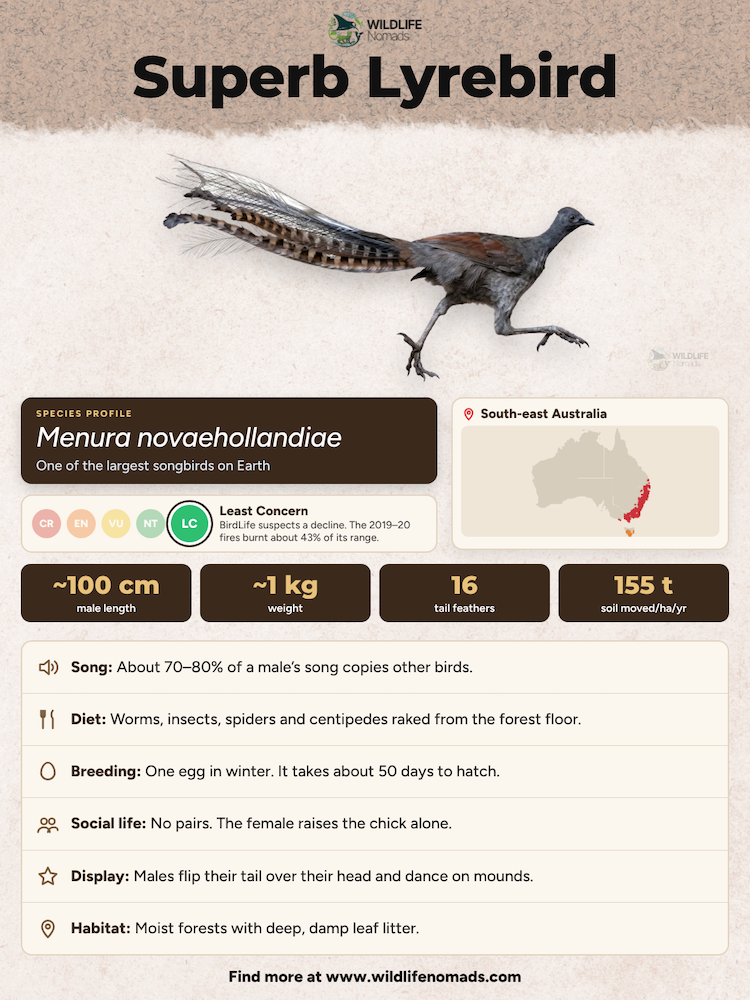
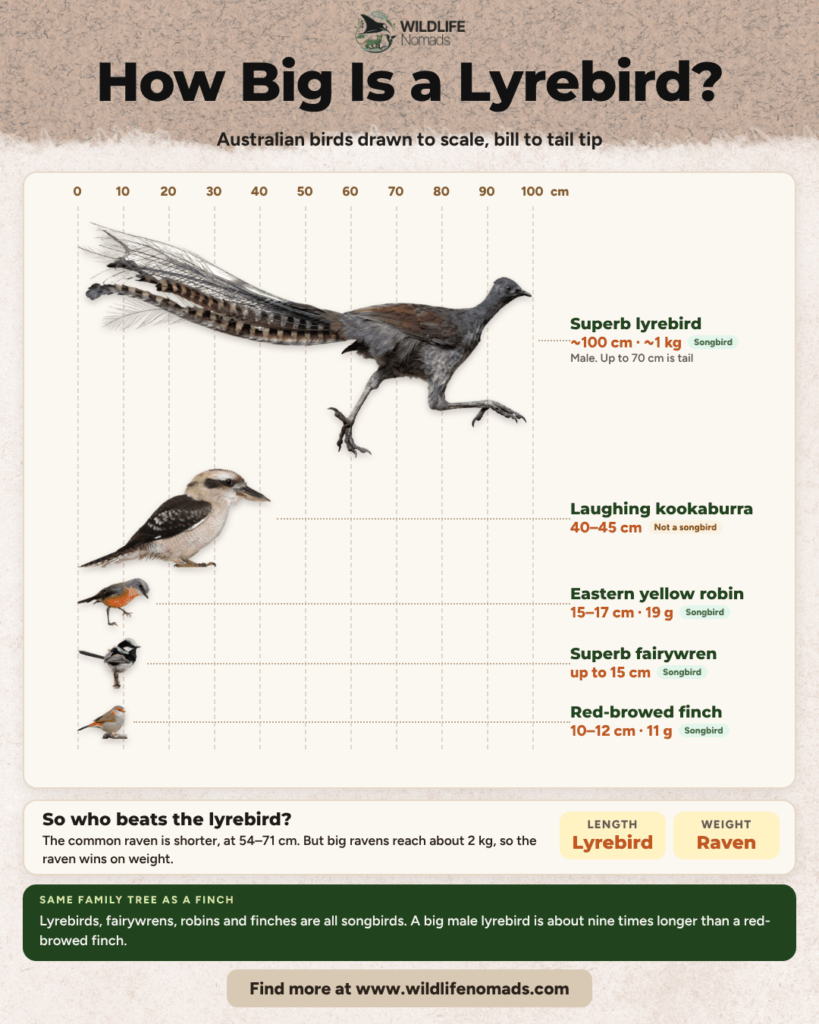
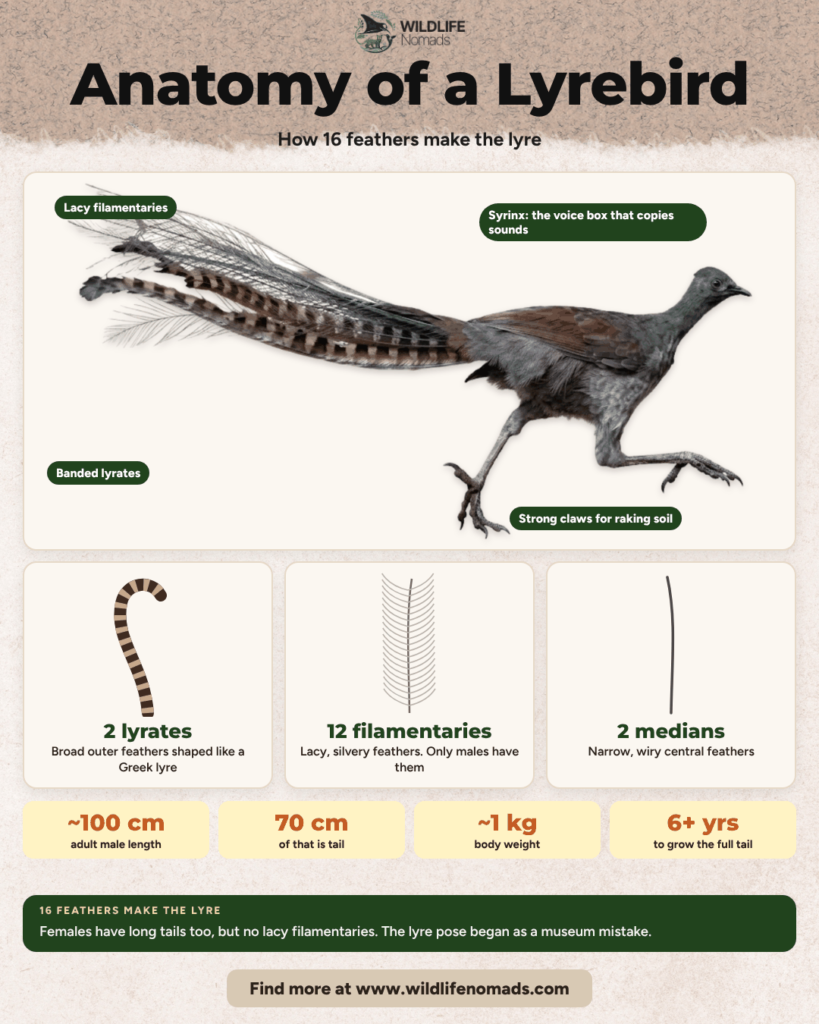
The superb lyrebird is a passerine, the same order as fairywrens and finches. Yet a big adult male reaches about 100 cm long, and up to 70 cm of that is tail. He weighs around 1 kg. Among songbirds, only the largest ravens compete with that bulk.
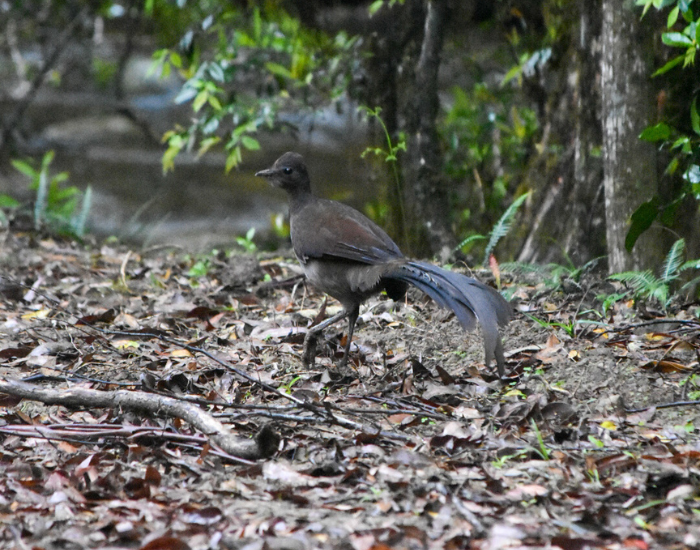
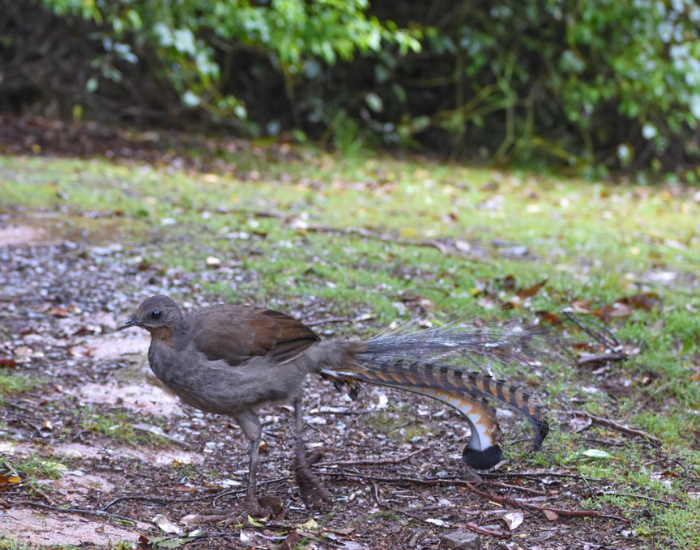
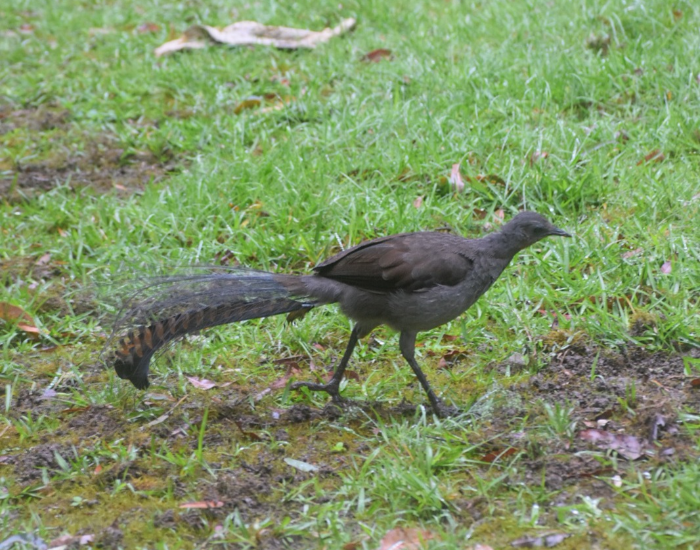
Up close, it looks more like a slim pheasant than a songbird. The upperparts are dark brown, the underparts greyish brown, and the wings carry a rusty tinge. Its legs are thick, and its long toes end in strong claws. Males and females look alike in body, so the tail is the giveaway.
Despite that size, lyrebirds rarely fly. They run, hop and glide downhill, usually only to escape danger. At dusk, they climb and flutter up into trees to roost high above the ground.
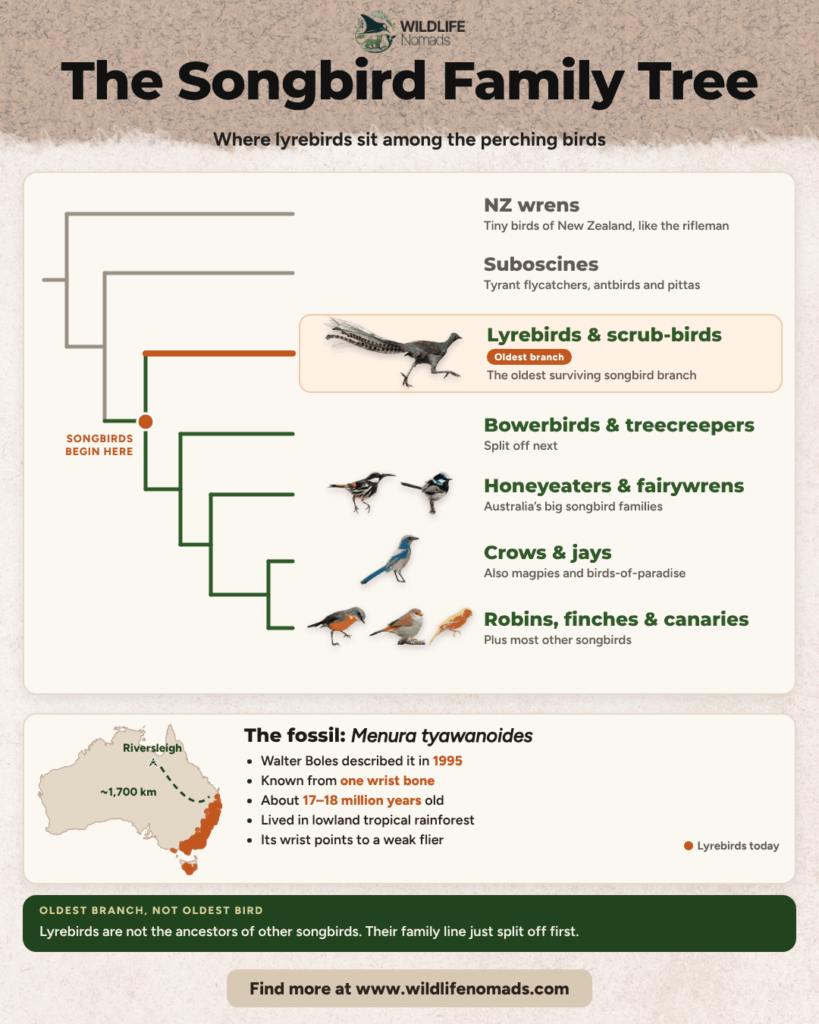
2. Lyrebirds Sit on the Oldest Branch of the Songbird Tree
That dinosaur feeling at Gloucester has real science behind it. Genetic studies place lyrebirds and their scrub-bird cousins on the oldest surviving branch of the songbird family tree. Every other living songbird, from crows to canaries, belongs to branches that split off later.
Fossils support that deep history. In 1995, Walter Boles described Menura tyawanoides from a single wrist bone found at Riversleigh, in north-western Queensland. The bone is roughly 17 to 18 million years old.
Back then, Riversleigh was lowland tropical rainforest, about 1,700 km north of today’s range. Its wrist bone suggests this smaller lyrebird was already a weak flier. In other words, the ground-dwelling lifestyle is ancient.
3. Most of Its Song Is Borrowed From Other Birds
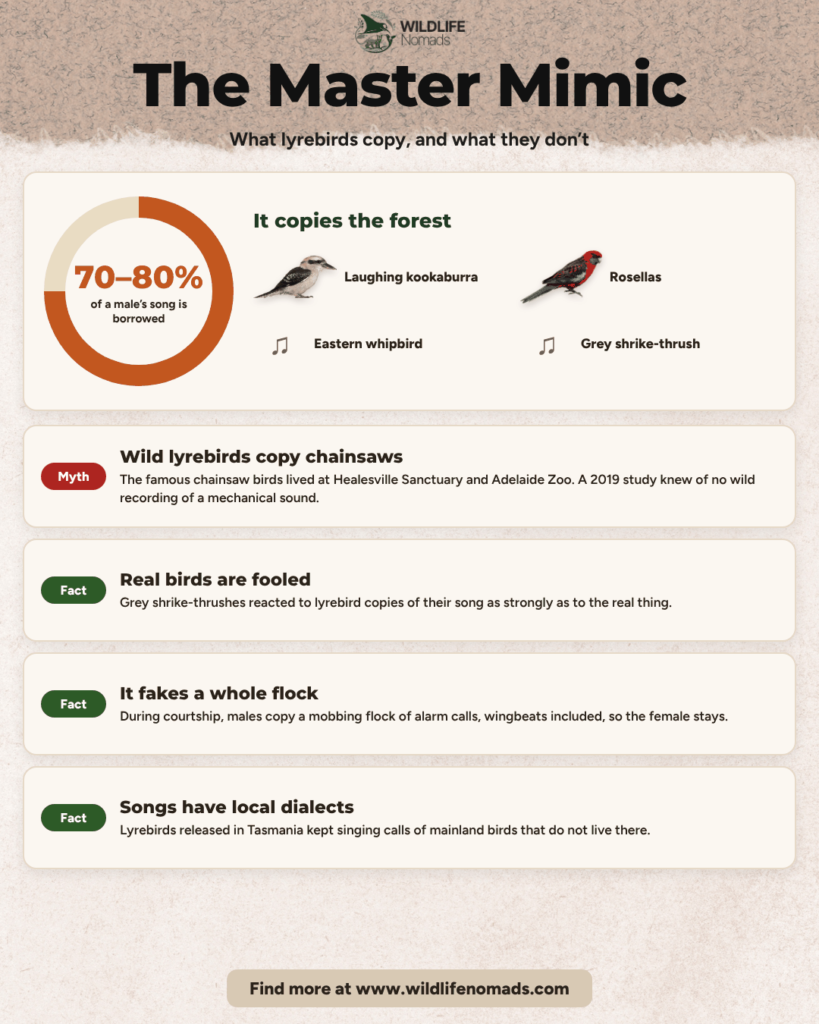
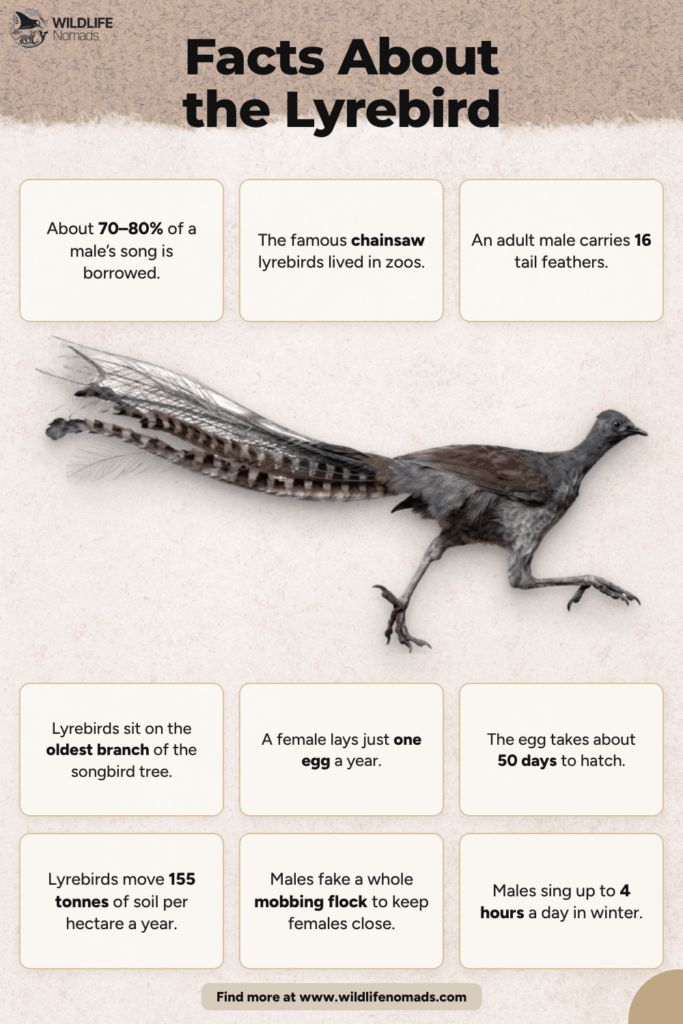
About 70 to 80 percent of a male’s song is mimicry. He strings together kookaburras, whipbirds, rosellas and many other species into one long medley. The sound comes from the syrinx, the vocal organ where the windpipe splits.
How accurate is it? Dalziell and Magrath played lyrebird copies of grey shrike-thrush song back to real shrike-thrushes. The shrike-thrushes reacted to the fakes as strongly as to their own song. That is expert mimicry by any measure.
Interestingly, the lyrebird also edits its sources. Males shortened the shrike-thrush songs by cutting repeated notes. As a result, they show off both accuracy and variety in less time. Females mimic too, mostly while foraging and defending their nests.
4. The Famous Chainsaw Lyrebird Was Not a Wild Bird
This is where my childhood memory needed correcting. In that famous Attenborough sequence, two of the three lyrebirds were captive birds. One lived at Healesville Sanctuary, the other at Adelaide Zoo.
The Adelaide bird, Chook, copied the noises of drills, hammers and saws he heard around the zoo. He died in 2011 at 32, an impressive lifespan for any bird. More recently, Echo at Taronga Zoo went viral for copying crying babies. He also copies the zoo’s evacuation alarm.
Wild birds are a different story. Many profiles still list chainsaws and car engines in the lyrebird’s repertoire. However, a 2019 study noted no known recording of a wild lyrebird making mechanical sounds. In theory, a lyrebird can copy almost any sound. In practice, wild males mostly copy the forest around them.
5. Lyrebird Songs Change From Valley to Valley
Lyrebirds learn their songs mainly from other lyrebirds. As a result, each area develops its own dialect. Males in one district share the same territorial song, and it barely shifts over decades.
Tasmania shows how stubborn those songs are. Between 1934 and 1949, people released 22 superb lyrebirds at Mount Field and Hastings. The released birds kept singing calls of mainland species that do not live in Tasmania. Two examples are the eastern whipbird and pilotbird.
Then there is the flute lyrebird legend of the New England Tableland. Supposedly, a chick raised in the 1920s learned flute tunes and spread them through the wild population. The flute-like dialect is real. Yet a 2020 sound analysis found the region’s song very stable. That makes a fast takeover by a new tune unlikely.
6. Sixteen Feathers Make the Lyre
The lyrebird’s tail gives the bird its name. An adult male carries 16 tail feathers. Two broad outer lyrates curve like the frame of a Greek lyre. Between them sit 12 lacy filamentaries and two narrow, wiry medians.
Females also have long tails, but they lack the lacy filamentaries. A young male needs years to earn the full set. He grows his first filamentary in about his fourth year at the earliest. The complete, spectacular tail takes at least six years.
Here is the funny part: the classic lyre pose began as a museum mistake. In the early 1800s, a London taxidermist mounted a specimen with its tail raised like a peacock. He had never seen a live bird. John Gould then painted it that way, and the image stuck.
7. Every Male Has a Stage and a Choreography
During the breeding season, each male scrapes several display mounds across his territory. Each display mound is a small circle of bare soil, his personal stage. When a female comes close, the male superb lyrebird steps onto the nearest one and sings.
At Gloucester, I watched the classic canopy dance. The male bird flipped his long, lacy tail forward, completely over his head. It formed a shimmering silver canopy.
The steps are not random. In a 2013 study, males matched four song types to four sets of moves, in a predictable order. One song sounds like a 1980s arcade game, and the male sidesteps with his tail spread like a veil. Like human dancers, they sometimes get the steps wrong.
Males also sing for up to four hours a day at the winter peak, from June to August. That is almost half the daylight. Similar to birds-of-paradise, male lyrebirds put everything into impressing potential mates.
8. Males Fake a Flock Under Attack
Here is my favourite discovery. In 2021, researchers found that males imitate a whole mobbing flock during courtship. A mobbing flock is a noisy group of small birds harassing a predator. The male copies several species’ alarm calls at once, and even the whirr of their wingbeats.
He only does this at two moments. The first is when a female tries to leave his mound before they mate. The second is during mating itself, in every copulation the team filmed. Playback tests showed the illusion was good enough to fool other birds.
The likely message is simple: it is dangerous out there, so stay. Scientists call this a sensory trap. In other words, not all of the lyrebird’s mimetic song is an honest advertisement. Some of it looks like deception.
9. One Egg, One Mother
Lyrebirds do not form pairs. A male mates with several females, then plays no part in raising young. Each female builds a bulky domed nest of sticks, moss and ferns, with a side entrance.
She lays a single egg in winter. Incubation takes about 50 days, a very long stretch for a songbird. She leaves the egg for hours each morning to feed, so it cools and develops slowly.
The chick then stays in the nest for about six weeks. Afterwards, it follows its mother for months. Females even defend their space from each other. In one recorded case, a female destroyed a neighbour’s nest. Females take six to seven years to reach maturity. That slow life history makes recovery after a disaster much harder.
10. It Moves 155 Tonnes of Forest Floor Every Year
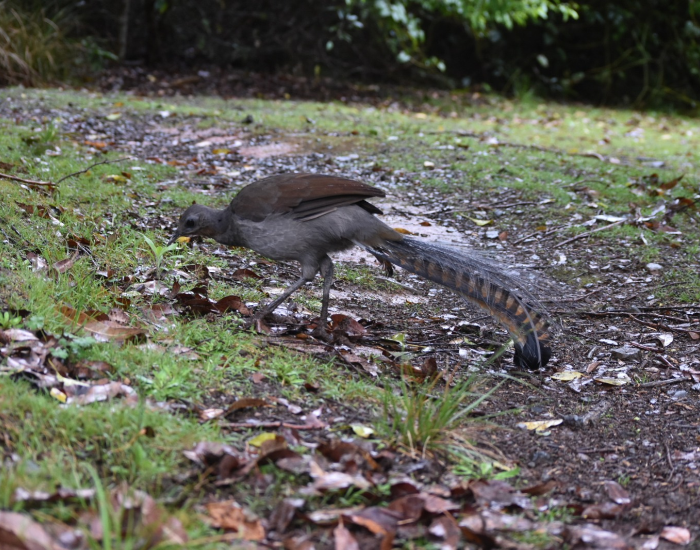
Lyrebirds are ground-dwellers that spend their days scratching through leaf litter and soil. Their strong claws uncover worms, insects, spiders and centipedes. At Gloucester, I watched one bird rake beside the camp toilets almost all day.
Maisey and colleagues measured that raking in Victoria’s Central Highlands. On average, lyrebirds displaced about 155 tonnes of litter and soil per hectare in one year. Moles and gophers manage around 10 to 20 tonnes. No other land vertebrate engineer comes close.
When the team fenced lyrebirds out, litter became almost three times deeper. Soil compaction also rose by 37 percent. That buried litter matters for fire, because a raked forest floor holds less dry fuel. Like the beaver, the lyrebird reshapes its whole ecosystem.
11. Lyrebirds Farm Their Own Food
A 2025 experiment took this further. The researchers fenced lyrebirds out of small plots, then raked some plots by hand to mimic foraging. Raked plots held more types of invertebrates, and larger ones.
In effect, lyrebirds farm their own food. Their raking creates microhabitats where prey becomes more varied and larger before the birds return. That kind of farming is rare among wild animals. Moreover, the raking goes on year-round, in every forest type the team studied.
It also changes how I picture a food web. The lyrebird is not just a predator at the top of the litter. It builds the conditions its prey needs, then harvests the results.
12. Fire, Foxes and the Rarer Albert’s Lyrebird
The IUCN lists the superb lyrebird as Least Concern, but BirdLife suspects a decline. Habitat loss and introduced predators such as foxes and cats drive it. Then the 2019 to 2020 Black Summer fires burnt about 43 percent of the species’ range.
The damage hit nesting habitat hardest. In the Greater Blue Mountains, over 74 percent of lyrebird nesting habitat burned. In Victoria, lyrebirds were largely missing from severely burnt forest one year later. Some researchers now argue the species faces more risk than its listing suggests.
Australia also has a second species, Albert’s lyrebird, Menura alberti. It lives only in a small patch of subtropical rainforest on the Queensland and New South Wales border. These ranges sit behind the Gold Coast, where I live. A male Albert’s lyrebird is smaller and redder, with a less ornate tail.
The IUCN moved Albert’s lyrebird to Least Concern in 2022, with up to about 8,100 mature birds. However, Queensland lists it as Near Threatened and New South Wales as Vulnerable. Fragmented forest also strips variety from its songs, a loss of culture alongside numbers.
FAQs About the Lyrebird
A lyrebird is a large, ground-dwelling Australian songbird famous for its mimicry and the male’s ornate tail. There are two living species: the superb lyrebird and Albert’s lyrebird. Both belong to the family Menuridae, one of the oldest songbird lineages alive.
Captive lyrebirds can. The famous chainsaw and camera shutter clips came from birds at Healesville Sanctuary and Adelaide Zoo. Wild lyrebirds mostly copy other forest birds, and researchers know of no recording of a wild bird making mechanical sounds.
Superb lyrebirds live in moist forests of south-eastern Australia, from south-east Queensland through New South Wales to Victoria. People also introduced them to Tasmania between 1934 and 1949. They need a deep, damp layer of leaf litter to forage in.
No. The IUCN lists both species as Least Concern. However, the 2019 to 2020 fires burnt about 43 percent of the superb lyrebird’s range. Albert’s lyrebird is listed as Near Threatened in Queensland and Vulnerable in New South Wales.
The name comes from the male’s tail. Its two broad outer feathers curve like the frame of a lyre, an ancient Greek stringed instrument. The full tail has 16 feathers, including 12 lacy filamentaries.
Yes, but they rarely fly far. Lyrebirds mostly run, hop and glide downhill to escape danger. At night they climb and flutter into tall trees to roost safely off the ground.
Lyrebirds eat invertebrates from the forest floor, such as worms, insects, spiders and centipedes. They rake through leaf litter and soil with their strong claws to find them. That raking moves about 155 tonnes of material per hectare each year.
Listen Before You Look
The lyrebird is far more than a mimic. It is an ancient songbird, a dancer, a con artist and a forest engineer in one brown body. Without it, south-eastern forests would hold deeper litter, hotter fires and fewer invertebrates.
If you want to see one, visit a wet forest on the south-east coast in winter and listen first. A kookaburra and a whipbird calling from the same thicket might be one lyrebird. Gloucester River was my lucky spot, but many of the best NSW national parks hold them too.
Have you heard a lyrebird copy something strange? Tell me in the comments. Then explore more Australian birds, or follow our lap for the next stop.
References:
Dalziell, A. H., & Magrath, R. D. (2012). Fooling the experts: Accurate vocal mimicry in the song of the superb lyrebird, Menura novaehollandiae. Animal Behaviour, 83(6), 1401–1410. https://doi.org/10.1016/j.anbehav.2012.03.009
Dalziell, A. H., Peters, R. A., Cockburn, A., Dorland, A. D., Maisey, A. C., & Magrath, R. D. (2013). Dance choreography is coordinated with song repertoire in a complex avian display. Current Biology, 23(12), 1132–1135. https://doi.org/10.1016/j.cub.2013.05.018
Dalziell, A. H., Maisey, A. C., Magrath, R. D., & Welbergen, J. A. (2021). Male lyrebirds create a complex acoustic illusion of a mobbing flock during courtship and copulation. Current Biology, 31(9), 1970–1976.e4. https://doi.org/10.1016/j.cub.2021.02.003
Hughes, E. J., Austin, V. I., Backhouse, F., Maisey, A. C., Lopez, K. A., Mikles, C. S., Odom, K. J., Welbergen, J. A., & Dalziell, A. H. (2023). Preferred nesting habitat of the slow-breeding Superb Lyrebird is rare and was disproportionately impacted by Australia’s “Black Summer” megafires (2019–2020) within a World Heritage Area. Ornithological Applications, 125(4), duad027. https://doi.org/10.1093/ornithapp/duad027
Maisey, A. C., Collins, L., Newell, G., & Bennett, A. F. (2023). Effects of a megafire vary with fire severity and forest type: The impact of Australia’s ‘Black Summer’ fires on the superb lyrebird (Menura novaehollandiae), an iconic forest species. Biological Conservation, 288, 110356. https://doi.org/10.1016/j.biocon.2023.110356
Maisey, A. C., Haslem, A., & Bennett, A. F. (2025). Foraging activity by an ecosystem engineer, the superb lyrebird, ‘farms’ its invertebrate prey. Journal of Animal Ecology, 94(5), 848–862. https://doi.org/10.1111/1365-2656.70009
Maisey, A. C., Haslem, A., Leonard, S. W. J., & Bennett, A. F. (2021). Foraging by an avian ecosystem engineer extensively modifies the litter and soil layer in forest ecosystems. Ecological Applications, 31(1), e02219. https://doi.org/10.1002/eap.2219