Of everything I miss about the Americas, the hummingbird sits near the top of the list. I was born in Oaxaca and spent 26 of my 32 years in Mexico. Now I live in Australia, a continent with no hummingbirds at all.
Even in Mexico City they found me. I lived in the Condesa for just three months, yet I spotted them in the trees near my place. Parque España and the leafy streets of La Roma had their regulars too.
They followed me on my travels as well, from misty Oaxacan mountains to the waterfalls of La Huasteca Potosina. Those tiny visitors pushed me to read the science behind them. The research turned out to be even stranger than the sightings.
So here are 12 facts about hummingbirds that still amaze me as a biologist. You’ll meet record-breaking hearts, tongues that trap nectar and Aztec warriors reborn as birds. Each fact draws on recent research, plus a few of my own field memories.
1. Hummingbirds Live Only in the Americas
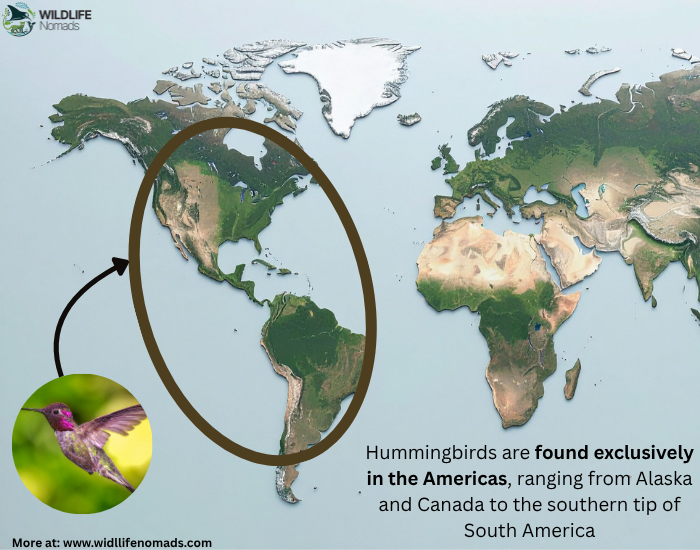
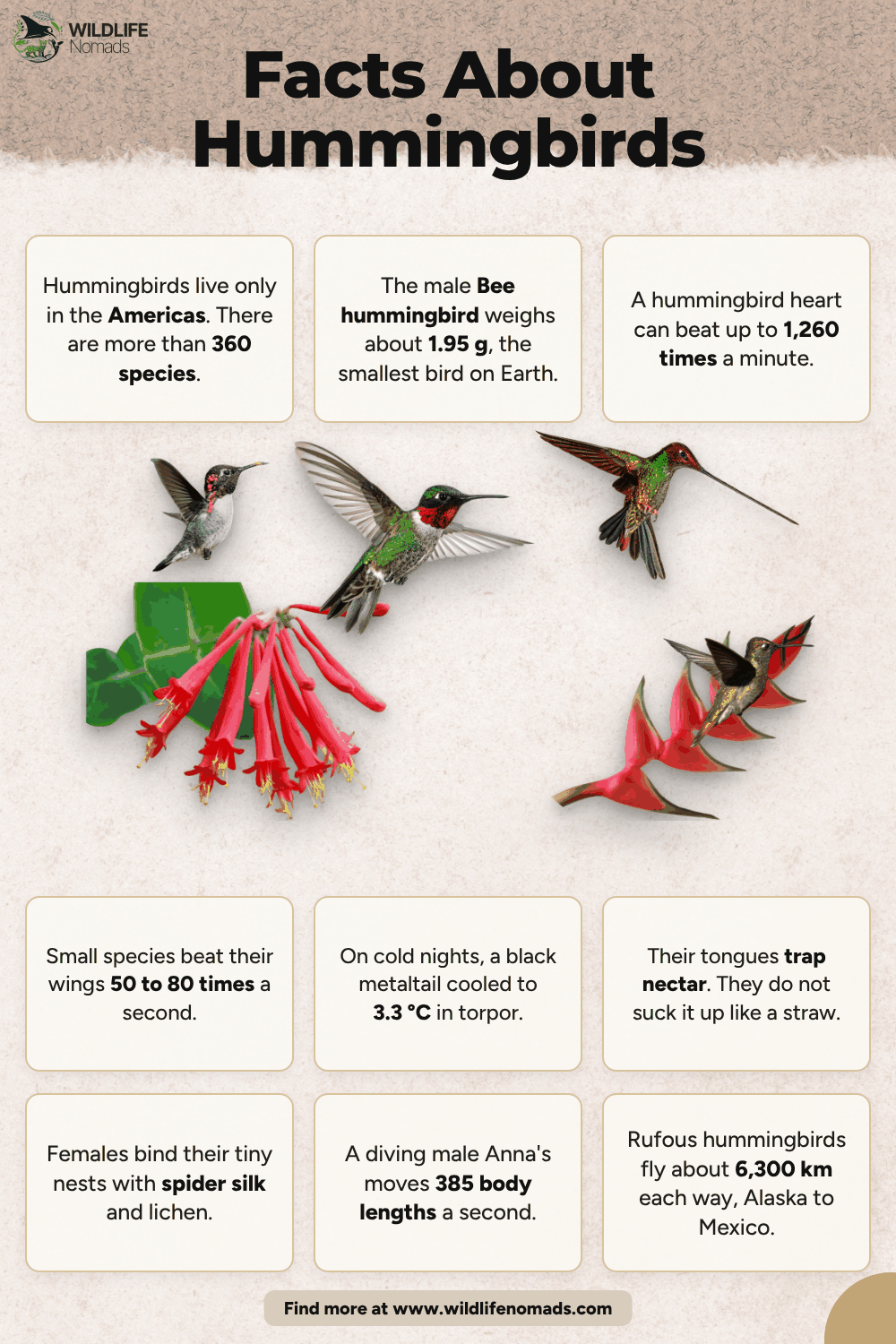
All 360-plus species in the hummingbird family (Trochilidae) live in the western hemisphere. You can find them from Alaska to Tierra del Fuego, and across the Caribbean islands. No wild hummingbird lives in Europe, Africa, Asia or Australia today. Most species live in Central and South America.
Diversity peaks near the equator, where the Andes create endless mountain niches. Colombia alone has about 165 species, more than any other country. Ecuador and Peru follow close behind.
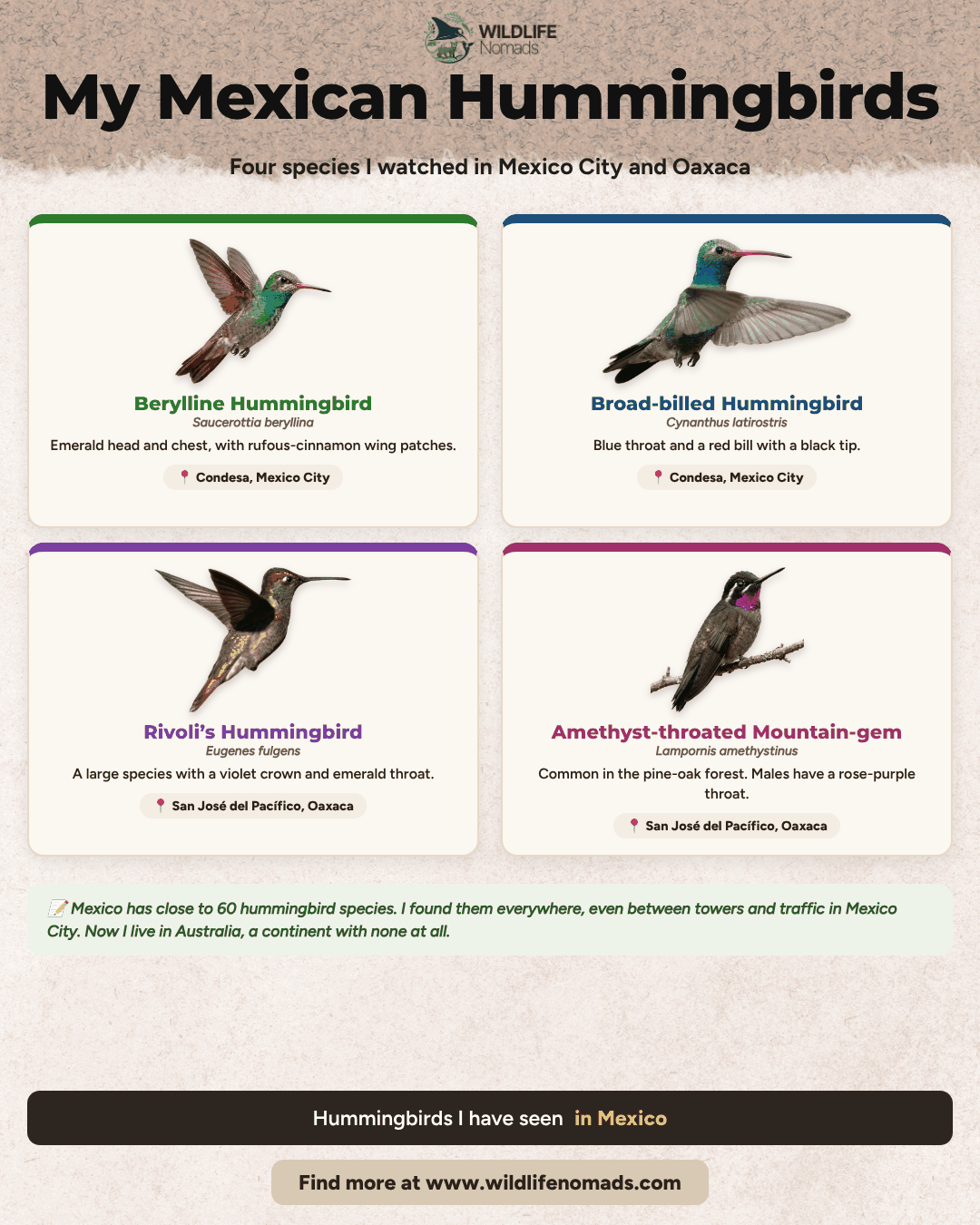
Mexico has close to 60 species, and many of them thrive in cities. In the Condesa I mostly saw the berylline hummingbird (Saucerottia beryllina). Its emerald head and chest contrast with rufous-cinnamon wing patches. The broad-billed hummingbird (Cynanthus latirostris) showed up too, flashing a blue throat and a red, black-tipped bill. Both rank among the easiest garden birds of Mexico to spot.
Here’s the twist. In 2004, Gerald Mayr described 30-million-year-old hummingbird fossils from Germany, named Eurotrochilus inexpectatus. Hummingbirds once fed in Europe, then vanished from the Old World. Meanwhile, Australian honeyeaters evolved into nectar specialists on their own, a neat convergent example. To meet individual birds, my guide to the species of hummingbirds covers 12 of them.
2. The Bee Hummingbird Is the Smallest Bird on Earth
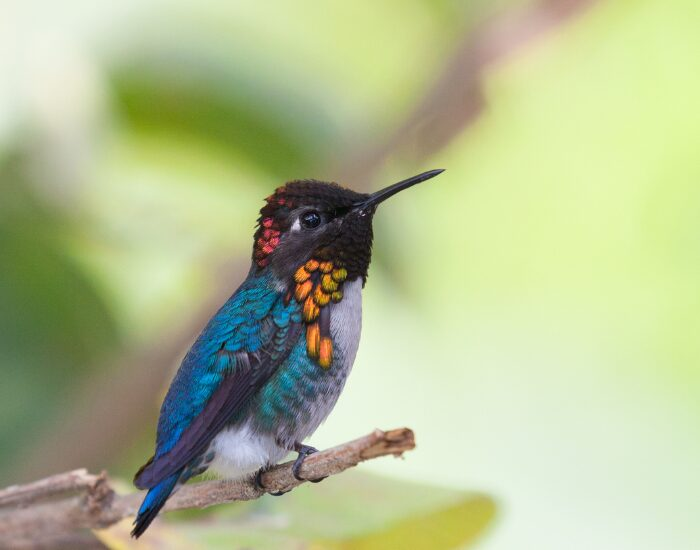
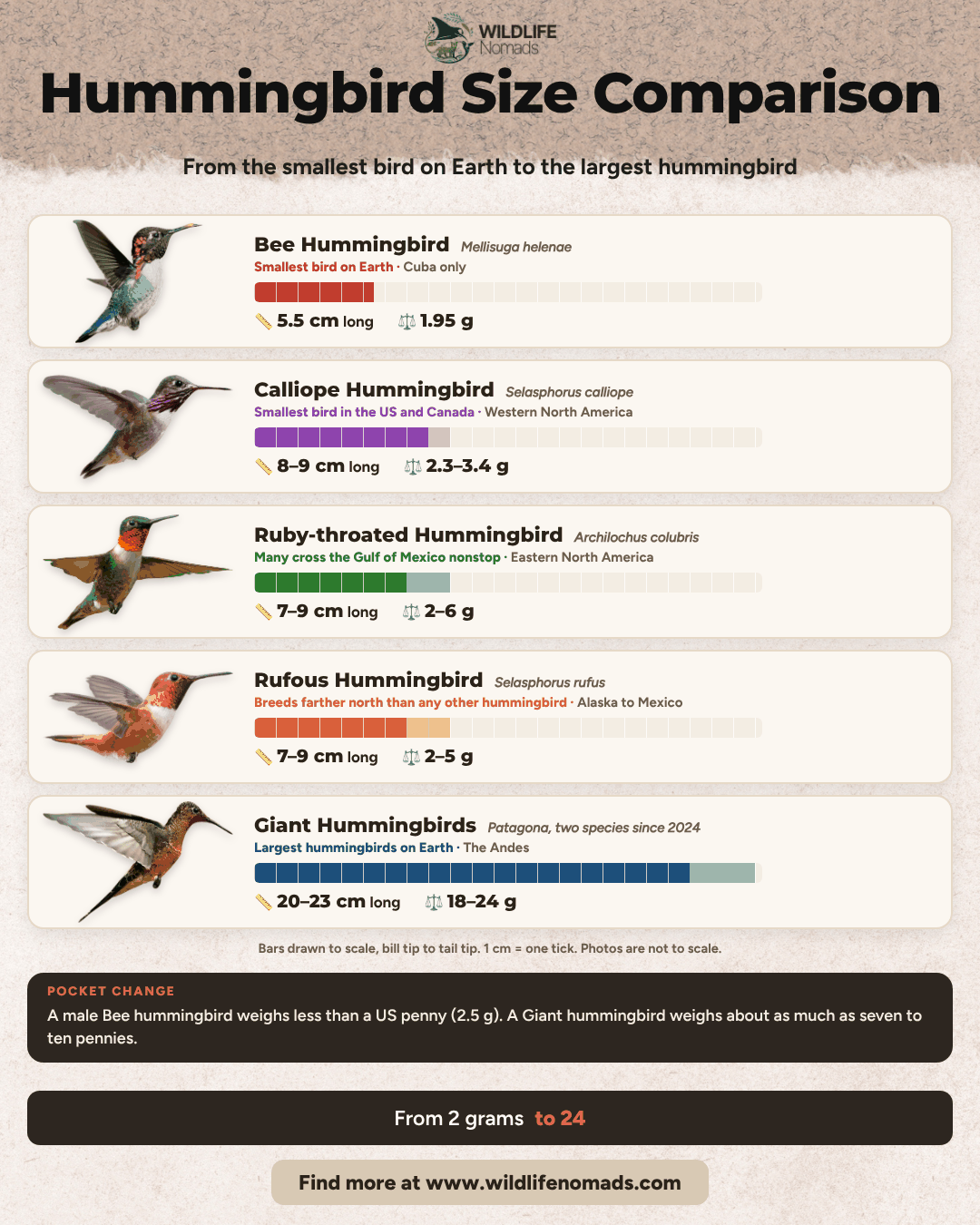
The bee hummingbird (Mellisuga helenae) lives only in Cuba. Males weigh about 1.95 grams and measure roughly 5.5 centimetres from bill to tail. Most hummingbird species weigh between 3 and 7 grams, so that is tiny even for the family. North of Mexico, the calliope hummingbird (Selasphorus calliope) is the smallest bird, at under 3.5 grams. That makes it the smallest bird on the planet. Since birds are living dinosaurs, it is also the smallest dinosaur alive.
Sadly, the IUCN lists the bee hummingbird as Near Threatened. Forest clearing for farms and towns keeps shrinking its range.
At the other extreme, the giant hummingbird of the Andes weighs around 20 grams. In 2024, Jessie Williamson and colleagues showed it is actually two species. They named the resident northern bird Patagona chaski. The southern form, Patagona gigas, migrates from the Chilean coast high into the Andes and back. Even so, the giant weighs a little less than a house sparrow.
3. Hovering Is a Hummingbird Superpower
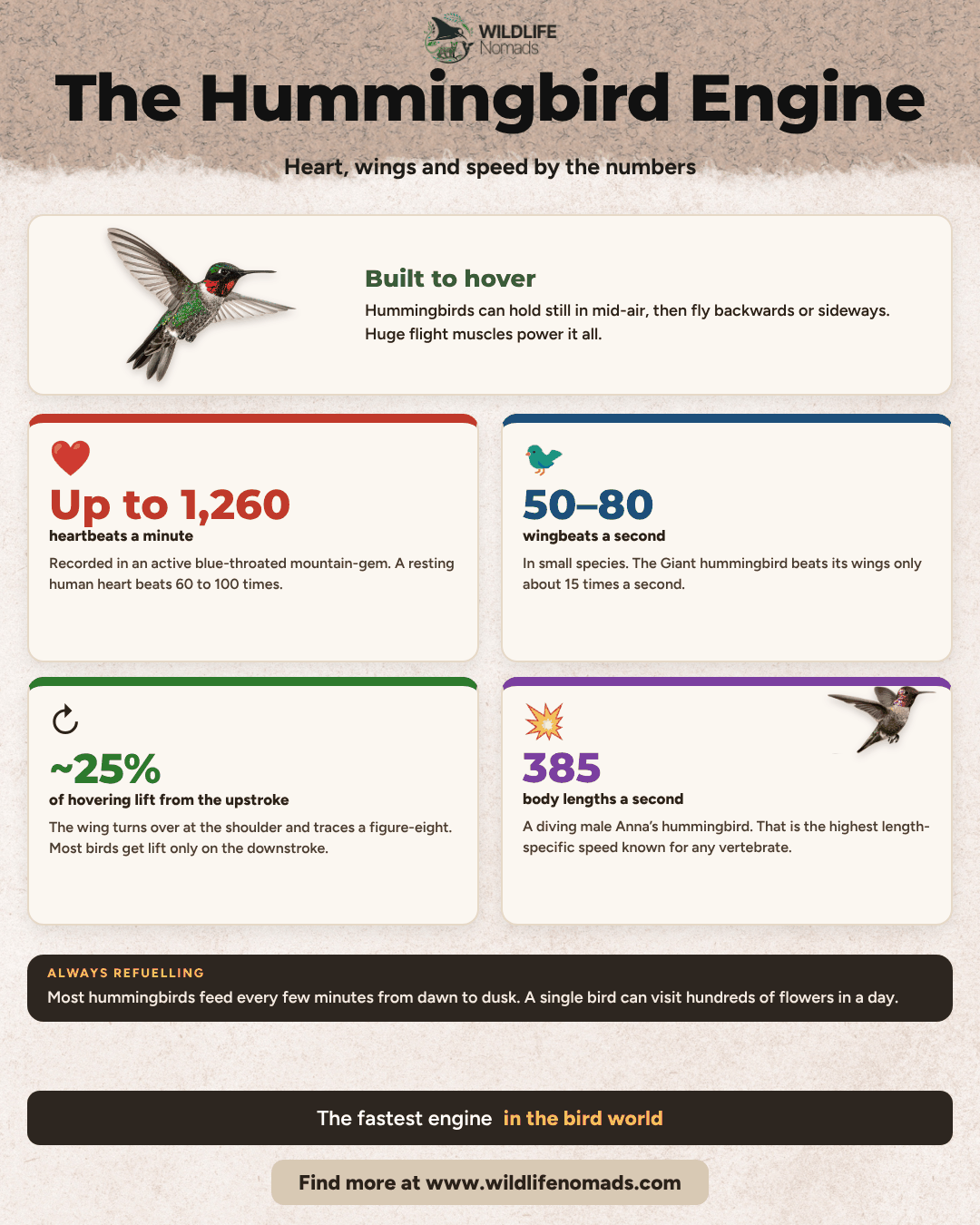
Most small birds can hover for a second or two. Hummingbirds can hold still in mid-air for long stretches, then fly backwards or sideways. Their secret sits in the shoulder joint, which lets the wing rotate almost flat.
As a result, each wing traces a figure-eight through the air. Unlike most birds, they generate lift on the upstroke as well as the downstroke. Roughly a quarter of their hovering lift comes from that upstroke.
Wingbeat speed varies with size. Small species flap up to about 80 times per second, while the giant hummingbird manages about 15. Huge flight muscles power the whole show. That engine also puts them among the fastest birds for their size, as you’ll see in fact 10.
4. A Heart That Beats More Than 1,200 Times a Minute
Hovering burns enormous amounts of energy. For that reason, hummingbirds run one of the highest metabolic rates of any animal. Their hearts can beat more than 1,200 times a minute during activity. The record, about 1,260 beats, came from a blue-throated hummingbird. By comparison, a resting human heart beats about 60 to 100 times.
To keep that engine running, they sip nectar from flowers constantly. In lab studies, small hummingbirds passed water equal to 75 to 85% of their body weight each day. That shows how much nectar they process. Most hummingbirds feed every few minutes from dawn to dusk. A single bird can visit hundreds of flowers in a day.
This lifestyle leaves very little margin. A hummingbird carries tiny fuel reserves, so a cold, foodless night becomes a real threat. Their solution is one of the strangest tricks in the bird world.
5. They Switch Off at Night to Survive the Cold
Whenever I visited Oaxaca, I split my time between the coast and the mountains. Puerto Escondido gave me the beach. San José del Pacífico, which I visited at least five times, gave me the hummingbirds. I would wake to a misty mountain view with hummingbirds zipping past, like a scene from a movie.
Up there I watched Rivoli’s hummingbird (Eugenes fulgens), an impressive large species with a violet crown and emerald throat. The amethyst-throated mountain-gem (Lampornis amethystinus) was common in the pine-oak forest too.
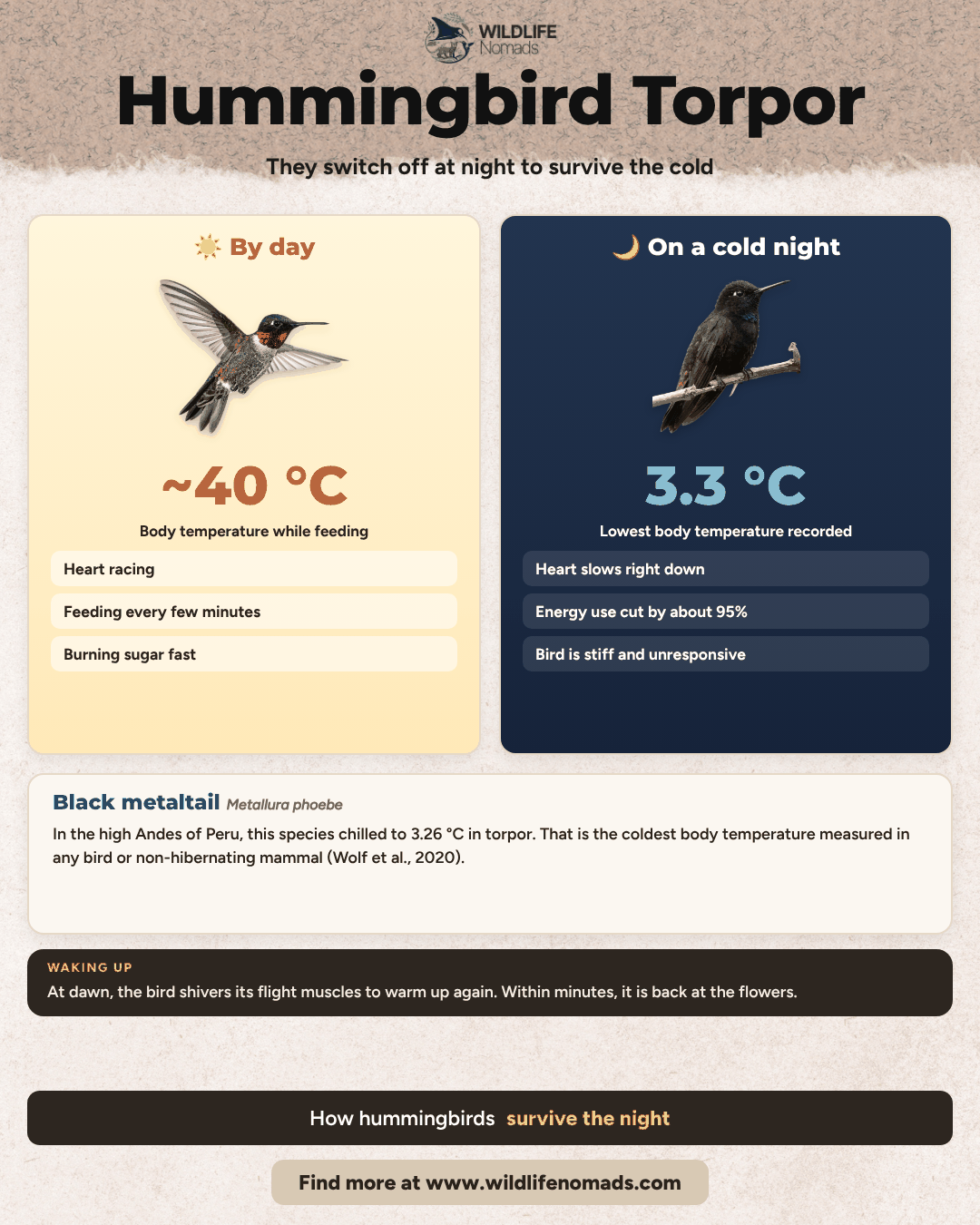
Mountain nights get cold, and smaller hummingbird species lose heat fast. So hummingbirds enter torpor, a deep energy-saving shutdown. In the Peruvian Andes, Blair Wolf’s team recorded a black metaltail cooling to 3.3 °C. That is the lowest body temperature ever measured in a bird or non-hibernating mammal.
During torpor, heart rates crash and energy use can drop by as much as 95%. At sunrise the birds shiver their flight muscles to warm up. Within minutes, they are back at the flowers.
6. Their Tongues Trap Nectar Instead of Sucking It
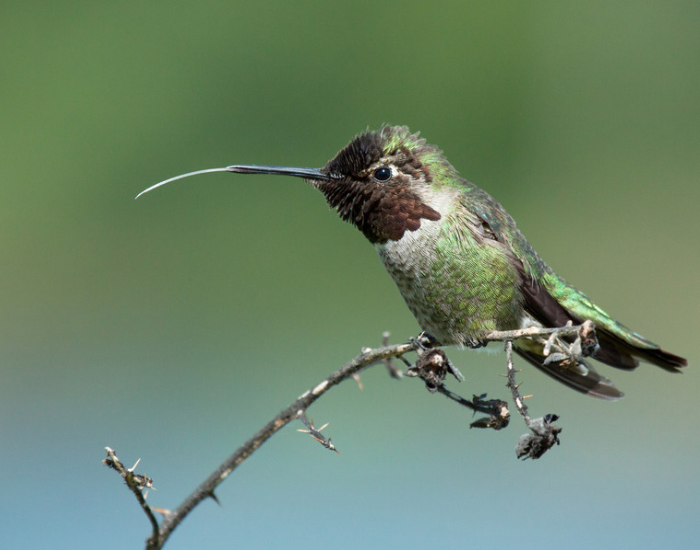
For almost two centuries, scientists assumed hummingbird tongues worked like tiny drinking straws. In 2011, Alejandro Rico-Guevara and Margaret Rubega filmed tongues inside see-through artificial flowers. Their footage showed the forked tips unfurl in the nectar, then curl shut to trap it.
The tongue flicks in and out up to about 20 times per second. Because the tip changes shape on its own, loading it costs the bird almost no energy. Engineers now study this design for tiny fluid-handling devices.
7. Hummingbirds Pollinate Thousands of Plants
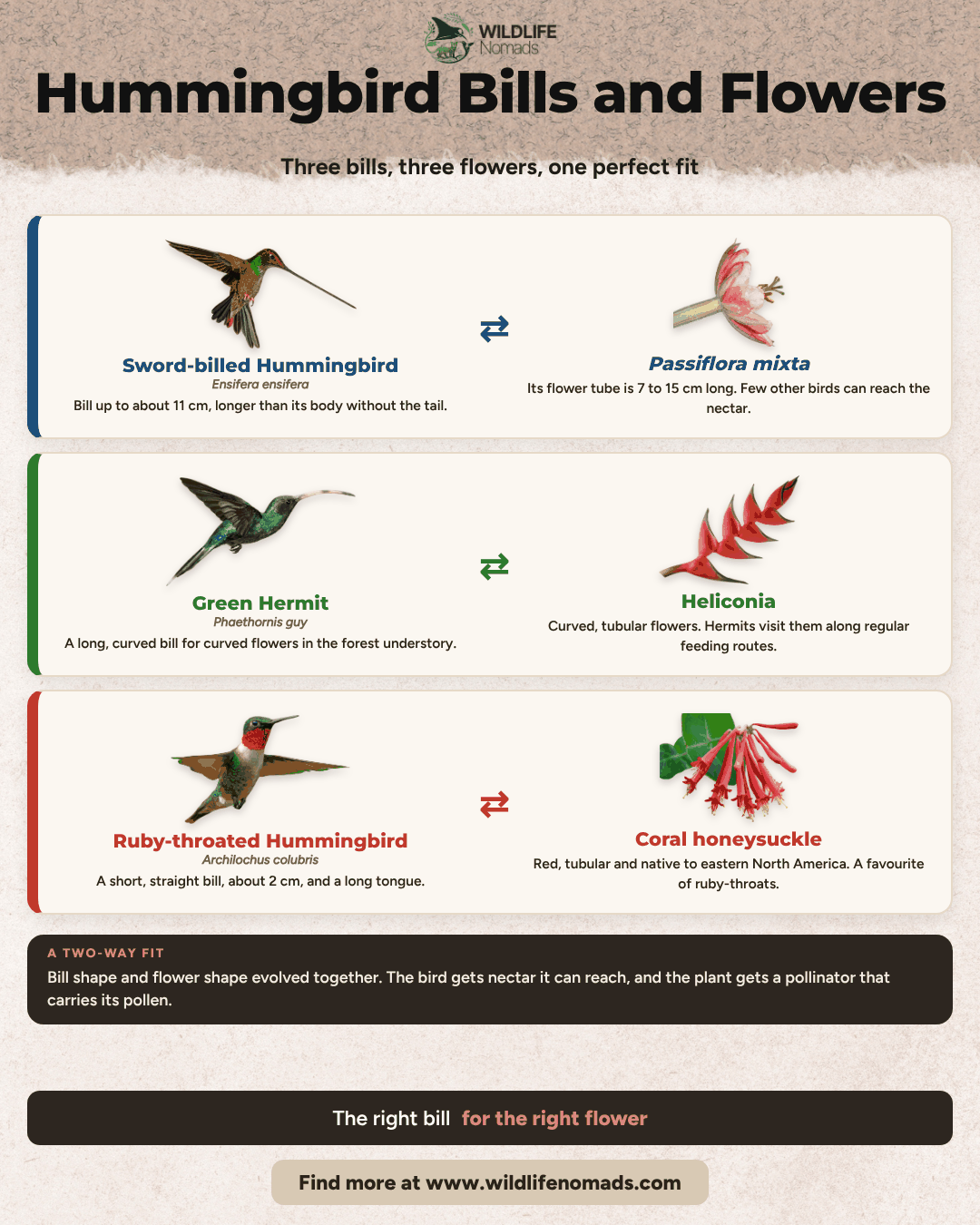
Around 7,000 plant species across the Americas rely on hummingbirds for pollination. Many of these hummingbird flowers are red or orange, tubular and almost scentless. Most bees see red poorly, so a red tube keeps its nectar for birds. Alongside bats and moths, hummingbirds rank among the key pollinators of the New World.
Still, hummingbirds don’t love red by instinct. They learn which colours pay off, and they see far more colours than we do. In 2020, Mary Caswell Stoddard’s team showed wild broad-tailed hummingbirds telling apart nonspectral colours such as ultraviolet+green. To us, those lights looked identical.
In 2023 I explored La Huasteca Potosina with two friends visiting from Belgium. We wandered Las Pozas, Edward James’ surreal garden in Xilitla, then chased the nearby waterfalls. Hummingbirds worked the flowers everywhere. I’m pretty sure one was a wedge-tailed sabrewing (Pampa curvipennis), a big green hummer with a thick, curved bill.
Want to attract hummingbirds at home? Plant native nectar flowers first, as part of a wildlife-friendly garden. In eastern North America, coral honeysuckle and bee balm both work well. Native coral honeysuckle also beats Japanese honeysuckle, an invasive species in many states. Like other invasive plants, it smothers the natives that hummingbirds rely on. Hummingbird feeders help too, filled with one part white sugar to four parts water. If more than one hummingbird fights over a single feeder, hang a second one out of sight.
8. Nectar Is Only Half the Menu
Flower nectar gives hummingbirds sugar, but very little protein. For that, they hunt small flying insects, aphids and gnats, often snatching them mid-air. During the breeding season, females feed young hummingbirds a protein-rich mash of tiny insects. In most species, the male takes no part in nesting or chick care.
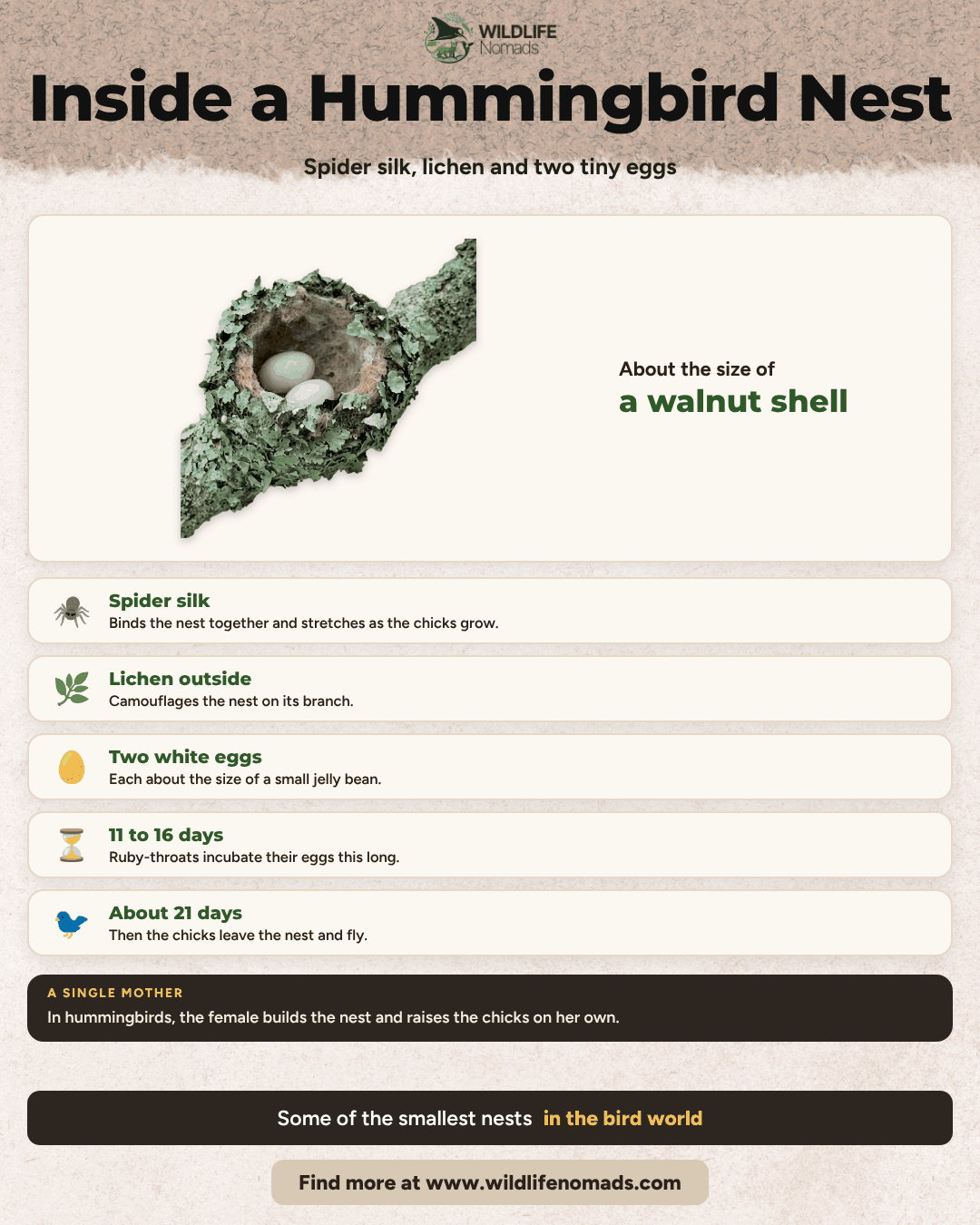
They also raid spiders and their webs, stealing trapped insects and the silk itself. That silk matters. A female binds her nest, roughly the size of a walnut shell, with spider webs and decorates it with lichen. The silk stretches as the chicks grow. She usually lays two white eggs, each about the size of a small jelly bean.
In the food web, hummingbirds play both roles. They eat insects, yet hawks, snakes, frogs and even praying mantises eat them. In North America, mantises often ambush them at garden feeders and flowers.
9. Their Shimmer Comes From Structure, Not Pigment
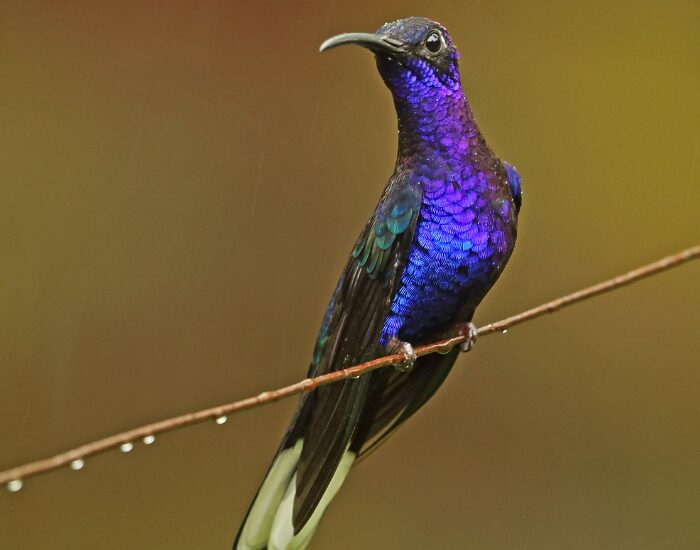
A male’s throat patch, called a gorget, can flash ruby one moment and look black the next. That colour doesn’t come from pigment. Instead, feather barbules hold stacks of melanin platelets filled with tiny air bubbles. Light reflects off these thin layers and interferes, boosting certain colours at certain angles.
So the gorget only blazes when the bird faces you, or the sun, at the right angle. Male hummingbirds use that flash to attract females and to warn rival males. They also chase off other hummingbirds, and even larger birds like hawks. Female hummingbirds usually wear duller greens and greys that hide them on the nest. As a result, male and female hummingbirds of the same species often look very different. A female ruby-throated hummingbird, for example, has a plain whitish throat instead of a red gorget.
10. Male Hummingbirds Sing With Their Tails
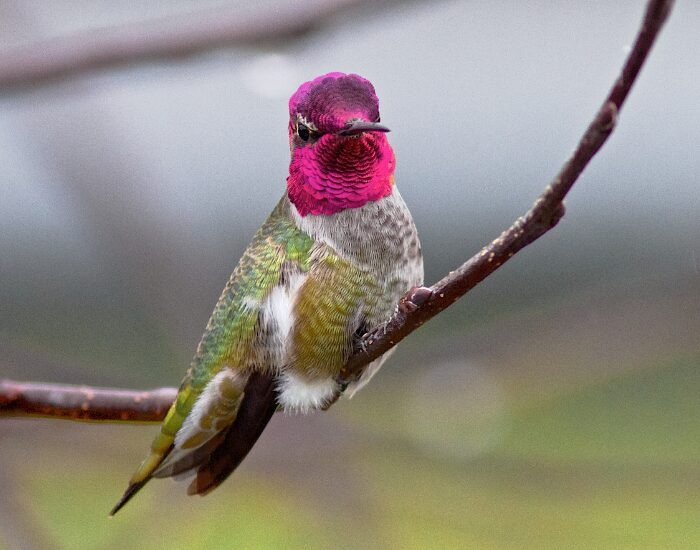
Male Anna’s hummingbirds (Calypte anna) climb up to about 30 metres, then plunge past a watching female. Christopher Clark clocked their dives at around 27 metres per second. That equals 385 body lengths per second, the highest length-specific speed known for any vertebrate.
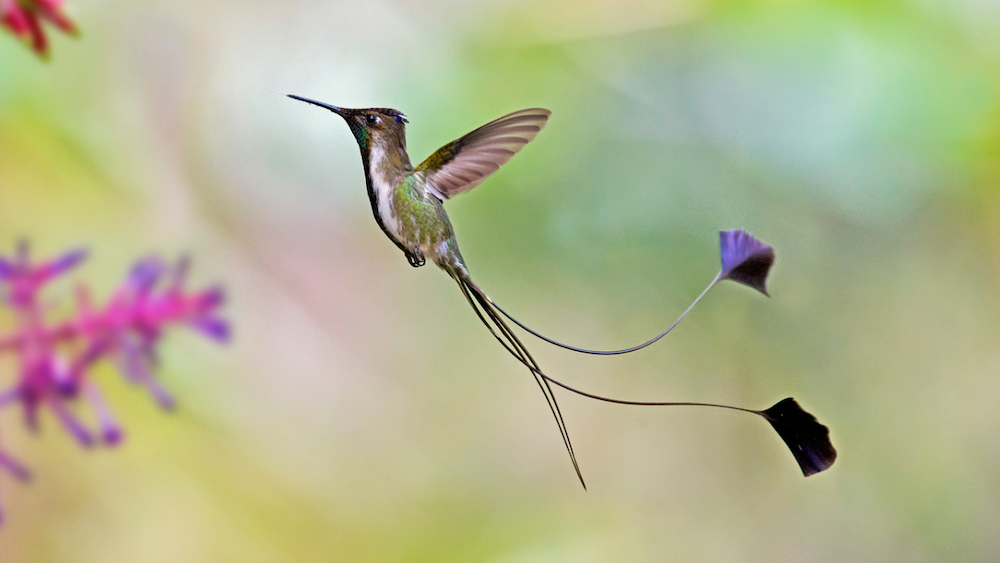
At the bottom of the dive, the male spreads his tail. Air rushing through the outer tail feathers makes them vibrate and produce a loud chirp. In other words, he sings with his feathers, and these courtship dives get louder as they get faster. Other species have their own displays. Costa’s hummingbird, a bird of desert and coastal sage scrub, performs swooping dives too.
A few species remain year-round in the United States, and Anna’s is the best known. It stays along the Pacific coast, now as far north as Canada. They have become one of the resident birds of British Columbia. Their numbers have grown since 1970, unlike several other hummingbirds.
11. Tiny Hummingbirds Make Epic Migrations
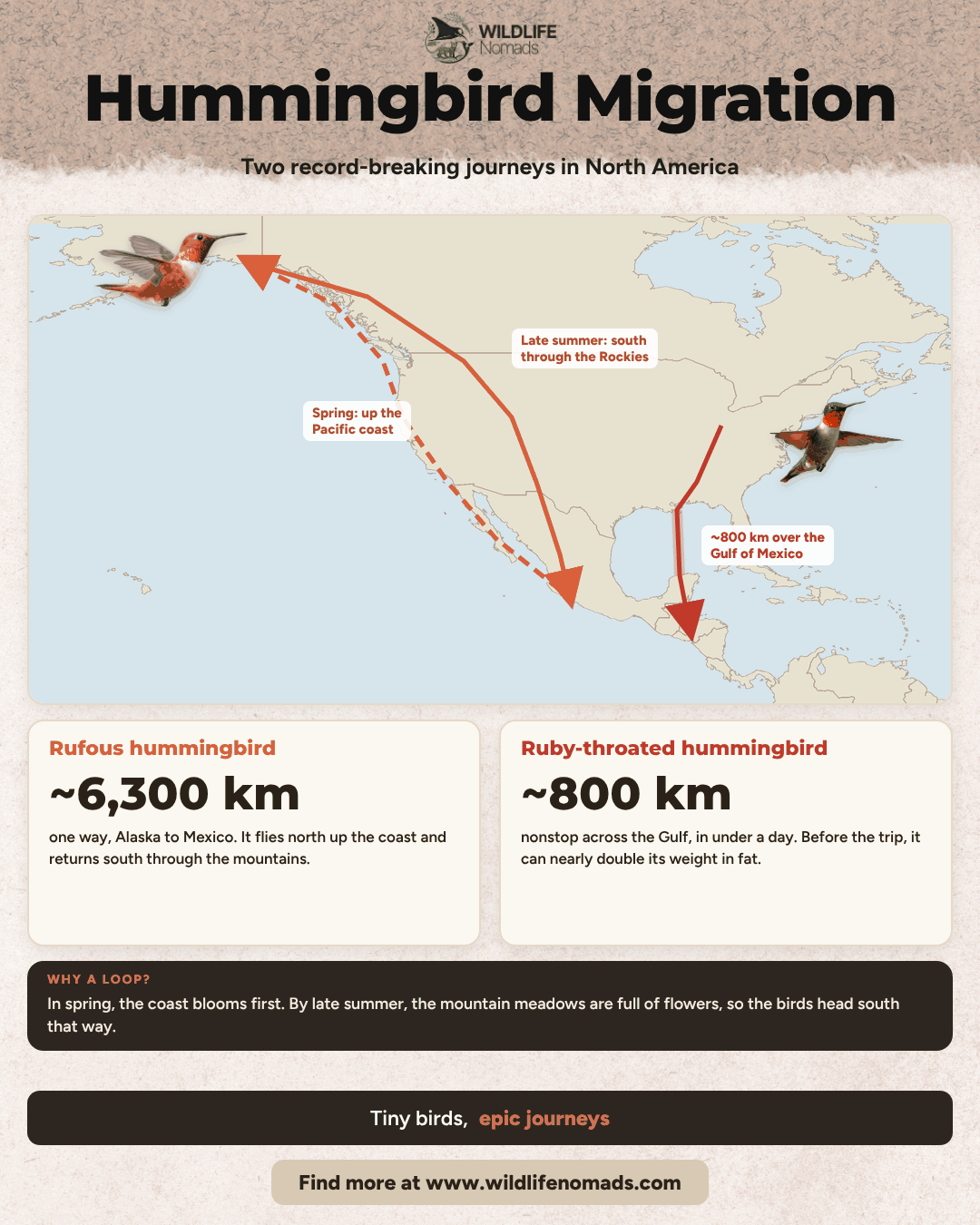
Many hummingbirds migrate each year. Day length triggers the urge, but temperature and food conditions shape the timing. Before migration, ruby-throated hummingbirds (Archilochus colubris) nearly double their body weight in fat. Many then cross the Gulf of Mexico nonstop, about 800 kilometres in 18 to 22 hours. Most spend the winter between southern Mexico and Central America. In spring they migrate north and reach the US Gulf Coast first. In the east, the ruby-throated is the only hummingbird that breeds.
The rufous hummingbird (Selasphorus rufus) migrates about 6,300 kilometres one way. It travels between its breeding range, reaching Alaska, and its wintering grounds in Mexico. Measured against its body size, that ranks among the longest animal migrations on Earth. It also loops clockwise, flying north along the Pacific coast and returning south through the Rocky Mountains. Those two migration routes show how flexible these tiny birds can be.
Across North America, hummingbird populations show mixed trends. Sadly, rufous hummingbird numbers have fallen about 65% since 1970. The IUCN Red List now lists the species as Near Threatened. Allen’s hummingbird and the broad-tailed hummingbird have declined too. By contrast, black-chinned hummingbird numbers rose about 52% over the same period. For the rufous, habitat loss on its breeding grounds and climate change top the list of suspects.
12. Messengers, Warriors and Gods Across the Americas
Long before science, people across the Americas built stories around the hummingbird. The Aztec god of sun and war, Huitzilopochtli, carries it in his name. His name joins huitzilin, meaning hummingbird, with a word for left or south.
The Mexica believed fallen warriors escorted the sun for four years. After that, they returned to earth as hummingbirds. I love that cosmology, because it turns a tiny bird into a brave, returning soul. Aztec featherworkers also prized shimmering hummingbird plumes, alongside the green feathers of the quetzal.
Further south, the Nazca people of Peru drew a giant hummingbird into the desert floor. That geoglyph has survived for well over 1,500 years. Some traditions also saw hummingbirds as messengers between worlds. Fittingly, chaski, the name of the newly described giant hummingbird, means messenger in Quechua.
I can only speak for Mexico, where I grew up with these stories. Still, I’m sure many Indigenous peoples in South America, the United States and Canada hold hummingbird stories of their own. If you know one, I’d love to hear it.
FAQs About Hummingbirds
Hummingbirds live only in the Americas, with more than 360 species. The bee hummingbird of Cuba is the smallest bird on Earth. Their hearts can beat more than 1,200 times a minute. On cold nights they enter torpor, and one species cooled to 3.3 °C. Male Anna’s hummingbirds make courtship sounds with their tail feathers.
It depends on the species and the region. In the United States and Canada, most species lay eggs between about April and July. Anna’s hummingbirds start much earlier, often in winter along the Pacific coast. In the tropics, many species time nesting to local flowering seasons.
Hummingbirds have an excellent memory for places and often return to the same feeders and flowers each year. Many learn the routine of the person who refills a feeder. However, there is little solid evidence that they recognise individual human faces.
Usually, the bird is checking you out. Bright clothing, especially red, can look like a possible flower. Territorial males also hover to inspect intruders near their food. In many folk traditions, people see the moment as a message from a loved one.
No single predator dominates everywhere. Around homes, domestic cats are among the most serious threats. Hawks, snakes, frogs, large spiders and praying mantises also catch hummingbirds. In North America, mantises often ambush them at garden feeders.
Mix one part white sugar with four parts water, which gives roughly a 20% solution. Skip red dye, honey and artificial sweeteners. Change the mix every few days, or daily in hot weather, and scrub the feeder clean.
Watch for the Flash of a Gorget
A hummingbird packs a record-breaking heart, a nectar-trapping tongue and a whole Aztec cosmology into a few grams. The more I learn, the more I miss them here in Australia. Honeyeaters are lovely, but nothing replaces that blur of wings at a Mexican flower.
If you live in the Americas, plant native flowers, keep a clean feeder and watch for that gorget flash. Then tell me in the comments which hummingbird species visits your garden or balcony. New to watching birds? My guide to birding for beginners is a great next step, and the quiz below will test what you’ve learned.
References:
Abrahamczyk, S., & Renner, S. S. (2015). The temporal build-up of hummingbird/plant mutualisms in North America and temperate South America. BMC Evolutionary Biology, 15, 104. https://doi.org/10.1186/s12862-015-0388-z
Clark, C. J. (2009). Courtship dives of Anna’s hummingbird offer insights into flight performance limits. Proceedings of the Royal Society B: Biological Sciences, 276(1670), 3047–3052. https://doi.org/10.1098/rspb.2009.0508
English, S. G., Bishop, C. A., Wilson, S., & Smith, A. C. (2021). Current contrasting population trends among North American hummingbirds. Scientific Reports, 11, 18369. https://doi.org/10.1038/s41598-021-97889-x
Mayr, G. (2004). Old World fossil record of modern-type hummingbirds. Science, 304(5672), 861–864. https://doi.org/10.1126/science.1096856
Nyffeler, M., Maxwell, M. R., & Remsen, J. V., Jr. (2017). Bird predation by praying mantises: A global perspective. The Wilson Journal of Ornithology, 129(2), 331–344. https://doi.org/10.1676/16-100.1
Rico-Guevara, A., & Rubega, M. A. (2011). The hummingbird tongue is a fluid trap, not a capillary tube. Proceedings of the National Academy of Sciences, 108(23), 9356–9360. https://doi.org/10.1073/pnas.1016944108
Stoddard, M. C., Eyster, H. N., Hogan, B. G., Morris, D. H., Soucy, E. R., & Inouye, D. W. (2020). Wild hummingbirds discriminate nonspectral colors. Proceedings of the National Academy of Sciences, 117(26), 15112–15122. https://doi.org/10.1073/pnas.1919377117
Warrick, D. R., Tobalske, B. W., & Powers, D. R. (2005). Aerodynamics of the hovering hummingbird. Nature, 435(7045), 1094–1097. https://doi.org/10.1038/nature03647
Williamson, J. L., Gyllenhaal, E. F., Bauernfeind, S. M., Bautista, E., Baumann, M. J., Gadek, C. R., Marra, P. P., Ricote, N., Valqui, T., Bozinovic, F., Singh, N. D., & Witt, C. C. (2024). Extreme elevational migration spurred cryptic speciation in giant hummingbirds. Proceedings of the National Academy of Sciences, 121(21), e2313599121. https://doi.org/10.1073/pnas.2313599121
Wolf, B. O., McKechnie, A. E., Schmitt, C. J., Czenze, Z. J., Johnson, A. B., & Witt, C. C. (2020). Extreme and variable torpor among high-elevation Andean hummingbird species. Biology Letters, 16(9), 20200428. https://doi.org/10.1098/rsbl.2020.0428