
The Fiery Little Bird That Refuses to Back Down
In my years as a biologist, I’ve studied some of the most elusive animals on the planet. However, the most staggering biological wonders aren’t always the giants. Sometimes, they weigh less than a nickel. While I recently wrote about Anna’s Hummingbird, today we are looking at its much rowdier cousin. The rufous hummingbird is a fairly small hummingbird, easily recognized by its slender bill, tapered tail, and short wings.
I grew up in Mexico, where various types of birds darted through the gardens daily. But one moment stood out above the rest. High up in the oak pine forests of San Jose del Pacifico, Oaxaca, I spotted rufous hummingbirds for the first time in their winter habitat. Their vivid iridescent red throat caught the mountain sun like sparks of copper, while the male’s back and belly glowed a bright orange. I stopped dead in my tracks. Despite their size, these birds are incredibly resilient and adaptable—traits that help them survive. Their long migratory journeys make life difficult, yet they continue to thrive.
If you’ve ever seen a brilliant orange male aggressively chasing every other bird from your feeder, you’ve met the “feisty ginger” of the avian world. Here are 12 things you need to know about these remarkable birds.

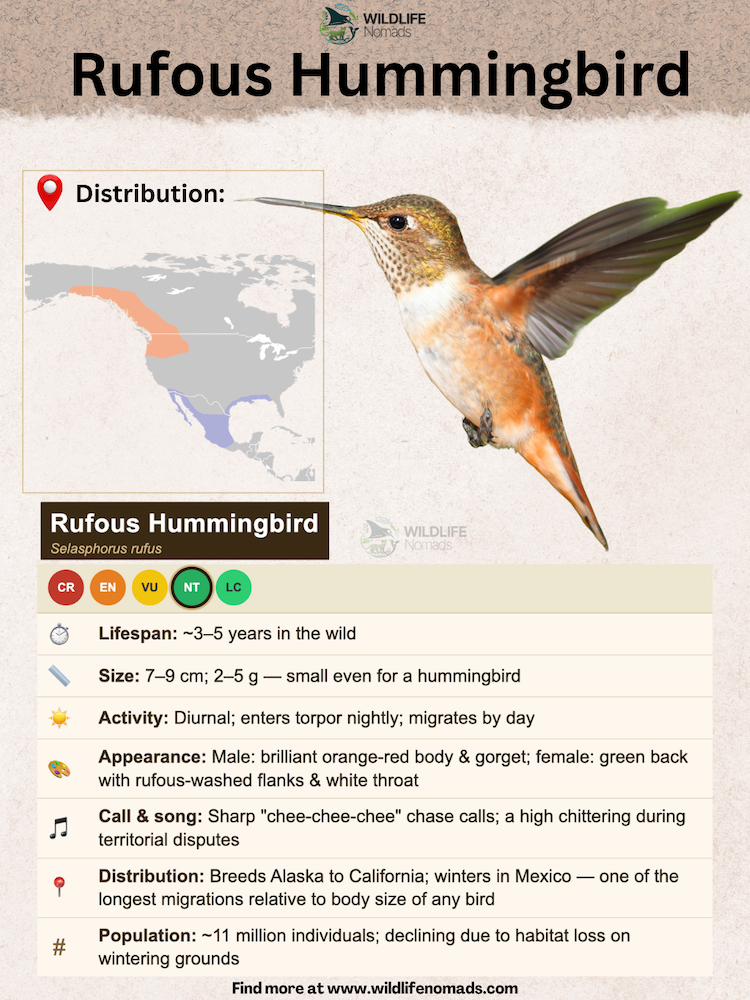
Rufous Hummingbird Quick Facts
| Feature | Description |
| Scientific Name | Selasphorus rufus |
| Length | 2.7 – 3.5 inches (7 – 9 cm) |
| Weight | 0.07 – 0.17 oz (2 – 5 g) — small even for a hummingbird |
| Lifespan | ~3–5 years in the wild |
| Conservation Status | Near Threatened (IUCN) |
| Key Field Marks | Male: Bright orange-red body & gorget; Female: Green back with rufous-washed flanks |
1. They Complete One of the Longest Migratory Journeys on Earth
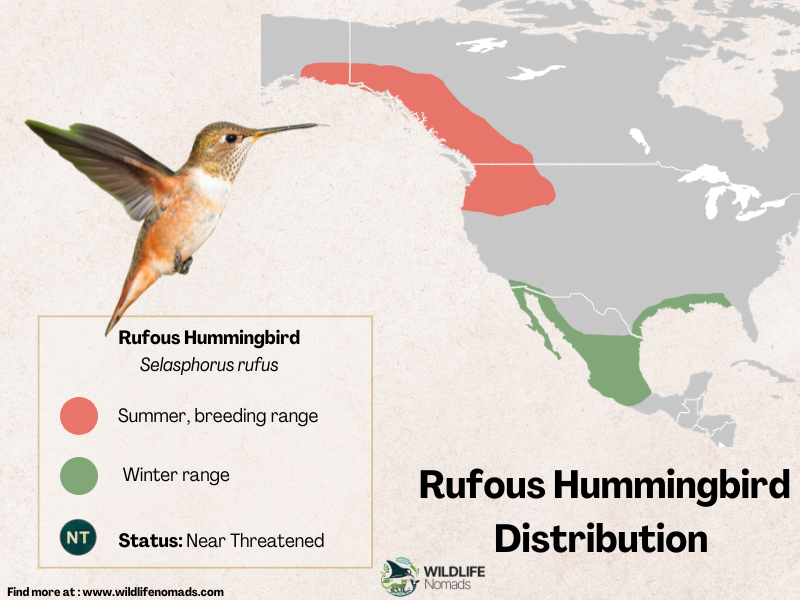
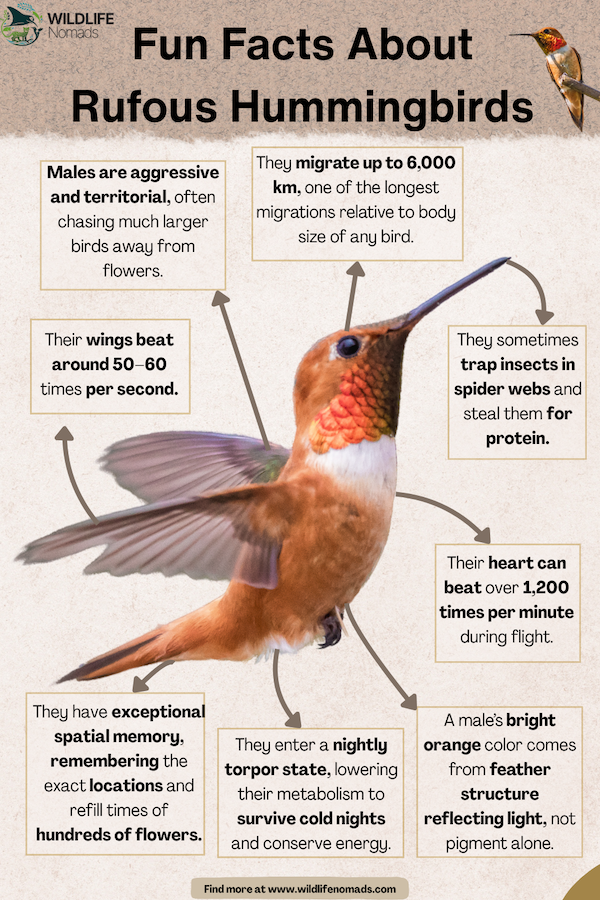
The rufous hummingbird range covers an extraordinary distance. These birds travel over 3,900 miles (6,300 km) — one of the longest migratory journeys relative to body size of any bird in North America. They breed farther north than any other hummingbird species, reaching southeasternAlaska and northwestern Canada. In late summer, they head south through the Rocky Mountains towardMexico.
For a bird measuring just 3 inches long, that journey equals roughly 78 million body lengths. Therefore, if a human covered a proportional distance, they would circle the Earth multiple times over.
2. The Adult Male Is Unmistakable
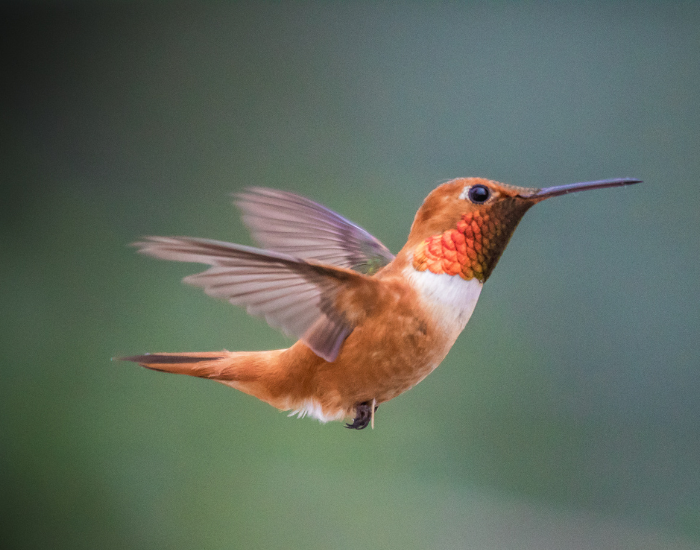
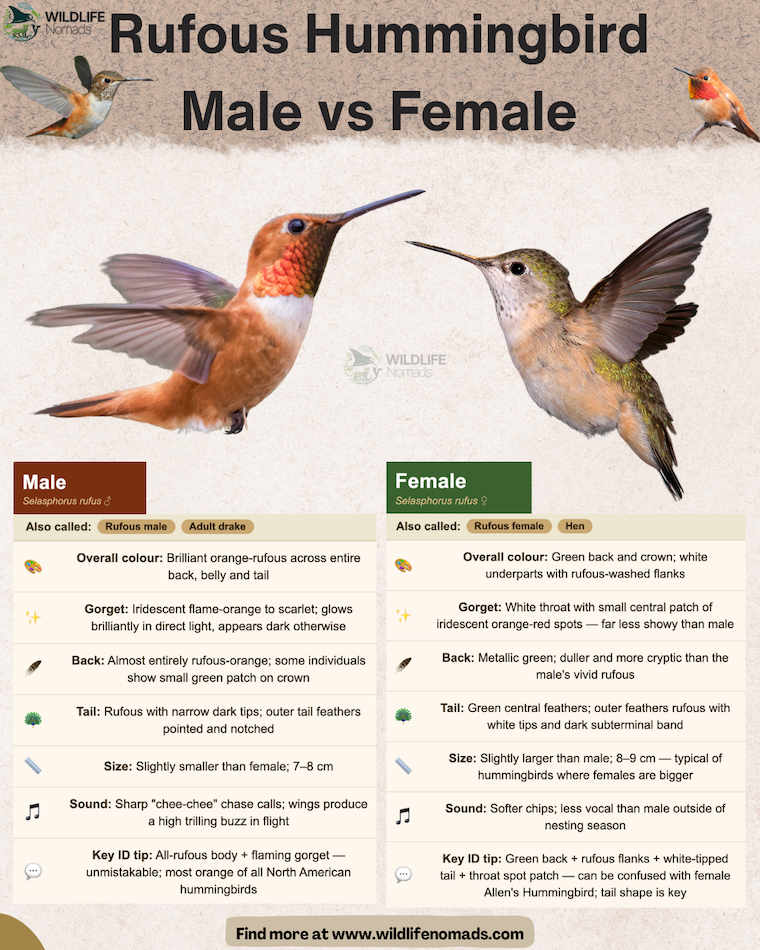
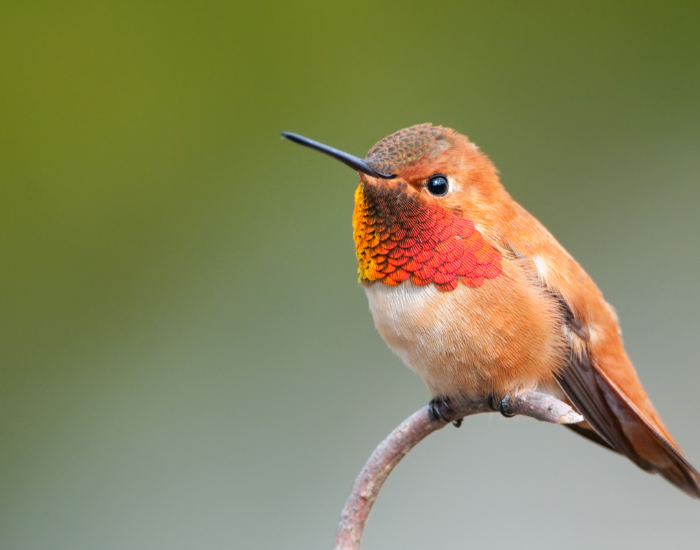
The adult male rufous hummingbird is one of North America’s most striking birds. He displays a bright orange plumage across his back and belly, and his vivid iridescent red throat — called a gorget — flashes like a flame in good light. Male Rufous Hummingbirds are the only hummingbirds found in the United States with an entirely orange-colored back. They are about the same size as a Ruby-throated Hummingbird, half sparrow-sized or smaller. Rufous Hummingbirds have a wingspan of 4.3 inches (11 cm) and weigh between 0.1-0.2 ounces (2-5 g).
Occasionally, you’ll spot a male rufous with a partially green back, sometimes called a green-backed form. However, that darting flight and copper-orange body still give him away. The white breast and rufous-washed flanks are additional field marks to watch for.
3. The Female Builds Everything Alone
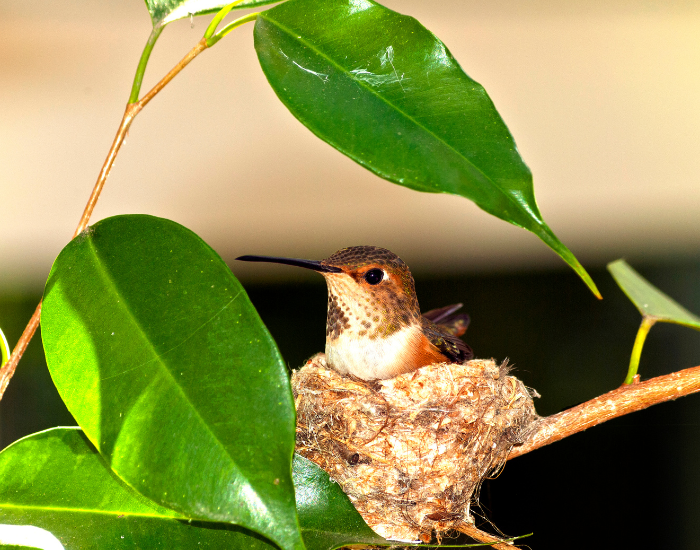
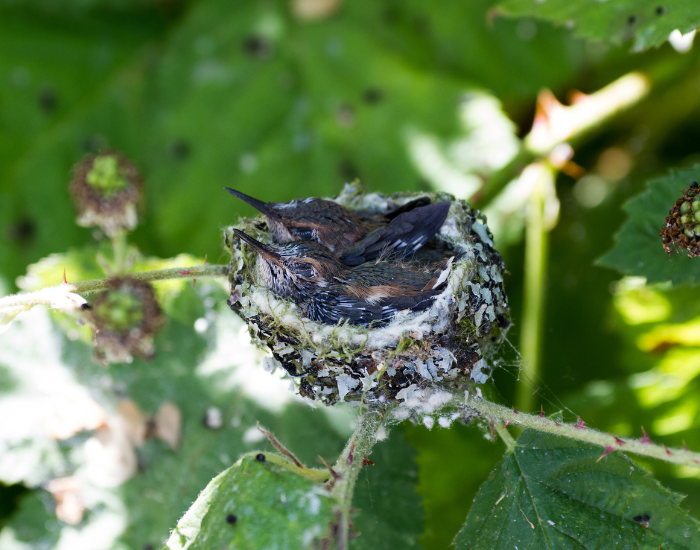
Several females may share the same habitat, but each one builds her nest entirely alone. The female rufous hummingbird is a master architect. She constructs a tiny cup nest on a branch — often in shrubby areas, forest edges, or mountain meadows — and binds it together with spider webs.
That elastic spider silk is genius engineering. As the chicks grow, the nest stretches to accommodate them. The female builds this structure with no help from the male, incubating two jellybean-sized eggs for around 15–17 days. She raises the young entirely on her own.
4. Male vs. Female: How to Tell Them Apart
Identifying male rufous hummingbirds versus females is a key skill for birders. The male is the brilliant orange bird with a vivid gorget and rufous patches on his tail feathers. The female is subtler — green above with rufous-washed flanks, rufous patches in the green tail, and often a spot of orange in the throat.
If you see a brownish-green hummingbird with a green tail, it is most likely a female or juvenile. In addition, juvenile males look similar to adult females at first, developing their full orange plumage over the first year.
5. They Are Relentless Attackers at the Feeder
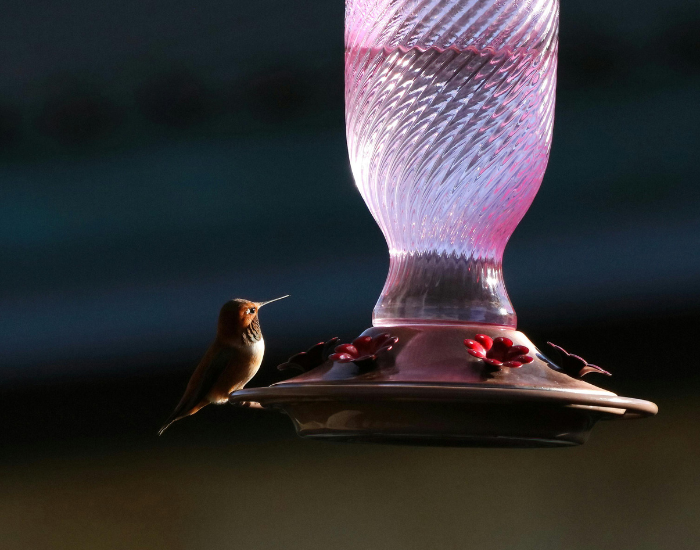
Rufous hummingbirds are the most extremely territorial of all North American hummingbirds. They behave as relentless attackers — dive-bombing hawks, chasing other hummers, and even intimidating squirrels many times their size. This aggression is a calculated survival strategy.
In the wild, they defend tubular flowers and hummingbird feeders with ferocious intensity. Therefore, if one brilliant orange male claims your feeder, expect him to hold it against all other species. Their body size is tiny, but their territorial drive is enormous.
6. Their Brains Work Like a GPS
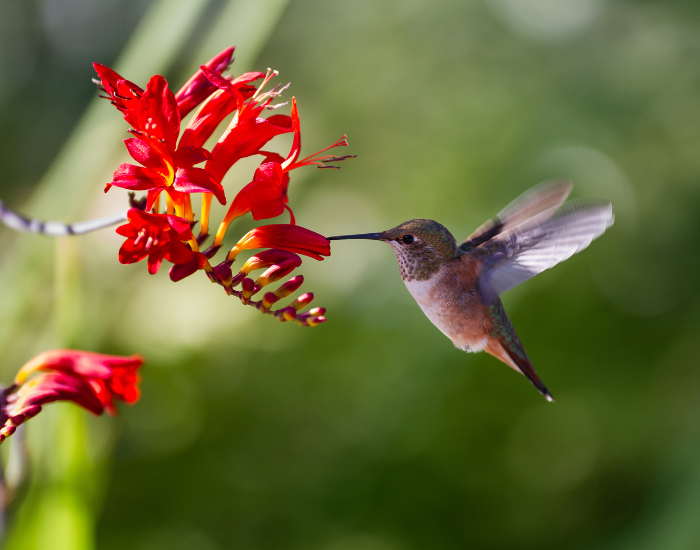
Don’t let the “bird brain” insult fool you. A hummingbird’s brain is proportionally larger than that of any other bird. Rufous hummingbirds have an enlarged hippocampal region that functions like a GPS, storing the precise location of hummingbird flowers and feeders visited the previous year. Probably way more intelligent than most people realise. Their intelligence and agility are a true hummingbird gift, making them remarkable among birds.
For example, an adult male can return to the same mountain meadow after migrating thousands of miles and find the exact patch of hummingbird flowers it used the season before.
7. They Enter a Near-Death State Every Night
In high elevation habitats, from the oak pine forests of Mexico to the mountains of the Pacific Northwest and Pacific coast, nights turn bitterly cold. To survive, rufous hummingbirds enter torpor each night. Their heart rate drops from around 1,200 beats per minute to as low as 50.
This near-hibernation state conserves up to 60% of their nightly energy expenditure. They often hang upside down like a dead leaf, completely unresponsive, until the morning sun warms them back to life. It is one of the most dramatic animal adaptations known to science.
8. All Hummingbirds Can Fly Backwards — But Rufous Do It Best
All hummingbirds share a unique shoulder joint that allows their wings to rotate in a full figure-eight stroke. This creates lift on both the forward and backward wing beats. Therefore, they can hover, fly straight up, down, and backwards — a feat no other bird group achieves.
The rufous hummingbird’s fairly short wings are adapted for speed and pinpoint maneuverability rather than long glides. Their darting flight and aggressive aerial pursuits make them one of the most athletic birds in North America, despite their tiny body size.

9. They Eat Insects More Than You Think
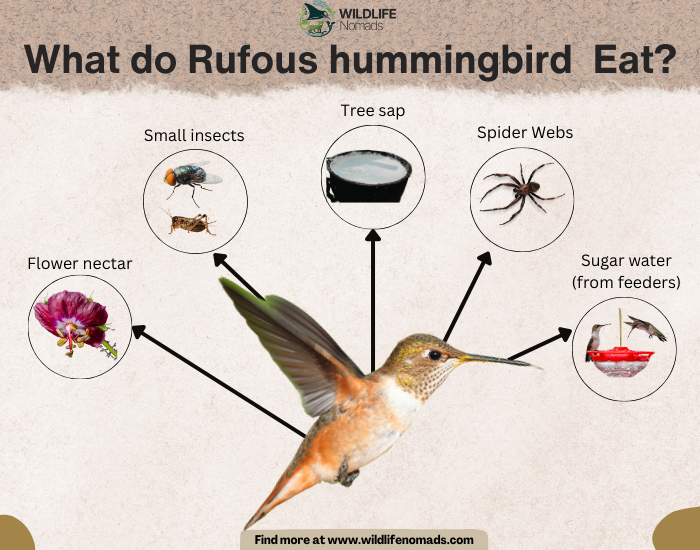
Rufous hummingbirds eat insects far more often than most people realize. Nectar provides quick energy, but insects supply the protein they need to sustain a metabolism this intense. They are prolific hunters — they “hawk” by darting from a perch to snatch gnats mid-air, and they pluck small spiders directly from spider webs.
Rufous hummingbirds require regular food intake, needing to eat every 10–15 minutes and maintain a high metabolism throughout the day. To fuel their energy demands, they must consume roughly half their body weight in food and visit up to 2,000 flowers in a single day.
In addition, they feed their chicks almost exclusively on insects at first. The chicks need protein to develop flight muscles before they can eat insects themselves. This makes protecting insect-rich habitats just as important as planting hummingbird flowers. When providing feeders, it is important to use proper sugar water mixtures as an artificial nectar source to help sustain these birds.
10. Their Tongue Moves 13 Times Per Second
Rufous hummingbirds do not sip nectar like a straw. Their forked tongue works as a micro-pump, lapping up nectar-rich liquid at roughly 13 times per second. They can consume up to twice their body weight in nectar every single day.
However, there is an important warning for anyone using hummingbird feeders: sugar water ferments rapidly in hot weather. Change your feeder every 2–3 days in warm conditions, and never use food coloring or honey — these produce toxic alcohol that harms their tiny systems. Use only table sugar dissolved in plain water. Change the sugar-water in feeders before it grows cloudy or discolored to keep it fresh for Rufous Hummingbirds.
11. They Are the High-Altitude Kings of Mexico
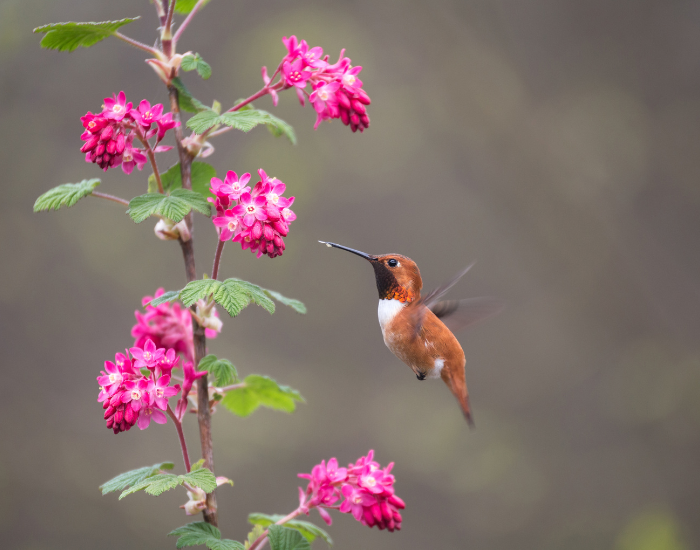
Rufous hummingbirds breed farther north than any other hummingbird species on Earth. Their breeding range extends from northern California and Oregon, through British Columbia, and all the way to southeastern Alaska. They thrive in open or shrubby areas, forest edges, and mountain meadows.
While many people think of hummingbirds as tropical beach-dwellers, the Rufous prefers the “islands in the sky.” Their primary winter habitat is found in the high-elevation pine-oak forests of central and southern Mexico, often at altitudes of 7,000 to 10,000 feet.
In places like Oaxaca and Guerrero, they don’t just relax; they spend their winter months defending territories just as fiercely as they do in your backyard. Interestingly, recent years have shown a “migratory shift,” with more Rufous hummingbirds choosing to winter along the Gulf Coast of the United States. Whether they are in a Mexican cloud forest or a garden in Louisiana, their survival depends on finding a reliable nectar source to fuel their tiny, high-performance bodies through the winter chill.
12. Their Populations Have Declined by Nearly Two-Thirds
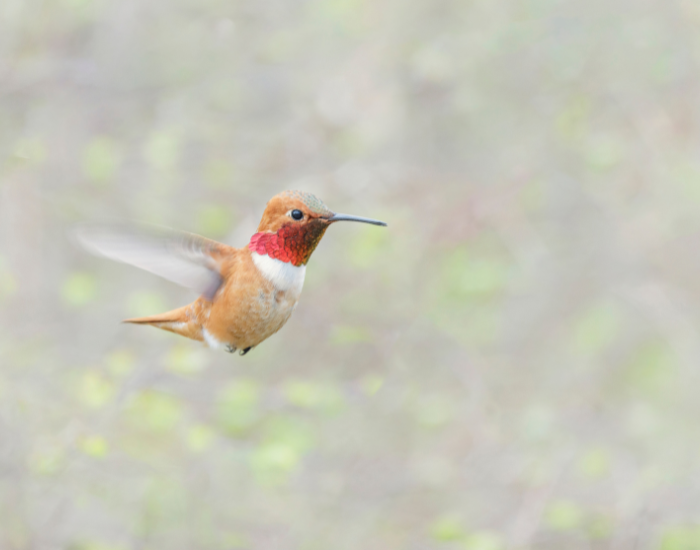
Unfortunately, rufous hummingbirds are classified as Near Threatened on the IUCN Red List. Their populations have declined by an estimated 61% since 1970, according to data from the North American Breeding Bird Survey. Climate change disrupts the bloom timing of hummingbird flowers along their migration route, creating dangerous mismatches between the birds’ arrival and peak nectar availability.
Habitat loss along the Pacific coast, Pacific Northwest, and wintering grounds in Mexico is an additional major threat. You can help by planting native tubular flowers, maintaining clean hummingbird feeders, and supporting conservation organizations working to protect their migration corridors.
Your FAQs about this tiny Hummingbird
Use table sugar only, dissolved at a ratio of 1 part sugar to 4 parts water. Never use honey, brown sugar, or food coloring. Sugar water ferments rapidly in warm weather, so clean your feeder every 2–3 days.
They move northwest in spring (March–May) through the Pacific coast lowlands. They head southeast in late June through August along the Rocky Mountain corridor toward Mexico.
To attract rufous hummingbirds, grow hummingbird flowers that are nectar-rich and tubular, as these naturally draw them in. Putting out hummingbird feeders also helps. Rufous Hummingbirds will take up residence in gardens if hummingbird flowers are grown or feeders are put out.
During courtship, rufous hummingbirds perform steep J-shaped or diving motions, often accompanied by a buzzing sound from their wings.
Behind the Rufous Legacy
Watching a male rufous hummingbird defend a patch of hummingbird flowers in the wild is a masterclass in tenacity. These birds remind us that even the smallest life forms play enormous ecological roles — as pollinators, they support entire plant communities across North America.
Next time you see that flash of vivid iridescent color at your feeder, take a moment. You’re watching a 3-gram athlete that just completed one of the longest migratory journeys on Earth.
References:
BirdLife International. (2020). Selasphorus rufus. The IUCN Red List of Threatened Species 2020: e.T22688296A152646278. https://www.iucnredlist.org/es/species/22688296/178595564
Danner, R. M., Greenberg, R., Danner, J. E., & Walters, J. R. (2015). Experimental support for food limitation of a short-distance migratory bird wintering in the tropics. Ecology, 96(12), 3358–3368. https://doi.org/10.1890/14-1snip
Healy, S. D., & Hurly, T. A. (1995). Spatial memory in rufous hummingbirds (Selasphorus rufus): A field test. Animal Learning & Behavior, 23(1), 63–68. https://doi.org/10.3758/BF03198016
Lasiewski, R. C. (1964). Body temperatures, heart and breathing rate, and evaporative water loss in hummingbirds. Physiological Zoology, 37(2), 212–223. https://doi.org/10.1086/physzool.37.2.30152332
Rico-Guevara, A., Fan, T. H., & Rubega, M. A. (2015). Hummingbird tongues are elastic micropumps. Proceedings. Biological sciences, 282(1813), 20151014. https://doi.org/10.1098/rspb.2015.1014
Sauer, J. R., Niven, D. K., Hines, J. E., Ziolkowski, D. J., Pardieck, K. L., Fallon, J. E., & Link, W. A. (2017). The North American Breeding Bird Survey, results and analysis 1966–2015. USGS Patuxent Wildlife Research Center. https://www.usgs.gov/tools/north-american-breeding-bird-survey-results-and-analysis
Toews, D. P., & Irwin, D. E. (2008). Cryptic speciation in a Holarctic passerine revealed by genetic and bioacoustic analyses. Molecular ecology, 17(11), 2691–2705. https://doi.org/10.1111/j.1365-294X.2008.03769.x