
A few months ago I was walking a ridge track in Springbrook National Park, sweating through my shirt. Something croaked above me like a rusty gate. I looked up and found a Blue-faced Honeyeater staring back, beautiful blue mask glowing in the shade. Since then, I’ve spotted these active birds regularly across campsites while documenting my Australia lap, including at Woody Head Campground, Evans Head, and Red cliff and Lake Arragan, and most recently on a coastal hiking trail toward Minnie Water town at Illaroo Campground, where they were exceptionally active in the late afternoon.
Australia’s honey eaters have something specia, because they hide in plain sight. Suburban gardens, roadside banksias and national parks all suit them.
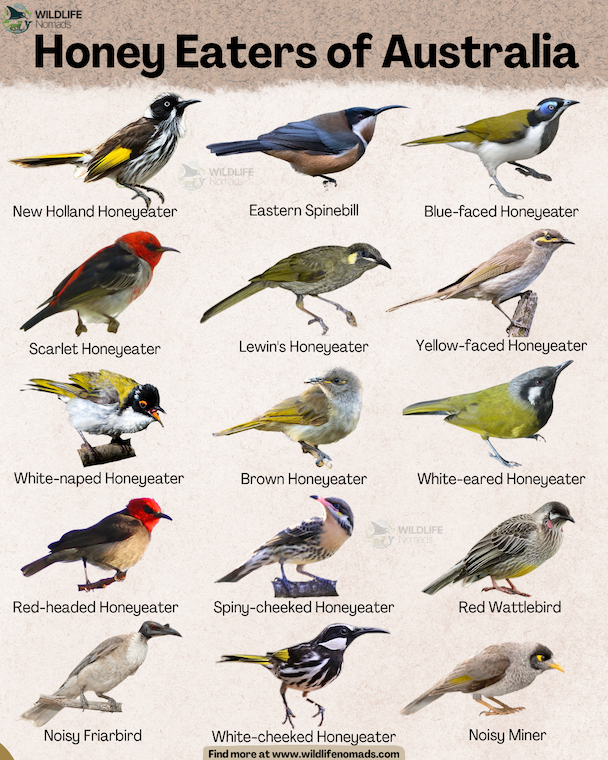
This guide covers 15 species I have watched in the field, from the Sunshine Coast to the Blue Mountains. You will learn to separate the lookalikes, what each one feeds on, and which native plants pull them into a garden.
What Makes a Honeyeater a Honeyeater
Honeyeaters belong to a large family of birds, the family Meliphagidae. Close to 190 species sit inside that honeyeater family. Roughly half live in Australia, most of the rest in New Guinea and the Pacific. Many birds visit blossom opportunistically; these are built for it.
Most honeyeaters use specialized brush-tipped tongues, frayed at the end like a tiny paintbrush. Recent biomechanics work shows the tongue expands as it touches nectar, then traps fluid between its bristles. That is how they collect nectar from deep inside flowers.
Sweet nectar alone will not raise a chick, though. Honey eaters supplement it with insects, spiders, fruits and plant exudates such as lerp and honeydew. Nectar is fuel; insect food is protein. They therefore help control insect populations while they feed.
Their bigger job is pollination. Australian plants in the Proteaceae and Myrtaceae depend heavily on honeyeaters, and vertebrate pollinators measurably lift plant reproductive success. Fruit-eaters also help in seed dispersal, excreting seeds far from the parent tree.
They vary drastically in size, too: the Scarlet Honeyeater weighs 8 grams, while Tasmania’s Yellow Wattlebird pushes 48 centimetres. Not every member is thriving, either. Wild Regent Honeyeaters have grown so rare that some young birds now copy other species’ songs.
1. New Holland Honeyeater
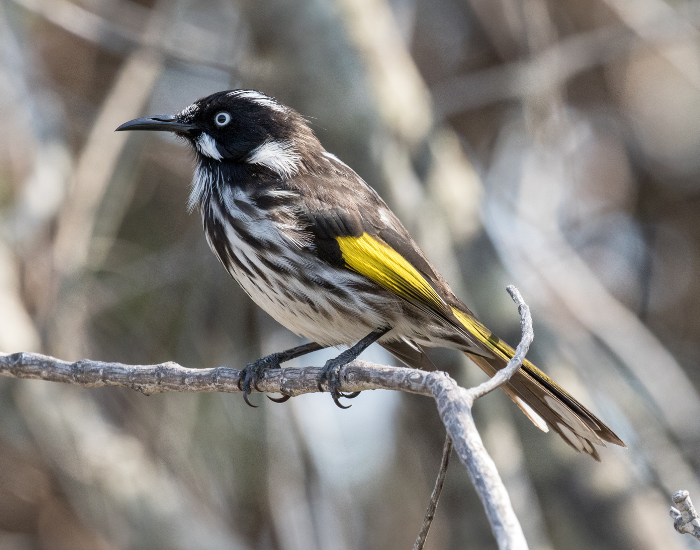
The New Holland Honeyeater (Phylidonyris novaehollandiae) is the striped, wild-eyed bird everyone photographs first. Look for the white eye, the black-and-white streaking and the bright yellow patch on its wing. That flash is your best clue in flight.
New Holland Honeyeaters primarily feed on nectar, and they love Banksia and Grevillea above all. They occupy the southern half of the continent, including south eastern Australia, South Australia and southwest Western Australia.
I met my first during a Sunshine Coast housesit. One banksia in the front garden held four of them, squabbling all morning.
2. White-cheeked Honeyeater
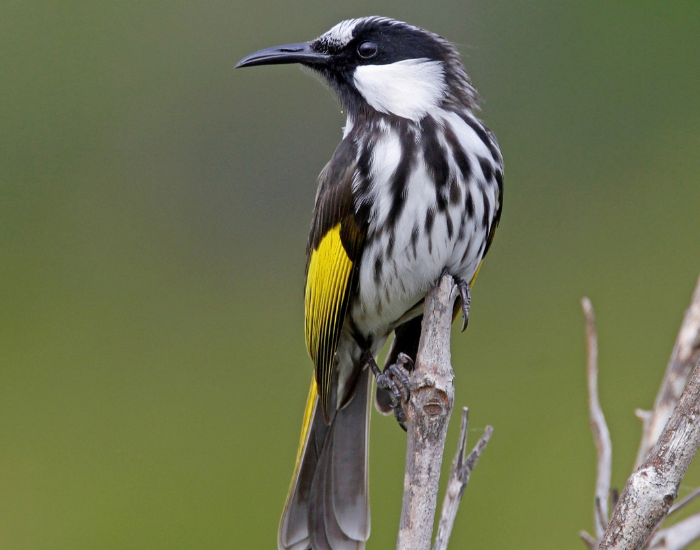
Confusing New Holland with the White-cheeked Honeyeater (Phylidonyris niger) is the classic beginner mistake. Check the eye. The white cheeked honeyeater has a dark eye and a huge white cheek patch, like a smear of chalk.
Two populations exist: one along the east coast of New South Wales and southern Queensland, another in southwest Western Australia. Heathland is their stronghold. White-cheeked Honeyeaters are attracted to Grevilleas and Callistemons, and defend good flowers aggressively.
I watched a pair in the coastal heath of Ku-ring-gai Chase National Park, and more recently at Illaroo Campground while on our lap around Australia. One male sang from a dead branch, launched almost vertically, then parachuted down.
3. Eastern Spinebill
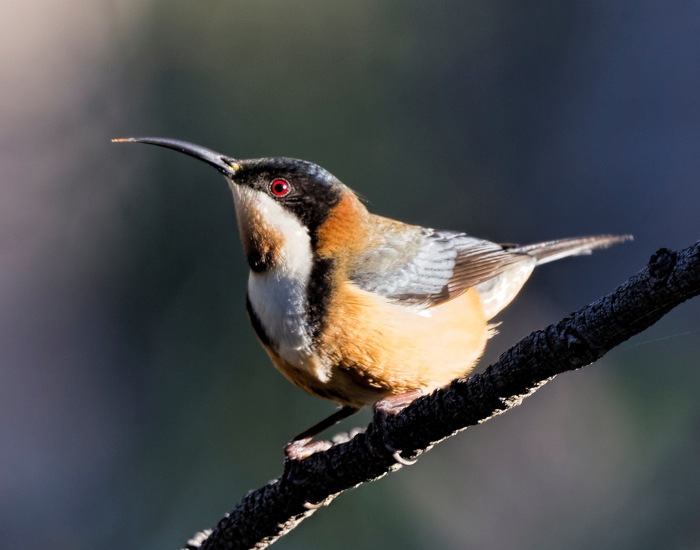
Nothing else looks like the Eastern Spinebill (Acanthorhynchus tenuirostris). The bill is long, fine and curved like a needle. Rufous underparts and white tail corners finish the picture.
Eastern Spinebills prefer nectar from tubular flowers, which their bill fits perfectly. Garden plantings of Kangaroo Paw, Correa and Grevillea bring them within a metre of your coffee. They hover too, wings whirring, like a small Australian answer to a hummingbird.
They range from southern Queensland through New South Wales into Victoria, Tasmania and South Australia. In Morton National Park I once watched one work a bank of heath for ten minutes, hovering at every second flower.
4. Blue-faced Honeyeater
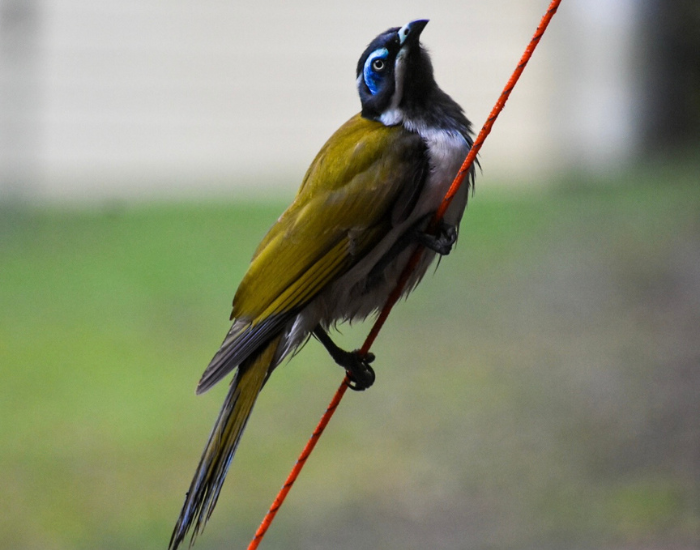
The Blue-faced Honeyeater is the only member of its genus, Entomyzon. At around 29 centimetres it counts among Australia’s large honeyeaters. Adults wear that sapphire face patch; young birds show yellow or olive-green skin, which slowly darkens to blue.
Blue-faced Honeyeaters eat insects and nectar from plants, with cockroaches, termites and lerp making up much of the diet. In tropical areas they are known as Banana-birds, after their fondness for banana flowers in far north Queensland. The species occurs across northern and eastern Australia, and in southern New Guinea. I have photographed this species in coastal areas along the east coast of Australia.
They rarely build a nest from scratch, renovating abandoned babbler nests instead. My Springbrook bird sat in the open for a full minute, which is generous for a honeyeater. During my coastal travels, I’ve logged them across three distinct spots: at Red Cliff, Illaroo (where a few bold individuals hung around near the amenities block), and at Woody Head Campground, where one routinely perched right on my Roof tent awning.
5. Scarlet Honeyeater
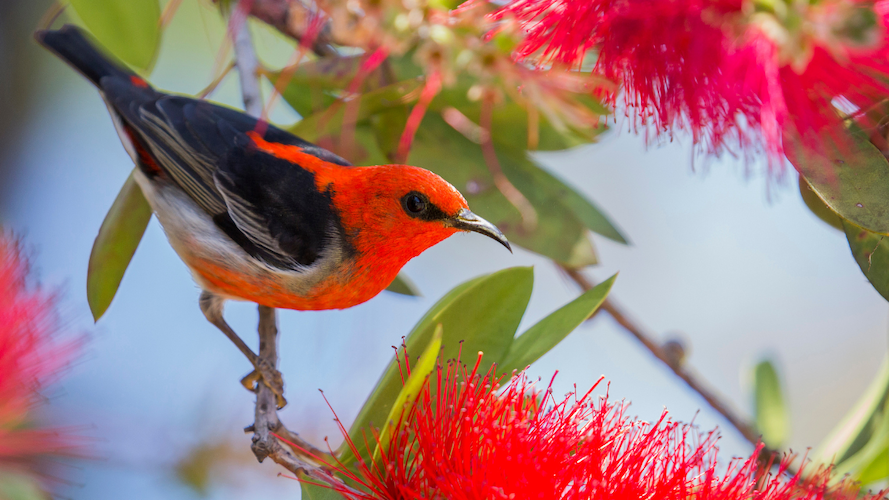
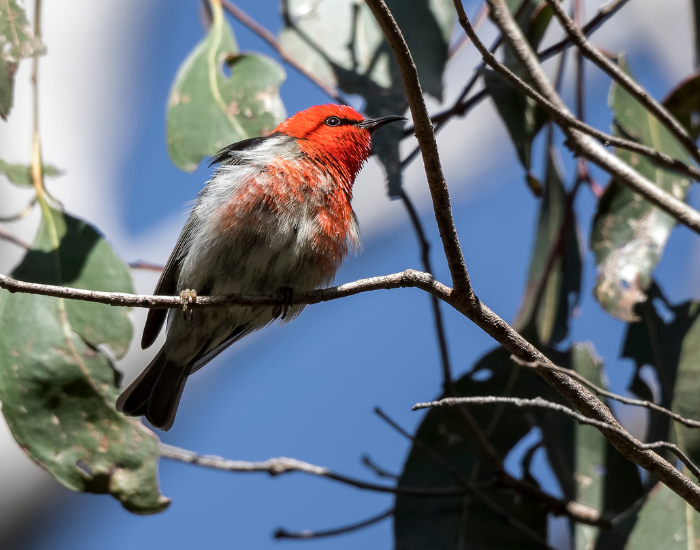
At 9 to 11 centimetres, the Scarlet Honeyeater (Myzomela sanguinolenta) is Australia’s smallest honeyeater. Males burn crimson and black. Females are plain brown, which fools plenty of birders.
Scarlet Honeyeaters feed on blossoms from Turpentine and Melaleuca, high in the canopy. Their range runs the east coast from Cooktown to Gippsland. Around Sydney they turn nomadic, following autumn and winter flowering, so the colder months often bring them into gardens.
My best sighting came in the Royal National Park, in July. Six males worked one flowering swamp mahogany, glowing like embers.
6. Lewin’s Honeyeater
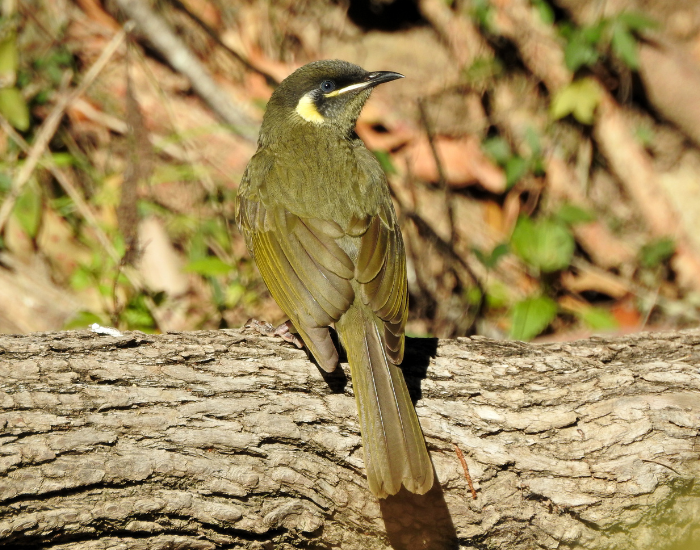
Lewin’s Honeyeater (Meliphaga lewinii) sounds like a machine gun. That staccato rattle carries through wet forest and gives the bird away instantly. Look for the pale crescent ear patch on an olive-grey body.
Lewin’s Honeyeaters favour berries and nectar, which makes them serious seed dispersers in rainforest. They also take insects from bark. Their range hugs the wet east coast from Victoria to the tropical north of Queensland.
At Lamington National Park one mugged my breakfast, taking a piece of pawpaw off the table before I could react. While exploring the forest edge at Woody Head Campground, I caught sight of them again, though they proved noticeably less common here than their Blue-faced relatives.
7. Yellow-faced Honeyeater
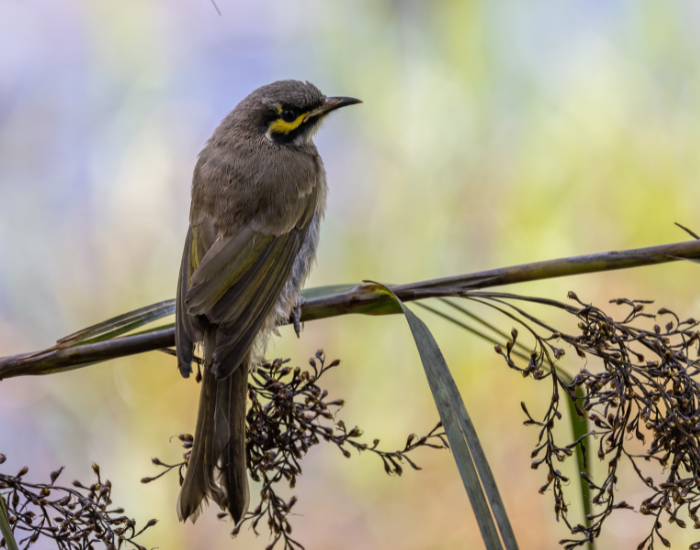
A slim olive bird with a neat yellow stripe under the eye, the Yellow-faced Honeyeater (Caligavis chrysops) is easy to overlook. Its migration is not. Every autumn, large flocks stream north along the Great Dividing Range, sometimes thousands per hour.
I saw my first ones in the Blue Mountains, moving through the canopy in loose parties. They dropped to lower branches to eat insects between visits to blossom.
8. White-naped Honeyeater
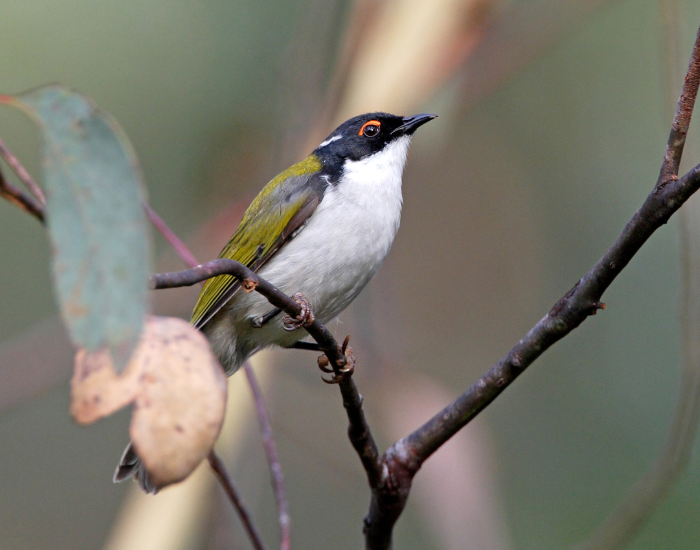
The white naped honeyeaters travelling with those autumn flocks deserve a second look. Melithreptus lunatus is compact and black-hooded, with a clean white band across the nape.
White-naped Honeyeaters forage high in eucalypt canopies, taking nectar, lerp, and insects. They occur across open forests and woodlands throughout eastern Australia.
Girraween National Park in southern Queensland gave me my clearest views, in the tops of granite-country ironbarks.
9. White-eared Honeyeater
The white eared honeyeater (Nesoptilotis leucotis) has a habit I still find absurd. It plucks fur for nest lining, from kangaroos, from livestock, occasionally from people sitting quietly in the bush.
Olive-green with a bold white ear patch, it works trunks and bark more than flowers. Termites, spiders, lerp and honeydew fill most of the menu, with nectar added in spring. It ranges across southern and eastern Australia, plus parts of Western Australia and South Australia.
In the Grampians one landed beside me, tugged wallaby fur from a log, and flew off with a beakful.
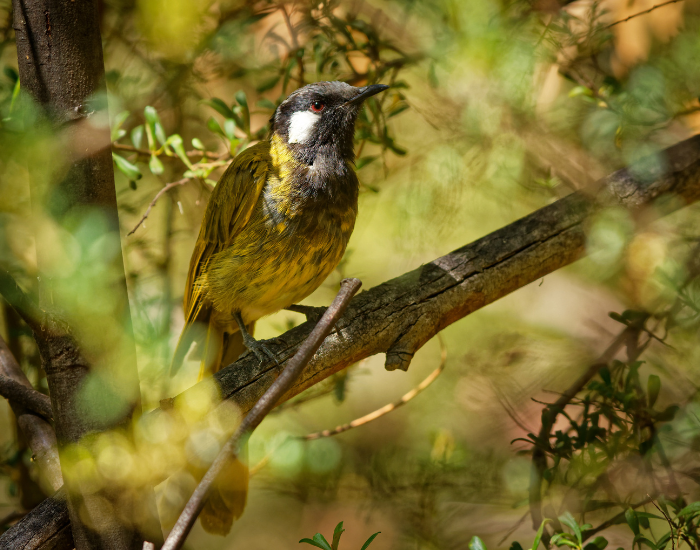
10. Brown Honeyeater
Plain does not mean boring. The Brown Honeyeater (Lichmera indistincta) is dull grey-brown with a small yellow tuft behind the eye. It sings better than almost any bird in the country.
Its range is huge: the Northern Territory, Western Australia, Queensland and inland New South Wales, from mangroves to farm lands to suburban gardens. Nectar dominates, supported by insects taken in fast, darting sallies.
Litchfield National Park at dawn is where the song landed for me. One bird sang from a paperbark for twenty minutes.
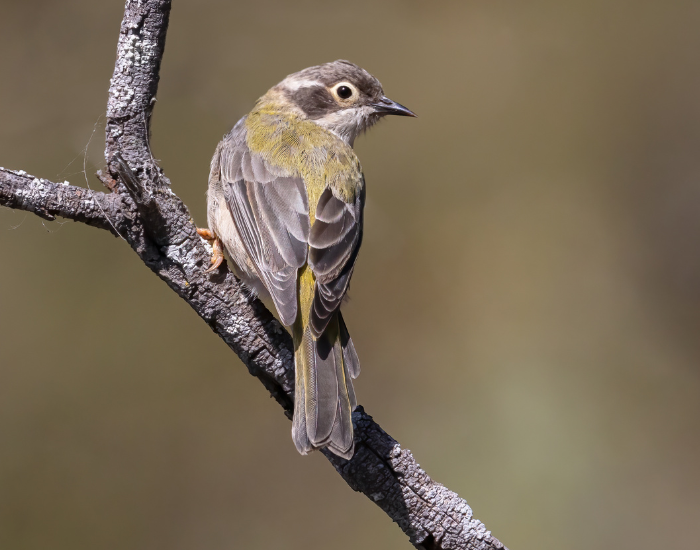
11. Red-headed Honeyeater
The red headed honeyeater (Myzomela erythrocephala) is a mangrove specialist of the tropical north. Males show a glowing scarlet head and rump against brown-black wings.
Mangroves along the Northern Territory, Kimberley and north Queensland coasts hold most of the population. They collect nectar from mangrove blossom and pick small insects and spiders off the foliage.
Kakadu’s mangrove fringe gave me a five-second view, which is normal. They move constantly and rarely sit still for a photo.
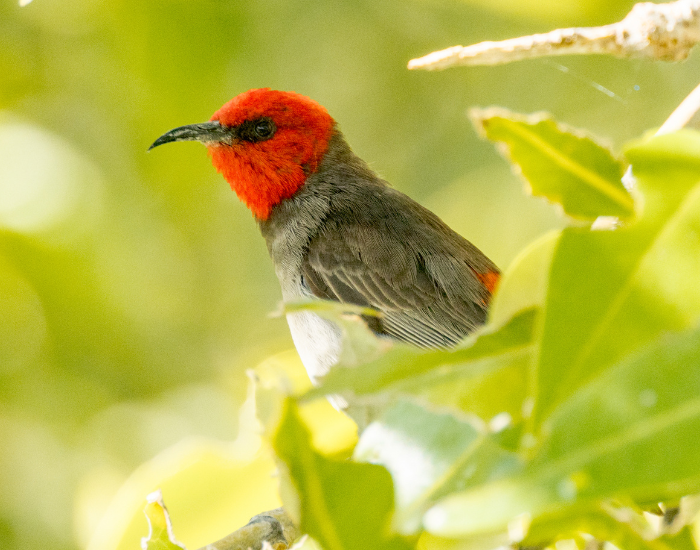
12. Spiny-cheeked Honeyeater
Head inland and the cast changes completely. The spiny cheeked honeyeater (Acanthagenys rufogularis) belongs to arid country. It has a buff-pink throat and fine white spiny feathers streaking the cheek.
Fruit matters more here than in wetter country. Mistletoe berries, saltbush fruit, nectar and insects all feature, shifting with the season. Their range covers most of inland Australia.
The Flinders Ranges introduced me to their song: a liquid, mournful warble drifting across the gorges at first light.
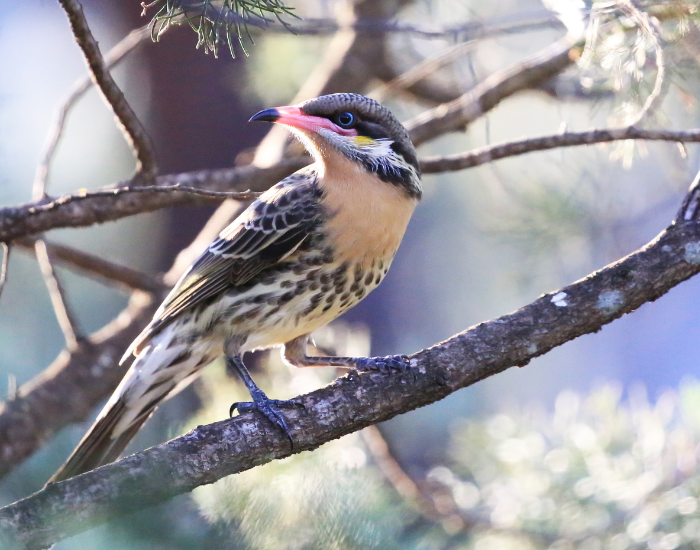
13. Red Wattlebird
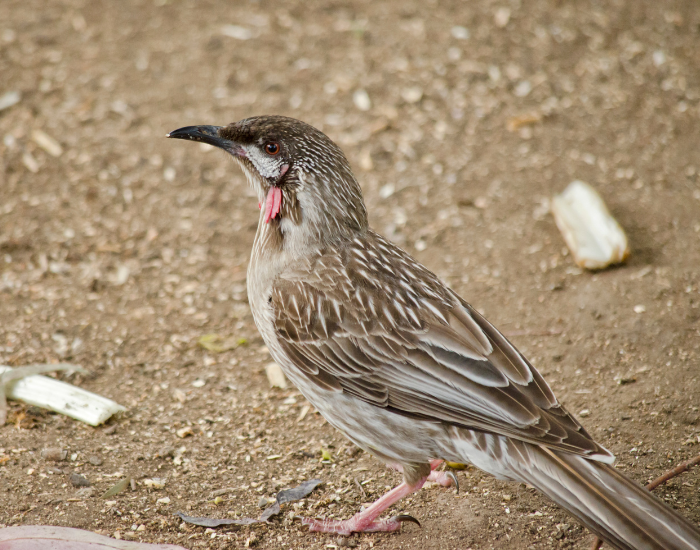
Red wattlebirds (Anthochaera carunculata) rank among the largest honeyeaters in Australia, at up to 35 centimetres. Pink-red wattles dangle from the neck, and a yellow belly patch shows in flight. The call is a harsh, coughing bark.
They dominate flowering trees and drive other birds off the nectar. Their range covers the southern half of the continent, including Victoria, South Australia and southwest Western Australia. Melbourne gardens are full of them.
At Wilsons Promontory I watched one hold a flowering banksia against three other species for half an hour.
Little Wattlebird
The Little Wattlebird (Anthochaera chrysoptera) is the coastal cousin with no wattles at all, despite the name. Rufous wing patches flash in flight, and banksia heath is its haunt.
14. Noisy Friarbird
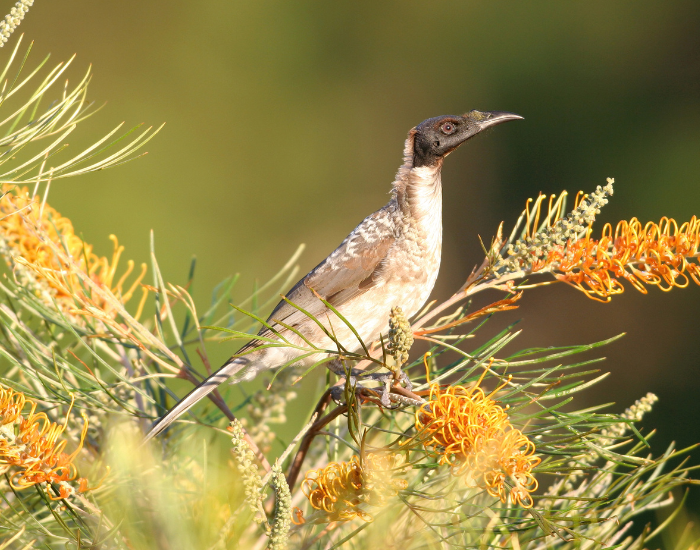
Some birds are beautiful in the conventional sense. The Noisy Friarbird (Philemon corniculatus) is not. Its bare black head, knobbed bill and pale eye look almost reptilian, which I mean kindly.
Friarbirds follow the blossom, moving into south eastern Australia in spring and retreating north in autumn. They are loud, quarrelsome and impossible to ignore around flowering eucalypts. Nectar, fruit and insects all feature.
Barrington Tops in NSW, in October, sounded like an argument in a hardware store. Twenty friarbirds worked one flowering ironbark, shouting throughout.
15. Noisy Miner
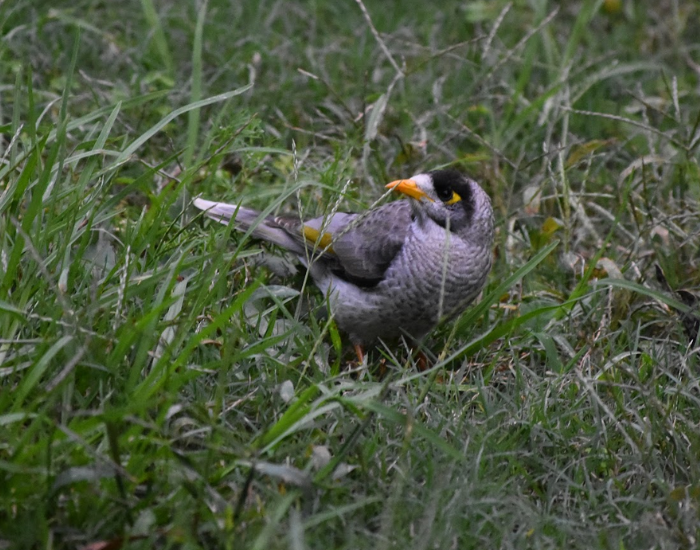
Here is the misconception worth correcting. The noisy miner (Manorina melanocephala) is a native honeyeater, not the introduced Common Myna. Grey body, black crown, yellow bill and yellow skin behind the eye: that is the native bird.
Noisy Miners live in permanent colonies and defend territory ferociously. Research across eastern Australia found they suppress small birds so consistently that the effect counts as ecosystem-level disruption. Clearing and fragmentation helped them expand.
They have swooped me at least three times, in Sydney and on the Sunshine Coast, always during the breeding season. Nothing personal. A dive-bombing miner is still gentle next to Australia’s genuinely dangerous animals. More recently I’ve encountered their noisy colonies in practically every campground, including local spots in Evans Head, as well as nature reserves like Coombabah Lakelands Conservation Area and Burleigh Heads National Park.
Bell Miner
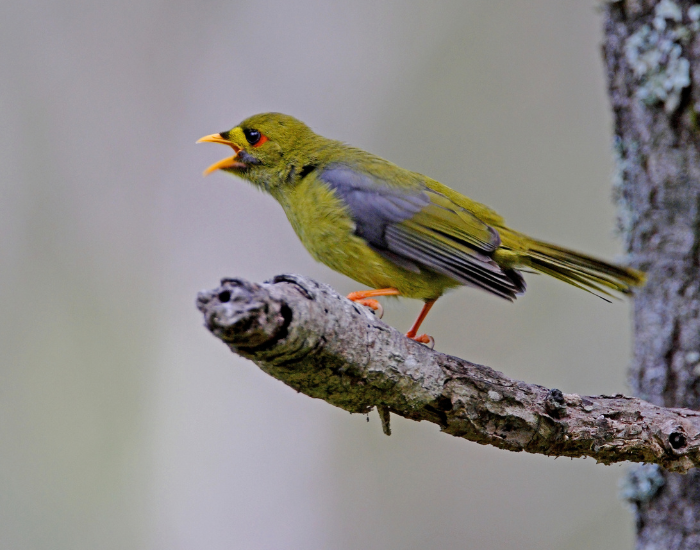
The Bell Miner (Manorina melanophrys), or bellbird, is the noisy miner’s olive-green relative. Colonies produce that ringing tink, one of the strangest sounds in Australian forest. They farm sap-sucking psyllids for lerp, and dense colonies are linked to eucalypt dieback (Steinbauer et al., 2015). The Dandenong Ranges near Melbourne are the classic place to hear them.
Frequently Asked Questions
Victoria supports roughly 25 honeyeater species. Common ones include the New Holland Honeyeater, Eastern Spinebill, Red Wattlebird, Little Wattlebird, White-eared Honeyeater, Yellow-faced Honeyeater, White-naped Honeyeater, Bell Miner and Noisy Miner. Melbourne gardens with banksias and grevilleas attract most of them. Drier northwest Victoria adds the Spiny-cheeked Honeyeater.
Several pairs cause genuine confusion. New Holland and White-cheeked Honeyeaters share bold black-and-white streaking, separated by eye colour: white in New Holland, dark in the white cheeked honeyeater. Noisy Miners and Bell Miners share build and behaviour but differ in colour. Lewin’s, Yellow-spotted and Graceful Honeyeaters need call and ear-patch shape to separate.
Plant flowering natives rather than hanging feeders. Banksia, Grevillea, Callistemon, Correa and Melaleuca produce reliable nectar and suit most species. Dense, prickly shrubs give small birds cover from Noisy Miners and cats. Structural variety matters as much as flower choice.
Go and Find Them
Honey eaters are the working engine of the Australian bush. They pollinate native plants, disperse seed and thin insect populations while they feed. Once you learn the wing patches and the calls, you stop seeing “a little brown bird” and start seeing species.
Start in your own street, then push further into the best national parks in NSW or a weekend among Victoria’s parks. My guide to Australian native birds covers the other families you will meet, including the wonderfully daft galah. Building a wildlife-friendly garden is easier than most people expect.
Which honeyeater turns up in your garden most often? Tell me in the comments, and include your suburb. I am building a picture of how these birds shift across the east coast.
Can You Name That Honeyeater? 🐦
A 16-photo identification challenge — the wrong answers are deliberately tricky look-alikes from a similar group. Go back and change any answer before you score.
Which honeyeater is this?
References:
Hewes, A. E., Baldwin, M. W., Buttemer, W. A., & Rico-Guevara, A. (2023). How do honeyeaters drink nectar? Integrative and Comparative Biology, 63(1), 48–58. https://doi.org/10.1093/icb/icad048
Maron, M., Grey, M. J., Catterall, C. P., Major, R. E., Oliver, D. L., Clarke, M. F., Loyn, R. H., Mac Nally, R., Davidson, I., & Thomson, J. R. (2013). Avifaunal disarray due to a single despotic species. Diversity and Distributions, 19(12), 1468–1479. https://doi.org/10.1111/ddi.12128
Ratto, F., Simmons, B. I., Spake, R., Zamora-Gutierrez, V., MacDonald, M. A., Merriman, J. C., Tremlett, C. J., Poppy, G. M., Peh, K. S.-H., & Dicks, L. V. (2018). Global importance of vertebrate pollinators for plant reproductive success: A meta-analysis. Frontiers in Ecology and the Environment, 16(2), 82–90. https://doi.org/10.1002/fee.1763
Steven, R., & Newsome, D. (2025). More than garden plants: Extending the conversation of urban gardens as an important refuge for Australian birds. Biodiversity and Conservation, 34(4), 1139–1154. https://doi.org/10.1007/s10531-025-03011-2
Crates, R., Langmore, N., Ranjard, L., Stojanovic, D., Rayner, L., Ingwersen, D., & Heinsohn, R. (2021). Loss of vocal culture and fitness costs in a critically endangered songbird. Proceedings of the Royal Society B: Biological Sciences, 288(1947), 20210225. https://doi.org/10.1098/rspb.2021.0225
Higgins, P. J., Peter, J. M., & Steele, W. K. (Eds.). (2001). Handbook of Australian, New Zealand and Antarctic Birds, Volume 5: Tyrant-flycatchers to Chats. Oxford University Press. https://global.oup.com/academic/