Our second official stop on the big lap was a small town with a big sky. We rolled into Reflections Evans Head on a Friday afternoon, and the place was full. Caravans, kids on scooters, dogs on leads. After Woody Head campground, where the bush pressed against our tent, this felt like another country.
Day one gave us almost nothing. I remember thinking we had made a mistake. Then the tide dropped, the crowds thinned, and the wildlife arrived in waves.
Over four days I logged 20 species, from a juvenile water dragon on the seawall to humpback whales offshore. I’m a biologist, so I record what I actually see, not what a brochure promises. Below is every animal, where I found it, and the science worth knowing
Why Evans Head delivers more wildlife than it should
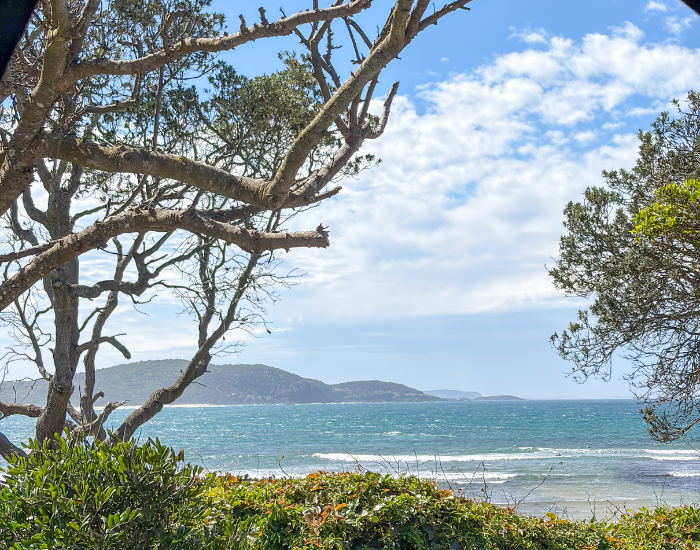
Evans Head NSW is located on the Far North Coast of New South Wales. Here the Evans River meets the Pacific Ocean, and that meeting point is the whole story. The estuary brings calm, glassy water and fish. The ocean brings whales and dolphins. Bundjalung National Park wraps the town in heath and coastal forest.
The holiday park sits surrounded by river and ocean. Brisbane is about two hours away, the Pacific Highway only 10 minutes, and Gold Coast Airport an hour and fifteen. Byron Bay lies a short drive north, so the region is easy to explore.
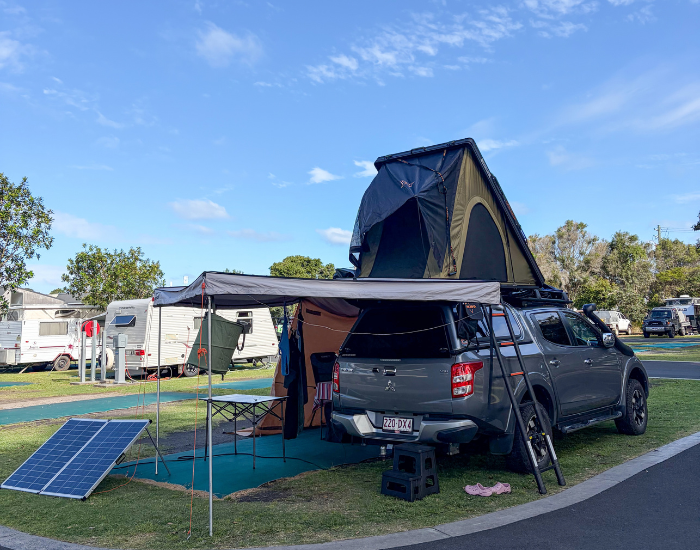
Here is the honest trade-off. This is a caravan park, not a national park campground. Dogs are allowed on the dog friendly campsites. On our first afternoon I watched one flush a lapwing off the grass. In exchange, every site has power and water, and the amenities are well equipped.
Dirawong Reserve, a 300-hectare coastal sanctuary, sits next door for anyone who wants the bush back.
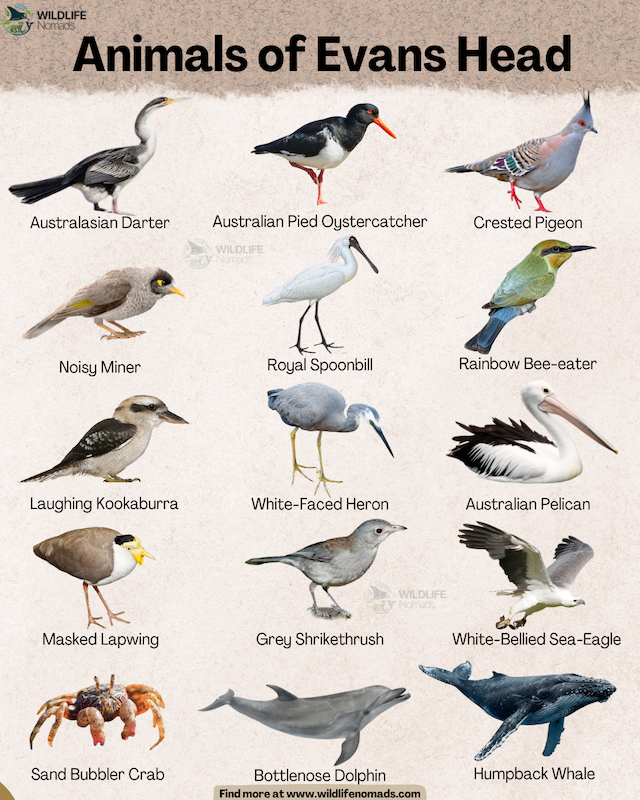
The 20 animals we recorded at Reflections Evans Head
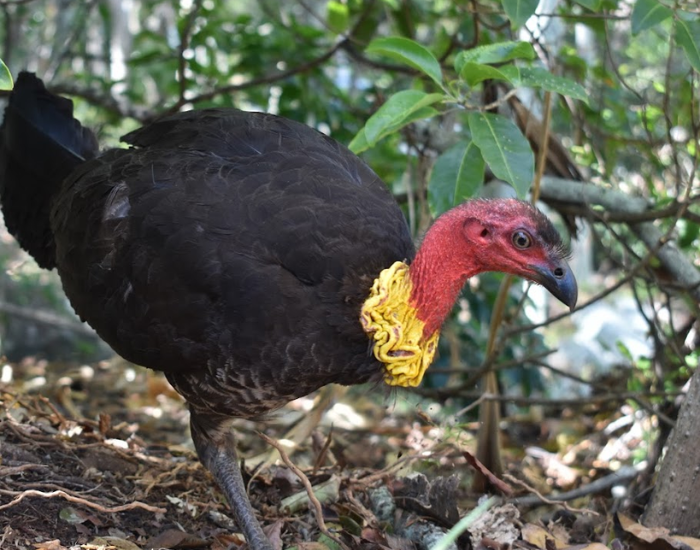
1. Australian Brushturkey (Alectura lathami)
Two brushturkeys worked the campground edge every morning, walking between annexes like they paid site fees. Males build compost mounds and manage them to near 33°C, adding or raking off leaf litter as needed.
That temperature control is not just about hatching. Research shows mound temperature shifts the sex ratio of the chicks, which is remarkable for a bird.
2. Masked Lapwing (Vanellus miles)
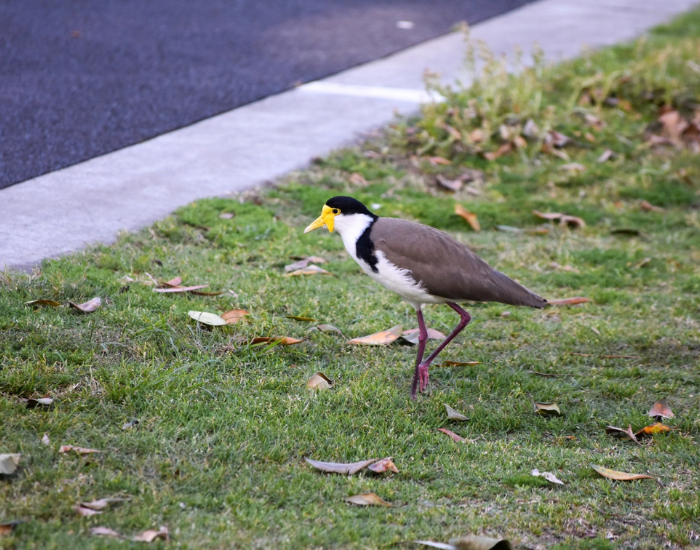
One masked lapwing greeted us on arrival, standing on the grass near the entrance. Locals call them plovers, and everyone knows the swooping season. Those yellow facial wattles and the small carpal spur are display tools, not weapons.
Interestingly, lapwings thrive on mown grass because they hunt by sight. A caravan park lawn is perfect habitat, provided the dogs stay on lead.
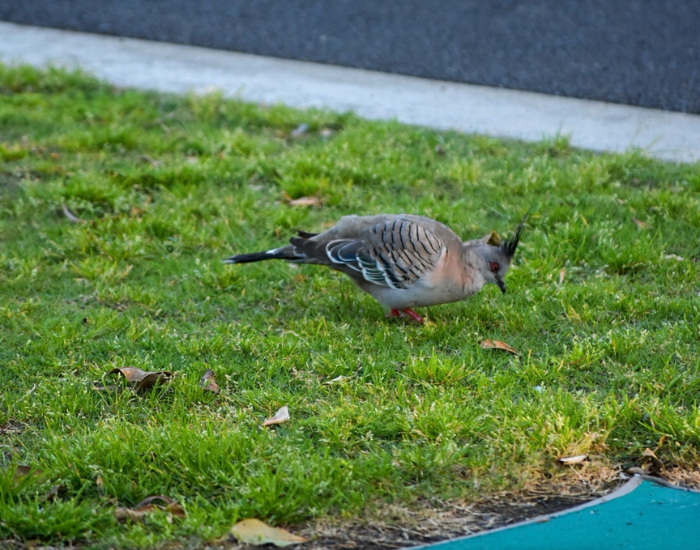
3. Crested Pigeon (Ocyphaps lophotes)
Nine crested pigeons fed on the ground beside our site, unbothered by guests walking past. I call this the punk pigeon because of that thin black crest.
The wings deserve more attention than the hairstyle. A modified eighth primary feather produces a high whistle when the bird flushes, and flock mates take off in response. That is a mechanical alarm signal, not just noise. See my full guide to the pigeons of Australia.
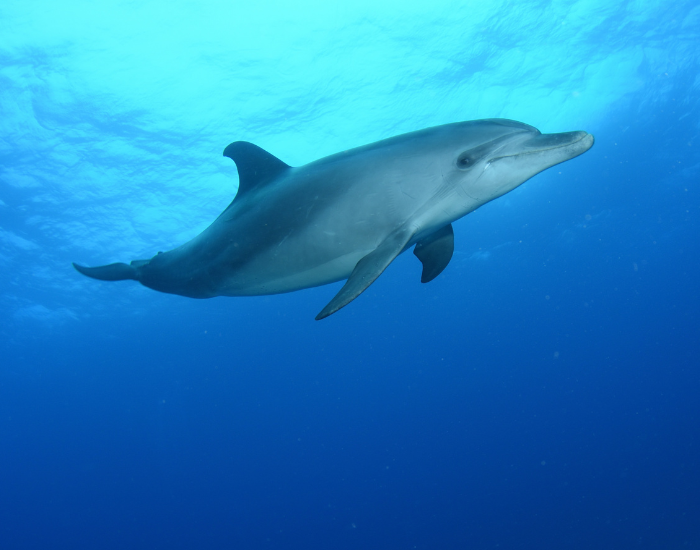
4. Indo-Pacific Bottlenose Dolphin (Tursiops aduncus)
Chinamans Beach gave us the best sighting of the stay. Seven or eight dolphins worked a patch of water just off the sand, barely moving for twenty minutes. Animals that stay put are usually feeding, not travelling.
Genetic work in nearby Moreton Bay shows inshore bottlenose dolphins form fine-scale local populations. The pod you watch here may spend its whole life along this stretch of coast.
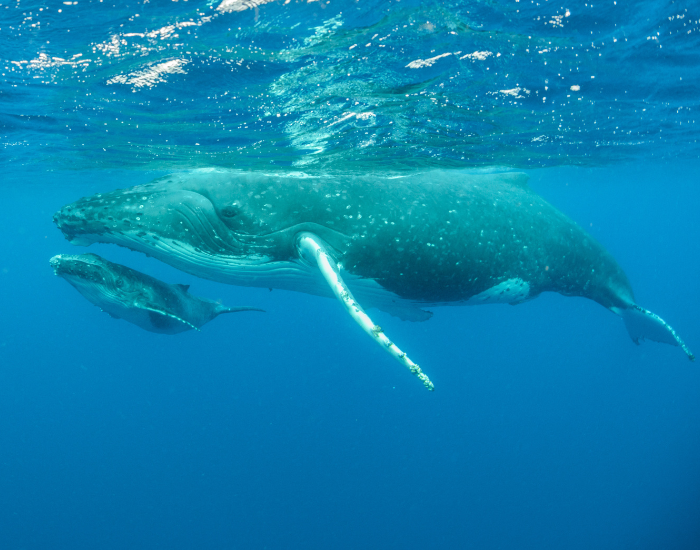
5. Humpback Whale (Megaptera novaeangliae)
Two humpbacks passed within sight of shore on the same morning as the dolphins. Watch the horizon for ten patient minutes and you will usually find a blow or a fin.
The east Australian population has recovered from a few hundred animals to tens of thousands, a rare conservation win. I mapped the whole route in my interactive humpback whale migration.
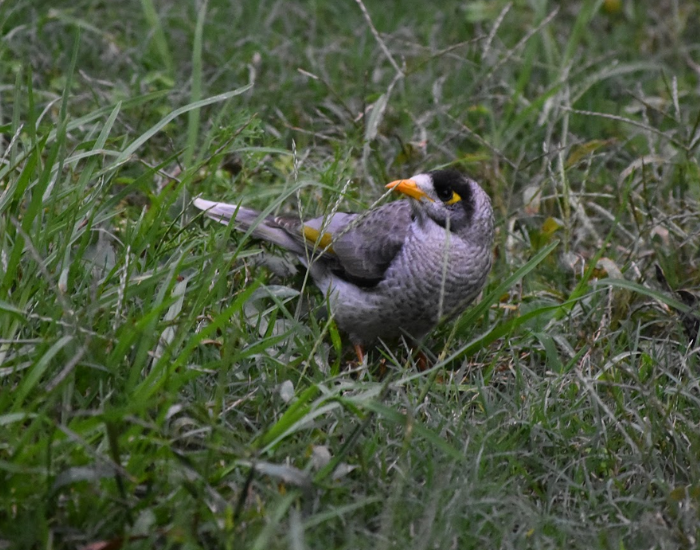
6. Noisy Miner (Manorina melanocephala)
Seven noisy miners held the campground trees and told everyone about it. People confuse them with the introduced Common Myna constantly. This one is native, and it is a honeyeater, not a starling.
That said, native does not mean harmless. Noisy miners aggressively exclude smaller birds from open, fragmented habitat. A landmark Australian study linked their dominance to broad declines in small woodland birds.
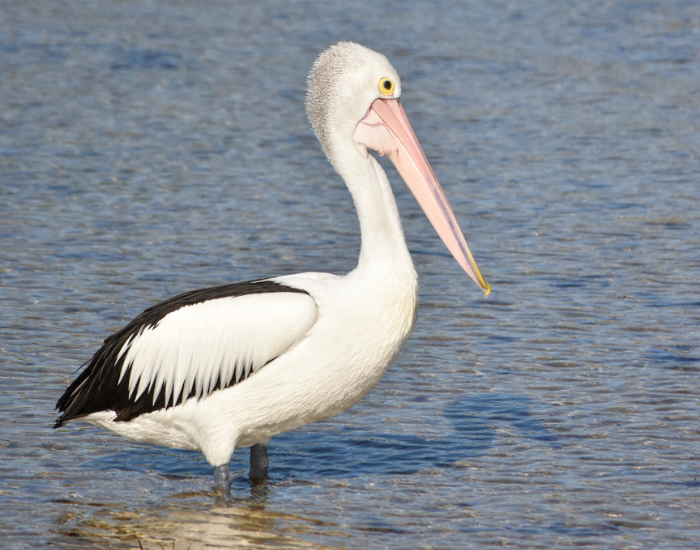
7. Australian Pelican (Pelecanus conspicillatus)
Nine pelicans loafed along the Evans River, and I watched them over breakfast after a morning swim. Their bill holds around 13 litres, the largest of any bird.
Pelicans fish cooperatively in shallow water, herding prey into the bank. Watch a group at low tide and the coordination becomes obvious.
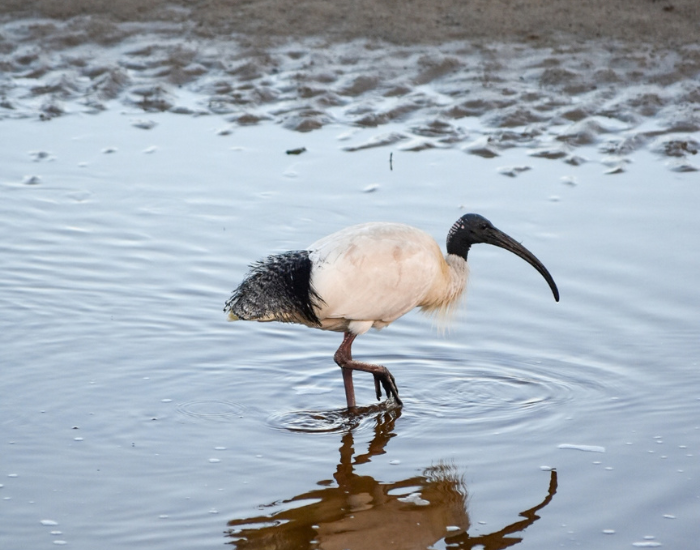
8. Australian White Ibis (Threskiornis molucca)
Nine ibis, and honestly, they were everywhere. Australians roll their eyes at the bin chicken. Visitors photograph it.
Here is the nuance. Inland breeding swamps were drained and dammed, and coastal cities offered reliable food instead. This native wetland bird did not invade our towns so much as get pushed into them. My ibis guide covers the full family.
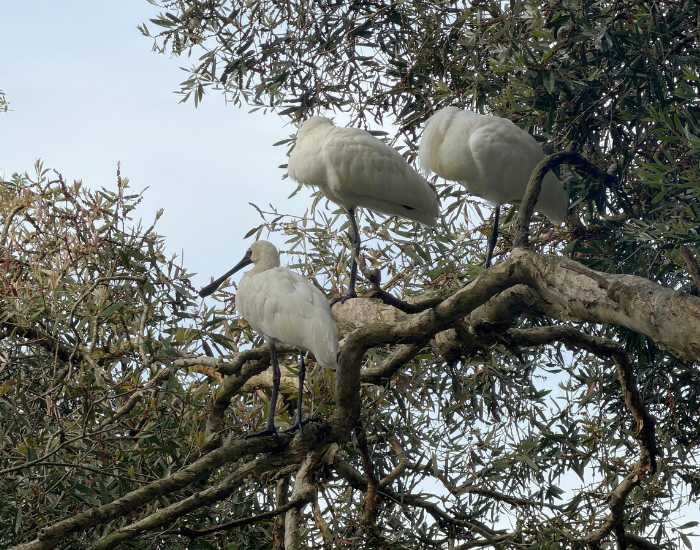
9. Royal Spoonbill (Platalea regia)
Three spoonbills stood in a tree at a park in town, close to the river. From a distance I called them white ibis. We were walking with friends when one yelled “spoonbills!”, and of course, he was right.
The bill is a sensory organ. Spoonbills sweep it through murky water and snap shut on contact, so they feed without seeing prey. Compare them with their pink American cousins in my roseate spoonbill post.
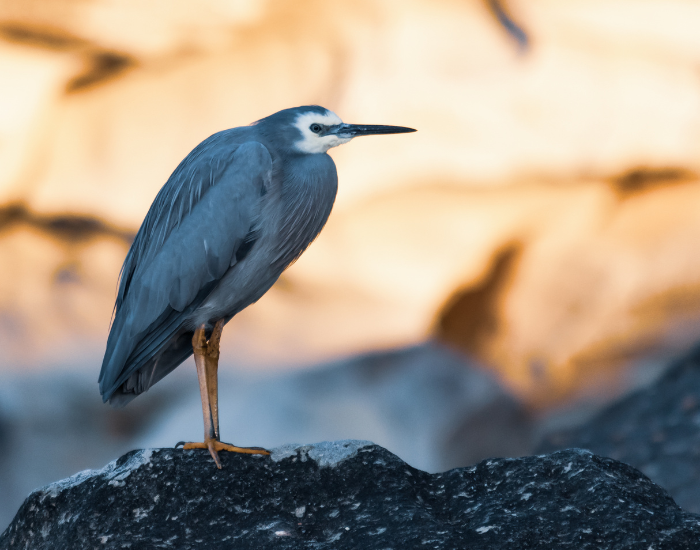
10. White-faced Heron (Egretta novaehollandiae)
Keep walking past Chinamans Beach and you reach a set of rock pools full of shells. One white-faced heron hunted there alone, stalking with that slow, deliberate step.
Herons stir the substrate with one foot to flush prey, a technique called foot-raking. It works best in shallow pools like these. See my guide to heron species.
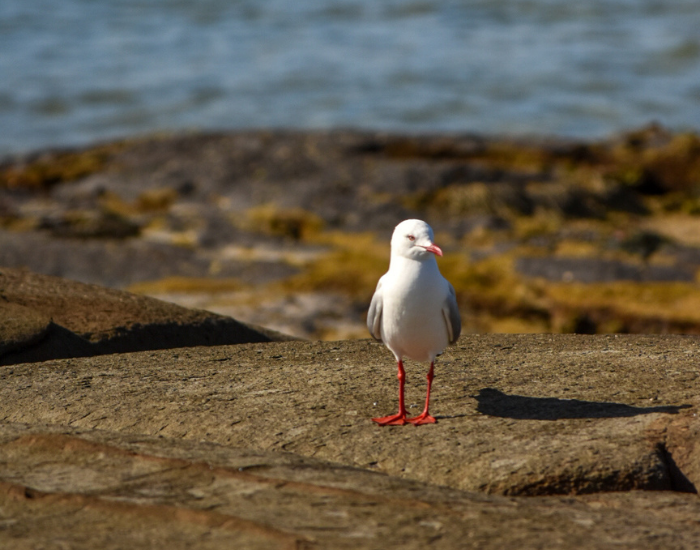
11. Silver Gull (Chroicocephalus novaehollandiae)
Four in my count, but realistically, everywhere. Silver Gulls are the default seabird of the Australian coast and the reason your chips are never safe.
Adults have bright red bills and legs; young birds show dark bills and mottled brown wings. Once you know that, the “different species” on the beach resolve into one.
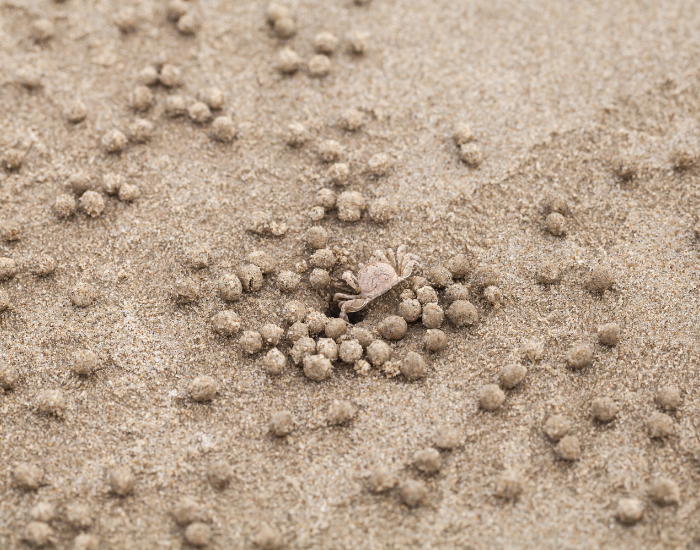
12. Sand Bubbler Crab (Scopimera inflata)
At low tide the beach looked pebbled with grey sand balls. Those pellets are leftovers. Each sand bubbler crab sifts organic matter from a mouthful of wet sand, then discards the rest.
The crabs work outward from their burrows in radiating lines, so the sand records exactly where they fed. Stand still and they emerge around your feet.
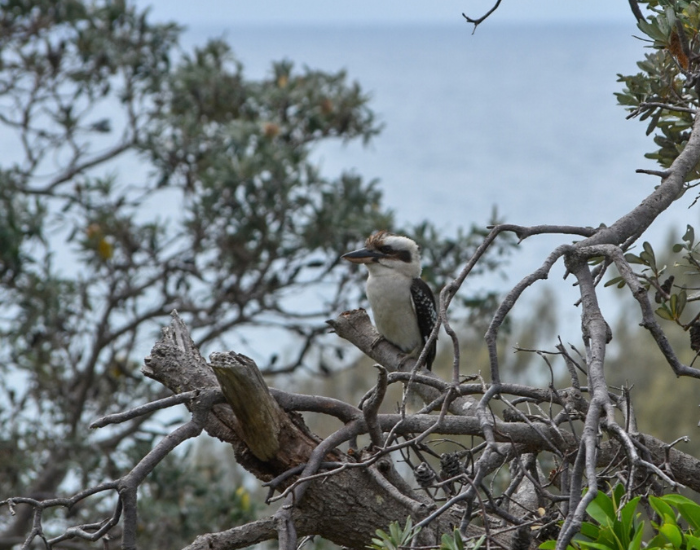
13. Laughing Kookaburra (Dacelo novaeguineae)
Kookaburras laughed every afternoon from the campground trees, and I spotted one on the walk down to the beach. They came closer to people here than at Woody Head, though not tame.
The call is territorial, not cheerful, a family group announcing its boundaries. Kookaburras are the world’s largest kingfishers, which surprises most visitors.
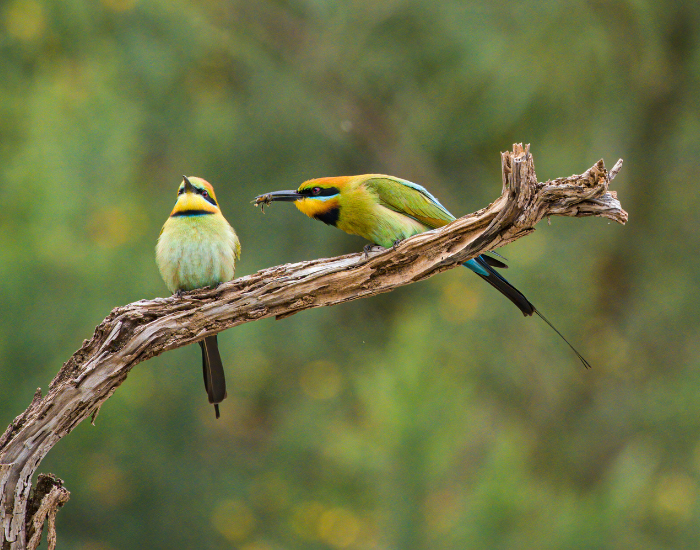
14. Rainbow Bee-eater (Merops ornatus)
Two bee-eaters hunted just past the car park on the walk to the beach. To my eye, they are the most beautiful bird on this list.
Bee-eaters catch stinging insects in flight, then rub the venom sac out against a perch before swallowing. They nest in burrows dug into sandy banks, which the Evans Head dunes supply.
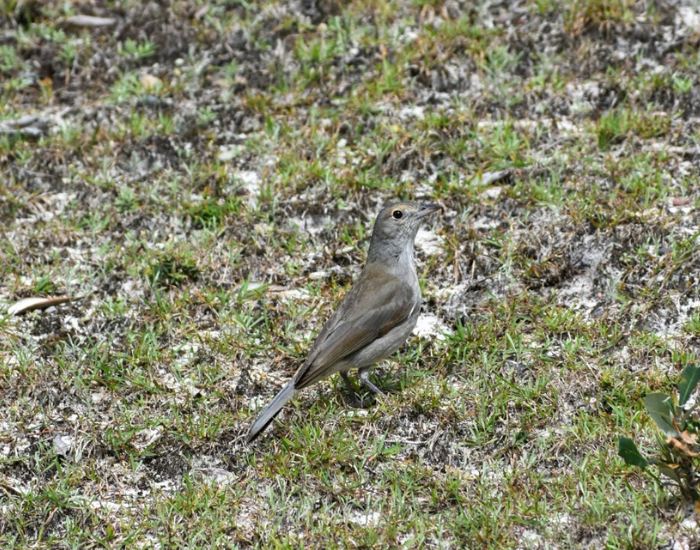
15. Grey Shrikethrush (Colluricincla harmonica)
One bird, same transect as the bee-eaters. Plain grey-brown, easy to overlook, and the best songster in the scrub.
Shrikethrushes work along trunks and branches, prising bark loose for insects. You will hear one before you see it. My roundup of Australian native birds has more of the quiet achievers.
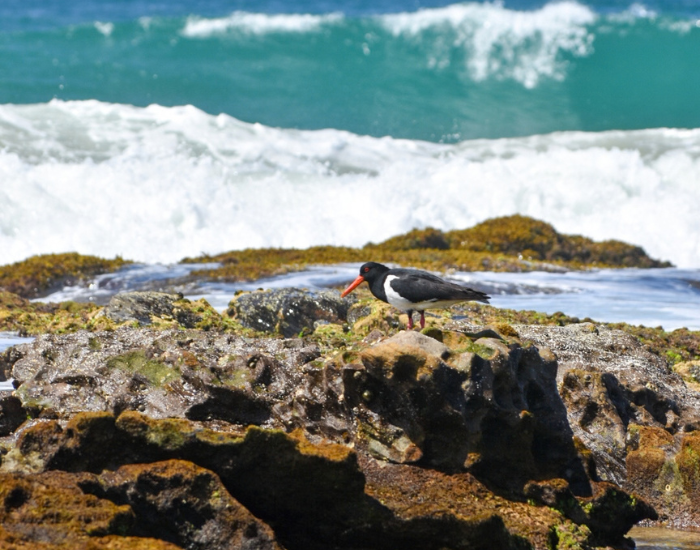
16. Australian Pied Oystercatcher (Haematopus longirostris)
Three oystercatchers patrolled the beach on our morning walks, black and white with that unmistakable orange bill. They are listed as Endangered in New South Wales, with fewer than a few hundred breeding pairs statewide.
Their problem is simple. They nest in a scrape on open sand, exactly where people, vehicles and dogs go. Give them distance and keep dogs leashed near the dunes.
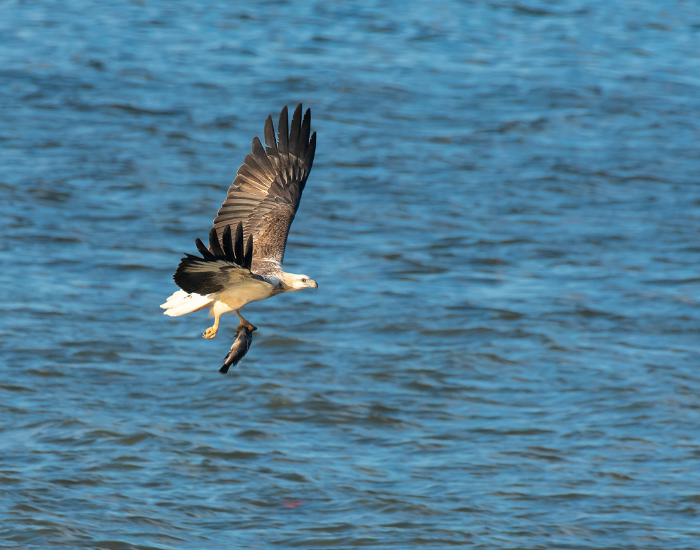
17. White-bellied Sea-Eagle (Haliaeetus leucogaster)
One adult flew low over the canopy, and I lost a minute of my life watching it. Sea-eagles hold huge coastal territories and reuse the same nest tree for years.
They hunt fish near the surface, but they also pirate catches from other birds. Australia’s second-largest raptor features in my types of eagles guide.
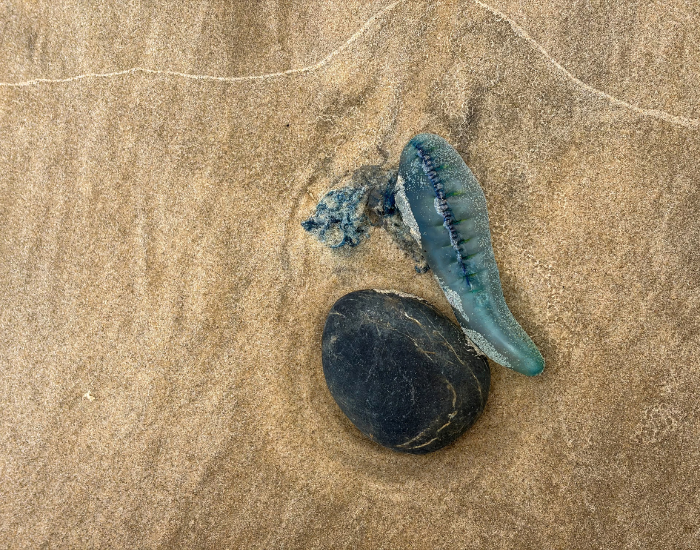
18. Portuguese Man o’ War / Bluebottle (Physalia sp.)
Three lay stranded on the sand, blue and glassy and dangerous. Australian families let their kids play around them with startling confidence. I keep my distance, because detached tentacles still sting.
Taxonomy here is a mess worth knowing. Recent genomic work split what we called one global species into at least four. Your Australian bluebottle may not be the Atlantic man o’ war at all. Note too that this is a siphonophore, a colony of specialised animals, not a single jellyfish.
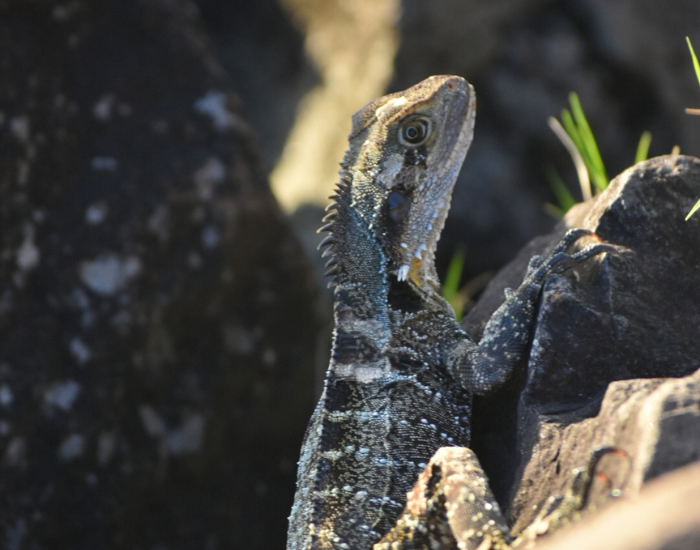
19. Australian Water Dragon (Intellagama lesueurii)
We walked to the end of the seawall. A small juvenile water dragon sat soaking up heat on the rocks. Juveniles stay near water and drop in when threatened, holding underwater for long stretches. These lizards have adapted beautifully to human edges, seawalls, creek paths, picnic areas.
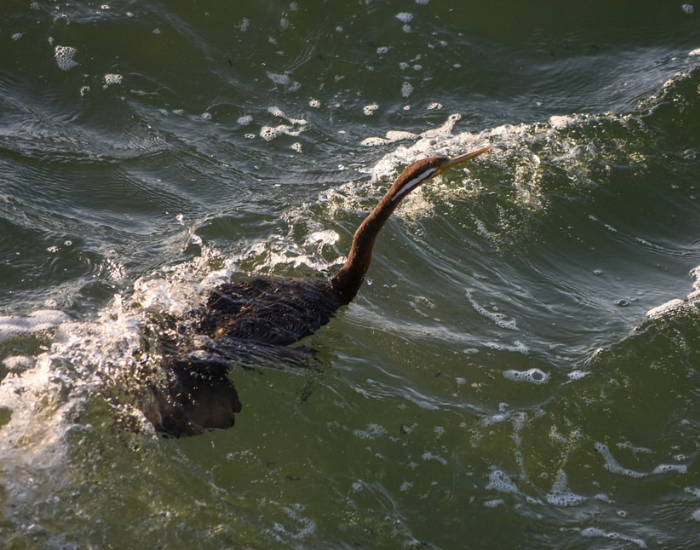
20. Australasian Darter (Anhinga novaehollandiae)
Same walk, same seawall: one darter diving where the ocean meets the creek. Darters swim with only the neck above water, earning the nickname snakebird.
Unlike ducks, their feathers wet through deliberately, cutting buoyancy for underwater pursuit. That is why you see them drying with wings spread.
Frequently asked questions
On the NSW north coast, expect roughly $40 to $60 per night for unpowered sites and $50 to $85 for powered sites in 2026. That lands near $300 to $550 per week for two guests. Cabins and tiny homes cost more, and school holidays lift every rate. Contact the park directly for current details, since Reflections adjusts pricing by season.
Not in town, and overnight parking is not permitted at the beaches. Your closest low-cost alternatives sit inside Bundjalung National Park, where Black Rocks and Woody Head campgrounds charge modest NPWS fees. Both sit a short drive away and stay far quieter. For a powered site with water and hot showers, the caravan park wins.
Cabin rates change by season and by cabin type, so read any figure you find online as a starting point. Linen and towels are provided in the cabins and beach houses, which saves packing. Each one includes a kitchenette with a microwave, and the amenities block sits within easy walking distance. Reviews from couples and families score the riverside setting highly. The park host can steer you to a quieter spot, so book early for holidays.
Reflections Evans Head offers powered and unpowered sites, plus villas, cabins and tiny homes. Three beach houses suit large groups or families travelling together. Dog friendly campsites are available, and the park provides disabled access facilities. Guests also get two camp kitchens, a BBQ area, a playground and a designated EV charging station.
Four days, twenty species, one small town
Reflections Evans Head is not wild, and I would not pretend otherwise. It is a busy holiday park in a quiet town, surrounded by water, and that geography does the heavy lifting. The river feeds the waders, the ocean feeds the whales, and the crabs feed almost everything else.
My advice is simple. Walk the beach at low tide, watch the seawall at the river mouth, then give the horizon ten minutes. As a first caravan park on a big lap, it is a great location. The night sky alone justifies the stay.
The whole project lives at Australia Big Lap, where I map every animal at every stop. Tell me in the comments what you have seen at Evans Head, especially anything I missed.
References:
Ansmann, I. C., Parra, G. J., Lanyon, J. M., & Seddon, J. M. (2012). Fine-scale genetic population structure in a mobile marine mammal: Inshore bottlenose dolphins in Moreton Bay, Australia. Molecular Ecology, 21(18), 4472–4485. https://doi.org/10.1111/j.1365-294X.2012.05722.x
Church, S. H., Abedon, R. B., Ahuja, N., Anthony, C. J., Cunha, T. J., Damian-Serrano, A., Haddock, S. H. D., Helm, R. R., & Dunn, C. W. (2024). Global genomics of the man-o’-war (Physalia) reveals biodiversity at the ocean surface [Preprint]. bioRxiv. https://doi.org/10.1101/2024.07.10.602499
Hingee, M., & Magrath, R. D. (2009). Flights of fear: A mechanical wing whistle sounds the alarm in a flocking bird. Proceedings of the Royal Society B: Biological Sciences, 276(1676), 4173–4179. https://doi.org/10.1098/rspb.2009.1110
Maron, M., Grey, M. J., Catterall, C. P., Major, R. E., Oliver, D. L., Clarke, M. F., Loyn, R. H., Mac Nally, R., Davidson, I., & Thomson, J. R. (2013). Avifaunal disarray due to a single despotic species. Diversity and Distributions, 19(12), 1468–1479. https://doi.org/10.1111/ddi.12128
Noad, M. J., Kniest, E., & Dunlop, R. A. (2019). Boom to bust? Implications for the continued rapid growth of the eastern Australian humpback whale population despite recovery. Remote Sensing in Ecology and Conservation, 5(4), 340–350. https://doi.org/10.1002/rse2.108