I was knee-deep in a mangrove channel off Holbox Island, Mexico, eating fresh ceviche that our local guide had just prepared on the bow of the boat. We’d spent the morning snorkeling with sea turtles and nurse sharks. My legs were still tingling from the saltwater. Then, standing perfectly still in the shallows maybe twenty meters away, a small group of roseate spoonbills appeared like something painted into the landscape. Bright pink, impossibly elegant, those flat spoon-shaped bills sweeping lazily through the water. I’d seen them once before near Mérida, but this felt different, wild mangroves, golden light, the smell of lime and cilantro in the air. These birds stopped me mid-bite. They have that effect on people.
Roseate spoonbills (Platalea ajaja) are among the most visually striking wading birds in the Americas. Yet most people either mistake these birds for flamingos or have never heard of them at all. Sometimes called the rose spoonbill or mistaken for a flat billed pink bird, this species deserves its own spotlight. Here are 12 facts that reveal just how fascinating it really is.
1. They’re Not Flamingos… Not Even Close
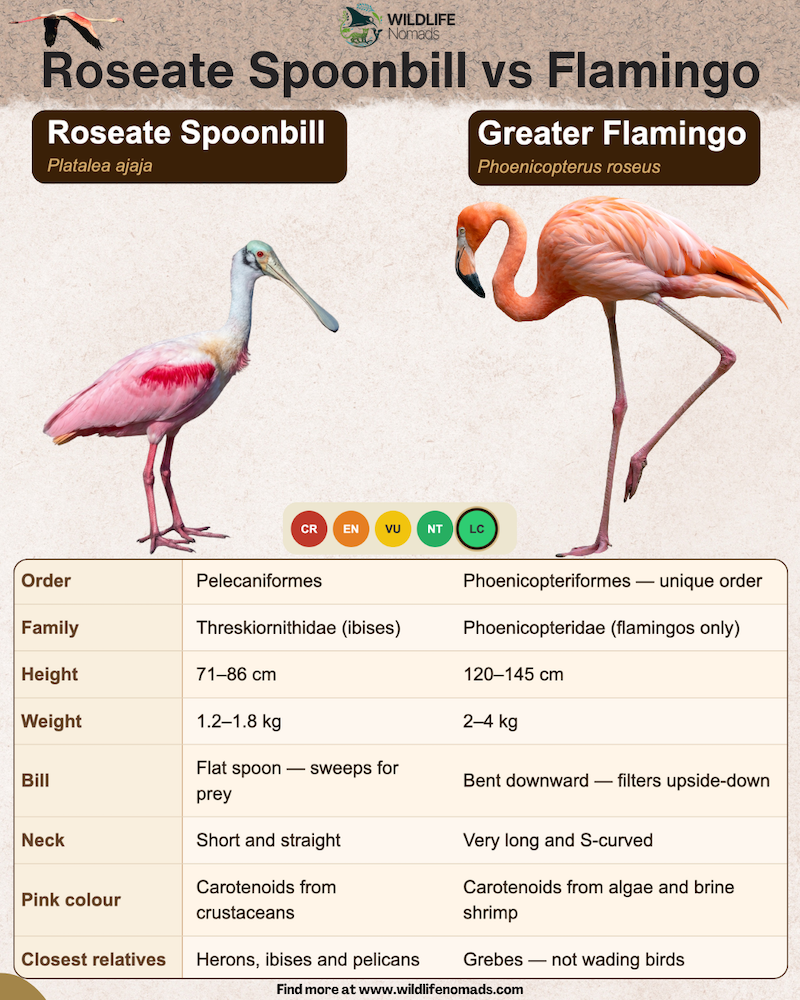
Let’s get this out of the way first. The roseate spoonbill is not a flamingo, not a flamingo like bird in disguise, and definitely not a white pink bird that got a dye job. These two species aren’t even in the same taxonomic family. Spoonbills belong to the family Threskiornithidae, alongside ibises. The pink flying bird people confuse them with sits in an entirely separate order — Phoenicopteridae. The resemblance begins and ends with the pink color. Their body shape, feeding behavior, and evolutionary history are all fundamentally different. Spoonbills share far more DNA with herons and storks than with any flamingo.
2. That Spoon-Shaped Bill Is a Sensory Marvel
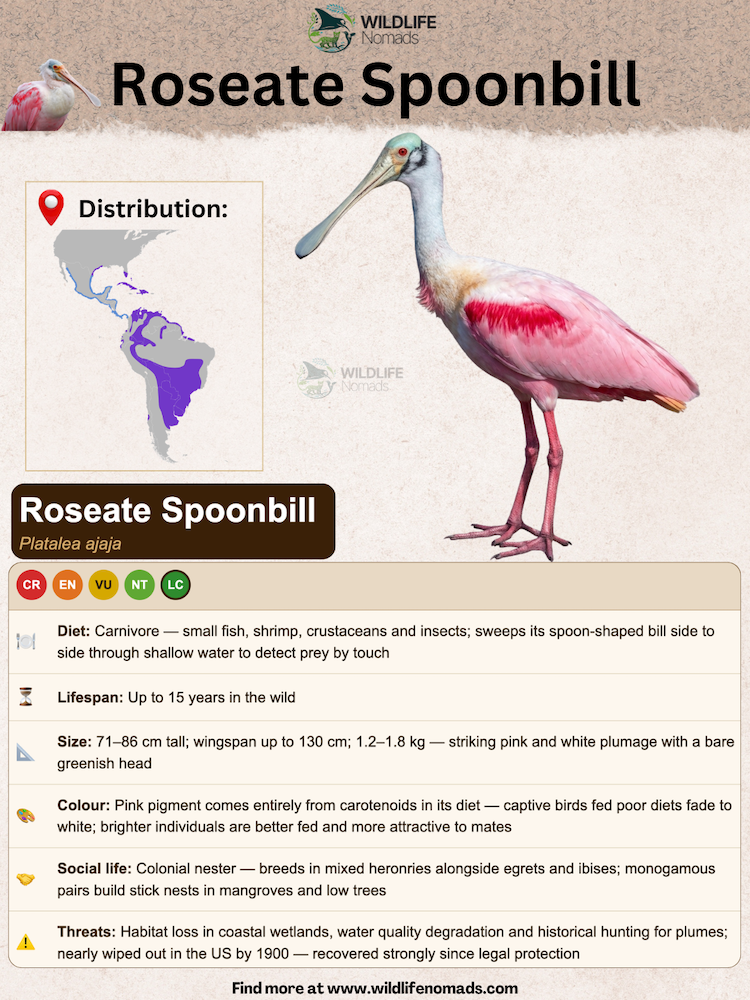
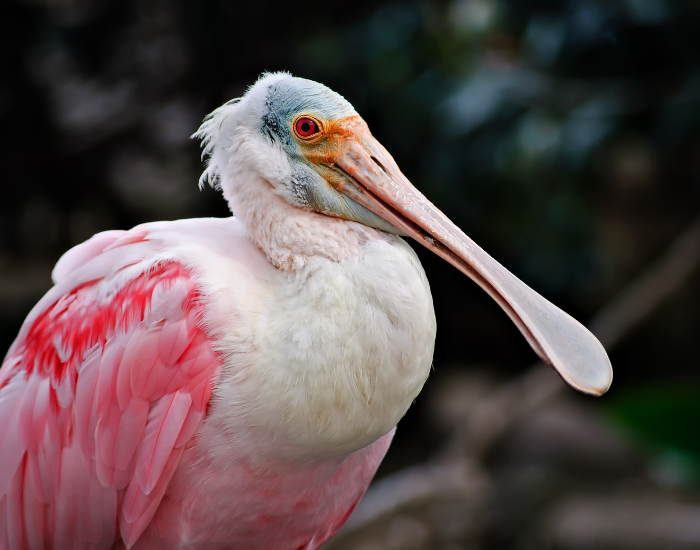
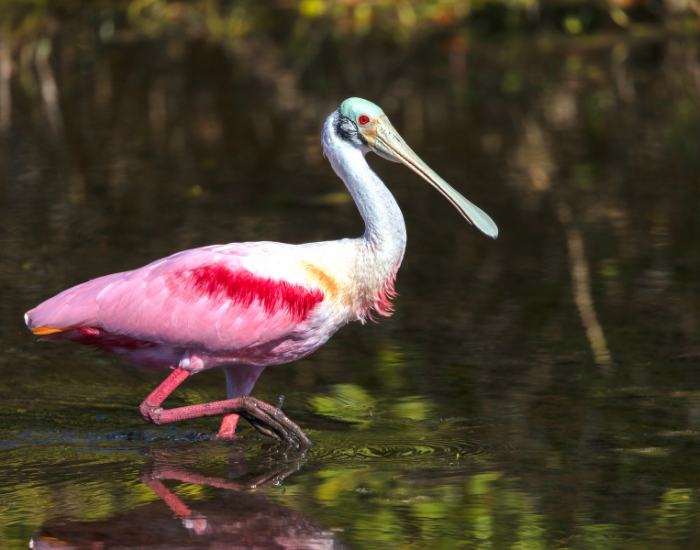
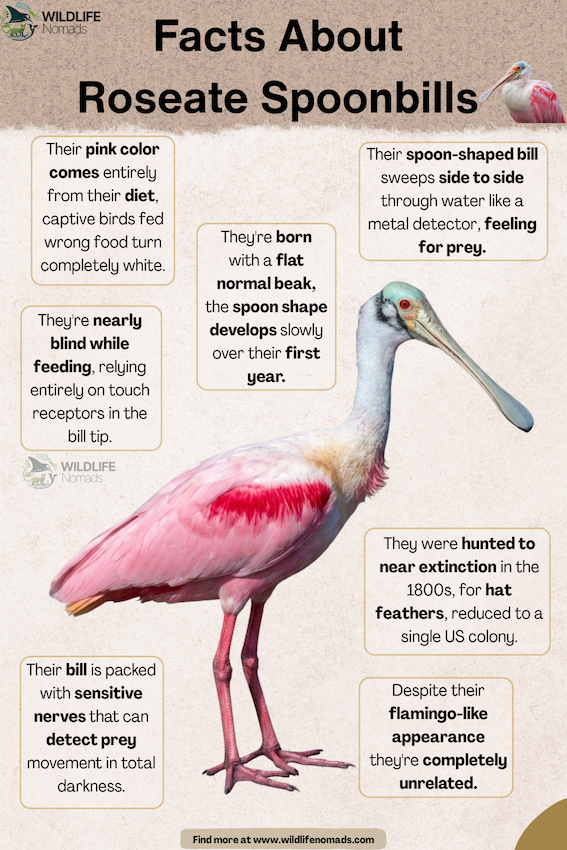
The most obvious feature of any roseate spoonbill is its bill, flat, wide, and shaped like a spatula. This spoon shaped bill isn’t just for show. It contains thousands of sensitive nerve endings that detect prey by touch alone. Spoonbills feed by wading through shallow water with their bill partially open, sweeping it side to side in a motion ornithology researchers call “tactile foraging.”
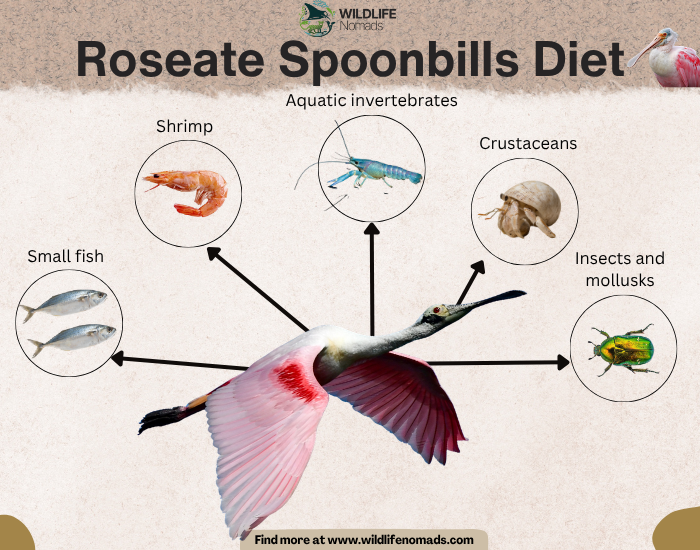
The moment the bill contacts small fish, shrimp, crustaceans, or aquatic invertebrates, it snaps shut in milliseconds. This sweeping motion is so distinctive that you can identify roseate spoonbills forage from hundreds of meters away, even before you see the pink. Among wading birds, few species rely so heavily on tactile feeding, most other birds hunt by sight.
3. Their Pink Comes Entirely from Food
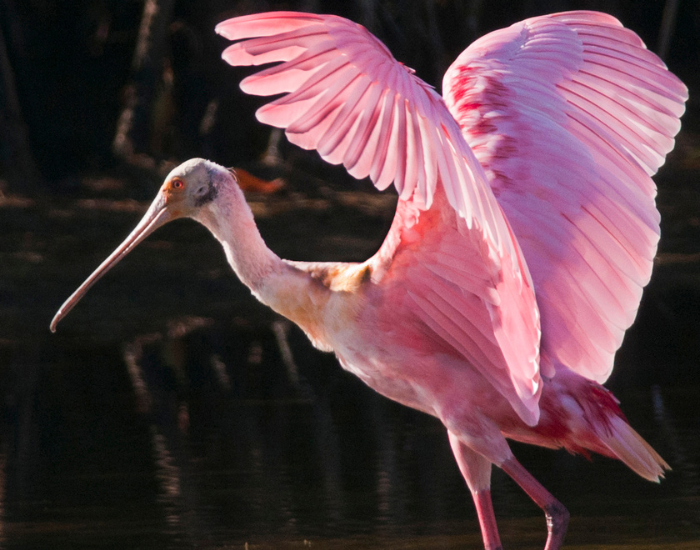
Here’s a fact that connects roseate spoonbills to flamingos after all, both get their pink color from carotenoid pigments in their diet. Specifically, the pigment canthaxanthin accumulates from the shrimp and other aquatic invertebrates these birds eat. The carotenoids bind to keratin in the feathers during molting. A spoonbill with a poor diet will look pale pink or nearly white. Adults with access to abundant prey glow in deep, saturated pink and rose tones. Juveniles start life almost entirely white with just a pale pink wash. As they mature and eat more carotenoid-rich food sources, their bright pink plumage intensifies year after year.
4. Babies Are Born with Straight Bills
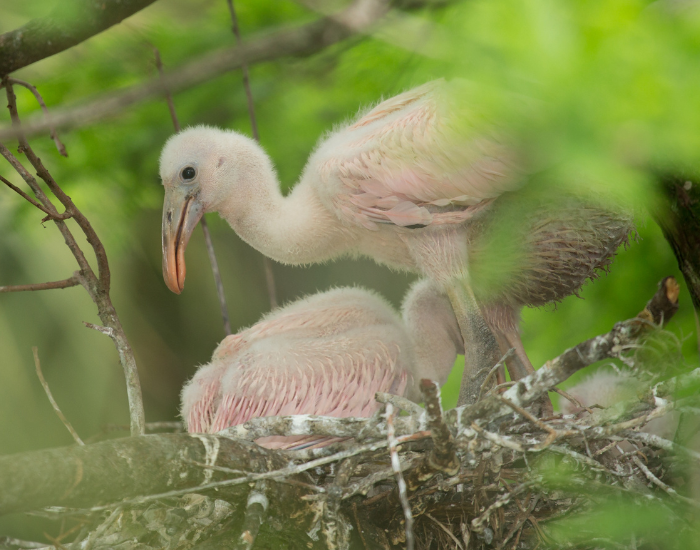
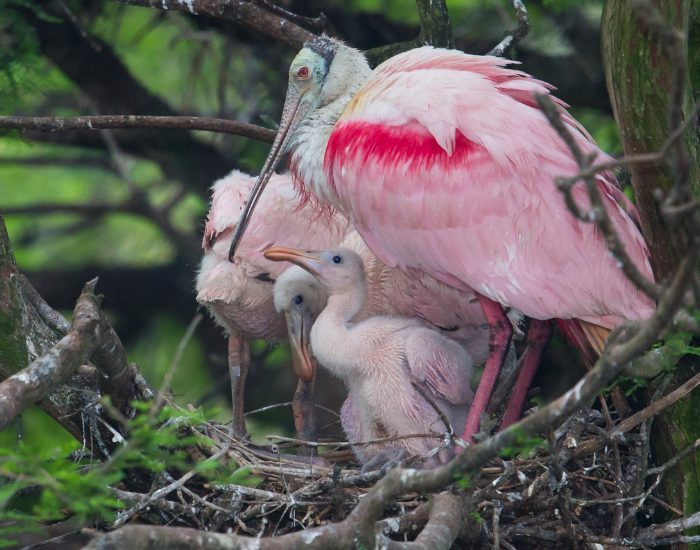
Roseate spoonbill chicks hatch looking nothing like their parents. Their bills are straight and narrow… no spoon shape at all. According to data from the Cornell Lab of Ornithology, the bill begins flattening around day nine. By day sixteen, it starts looking vaguely spoon-like. The full spoon shape doesn’t develop until roughly day thirty-nine. Watching juveniles in nests with their stubby, half-formed bills is a reminder that even the most specialized adaptations develop gradually. These young birds also sport a completely feathered head, a detail that separates them sharply from adults.
5. Adults Lose Their Head Feathers on Purpose
One of the stranger facts about this species: adult roseate spoonbills have bald, greenish-yellow heads. They lose the feathers on top of their heads as they mature. This isn’t a sign of disease or poor health. Ornithology researchers believe the bald head is actually an adaptation for hygiene.
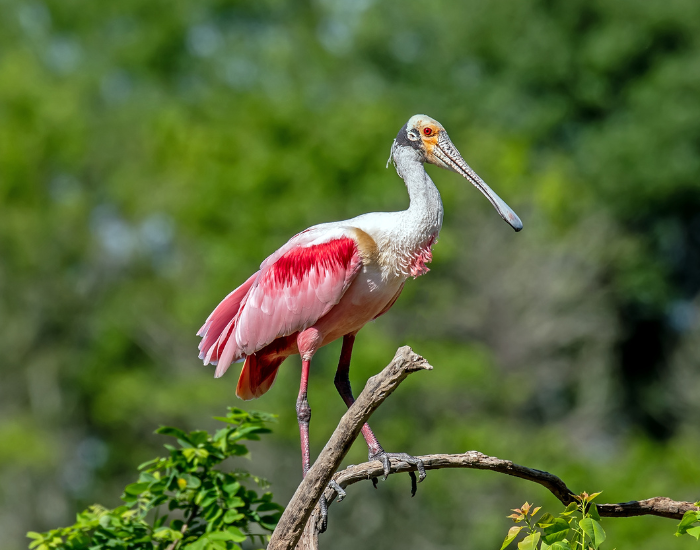
Because spoonbills feed by plunging their heads into muddy, murky water, through marsh, mangroves, and forested swamps, a featherless head is easier to keep clean. Juveniles have a completely feathered head covered in white plumage, but by adulthood, that changes. The bare skin, combined with their red eyes and pink body, gives adults an almost prehistoric look. It’s one of the easiest ways to tell adults from younger birds in the field.

6. They Nearly Vanished Because of Fashion
Between 1850 and 1890, plume hunters devastated roseate spoonbill populations across Florida and the Gulf Coast. Their feathers were harvested for ladies’ fans and hats. The birds’ habit of nesting in colonies with egrets, herons, and other waterbirds made them easy targets, hunters would raid entire nesting sites.
Even birds that survived the initial shooting would often abandon their nests, leaving eggs and chicks to die. By the 1930s, as few as 30 to 40 breeding pairs remained in all of North America, clinging to existence in a few small colonies along the keys of Florida Bay. The species teetered on the edges of extinction. The Migratory Bird Treaty Act of 1918 was critical to stopping the slaughter, but recovery took decades.
7. Texas Is Their Stronghold… Not Just Florida
When most people picture roseate spoonbills, they think of Florida. Fair enough, birds of Florida are famous worldwide. However, Texas actually hosts some of the largest breeding colonies in the United States. The Texas Gulf Coast, particularly areas around Galveston Bay and the Laguna Madre, supports thousands of nesting pairs each breeding season. In Texas, spoonbills build nests in dense shrubs and low trees on isolated islands, often alongside egrets, ibises, and herons.
Adults crowd their nests into trees so tightly that branches bend under the weight of entire colonies. These mixed-species colonies can contain hundreds of nests packed into a few acres. You can also find smaller populations along the Gulf Coast of Louisiana, Georgia, and increasingly further inland and north as their range expands.
8. Their Range Is Expanding Thanks to Climate Change
This is a rare conservation story with a somewhat positive twist. Following decades of protection, roseate spoonbill populations have rebounded significantly. According to the North American Breeding Bird Survey, their numbers increased by nearly 6.5% per year between 1966 and 2019. Warming temperatures have pushed their range northward. Spoonbills now breed in states where they were historically absent.
Birders in the Carolinas, Virginia, and even New York have reported sightings of these birds. The species is currently classified as Least Concern by the IUCN and is considered locally common across much of its historical range. That said, this expansion also reflects shifting ecosystems, and what benefits one species may stress others.
9. They Need Very Specific Habitat to Thrive
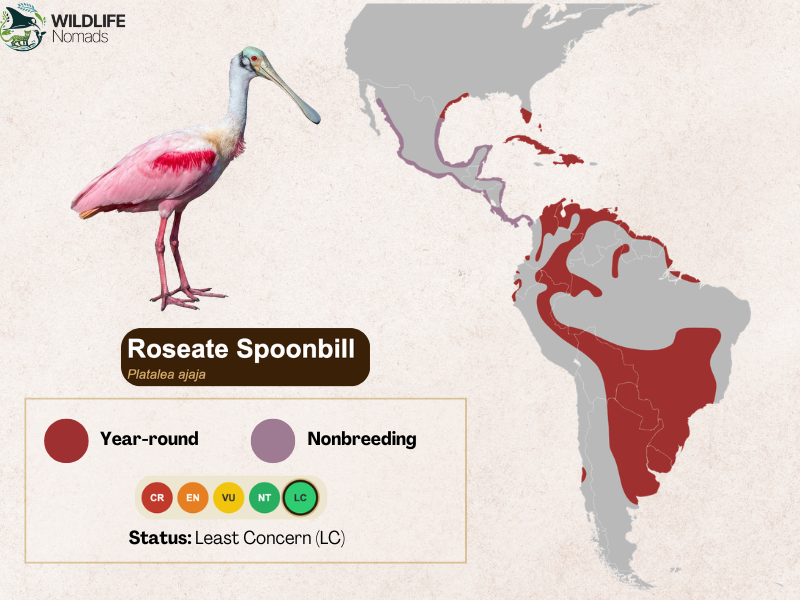
Roseate spoonbills aren’t generalists. They depend on shallow water, ponds, lagoons, marsh edges, mangroves, and freshwater habitats where water levels concentrate prey. They forage in both saltwater wetlands and fresh water environments, from coastal mudflats to inland rivers and tidal creeks. You’ll also find roseate spoonbills forage along rivers, lakes, and forested swamps farther from the coast. The key requirement is standing water shallow enough for their sweeping feeding style to work.
Too deep, and the bill can’t make contact with prey. Too dry, and the small fish, insects, mollusks, and crustaceans they depend on disappear. These habitats support the dense concentrations of food that spoonbills require. In Florida, researchers at Everglades National Park use roseate spoonbills as an indicator species, their nesting success reflects the overall health of freshwater flow through the Everglades system. When habitats degrade, these birds are among the first to show declines in body condition and reproductive output. Places like Orlando Wetlands Park offer excellent viewing opportunities during winter months.
10. Nesting Season Is a Full Production
Breeding season for roseate spoonbills typically runs from November through spring in Florida, and from March through summer in Texas. Males court females with dramatic displays, shaking branches, bobbing their heads, and clapping their bills. Once paired, both adults build the nest together from sticks, twigs, and plant material, usually positioned in trees or dense shrubs over or near water.
Females lay two to five eggs per clutch. Both parents share incubation duties for about 22 to 24 days. The chicks fledge at roughly six weeks but may return to the nest to beg for food for several more weeks. Roseate spoonbill nests are rarely solitary, these birds always nest in colonies, often with dozens of other waterfowl species.
11. They’re One of Only Six Spoonbill Species Worldwide
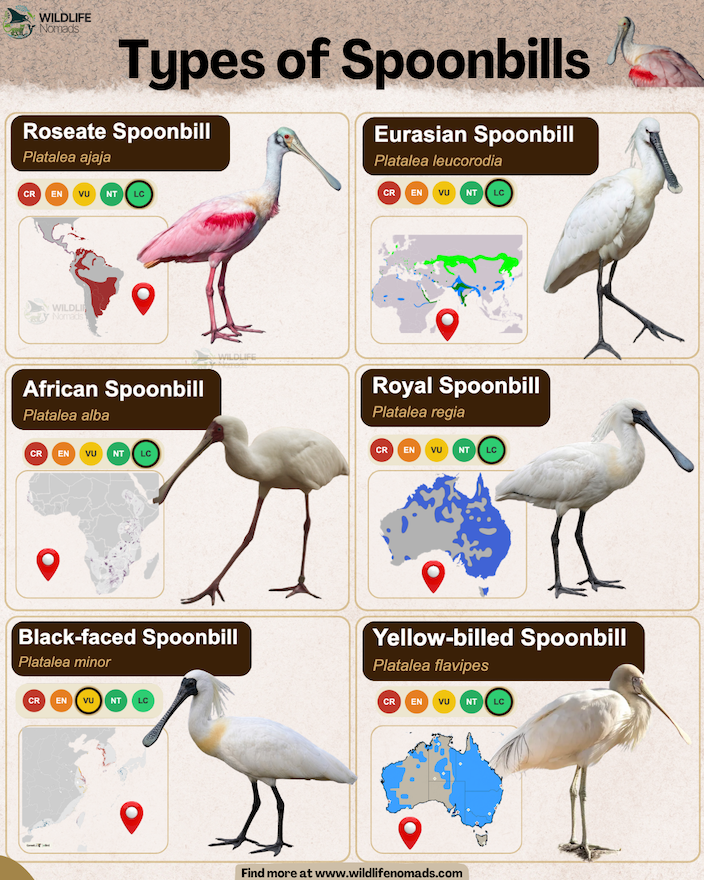
The roseate spoonbill is the only spoonbill species found in the Americas. Globally, there are six spoonbill species spread across every continent except Antarctica. The others, the Eurasian spoonbill, African spoonbill, black-faced spoonbill, royal spoonbill, and yellow-billed spoonbill, occur across Europe, Asia, Africa, and Australia.
Genetic studies published in Molecular Phylogenetics and Evolution found that the roseate and yellow-billed spoonbills are each other’s closest relatives, having diverged from the common ancestor of all other spoonbills early in the family’s evolutionary history. The roseate spoonbill’s range extends from the southeastern United States through Central America and across much of South America, making it one of the most widely distributed members of its family.
12. Their Feathers Tell Their Life Story
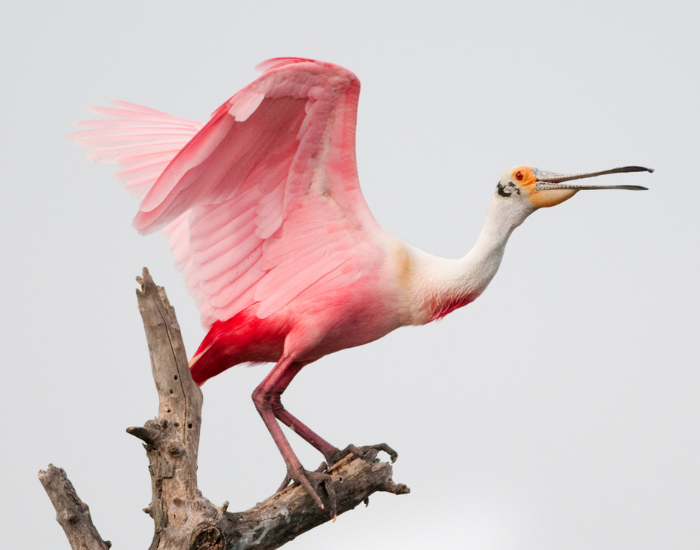
You can roughly age a roseate spoonbill just by looking at it. Juveniles appear mostly white with pale pink wings and a fully feathered head. As birds with pink wings mature through their first and second years, the pink color deepens progressively. Subadults show a mix of pale pink and white across their body and neck. Fully mature adults, typically three years and older, display deep rose-pink feathers across the wings and body, a bare greenish head, an orange tail, and bright red shoulder patches.
Their long legs wade through the shallows while their white neck transitions into that signature pink. The neck thickens with age, and older adults develop a muscular neck that supports their heavy bill during hours of tactile foraging. Each flock you encounter likely contains a visible gradient of ages, from brown-tinged juveniles to the most vividly pink adults. Even the bill changes, from yellowish in young birds to a mottled gray-green in older individuals.
Frequently Asked Questions
Roseate spoonbills were once extremely rare in North America, with fewer than 40 breeding pairs by the 1930s after plume hunters decimated their populations. Today, they have recovered significantly and are classified as Least Concern by the IUCN. They are locally common across Florida, Texas, and the Gulf Coast. However, they remain uncommon inland and are still expanding their range northward.
Roseate spoonbills get their pink color from carotenoid pigments — specifically canthaxanthin — found in the shrimp and aquatic invertebrates they eat. The pigments deposit into their feathers during molting. A spoonbill with a poor diet will appear much paler. This is the same mechanism that gives flamingos their color. If you’ve ever searched for “pink florida bird” or “duck billed flamingo,” the roseate spoonbill is almost certainly the bird you saw.
Male and female roseate spoonbills look nearly identical. Both sexes display the same pink plumage, bald head, and spoon shaped bill. Males are slightly larger on average and tend to have marginally longer bills, but these differences are subtle. The roseate spoonbill wingspan measures 120 to 133 centimeters in both sexes. You typically can’t distinguish a female roseate spoonbill from a male without direct measurements or behavioral observation during breeding season.
A Rose Colored Bird Worth Protecting
Roseate spoonbills survived plume hunters, habitat destruction, and the edges of extinction. Their comeback is one of North American ornithology’s genuine success stories — proof that legal protection and habitat conservation work when sustained over decades. Yet their future depends on healthy wetlands, stable freshwater flow, and the same coastal habitats that face mounting pressure from development and sea-level rise.
Next time you’re near a Gulf Coast marsh or a Florida mangrove, slow down and look for that unmistakable flash of pink. These birds reward patience. If you want to explore more about the incredible birds that share their habitats, from towering whooping cranes to the stately great blue heron — we’ve got you covered. Drop a comment below if you’ve spotted roseate spoonbills in the wild. I’d love to hear where.
References:
Chesser, R. T., Yeung, C. K. L., Yao, C.-T., Tian, X.-H., & Li, S.-H. (2010). Molecular phylogeny of the spoonbills (Aves: Threskiornithidae) based on mitochondrial DNA. Molecular Phylogenetics and Evolution, 56(1), 256–263. https://doi.org/10.1016/j.ympev.2010.01.033
Dumas, J. V. (2000). Roseate Spoonbill (Platalea ajaja). In A. F. Poole & F. B. Gill (Eds.), The Birds of North America, No. 490. Cornell Lab of Ornithology. https://doi.org/10.2173/bna.490
Lorenz, J. J. (2014). The relationship between water level, prey availability, and reproductive success in roseate spoonbills foraging in a seasonally-flooded wetland while nesting in Florida Bay. Wetlands, 34(S1), 37–49. https://doi.org/10.1007/s13157-012-0364-y
Lorenz, J. J. (2014). A review of the effects of altered hydrology and salinity on vertebrate fauna and their habitats in northeastern Florida Bay. Wetlands, 34(S1), 89–99. https://doi.org/10.1007/s13157-013-0377-1
Rojas, L. M., McNeil, R., Cabana, T., & Lachapelle, P. (1999). Behavioral, morphological and physiological correlates of diurnal and nocturnal vision in selected wading bird species. Brain, behavior and evolution, 53(5-6), 227–242. https://doi.org/10.1159/000006596
Thomas, D. B., McGraw, K. J., Butler, M. W., Carrano, M. T., Madden, O., & James, H. F. (2014). Ancient origins and multiple appearances of carotenoid-pigmented feathers in birds. Proceedings of the Royal Society B, 281(1788), 20140806. https://doi.org/10.1098/rspb.2014.0806