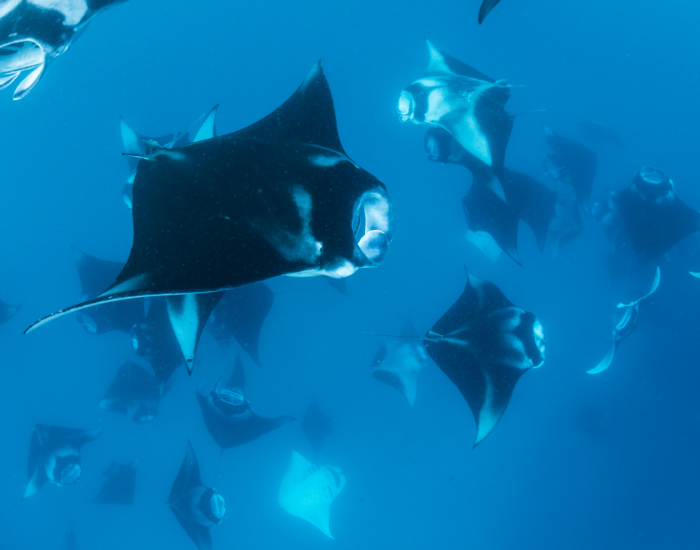
Discovering the World’s Most Emblematic Birds
Step into the heart of the world’s most biodiverse ecosystems, and you’ll be greeted by a symphony of calls, a kaleidoscope of colors, and some of the most extraordinary creatures on Earth! If you have hiked along one, you will know what I mean. The world’s rainforests are home to the greatest diversity of tropical birds. Jungle birds represent nature’s most spectacular evolutionary achievements, showcasing incredible adaptations that have allowed them to thrive in the dense, humid environments of tropical rainforests.
Growing up in Mexico, I was always surrounded by birds, whether it was the chatter of parakeets in city parks or the sudden flash of wings in the countryside. But it wasn’t until I began traveling deeper into the country’s lush jungles that I truly understood how diverse and breathtaking birdlife could be. I still remember the first time I saw a scarlet macaw flying freely over the forests of Chiapas. Its wings lit up the sky like fire against the emerald canopy, and for a moment I could hardly believe my eyes. Years later, while wandering through the dense rainforests of Sumatra, I spotted a hornbill gliding through the trees, its oversized beak and prehistoric silhouette unlike anything I’d seen before!
Let’s explore 12 of the most amazing jungle birds that call the world’s rainforests home. Most birds in these environments have developed unique adaptations to thrive in the world’s rainforests, from the towering canopies of the Amazon to the dense undergrowth of the Congo Basin.

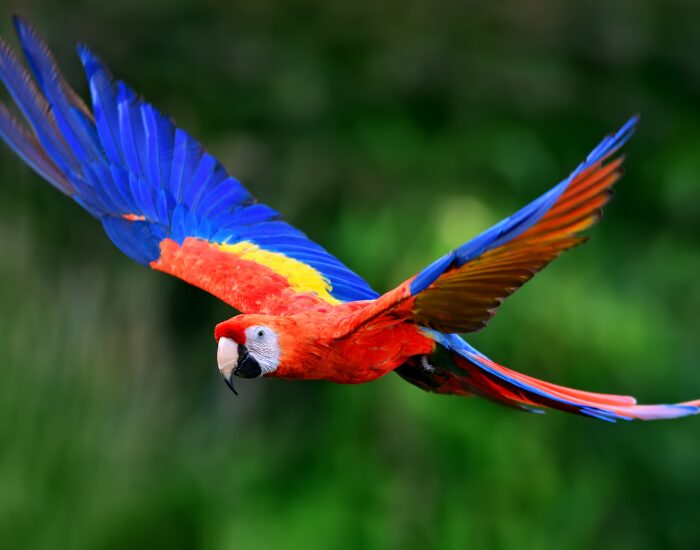
1. Scarlet Macaw (Psittacus macao) – The Amazon’s Living Rainbow
No bird represents the vibrancy of the Amazon quite like the Scarlet Macaw. They have a bright red, yellow, and blue feathers. This parrot is a living rainbow! These magnificent rainforest birds are among the largest parrots in the world, with wingspans reaching up to 33 inches and weighing up to 2.2 pounds.
What makes Scarlet Macaws truly special isn’t just their stunning appearance – it’s their incredible intelligence and social bonds. Scarlet Macaws are known for their strong, sociable bonds, often seen flying in pairs or small flocks. These birds mate for life and can live up to 80 years, making them one of the longest-lived jungle birds in the Amazon.
Habitat and Distribution:
- Primary range: Amazon rainforest across Brazil, Peru, Colombia, and Ecuador, within tropical South America
- Preferred habitat: Tall canopy trees near rivers and clearings
- Diet: Fruits, nuts, seeds, and clay from riverbanks (for essential minerals)
Unfortunately, domestication and deforestation have negatively impacted this Amazon bird’s population, making several macaw species endangered. Conservation efforts are crucial to protecting these iconic symbols of the rainforest. If you want to know more beautiful parrtos, visit our blog ” 15 Fascinating Types of Parrots“.
2. Harpy Eagle (Harpia harpyja) – The Amazon’s Apex Predator
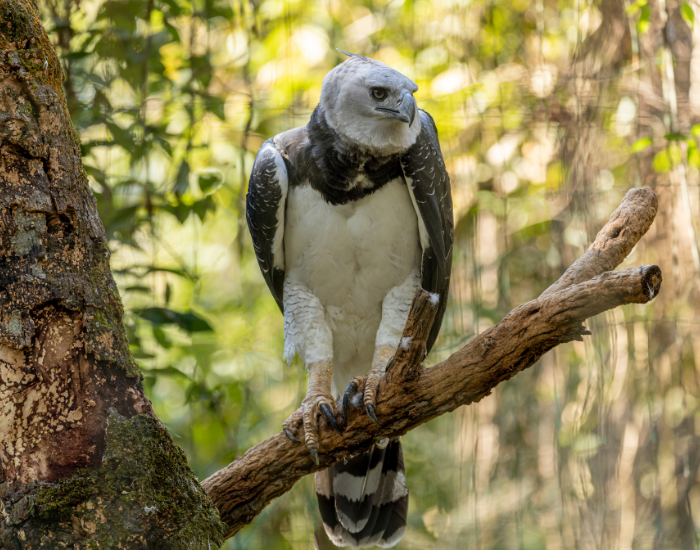
Meet the undisputed ruler of the Amazon canopy. Undoubtedly one of the most majestic Amazon birds, the harpy eagle is over a metre tall, and has a wingspan of 2 m. Its legs and feet are extraordinarily thick and powerful, while the head has a tall, blackish-grey crest of feathers.
The Harpy Eagle represents the perfect adaptation to rainforest hunting. Their broad wings allow them to maneuver through dense forest canopies with surprising agility, while their powerful talons – larger than those of a grizzly bear – can crush the bones of their prey instantly.
Key Characteristics:
- Weight: Up to 20 pounds (females are larger than males)
- Prey: Sloths, monkeys, iguanas, and other arboreal mammals
- Hunting strategy: Silent flight through the forest canopy
- Conservation status: Near threatened due to habitat loss
These magnificent raptors are so elusive that many indigenous communities consider spotting one a sign of good fortune. Their presence indicates a healthy rainforest ecosystem, making them an important indicator species for conservationists. You are intrigues by this beautiful raptor: have a loot at our articles to learn more:
- Harpy Eagle Facts
- Birds of Prey: Indise the World of raptors.
3. Toco Toucan (Ramphastos toco) – The Rainforest’s Most Recognizable Bill
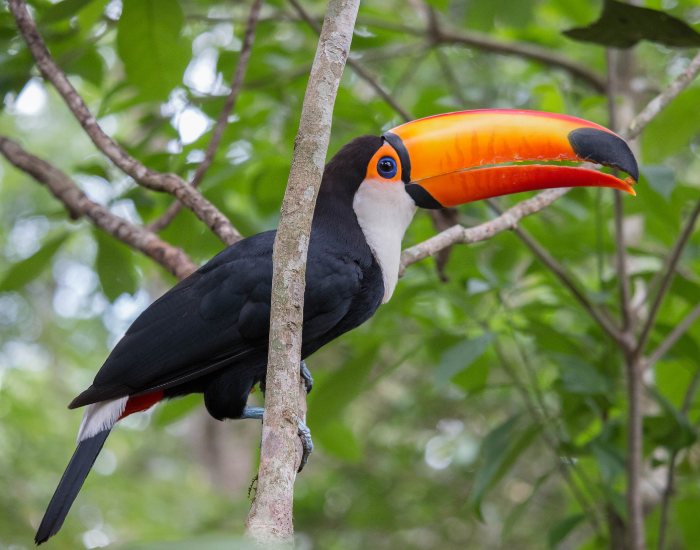
With its oversized, colorful beak and distinctive appearance, the Toco Toucan is perhaps the most recognizable of all jungle birds. That famous beak isn’t just for show – it serves multiple crucial functions in the rainforest environment.
Despite its impressive size (up to one-third of the bird’s total body length), the toucan’s beak is surprisingly lightweight, composed of a honeycomb-like structure that makes it both strong and manageable. This remarkable adaptation allows toucans to reach fruit on branches too thin to support their body weight.
Ecological Importance:
- Seed dispersal: Toucans are crucial for forest regeneration, spreading seeds across wide areas
- Thermoregulation: Their large beaks help regulate body temperature in hot, humid conditions
- Social signaling: Beak size and coloration play important roles in mating displays
Toco Toucans are found throughout the Amazon Basin and are generally stable in population, though habitat destruction remains a concern for their long-term survival. Interested in biodiversity of the amazon, have a look at the blog entry : “Animals of Brazil“
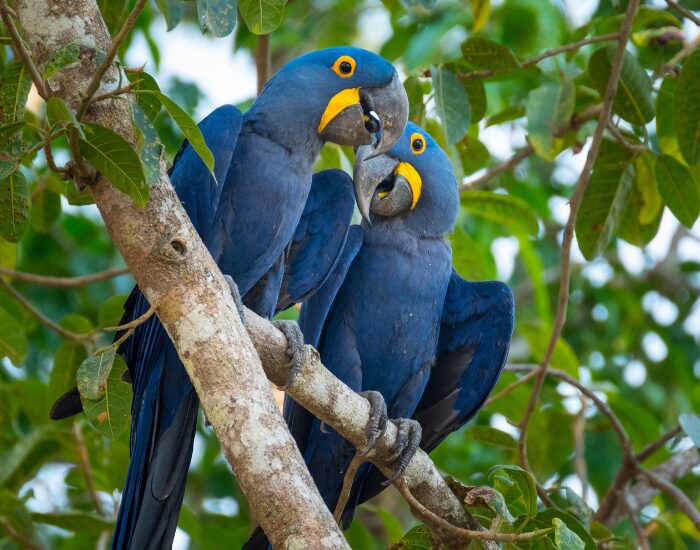
4. Hyacinth Macaw (Anodorhynchus hyacinthinus) – The Gentle Giant
The Hyacinth Macaw holds the distinction of being the largest parrot in the world, with a striking cobalt-blue plumage that seems to glow in the dappled rainforest light. Despite their impressive size – reaching up to 40 inches in length – these birds in the rainforest are known for their gentle, curious nature.
What sets Hyacinth Macaws apart from other parrots is their specialized diet and habitat requirements. They primarily feed on palm nuts, using their incredibly powerful beaks to crack open even the hardest shells. This specialization makes them vulnerable to habitat changes and palm tree harvesting.
Conservation Challenges:
- Population: Estimated 4,300 individuals in the wild
- Threats: Habitat loss, illegal pet trade, and limited food sources
- Protection efforts: Breeding programs and habitat preservation initiatives
- Success stories: Population has increased by 30% in recent years due to conservation efforts
The Hyacinth Macaw’s recovery story demonstrates how targeted conservation efforts can make a real difference for endangered jungle birds.
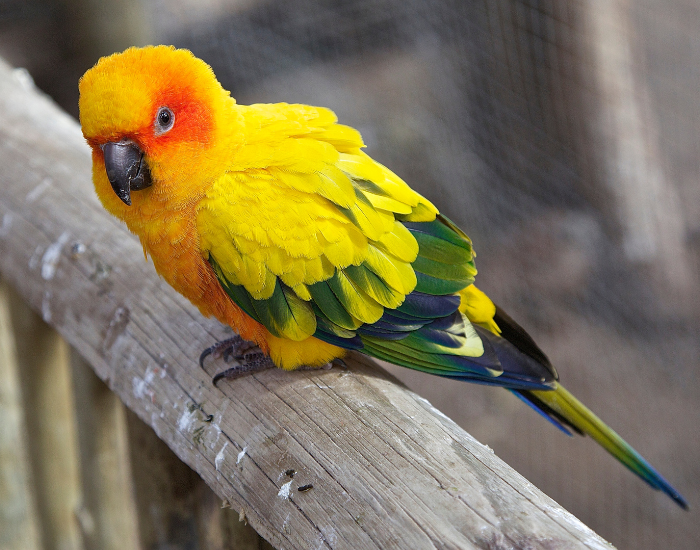
5. Sun Parakeet (Aratinga solstitialis) – The Golden Jewel of the Canopy
The Sun Parakeet is appropriately named: It bears little of the green or red typically associated with parrots, but instead is a brilliant gold with an orange flush on its head and face, shining like the sun. These medium-sized parrots bring a burst of sunshine to the rainforest canopy.
Unlike many other rainforest birds that prefer the understory, Sun Parakeets are canopy specialists, spending most of their time in the upper reaches of the forest. Their bright coloration, which might seem conspicuous to us, actually provides excellent camouflage among the sun-dappled leaves of the canopy.
Behavioral Highlights:
- Flock dynamics: Travel in groups of 20-50 individuals
- Nesting: Use tree cavities, often competing with other species for prime real estate
- Communication: Extremely vocal, with complex calls that can be heard over long distances
- Diet: Fruits, flowers, and young leaves from a variety of tree species
Its range is limited to large areas of intact forest in northern Brazil and Guyana, making habitat preservation crucial for their survival. At the height of the illegal pet trade, hundreds of thousands of Sun Parakeets were taken from the wild annually, severely impacting their population.
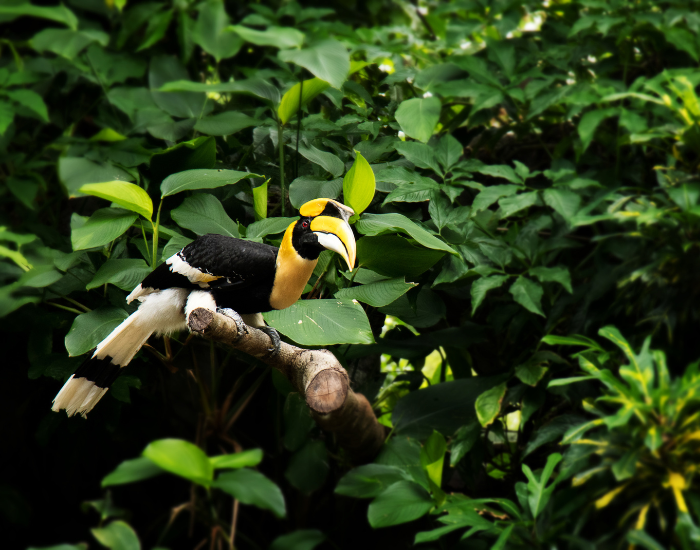
6. Great Hornbill (Buceros bicornis) – Asia’s Rainforest Giant
Moving from the Americas to Asia, the Great Hornbill represents one of the most impressive jungle birds in the Indonesian and Malaysian rainforests. These massive birds can reach lengths of up to 4 feet and weights of 6.6 pounds, making them one of the largest birds in Asian forests.
The Great Hornbill’s most distinctive feature is its casque – a hollow, horn-like structure on top of its massive bill. This casque serves multiple purposes: it amplifies the bird’s calls, plays a role in courtship displays, and may help with thermoregulation in the hot, humid rainforest environment.
Unique Breeding Behavior:
- Nesting ritual: Females seal themselves inside tree cavities during incubation
- Male responsibility: Males feed the female and chicks through a small opening
- Incubation period: 38-40 days, with chicks remaining in the nest for 3 months
- Parental care: Both parents continue feeding young for weeks after fledging
Great Hornbills are considered sacred in many Southeast Asian cultures and play important roles in local folklore and traditions. If you are as interested as me in these impressive looking dinosaur, explore our blogs:
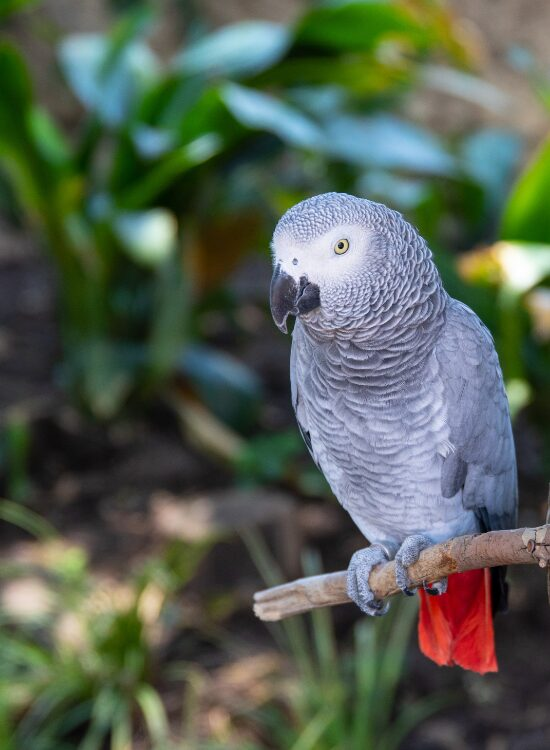
7. African Grey Parrot (Psittacus erithacus) – The Congo’s Einstein
The African Grey Parrot, native to the dense rainforests of the Congo Basin, is easily recognized by its predominantly gray plumage, which contrasts strikingly with its bright red tail. This species has earned worldwide recognition for its exceptional intelligence. Research has shown that these birds in the rainforest possess cognitive abilities comparable to those of a 5-year-old child, you can visit the article here.
In their natural habitat, African Grey Parrots demonstrate remarkable problem-solving skills and social intelligence. They live in large flocks that can contain hundreds of individuals, with complex social hierarchies and communication systems that researchers are still working to understand.
Intelligence Indicators:
- Vocabulary: Can learn over 1,000 words and use them in context
- Problem-solving: Demonstrate tool use and logical reasoning
- Emotional intelligence: Form strong bonds and show empathy
- Memory: Can remember and recognize individual humans for decades
Sadly, the illegal pet trade has severely impacted wild populations, with an estimated 2.1 million African Grey Parrots captured from the wild between 1982 and 2001. This parrot is incredible intelligent, and it was featured in our blog: Top 12 Smartest Animals in the World.
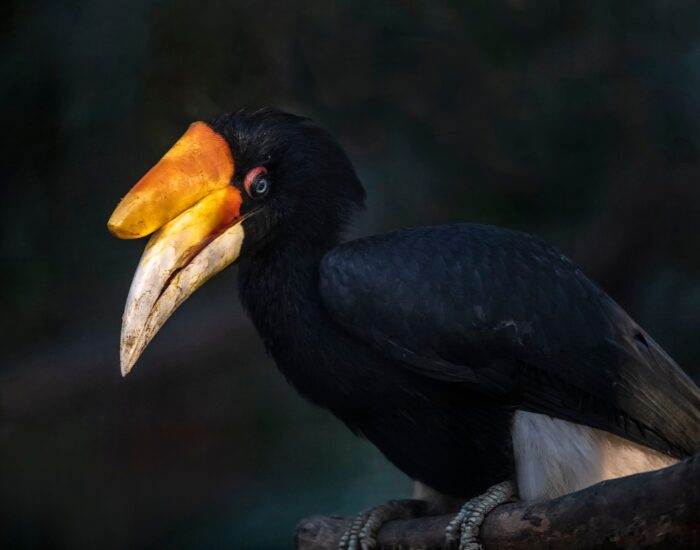
8. Rhinoceros Hornbill (Buceros rhinoceros) – Indonesia’s State Bird
The Rhinoceros Hornbill, Malaysia’s national bird, represents one of the most culturally significant jungle birds in Southeast Asia. These impressive creatures inhabit the rainforests of Indonesia, Malaysia, and Brunei, where they play crucial ecological and cultural roles.
Named for the distinctive horn-like casque on their bills, Rhinoceros Hornbills are primarily frugivorous, making them essential seed dispersers in their rainforest ecosystems. They prefer large, lipid-rich fruits and can disperse seeds over considerable distances.
Cultural Significance:
- Dayak culture: Considered sacred by indigenous Dayak people of Borneo
- Symbol of strength: Represents power and spiritual connection to the forest
- Traditional art: Features prominently in wood carvings and ceremonial objects
- Conservation symbol: Used to promote rainforest protection efforts
The Rhinoceros Hornbill’s dependence on large, old-growth trees for nesting makes them particularly vulnerable to deforestation and logging activities.
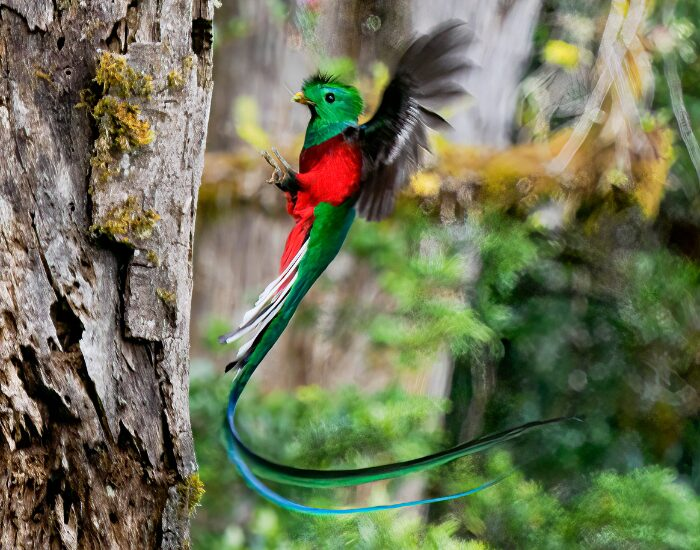
9. Quetzal (Pharomachrus mocinno) – The Sacred Bird of Central America
The Resplendent Quetzal, though technically inhabiting cloud forests rather than lowland rainforests, deserves mention as one of the most spectacular Central American jungle birds in the Americas. These birds were considered sacred by the ancient Maya and Aztec civilizations, who believed that killing a quetzal was punishable by death.
Male quetzals during breeding season develop extraordinary tail coverts that can extend up to 3 feet beyond their bodies, creating one of the most dramatic plumage displays in the bird world. Their brilliant emerald-green backs and crimson bellies create a stunning visual contrast against the misty cloud forest backdrop.
Ecological Role:
- Fruit dispersal: Specialize in avocados and other large-seeded fruits
- Altitude preferences: Found at elevations between 4,000-10,000 feet
- Nesting habits: Excavate holes in rotting trees, often reusing sites for years
- Migration patterns: Move seasonally following fruit availability
Climate change poses a significant threat to quetzals, as rising temperatures force them to seek higher elevations where suitable habitat becomes increasingly limited.
The Quetzal is also the national bird of costa Rica, if you are curious about this country wildlife, have a look at our article: “Birds of Costa Rica“.
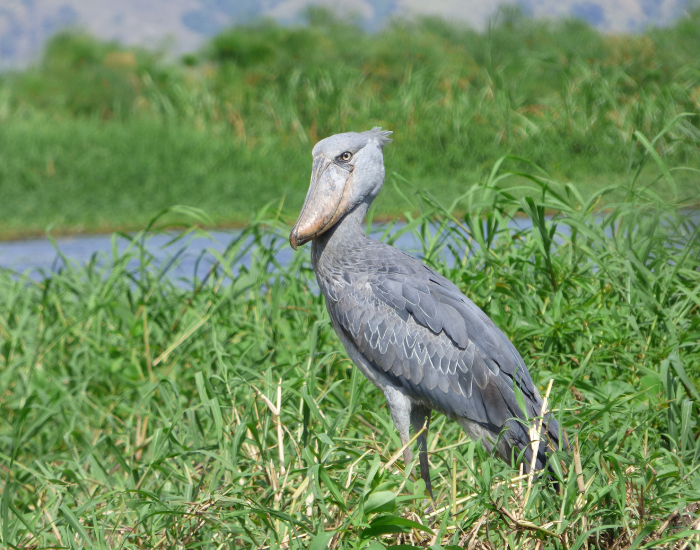
10. Shoebill (Balaeniceps rex) – The Congo’s Prehistoric Giant
The Shoebill, found in the wetlands and swamps bordering the Congo rainforest, looks like something from the age of dinosaurs. These massive birds in the rainforest can stand 5 feet tall and possess one of the most distinctive bills in the bird world – a massive, shoe-shaped appendage perfectly adapted for catching lungfish.
Despite their intimidating appearance, Shoebills are surprisingly approachable and have been observed showing curiosity toward humans rather than fear. Their unique hunting strategy involves standing motionless for hours, often remaining on foot while stalking prey in shallow water, waiting for the perfect moment to strike.
Unique Characteristics:
- Hunting technique: “Collapse” method where they fall forward onto prey
- Vocalizations: Machine-gun-like bill clattering and low, cow-like bellowing
- Breeding: Typically lay 2 eggs but only one chick usually survives
- Conservation status: Vulnerable, with only 3,300-5,300 individuals remaining
The Shoebill’s dependence on pristine wetland habitats makes them extremely vulnerable to human encroachment and climate change. If you are interested in knowing more about african wildlife, visit our article: “Top 10 Fascinating Animals in Africa“
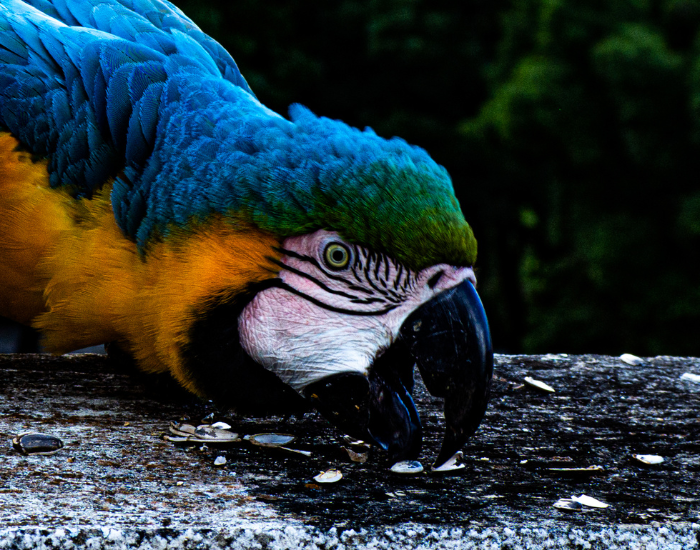
11. Blue-and-Yellow Macaw (Ara ararauna) – The Amazon’s Gentle Giant
From Blue-and-Yellow and Scarlet Macaws to Green-Winged and Chestnut-Fronted Macaws, these New World parrots will easily rank among the most colorful birds you’ll see in the Peruvian Amazon. The Blue-and-Yellow Macaw, with its striking azure wings and golden underparts, represents one of the most beloved jungle birds in South America.
These intelligent parrots are known for their playful nature and complex social behaviors. Unlike some other macaw species, Blue-and-Yellow Macaws have shown remarkable adaptability to human presence, often thriving in areas where other species struggle.
Behavioral Adaptations:
- Flexibility: Can adapt to various forest types and altitudes
- Diet diversity: Eat over 100 different plant species
- Learning ability: Young birds learn foraging techniques from adults over several years
- Longevity: Can live 60-80 years in the wild
Their relatively stable population makes them ambassadors for rainforest conservation, appearing in countless documentaries and educational programs worldwide.
12. Crimson Topaz (Topaza pella) – The Rainforest’s Flying Jewel
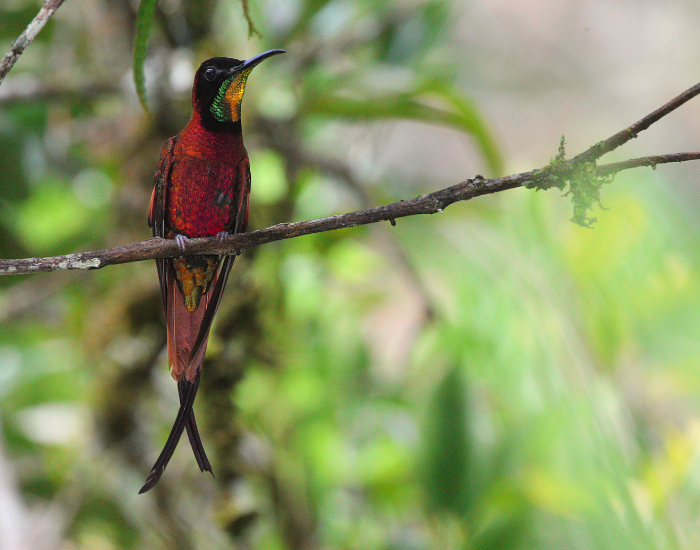
Our final amazing jungle bird might be small, but it’s arguably the most spectacular. The Crimson Topaz, one of the largest hummingbirds in the world, inhabits the understory of Amazon rainforests where it creates flashes of brilliant red and orange, along with iridescent brown, chestnut, and bronze hues among its vibrant feathers, as it darts between flowers.
Male Crimson Topaz hummingbirds are particularly stunning, with their glittering crimson throat, orange-red crown, and distinctive crossed tail feathers. These tiny aerial acrobats can hover, fly backwards, and even fly upside down – adaptations that make them perfectly suited to rainforest life.
Hummingbird Specializations:
- Metabolism: Heart rate can reach 1,260 beats per minute
- Energy requirements: Must consume half their body weight in nectar daily
- Pollination services: Essential pollinators for many rainforest plants
- Territorial behavior: Aggressively defend feeding territories from competitors
There are more than 330 species of hummingbirds and they are only found in the Western Hemisphere, making them uniquely American contributions to global biodiversity. If you want to know more about these special little bird, have a look at the article: 12 Species of Hummingbird you Should Know.
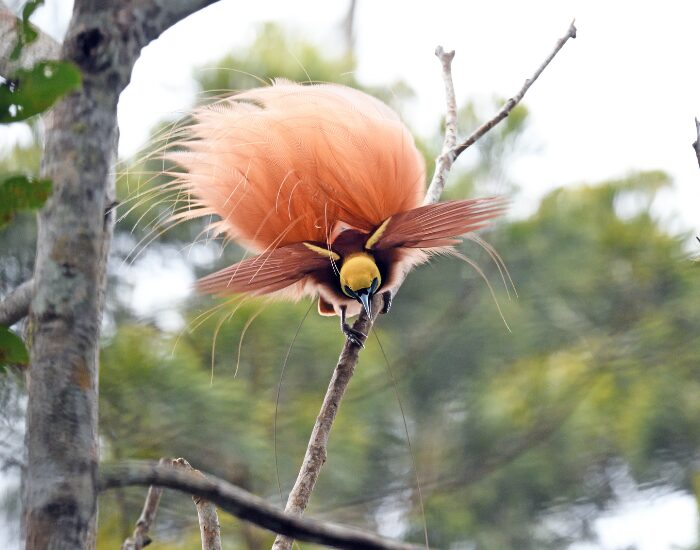
13. Greater Bird-of-Paradise (Paradisaea apoda) – The Rainforest’s Dancer
The Greater Bird-of-Paradise is perhaps the ultimate symbol of rainforest wonder. Endemic to the lowland and hill forests of New Guinea and nearby Aru Islands, this species epitomizes the extraordinary creativity of evolution. Males are adorned with cascades of golden flank plumes, white tail feathers, and emerald-green throats that shimmer in the filtered jungle light. When they display, the forest floor transforms into a stage, and the bird itself into a living work of art.
Courtship Rituals:
- Leks: Dozens of males gather at traditional display sites known as leks, each performing an elaborate dance that involves hanging upside down, spreading their golden plumes, and giving high-pitched calls.
- Female choice: Females carefully watch these performances, selecting mates based on the quality of their plumage and display vigor — a vivid example of sexual selection in action.
Cultural and Ecological Significance:
- Revered in Papuan cultures, their feathers were historically used in ceremonial headdresses and traded widely across Asia and Europe.
- As fruit eaters, they play important roles in seed dispersal, helping regenerate the rainforest they depend on.
Although not currently endangered, Greater Birds-of-Paradise face pressure from deforestation, habitat fragmentation, and hunting. Protecting large tracts of old-growth forest is essential to their survival, ensuring that future generations can still witness their otherworldly dances. More information about these incredible birds, have a look at the article: “A guide to the Birds of Paradise“
A Lot Of Jungle Birds – More than you can Imagine
What we’ve explored so far is only a glimpse into the kaleidoscope of birdlife that thrives in the world’s jungles. From Central and South America to the steaming rainforests of Southeast Asia, these ecosystems are overflowing with life. Walk a few steps along a rainforest trail and you might hear the raucous call of a macaw, the distant drumming of a woodpecker, or the delicate flutter of a hummingbird darting between flowers.
The sheer number of species, thousands across the tropics, means that no two visits to the jungle are ever the same. Some birds announce themselves in brilliant flashes of color, while others remain shadows in the undergrowth, waiting to be discovered by patient eyes. It’s this sense of mystery and abundance that makes the rainforest such a magnetic place for travelers, birdwatchers, and scientists alike.
Exploring jungle birds is not just about learning facts; it’s about stepping into a world where every branch, every leaf, and every call could reveal something extraordinary.
Habitat and Distribution of Jungle Birds
The world’s great jungles are scattered across three continents, each a sanctuary bursting with unique birdlife. In South America, the Amazon rainforest stretches across nine countries and shelters more bird species than anywhere else on Earth. Its towering canopy, tangled understory, and winding rivers provide homes for everything from jewel-toned hummingbirds to the mighty harpy eagle. To the north, the mist-shrouded cloud forests of Central America harbor treasures like the resplendent quetzal, while Brazil’s Atlantic Forest hides species found nowhere else.
Across the ocean, Africa’s Congo Basin sprawls as the second-largest rainforest, alive with parrots, hornbills, and the haunting presence of the shoebill in nearby wetlands. Meanwhile, Southeast Asia’s rainforests, from Borneo and Sumatra to the Malay Peninsula, are the domain of rhinoceros hornbills, great argus pheasants, and countless other avian wonders. And in the far-flung islands of Papua New Guinea, the Birds-of-Paradise transform the jungle into a stage for their dazzling displays.
Each of these habitats is a world within a world, where the availability of food, nesting sites, and shelter shapes the distribution of birds. Fruit-eaters like scarlet macaws and toucans often dominate the canopy, while predators such as eagles and hawks patrol from above. Step down into the forest floor and you’ll find a different cast of characters altogether—shy tinamous, ground-dwelling antbirds, and camouflaged nightjars blending seamlessly into the shadows.
Together, these forests form the beating heart of the tropics, sustaining an almost unimaginable wealth of biodiversity. Protecting them is about more than saving birds; it’s about preserving some of the last great wild places on Earth.
Why Are Jungle Birds So Colorful?
One of the most frequently asked questions about rainforest birds is why they display such vibrant colors. The answer lies in the unique characteristics of rainforest environments:
Evolutionary Factors:
- Light filtering: Dense canopy creates dappled light conditions where bright colors help birds blend in
- Species recognition: Bright plumage helps birds identify potential mates of the same species
- Sexual selection: Vibrant colors indicate health and genetic fitness to potential partners
- Camouflage: Surprisingly, bright colors can provide excellent camouflage among colorful fruits and flowers
Communication advantages: In the dense, visually cluttered environment of the rainforest, bright colors help birds communicate over short distances more effectively than in open habitats.
The Vital Role of Rainforest Birds in Ecosystem Health
Jungle birds aren’t just beautiful – they’re essential to the health and survival of rainforest ecosystems. These feathered engineers perform crucial services that keep entire forest systems functioning:
Seed Dispersal:
- Large birds like toucans and hornbills disperse seeds from large-fruited trees
- Small birds carry seeds to new areas, promoting forest regeneration
- Some seeds can only germinate after passing through specific bird digestive systems
Pollination Services:
- Hummingbirds pollinate countless flowering plants
- Some rainforest plants depend entirely on specific bird species for reproduction
- Birds often have co-evolved relationships with particular plant species
Insect Control:
- Many birds in the rainforest consume enormous quantities of insects
- This natural pest control protects forest trees from insect damage
- Reduces the need for chemical pesticides in adjacent agricultural areas
Nutrient Distribution:
- Bird droppings distribute nutrients throughout the forest
- Fertilization helps maintain soil fertility in nutrient-poor rainforest soils
- Supports the growth of plants that form the forest foundation
Conservation Challenges Facing Jungle Birds
Despite their importance, jungle birds face unprecedented threats in the modern world. Understanding these challenges is crucial for developing effective conservation strategies:
Habitat Loss:
- Deforestation eliminates nesting sites and food sources
- Forest fragmentation isolates populations and reduces breeding success
- Palm oil plantations and cattle ranching destroy primary forest habitat
- Climate change alters traditional migration patterns and breeding seasons
Human Impacts:
- Illegal wildlife trade threatens many species with extinction
- Noise pollution from development disrupts bird communication
- Pesticide use in agriculture poisons birds and their food sources
- Infrastructure development creates barriers to movement and migration
Conservation Success Stories:
- Hyacinth Macaw populations have increased through dedicated breeding programs
- Protected areas have stabilized many species’ populations
- Ecotourism provides economic incentives for habitat preservation
- Indigenous communities are becoming partners in conservation efforts
How You Can Help Protect Jungle Birds
The future of rainforest birds depends on immediate action from individuals, communities, and governments worldwide. Here are practical