
Back in undergrad, my friend skipped a whole day of biology classes to drive to Mexico City. He came back that afternoon with a baby African grey parrot, an eye-watering receipt, and the obsessed look of a guy who’d just fallen in love with a bird. At that time, he already ran a small reptile breeding facility focused on royal ball pythons, but the parrot wasn’t a breeding project. It was a pet.
He also kept a barn owl, a few sugar gliders, and now a young african grey. I was a biology student, more comfortable with snakes than feathers, but I sat with the parrot for an hour that day. The way that little grey bird watched us — clinical, calculating, surgical — stuck with me for years. As a field biologist who has since chased wildlife around the world, I want to share what the science actually says about african grey parrots, where they come from, and why so much of what people expect from them is wrong.
1. They’re One of the Most Highly Intelligent Birds in the World
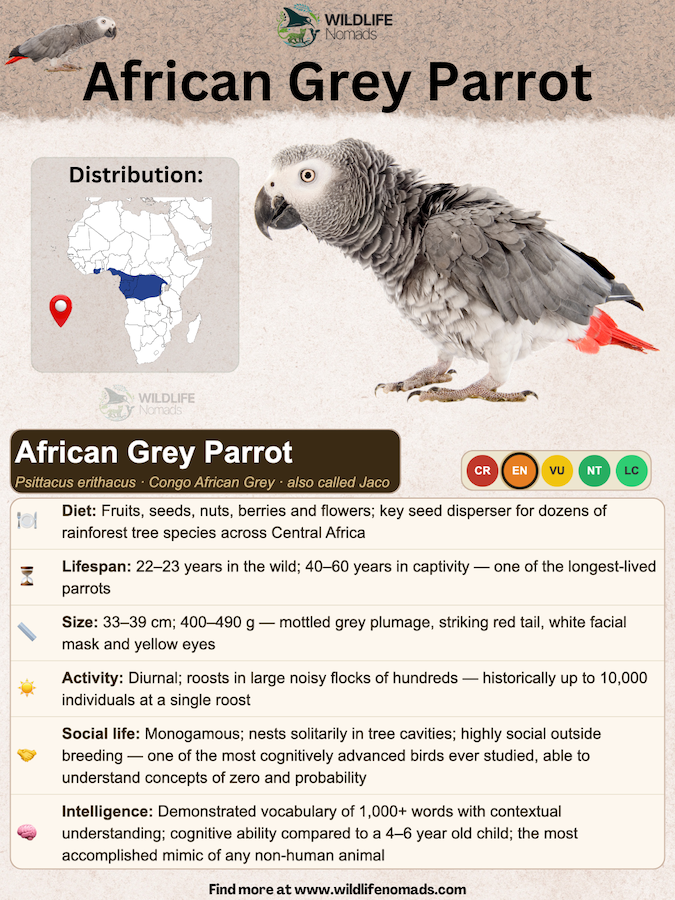
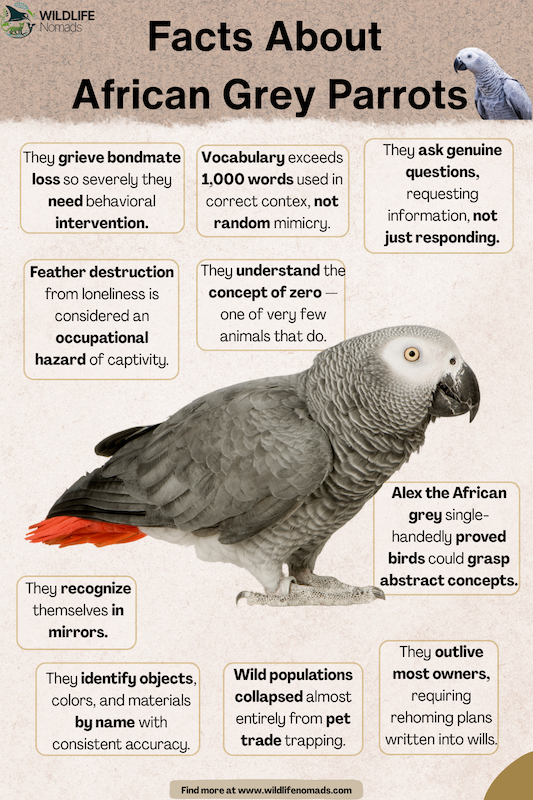
Researchers describe african grey parrots as “scary smart,” and they aren’t exaggerating. The most famous case study is Alex, a Congo african grey trained for 30 years by Dr. Irene Pepperberg. Alex could identify colors, count small numbers, and use simple human language with apparent intent.
In my experience, I’ve watched crows and ravens solve impressive puzzles, but the grey parrot operates on a different frequency. Its cognitive ability rivals a five-year-old human child’s and, on certain tasks, matches great apes like chimpanzees and bonobos. Greys understand concepts like “same” and “different,” and some grasp a rudimentary sense of zero. Dolphins and even the eight-armed octopus get the same kind of attention in cognition research. The grey parrot earns its place beside them. For a bird that weighs less than a pound, that level of intelligence is wild.
2. African Greys Are Actually Two Separate Species
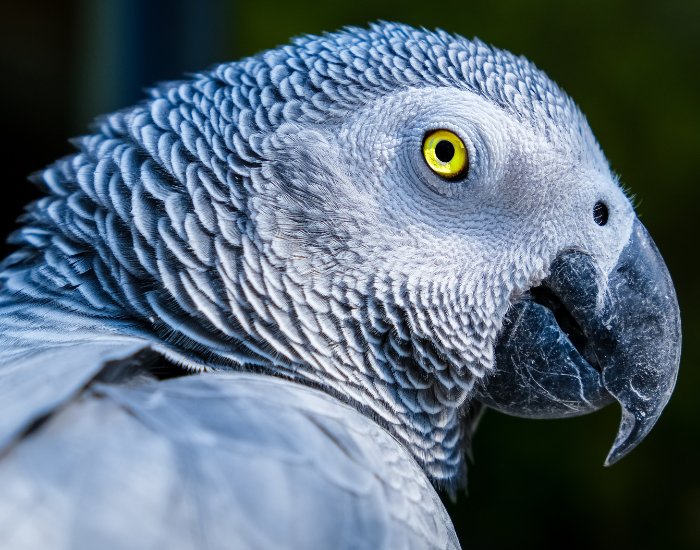
Most people lump all grey parrots together. The taxonomy says otherwise. In 2012, biologists split the African grey complex into two separate species: the Congo african grey (Psittacus erithacus) and the Timneh african grey (Psittacus timneh). They’re related, but distinct enough to warrant their own scientific names.
The Congo african grey is larger and lighter, with bright red tail feathers. The Timneh is smaller and darker, with a maroon tail. Their ranges barely overlap in Central Africa. Both species are traded as pets in different parts of the world, and very few owners realize they’re keeping a different parrot species than the one in the YouTube videos that sold them on the idea. If you’re into parrot diversity in general, my guide to types of parrots covers the whole family.
3. Their Real Home Is the Forests of Central Africa
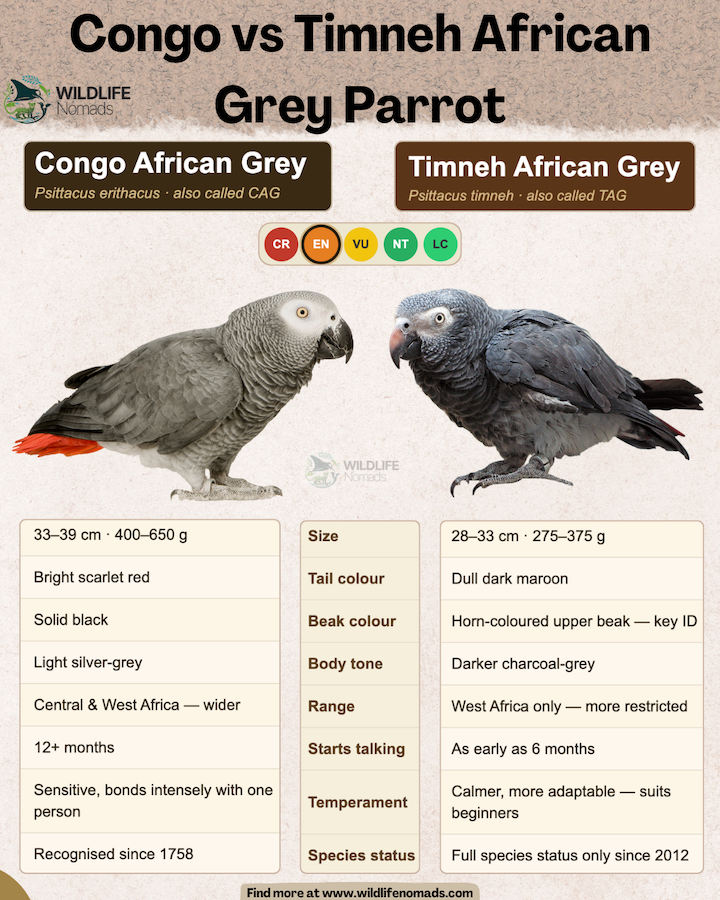
Wild african grey parrots live across a band that stretches from Côte d’Ivoire through the Congo basin to western Kenya. They favor forest edges, mangroves, and tall trees they can use as roosts and nest sites. The Congo basin remains the species’ stronghold, and it’s where most of the remaining wild population still feeds and breeds.
The african grey is native to humid lowland forest, but the bird readily uses forest edges and agricultural mosaics if old trees remain standing. I haven’t worked grey parrots directly in Africa, but colleagues have. They describe the evening flights, large flocks of grey parrots streaming back to roost trees at dusk, calling constantly. Once you’ve heard recordings of that sound, a single caged bird feels impossibly lonely.
4. They Nest High Up in Tree Cavities
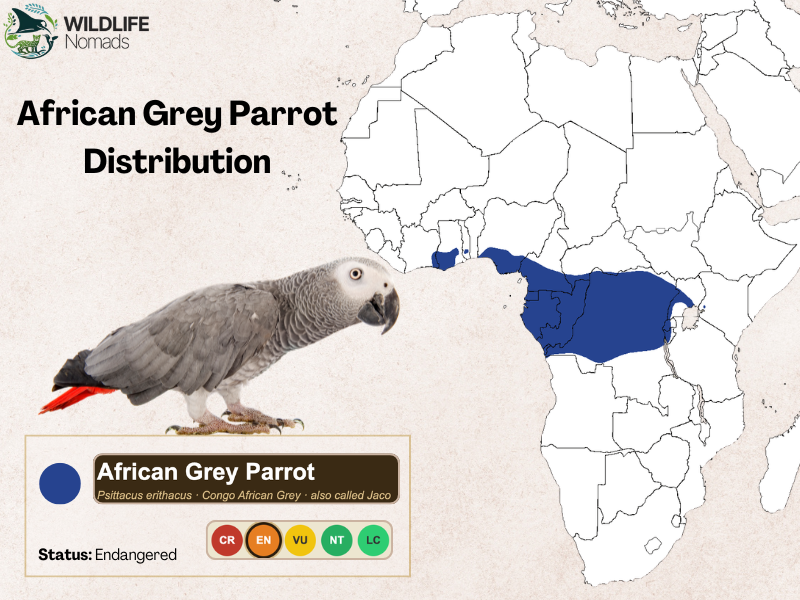
Grey parrots are cavity nesters. Females select holes high up in tall trees, sometimes 30 meters above the forest floor, and lay clutches of 3 to 5 eggs over a short time period. Both parents help feed the babies after the eggs hatch. The female handles most incubation while the male brings food back to the nest.
This nesting strategy is part of why habitat loss hits the species so hard. A good nest cavity doesn’t appear overnight. It takes a mature hardwood tree decades to develop the right hollow, and logging an old-growth forest removes those trees in an afternoon. Lose the trees, and the next generation of grey parrots loses its real estate.
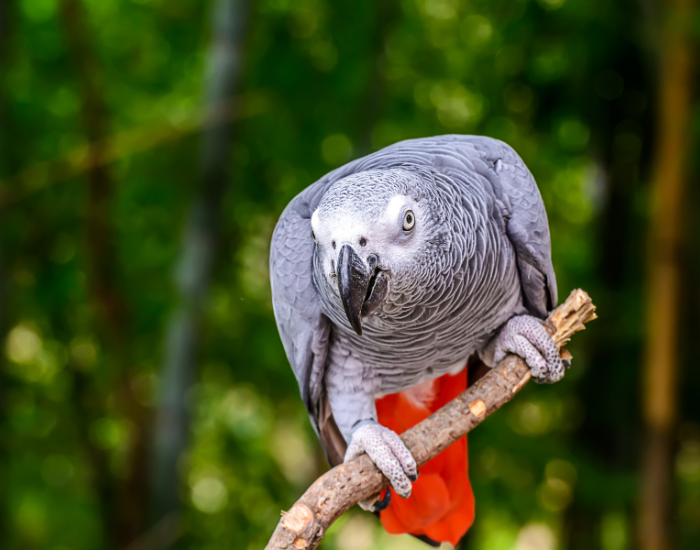
5. In the Wild, They Live in Big Groups, Sometimes Hundreds Strong
African greys are a highly social species. During the day, they break into smaller groups to feed on fruit, seeds, palm nuts, and occasionally tree bark for minerals. At dusk, those smaller groups merge into massive communal roosts. In some regions, researchers have counted several hundred pairs roosting together in the same stand of tall trees.
This is the part I want every prospective owner to understand. A grey parrot evolved to spend its life surrounded by other members of its flock, exchanging calls, body language, and social interaction every single day. The species cannot thrive in social isolation. That isn’t anthropomorphism, it’s basic biology.
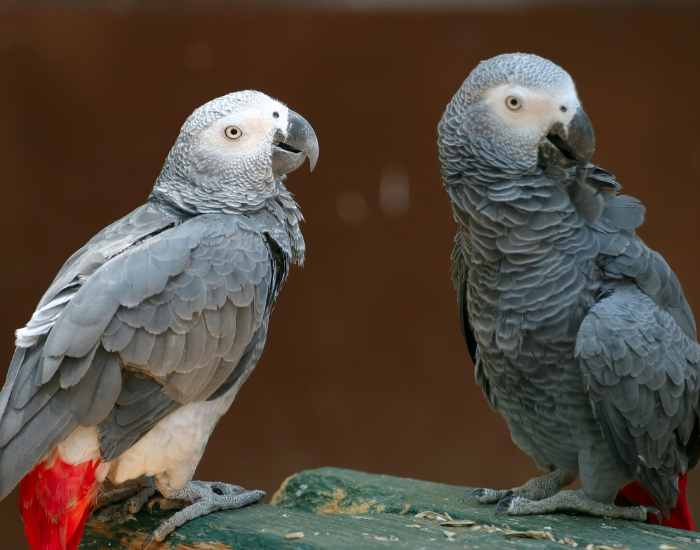
6. They Mimic Human Speech — But It’s More Complicated Than YouTube Suggests
The ability to mimic human speech is what made african grey parrots famous. Some captive greys learn hundreds of words. They imitate phones, microwaves, doorbells, and the voices of specific family members. My friend’s young grey parrot in Mexico City was already producing clean vowel sounds at only a few months of age.
But mimicry isn’t language. In the wild, grey parrots don’t speak human words. They use a flexible repertoire of contact calls, alarm calls, and learned sounds to coordinate with the flock. When researchers like Pepperberg work intensively with greys for years, a few exceptional birds appear to use words meaningfully. For everyday pet grey parrots, mimicry is closer to a sophisticated impression than to human language.
7. They Are Endangered in the Wild
The IUCN lists Psittacus erithacus as Endangered. In 2016, CITES upgraded both species to Appendix I, banning international trade in wild-caught grey parrots. The reasons are bleak: habitat loss, deforestation, and the illegal wildlife trade have gutted the species across its range.
For decades, hundreds of thousands of wild birds were trapped and shipped through international trade routes — to Europe, the United States, and the Middle East. Animal Diversity Web, BirdLife International, and Ghanaian field surveys estimate that some populations have collapsed by more than 90% in ghana. The wild african grey isn’t extinct, but it’s heading the wrong direction fast.
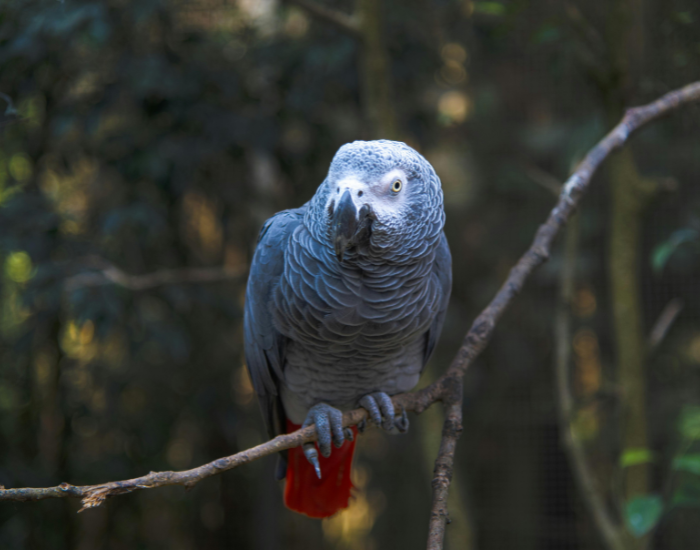
8. The Pet Trade Has Devastated Wild Populations
Popular pets carry a hidden cost, and the african grey is one of the most popular pets in the parrot world. Its intelligence, its mimicry, and the social-media fame of certain captive grey parrots have driven enormous demand. But every captive grey that started its life as a wild bird represents a forest that lost a breeding adult.
My friend’s bird back in undergrad was almost certainly captive-bred, that side of the trade is legal in many countries. Even so, the lines between legal and illegal capture blur quickly. As a biologist, I have a complicated relationship with the grey parrot industry. I can love the species and still wish fewer humans kept them as pets.
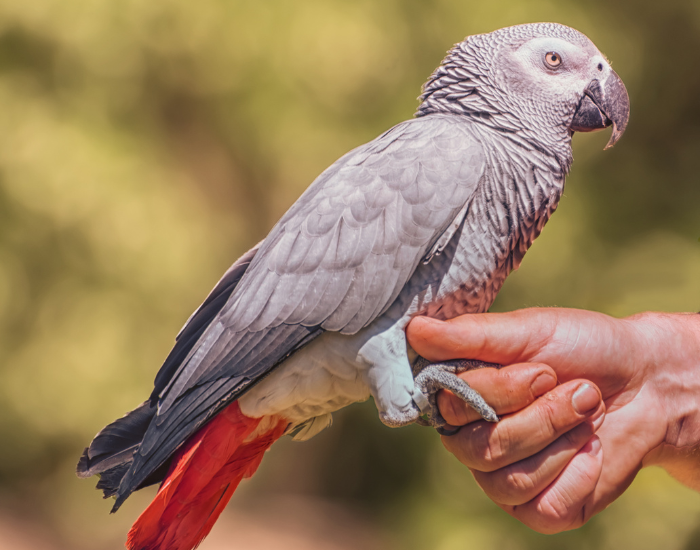
9. They Live Astonishingly Long Lives
A healthy african grey can live from 40 to 80 years in captivity, and a few have made it past 70. That longevity is part of why grey parrots are bad pets for most households. People buy a parrot in their thirties without thinking about who’ll handle cage time and feed schedules when they’re 80.
I once spoke with a veterinary technician at an exotic bird clinic who routinely treats grey parrots older than she is. The species’ life expectancy means a captive grey usually outlives the marriage of its first owner, the cage it was bought with, and sometimes the whole era it was born into. That older bird sitting quietly in the corner of someone’s living room has seen things.
10. Their Body Language Says Everything
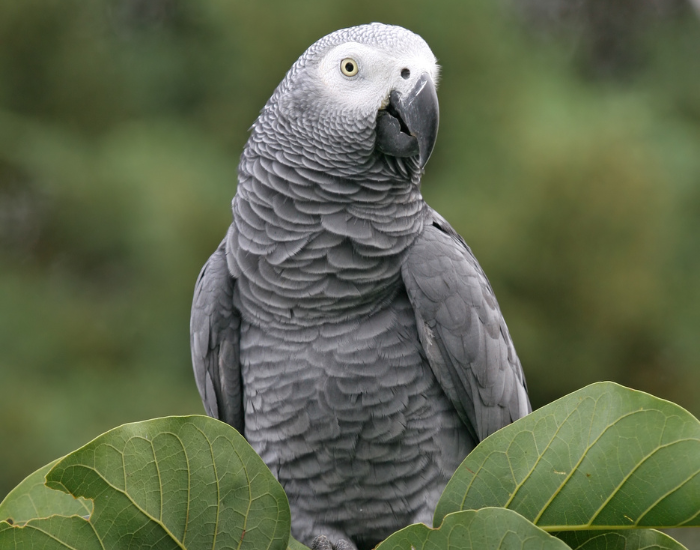
Grey parrots communicate constantly through body language, not just sounds. A relaxed grey sits with smooth feathers, one foot tucked up, eyes half-closed. A scared one slicks its feathers tight against the body and watches with wide eyes. A frustrated or threatened grey “pins” its eyes, rapidly contracting the pupils, while raising the small feathers around its neck.
I noticed this with my friend’s young grey the day I met her. She wasn’t aggressive, but she tracked every gesture I made, head tilting, eyes flicking. Reading that body language well is why people who do well with grey parrots do extremely well, and why people who ignore it end up with a stressed, plucked bird and a stack of behavioral problems.
11. Captivity Without Stimulation Breaks Them
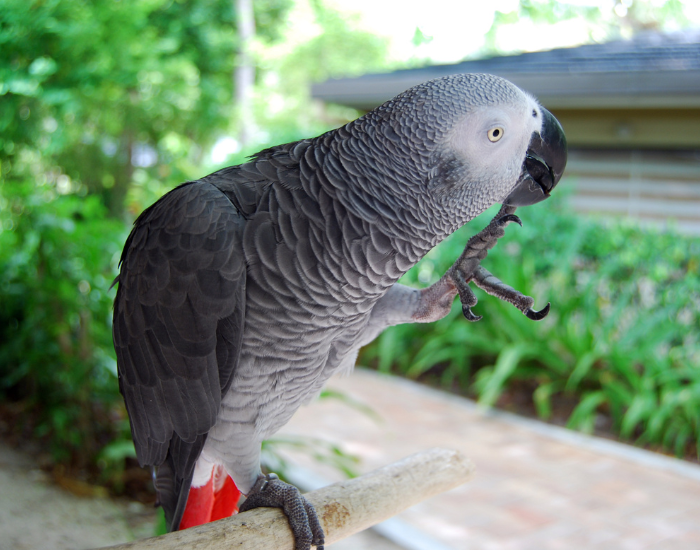
A captive grey parrot stripped of social interaction and enrichment falls apart fast. Feather plucking, screaming, biting, and chronic stress are common. The bird isn’t broken, the environment is.
In the wild, an African Grey spends its whole life solving small problems: finding food, dodging predators, navigating flock politics. Replace that with a cage and silence, and you get a miserable animal. The species needs foraging puzzles, daily out-of-cage time, and either a long-term mate or a deeply involved human family. Anything less is cruelty dressed up as ownership.
12. How They Compare to Other Smart Animals
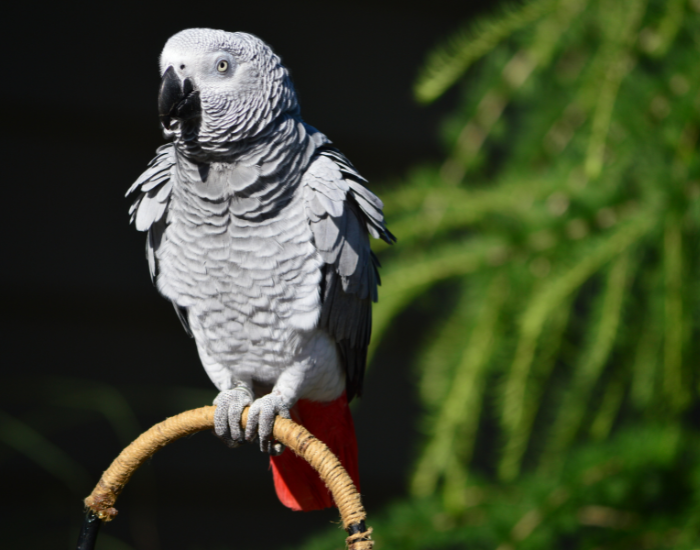
People often ask how grey parrots compare to the other highly intelligent birds and mammals out there. The honest answer is that direct comparisons are slippery. African Greys outperform most birds on certain cognitive tests, but black cockatoos and corvids both rival them in tool use and problem-solving.
If you’re curious where greys land in the broader animal intelligence picture, I dig into that in my guide to the smartest animals on Earth. And if you want to keep going down the parrot rabbit hole, the bizarre dracula parrot is a wild contrast, equally striking, completely different ecology.
FAQs About African Grey Parrots
They can be — but only for the right human. African greys demand hours of daily attention, mental enrichment, and a 40-to-60-year commitment. They are not beginner birds. For most families, a smaller, less cognitively demanding parrot species is a kinder choice, and a dog or cat is usually better still.
In the wild, they mimic environmental sounds to communicate within the flock and recognize other members. In captivity, that same ability gets applied to human language. Some grey parrots use words contextually after years of training, but most simply repeat sounds they’ve learned to associate with attention, food, or other rewards.
On certain cognitive tests, yes — grey parrots match or exceed young children on tasks involving abstract concepts. Dogs aren’t dumber, though; they read human social cues far better than parrots do. Different intelligence, different jobs.
Not happily. They are a highly social species, and a solo grey parrot without daily human interaction or another bird companion suffers chronic stress. If you can’t spend significant time with the bird every single day, you should seriously expect problems and reconsider getting one.
Intelligence Without Freedom
African grey parrots sit awkwardly at the intersection of intelligence, conservation, and the human urge to keep wild things close. Their future depends less on better cages and more on the forests of Central Africa staying intact, the international trade staying tightly regulated, and fewer people buying them on impulse. If this piece sparked something, leave a comment with your own grey parrot story, I read every one. And if you want to keep exploring, my deep dives into other types of parrots, the smartest animals on Earth, and the gothic dracula parrot are good next stops.
References:
Pepperberg, I. M. (2017). Animal language studies: What happened? Psychonomic Bulletin & Review, 24(1), 181–185. https://doi.org/10.3758/s13423-016-1101-y
BirdLife International. (2021). Psittacus erithacus. The IUCN Red List of Threatened Species 2021: e.T22724813A154428817. https://dx.doi.org/10.2305/IUCN.UK.2021-3.RLTS.T22724813A154428817.en.
Martin, R. O., Perrin, M. R., Boyes, R. S., Abebe, Y. D., Annorbah, N. N. D., Asamoah, A., Bizimana, D., Bobo, K. S., Bunbury, N., Brouwer, J., Diop, M. S., Ewnetu, M., Fotso, R. C., Garteh, J., Hall, P., Holbech, L. H., Madindou, I. R., Maisels, F., Mokoko, J., Williams, E. (2014). Research and conservation of the larger parrots of Africa and Madagascar: A review of knowledge gaps and opportunities. Ostrich, 85(3), 205–233. https://doi.org/10.2989/00306525.2014.948943
Annorbah, N. N. D., Collar, N. J., & Marsden, S. J. (2016). Trade and habitat change virtually eliminate the grey parrot Psittacus erithacus from Ghana. Ibis, 158(1), 82–91. https://doi.org/10.1111/ibi.12332
Tamungang, S. A., Onabid, M. A., Awa, T., & Balinga, V. S. (2016). Habitat preferences of the grey parrot (Psittacus erithacus) in heterogeneous vegetation landscapes and their conservation implications. International Journal of Biodiversity, 2016, 1–8. https://doi.org/10.1155/2016/7287563
Pepperberg, I. M., & Hartsfield, L. A. (2014). Can grey parrots (Psittacus erithacus) succeed on a “complex” foraging task failed by nonhuman primates but solved by wrasse fish? Journal of Comparative Psychology, 128(3), 298–306. https://doi.org/10.1037/a0036205
Valle, S., Collar, N. J., Harris, W. E., & Marsden, S. J. (2017). Spatial and seasonal variation in abundance within an insular grey parrot population. African Journal of Ecology, 55(4), 433-442. https://doi.org/10.1111/aje.12367