
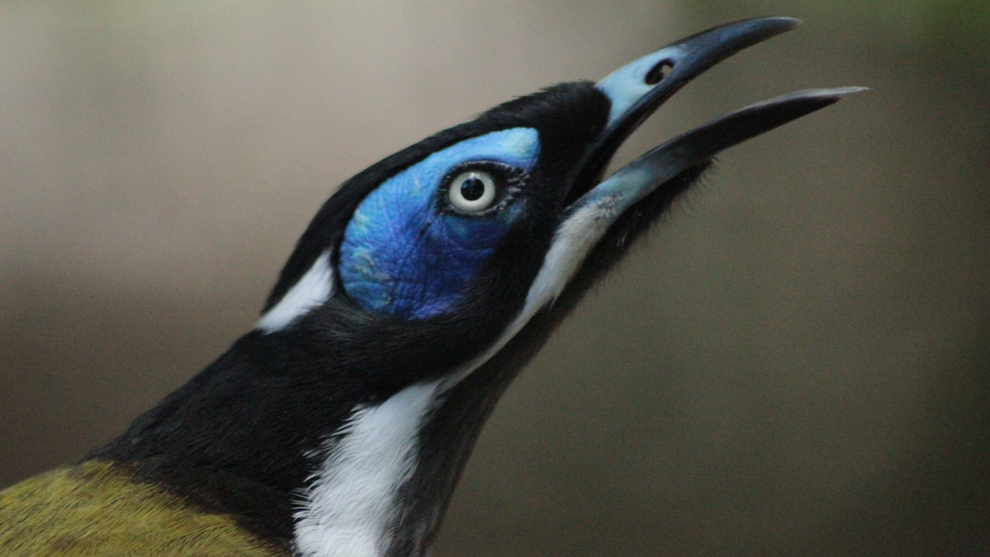
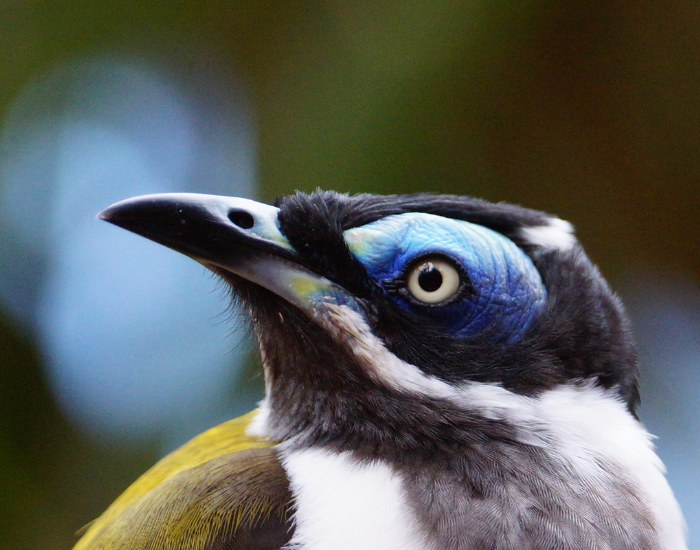
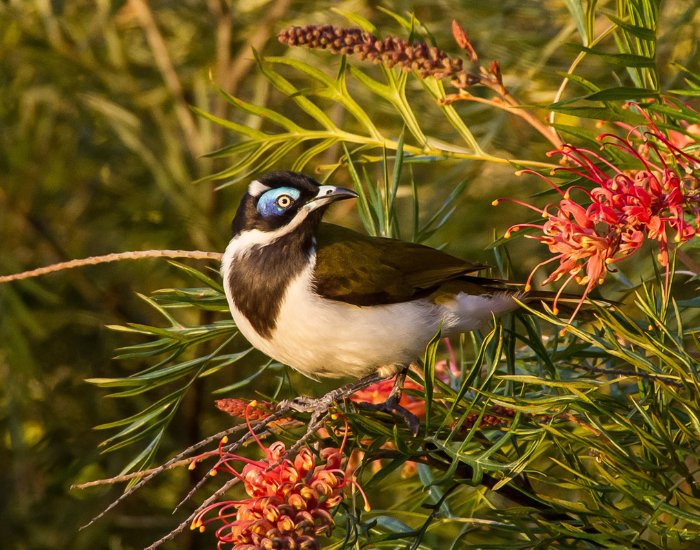
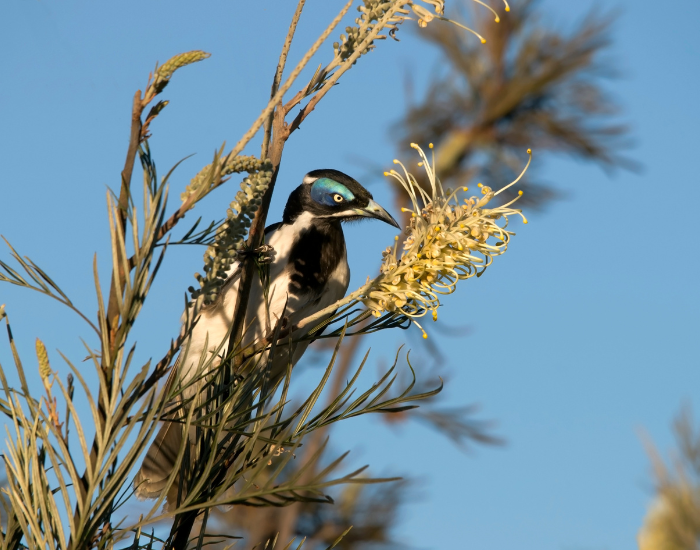
The first one landed on my awning at Woody Head. I had the back of the car open, facing the bush, and this bird simply dropped in. A blue-faced honeyeater, close enough that I could see the skin around its eye. Pale blue above, brilliant cobalt below.
It came back every morning for four days.
It was almost certainly waiting for food. I did not give it any, and neither should you. A bird that learns to associate campers with breakfast stops foraging properly.
I am three stops into my lap around Australia, and this species has shadowed me down the coast. Woody Head, then Evans Head, and now Red Cliff campground beside Lake Arragan. Same species every time. Wildly different behaviour every time.
That contrast sent me back into the literature. Below are twelve things I learnt about Entomyzon cyanotis. One of them is a scrappy university experiment in Sweden that finally explained Red Cliff.
1. The Blue Face Is Built, Not Painted
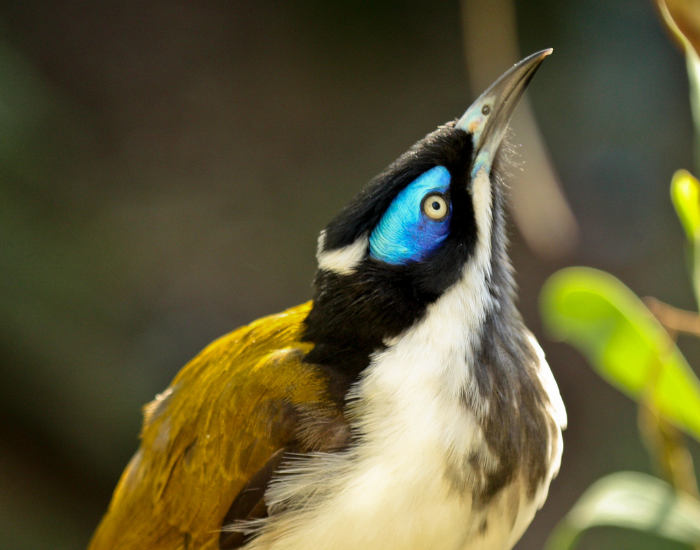
That colour is not pigment. Blue in birds almost never is. Prum and Torres showed that structurally coloured bare skin comes from nanoscale arrays of collagen fibres in the dermis. Those fibres sit so precisely spaced that they scatter blue wavelengths straight back at you.
In other words, the bird is not blue. The bird is shaped like blue.
This matters practically. Pigment fades with diet and wear. Structural colour holds its intensity as long as the tissue stays healthy. Up close at Woody Head, the lower half of that bare facial skin looked almost fluorescent. The upper half was noticeably duller.
2. They Hardly Go Anywhere, and They Live a Long Time
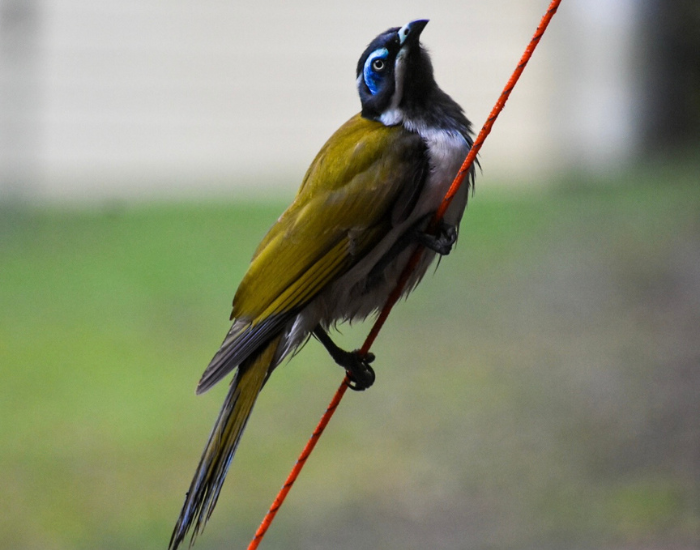
Australian banding records make this concrete. Of 422 birds banded between 1953 and 1997, 109 were later recovered. Of those, 107 turned up within 10 km of where they were first caught.
That is extreme site fidelity for a bird that flies perfectly well. The longevity record belongs to one banded near Kingaroy in May 1990. It was found dead in September 1998, roughly 2 km away. Eight years and three months, and it died almost exactly where it started.
This also explains Woody Head. The bird on my awning was not passing through. It lived there, it knew that campground, and it had almost certainly worked those sites long before I arrived.
3. Juveniles Wear the Wrong Colour for Over a Year
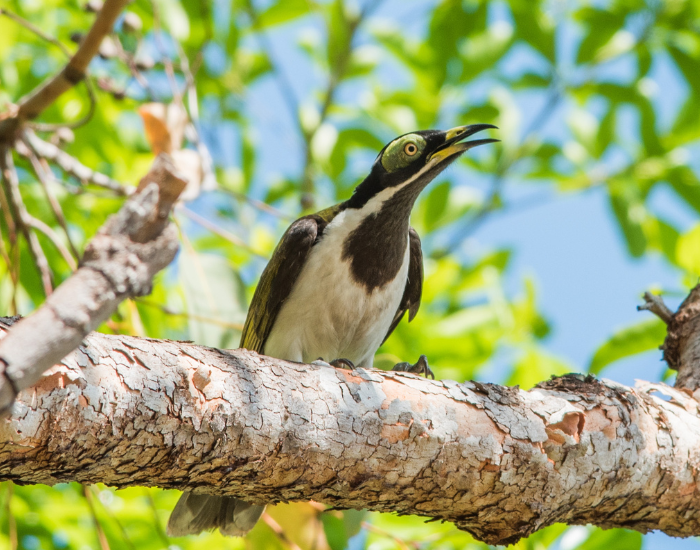
Immature birds are not blue at all. Freshly fledged juveniles carry yellow-green facial skin and a lighter grey bib. Their upperparts are brown rather than the adult’s olive-green wings and clean white underparts.
The change is slow. By six months the face usually shifts greener, then darkens beneath the eye. Adults reach full blue at around sixteen months of age.
So a bird can fly like an adult and still advertise “not quite yet” on its face. A green-faced version in your garden is not a separate species. It is last season’s chicks.
4. It Is a Big, Heavy Honeyeater
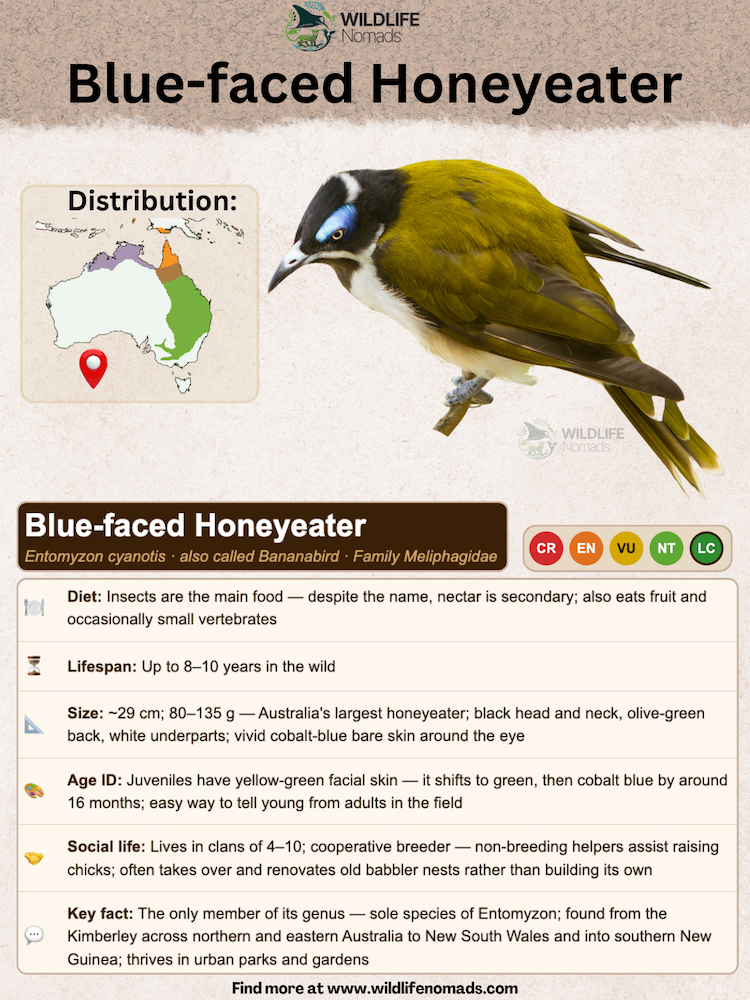
Most Australian honeyeaters are small and fidgety. This one is not. Adults run 26 to 32 cm long, carry a wingspan near 44 cm, and weigh around 105 g.
That bulk is why they are so easily recognised at distance. At Evans Head I only saw mine from far off, moving through bush near Chinamans Beach. The size gave it away long before the face did.
Interestingly, body size decreases toward the equator, consistent with Bergmann’s rule. Northern birds are the smaller ones.
5. It Is the Only Bird in Its Genus
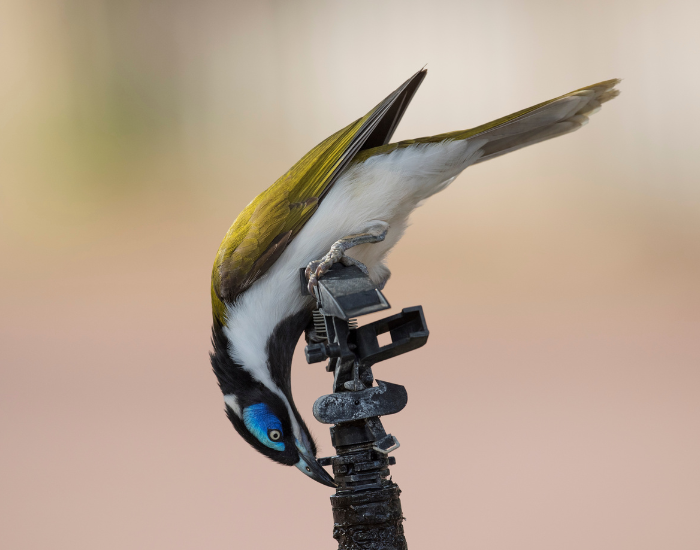
Entomyzon cyanotis is the sole member of its genus. That is unusual within the honeyeater family, which is otherwise crowded with close relatives.
Its placement took two centuries to settle. John Latham described it in 1801 as three separate species, working from different specimens. Later authors shuffled it between Anthochaera, Manorina, and the small black-capped Melithreptus honeyeaters.
Molecular work finally resolved it. Genetic analyses place it as sister to Melithreptus. The two lineages split somewhere between 12.8 and 6.4 million years ago, in the Miocene. The plumage hint was right all along.
6. A Honeyeater That Mostly Eats Meat
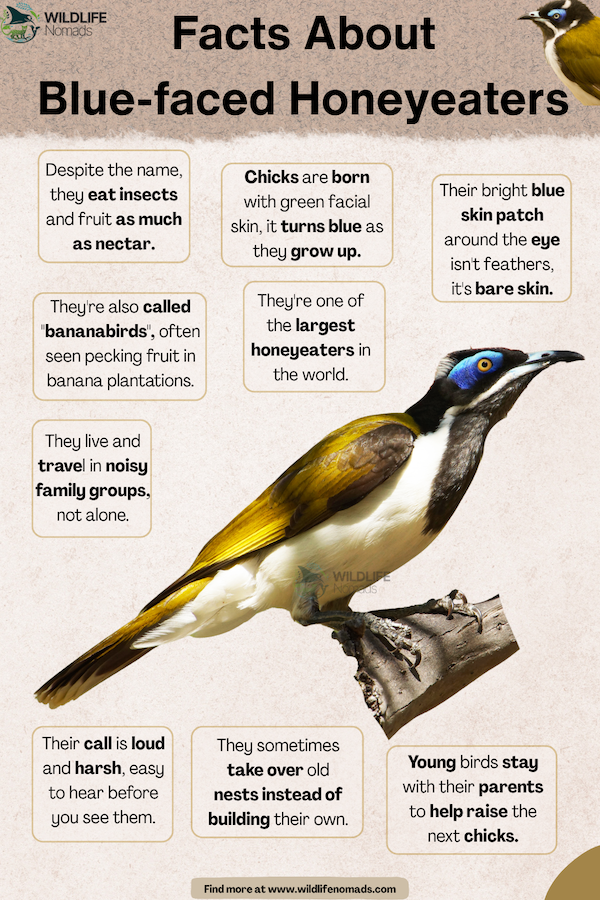
Here is the misconception worth killing. Despite the name, the diet consists mainly of insects and other invertebrates, not nectar.
They take cockroaches, termites, grasshoppers, lerps, shield bugs, weevils, beetles, moths, bees, ants and spiders. Nectar and fruit supplement that, drawn from eucalypt flowers, banksias, grevilleas and grasstrees. They will also raid a campsite for jam or honey. Parents have even been recorded regurgitating stolen milk to nestlings.
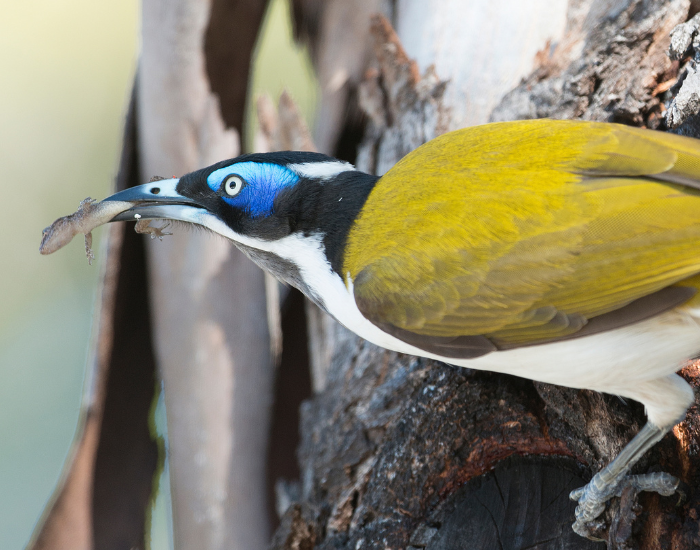
They have been reported preying on small lizards too. In Kakadu, researchers found them hunting between the leaf bases of screw palm. That is not a nectar specialist. That is a generalist with a sweet tooth.
7. Banana Bird, Pandanus Bird, Blue-Eye
Local names track local behaviour. In north Queensland it is the banana bird, after its habit of working banana flowers and fruit. Around Mackay it is the pandanus bird, because it lives permanently in the screw palms there.
Older references also call it the white-quilled honeyeater, for the white wing patch. Blue-eye and morning-bird appear too. That last one is earned. They start calling roughly half an hour before dawn.
The Handbook of Australian, New Zealand and Antarctic Birds remains the deepest reference on all this. Oxford University Press published it, and most field guide entries are condensed from it.
8. They Move Into Other Birds’ Nests
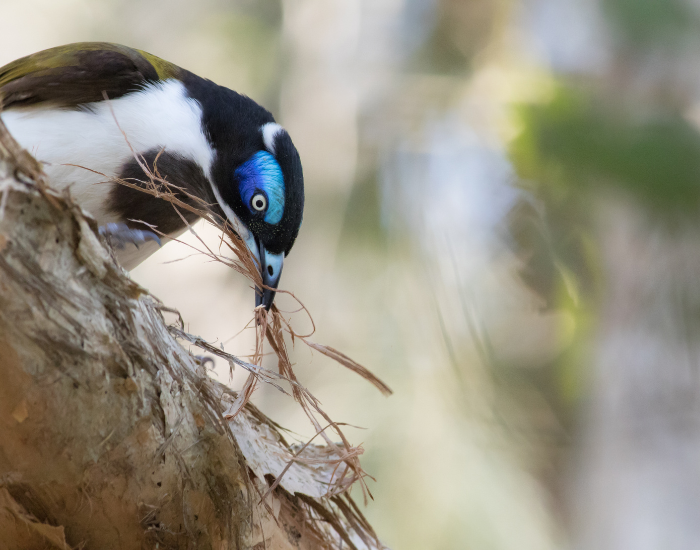
This is my favourite fact about the species. Rather than always building from scratch, they frequently take over old nests and abandoned nests of other species.
Grey-crowned babbler nests are the most common target. They also renovate structures built by noisy miners, red wattlebirds, friarbirds, the Australian magpie, butcherbirds and even the magpie-lark. One pair at Coen stripped a babbler nest of its bark lining, then re-lined it with paperbark.
Their own nests are deep bowls of sticks and bark. They wedge them into a tree fork, a staghorn fern, or a pandanus crown.
9. Breeding Runs Half the Year, and the Teenagers Help
The breeding season stretches from June through January, occasionally into February. Clutches hold two eggs, rarely three, buff-pink and splotched with red-brown.
The female alone incubates, for 16 to 17 days. Chicks hatch blind and nearly naked, then open their eyes around day four. They fledge at roughly three to four weeks. That last figure is the shakiest number here, and it is poorly documented compared with the rest.
They are also facultative cooperative breeders. Immature birds sometimes stay on to help the main breeding pair feed nestlings. Fledglings then hang around their parents well after leaving the nest.
10. The Range Covers Half a Continent, Plus New Guinea
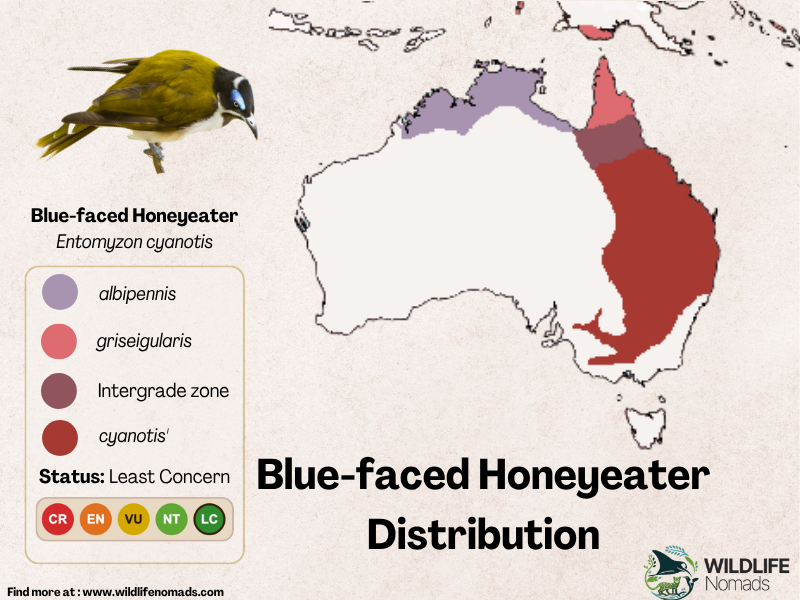
They occupy northern and eastern Australia. The range runs from the Kimberley region of Western Australia, east across the Northern Territory, and down through Queensland.
The New South Wales picture is messier than most maps suggest. They hold the Northern Rivers and Northern Tablelands, then run south along the coast to around Nambucca Heads. From there they largely vanish from the central and south coast. West of the Great Divide they reappear through the South West Slopes and Riverina. The range then continues into northern Victoria and along the Murray toward Adelaide. Add Papua New Guinea and the Aru Islands and the total area is enormous.
Northern populations sit tight. Southern ones are locally nomadic, chasing flowering events rather than a calendar. Most sightings come as pairs or small flocks, occasionally as gatherings of up to thirty. Habitat is broad: open forests and woodlands near water, mangroves, pandanus thickets, orchards, parks, gardens and golf courses.
11. Why It Sprinted at Red Cliff and Loitered at Woody Head
Now the part that has been bothering me for two days.
At Red Cliff I expected them everywhere. Instead I have seen one bird, once. It broke from the bush, crossed open ground, snatched at something, and went straight back into cover. Total exposure, maybe eight seconds.
That is textbook predation-risk foraging. At university in Sweden I ran a short ecology-course experiment with friends. We tested how a predator on an open plain changed how long birds would stay out there feeding. The result was blunt. Perceived risk shortens foraging bouts, and distance from cover does the heavy lifting. Later urban work found the same pattern, with risk and cover connectivity shaping foraging together.
Bird species differ enormously in their tolerance for the open. A kookaburra will sit exposed on a branch for twenty minutes. An Australian magpie or a crow will walk open lawn for an hour, because almost nothing hunts it there. The blue-faced honeyeater sits in the nervous middle. At Woody Head, dense fringing bush and four days of campers made the open safe. At Red Cliff, apparently, it does not.
Frequently Asked Questions
The blue-faced honeyeater (Entomyzon cyanotis) is the classic answer. It has a black head with a large patch of bare blue skin around the eye. That patch is two-toned, with brilliant cobalt on the lower half. It is a large honeyeater, 26 to 32 cm long, found across northern and eastern Australia. Juveniles show yellow-green facial skin until about sixteen months old.
Yes. It is a native Australian bird and a member of the honeyeater family, Meliphagidae. That family is one of the largest on the continent. Its natural range also extends into Papua New Guinea and the Aru Islands. Three subspecies are recognised, including albipennis across the Kimberley region and the Top End.
They do, but it is a side dish. The diet consists mostly of insects and other invertebrates, supplemented with nectar, pollen and fruit. They visit eucalypts, banksias, melaleucas, grevilleas and grasstrees, and will work banana and grape crops. They also take small lizards occasionally, which surprises most people.
They are assertive rather than relentlessly aggressive. Small flocks of up to seven birds will exclude other species from a good feeding patch. Even so, they tolerate little friarbirds and yellow-throated miners. They also mob goshawks, owls, goannas and dogs near nests. One bird was recorded in what looked like play with an immature Australian magpie.
What Camping Actually Taught Me about Them
One species, three behaviours, and none of it random. The bird on my awning at Woody Head was not friendlier than the one at Red Cliff. It had simply learnt that the open ground beside my car carried no cost. That is the uncomfortable half of habituation, and it is why I keep my food packed away.
Watch this species across a few sites and the blue face stops being the interesting part. The decision-making does. Time a bird’s exposure next time you camp. How many seconds does it spend away from cover?
Tell me in the comments what you have found. For a wider east coast list, start with my guide to Australian native birds. Then work through the honeyeaters of Australia. A wildlife-friendly garden will bring them to you without a feeder.
Blue-faced Honeyeater True or False Challenge
Eight questions to test your knowledge on Blue-faced Honeyeater optics, nest-stealing habits, and diet. Can you get a perfect score?
True / False
References:
Joseph, L., Toon, A., Nyári, Á. S., Longmore, N. W., Rowe, K. M. C., Haryoko, T., Trueman, J., & Gardner, J. L. (2014). A new synthesis of the molecular systematics and biogeography of honeyeaters (Passeriformes: Meliphagidae) highlights biogeographical and ecological complexity of a spectacular avian radiation. Zoologica Scripta, 43(3), 235–248. https://doi.org/10.1111/zsc.12049
Prum, R. O., & Torres, R. (2003). Structural colouration of avian skin: convergent evolution of coherently scattering dermal collagen arrays. Journal of Experimental Biology, 206(14), 2409–2429. https://doi.org/10.1242/jeb.00431
Toon, A., Hughes, J. M., & Joseph, L. (2010). Multilocus analysis of honeyeaters (Aves: Meliphagidae) highlights spatio-temporal heterogeneity in the influence of biogeographic barriers in the Australian monsoonal zone. Molecular Ecology, 19(14), 2980–2994. https://doi.org/10.1111/j.1365-294X.2010.04730.x
Visscher, D. R., Unger, A., Grobbelaar, H., & DeWitt, P. D. (2018). Bird foraging is influenced by both risk and connectivity in urban parks. Journal of Urban Ecology, 4(1), juy020. https://doi.org/10.1093/jue/juy020