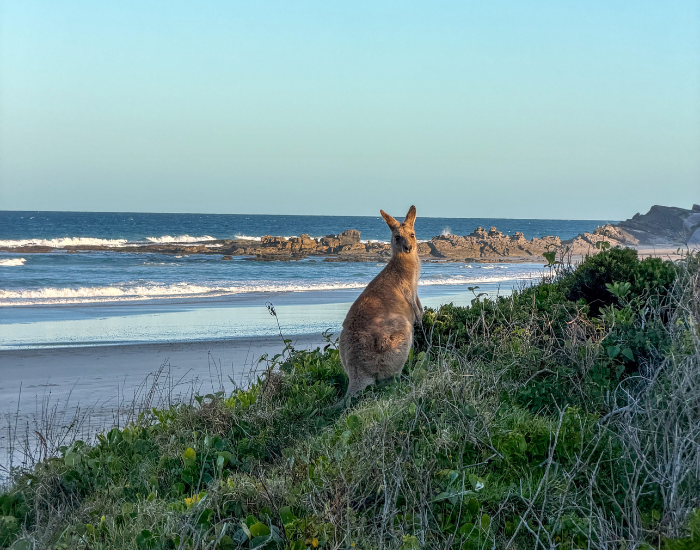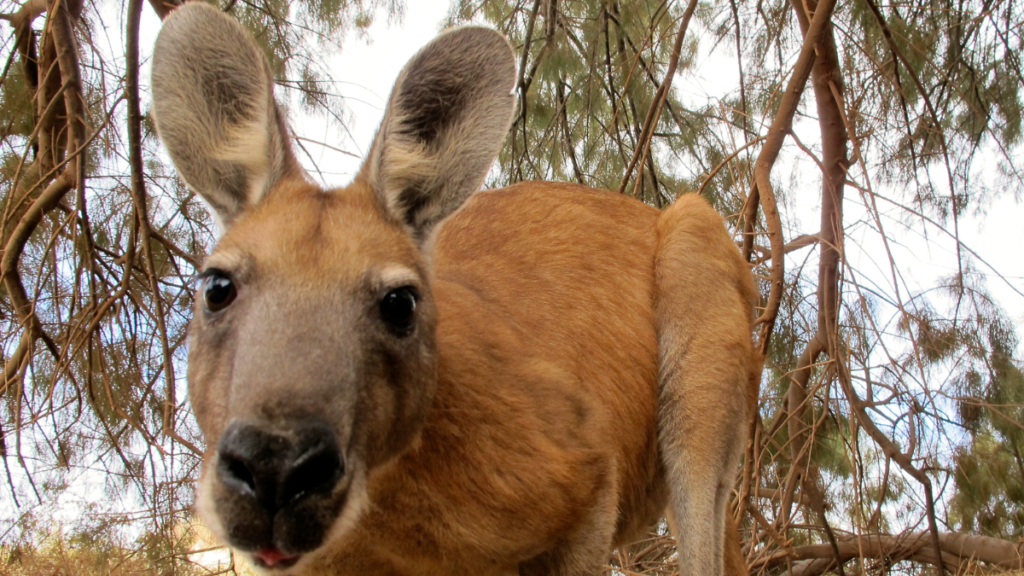
I lived in Australia for five and a half years, and I never once got tired of kangaroos. People imagine them as a rare safari sighting. The truth is funnier. You won’t find them in the Sydney CBD, but walk through almost any suburb at dusk and there they are, grazing on a sports oval like they own it. I saw kangaroos on every hike. I saw them lounging in the dunes on my way to surf. They became part of the furniture, the way you stop noticing the wild birds screaming outside your window every morning.
But familiarity is dangerous for a biologist, because it hides how strange these animals really are. Kangaroos are large marsupials found nowhere else on Earth naturally, and almost everything about them, the hopping, the pouch, the jellybean-sized newborn, breaks the rules other mammals follow. Over years of travel, from Cairns down to Tasmania on the east coast, and from Perth across to Albany in the west, I watched kangaroos in nearly every landscape this continent offers. Here are twelve facts that still make me stop and stare.
1. They Belong to a Family Built Entirely for Hopping
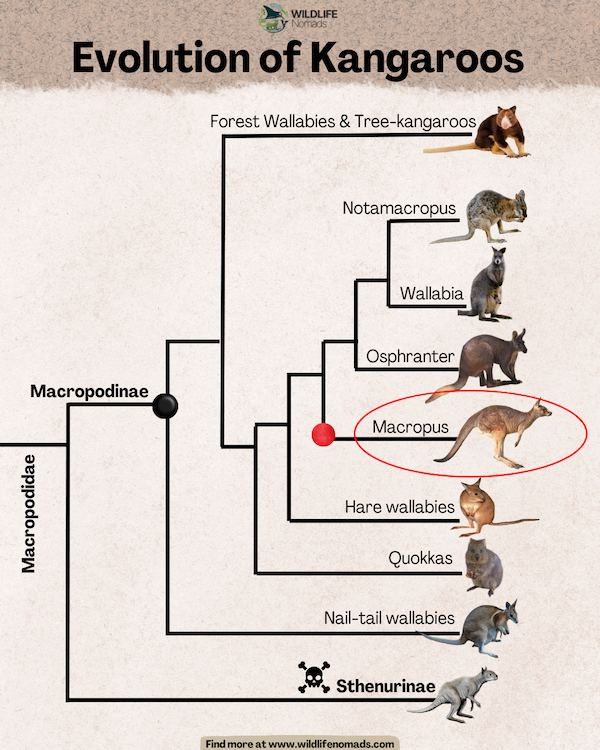
Kangaroos belong to the family Macropodidae, a word that literally means “big foot.” It’s a fitting name. The family includes wallabies, tree kangaroos, rat kangaroos, and rock wallabies, dozens of macropod species sharing the same basic blueprint. Kangaroos are simply the largest members.
As marsupials, they raise their young in a pouch rather than a placenta-fed womb. That single trait connects them to a whole branch of Australian native animals, from tiny dunnarts to wombats. People lump every hopping animal together, but a true kangaroo and a smaller wallaby are different beasts, and confusing them is the fastest way to annoy an Australian.
2. There Are Four Main Species of Kangaroos… and Wallaroos
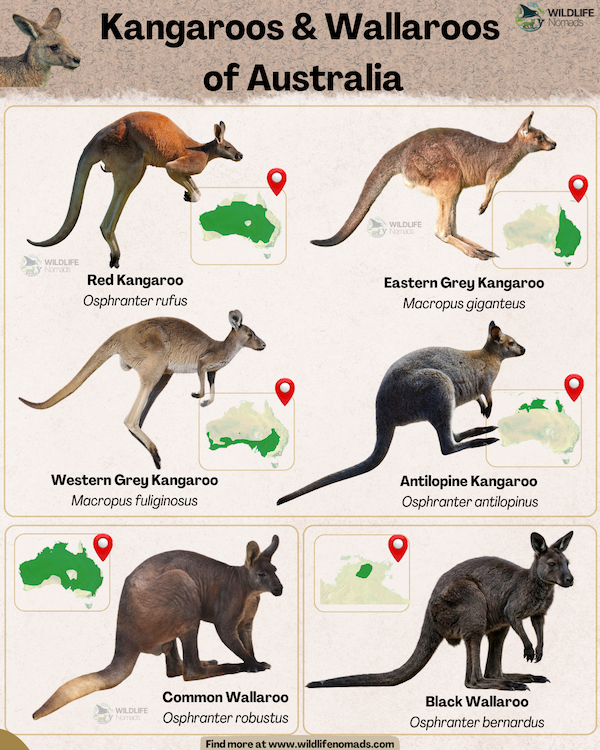
When tourists say “kangaroo,” they usually picture one animal. In reality there are four main kangaroo species: the red kangaroo, the eastern grey kangaroo, the western grey kangaroo, and the antilopine kangaroo of the tropical north. Each one fills a different slice of the continent.
The red kangaroo (Osphranter rufus, long known as Macropus rufus) rules the arid interior. The eastern grey (Macropus giganteus) dominates the fertile east, while western grey kangaroos hold the southwest. I learned to read the landscape by which species turned up: dusty red plains in the outback, then greens and grey kangaroos as you near the coast. Don’t confuse any of them with the smaller wallabies, which live alongside them but stay compact.
3. The Red Kangaroo Is the Largest Marsupial on Earth
A big male red kangaroo can stand around two meters tall and weigh 90 kilograms of pure muscle. That makes the red kangaroo the largest marsupial in the world, and frankly the most intimidating animal you’ll meet on a casual walk.
This is where their many “phases” come in, something I learned the hard way after years of watching them. A mob grazing at sunrise looks impossibly gentle, all soft ears and curious faces. Then a dominant male stands up, flexes those forearms, and the cuteness evaporates. Male kangaroos box, kick, and grapple with other males to settle disputes, and a kick from those hind legs can break bone. Adorable one minute, gym-bro the next.
4. They Are Engineered for Speed and Distance
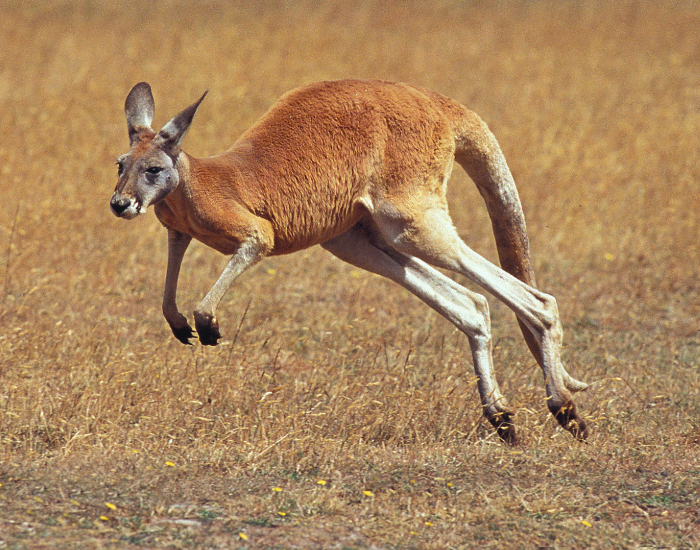
Kangaroos primarily use hopping to get around, and they are astonishingly good at it. A red kangaroo can travel at speeds exceeding 48 km/hr or 30 miles per hour (one of the fastest animals on land) and clear enormous ground in a single bound, leaps of seven to nine meters are documented. Those powerful hind legs work like springs, storing and returning energy with every stride.
That elastic recoil makes hopping one of the most energy-efficient forms of movement in the animal kingdom. The faster a kangaroo goes, the less extra energy each hop costs, which is the opposite of how running works for us. One quirk of that long-footed, heavy-tailed design: kangaroos cannot move backwards. The tail acts as a fifth limb for balance and even as a prop when they walk slowly on all fours.
5. A Newborn Joey Is the Size of a Jellybean
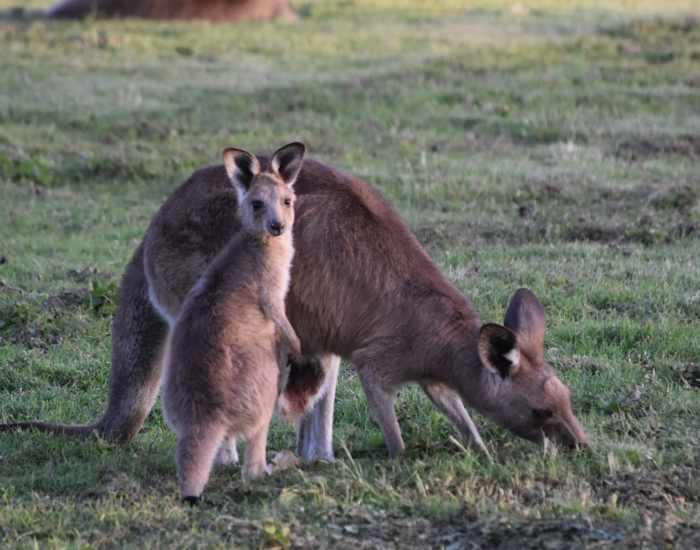
Here is the fact that stops every audience cold. Kangaroo gestation lasts just 31 to 36 days, and the joey is born weighing less than two grams, smaller than a jellybean. This blind, pink, half-formed newborn crawls unaided through its mother’s fur and into the mother’s pouch, where it latches onto a teat and finishes developing.
These young kangaroos are called joeys, and one stays in the mother’s pouch for around nine months. Even more remarkable, a mother kangaroo can run a kind of reproductive relay: she may nurse an older joey at foot, carry one baby in the pouch, and hold a third embryo in paused development all at once. That pause is called embryonic diapause, and it lets her delay birth until drought breaks and conditions favor a newborn. It is one of the most elegant survival tricks in mammalian biology.
6. Kangaroos Live in Mobs With Real Social Rules
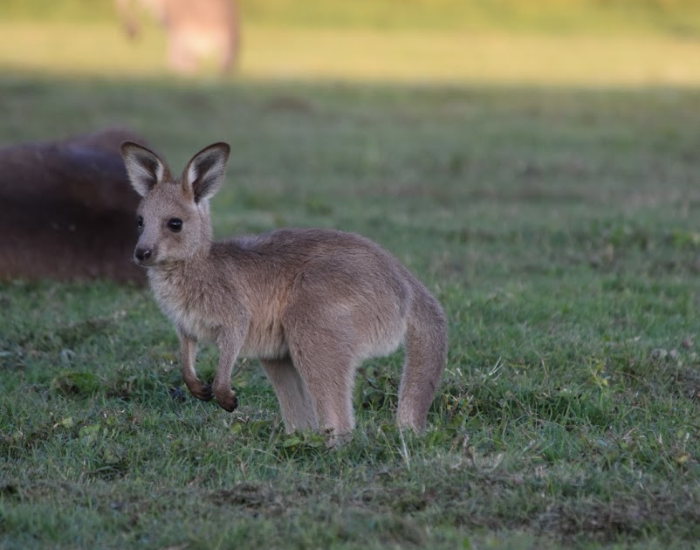
Kangaroo groups are called mobs, though “troops” and “courts” turn up too. A mob usually consists of ten or more individual animals, and across eastern Australia these mobs tend to be larger and more stable than in the harsh interior.
These are genuinely social animals, not random gatherings. The dominant male defends breeding rights against other males and earns his status through those boxing contests. They communicate through soft clucking calls, foot thumps alerting family members to danger, and gentle nose touching between familiar individuals. Watching a mob alert each other to a threat, the warning rippling outward in seconds, you realize how much quiet coordination is happening.
I got good at picking out mobs from drone footage during some work in Sydney. From overhead you learn to read their loose formation, ten or more individual animals fanned across the grass, not clumped like livestock.
7. You’ll Find Them in Almost Every Australian Landscape
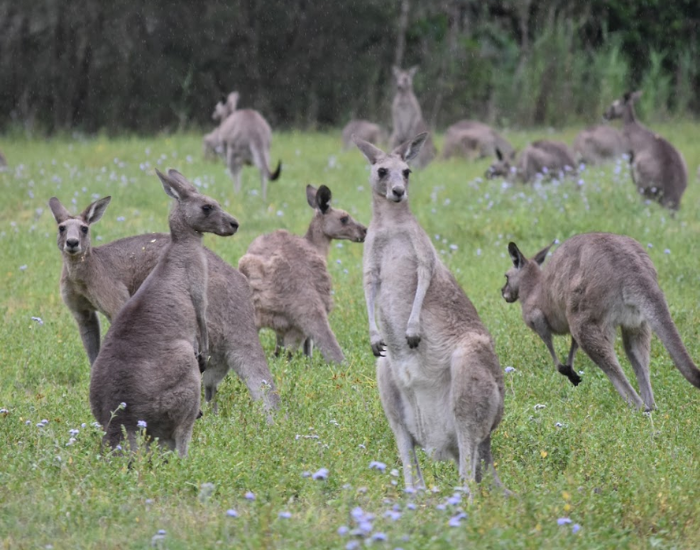
Kangaroos inhabit a remarkable range of environments: forests, woodlands, open plains, and dry savannahs. This adaptability is exactly why they’re so common, and why they’ve become such an enduring Australian icon. They are not fragile specialists clinging to one wilderness corner.
In Sydney, I worked for an ecosystem-restoration startup where I analysed satellite and drone imagery. Learning to identify kangaroos from the air drove home just how widespread they are, from above, a mob reads as a scatter of pale shapes drifting across a paddock at first light.
This range is what surprises visitors most. The Australian landscape practically hums with them once you know where to look, golf courses at dawn, roadside verges, paddocks at the edge of town. Living there for years, I came to expect a few grey kangaroos waiting in the half-light whenever I drove home late. They are native wildlife you learn to share your suburb with.
8. They Are a Keystone Species That Shapes the Bush
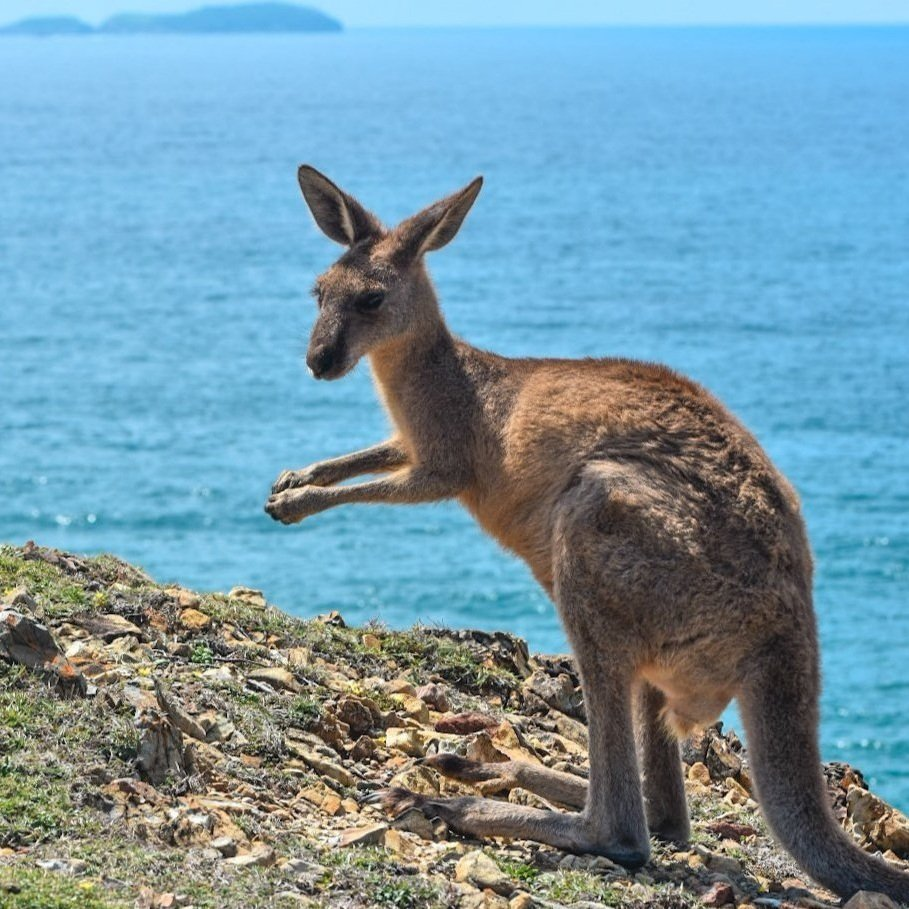
Kangaroos are a keystone species, meaning the whole ecosystem leans on what they do. By grazing native grasses, they keep pastures open and promote the regeneration of native plants, which in turn maintains biodiversity across the bush.
Their influence runs deeper than mowing. Kangaroos disperse seeds caught in their fur and passed in their droppings. As they rest, they dig shallow depressions known as hip holes, and these little hollows trap seeds and moisture, creating tiny nurseries for new growth. Remove the kangaroos and the landscape itself starts to change.
9. Their Gut Is a Low-Methane Marvel… But Not a Zero-Methane One
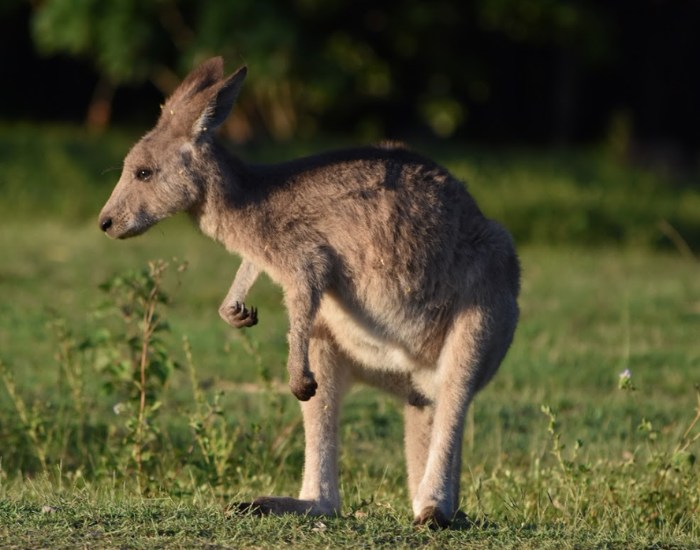
Kangaroos have a chambered stomach and can regurgitate food to chew it again, much like a cow. They are foregut fermenters, relying on gut microbes to break down tough grasses. Food moves through them quickly, so microbes get less time to generate methane.
You’ll often read that kangaroos produce “almost no methane.” That’s a myth worth correcting. Research found kangaroos do emit methane, roughly 27 percent of the body-mass-specific volume that cattle and sheep produce. Far lower than a cow, yes, but not zero. The science is more interesting than the slogan: their gut chemistry is genuinely efficient without being magical.
10. Kangaroo Meat Is One of the Leanest Red Meats Around
Kangaroo meat has been part of life here for a very long time. Indigenous Australians have relied on it for tens of thousands of years, and today human consumption is a niche but growing market. Nutritionally it’s impressive: very high in protein, very low in fat, and it carries one of the highest known concentrations of conjugated linoleic acid (CLA) of any food.
The meat is exported to around 70 countries, and halal-certified kangaroo meat is available from some suppliers for the Muslim market. It’s a divisive topic among Australians, eating the national emblem feels strange to many, but ecologically, harvesting wild kangaroos has a far lighter footprint than farmed beef.
11. Kangaroos Have Few Predators, and Most Threats Are Human
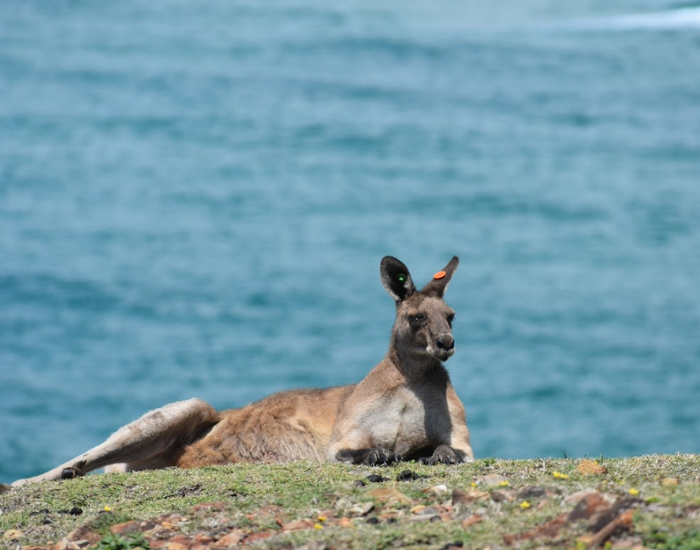
Adult kangaroos have few natural predators. Dingoes are the main one, with wedge-tailed eagles taking joeys, and introduced species like foxes and feral cats preying on the young. Smaller species are far more vulnerable than a healthy adult red kangaroo, which is simply too large and powerful for most hunters.
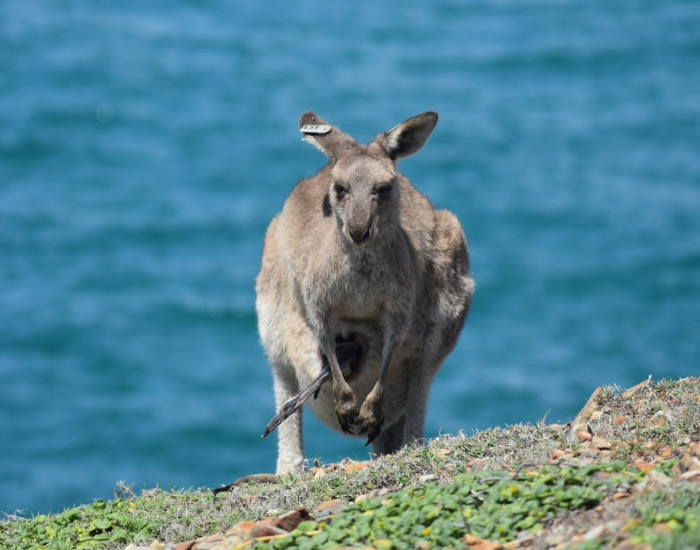
The real pressures are human. European settlers reduced kangaroo populations through habitat destruction, and across states from New South Wales to South Australia, vehicle collisions kill huge numbers every year, anyone who has driven rural New South Wales at dusk knows the danger. The commercial industry is significant too: by some estimates, close between 1.5M to 3M annually across commercial zones. Kangaroos and wallabies have been harvested for meat and skins over the past 30 years, the largest commercial harvest of wild land animals on Earth.
12. They Are Culturally Sacred… and the Name Itself Tells a Story
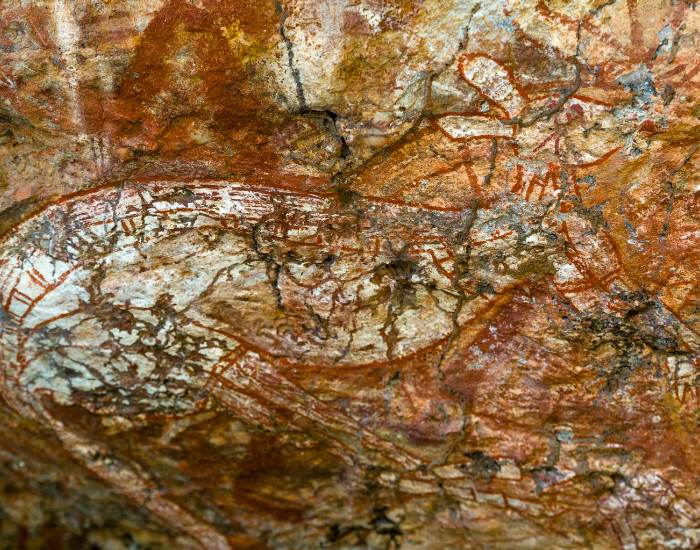
Long before kangaroos were a national image stamped on coins and tails of planes, they were sacred. Kangaroos are deeply significant to Aboriginal people across Australia, appearing in ancient rock paintings that date back thousands of years and featuring in important Dreaming stories and ceremonies. Their hides were even used in traditional games.
The name carries that history. “Kangaroo” derives from gangurru, a word from the Guugu Yimithirr language of north Queensland, recorded by Joseph Banks in 1770. There’s a common misconception that it means “I don’t understand”, supposedly what a local said when Cook’s crew pointed and asked. Linguists debunked that long ago. Gangurru simply referred to a particular large grey kangaroo. The animal had a name all along; the newcomers just didn’t know it yet.
Frequently Asked Questions
Kangaroos are marsupials in the family Macropodidae, so their closest relatives are other macropods: wallabies, tree kangaroos, rat kangaroos, and rock wallabies. More broadly, they’re part of the same marsupial group as wombats, koalas, and bilbies — all native animals that raise young in a pouch.
There are four main kangaroo species: the red kangaroo, the eastern grey kangaroo, the western grey kangaroo, and the antilopine kangaroo. The red and the eastern grey (Macropus giganteus) are the two most numerous and widespread. Each occupies a different region of Australia.
A kangaroo is a large marsupial native to Australia, belonging to the family Macropodidae. Kangaroos move by hopping on powerful hind legs, carry their young in a pouch, and live in social groups called mobs. The red kangaroo is the largest, standing up to two meters tall.
A real kangaroo has a muscular body, very large hind legs and feet, short forelimbs, a long thick tail for balance, and a small head with large upright ears. Coloring ranges from rusty red in red kangaroos to soft grey-brown in grey kangaroos. Adult male kangaroos are noticeably larger and more heavily muscled than females.
A red kangaroo can hop at speeds exceeding 30 miles per hour over short distances and cruise comfortably at lower speeds for long stretches. Their hopping gait is extraordinarily energy-efficient, letting them cover vast ground across the arid interior in search of food and water.
Kangaroo: Fact or Fiction? 🦘
Ten statements about Australia’s most famous marsupial — some true, some myths everyone repeats. Can you tell them apart?
Fact or Fiction?

A Continent’s Whole Story in One Animal
Spend enough time with kangaroos and you stop seeing a tourist mascot and start seeing the engine of an ecosystem — a grazer that regenerates the bush, a marsupial that rewrote the rules of reproduction, and a cultural figure older than any nation’s borders. That’s a lot to carry in one pair of oversized feet. If you ever get the chance to watch a mob at dawn, take it, and look past the cuteness to the biology underneath.
What’s your own kangaroo story — a roadside encounter, a cheeky thief at a campsite, a boxing match you witnessed? Drop it in the comments below. And if you’re keen to keep exploring Australia’s stranger residents, meet the egg-laying echidna, the burrowing bilby, and the gloriously confusing platypus next.
References:
Kram, R., & Dawson, T. J. (1998). Energetics and biomechanics of locomotion by red kangaroos (Macropus rufus). Comparative biochemistry and physiology. Part B, Biochemistry & molecular biology, 120(1), 41–49. https://doi.org/10.1016/s0305-0491(98)00022-4
Vendl, C., Clauss, M., Stewart, M., Leggett, K., Hummel, J., Kreuzer, M., & Munn, A. (2015). Decreasing methane yield with increasing food intake keeps daily methane emissions constant in two foregut fermenting marsupials, the western grey kangaroo and red kangaroo. The Journal of experimental biology, 218(Pt 21), 3425–3434. https://doi.org/10.1242/jeb.128165
Renfree, M. B., & Shaw, G. (2014). Embryo-endometrial interactions during early development after embryonic diapause in the marsupial tammar wallaby. International Journal of Developmental Biology, 58(2-4), 175–181. https://doi.org/10.1387/ijdb.140059mr
Dawson L, Flannery T. (1985) Taxonomic and Phylogenetic Status of Living and Fossil Kangaroos and Wallabies of the Genus Macropus Shaw (Macropodidae: Marsupialia), with a New Subgeneric Name for the Larger Wallabies. Australian Journal of Zoology 33, 473–498. https://doi.org/10.1071/ZO9850473