
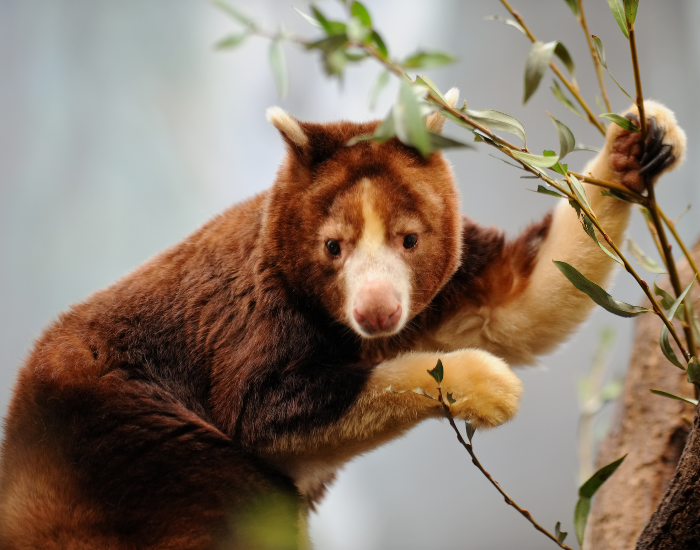
I have been studying and working in conservation in Australia for five years, and I thought I knew marsupials pretty well. Kangaroos, wallabies, possums, I’d encountered them all across the bush. Yet one creature kept eluding me: the tree kangaroo. I knew they existed somewhere in the rainforest of northeastern Australia, but spotting one felt like chasing a ghost. I trekked through Queensland’s Wet Tropics during my master’s degree, scanning the canopy until my neck ached. No luck. It wasn’t until the Wildlife Nomads team visited a sanctuary that I finally locked eyes with one, a Lumholtz’s tree kangaroo perched on a branch, staring back at me with those enormous dark eyes. Even in captivity, this animal looked like something straight out of Avatar. A kangaroo that climbs, wrapped in dense fur, with a long tail draped like a vine. That encounter changed how I think about these habitats and the animals hiding in them.
Here are twelve facts that explain why tree kangaroos deserve far more attention than they get.

1. Tree Kangaroos Are Kangaroos That Went Back Up
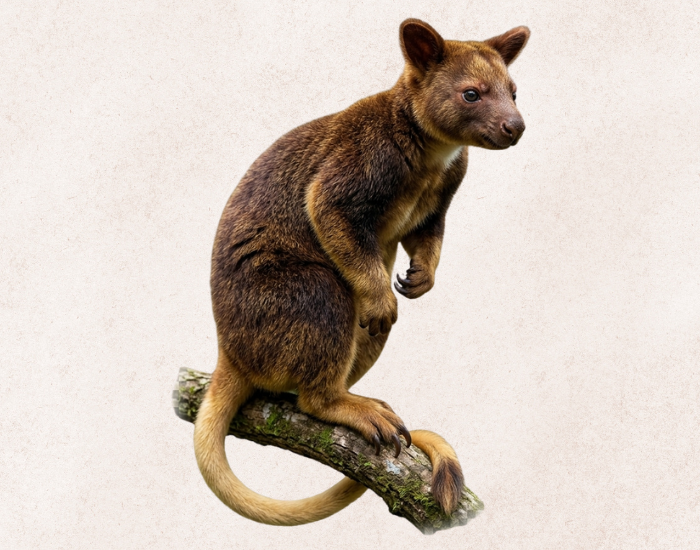
This is the part that bends most people’s brains. All kangaroos descended from arboreal ancestors millions of years ago. Most species adapted to open ground, developing powerful hind legs for hopping across grasslands. Tree kangaroos did the opposite. They returned to the canopy, re-adapting for climbing trees rather than hopping. The genus Dendrolagus — their scientific family namem literally means “tree hare.” Their front limbs grew stronger and more muscular than those of terrestrial kangaroos.
Their hind feet became shorter and wider, with rubbery soles that grip tree bark and branches like natural shoes. They even developed curved, sharp claws for hooking into tree trunks. However, this return trip wasn’t a clean swap. Tree kangaroos still move awkwardly when grounded, waddling forward rather than hopping efficiently. They remain adapted for life spent among branches, foliage, and thick rainforest canopy.
2. There Are at Least 14 Tree Kangaroo Species… and Scientists Keep Finding More
The genus Dendrolagus includes species you’ve almost certainly never heard of. Matschie’s tree kangaroos live on the Huon Peninsula of Papua New Guinea. Lumholtz’s tree kangaroo inhabits the Atherton Tablelands. Goodfellow’s tree kangaroo (Dendrolagus goodfellowi) sports a striking chocolate-brown coat with golden rump stripes. Doria’s tree kangaroo is one of the largest species, with a body length reaching 78 centimeters and weighing up to 14.5 kilograms. The golden mantled tree kangaroo wears a double golden band across its back.
Then there’s the Wondiwoi tree kangaroo, a species so rare it was considered extinct for nearly 90 years before researchers spotted one in 2018. Seri’s tree kangaroo (Dendrolagus stellarum) occupies high-altitude forests in New Guinea’s central highlands. Each has adapted to specific elevations and conditions across Papua New Guinea. Scientists suspect additional varieties remain undescribed in remote areas, where dense rainforest and rugged terrain make surveys extremely difficult.

3. Papua New Guinea Is the Global Hotspot for Tree Kangaroos
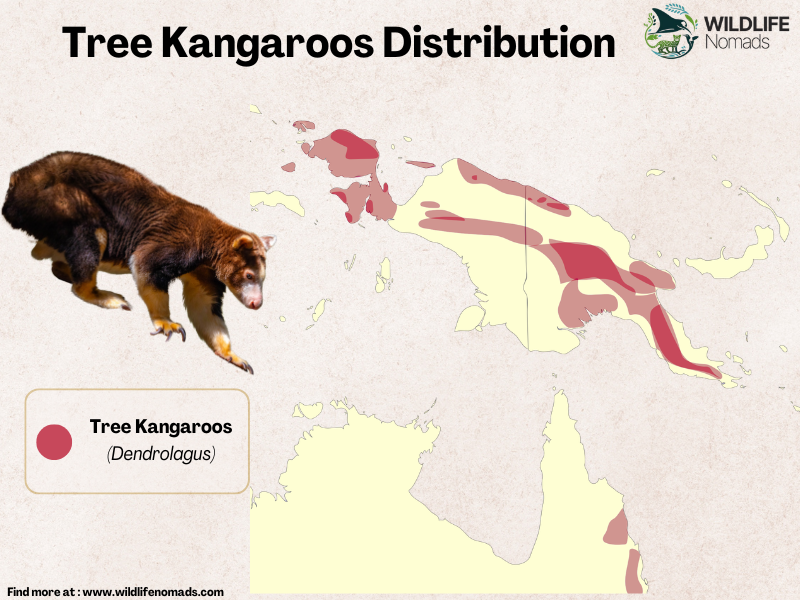
If you want to find tree kangaroos in the wild, Papua New Guinea is where you go. Twelve of the fourteen known species live on this island. New Guinea, from lowland tropical rainforests to cloud cover above 3,000 meters, shelters the greatest diversity of these marsupials on Earth. The Huon Peninsula alone is home to Matschie’s tree kangaroos, which live nowhere else. Huon tree kangaroos depend on these habitats, where rainfall is heavy, temperatures stay cool, and ferns carpet the floor beneath towering canopy.
By contrast, only two species exist in the wild further south: Bennett’s tree kangaroo and Lumholtz’s tree kangaroo (Dendrolagus lumholtzi), both confined to a narrow strip of tropical rainforest in far north Queensland. That geographic concentration makes Papua New Guinea critically important for the survival of tree kangaroo populations worldwide.
4. They Sleep Up to 60% of Their Lives
Here’s something I didn’t expect when I first learned about tree kangaroo behavior. These animals are champion sleepers. Matschie’s tree kangaroos spend roughly 60 percent of their time curled up asleep in the canopy, tucked into whatever perch they happen to be resting on. That’s more than cats, more than koalas relative to body size, and far more than kangaroos that live on open ground. The reason likely comes down to energy conservation.
A 2022 study found that Matschie’s tree kangaroos have relatively low total energy expenditure. Their diet of leaves, bark, flowers, and fruit provides modest caloric returns, so sleeping more helps them balance the scales. When they are awake, they move slowly and deliberately through the canopy, nothing like the explosive speed of a red kangaroo bounding across the outback
5. Their Climbing Skills Are Extraordinary… but Watch Them on the Ground
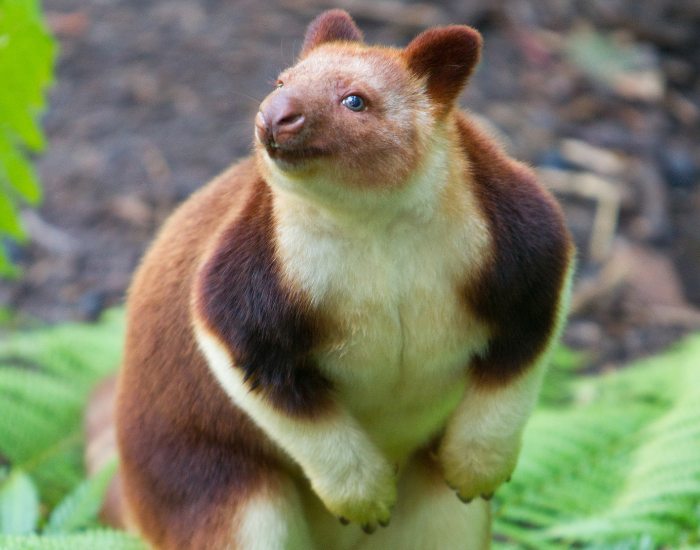
Watching a tree kangaroo climb is unforgettable. They grip tree trunks with powerful forelimbs, pushing upward with their feet in a rhythmic motion. Their rubbery, padded soles mold around branches, and those claws anchor them to bark. Lumholtz’s tree kangaroo can leap up to nine meters between branches. Some species descend by sliding down trunks, then jumping off from heights of ten meters or more. Climbing trees is what these creatures were built for.
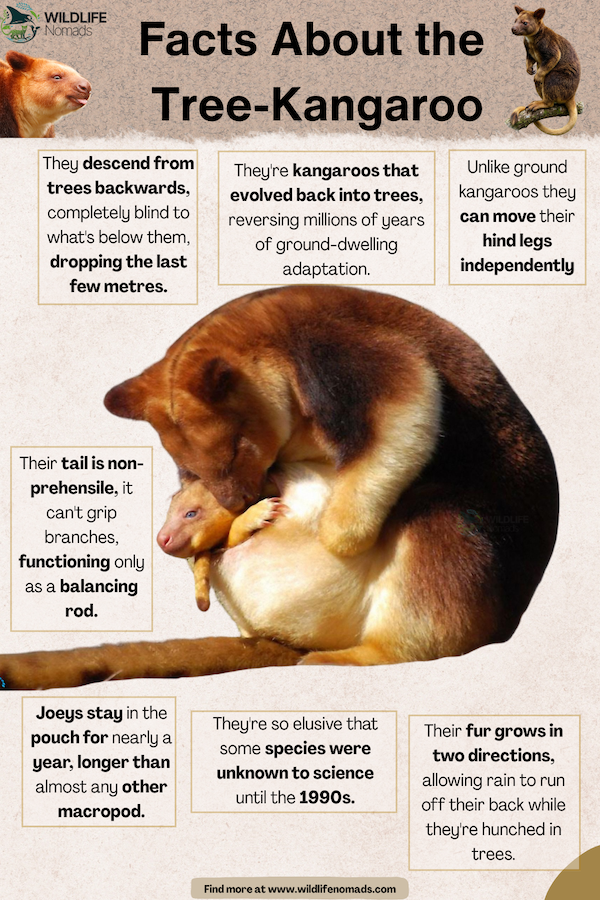
On the ground, though? It’s a different story. Tree kangaroos waddle clumsily, moving their legs independently. While ground-dwelling kangaroos are physically incapable of ‘walking’ their hind legs, tree kangaroos evolved this ability to navigate uneven branches, a skill that translates to a clumsy, shuffling gait on the forest floor.
Their slightly smaller hind legs and longer front feet, perfect for climbing trees, make ground locomotion inefficient. This vulnerability is one reason habitat fragmentation hits them so hard. When forests are cleared, tree kangaroos must cross open ground to reach remaining patches, exposing them to predators and vehicles.
6. Those Long Tails Are Not What You’d Expect
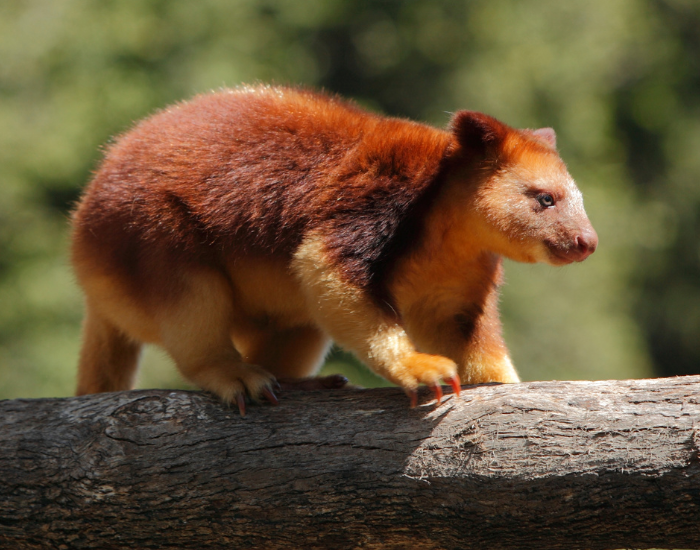
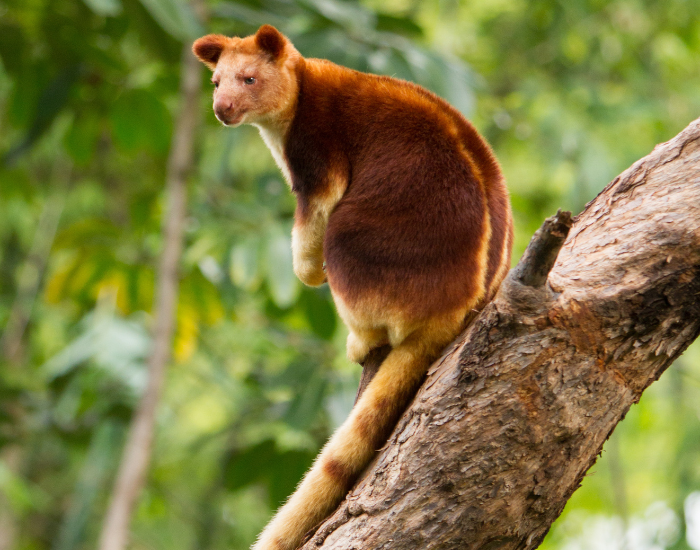
Most people assume a tree kangaroo uses its long tail to grip branches, like a primate or a possum. Not quite. A tree kangaroo uses its tail primarily as a counterweight for balance while moving along branches or resting in the canopy. Unlike the prehensile appendages of some Australian possums, a tree kangaroo cannot curl it around a branch and hang.
Doria’s tree kangaroo has one measuring 44 to 66 centimeters, nearly as long as the body itself. That length provides crucial stability during leaps and when navigating thin branches high above the forest floor. Interestingly, the underside in many species features roughened skin that provides additional friction.
7. They Have the Longest Gestation Period of Any Known Marsupial
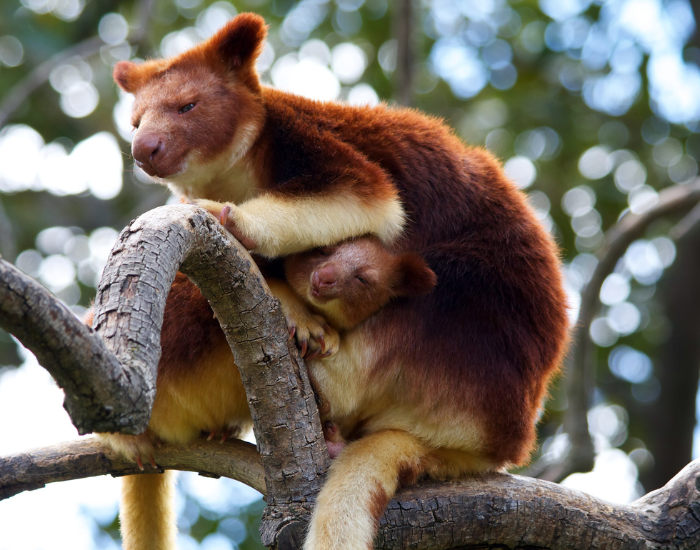
Marsupial reproduction is already strange by mammal standards. Most marsupials have remarkably short gestation periods, a red kangaroo joey is born after just 33 days. Tree kangaroos push that timeline further than any other known marsupial. Female tree kangaroos carry their young for approximately 44 days before giving birth. That might not sound like much, but for marsupials, it’s a record.
The newborn joey is roughly the size of a kidney bean, blind, hairless, and profoundly underdeveloped. After birth, it crawls through the mother’s fur and into the mother’s pouch, where it latches onto a teat and continues growing for about seven months. After that, the joey begins poking its head out of the mother’s pouch, testing the world in short bursts. It takes another three months before the joey fully leaves. Weaning doesn’t happen until around 13 months of age. Females typically raise one joey at a time, which means these animals reproduce slowly, a serious concern for conservation.
8. Males and Females Live Very Different Lives
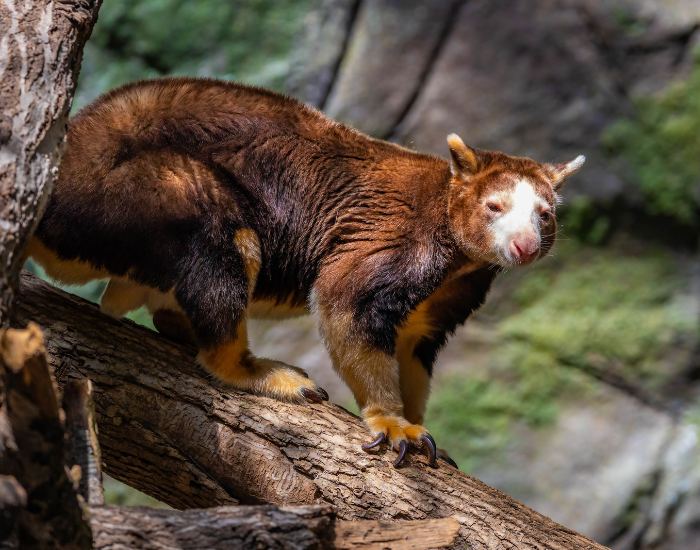
Tree kangaroos are largely solitary mammals. Males and females maintain separate territories, coming together primarily to mate. Males tend to hold larger territories that overlap with those of several females, increasing their breeding opportunities. Females defend smaller, more focused home ranges centered around reliable food sources and safe nesting habitats.
A 2014 study examined the spatial requirements of free-ranging Huon tree kangaroos on the Huon Peninsula. Researchers found that males ranged across significantly broader areas than females, with overlapping territories between the sexes being common. Females are slightly smaller than males in most tree kangaroo varieties, with distinct ear tips and face markings that vary between individuals. This solitary lifestyle means that when you do spot a tree kangaroo in the wild, or even in a sanctuary, it’s almost always alone. During my encounter at the sanctuary, the one I observed sat completely alone on its branch, seemingly unbothered by anything happening around it.
9. Hunting Remains One of Their Biggest Threats
Conservation conversations often focus on habitat loss, and rightfully so. But for many tree kangaroo species, hunting pressure is equally devastating. Indigenous communities across Papua New Guinea have hunted tree kangaroos for food for thousands of years. Traditionally, this hunting was sustainable, small human populations taking relatively few from vast forests.
That balance has shifted. Growing numbers of humans, easier access to remote areas through logging roads, and the introduction of hunting dogs have dramatically increased the toll. Matschie’s tree kangaroos are hunted primarily for their meat in many areas. The golden mantled tree kangaroo, with only an estimated 500 mature individuals remaining, faces similar hunting pressure combined with habitat destruction from agricultural expansion and mining. For species with slow reproduction rates, even modest hunting can push populations toward collapse.
10. Habitat Loss Is Shrinking Their World Fast
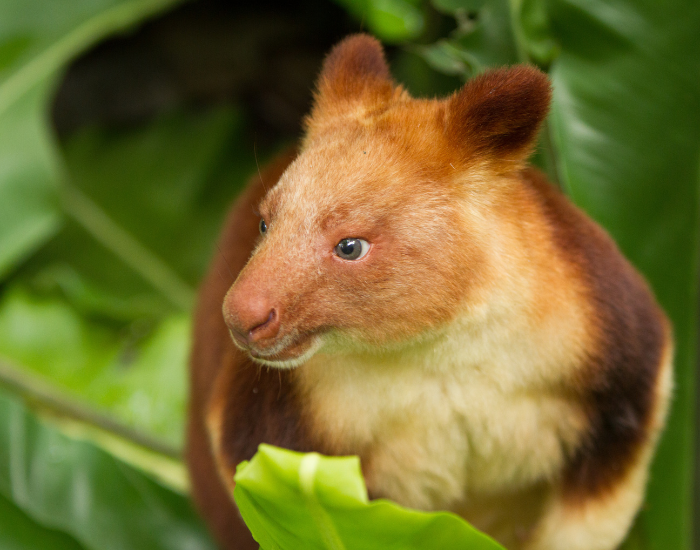
Across Papua New Guinea and Australia, the tropical rainforests that tree kangaroos depend on are disappearing. Logging, mining, oil extraction, and conversion of land to agriculture fragment the continuous canopy these animals need. Lumholtz’s tree kangaroo faces threats from land clearing and road mortality on the Atherton Tablelands. These habitats are not just nice places to live, they are the only environments where tree kangaroos can survive.
Habitat loss severs connections between populations, isolating small clusters that become vulnerable to inbreeding and local extinction. Damp weather and dense canopy cover are essential features of their environment. When those conditions vanish, so do the populations. A study found that even restored riparian habitats can support some terrestrial activity, suggesting that reforestation efforts could help reconnect fragmented areas.

11. The Tree Kangaroo Conservation Program Is a Model for Success
Not all the news is grim. The Tree Kangaroo Conservation Program (TKCP), managed by the Woodland Park Zoo in Seattle, has become one of the most successful conservation models in the Pacific region. Operating in Papua New Guinea, the program works directly with local landowners to protect tree kangaroo habitats. In 2009, their efforts led to the creation of the YUS Conservation Area, the country’s first nationally recognized community-managed protected area. It spans over 76,000 hectares of forest, protecting not just Matschie’s tree kangaroos but an entire ecosystem of plants, birds, and other wildlife.
What makes TKCP remarkable is its approach. Rather than imposing restrictions from outside, the program empowers local communities to manage their own land, providing alternative livelihoods and education. For humans living alongside these animals, conservation becomes a practical choice rather than an abstract ideal. This is the kind of model that gives me hope, practical, community-driven, and built on mutual respect between people and wildlife.
12. Some Varieties Teeter on the Edge of Extinction
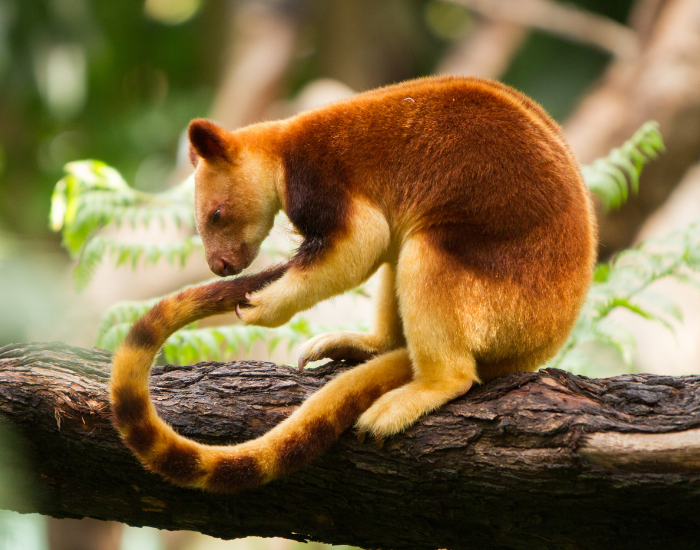
The Wondiwoi tree kangaroo is the most dramatic example. Known from a single specimen collected in 1928, scientists assumed it was extinct until an amateur botanist photographed one in Papua’s Wondiwoi Mountains in 2018. (A great example of Citizen Science) With an estimated count of just 40 mature individuals, the Wondiwoi tree kangaroo remains critically endangered.
The tenkile tree kangaroo hovers around 200 mature individuals. The golden mantled tree kangaroo sits at roughly 500. Even “better off” animals like Goodfellow’s tree kangaroo (Dendrolagus goodfellowi) face decline due to ongoing habitat destruction and hunting.
FAQs About Tree Kangaroos
Tree kangaroos live in the tropical rainforests of Papua New Guinea, parts of Indonesia, and far northeastern Australia. Most are found across New Guinea, where they inhabit everything from lowland areas up to mountainous regions above 3,000 meters. Two varieties occupy a narrow strip of rainforest in northeastern Australia.
Tree kangaroos are herbivores that eat primarily leaves, which make up the bulk of their diet. They also consume fruit, flowers, tree bark, ferns, and occasionally nuts and insects. Their diet varies by habitat. Matschie’s tree kangaroos feed on a range of foliage available in their montane habitats, while those in Australia favor the leaves and fruit of specific canopy plants.
Tree kangaroos belong to the same family as kangaroos you’d see in the outback but have evolved key differences for life in the canopy. Their front arms are much stronger and more muscular. Their feet are shorter and wider with rubbery soles for gripping. They have sharp, curved claws for climbing trees. Their long tail serves as a counterbalance rather than a prop.
Protect Tree Kangaroos by Knowing They Exist
The biggest threat to tree kangaroos might be the simplest one: most people don’t know they’re real. A kangaroo that climbs sounds like a children’s book invention, not a living, breathing creature clinging to branches in forests across New Guinea and Australia. Every tree kangaroo species represents millions of years of evolutionary experimentation, mammals that defied the typical kangaroo trajectory and carved out life in the canopy.
If this article sparked something for you, share it. Talk about tree kangaroos the way you’d talk about tigers or pandas. And if you ever find yourself near forests in Queensland or Papua New Guinea, look up. You might catch a glimpse of something extraordinary. For more about the remarkable animals of Australia, explore our other guides on Wildlife Nomads.
References
Dunham, N. T., Koester, D. C., Dierenfeld, E. S., Rimbach, R., Pontzer, H., & Righini, N. (2022). Balancing the scales: Preliminary investigation of total energy expenditure and daily metabolizable energy intake in Matschie’s tree kangaroo (Dendrolagus matschiei). PLOS ONE, 17(7), e0270570. https://doi.org/10.1371/journal.pone.0270570
Finch, K., & Humphreys, A. (2022). Day time activity budgets, height utilization and husbandry of two zoo-housed Goodfellow’s tree kangaroos (Dendrolagus goodfellowi buergersi). Journal of Zoological and Botanical Gardens, 3(1), 9. https://doi.org/10.3390/jzbg3010009
Heise-Pavlov, S., Semper, C., & Burchill, S. (2021). Terrestrial activity patterns of the Lumholtz’s tree-kangaroo (Dendrolagus lumholtzi) in a restored riparian habitat — Implications for its conservation. Ecological Management & Restoration, 22(S2). https://doi.org/10.1111/emr.12481
Heise-Pavlov, S. R., & Burchill, S. (2016). Current knowledge of the behavioural ecology of Lumholtz’s tree-kangaroo (Dendrolagus lumholtzi). Pacific Conservation Biology, 22(4), 302–313. https://doi.org/10.1071/PC16041
Inman M. (2010). Jumping genes reveal kangaroos’ origins. PLoS biology, 8(7), e1000437. https://doi.org/10.1371/journal.pbio.1000437
Dierenfeld, E. S., Bezjian, M., & Dabek, L. (2020). Nutrient composition of locally available browses consumed by Matschie’s tree kangaroos (Dendrolagus matschiei) in six North American zoological facilities. Journal of Agriculture and Ecology Research International, 21(11), 56–68. https://doi.org/10.9734/JAERI/2020/v21i1130177
Procter-Gray, E., & Ganslosser, U. (1986). The individual behaviors of Lumholtz’s tree-kangaroo: Repertoire and taxonomic implications. Journal of Mammalogy, 67(2), 343–352. https://doi.org/10.2307/1380887
Porolak, G., Dabek, L., & Krockenberger, A. K. (2014). Spatial requirements of free-ranging Huon tree kangaroos, Dendrolagus matschiei (Macropodidae), in upper montane forest. PloS one, 9(3), e91870. https://doi.org/10.1371/journal.pone.0091870