In a microbiology lab at university I put a drop of pulque under a microscope. Pulque is a fermented agave drink you buy on the street in Mexico, and what came into focus was Lactobacillus, thousands of them, doing the work that turns sap into a drink. In another class we took samples from the lake on campus and found amoebas and paramecia hunting each other. On exchange at Uppsala a group of us went looking for tardigrades in moss and found a few.
Three labs, three completely different kinds of life, and the system that keeps them straight is the kingdom of living things. This is a guide to the six kingdoms as biologists use them now, what has changed since the five kingdom system was proposed in 1969, and where the latest research has moved the boundaries.
How the Classification System Works
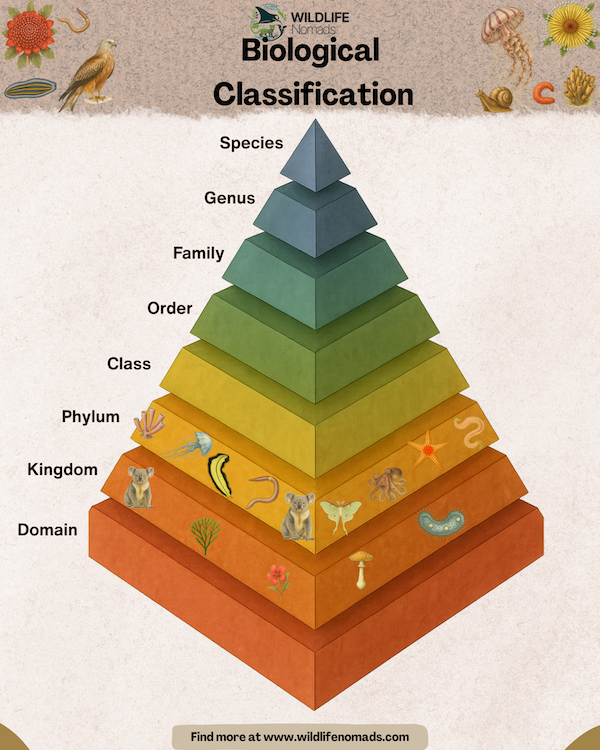
To classify organisms is to sort living organisms into large groups by similar characteristics, and the result is called classification: a set of nested boxes. Each level holds the one below it, and each step down means a tighter family resemblance.
The taxonomic categories run: domain, kingdom, phylum, class, order, family, genus, species. Learn it as phylum class order family and then class order family genus and the middle of the sequence stops being slippery.
Kingdom sits near the highest rank, so a kingdom covers enormous ground: every animal on Earth sits in one. Species is the bottom, and the only level with a biological test behind it. Two organisms belong to the same species if they can interbreed and produce fertile offspring. Everything above that is a judgement about evolutionary origins.
🌳Phylum Explorer: the Tree of LifeZoom through 3 domains, 6 kingdoms and the major phyla, grow 4 billion years of life and find out how related any two living things are.Explore the tree →How Biologists Decide
Organisms are classified based on a short list of questions, and for most of this system’s history they were questions you could answer by looking.
- One cell or more than one cell? Single celled organisms sit apart from multicellular organisms in every scheme.
- Is there a defined nucleus? Prokaryotes have none. Eukaryotic organisms have a distinct nucleus and membrane bound organelles.
- Cell walls, and made of what? Cellulose in plants, chitin in fungi, peptidoglycan in most bacteria, none at all in animals.
- Where does the food come from? Autotrophs make their own food. Heterotrophs take it from other organisms.
- How does it reproduce? Sexual reproduction, asexual, spores, or some combination.
DNA sequencing now does most of the work, and it keeps finding that organisms which look alike are not related and that organisms which look nothing alike evolved the same way from a shared ancestor. That is why the boundaries keep moving. For the level below kingdom, I have a separate guide to understanding phyla in animals, and convergent evolution explains why appearance misleads so often.
The Six Kingdoms of Life
The five kingdom system that R. H. Whittaker proposed in 1969 was Monera, Protista, Fungi, Plantae and Animalia. Its weak point was the Monera kingdom, which lumped all prokaryotic organisms into one. Kingdom Monera no longer appears in current schemes. Once genetic sequencing showed that bacteria and archaea are as different from each other as either is from us, Monera was divided into two kingdoms and the six kingdom system became the standard teaching model.
| Kingdom | Cells | Nucleus | Cell wall | Food | Examples |
|---|---|---|---|---|---|
| Archaebacteria | Single celled | No | Varies, no peptidoglycan | Varies | Methanogens, halophiles |
| Eubacteria | Single celled | No | Peptidoglycan | Mostly heterotrophic | E. coli, Staphylococcus aureus, cyanobacteria |
| Protista | Mostly single celled | Yes | Varies | Both | Amoebas, paramecia, algae, slime moulds |
| Fungi | Mostly multicellular | Yes | Chitin | Heterotrophic | Yeasts, moulds, mushrooms |
| Plantae | Multicellular | Yes | Cellulose | Autotrophic | Mosses, ferns, conifers, flowering plants |
| Animalia | Multicellular | Yes | None | Heterotrophic | Sponges, insects, fish, mammals |
Two of these kingdoms hold prokaryotes and four hold eukaryotes, which is the single most useful thing to remember about the table.
1. Archaebacteria (the Archaea)
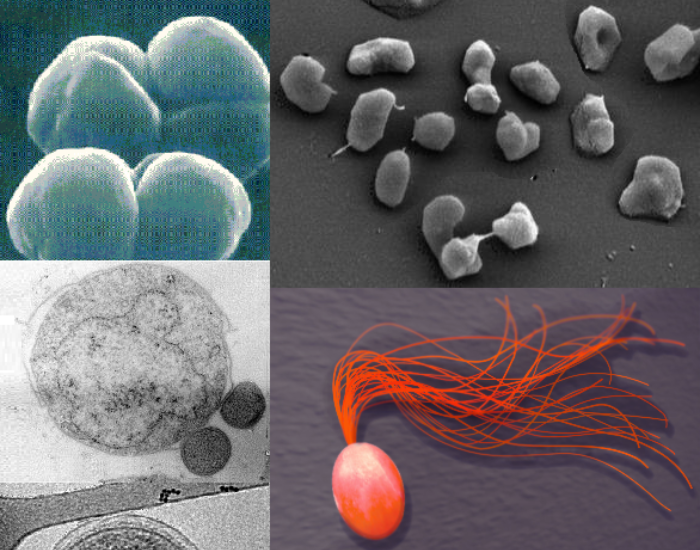
Single-celled prokaryotic organisms with no nucleus and no membrane bound organelles, and a biochemistry unlike anything else alive. Archaea run the extremes: boiling hot springs, salt lakes past saturation, acid, and the hydrothermal vents that feed whole communities of deep sea animals.
Under a microscope they look like bacteria. Their cell membranes and their DNA say otherwise. Archaea use ether-linked lipids where bacteria use ester-linked ones, and their gene-reading machinery is closer to ours than to a bacterium’s. That last detail turned out to matter a great deal.
2. Eubacteria
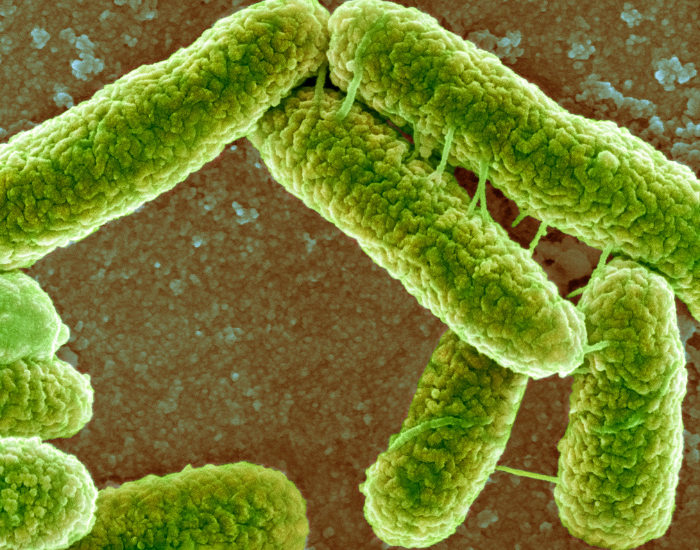
The true bacteria, and the most numerous organisms on the planet. E. coli, the gut microbes digesting your lunch, Staphylococcus aureus, and the cyanobacteria once called blue green algae.
Most bacteria in this kingdom are aerobic and heterotrophic, though the metabolic range is enormous. Cyanobacteria photosynthesise, and did so for a billion years before anything else figured it out. Bacteria fix nitrogen into soil, recycle nutrients as decomposers and keep the carbon, nitrogen and sulfur cycles running. Fossil evidence puts prokaryotic life at around 3.5 billion years old, and for more than two billion of those years it was the only life there was. Everything in the rainforest, the reef and the deep ocean arrived long afterwards.
3. Kingdom Protista
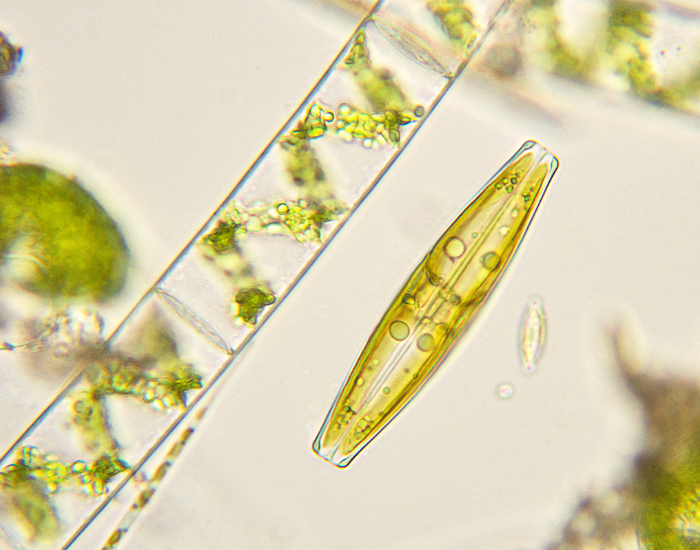
Single celled organisms with a distinct nucleus and membrane bound organelles. Amoebas, paramecia, diatoms, many algae, and the slime moulds, which spend most of their lives as single cells and then pool into a single crawling mass when food runs out. Some protists swim with flagella or cilia, some photosynthesise, some hunt other organisms.
Protista is also the kingdom biologists are least comfortable with. It is a paraphyletic group: a bin for eukaryotes that are not animals, plants or fungi, holding lineages that are not each other’s closest relatives. Giant kelp is the clearest example. It is multicellular, metres long, and forms kelp forests that function like underwater woodland, but it is not a plant. It belongs to the stramenopiles, a lineage closer to diatoms than to anything with roots.
4. Kingdom Fungi
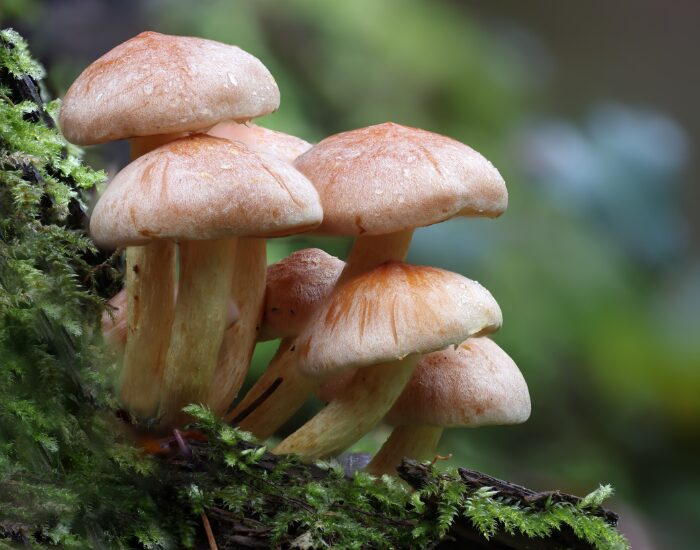
Multicellular eukaryotes, mostly, with a few single celled exceptions like yeasts. Moulds, mushrooms, and the mycelial networks running under forest floors. Fungi are nonmotile, lack flagella, and reproduce through spores.
Their cell walls are made of chitin, the same material as an insect’s exoskeleton, not the cellulose plants use. They are heterotrophic but feed in reverse: enzymes go out, break down organic matter outside the body, and the resulting nutrients come back in. That makes them the planet’s primary decomposers. Mycorrhizal fungi wrap plant roots and trade water and minerals for sugar, a partnership most land plants cannot live without. Genetically, fungi are closer to animals than to plants.
5. Kingdom Plantae
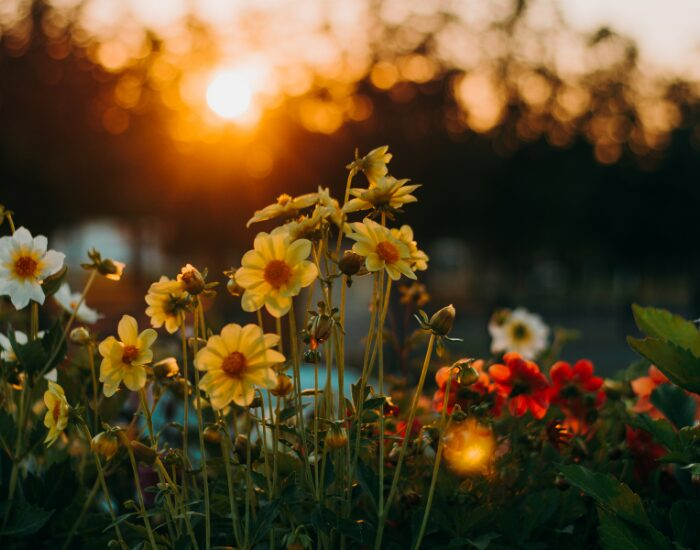
Multicellular eukaryotic organisms that make their own food. Mosses, ferns, conifers and flowering plants, all running photosynthesis: sunlight, carbon dioxide and water into glucose and oxygen.
Plant cells contain cellulose in the cell walls and chlorophyll in the chloroplasts. Cellulose is what lets a redwood stand 100 metres tall and compete for light. Reproduction runs both ways: sexual reproduction through spores or seeds, and asexual through runners, bulbs and rhizomes. The plants included in the Plantae kingdom are all land plants plus their closest green algal relatives, which is narrower than the everyday use of the plant kingdom label. As autotrophs, plants are the primary producers under almost every land food web, which is why biodiversity in an ecosystem tends to track plant diversity first.
6. Kingdom Animalia
The animal kingdom holds multicellular heterotrophic eukaryotes, and it is the one we are in. Multicellular animals from sponges and sea anemones to blue whales, divided first into vertebrates and invertebrates, two groups that split more than 500 million years ago.
Animal cells have no rigid cell wall, which is the structural reason animals can move the way they do. Most run aerobic respiration, most reproduce sexually, and most have nervous systems, from the nerve net of a jellyfish to a mammal brain. The range is absurd: tardigrades survive vacuum and radiation at half a millimetre long; a blue whale is the largest animal that has ever lived. Both are Animalia. For the next level down, see understanding phyla in animals.

The Three Domains Above the Kingdoms
In 1990 Woese, Kandler and Wheelis proposed a level above kingdom entirely. Comparing ribosomal RNA, they found that life divides first into three domains: Bacteria, Archaea and Eukarya.
Eukarya holds every organism whose cells have a membrane bound nucleus, so Protista, Fungi, Plantae and Animalia all sit inside it. Bacteria and Archaea take one kingdom each. The point of the domain system is that the gap between a bacterium and an archaeon is deeper than the gap between a mushroom and a whale, which is not obvious from looking at them.
Thomas Cavalier Smith spent decades arguing for different arrangements, including a revised six kingdom system that splits off the Chromista and keeps Protozoa as its own kingdom. Under his scheme, organisms that sit together in the standard model end up in two different kingdoms, which is a reminder that no arrangement is the only one. Several schemes remain in use. Six kingdoms is what most courses teach; three domains is what most phylogenetic work uses, and the two are not in conflict so much as built for different jobs.
What Has Changed: Classification in 2026
Three things have shifted since the five kingdom system, and the third is still unfolding.
Protista is being dismantled. Burki and colleagues set out the modern replacement: eukaryotes organised into a small number of supergroups, including Amorphea, which holds animals and fungi together, and Diaphoretickes, which holds plants, algae and a great deal else. Protista does not survive that reorganisation as a natural group, though it remains useful shorthand.
The root of the eukaryote tree has moved. In 2025 Williamson and colleagues published the best-supported rooting yet, placing it between two large assemblages and concluding that the complex cellular machinery found in excavate organisms was already present in the last common ancestor of all eukaryotes rather than evolving later. Features we thought were late inventions were there at the start.
The three domain tree may be wrong. This is the big one. Eme and colleagues placed eukaryotes with high confidence inside the Asgard archaea, as a sister lineage to a group called the Hodarchaeales. If that holds, Eukarya is not a third domain beside Archaea. It is a branch within it, and life has two primary domains, not three. We would be a very strange kind of archaeon that swallowed a bacterium and never let go.
None of this makes the six kingdoms useless. It makes them a working map rather than a finished one, which is how classification has always functioned. New species are described constantly, drones and satellites keep finding things nobody had seen, and environmental DNA from a cup of water or a handful of soil now reveals organisms nobody has ever observed directly. The list of newly discovered species grows every year. More on how the field thinks about this in what is evolutionary biology.
To see all 6 kingdoms on one map, try my interactive tree of life. You can zoom from the first cell all the way to fungi, plants and animals.
FAQs About the Kingdoms of Life
Monera, Protista, Fungi, Plantae and Animalia, proposed by R. H. Whittaker in 1969. The five kingdom system was based on cell type, nutrition and body organisation, and it held until genetic sequencing split Monera in two.
Domain sits above kingdom. There are three domains, Bacteria, Archaea and Eukarya, and the six kingdoms distribute between them: one kingdom each for Bacteria and Archaea, four inside Eukarya.
Animalia, within the domain Eukarya. Full line: domain Eukarya, kingdom Animalia, phylum Chordata, class Mammalia, order Primates, family Hominidae, genus Homo, species Homo sapiens.
Because it is defined by what its members are not. Protista groups every eukaryote that is not an animal, plant or fungus, which puts organisms with wildly different ancestry in the same box. Giant kelp and an amoeba share a kingdom and almost nothing else.
Animals. Fungi and animals both sit in the supergroup Amorphea, and share an ancestor more recently with each other than either does with plants. The chitin in fungal cell walls, the same material as insect exoskeletons, is a hint.
Look at It as a Tree, Not a List
Six boxes in a row is the wrong mental picture. Life is a branching structure where the deepest splits happened among single cells billions of years ago, and everything commonly found at the scale of the naked eye, every plant, fungus and animal, sits out near the tips of one branch.
A better understanding of the kingdoms is mostly a matter of seeing that shape rather than memorising the list, and a list on a page cannot show it. That is why I built the tree instead. If you want the ecology that sits on top of this structure, start with keystone species and why biodiversity matters.
Tree of Life & Taxonomy Challenge 🌳
Ten fun photo-based True/False and Multiple Choice questions to test what you’ve learned about the 6 kingdoms and 3 domains of life!
Multiple Choice
References:
Burki, F., Roger, A. J., Brown, M. W., & Simpson, A. G. B. (2020). The new tree of eukaryotes. Trends in Ecology & Evolution, 35(1), 43–55. https://doi.org/10.1016/j.tree.2019.08.008
Cavalier-Smith, T. (1998). A revised six-kingdom system of life. Biological Reviews, 73(3), 203–266. https://doi.org/10.1111/j.1469-185X.1998.tb00030.x
Eme, L., Tamarit, D., Caceres, E. F., Stairs, C. W., De Anda, V., Schön, M. E., Seitz, K. W., Dombrowski, N., Lewis, W. H., Homa, F., … Ettema, T. J. G. (2023). Inference and reconstruction of the heimdallarchaeial ancestry of eukaryotes. Nature, 618(7967), 992–999. https://doi.org/10.1038/s41586-023-06186-2
Whittaker, R. H. (1969). New concepts of kingdoms of organisms. Science, 163(3863), 150–160. https://doi.org/10.1126/science.163.3863.150
Williamson, K., Eme, L., Baños, H., McCarthy, C. G. P., Susko, E., Kamikawa, R., Orr, R. J. S., Muñoz-Gómez, S. A., Minh, B. Q., Simpson, A. G. B., & Roger, A. J. (2025). A robustly rooted tree of eukaryotes reveals their excavate ancestry. Nature, 640(8060), 974–981. https://doi.org/10.1038/s41586-025-08709-5
Woese, C. R., Kandler, O., & Wheelis, M. L. (1990). Towards a natural system of organisms: Proposal for the domains Archaea, Bacteria, and Eucarya. Proceedings of the National Academy of Sciences, 87(12), 4576–4579. https://doi.org/10.1073/pnas.87.12.4576