

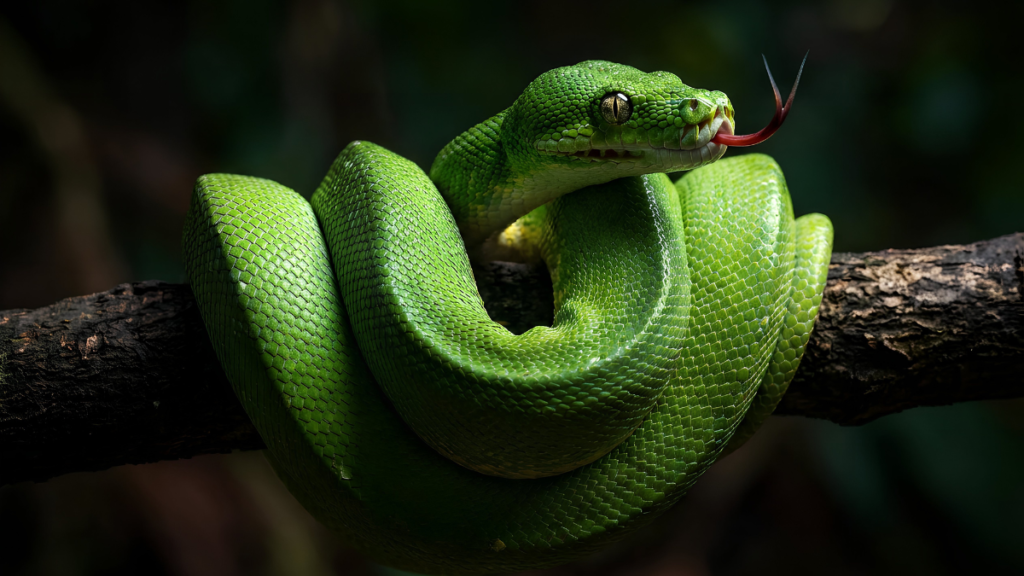
During my biology degree I worked the reptile and amphibian house at a zoo in North America. My rounds covered crocodiles, Gila monsters, tegus, poison dart frogs and a rack of tarantulas. Three pythons shared that building with me: a ball python, a reticulated python and a Burmese.
Feeding those three taught me something no textbook chapter had. Pythons are not aggressive animals. They are patient ones, and patience is the entire strategy of this family.
Around 40 python species live across Africa, Asia and Australia. Some never pass two feet. Others clear thirty. Below you’ll meet 15 of them. You’ll also learn what pythons eat, how they hunt and where pythons live. I’ll explain why many python species now face heavy commercial pressure.
I’ve kept the biology honest. Where a popular claim outruns the evidence — and a few do — I say so.
What Are Pythons? An Overview of the Family
Pythons are non venomous snakes in the family Pythonidae, roughly 40 species across about 11 genera. They kill by constriction, not venom. That single trait separates them from the cobra and other venomous snakes.
Run your fingers near the vent of a large python and you’ll feel two small claws. Those are pelvic spurs, vestigial remnants of hind limbs. Males rake them along a female’s flanks during courtship.
Pythons are found across sub-Saharan Africa, South and Southeast Asia, and Australia, with a rich radiation on New Guinea. Their habitats include tropical rainforests, savannas, swamps, grasslands and semi-arid deserts, usually near water. Many swim strongly and plenty climb well.
Most pythons are solitary and mostly nocturnal, and their body temperature tracks the air around them. By eating rodents and other small animals, they help regulate prey populations and keep ecosystems in balance.

15 Amazing Types of Python Species Around the World
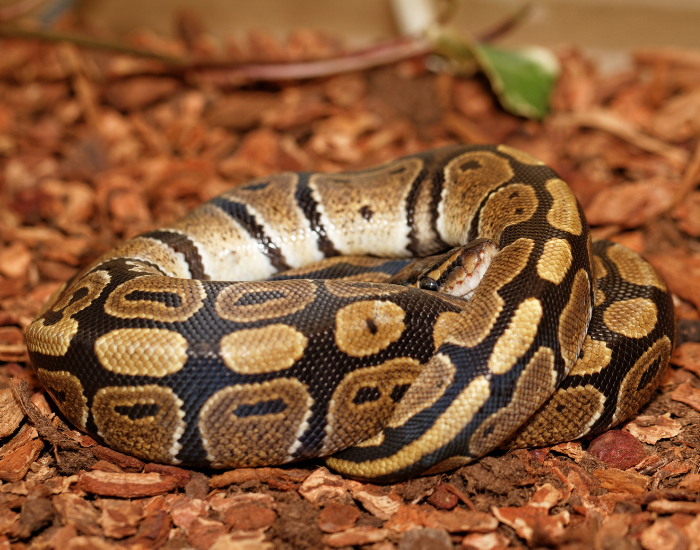
1. Ball Python (Python regius)
Range: West and Central Africa | Size: 1–1.5 m | Diet: rodents
A friend of mine ran a ball python breeding facility, and I spent time there watching the full cycle, pairing, ovulation, laying, incubation, hatching. Ball pythons eat mice and rats almost exclusively, and adults feed only once every 10 to 14 days.
The name comes from the defensive posture: head tucked into the centre, body coiled into a ball. More ball python facts here.
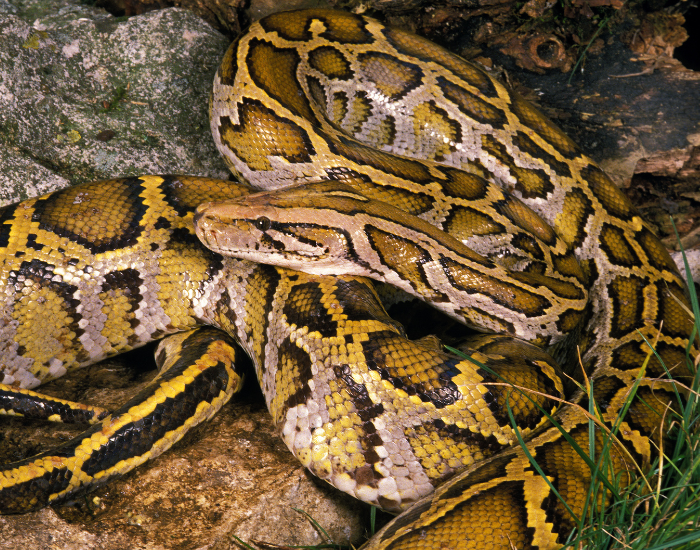
2. Burmese Python (Python bivittatus)
Range: Southeast Asia to southern China | Size: 4–5 m | Diet: mammals, birds
Burmese pythons rank among the largest snakes in the world, and they swim and climb better than their bulk suggests.
In Florida they became a textbook invasive species, breeding in the Everglades since the late 1990s. Dorcas and colleagues recorded raccoons down 99.3% and opossums down 98.9% in the park’s core. Pythons there have eaten alligators and white-tailed deer. Media reports often cite half a million animals, but the USGS calls tens of thousands the only defensible figure. I’ve written about how they got there.

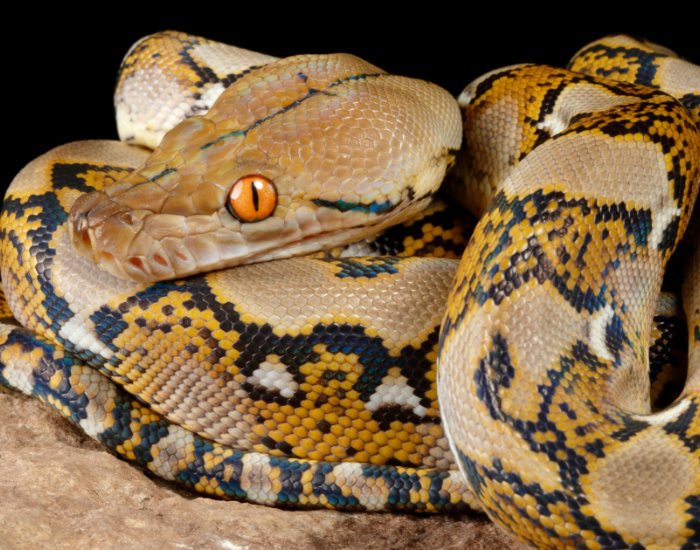
3. Reticulated Python (Malayopython reticulatus)
Range: Southeast Asia | Size: up to 7 m | Diet: mammals, pigs, monkeys
The reticulated python is the longest snake species alive, routinely exceeding 20 feet. The retic I cared for was a different animal from the Burmese, alert, calculating, always tracking my hands.
Headland and Greene documented genuine predation on humans among the Agta of the Philippines, though such events stay vanishingly rare. The species has also colonised Puerto Rico, where surveys first recorded it in 2009.
4. Indian Rock Python (Python molurus)
Range: Indian subcontinent | Size: 3 m | Diet: mammals, birds
Python molurus is lighter and more olive-tan than its Burmese cousin, which taxonomists split off in 2009. The Indian python favours rocky foothills, mangroves and river margins. Heavy skin hunting earned it CITES Appendix I protection, and conservation efforts in Indian reserves have stabilised several populations.
5. African Rock Python (Python sebae)
Range: sub-Saharan Africa | Size: 4–5 m | Diet: antelope, monkeys, warthogs
Africa’s largest snake has a reputation problem: it defends itself hard when cornered, which gets misread as aggression. Its diet skews to larger mammals than most pythons manage. Habitat loss and bushmeat hunting drive declines across much of its range.
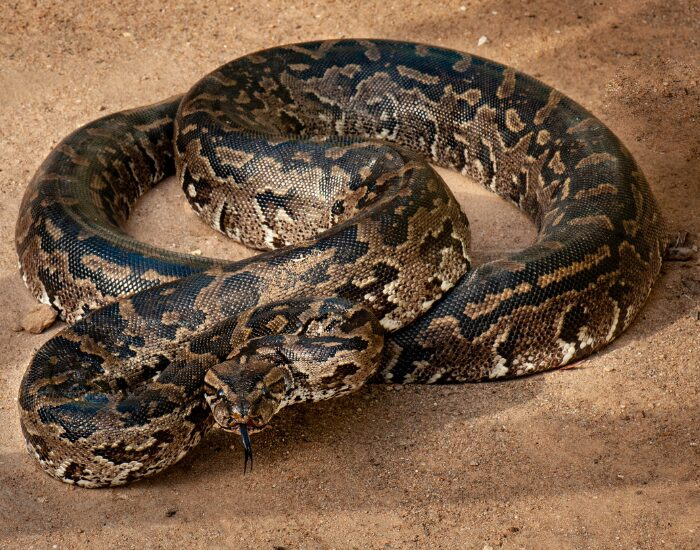
6. Green Tree Python (Morelia viridis)
Range: New Guinea, Cape York | Size: 1.5–2 m | Diet: birds, small mammals
Hatchlings emerge bright yellow or brick red, then shift to green over the first year. That juvenile phase overlaps with our guide to yellow snakes. Adults drape in a tight saddle over a branch and twitch the tail tip to lure prey species within reach.
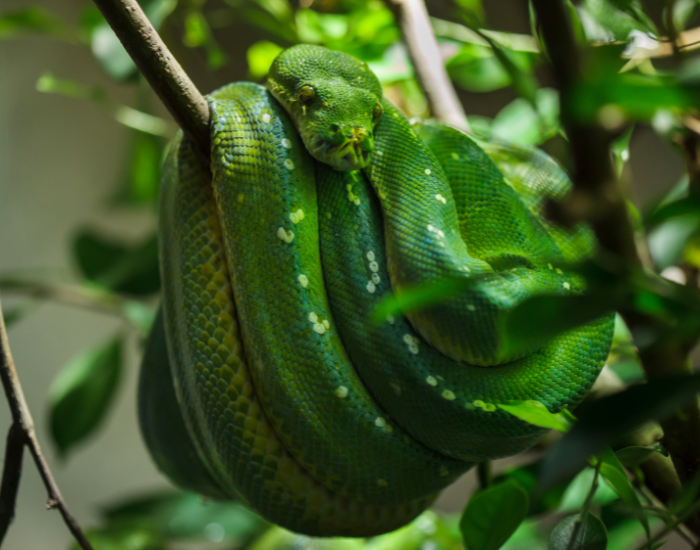
7. Carpet Python (Morelia spilota)
Range: Australia, New Guinea | Size: 2–3 m | Diet: possums, rats, birds
I live in southeast Queensland now, which is carpet python country. They work through suburban roof spaces here doing free rodent control, and most residents never know. Six or so subspecies span the continent, from jungle carpets in the wet tropics to coastal diamond pythons.
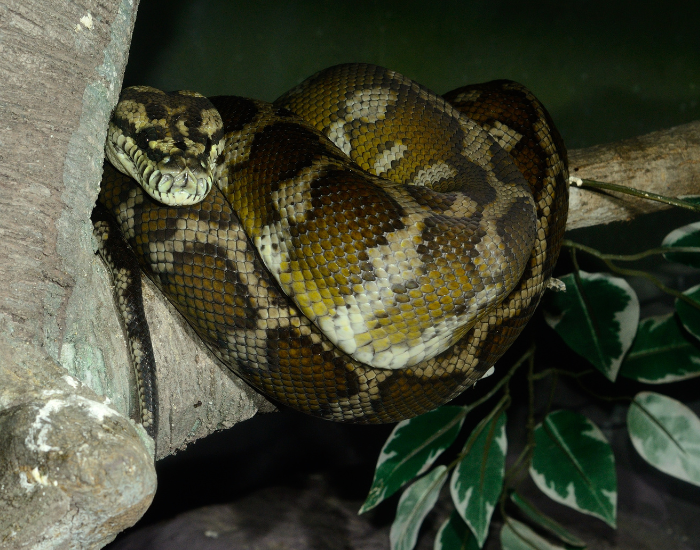
8. Woma Python (Aspidites ramsayi)
Range: arid inland Australia | Size: 1.5–2 m | Diet: reptiles, small mammals
Womas lack heat-sensing pits, because their prey lives underground where infrared cues are useless. They hunt inside burrows, pinning animals against the tunnel wall instead of coiling. The species has vanished from most of its southern range under fox and cat predation.
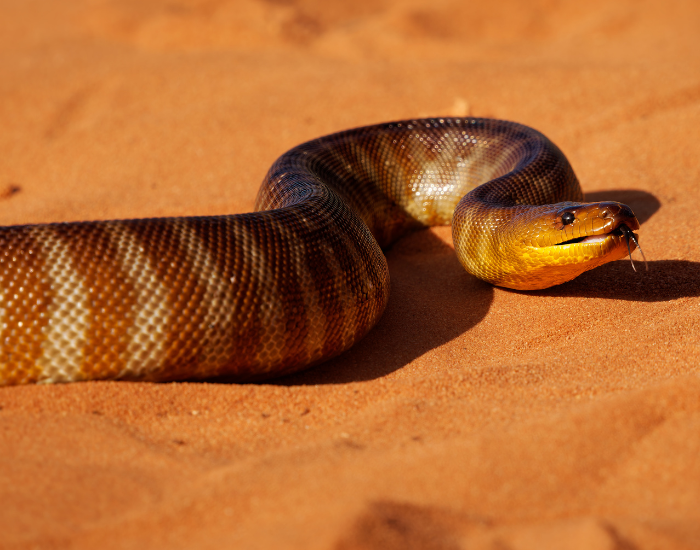
9. Black-headed Python (Aspidites melanocephalus)
Range: northern Australia | Size: 2–3 m | Diet: reptiles, other snakes
Despite what the name suggests, this slender cousin of the reticulated python isn’t found on Timor, its range is limited to Flores and nearby Lesser Sunda Islands. Fast and agile, it frequents the scrub and grassland around local villages, yet its wild behavior remains largely unstudied.
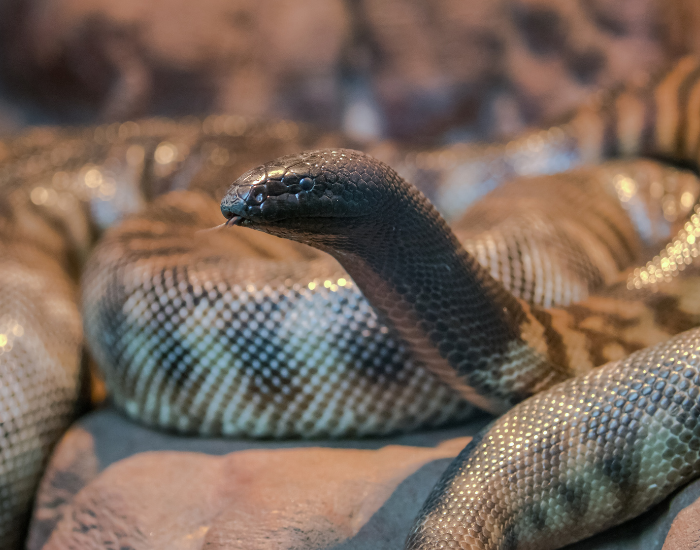
10. Blood Python (Python brongersmai)
Range: Sumatra, Malay Peninsula | Size: 1.5–1.8 m | Diet: rodents, birds
Short, immensely thick and blotched in brick and rust, blood pythons look nothing like the long-bodied snake most people picture. They favour swamp forest and oil palm plantations, where rodents swarm. Their hides carry much of Southeast Asia’s commercial skin harvest.
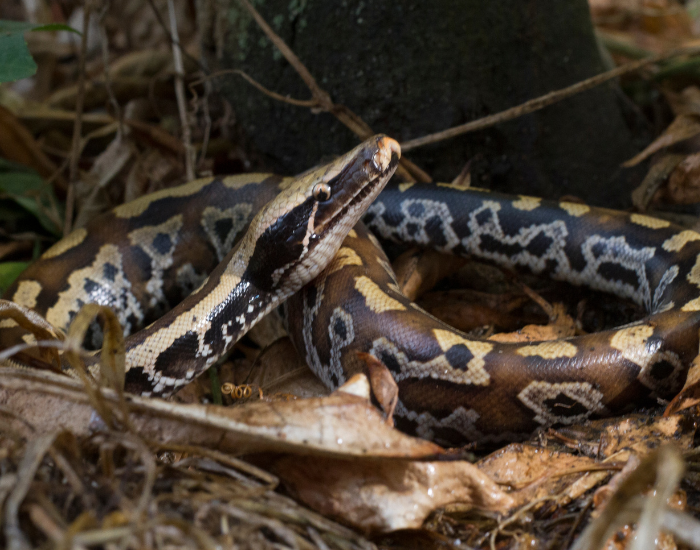
11. Children’s Python (Antaresia childreni)
Range: northern Australia | Size: under 1 m | Diet: bats, lizards, frogs
The name honours zoologist John George Children, not the size of the snake. At Northern Territory cave mouths, these small pythons hang from the rock and snatch bats from the air at dusk.
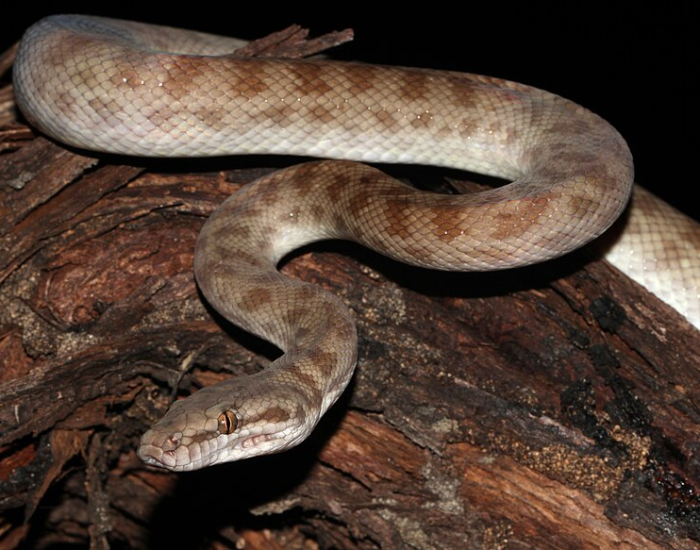
12. Water Python (Liasis fuscus)
Range: northern Australia, New Guinea | Size: 2–2.5 m | Diet: dusky rats, waterbirds
Iridescent bronze above and butter yellow below, water pythons track the boom-and-bust cycles of dusky rats on the Adelaide River floodplain. Long-term research at Fogg Dam made them among the best-studied snakes on Earth. When the rats crash, these pythons travel kilometres to find more.
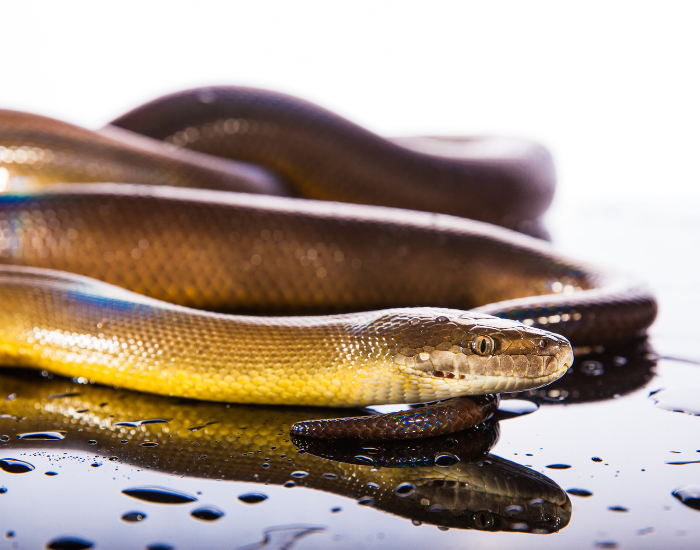
13. Olive Python (Liasis olivaceus)
Range: northern and western Australia | Size: 3–4 m | Diet: rock wallabies, birds
Plain olive-brown with a satin sheen, this species hunts gorges and rock pools in the Pilbara, ambushing rock wallabies that come down to drink. Australia lists the Pilbara subspecies as vulnerable, squeezed by mining and altered fire regimes.
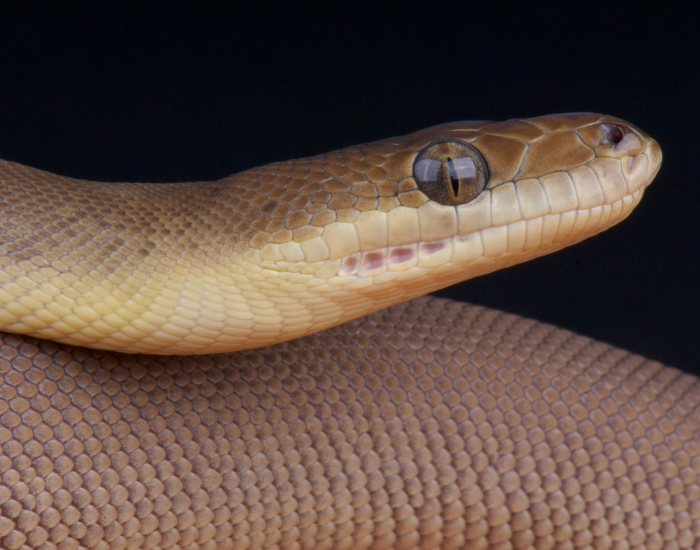
14. Angolan Python (Python anchietae)
Range: Angola, northwest Namibia | Size: 1.5–1.8 m | Diet: rodents, birds
Rare in captivity and barely studied in the wild, the Angolan python lives on rocky outcrops in arid southwestern Africa. Decades of civil conflict kept researchers out of its core range. Bead-like head scales give it a texture no other python shares.
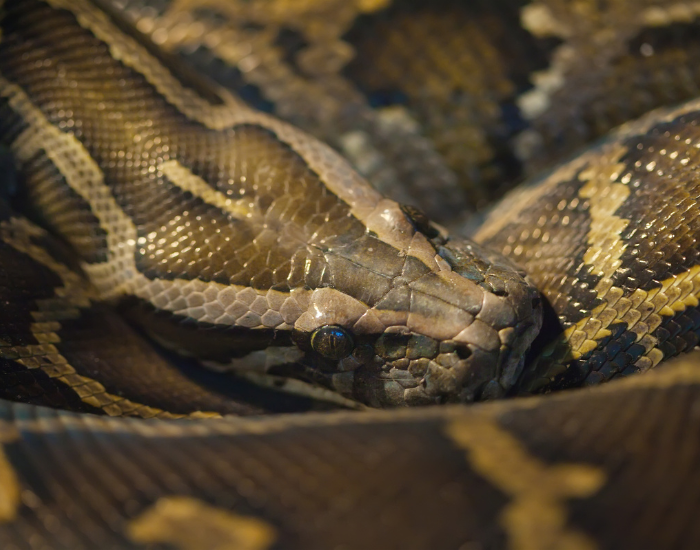
15. Timor Python (Malayopython timoriensis)
Range: Lesser Sunda Islands | Size: 2–3 m | Diet: rodents, birds, lizards
Slender, fast and restricted to Timor, Flores and neighbouring islands, this is the reticulated python’s small cousin. Islanders meet it in grassland and scrub near villages. Researchers have published almost nothing on its wild ecology.
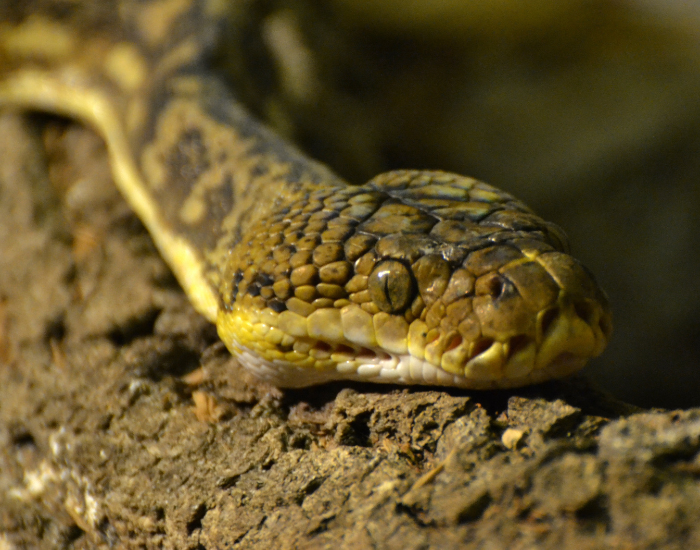
How Pythons Hunt: Strike Speed, Constriction and Diet
Does a python strike? Absolutely. William Ryerson’s laboratory work on ball pythons measured strikes in fractions of a second. The human eye cannot follow it. That strike grabs; it does not wound.
Four rows of backward curving teeth line the upper jaw, with two more rows below. Those teeth work like barbs on a fish hook, so a struggling prey item only drives them deeper.
Then comes the coil. Pythons squeeze their prey, and the old textbook line says they suffocate it. Boback and colleagues found something faster. Within six seconds, arterial pressure in constricted rats halved while venous pressure rose sixfold. Circulatory arrest, not slow smothering, does the work.
Heat-sensing pits along the lips read the infrared signature of a nearby animal. That lets pythons hunt warm blooded animals in total darkness. Gracheva’s team traced the ability to a single ion channel.
So what do python snakes eat? Mammals and birds dominate, plus other reptiles and, for a few specialists, other snakes. Large species eat animals the size of monkeys, wild pigs and other larger mammals. Smaller pythons eat rodents and lizards instead, so prey size scales with the predator. Pythons swallow food whole and head-first. The snake’s throat and the skull’s joints stretch far past its resting body width.
People call that “unhinging the jaw,” which is wrong. An elastic ligament joins the two halves of the lower jaw, so they spread without dislocating anything.
How fast do pythons move? Slowly. Heavy species use rectilinear progression, a travelling ripple of the belly scales. It pushes them forward in a straight line at walking pace or less. Ambush predators need camouflage and dense foliage, not speed.
Pythons, People and the Trade
A 2012 International Trade Centre report put the python skin trade at roughly US$1 billion. About 500,000 skins leave Southeast Asia each year. A villager in Indonesia might get $30 for a hide that becomes a $15,000 handbag in Europe.
The exotic pet trade runs a parallel story. Exporters have shipped over three million ball pythons out of Africa since the 1980s, making them the continent’s most traded live animal. Toudonou and colleagues also recorded heavy domestic use, with pythons sold as bushmeat and for traditional medicine. The IUCN listed the species as Near Threatened in 2021.
Habitat loss compounds all of it. The animals people most want to own often lose ground fastest.
Frequently Asked Questions About Pythons
Pythons, boa constrictors and anacondas are the main constrictors, along with many rat snakes and kingsnakes. Most snakes lack venom, so constriction evolved repeatedly as a safe way to subdue food.
Both, in that order. The strike anchors the prey with backward curving teeth, and the coils follow immediately. A defensive bite from a python is a puncture wound with no venom, and it heals like any laceration.
Because nobody can find them. Cryptic patterning, nocturnal habits and dense sawgrass hide the overwhelming majority. Florida runs bounty programmes and scout-snake tracking instead, and the USGS considers full eradication unrealistic with current tools.
Why Pythons Are Worth a Second Look
Strip away the monster framing. Pythons are the reptile world’s most efficient ambush hunters — animals that eat large prey without venom or speed. Attacks on humans stay extremely rare. Traffic in the other direction runs to hundreds of thousands of animals a year.
If you keep a python, ask where it came from. If you meet one in the wild, watch it and leave it be.
Have you come across a python in the field or in a roof space? Tell me in the comments. For more, browse our guides to types of snakes and these facts about snakes.
Can You Name That Python? 🐍
A 15-photo identification challenge — the wrong answers are deliberately tricky look-alikes from a similar group. Go back and change any answer before you score.
Which python is this?
References:
Boback, S. M., McCann, K. J., Wood, K. A., McNeal, P. M., Blankenship, E. L., & Zwemer, C. F. (2015). Snake constriction rapidly induces circulatory arrest in rats. Journal of Experimental Biology, 218(14), 2279–2288. https://doi.org/10.1242/jeb.121384
Currylow, A. F., McBride, L. M., Anderson, G. E., Guzy, J. C., McCollister, M. F., Romagosa, C. M., Hart, K. M., & Yackel Adams, A. A. (2025). Wild Burmese python nest site selection, thermogenesis, and brooding behaviors in the Greater Everglades Ecosystem. Ecosphere, 16, e70271. https://doi.org/10.1002/ecs2.70271
Dorcas, M. E., Willson, J. D., Reed, R. N., Snow, R. W., Rochford, M. R., Miller, M. A., Meshaka, W. E., Andreadis, P. T., Mazzotti, F. J., Romagosa, C. M., & Hart, K. M. (2012). Severe mammal declines coincide with proliferation of invasive Burmese pythons in Everglades National Park. Proceedings of the National Academy of Sciences, 109(7), 2418–2422. https://doi.org/10.1073/pnas.1115226109
Gracheva, E. O., Ingolia, N. T., Kelly, Y. M., Cordero-Morales, J. F., Hollopeter, G., Chesler, A. T., Sánchez, E. E., Perez, J. C., Weissman, J. S., & Julius, D. (2010). Molecular basis of infrared detection by snakes. Nature, 464(7291), 1006–1011. https://doi.org/10.1038/nature08943
Ryerson, W. G. (2020). Ontogeny of strike performance in ball pythons (Python regius): A three-year longitudinal study. Zoology, 140, 125780. https://doi.org/10.1016/j.zool.2020.125780
Toudonou, C., Elwin, A., Penner, J., Coulthard, E., Norrey, J., Megson, D., Rödel, M.-O., Sinsin, B., Harrington, L. A., Auliya, M., & D’Cruze, N. (2022). Seeking serpents: Ball python trade in Benin, West Africa. Nature Conservation, 50, 85–114. https://doi.org/10.3897/natureconservation.50.86352




_(8692421368).jpg)