Wildlife Nomads


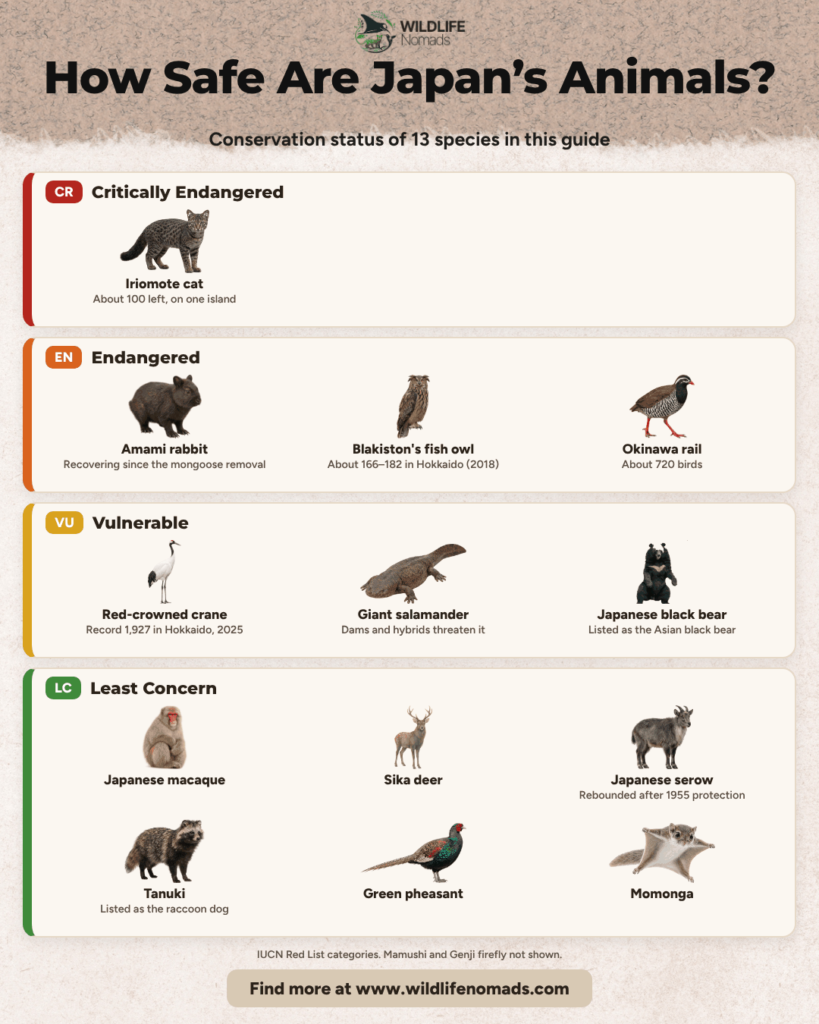
Japan is still on my list. I have not been lucky enough to go yet, and I want to be upfront about that. So this guide comes from my training as a conservation biologist, not from field days in Hokkaido. That said, I know I am not the only one hooked on this country. I have also watched a few anime, and Japanese wildlife turns up in them all the time.
The animals from Japan make a brilliant case study in island biology. The Japanese archipelago runs from snowy Hokkaido to the subtropical Ryukyu Islands. Cold climates in the north and warm forests in the south shape very different wildlife. Long isolation from mainland Asia did the rest, producing some truly unique animals.
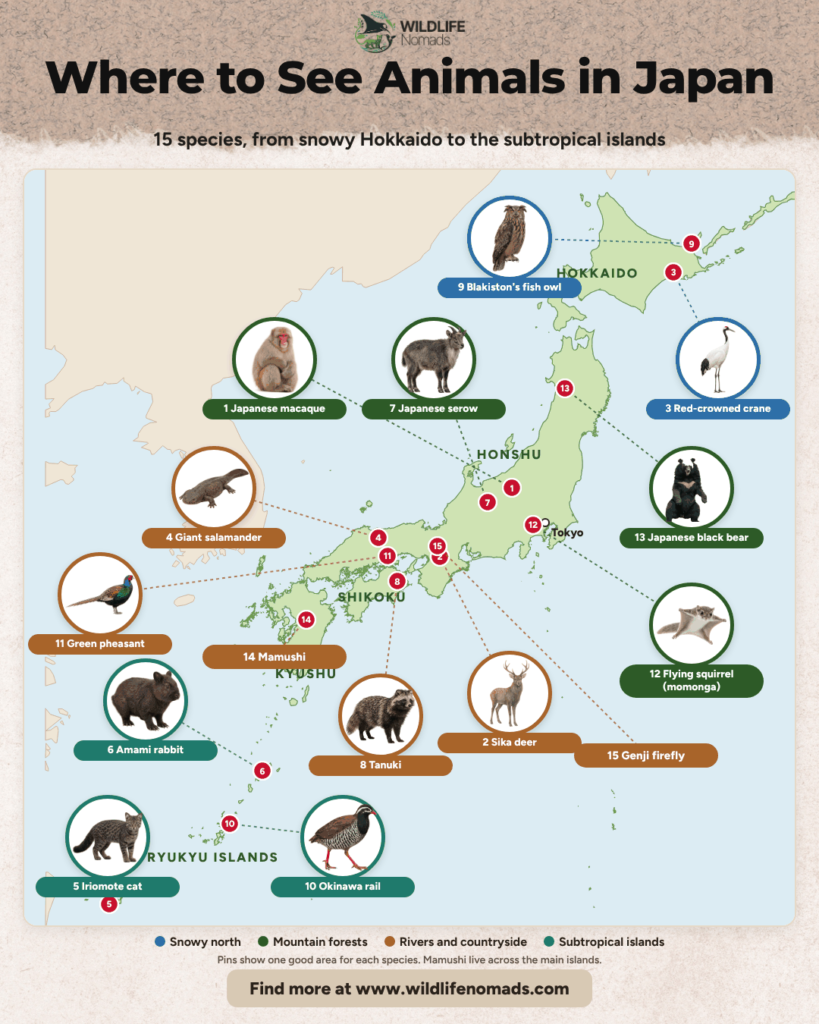
Below are 15 species, from snow monkeys to a firefly that flashes with a regional accent. For each one, I cover biology, behaviour, range and conservation status. Some are thriving. Others hang on by a thread.
What Makes Animals From Japan So Unique?
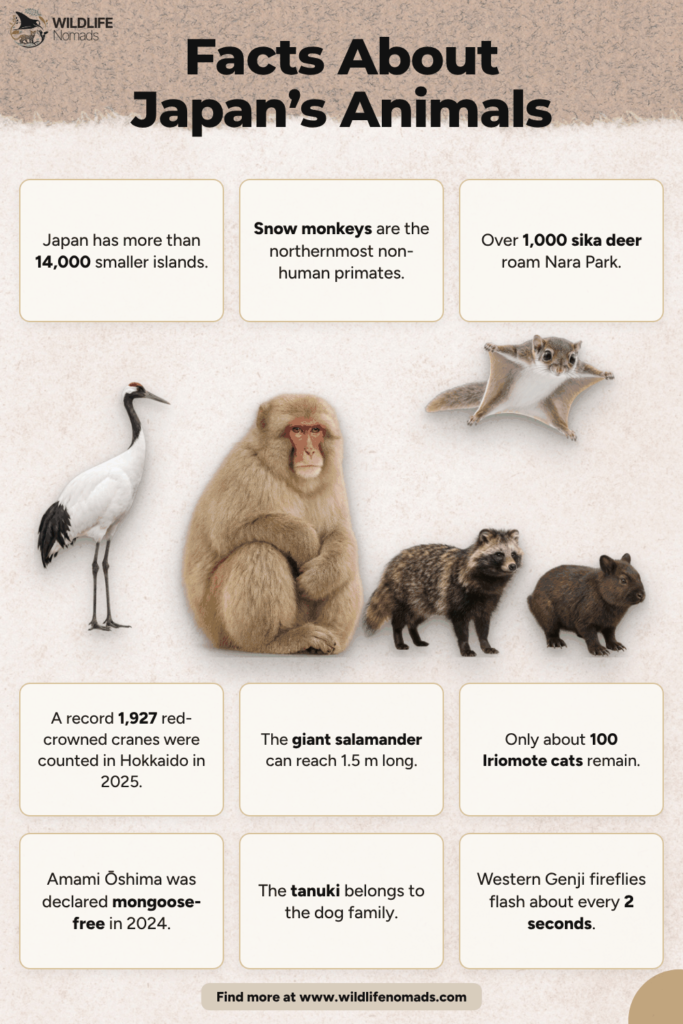
Japan has four main islands and more than 14,000 smaller ones. During the ice ages, low seas exposed land bridges to mainland Asia. Many species crossed, and rising seas later cut them off. Over time, isolation turned many of them into endemic species found nowhere else.
As a result, Japan’s wildlife mixes these endemics with resident and migratory species shared with the mainland. The southern islands are the extreme case, with forests as quirky as Madagascar. However, island animals often have small ranges and few defences. That leaves them exposed to invasive species and habitat loss.
1. Japanese Macaque (Snow Monkey)
The Japanese macaque (Macaca fuscata) is the northernmost non-human primate in the world. It lives on Honshu, Shikoku, Kyushu and several smaller islands. Thick hair, red faces and short tails make it easy to recognise. In winter, its coat grows long and dense.
The snow monkeys of Jigokudani Monkey Park in Nagano Prefecture famously bathe in hot springs. A young female started the habit in 1963, and others copied her. A 2018 study found lower stress hormone levels in females during weeks they bathed. Adult males rarely join in.
Like other macaques, they live in troops built around related females. The IUCN lists the species as Least Concern. However, farmers in rural areas often see it as a crop pest.

2. Sika Deer
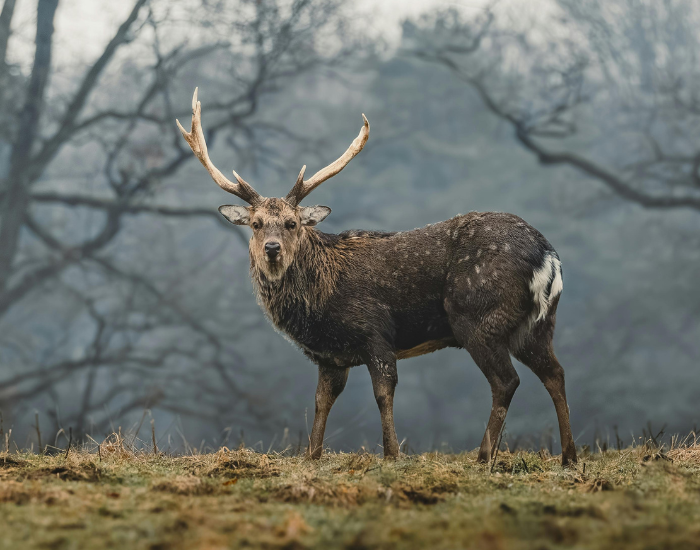
The sika deer (Cervus nippon) is the classic Japanese deer. Its chestnut summer coat carries white spots that fade in winter. Stags grow branching antlers and whistle loudly during the autumn rut. The species also lives in mainland East Asia, so it is native rather than endemic.
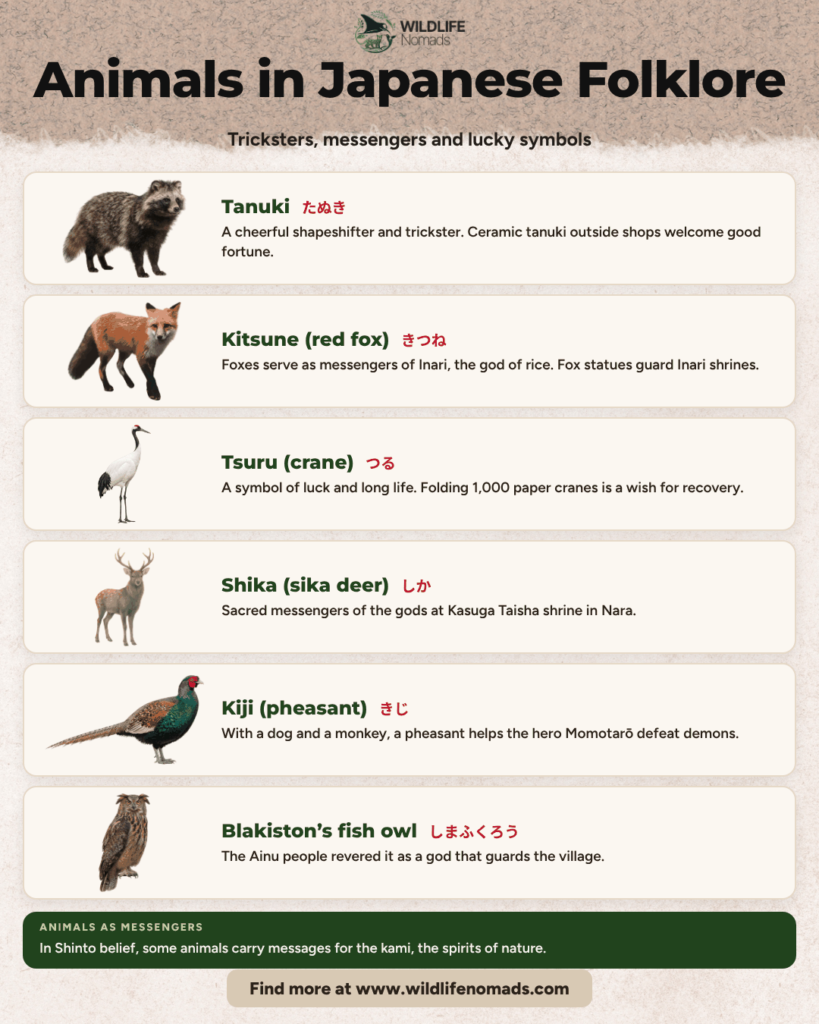
In Nara, over a thousand deer roam the city park. Local tradition treats them as sacred messengers of the gods at Kasuga Taisha shrine. Many have even learned to bow for crackers.
Elsewhere, numbers have exploded since their main natural predator, the Japanese wolf, died out. Herds now strip naturally growing vegetation from forest floors. As a result, local governments fund large culls. You can compare it with other deer species worldwide.
3. Red-Crowned Crane
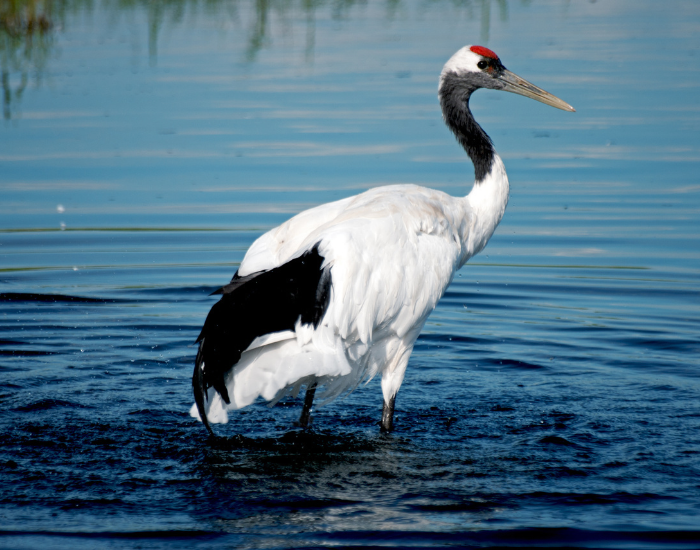
The red-crowned crane (Grus japonensis) ranks among the rarest cranes on Earth. It stands about 1.5 metres tall, with a wingspan of up to 2.5 metres. The red crown is bare skin, not feathers. This aquatic bird feeds on small fish, frogs and insects in marshes.
In Japanese folklore, the crane stands for luck and longevity. Folding 1,000 paper cranes is still a common wish for recovery. Yet hunting left only a few dozen birds in Hokkaido by the 1920s.
Strong conservation efforts, including winter feeding, then turned things around. A January 2025 count found a record 1,927 cranes in Hokkaido. In 2026, Japan’s Environment Ministry moved it out of its threatened category. Globally, however, the IUCN still lists it as Vulnerable, because the mainland population keeps falling.
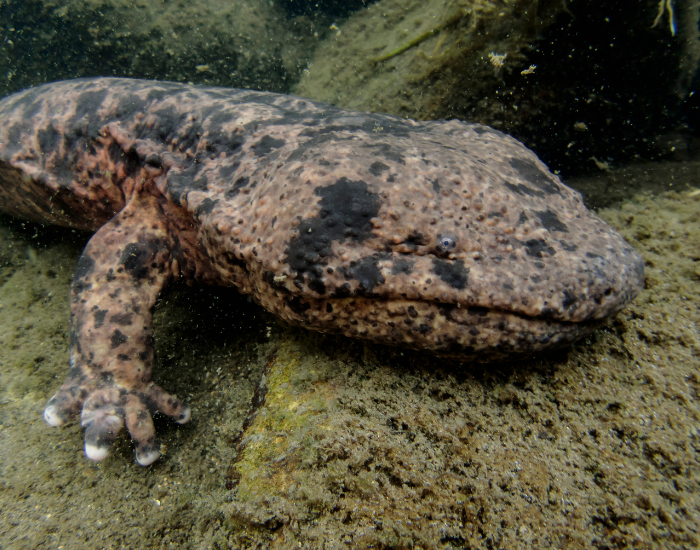
4. Japanese Giant Salamander
The Japanese giant salamander (Andrias japonicus) can reach 1.5 metres long. That makes it one of the largest salamanders alive. It lives only in cool, clear rivers of western Japan. It breathes mostly through its wrinkled skin and never leaves the water.
At night, it waits in ambush for small fish, freshwater crabs and frogs. Its North American cousin, the hellbender, hunts the same way. One local name, hanzaki, comes from a legend that it survives being torn in half.
The IUCN moved it to Vulnerable in 2022. Dams and concrete channels block its routes to breeding dens. Meanwhile, hybrids with introduced Chinese giant salamanders threaten its genetic identity.
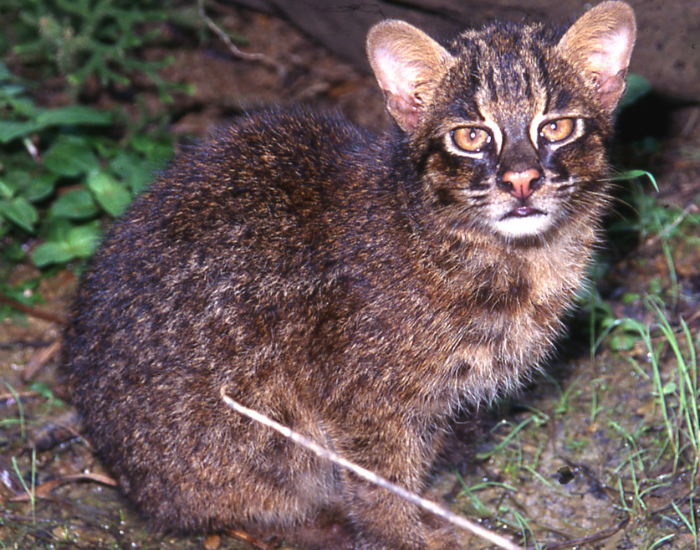
5. Iriomote Cat
The Iriomote cat (Prionailurus bengalensis iriomotensis) lives on a single island of about 290 square kilometres. Science only learned of it in 1965. Most experts now treat it as a subspecies of the leopard cat. Look for a spotted coat and white patches on the backs of its ears.
No other wild cats share the island, so it eats almost anything. Prey includes rats, birds, frogs, lizards, insects and even freshwater prawns. It favours lowland forests, river edges and coastal areas, and it swims well.
Only about 100 cats remain, and the IUCN lists the population as Critically Endangered. Road traffic and traps set for wild boar kill some each year. A sister subspecies, the Tsushima leopard cat, survives on Tsushima Island near Korea.
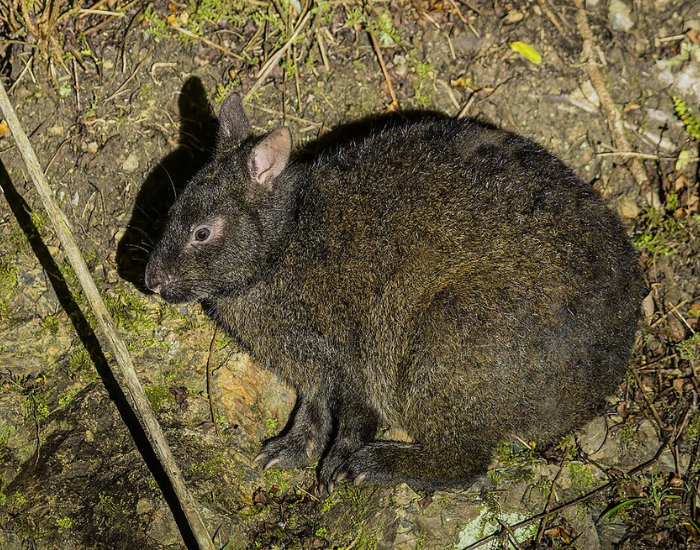
6. Amami Rabbit
The Amami rabbit (Pentalagus furnessi) looks nothing like a typical bunny. It has dark, woolly fur, small ears and long, curved claws for digging. It lives only on Amami Ōshima and Tokunoshima in the Ryukyu Islands. Scientists call it a living fossil, because its lineage keeps many primitive traits.
Unusually for rabbits, it calls with high-pitched cries. In 1979, people released about 30 mongooses to control venomous habu snakes. The mongooses hunted by day while the snakes hunted by night. So the mongooses ate rabbits instead.
By 2000, around 10,000 mongooses roamed the island. Japan declared Amami Ōshima mongoose-free in September 2024, and rabbit numbers are recovering. The species remains Endangered.
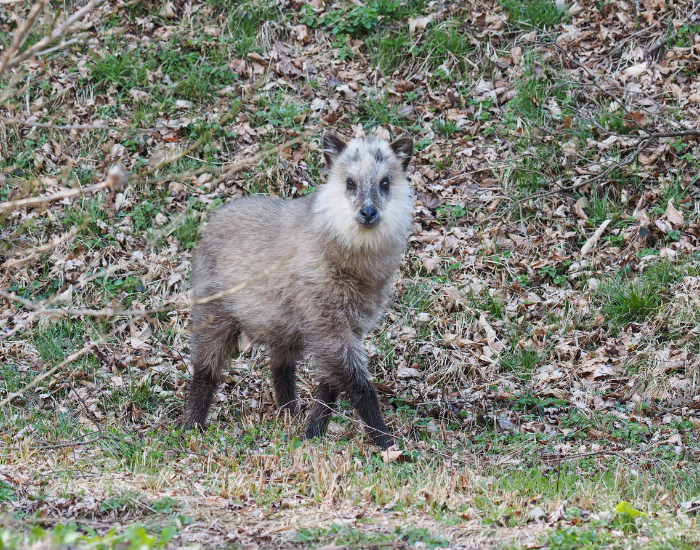
7. Japanese Serow
The Japanese serow (Capricornis crispus) is a stocky goat-antelope endemic to Honshu, Shikoku and Kyushu. Despite its name, it sits closer to goats than to true antelopes. Both sexes carry short, curved horns that sweep backwards. Broad hooves give it superb sure-footedness on steep, snowy slopes.
Serows live alone or in pairs in the dense forests of mountainous regions. They browse leaves, shoots and acorns in early mornings and late afternoons. They also leave dung in regular latrines, much like tanuki.
Hunting pushed them close to extinction by the mid-1900s. In 1955, Japan designated the serow a Special Natural Monument. Numbers rebounded, and the IUCN now lists it as Least Concern.
8. Tanuki (Japanese Raccoon Dog)
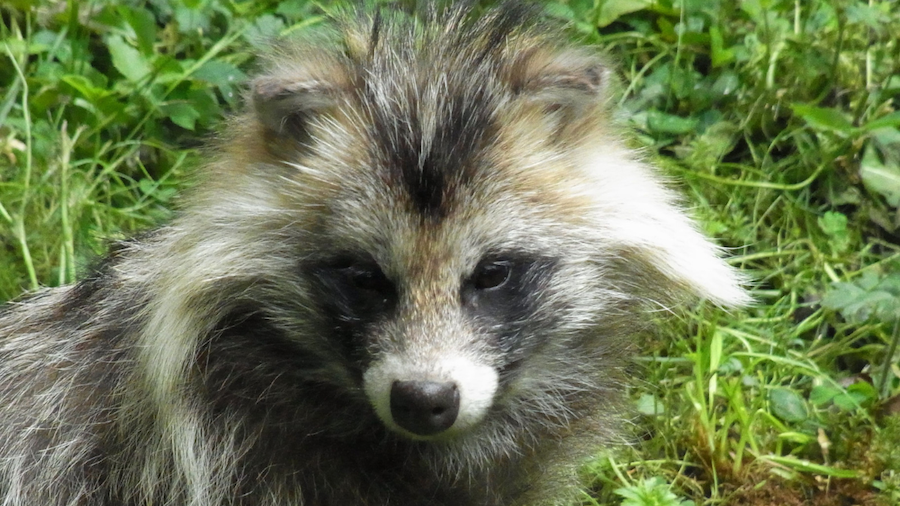
The tanuki (Nyctereutes viverrinus) is not a raccoon at all. It belongs to the dog family. Many researchers now treat it as a separate species from the mainland common raccoon dog. A black eye mask and a fluffy winter coat give it a round, cartoon look.
Tanuki eat fruit, insects, frogs and rodents, and some even live in Tokyo. In Japanese folklore, they are cheerful shapeshifters and tricksters. Ceramic tanuki statues stand outside many restaurants to welcome good fortune.
As I mentioned, I have watched a few anime. Tanuki pop up in Japanese pop culture constantly, and Studio Ghibli’s Pom Poko is the classic example. The IUCN lists raccoon dogs as Least Concern.

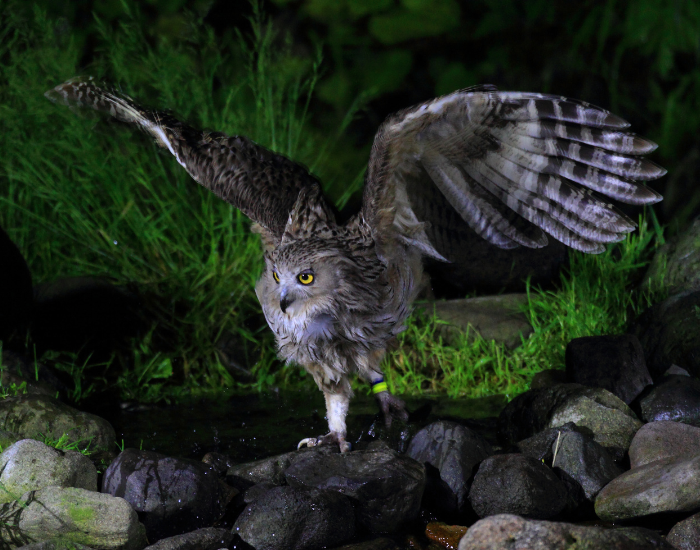
9. Blakiston’s Fish Owl
Blakiston’s fish owl (Bubo blakistoni) competes with the Eurasian eagle-owl for the title of largest owl in the world. It can weigh over 4 kilograms. In Japan, it survives only in riverside forests of eastern Hokkaido.
It wades into shallow rivers to grab freshwater fish, frogs and crayfish. Pairs need huge old trees for nest holes and rivers that stay unfrozen in winter. The Ainu people revered it as a god that guards the village.
Logging and dams cut the Hokkaido population to fewer than 100 birds in the 1980s. Nest boxes and feeding ponds have since helped. A 2018 estimate put the island population at about 166 to 182 birds. The species is Endangered.
10. Okinawa Rail
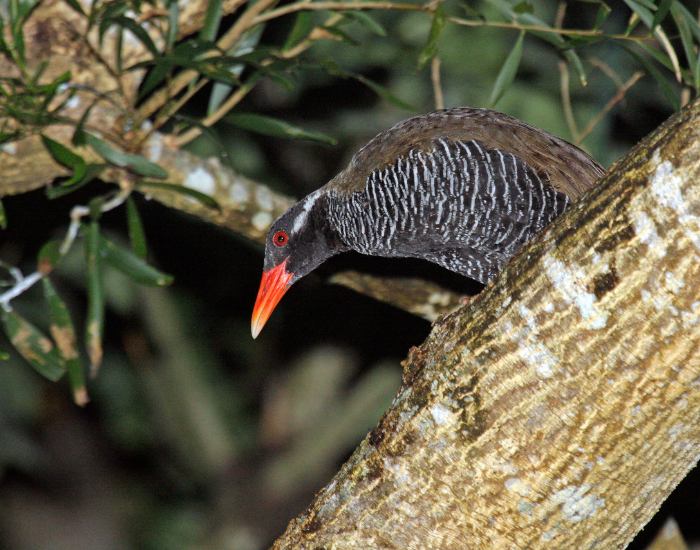
The Okinawa rail (Hypotaenidia okinawae) is a nearly flightless bird. Scientists only described it in 1981, from the Yanbaru forest of northern Okinawa Island. It has an olive-brown back, a barred black-and-white belly, and a bright red bill. Strong, long legs make it a fast runner.
At night, it climbs into trees to roost away from ground predators. Like the dodo, it evolved on an island with few predatory mammals. Now introduced mongooses, feral cats and cars hit it hard.
BirdLife estimates about 720 birds, including roughly 480 adults. It is Endangered, not a critically endangered species as some websites claim.
11. Green Pheasant
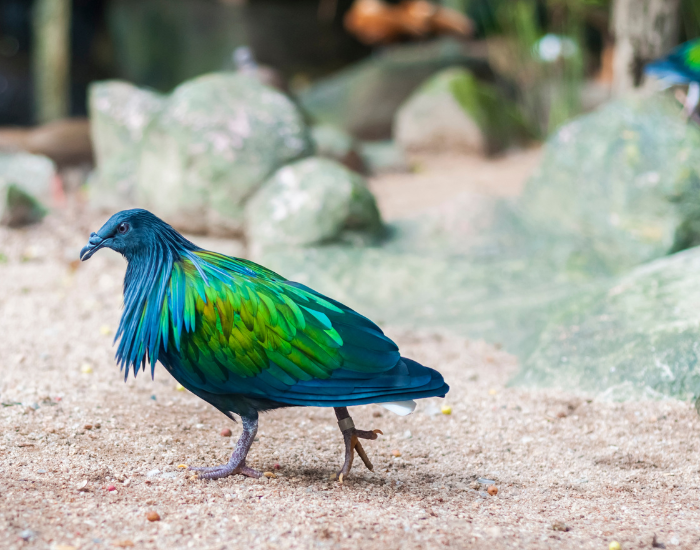
The green pheasant (Phasianus versicolor) became Japan’s national bird in 1947. It is endemic to Honshu, Shikoku and Kyushu. Males shine emerald green, with violet necks and bright red faces. Females wear mottled brown for camouflage on the nest.
You find them along farmland edges, grassland and rice paddies. In Japanese folklore, a pheasant helps the hero Momotarō defeat a band of demons. Ancient poems in the Man’yōshū mention its calls too. The IUCN lists it as Least Concern.
12. Japanese Dwarf Flying Squirrel (Momonga)
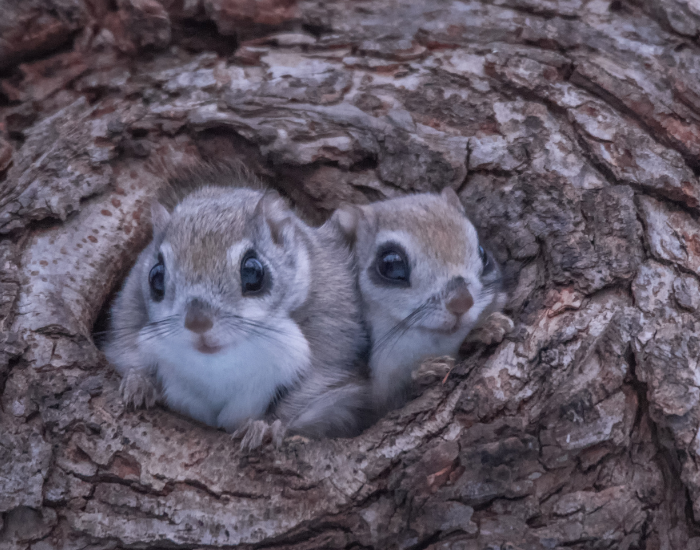
The Japanese dwarf flying squirrel (Pteromys momonga) may be one of the most adorable animals on this list. Locals call it momonga. It weighs only about 150 to 220 grams. It is endemic to Honshu and Kyushu.
They glide between trees on a furry membrane stretched between its legs. Huge dark eyes help it see at night, when it feeds on buds, leaves, seeds and fruit. Unlike colugos, momonga are true rodents.
Hokkaido has its own momonga, a subspecies of the Siberian flying squirrel. Both need old trees with hollows for dens. That puts them high on any list of the cutest animals that depend on mature forests.
13. Japanese Black Bear
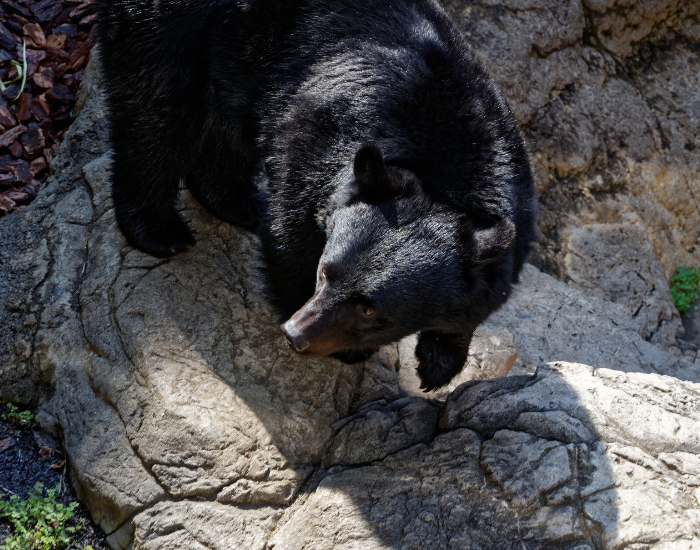
The Japanese black bear (Ursus thibetanus japonicus) is a subspecies of the Asian black bear. It lives in mountainous areas of Honshu and Shikoku, and Japan declared it extinct on Kyushu in 2012. A white crescent on its chest earns it the nickname moon bear. It eats mostly acorns, beech nuts, fruit and insects.
When beech and oak crops fail, hungry bears move closer to humans in search of food. Fiscal 2025 brought a record 238 attack casualties, including 13 deaths. Sightings jumped to more than 50,000. The IUCN lists the species as Vulnerable.
I have only seen an American black bear in the wild. One crossed a trail in front of me while I was hiking near Vancouver. The Asian species looks similar, apart from that chest crescent and bigger ears.
14. Japanese Mamushi
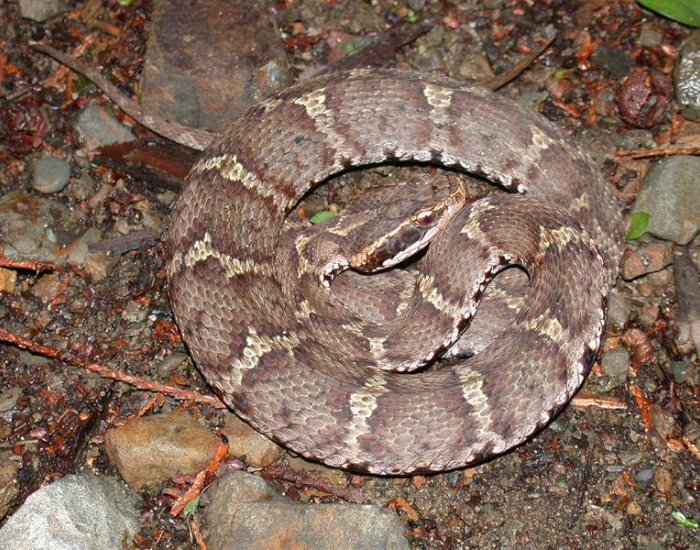
The mamushi (Gloydius blomhoffii) is the most widespread venomous snake among the reptiles found in Japan. It is a pit viper, related to the rattlesnakes I worked with at the zoo. Heat-sensing pits between its eyes and nostrils help it find warm prey in the dark. Adults usually reach about 45 to 65 centimetres.
Mamushi live in forests, grassland, stream banks and rice paddies across the main islands. They eat rodents, frogs and other amphibians. Females give birth to live young rather than laying eggs.
Bites happen every year, mostly to farmers and hikers. Deaths are rare when people reach hospital quickly. At the zoo, we caught rattlesnakes with hooks and tongs, never hands. I would give a mamushi the same respect.
15. Genji Firefly
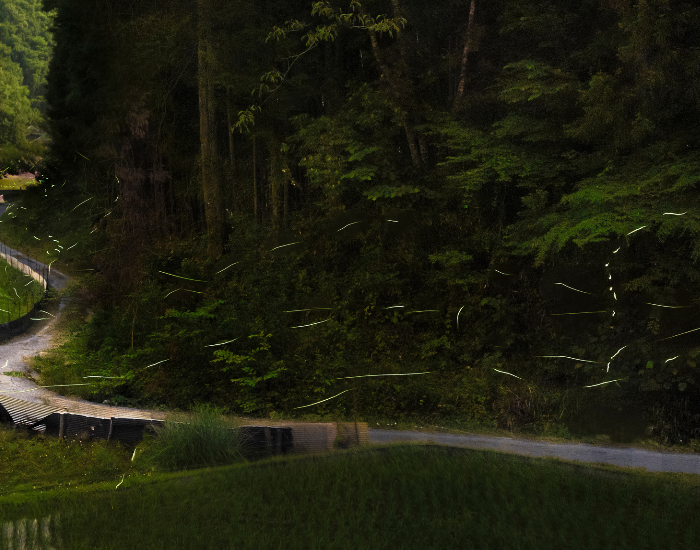
The Genji firefly (Nipponoluciola cruciata) is one of Japan’s best-loved insects. Despite the name, fireflies are beetles. Its bioluminescent larvae live underwater in clean streams, where they hunt freshwater snails. Adults emerge in late spring and early summer.
Here is the twist. In western Japan, males flash about every two seconds. In eastern Japan, they flash about every four seconds. The dividing line follows the Fossa Magna, a great rift across central Honshu. A 2020 genetic study found these groups barely interbreed in the wild.
Firefly viewing is a much-loved summer tradition, and the insect even appears in the 8th-century Nihon Shoki. The closest I have come to that kind of spectacle was a monarch butterfly sanctuary in Michoacán as a child.
Free mini guide
Take Japan’s wildlife with you
All seven infographics in one printable PDF: the wildlife map, folklore, Japanese animal words, comeback stories and a quick quiz.
 Free PDF · 16 pagesAnimals of Japan Mini GuideSnow monkeys, island cats, folklore and more, ready to print.Download free →
FAQs About Animals From Japan
The Japanese macaque, or snow monkey, is probably Japan’s most famous animal. Its winter hot spring baths at Jigokudani Monkey Park in Nagano draw visitors from around the world. The sika deer of Nara and the red-crowned crane of Hokkaido are close contenders.
Japan’s national bird is the green pheasant (Phasianus versicolor), chosen in 1947. It is endemic to Japan and lives on Honshu, Shikoku and Kyushu. A pheasant also appears in the folk tale of Momotarō.
Many animals live only in Japan. Examples include the Japanese macaque, Japanese serow, Japanese giant salamander, green pheasant, Amami rabbit, Okinawa rail and Japanese dwarf flying squirrel. The Iriomote cat, a leopard cat subspecies, lives only on Iriomote Island.
The Iriomote cat is one of Japan’s rarest animals, with only about 100 left on a single island. The IUCN lists it as Critically Endangered. The Okinawa rail and Blakiston’s fish owl are also very rare in Japan.
Start Your Own Japan Wildlife List
The animals from Japan show what mountains, isolation and a long north-to-south climate can build. The red-crowned crane and Amami rabbit prove that conservation works when people commit. Others, like the Iriomote cat, still balance on a knife edge.
Japan is still on my list, and these 15 species are a big reason why. Which of these wild animals would you travel to see first? Tell me in the comments. Then test yourself with the quiz below, or explore more threatened species in our endangered animals tool.
Which species is this?
You scored
References:
Borzée, A., Angulo, A., Meredith, H., Taguchi, Y., Groffen, J., Kohler, D. B., Abernethy, J. P. D., Othman, S. N., Messenger, K., Heo, K., Wan, L., Um, T. E., Zhang, X., Shin, Y., Bae, Y., Wang, Z., Qiu, Z., & Pearce, R. (2024). Protecting Japanese giant salamanders (Andrias japonicus) in the Nawa River Basin, Japan: Policy recommendations addressing water pollution and waterway disruption. Frontiers in Amphibian and Reptile Science, 2, 1348251. https://doi.org/10.3389/famrs.2024.1348251
Kato, D., Suzuki, H., Tsuruta, A., Maeda, J., Hayashi, Y., Arima, K., Ito, Y., & Nagano, Y. (2020). Evaluation of the population structure and phylogeography of the Japanese Genji firefly, Luciola cruciata, at the nuclear DNA level using RAD-Seq analysis. Scientific Reports, 10, 1533. https://doi.org/10.1038/s41598-020-58324-9
Kubo, T., & Mameno, K. (2025). Mongoose eradication achieved on Japanese World Heritage island: Social benefits outweigh costs. Oryx, 59(3), 286. https://doi.org/10.1017/S0030605325000250
Omote, K., Nishida, C., Takenaka, T., Saito, K., Shimura, R., Fujimoto, S., Sato, T., & Masuda, R. (2015). Recent fragmentation of the endangered Blakiston’s fish owl (Bubo blakistoni) population on Hokkaido Island, northern Japan, revealed by mitochondrial DNA and microsatellite analyses. Zoological Letters, 1, 16. https://doi.org/10.1186/s40851-015-0014-3
Takeshita, R. S. C., Bercovitch, F. B., Kinoshita, K., & Huffman, M. A. (2018). Beneficial effect of hot spring bathing on stress levels in Japanese macaques. Primates, 59(3), 215–225. https://doi.org/10.1007/s10329-018-0655-x