

Bears pull off something few animals manage. They frighten us and charm us at the same time.
I have only ever met one in the wild. A black bear crossed a hiking trail near Vancouver while I was mid-sentence with a friend. It glanced at us, decided we were boring, and kept walking into the salal. That is the honest extent of my wild bear encounters.
Every other bear I have seen has been in a zoo. Everything else I know comes from the literature and from people who study bears full time. That distinction matters when you read an article like this one.
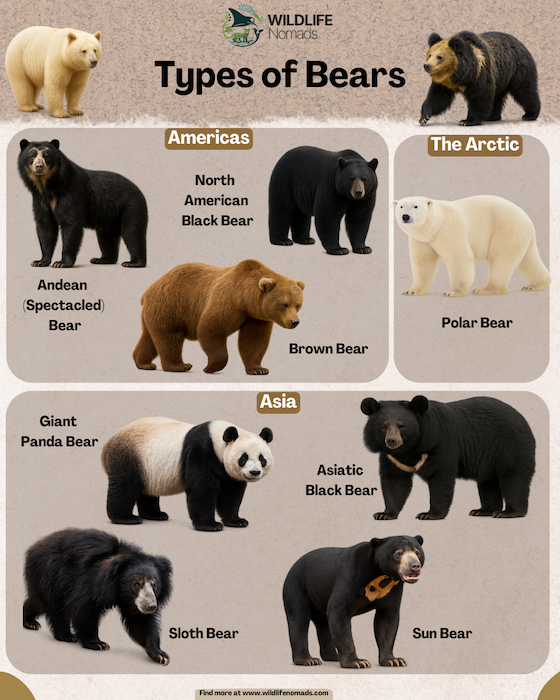
So how many types of bears are there? The bear family, Ursidae, includes eight officially recognized species spread across North America, South America, Europe, and Asia. Dozens of subspecies sit underneath them, which is where most of the confusion starts. Let’s go through all of them, their habitats, and their conservation status.
How Many Bear Species Are There?
The bear family, scientifically known as Ursidae, consists of eight species of bears distributed across four continents. Genomic work by Kumar and colleagues confirmed those eight lineages, and also showed that bears interbred repeatedly as they diverged. The family tree is a braid, not a ladder.
- Brown bear (Ursus arctos)
- Polar bear (Ursus maritimus)
- American black bear (Ursus americanus)
- Asiatic black bear (Ursus thibetanus)
- Spectacled bear (Tremarctos ornatus)
- Giant panda (Ailuropoda melanoleuca)
- Sloth bear (Melursus ursinus)
- Sun bear (Helarctos malayanus)
All eight are carnivores by ancestry, whatever they actually eat. Most belong to the genus Ursus. The giant panda and the spectacled bear sit on their own branches, separated from the rest by millions of years.
Here is the number that should worry you. Six species out of eight are listed as vulnerable or endangered. Only the brown bear and the American black bear are ranked Least Concern.
Subspecies add another layer. The brown bear alone has more than 15 recognized subspecies, including the grizzly bear and the Kodiak bear.
Explore Our Interactive Infographics
Here are the 8 Species of Bears
1. Brown Bear
The brown bear (Ursus arctos) is the most widespread of all bear species, ranging across North America, Europe, and Asia. Its adaptability is the whole story. Coastal salmon runs and alpine meadows produce very different animals from the same genetic template.
The grizzly bear is North America’s most recognisable brown bear, roaming from Alaska to the northwestern United States. Big males reach around 800 pounds and stand 8 feet tall on their hind legs. Grizzlies are omnivores, working through salmon, berries, roots, insect larvae, and small mammals depending on the month.
Their home ranges are enormous. A male grizzly may cover hundreds of square miles in a single season chasing food.
Subspecies include:
- Grizzly bear (Ursus arctos horribilis) – western North America
- Kodiak bear (Ursus arctos middendorffi) – isolated on Alaska’s Kodiak Archipelago, often rivalling polar bears in size
- Kodiaks grow larger on a protein-rich diet of salmon and marine carrion.
- Grizzlies and Kodiaks are the same species. Isolation, not genetics alone, built the size difference.
- Eurasian brown bear (Ursus arctos arctos) – Europe and Russia
- Himalayan brown bear (Ursus arctos isabellinus) – an endangered species in the Himalayas
- Gobi bear (Ursus arctos gobiensis) – the only desert-dwelling brown bear, covered in my guide to the animals of the Mongolian Gobi Desert
- Syrian brown bear and Kamchatka brown bear, among others
You will also run into older names in the literature, like the Dall Island brown bear from southeast Alaska. Naturalists in the early 1900s split brown bears into dozens of species based on skull shape. Modern genetics folded almost all of them back into Ursus arctos.
Brown bears feed hard through summer, then den through winter. Their powerful shoulders and claws earned them a spot on our list of strongest animals on earth.

2. Polar Bear and the Arctic
The polar bear (Ursus maritimus) is the largest living land carnivore. Dense fur and a thick fat layer let it work in temperatures that would kill most mammals.
Polar bears swim exceptionally well and have been tracked covering more than 400 miles of open water. Females dig maternity dens in snowdrifts and give birth to cubs weighing under two pounds. Those cubs grow fast on milk that can exceed 30% fat.
- Male polar bears can exceed 600 kg, roughly twice the weight of females.
- They hunt seals from sea ice, which makes them the most carnivorous bears alive.
- Climate change is shortening the hunting season they depend on.
That last point is not vague. Molnár and colleagues modelled fasting limits across the Arctic. Most polar bear populations face reproductive failure this century if sea ice keeps retreating. The bears are not being outcompeted. They are running out of platform.
Polar bears live across Canada, Greenland, Russia, Alaska, and Norway’s Svalbard. They are listed as vulnerable.

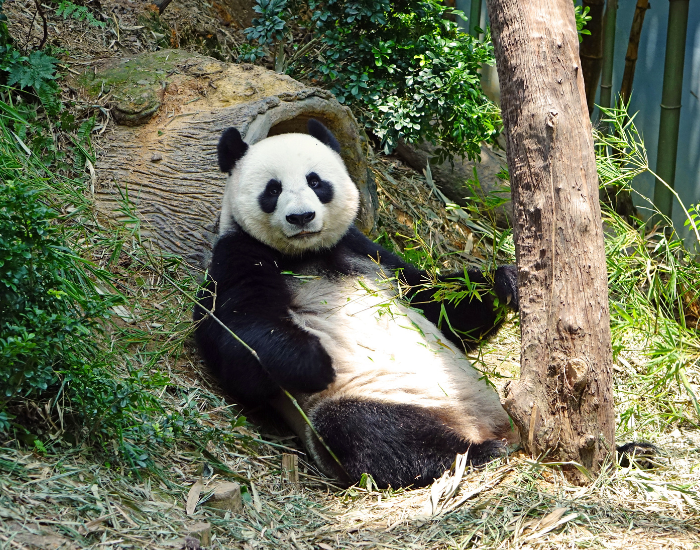
3. Giant Panda
The giant panda (Ailuropoda melanoleuca) is the most famous bear on the planet, and you already know why. You have seen the videos. Pandas rolling down grassy slopes, faceplanting off climbing frames, refusing to let go of a keeper’s leg.
Pandas are native to central China and are almost entirely herbivorous. Bamboo makes up around 99% of their diet. They have a modified wrist bone that works as a thumb for gripping stalks.
- Two subspecies are recognised: the Sichuan panda and the smaller, browner Qinling panda.
- Conservation work moved them from endangered to vulnerable, one of the genuine wins in modern conservation.
- They remain restricted to mountain forests in eastern Asia.
Here is the part people miss. Pandas kept the short, simple digestive tract of a carnivore. Guo and colleagues found their gut bacterial diversity is unusually low and looks nothing like that of a true herbivore. A panda is a meat-eater’s body running on grass.
That mismatch is why they must eat 20 to 40 pounds of bamboo a day. Cubs are born about the size of a stick of butter, blind and nearly hairless. Among mammals, few newborns start life this helpless.
Black Bears
4. North American Black Bears
The American black bear (Ursus americanus) is the most common bear in North America, found from Alaska through Canada, the US, and into Mexico.
This is the one I have actually stood near. What surprised me was how quiet it was. A 200-pound animal moved through dense coastal brush with less noise than the two of us standing still on the trail.
Black bears are the generalists of the family. They eat berries, nuts, insects, carrion, fish, eggs from ground-nesting birds, and whatever people leave in unsecured bins.
- Highly adaptable: forests, swamps, mountains, and suburban edges all work.
- Colour ranges from black to brown, cinnamon, blue-grey, and white.
- Home ranges are far smaller than a grizzly’s, often under 50 square miles.

Black Bear Subspecies
Taxonomists recognise around 16 regional forms of Ursus americanus. Several are island or peninsula populations that drifted apart in isolation.
- Eastern black bear – the widespread form across eastern North America
- Vancouver Island black bear – larger and darker than the mainland form
- Haida Gwaii black bear – heavy-skulled and big-toothed, adapted to crunching shellfish and salmon
- Kenai black bear – restricted to Alaska’s Kenai Peninsula
- Olympic black bear – the rainforest population of Washington’s Olympic Peninsula
- California black bear and the Florida black bear – both regional forms of the same species
The island populations interest me most. Haida Gwaii and Vancouver Island bears show how quickly a few thousand years of separation reshape an animal.
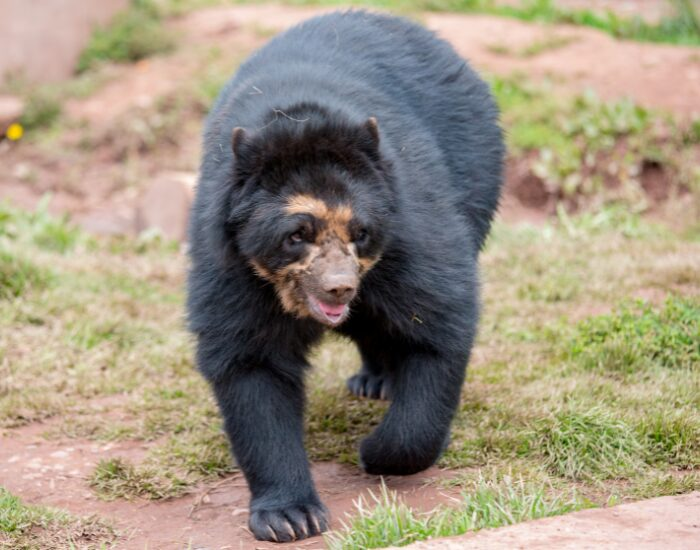
5. Andean Bear: South America’s Only Bear
The Andean bear (Tremarctos ornatus), also called the spectacled bear, is the only bear species native to South America. I wrote a longer piece on spectacled bears if you want the full profile.
- Found along the Andes mountains from Venezuela to Bolivia.
- Named for the pale rings around the eyes, which are unique to each individual like a fingerprint.
- Mostly herbivorous, feeding on bromeliads, fruit, and palm hearts, with opportunistic meat.
- Habitat loss and forest fragmentation are the main threats.
There is one more thing about them that deserves more attention. Andean bears are the last surviving member of the Tremarctinae, the short-faced bear lineage. Every other bear in that group is gone.
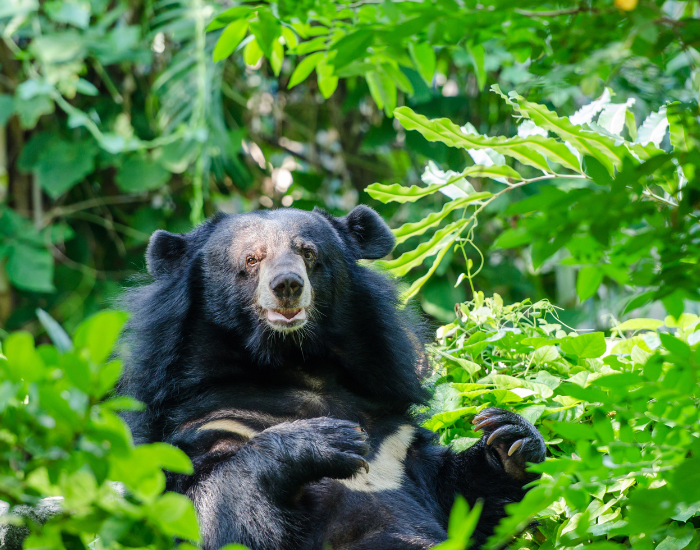
6. Asiatic Black Bear
The Asiatic black bear (Ursus thibetanus) lives across eastern Asia, from India and the Himalayas through China, Korea, and Japan.
- Recognised by the white crescent on the chest, which gives them the name moon bear.
- A medium sized bear, weighing 100–200 kg.
- Regional forms include the Himalayan black bear, the Tibetan black bear, the Indochinese black bear, the Japanese black bear, and the Formosan black bear.
- Logging, poaching, and the bear bile trade drive their decline.
Asiatic black bears climb well and spend real time in trees, building feeding platforms out of broken branches. They are also the species most heavily targeted for bear bile farming, which I cover further down.
7. Sloth Bears: The Termite Specialists
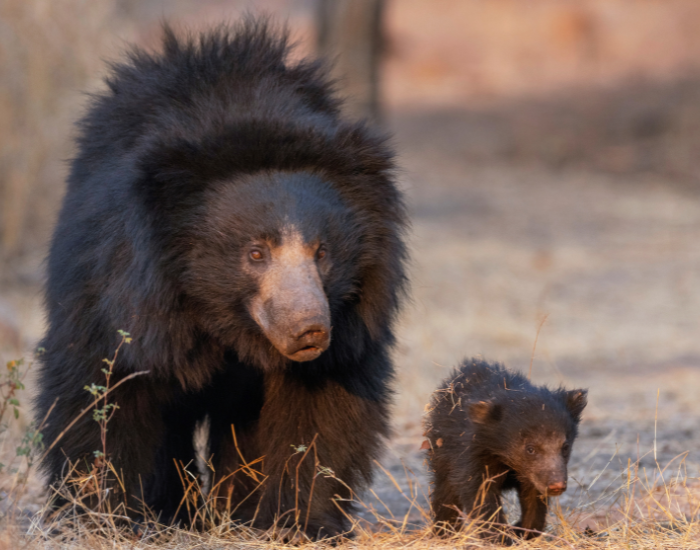
The sloth bear (Melursus ursinus) is the strangest bear in the family. The Indian sloth bear ranges across India, Nepal, and Sri Lanka. Evolution rebuilt it almost entirely around eating insects.
Watch one feed and the adaptations make immediate sense. They close their nostrils, purse their lips into a tube, and vacuum termites straight out of the mound. The sucking noise carries over 500 feet.
- Sloth bear adaptations:
- Closeable nostrils to keep insects out of the airway
- Mobile lips that form a suction tube
- A gap where the upper incisors should be, for airflow
- Long, curved claws for tearing open termite mounds
- Shaggy fur that blunts bites from ants and termites
They also take honey, fruit, and insect larvae when the season allows. Despite the name, they are not related to sloths. Early naturalists saw the claws and shaggy coat and guessed wrong.
8. Sun Bears: The Smallest Bear Species
The sun bear (Helarctos malayanus) is the smallest of all bear species, weighing 60 to 150 pounds. They live in the tropical forests of southeast Asia.
The name comes from the golden chest patch, which is different on every bear. Sun bears are superb climbers and spend much of their time above ground hunting honey, insects, and fruit. Their tongue can reach 10 inches, which is how they empty a bee nest.
Sun Bear characteristics:
- Smallest bear species
- Distinctive golden chest patch
- Excellent climbing ability
- Very long tongue for extracting honey
- Short, sleek fur suited to tropical heat
Unlike other bears, sun bears do not hibernate. Tropical forests supply food year round. They stay active and build sleeping platforms in trees instead.

Rare Bears and Subspecies
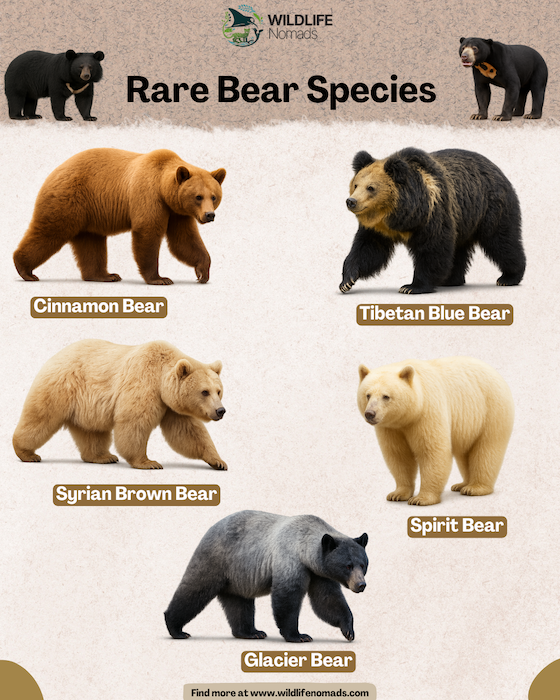
Some of the most interesting bears are not species at all. They are colour morphs and isolated populations.
- Spirit bear: a white-coated American black bear from coastal British Columbia, caused by a recessive allele.
- Glacier bear: a silvery blue-grey black bear from southeast Alaska.
- Cinnamon bear: a red-brown colour phase of the black bear, constantly mistaken for a grizzly.
- Tibetan blue bear and the Syrian brown bear: two rare and rarely photographed subspecies of the brown bear.
The spirit bear is rarer than most people assume. Service and colleagues sampled bear hair across the Great Bear Rainforest. The white allele turned up at lower frequencies than earlier estimates suggested. Worse, the areas with the highest allele frequency fall largely outside protected boundaries.
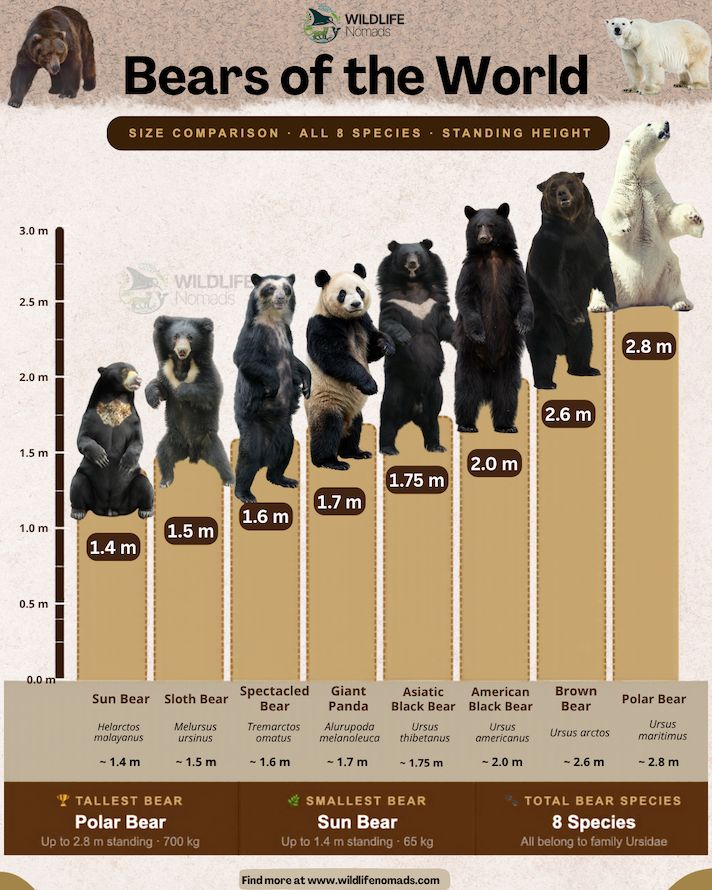
Bear Size Comparisons:
Bear species range from animals the size of a large dog to animals that outweigh a grand piano.
Size rankings (adult males, upper limits):
- Polar Bear – up to around 1,700 pounds, though most are far lighter
- Kodiak Bear – up to around 1,500 pounds
- Grizzly Bear – up to 800 pounds
- American Black Bear – up to 550 pounds
- Asiatic Black Bear – up to 440 pounds
- Spectacled Bear – up to 340 pounds
- Sloth Bear – up to 320 pounds
- Sun Bear – up to 150 pounds
Polar bears and Kodiaks trade the top spot depending on the individual. Both are the largest bears alive, and record weights come from exceptional animals, not averages.
How Bears Survive Winter
Hibernation in bears does not work the way most people picture it. A hibernating ground squirrel drops close to freezing. A bear does not.
Denning bears hold body temperature only a few degrees below normal, yet their metabolic rate falls by roughly three quarters. Jansen and colleagues traced this to widespread changes in gene expression across fat, liver, and muscle tissue. The bear switches its metabolism, not its thermostat.
That is why a denning bear can rouse and defend itself within seconds. It is also why females give birth mid-winter and nurse cubs while eating nothing for months. Sun bears skip the whole process, because tropical forests never force the issue.
FAQ About Bears
By recorded attacks on humans, the sloth bear. Sharp and colleagues compiled 1,778 sloth bear attacks across the Indian subcontinent, a rate no other bear approaches. Sloth bears are short-sighted, live alongside dense human populations, and charge when surprised at close range.
Polar bears are the most likely to treat a person as prey. Grizzly bears cause the most serious injuries in North America, usually defending cubs or a carcass. Aggression in bears is almost always defensive, not predatory.
The Gobi bear is the rarest bear on earth, with fewer than 40 individuals surviving in Mongolia’s Great Gobi Reserve. It is a desert-adapted subspecies of the brown bear, not a separate species.
Among full species, the giant panda remains the rarest, with roughly 1,800 in the wild. For colour morphs, the spirit bear allele is rarer than researchers once thought.
Hawaii. No bear species has ever occurred there naturally, and none is established today.
Delaware and Rhode Island have no breeding black bear population either, though wandering young males occasionally cross state lines. Every other US state holds bears somewhere within its borders.
The koala. It is a marsupial and is not related to bears at all. Red pandas are not bears either, despite the name.
How Many Can You Remember? Let’s Protect Them
From the giant panda in central China to the Andean bear in the Andes mountains, the eight species of bears show how far one family stretched. Some hunt seals on sea ice. One vacuums termites. One eats grass with a carnivore’s gut.
Six of those eight are already in trouble. Habitat loss and a warming Arctic are the two pressures that will decide whether that list stays at eight.
I would like more people to see a bear the way I saw mine. On a trail, at a respectful distance, with the bear entirely uninterested in us.
Bears of the World Challenge
Ten questions on the eight species of bear — first a fact-or-fiction round, then multiple choice. How many can you get?
References:
Crudge, B., Nguyen, T., & Cao, T. T. (2020). The challenges and conservation implications of bear bile farming in Viet Nam. Oryx, 54(2), 252–259. https://doi.org/10.1017/S0030605317001752
Guo, W., Chen, Y., Wang, C., Ning, R., Zeng, B., Tang, J., Li, C., Zhang, M., Li, Y., Ni, Q., Ni, X., Zhang, H., Li, D., Zhao, J., & Li, Y. (2020). The carnivorous digestive system and bamboo diet of giant pandas may shape their low gut bacterial diversity. Conservation Physiology, 8(1), coz104. https://doi.org/10.1093/conphys/coz104
Hwang, M.-H., Ditmer, M. A., Teo, S.-D., Wong, S. T., & Garshelis, D. L. (2021). Sun bears use 14-year-old previously logged forest more than primary forest in Sabah, Malaysia. Ecosphere, 12(10), e03769. https://doi.org/10.1002/ecs2.3769
Jansen, H. T., Trojahn, S., Saxton, M. W., Quackenbush, C. R., Evans Hutzenbiler, B. D., Nelson, O. L., Cornejo, O. E., Robbins, C. T., & Kelley, J. L. (2019). Hibernation induces widespread transcriptional remodeling in metabolic tissues of the grizzly bear. Communications Biology, 2, 336. https://doi.org/10.1038/s42003-019-0574-4
Molnár, P. K., Bitz, C. M., Holland, M. M., Kay, J. E., Penk, S. R., & Amstrup, S. C. (2020). Fasting season length sets temporal limits for global polar bear persistence. Nature Climate Change, 10, 732–738. https://doi.org/10.1038/s41558-020-0818-9
Service, C. N., et al., (2020). Spatial patterns and rarity of the white-phased “Spirit bear” allele reveal gaps in habitat protection. Ecological Solutions and Evidence, 1(2), e12014. https://doi.org/10.1002/2688-8319.12014
Sharp, T. R., Smith, T. S., Swaminathan, S., & Arun, A. S. (2022). Sloth bear attacks: Regional differences and safety messaging. Scientific Reports, 12, 3943. https://doi.org/10.1038/s41598-022-07974-y