Wildlife Nomads


I recently stood in Hintze Hall at London’s Natural History Museum, neck craned back like a kid. Hope, the 25-metre blue whale, dives from the ceiling. Further in, a giant ground sloth skeleton reminds you how strange the last Ice Age really was.
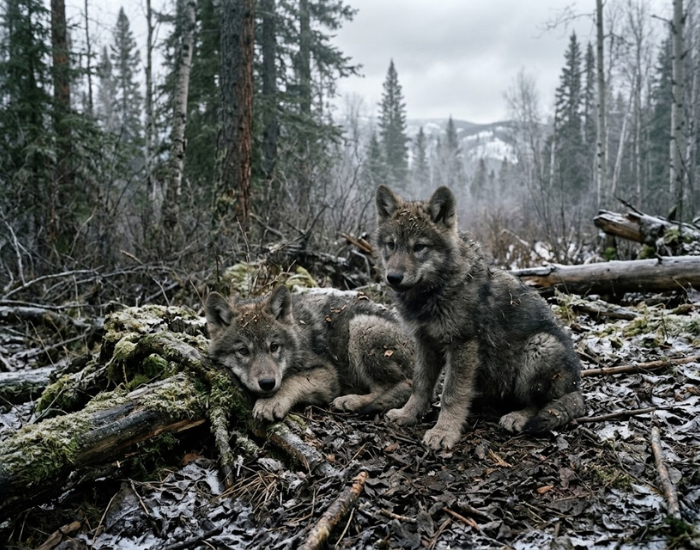
Walking among those bones, my mind drifted to wolves. Like millions of people, I met the direwolf through a screen first. For me, it was a litter of pups found in the snow in the first episode of Game of Thrones.
Because the same show has dragons, plenty of people assume dire wolves are fantasy too (they sound too similar to werewolves). Well, they aren’t. Dire wolves hunted across the Americas until the end of the last ice age. Then, in 2025, a Texas company announced it had brought them back from extinction.
So I went back to the papers and the press releases. These are the 12 truths about the dire wolf I think everyone should know, from fossils to the three animals now living on a private preserve.
Real wolf or Westeros legend? Twelve truths, twelve questions. Read on, then take the dire wolf quiz at the end and see if you’d lead the pack or end up in the tar pits. Jump to the quiz ↓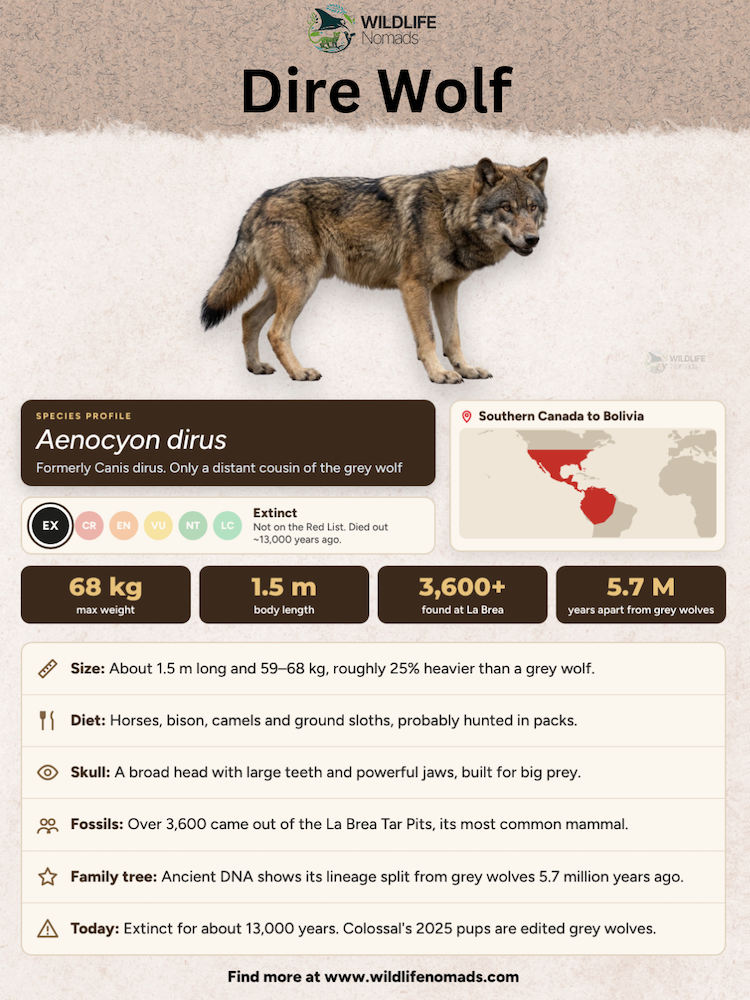
1. The Direwolf of House Stark Borrowed a Real Animal
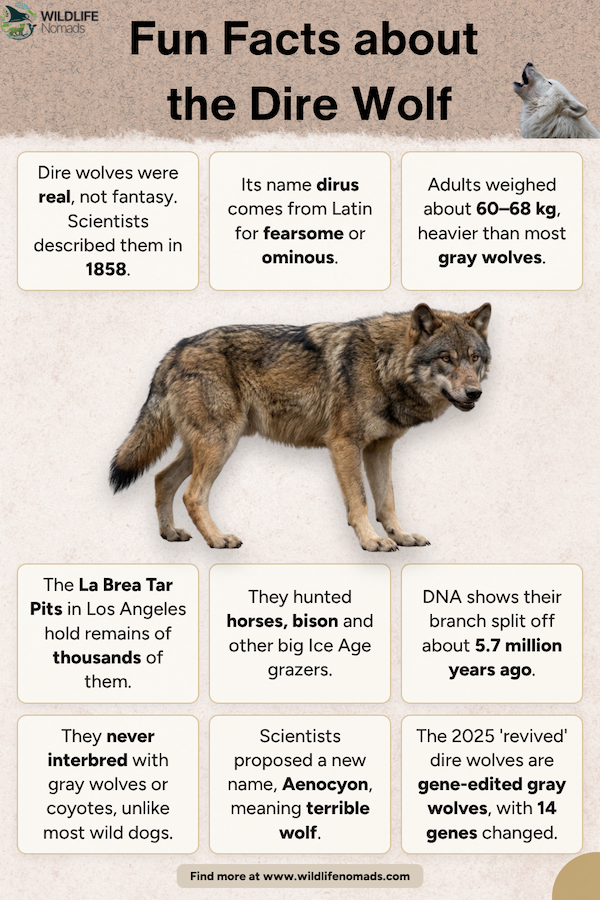
George R.R. Martin didn’t invent the dire wolf. Joseph Leidy described the species in 1858, and the scientific name dirus comes from Latin for fearsome or ominous.
In the books and the series, a grey direwolf is the sigil of House Stark. It stands for family loyalty and survival through hard winters. Each Stark child gets a pup that mirrors their personality, from Jon’s silent white Ghost to Arya’s wild Nymeria.
The link between fiction and science is now oddly literal. Martin is an investor in Colossal, and he appears among the co-authors of the company’s 2025 dire wolf genome preprint.
2. Dire Wolves Were Real Ice Age Predators
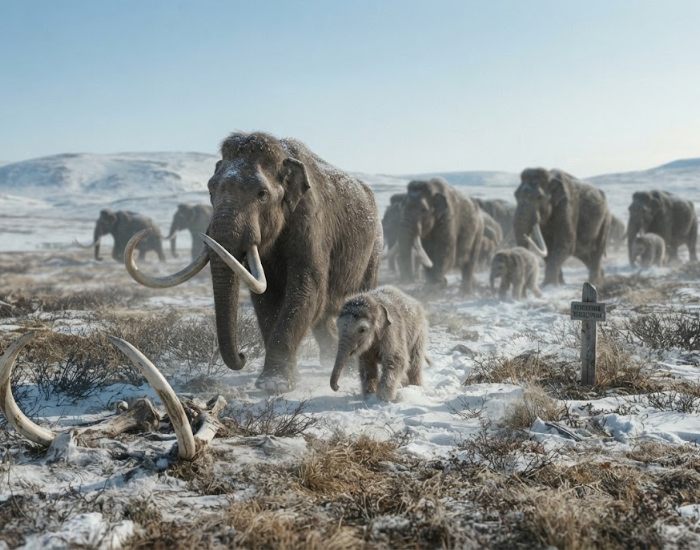
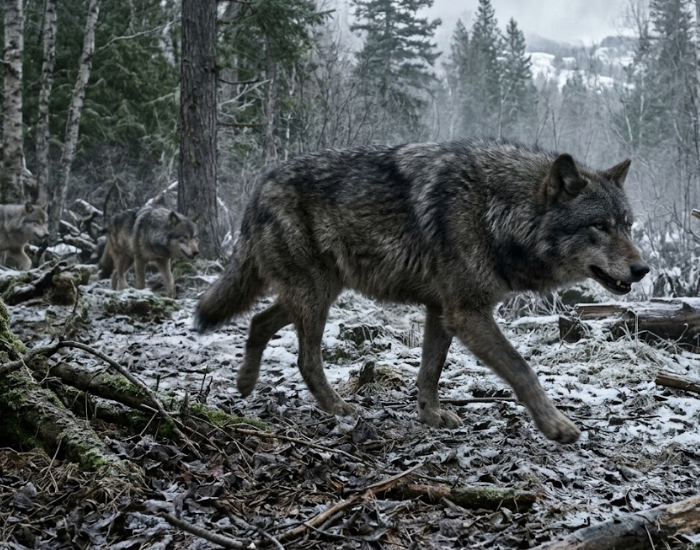
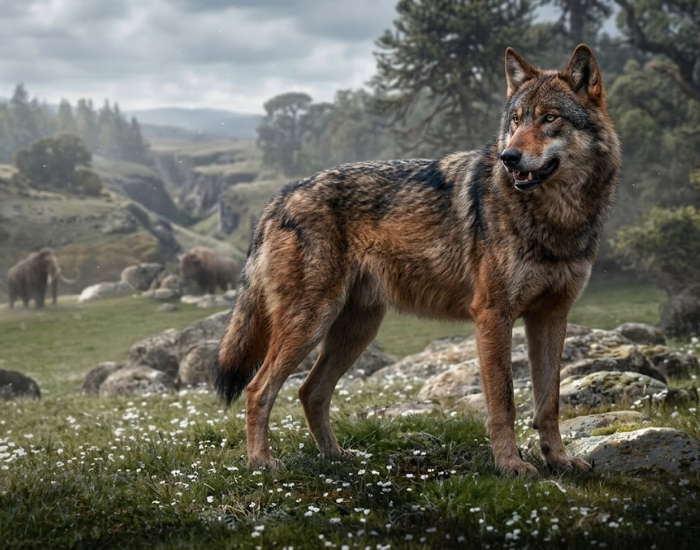
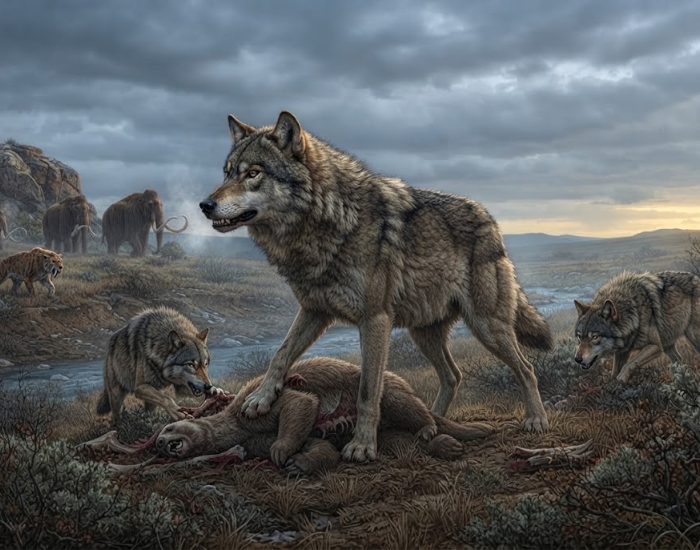
Dire wolves roamed North and South America through the Late Pleistocene. They overlapped with mammoths, saber-toothed cats and ground sloths, the cast I wrote about in my guide to Ice Age animals.
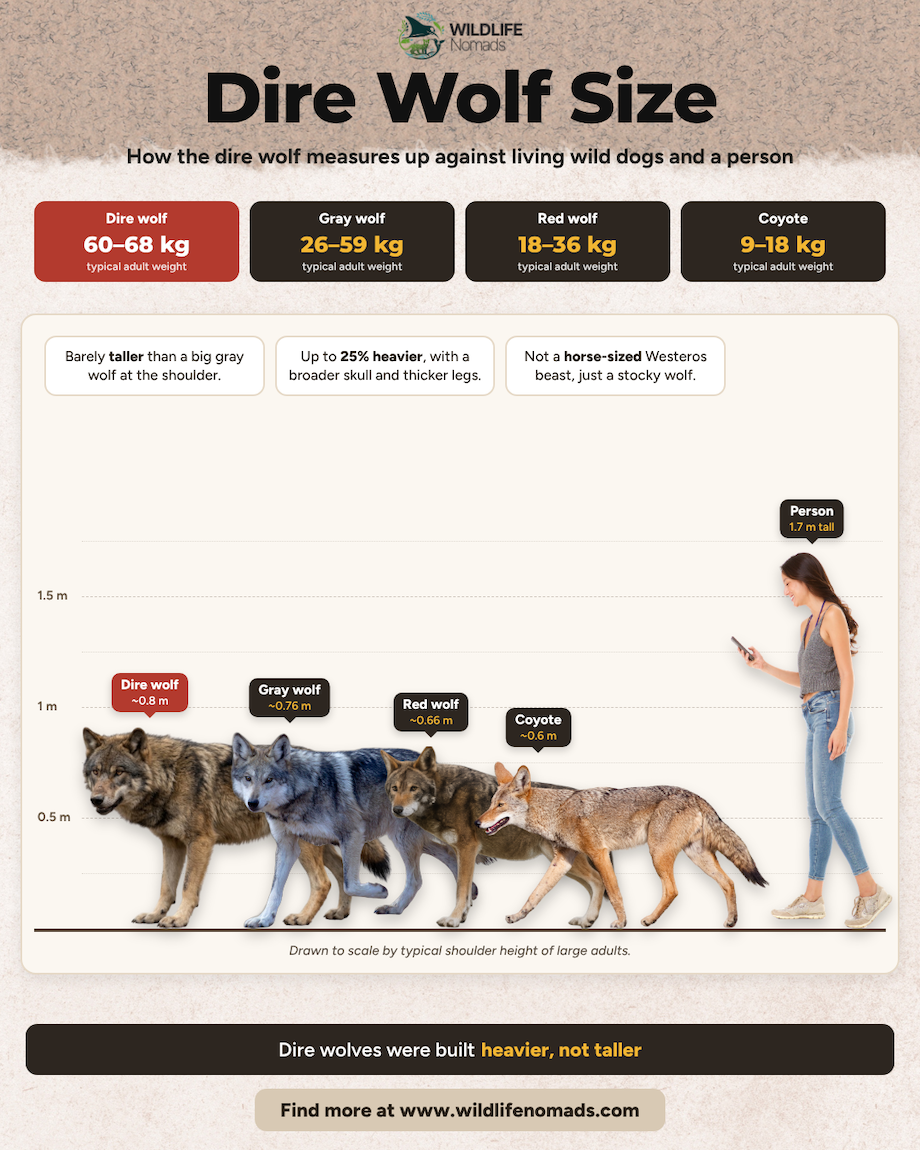
They weren’t the giants Hollywood suggests. Most estimates put adults at roughly 60–68 kg (130–150 lb), heavier than modern gray wolves (Canis lupus) but not dramatically longer. What set them apart was build. They had broader skulls, larger teeth and stronger bites, all suited to tackling big prey.
3. The La Brea Tar Pits Hold a Wall of Dire Wolf Fossils
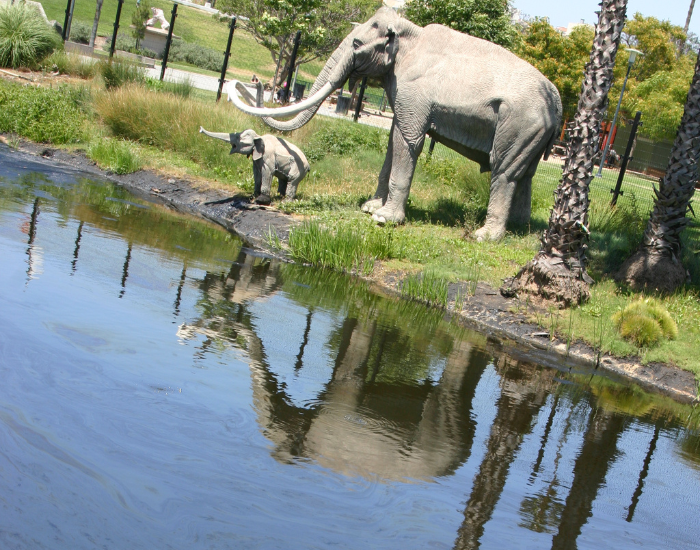
If you want dire wolf fossils, Los Angeles is the place. At the La Brea tar pits, dire wolf individuals outnumber gray wolves by more than a hundred to one. The museum there displays a wall of several hundred dire wolf skulls.
Why so many? A large herbivore would get stuck in the asphalt and start struggling. That noise drew predators, which then got stuck themselves. As a result, carnivores dominate the La Brea record, and dire wolf remains are the most common of all.
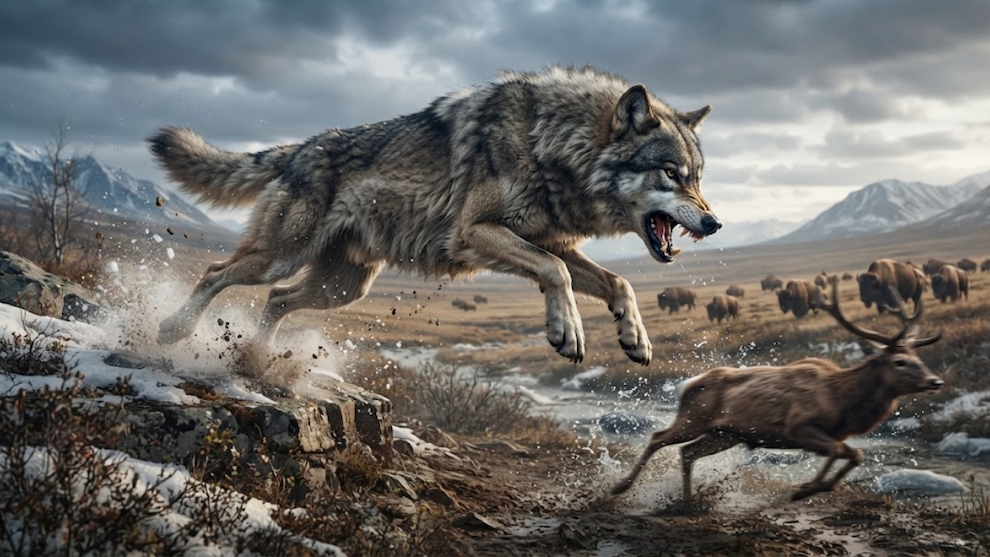
4. They Hunted Horses, Bison and Other Big Game
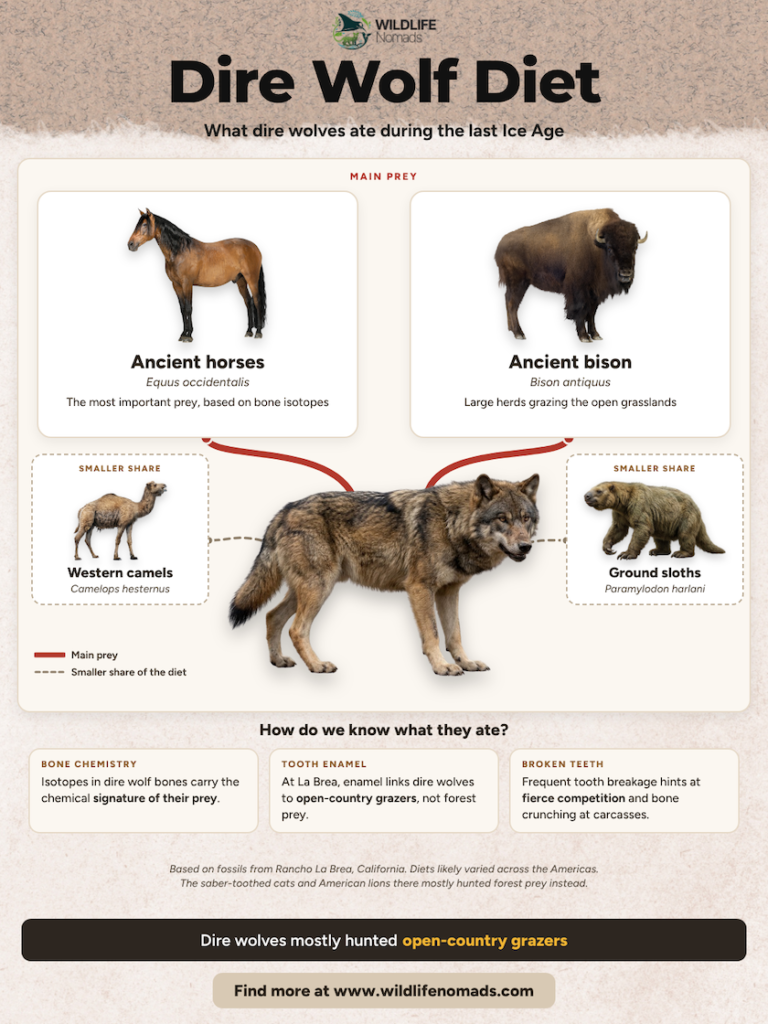
Dire wolves specialised in large Ice Age megafauna. They preyed on large mammals such as bison, and isotope work from La Brea points to horses and other grazers too. Ground sloths may have featured occasionally, though that evidence is thinner.
Their teeth tell a rough story. Studies of Pleistocene carnivores found high rates of broken teeth, which suggests intense competition and heavy bone-crunching. In a crowded predator guild, nothing got wasted.
At university in Sweden, I ran a small experiment with friends on how a predator changed birds’ foraging time on an open plain. Even that modest setup showed how much a hunter reshapes prey behaviour on the food web. Scale that up to dire wolf packs, and you get whole landscapes shaped by fear. I dig into that idea in my post on how apex predators shape ecosystems.
5. Are Dire Wolves Extinct? Yes, for About 13,000 Years
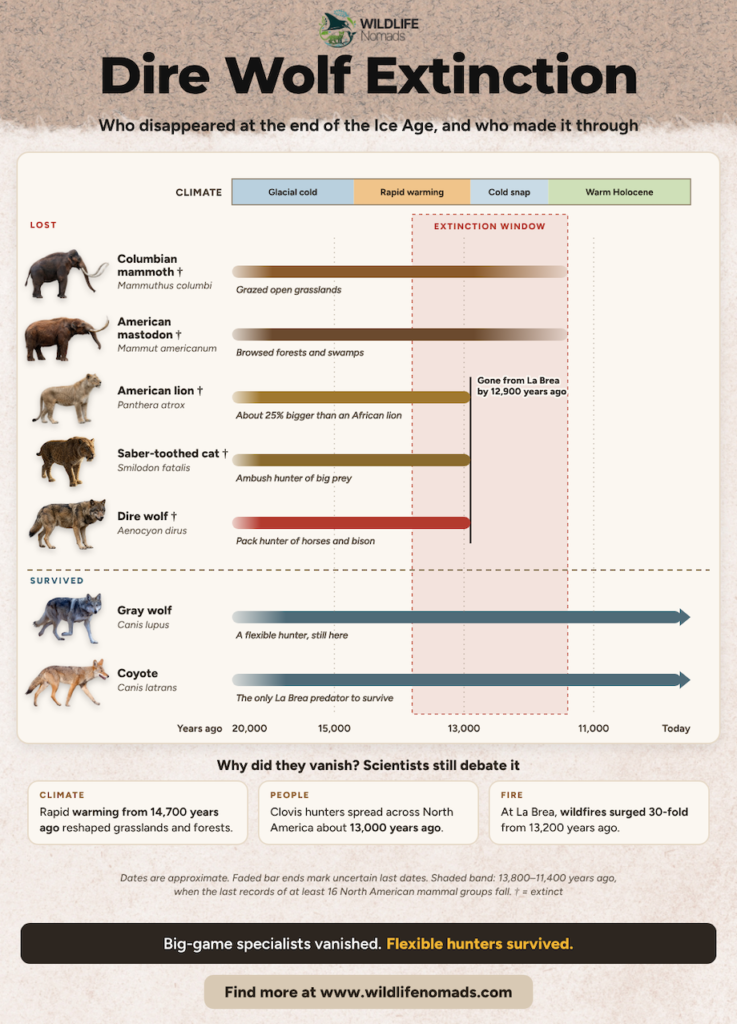
The real dire wolf vanished at the end of the Pleistocene. Researchers place its extinction around 13,000 years ago, alongside dozens of other large North American mammals.
Scientists still debate the exact causes. Rapid climate warming reshaped habitats, while expanding human populations hunted the same big herbivores. When horses, camels and giant ground sloths collapsed, a predator built for big game had nowhere to turn. The American cave lion and the saber-tooth tiger disappeared in the same wave.
Gray wolves, by contrast, survived. They were more flexible hunters, and that flexibility likely saved them.
6. Dire Wolves Weren’t Closely Related to Gray Wolves
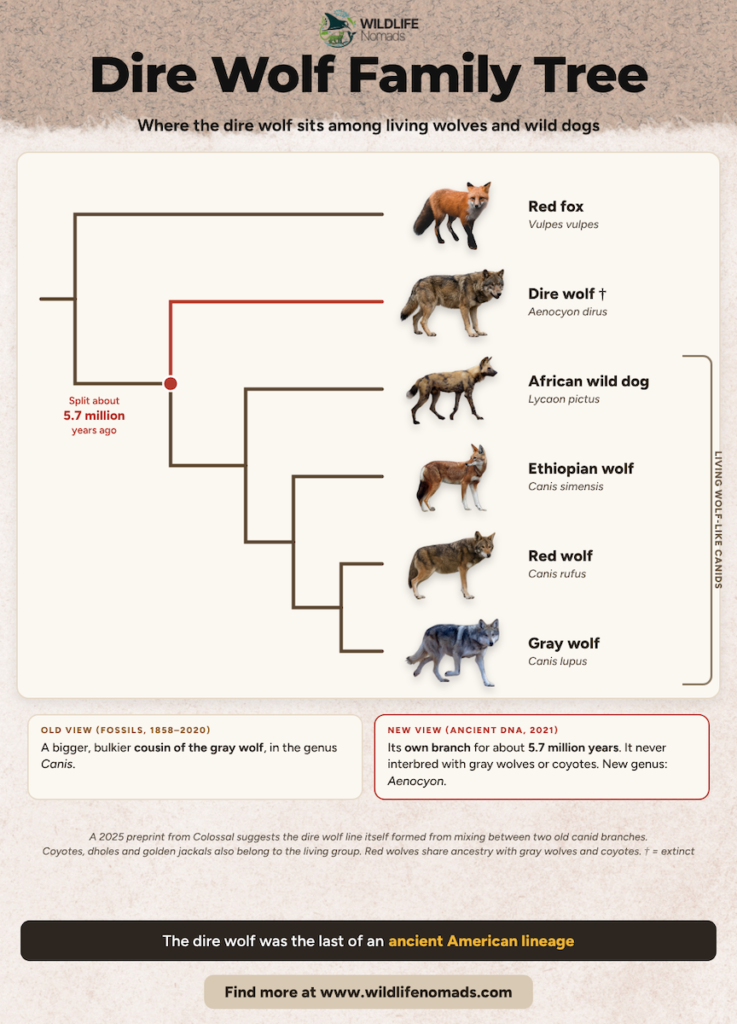
For over a century, everyone assumed dire wolves were beefed-up cousins of modern gray wolves. Ancient dire wolf DNA overturned that in 2021.
A team led by Angela Perri sequenced genomes from dire wolf remains across North America. Their results showed the dire wolf lineage split from modern canids around 5.7 million years ago. Even more striking, they found dire wolves never interbred with gray wolves.
In evolutionary biology, that’s a big deal, because most Canis species hybridise easily. Coyotes, wolves and other canids do it all the time. The dire wolf stayed isolated in the Americas long enough to become a highly divergent lineage. The authors proposed moving it to its own genus, Aenocyon dirus, meaning “terrible wolf”.
If you wonder how lineage divergence works, have a look at our tree of life interactive explorer to see how animal kingdoms divide in real time.
7. The Dire Wolf Genome Got More Complicated in 2025
Colossal scientists then produced higher-quality genomes from two specimens: one older than 13,000 years and one older than 72,000 years. The younger sample came from a tooth found in Ohio, the older from a skull in Idaho.
Their analysis suggested a mixed origin. About two-thirds of dire wolf ancestry traced to a lineage sister to gray wolves, coyotes and dholes, with the remaining third from a much older canid branch. In other words, the dire wolf lineage itself formed from ancient hybridisation.
This doesn’t make dire wolves and gray wolves close relatives. However, it does mean they share a common ancestor more recently than the 2021 study implied. Keep in mind that this work came from company-affiliated researchers and first appeared as a preprint.
8. Was the Dire Wolf Brought Back? Here’s What Colossal Did
In April 2025, Colossal Biosciences announced its dire wolf de-extinction, billing it as the world’s first. Its team edited gray wolf cells at 20 sites across 14 genes, cloned those cells, and implanted the embryos into surrogate dogs.
The team compared dire wolf genes with gray wolf ones, then edited for key traits: body size, more muscular legs, a broader head and a pale coat. Interestingly, the team swapped in a coat variant found in dogs rather than the ancient one, to avoid health risks. The scientific team produced 45 engineered ova and carried embryos to term in hound-mix surrogates. Each surrogate mother was a domestic dog, and each dog gave birth by planned cesarean section to reduce complications.
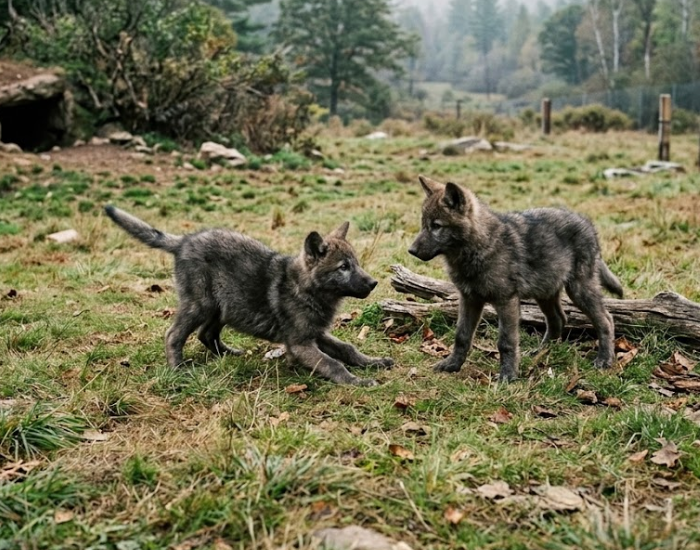
Romulus and Remus were born on 1 October 2024. The third dire wolf pup, Khaleesi, followed on 30 January 2025. The names nod to Rome’s founding twins and, of course, Game of Thrones.
9. Colossal’s Dire Wolves Are Genetically Engineered Gray Wolves
Is the new dire wolf 100% direwolf? No. A gray wolf genome holds roughly 19,000 genes, and Colossal changed 14 of them. That’s a striking feat of genetic engineering, but it isn’t a resurrected species. Colossal claims otherwise, but not everyone accepts that 14 gene edits turn one species into another.
The world’s leading canid experts said so directly. The IUCN SSC Canid Specialist Group stated that the three animals are not dire wolves, nor proxies under IUCN SSC guiding principles. They added that the project may show technical capability but doesn’t contribute to conservation.
Colossal responded that it never aimed for an exact replica, but for animals carrying the lost traits. As a conservation biologist, I think both sides have a point. “Creating proxies” is a defensible goal. Calling those proxies the original species is marketing, and it muddies public understanding of extinction.
10. Romulus, Remus and Khaleesi Turned Two in 2026
Colossal’s dire wolves are now adults. At their October 2026 health check, Romulus weighed 134 lb and Remus 132 lb, while Khaleesi came in at 102 lb. The trio has lived as a pack since August 2025, with Remus as the leader.
They live on a 2,000-plus-acre preserve certified by the American Humane Society, enclosed by 10-foot zoo-grade fencing. The site includes natural dens and an extreme weather shelter. Chief animal officer Matt James moved them onto whole prey such as rabbits and chickens.
That detail made me smile. In the zoo reptile house, I fed crocodiles whole chickens for the same reason: natural behaviors need natural food. James has said the wolves are good at chasing but poor at killing, once returning with a very live bunny. Without experienced adults to learn from, wild skills come slowly.
Colossal isn’t stopping at three wolves. CEO Ben Lamm has said the next litter is underway, and the company plans an eventual pack of six to eight.
11. The Real Win Might Be the Red Wolf
Lost in the dire wolf headlines was a quieter, more useful result. Colossal also cloned four red wolves, named Hope, Blaze, Cinder and Ash, using non-invasive blood cloning.
Red wolves are a critically endangered species, with fewer than 20 surviving in the wild at the time of the announcement. The clones carry “ghost alleles,” red wolf genes hiding in Gulf Coast coyote populations. Colossal says these founders could raise red wolf genetic diversity by about 25%.
Low genetic diversity is what quietly kills small populations. So if the cloned red wolves feed into recovery programs with real conservation partners, Colossal’s dire wolf work will have paid off unexpectedly. Tribal leaders of the MHA Nation in North Dakota have also voiced support for future rewilding on Indigenous lands.

12. De-Extinction Won’t Undo the Causes of Extinction
Colossal’s wider pipeline reads like Jurassic Park with spreadsheets. It produced a woolly mouse in 2025 as a step toward the woolly mammoth, via edited Asian elephants. It also targets other species, including the thylacine here in Australia.
Still, every one of those animals, real or engineered, needs habitat. In the modern world, habitat loss, invasive species and climate change threaten far more extant species than any lab can rescue. No genome edit fixes a cleared forest. The dodo didn’t vanish for lack of DNA; it vanished because its island changed faster than it could.
That’s the lens I keep coming back to. The tools are a game changer for living species if we use them to rescue genetic diversity before it disappears. Otherwise, we risk treating extinction as reversible, and it isn’t.
FAQs you may Have about Direwolves
The original dire wolf, Aenocyon dirus, has been extinct for roughly 13,000 years. In 2026, three gene-edited gray wolves named Romulus, Remus and Khaleesi live on a private US preserve. Colossal calls them dire wolves, but independent experts classify them as genetically engineered gray wolves.
No. Colossal made 20 edits across 14 genes in a gray wolf genome. The animals carry some dire wolf traits, such as size and a pale coat, but remain gray wolves genetically.
Romulus and Remus turned two in October 2026 and reached their predicted adult size. The three wolves now live as a pack and chase live prey. Colossal says more pups are on the way.
Not in the strict sense. Colossal plans more engineered animals and a pack of six to eight, and talks about eventual rewilding. However, the current wolves aren’t being prepared for release.
No extinct species is confirmed to return in 2027. Colossal has publicly targeted around 2028 for its first mammoth-edited Asian elephant calves, with dodo, moa and thylacine projects further out.
The vaquita porpoise in Mexico’s Gulf of California numbers only around ten individuals. The red wolf is also critically endangered, with only a few dozen at most in the wild. You’ll find more recent losses in my list of animals that went extinct recently.
The direwolf deserves better than hype
The direwolf on House Stark banners was built on a real animal, and the real animal is stranger than fiction. It was a lone American lineage that never mixed with gray wolves, then vanished with its prey.
Colossal’s wolves are remarkable, and I’d love to watch them hunt. But they’re a new kind of animal, not a returned one. The red wolf clones may end up being the bigger story.
If this sparked your curiosity, explore more extinct birds or the giant shark in my megalodon facts. Then tell me in the comments: should we call them dire wolves, or not?
The Dire Wolf Quiz
One question for each of the 12 truths above. Pick an answer and you’ll see straight away whether you got it, plus a little extra I couldn’t fit above.
Hungry for more Ice Age predators? Meet the saber-tooth tiger, the American cave lion or the mammoths they shared the plains with.
References:
Perri, A. R., Mitchell, K. J., Mouton, A., Álvarez-Carretero, S., Hulme-Beaman, A., Haile, J., … Larson, G. (2021). Dire wolves were the last of an ancient New World canid lineage. Nature, 591, 87–91. https://doi.org/10.1038/s41586-020-03082-x
Gedman, G. L., Morrill Pirovich, K., Oppenheimer, J., … Lamm, B., & Shapiro, B. (2025). On the ancestry and evolution of the extinct dire wolf [Preprint]. bioRxiv. https://doi.org/10.1101/2025.04.09.647074
DeSantis, L. R. G., Crites, J. M., Feranec, R. S., Fox-Dobbs, K., Farrell, A. B., Harris, J. M., Takeuchi, G. T., & Cerling, T. E. (2019). Causes and consequences of Pleistocene megafaunal extinctions as revealed from Rancho La Brea mammals. Current Biology, 29(15), 2488–2495. https://doi.org/10.1016/j.cub.2019.06.059
Van Valkenburgh, B., Hayward, M. W., Ripple, W. J., Meloro, C., & Roth, V. L. (2016). The impact of large terrestrial carnivores on Pleistocene ecosystems. Proceedings of the National Academy of Sciences, 113(4), 862–867. https://doi.org/10.1073/pnas.1502554112
Heppenheimer, E., Brzeski, K. E., Wooten, R., Waddell, W., Rutledge, L. Y., Chamberlain, M. J., Stahler, D. R., Hinton, J. W., & vonHoldt, B. M. (2018). Rediscovery of red wolf ghost alleles in a canid population along the American Gulf Coast. Genes, 9(12), 618. https://doi.org/10.3390/genes9120618
Shapiro, B. (2017). Pathways to de-extinction: How close can we get to resurrection of an extinct species? Functional Ecology, 31(5), 996–1002. https://doi.org/10.1111/1365-2435.12705
IUCN SSC. (2016). IUCN SSC guiding principles on creating proxies of extinct species for conservation benefit (Version 1.0). IUCN Species Survival Commission. https://portals.iucn.org/library/efiles/documents/Rep-2016-009.pdf