Meet the Vaquita Before its to Late
I first heard about the vaquita during a field trip to Baja in Mexico’s northern waters. A fisherman in the Upper Gulf of California leaned over his weathered net and asked us, “Have you ever seen the little porpoise with panda eyes?” I hadn’t, and truthfully, almost nobody has. The vaquita porpoise is so elusive that sightings are rare even among locals who spend their lives at sea. That mystery, combined with its precarious status as the most endangered marine mammal, is what drew me deeper into its story.
Today, the vaquita holds a heartbreaking record: it’s the most endangered marine mammal on Earth. Fewer than 20 individuals remain, swimming in a tiny pocket of ocean called the Upper Gulf of California. Their story is one of beauty, fragility, and the destructive weight of human activity, but also of resilience and the possibility of recovery if urgent action is taken.
And the Vaquita is not the only one, if you are curious about other sea animals, check our article on “Almost Extinct Sea Animals” and “10 Endangered Bird and Animals you need to know“.

Biology and Ecology of the Vaquita
Smallest Porpoise in the World
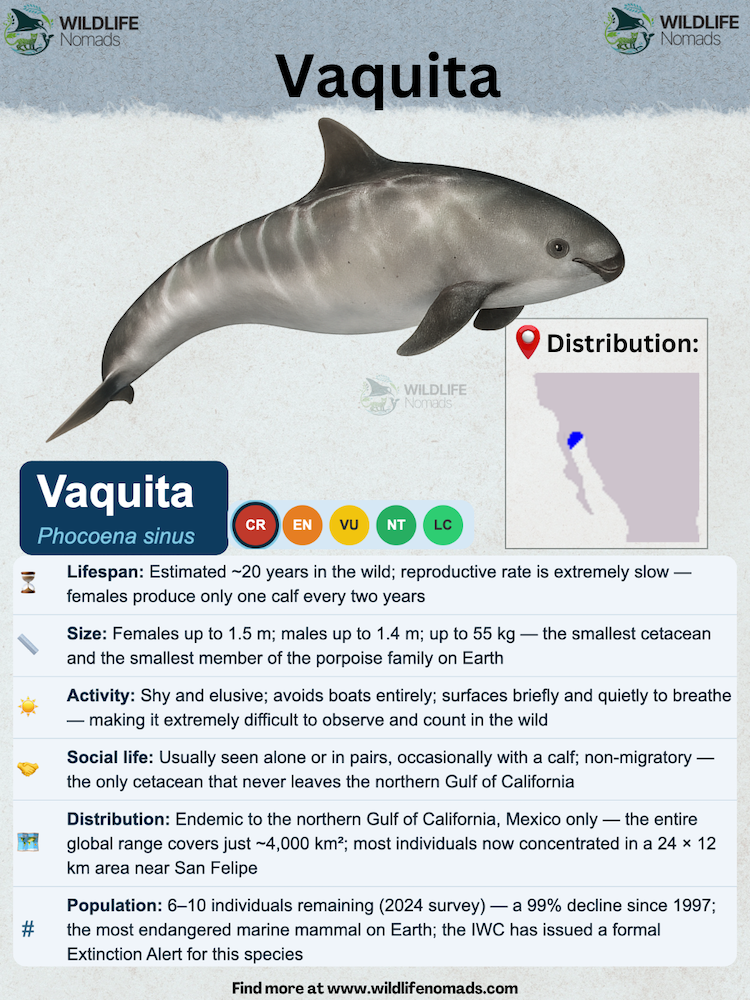
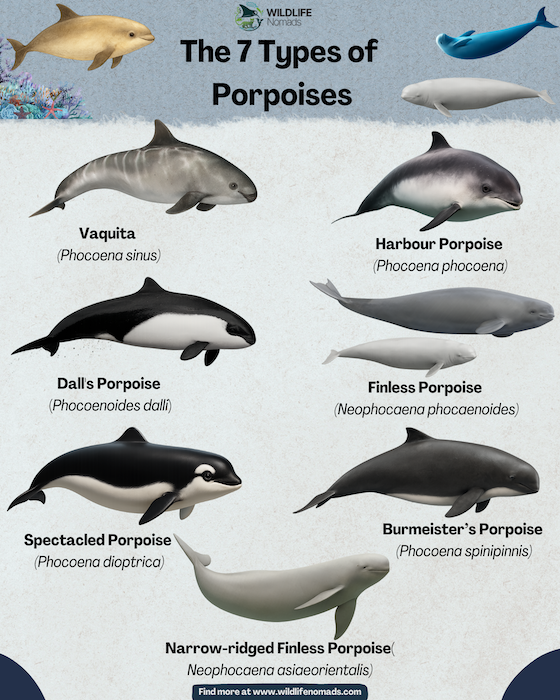
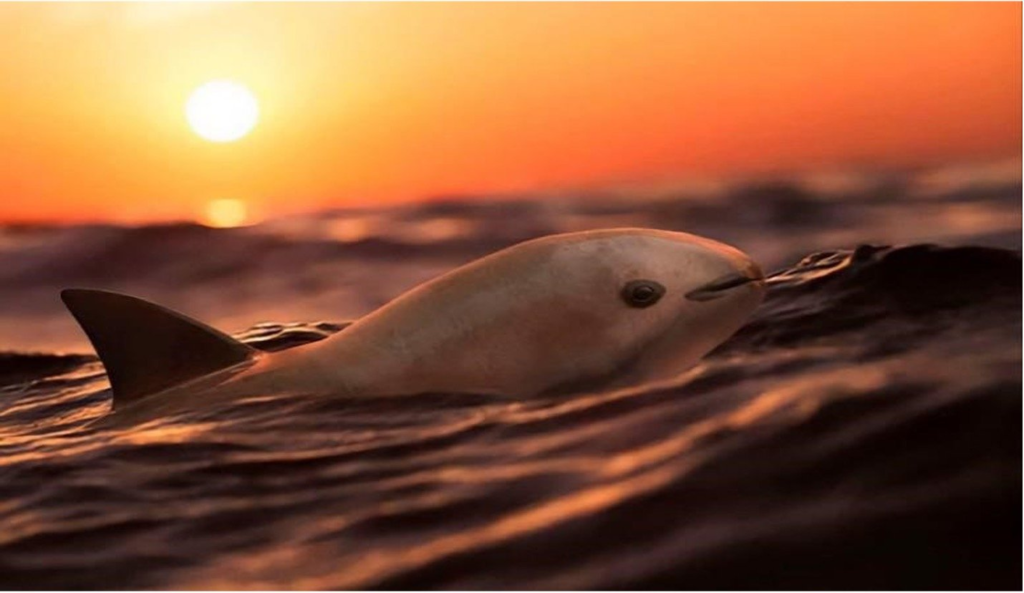
The Vaquita is a type of porpoise, and it is the most critically endangered porpoise, and also the smallest. Adults measure just 140–150 cm (around 4.5–5 ft) and weigh about 40–55 kg. They are distinguished by dark eye rings and lip markings that look like nature’s version of eyeliner.
Vaquita Habitat
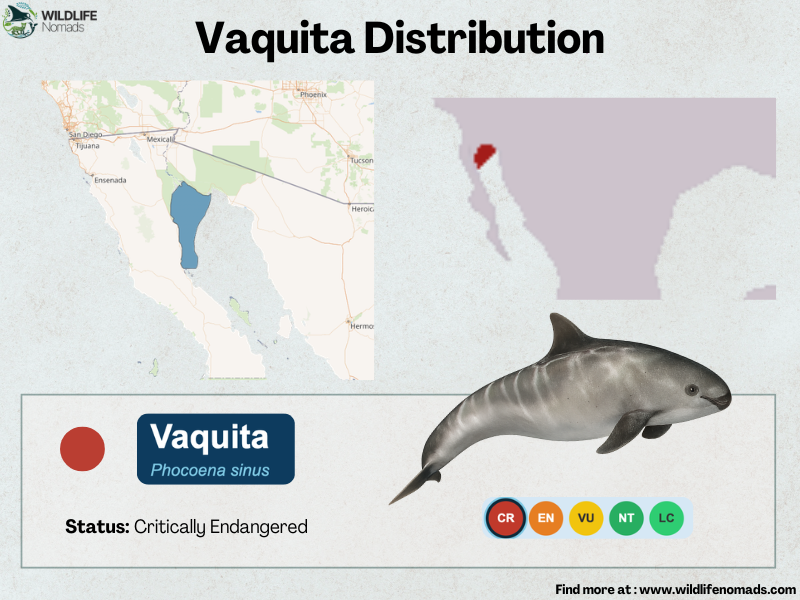
Vaquitas inhabit shallow, murky waters of the northern Gulf, particularly around the Vaquita Refuge and the Upper Gulf of California Biosphere Reserve. These areas were designated as protected areas to safeguard their limited range. Unlike other cetaceans, vaquitas don’t migrate, they are true homebodies of the sea.
Diet & Ecology
They are generalist feeders, consuming small fish, squid, and crustaceans. Their ecological role is significant, they help balance the marine food web in this unique ecosystem.
Life History
- Sexual maturity: 3–6 years
- Lifespan: 20 years
- Reproduction: One calf every 2 years
- Abundance estimates: Calculated through acoustic monitoring and rare visual surveys
This slow reproductive rate means recovery is possible, but only if mortality from fishing nets stops immediately.

Threats to the Vaquita
1. Gillnet Fishing & Accidental Entanglement
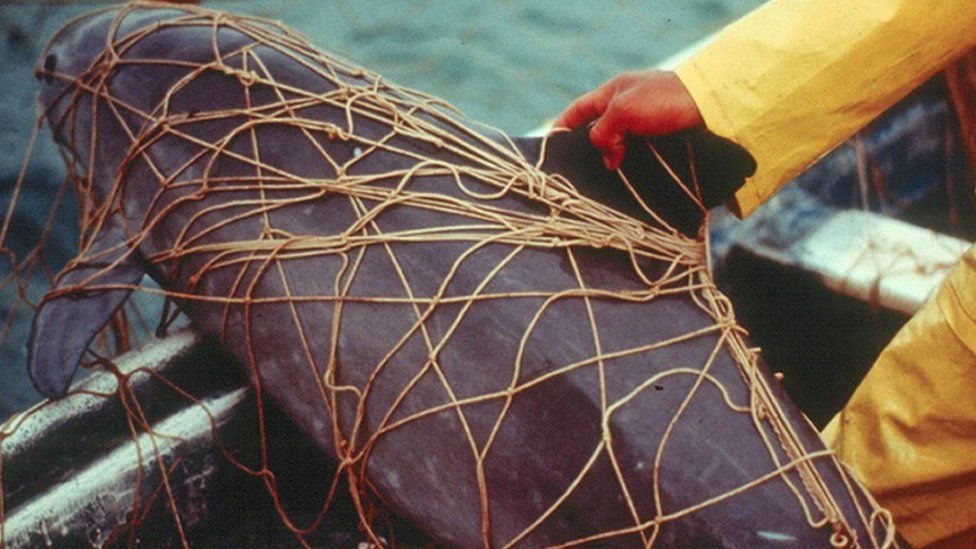
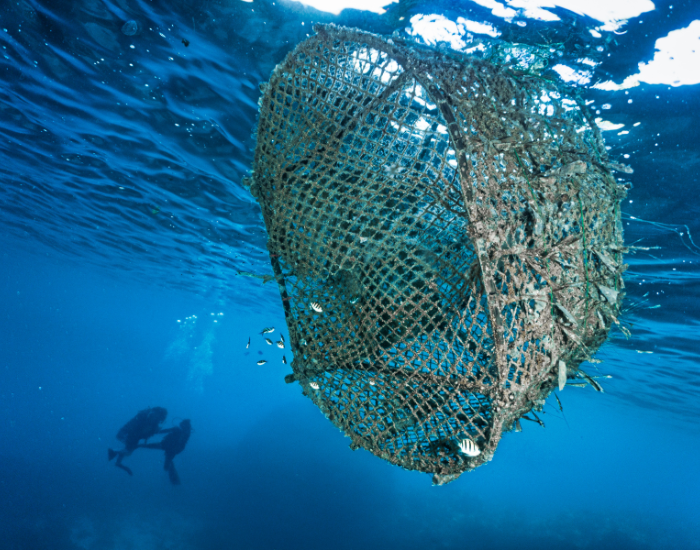
The vaquita’s main threat is gillnet fishing. These fine-mesh walls are invisible in murky waters. When vaquitas swim into them, they become entangled and drown. Accidental entanglement, also called incidental mortality or bycatch, remains the leading cause of death.
2. Totoaba Fishing & Illegal Trade
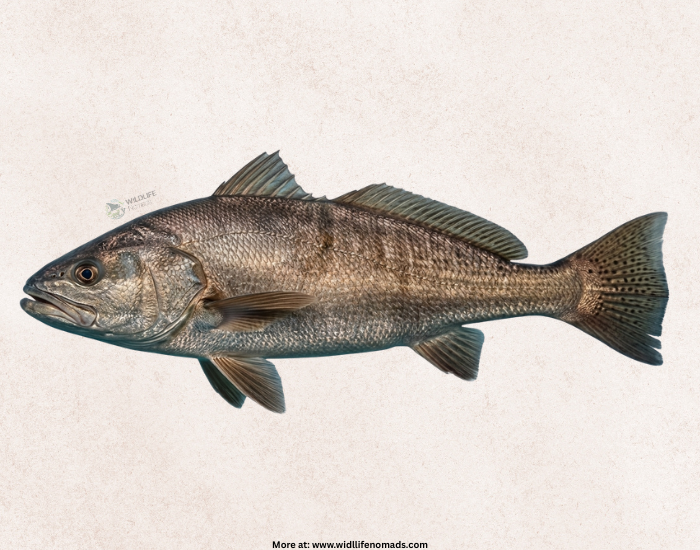
Another driver is illegal totoaba fishing. Totoaba, a large fish also endemic to the Gulf, is targeted for its swim bladder, considered valuable in Chinese medicine. The illegal totoaba trade fuels organized crime networks, and vaquitas die as collateral damage.
3. Habitat Alteration
The Colorado River’s reduced flow has changed the Gulf’s productivity, impacting vaquita prey. Habitat alteration and shallow water degradation also contribute to population decline.
4. Small Population Risks
With fewer than 20 individuals left, the vaquita faces risks of inbreeding depression, reduced genetic diversity, and population decline from random catastrophic events. Yet genomic studies suggest they still have the genetic resilience to recover.
Conservation Status
- IUCN Red List: Critically Endangered
- Population: < 20 in 2025
- Range: Northern Gulf of California only
- Protected Areas:
- Vaquita Refuge
- Upper Gulf of California Biosphere Reserve
- Zero tolerance area for gillnets
Despite these protections, illegal fishing continues inside these zones. Laws exist, but enforcement is inconsistent.

Impact of Human Activities
Fishing Pressure
Gillnets and fishing nets used for shrimp and totoaba dominate the region. Despite bans, illegal fishing gear is still found in the refuge.
Commercial Fishing
Even commercial fishing activities not targeting totoaba have caused vaquita bycatch. Shrimp trawls, for example, once impacted their numbers.
Human Demand & Black Markets
The medicinal value attributed to totoaba bladders drives this destructive trade.
Climate Change
Rising ocean temperatures and shifting fish stocks may further stress the vaquita’s fragile ecosystem.
Community Involvement
I’ve seen this firsthand while traveling in fishing communities around the world: conservation can’t succeed without local buy-in. The same is true in the Gulf of California.
- PACE Vaquita: Supports the adoption of alternative gear that doesn’t harm vaquitas.
- Education programs: Local schools teach children about the vaquita’s plight.
- Community science: Fisher-led monitoring helps enforce the tolerance area.
One fisherman I spoke to described the dilemma well: “We don’t want to kill the vaquita. But nets are how we survive.” Unless conservation supports communities, enforcement will always be met with resistance.
Enforcement and Regulation
Mexican Authorities & Navy
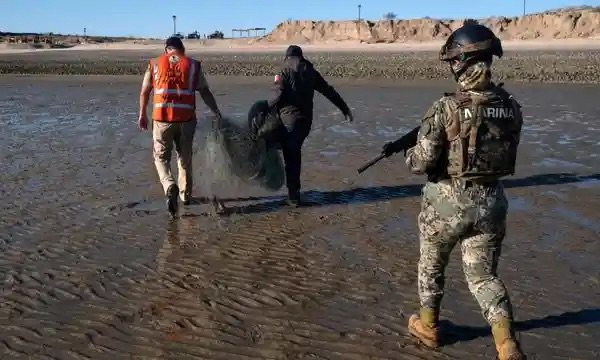
The Mexican Navy patrols the zero tolerance area but faces logistical and financial challenges.
Sea Shepherd Conservation Society
NGOs like the Sea Shepherd Conservation Society remove illegal gillnets and patrol the refuge alongside government agencies.
International Pressure
The international community and international committees have pushed Mexico to act. U.S. sanctions on seafood imports highlight the global dimension of this issue.
But enforcement without community support risks creating conflict on the water.
Research and Monitoring
Monitoring such a small population is no easy task.
- Passive Acoustic Monitoring: Hydrophones detect vaquita clicks, providing data on abundance estimates and range.
- Acoustic Monitoring Programs: Long-term studies track population decline.
- Genetic Diversity Studies: Show that despite their small population, vaquitas still have survival potential.
- Conservation Biology Research: Offers models for recovery if bycatch ends.
Collaboration and Funding
Saving the vaquita requires global collaboration:
- Funding recovery plans through NGOs and international donors
- Collaboration between governments, NGOs, and local fishers
- Raising awareness to build public pressure
- Protected areas managed effectively with real enforcement
10 Quick Facts About the Vaquita
1. The vaquita is the smallest of all porpoises.
Reaching just 140–150 cm, the critically endangered vaquita porpoise is tiny compared to other cetaceans. Its size makes it both endearing and vulnerable, especially when trapped in fishing nets.
2. It lives only in the Upper Gulf of California.
This limited range in the northern Gulf makes the species highly susceptible to habitat threats. Unlike dolphins or whales, it cannot migrate elsewhere when conditions change.
3. Less than 20 remain in 2025.
Acoustic monitoring estimates confirm a devastating decline. With such a small population, every individual counts toward survival.
4. First described scientifically in 1958.
Remarkably, the vaquita was unknown to science until mid-20th century, making it one of the most recently discovered marine mammals. Its scientific name, Phocoena sinus, directly ties it to the Gulf of California.
5. Dark “panda-like” eye rings make it instantly recognizable.
These markings are more than cute, they’re a distinguishing feature that sets the vaquita apart from other marine mammals. Locals often call it the “panda of the sea.”
6. Victim of bycatch in fishing nets.
The primary reason for its decline is accidental entanglement in gillnets. Despite conservation efforts, illegal fishing remains a deadly threat.
7. Shares its habitat with the endangered totoaba fish.
Both species suffer from the illegal totoaba fishing industry. The demand for totoaba swim bladders drives the black market that puts the vaquita at risk.
8. Its name means “little cow” in Spanish.
A fitting nod to its gentle nature, the word “vaquita” reflects how local communities once viewed the species before it became globally recognized as critically endangered.
9. The vaquita refuge was created in 2005.
The Vaquita Refuge and the Biosphere Reserve were designed as protected areas, but enforcement challenges mean illegal gillnetting continues inside their borders.
10. It may be the rarest animal in the world today.
With fewer than 20 individuals left, the vaquita has become a symbol of how quickly human pressure can push a species toward extinction, and how urgent it is to act now to save the vaquita.

Vaquita Fact-Check: True or False? 🐬
Ten statements about the vaquita — some true, some common misconceptions. Answer each, then see how well you understand its story.
Fact-check · True or False?
FAQs About the Vaquita
Fewer than 20 individuals, possibly as few as 10.
Bycatch in gillnet fishing, especially for totoaba, is the main driver.
Yes. If bycatch ends, models suggest recovery is possible.
It is listed as critically endangered on the IUCN Red List.
The Mexican government, NGOs like Sea Shepherd, and international partners enforce bans, monitor populations, and promote alternative gear.
It’s a technique that uses underwater microphones to detect vaquita echolocation, giving scientists abundance estimates.
It translates to “porpoise of the Gulf.
They have few natural predators; their main threat is human activity.
Yes, it is considered the most endangered marine mammal.
We Must Save It
When I think back to the fisherman who first told me about the vaquita, I realize how much has changed. At that time, there were still a few hundred left. Now, we are down to double digits. Yet, the critically endangered vaquita porpoise continues to survive despite overwhelming odds and still has hope.
Its survival isn’t just about saving one species, it’s about saving an ecosystem, supporting fishing communities, and proving that humanity can act before it’s too late.
If you care about ocean conservation:
- Support NGOs removing illegal nets.
- Share the vaquita’s story.
- Ask where your seafood comes from.
The vaquita’s story is a warning. But it can also be a story of hope, if we act now.
References:
Arreguín-Sánchez, F., Zetina-Rejón, M. J., Vergara-Solana, F. J., Del Monte-Luna, P., Rodríguez-Fuentes, M., Arreguín-Rodríguez, G. J., Medina-Contreras, D., & Sánchez-Velasco, L. (2025). State of knowledge of the population of the vaquita (Phocoena sinus) from the Upper Gulf of California: A bibliometric analysis. Frontiers in Conservation Science, 5, Article 1480035. https://doi.org/10.3389/fcosc.2024.1480035
Jaramillo-Legorreta, A. M., Cardenas-Hinojosa, G., Nieto-Garcia, E., Rojas-Bracho, L., Thomas, L., Ver Hoef, J. M., Moore, J., Taylor, B., Barlow, J., & Tregenza, N. (2019). Decline towards extinction of Mexico’s vaquita porpoise (Phocoena sinus). Royal Society Open Science, 6(7), Article 190598. https://doi.org/10.1098/rsos.190598
Robinson, J. A., Kyriazis, C. C., Nigenda-Morales, S. F., Beichman, A. C., Rojas-Bracho, L., Robertson, K. M., Fontaine, M. C., Wayne, R. K., Lohmueller, K. E., Taylor, B. L., & Morin, P. A. (2022). The critically endangered vaquita is not doomed to extinction by inbreeding depression. Science (New York, N.Y.), 376(6593), 635–639. https://doi.org/10.1126/science.abm1742
Rodríguez-Pérez, M. Y., Ruiz-Cooley, R. I., Aurioles-Gamboa, D., Sánchez-Velasco, L., Lavín, M. F., & Gallo-Reynoso, J. P. (2021). Deciphering the trophic niche of the nearly extinct vaquita (Phocoena sinus) and its variability through time. Progress in Oceanography, 199, Article 102694. https://doi.org/10.1016/j.pocean.2021.102694