I’ve spent the last few months deep in the bear rabbit hole. After writing about grizzly bears, Andean bears, polar bears, and breaking down all the different species of bears, today is the turn to one member of the bear family that genuinely baffled me. The sun bear or honey bear. Of all eight species of bears on the planet, this is the one that breaks every rule you think you know about bears. They’re tiny. They have absurdly long tongues. They walk like little pirates. And they went viral because the internet was convinced they were humans in bear costumes.
I’ve seen Malayan sun bears up close in wildlife sanctuaries in Sumatra, and even standing a few feet away, your brain short-circuits. They look nothing like what most people picture when they hear the word “bear.” So let’s break down the wildest facts about these animals, because the sun bear deserves way more attention than it gets.
1. Sun Bears Are the Smallest Bears on Earth
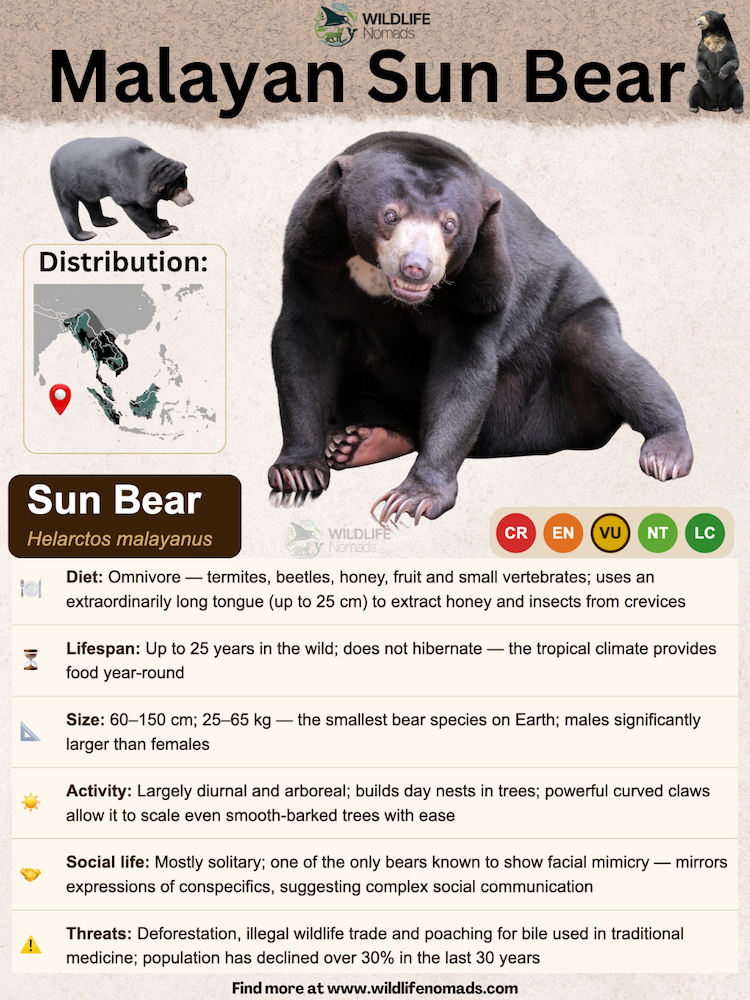
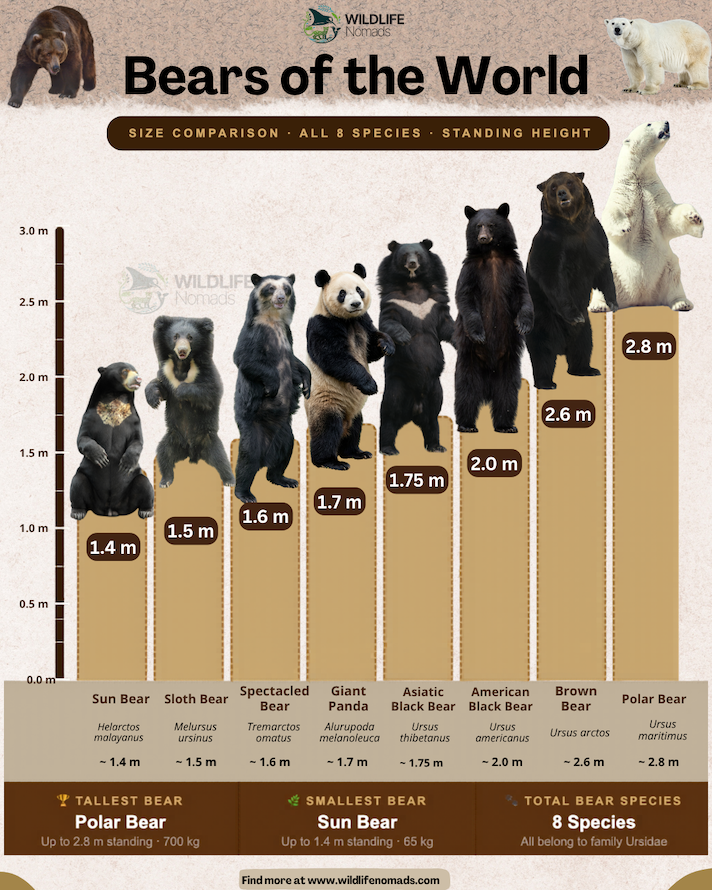
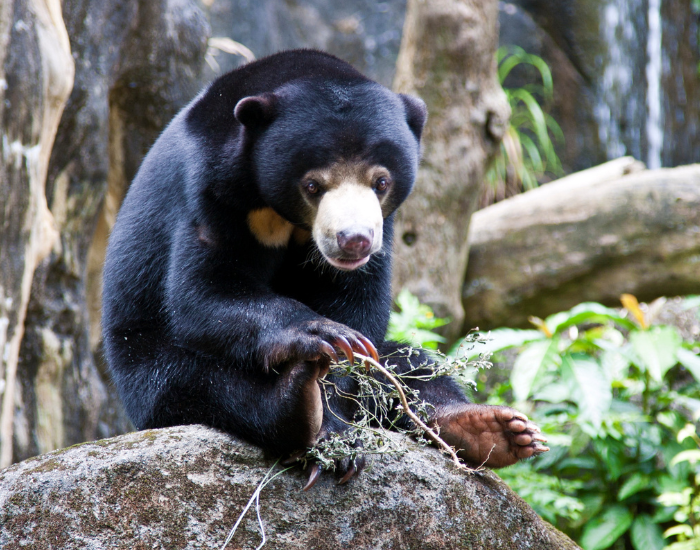
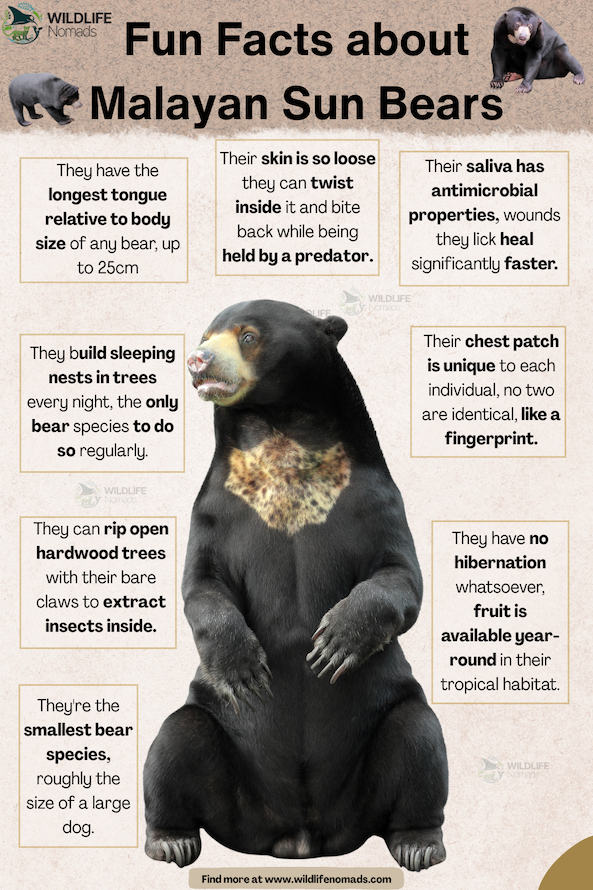
When most people think of bears, they picture massive grizzly bears or polar bears. The sun bear flips that image. Standing just 70 centimeters at the shoulder and weighing 25 to 65 kilograms, the Malayan sun bear (Helarctos malayanus) is the smallest bear species in the world. A large brown bear can weigh over 600 kilograms. That makes the smallest bear roughly the size of a large dog.
Among the eight species of bears in the bear family Ursidae, the sun bear sits at the opposite end of the size spectrum from the polar bear. Even the sloth bear and the black bear are significantly larger. This compact size isn’t a disadvantage, though. It’s an evolutionary adaptation to life in dense tropical forests, where being small means you can climb higher and navigate the canopy with ease.
2. That Golden Chest Patch Gave Them Their Name
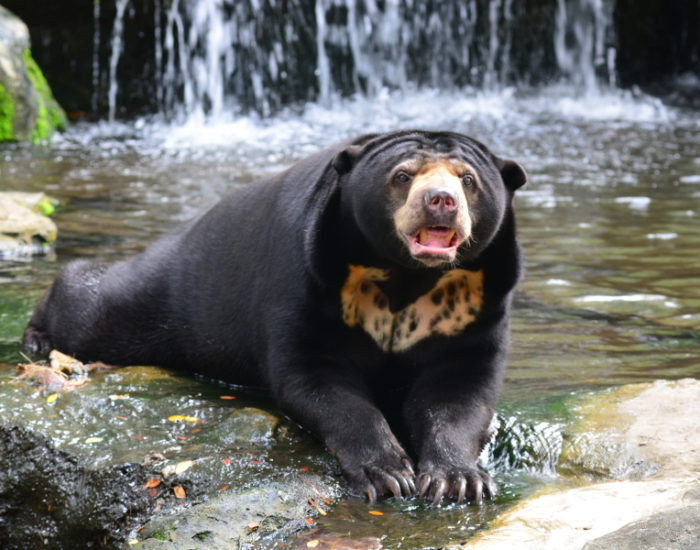
Every sun bear sports a distinctive golden crescent on its chest. This chest patch ranges from pale cream to bright orange, and no two bears share the same pattern, like a fingerprint. The marking sits high on the chest, contrasting sharply against the bear’s dark brown or jet-black fur.
So why the name “sun bear”? Legend across Southeast Asia holds that the chest patch represents the rising sun, or, depending on who you ask, the setting sun. In the Malay language, the bear is called “beruang madu,” which translates to “honey bear”, a nod to its obsession with raiding bee nests. Others call it the Malay bear or even the dog bear, thanks to its compact frame and rounded ears. The scientific name Helarctos malayanus loosely translates to “sun bear of Malaya,” connecting this species directly to Peninsular Malaysia and the broader region where it roams.
3. They Have the Longest Tongue in the Entire Bear Family
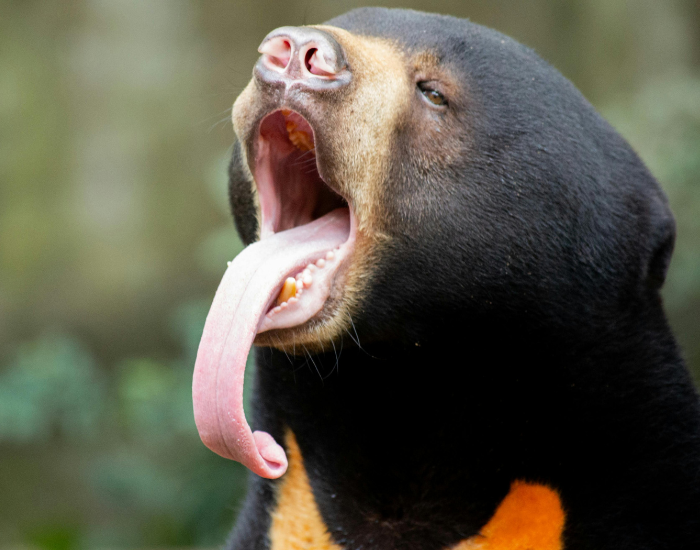
The sun bear has a tongue that can extend 20 to 25 centimeters. That’s the longest tongue of any bear species, and it exists for one reason: food extraction. Sun bears use this remarkably long tongue to probe deep into bee nests, termite mounds, and narrow crevices in tree bark where insects hide.
Paired with an incredible sense of smell, roughly 2,100 times more powerful than a human’s, the sun bear can detect a beehive from considerable distance. Once it locates the target, it rips the hive apart with its front paws and extremely long claws, then deploys that tongue to lap up every drop of honey inside. This is exactly why the Malayan sun bear earned the nickname “honey bear.”
4. Sun Bears Walk Like Little Pirates
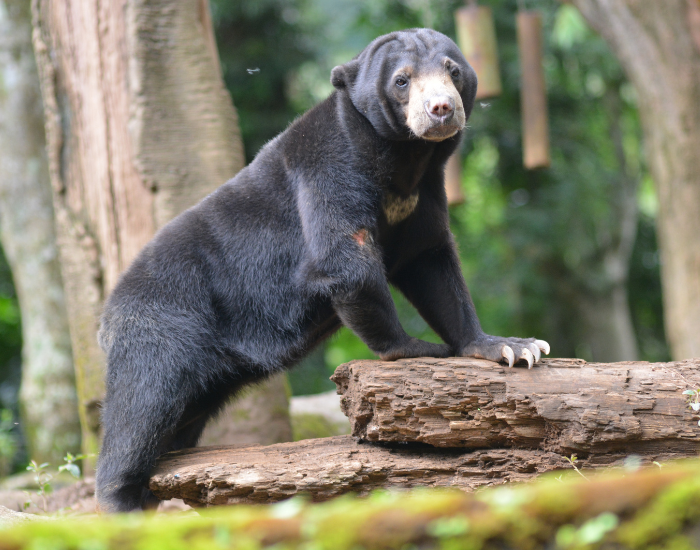
Watch a sun bear walk and you’ll notice something immediately strange. They have a distinctive pigeon-toed walk, with their front paws turned sharply inward. It looks almost comical, like a small, furry pirate swaggering across the forest floor. But this gait isn’t accidental. It’s a structural adaptation tied to their arboreal lifestyle.
Sun bears have large paws with extremely long claws that curve inward, designed for gripping bark, not walking on flat ground. They use their powerful hind legs to push upward against trunks, making them remarkably fast climbers. On the ground, though, that same anatomy produces the unmistakable waddle.
5. They’re the Most Tree-Loving Bears Alive
No other bear species spends as much time above ground. Their arboreal lifestyle is extreme, wild sun bears spend significant portions of their day in the canopy, resting in nests they build by folding tree branches into platforms. These bears sit high in the trees, sometimes 20 meters up, where they sleep, sunbathe, and find food.
This habit helps sun bears avoid predators like tigers and access bee nests that other species can’t reach. In the dense lowland forests of Southeast Asia, exploiting the vertical dimension is a massive advantage. Their sharp claws grip bark like grappling hooks, and their lightweight frame means branches that would snap under a black bear hold them easily.
6. Sun Bears Never Hibernate
Unlike the polar bear, the brown bear, or the black bear — all of which enter some form of winter dormancy — sun bears never hibernate. Not even close. They remain active year round, and the reason is simple: they live in tropical weather zones where food is available every single month.
In Southeast Asia, there’s no harsh winter forcing bears to conserve energy. Fruit ripens on different cycles. Termite mounds and bee nests stay active. As a result, sun bears are primarily nocturnal, foraging after dark when temperatures drop slightly. Researchers have documented daytime activity as well, particularly in areas with less human disturbance.
7. Their Loose Skin Is a Secret Defense Weapon
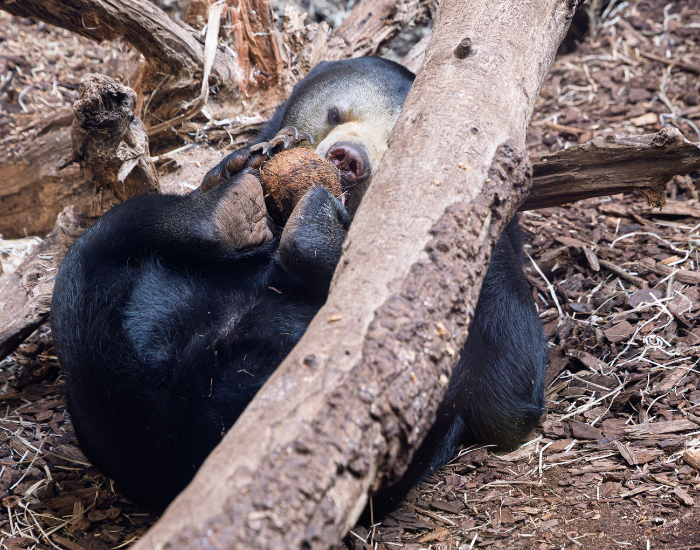
Sun bears have an unusual amount of loose skin around the neck and shoulders. That wrinkly, baggy appearance confused millions of internet viewers, but it’s actually a survival adaptation.
If a predator grabs a sun bear by the back of the neck, the bear can twist inside its own loose skin to turn around and bite back. The excess skin provides enough slack that the bear isn’t pinned, it can rotate, claw, and fight. For a small sun bear facing predators many times its size, that loose skin can mean the difference between escape and death. It also helps provide protection during fights with other sun bears over territory.

8. The Internet Was Convinced They Were Humans in Costumes
In 2023, a sun bear named Angela at the Hangzhou Zoo in southern China broke the internet. A video showed her standing upright on her hind legs, waving at visitors. The internet decided she was a human in a bear suit. The zoo had to issue a formal statement confirming Angela was a real Malayan sun bear.
The confusion makes sense when you understand sun bear anatomy. When they stand on their hind legs — which they do regularly — they look eerily human. Some people call them the “dog bear” because their compact frame, short snout, and rounded ears resemble a dog more than a typical bear. But Angela’s viral moment did something important: it introduced millions of people to a bear species most had never heard of.
9. Sun Bear Cubs Are Tiny and Completely Dependent on Mom
Sun bear cubs are among the most helpless newborns in the bear family. Born blind, hairless, and weighing around 300 grams — roughly the weight of an apple — these cubs are completely dependent on their mothers for survival. Mother bears nurse, carry, and fiercely defend their cubs for approximately two years before the young bears strike out on their own.
Malayan sun bears don’t have a fixed breeding season. They breed year round in their consistent tropical climate. Females carry their cubs for roughly 95 to 100 days before giving birth to one or two sun bear cubs. During the early weeks, the mother barely leaves the den, often a hollow log or a cavity inside a large tree. She cradles her cubs against her chest. By 18 months, the cubs are weaned but may stay close to their mother for several more months.
10. Where Do Sun Bears Actually Live?
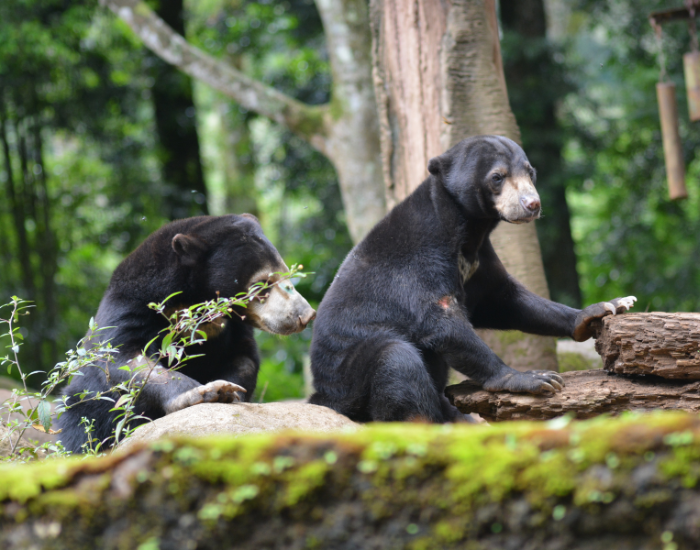
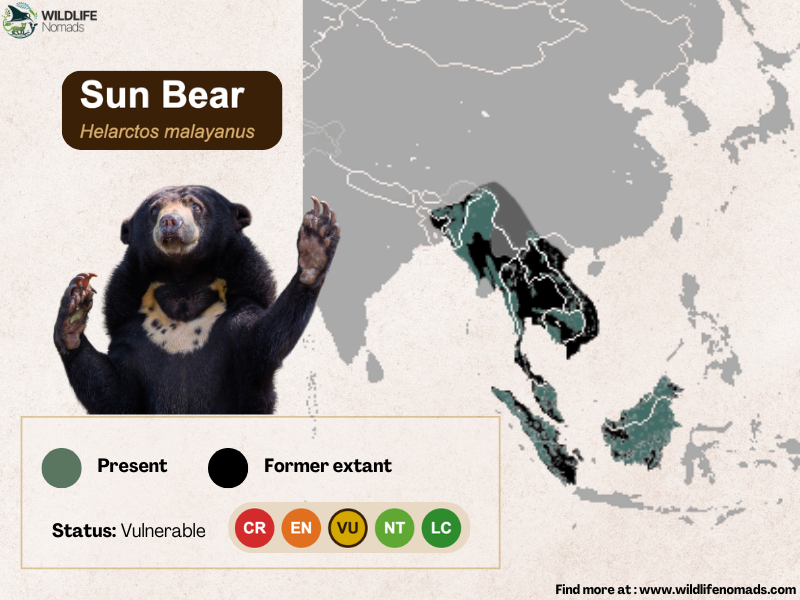
The Malayan sun bear ranges across Southeast Asia, from northeastern India through Myanmar, Thailand, Cambodia, Vietnam, and into southern China. Their range extends south through Peninsular Malaysia and onto Borneo and Sumatra. The Bornean sun bear (Helarctos malayanus euryspilus) is a recognized subspecies found exclusively on Borneo.
These bears thrive in dense lowland forests, particularly tropical broadleaf rainforests. They favor primary forest but show adaptability, a 2021 study found that Bornean sun bears used previously logged forest more than primary forest in Sabah, Malaysia. That said, oil palm plantations are devastating their habitat. As palm trees replace ancient rainforest, sun bears lose access to the fruiting trees, hollow logs, and open trees they depend on.
11. What Sun Bears Eat Might Genuinely Surprise You
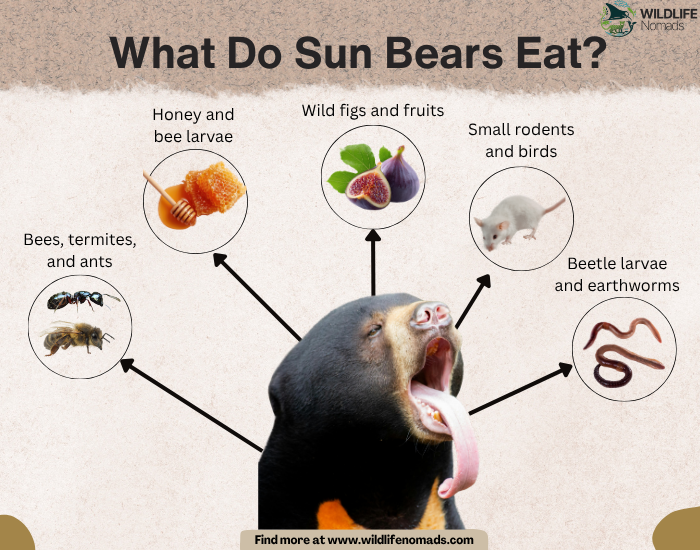
Sun bears eat just about anything the forest offers. They’re true omnivores with a menu that shifts based on what’s available. Honey and insects form the backbone of their diet, sun bears raid honeybee nests and tear open termite mounds with their extremely long claws, using that extraordinary tongue to extract every morsel. They dig through soil and leaf litter for earthworms and beetle larvae. They peel bark from trees to find insects hiding underneath.
But the diet goes beyond bugs and honey. Sun bears eat fruit from dozens of tree species, playing a critical role in seed dispersal across the forest. They eat tree roots and soft plant material. They catch small birds and raid bird eggs. This dietary flexibility helps sun bears survive in forests where no single food source is reliable year round. It also makes them important ecosystem engineers across large areas of Malaysian wildlife habitat.
12. Sun Bears Are Disappearing Faster Than Most People Realize
The conservation status of the sun bear is grim. The International Union for Conservation of Nature (IUCN) lists the species as Vulnerable, with sun bear populations declining by an estimated 30 percent over the last three bear generations. Habitat loss from logging and oil palm agriculture is the primary driver, leaving wild sun bears in increasingly fragmented patches across Southeast Asia.
Commercial hunting compounds the problem. Sun bears are killed for their gall bladders, used in traditional medicine across East Asia. Demand for traditional medicine ingredients shows no sign of slowing. The illegal pet trade takes a devastating toll, poachers kill mother bears to capture cubs, which are sold as exotic pets. Sun bears endangered by these combined pressures face a future that demands urgent action.
The Bornean Sun Bear Conservation Centre in Sabah runs an international captive breeding program and rehabilitates rescued bears for release. However, as long as global palm oil demand drives deforestation and wildlife trafficking laws remain weakly enforced, endangered animals like the sun bear will keep losing ground.
Frequently Asked Questions
Sun bears are generally shy and avoid humans. They can become aggressive if cornered or protecting their cubs, and their sharp claws can inflict serious injuries. Attacks on humans are rare but documented in areas where habitat loss pushes bears closer to villages.
The name comes from the sun bear’s intense love of honey. They use their extremely long claws and 25-centimeter tongue to tear open hives and extract every drop. In the Malay language, their name “beruang madu” literally translates to “honey bear.”
In the wild, sun bears typically live 20 to 25 years. In captivity with proper care, they can reach 30 years or more. The oldest recorded captive Malayan sun bear lived to approximately 34 years.
No — and the pet trade is one of the biggest threats to this species. Sun bear cubs are illegally captured after poachers kill their mothers. Captive sun bears suffer enormously, requiring vast territory and specialized diets no domestic setting can provide. Keeping a sun bear is illegal in most countries within their range.
Black bears are significantly larger — up to 300 kilograms versus the sun bear’s 65. Sun bears live exclusively in Southeast Asia, while black bears occupy North America and parts of Asia. Sun bears are far more arboreal, spending extensive time climbing trees, and they never hibernate.
Protecting the Honey Bear
The sun bear is proof that the natural world still has the power to genuinely surprise us. A bear the size of a large dog, with a tongue longer than your forearm, a pirate walk, and skin so loose it can twist out of a predator’s jaws — no fiction writer would dare invent something this strange. Yet here they are, quietly vanishing from the forests of Southeast Asia while most of the world doesn’t know they exist.
If this article made you rethink what a bear can be, dig deeper. Check out my breakdown of all eight species of bears, or read about the polar bear and the Andean bear. Drop a comment below and tell me which sun bear fact surprised you most. And if you’re ever in Borneo, the Bornean Sun Bear Conservation Centre is worth the trip.
Where to See Sun Bears in the Wild?
Here is a list of 3 tours where you can spot them in the wild in Sandakan, Malaysian Borneo. As a biologist, I only recommend tours that follow strict ethical guidelines to ensure we don’t disturb wildlife. These are the three tours/ partners I trust most based on their conservation records:
This website is reader-supported. When you buy experiences through links listed on this site, we may earn an affiliate commission.
References:
Brunton, E. A., Burnett, S. E., & Kemp, J. (2025). A window into the forest: post-release behaviour of rehabilitated Bornean sun bears Helarctos malayanus euryspilus in Sabah, Malaysia. Wildlife Biology, e01264. https://doi.org/10.1002/wlb3.01264
Hwang, M. H., Garshelis, D. L., Wu, Y. H., & Wang, Y. (2021). Sun bears use 14-year-old previously logged forest more than primary forest in Sabah, Malaysia. Ecosphere, 12(10), e03769. https://doi.org/10.1002/ecs2.3769
Kunde, M. N., Barlow, A., Klittich, A. M., Yakupova, A., Patel, R. P., Fickel, J., & Förster, D. W. (2023). First mitogenome phylogeny of the sun bear Helarctos malayanus reveals a deep split between Indochinese and Sundaic lineages. Ecology and evolution, 13(4), e9969. https://doi.org/10.1002/ece3.9969
Scotson, L., Fredriksson, G., Augeri, D., Cheah, C., Ngoprasert, D. & Wai-Ming, W. (2017) Helarctos malayanus (errata version published in 2018). The IUCN Red List of Threatened Species 2017: e.T9760A123798233. https://dx.doi.org/10.2305/IUCN.UK.2017-3.RLTS.T9760A45033547.en.
Tee, T. L., van Manen, F. T., Kretzschmar, P., Sharp, S. P., Wong, S. T., Gadas, S., & Ratnayeke, S. (2021). Anthropogenic edge effects in habitat selection by sun bears in a protected area. Wildlife Biology, 2021(2), wlb.00776. https://doi.org/10.2981/wlb.00776
Wong, S. T., Servheen, C., & Ambu, L. (2004). Home range, movement and activity patterns, and bedding sites of Malayan sun bears Helarctos malayanus in the rainforest of Borneo. Biological Conservation, 119(2), 169–181. https://doi.org/10.1016/j.biocon.2003.10.029