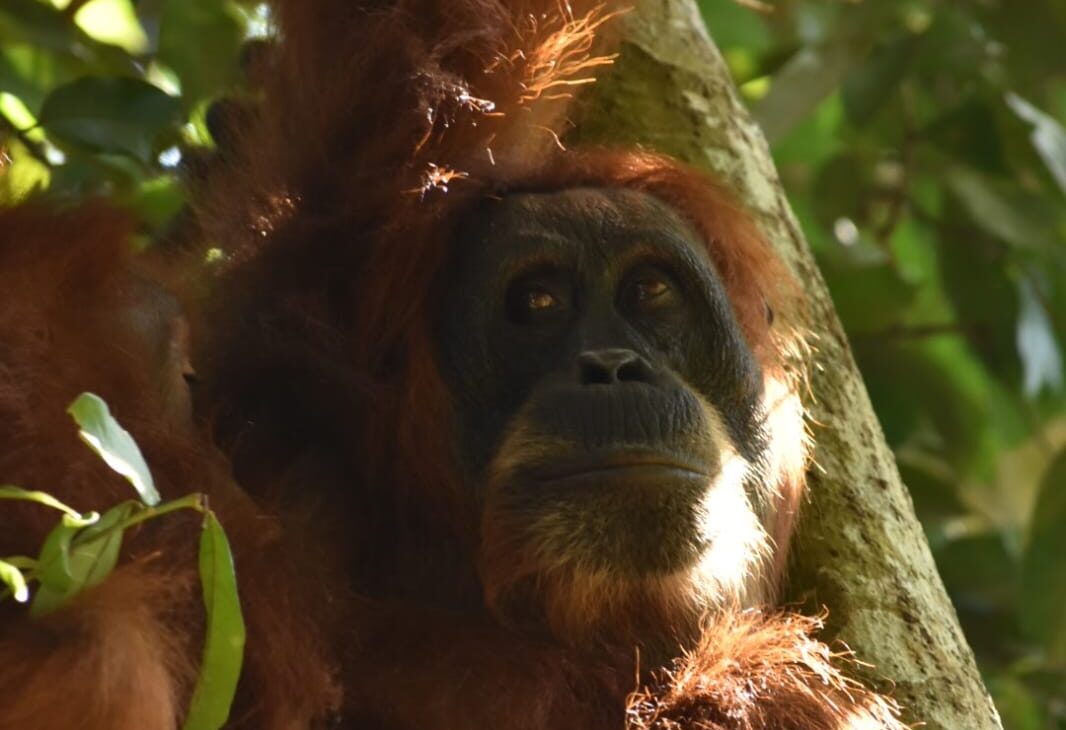
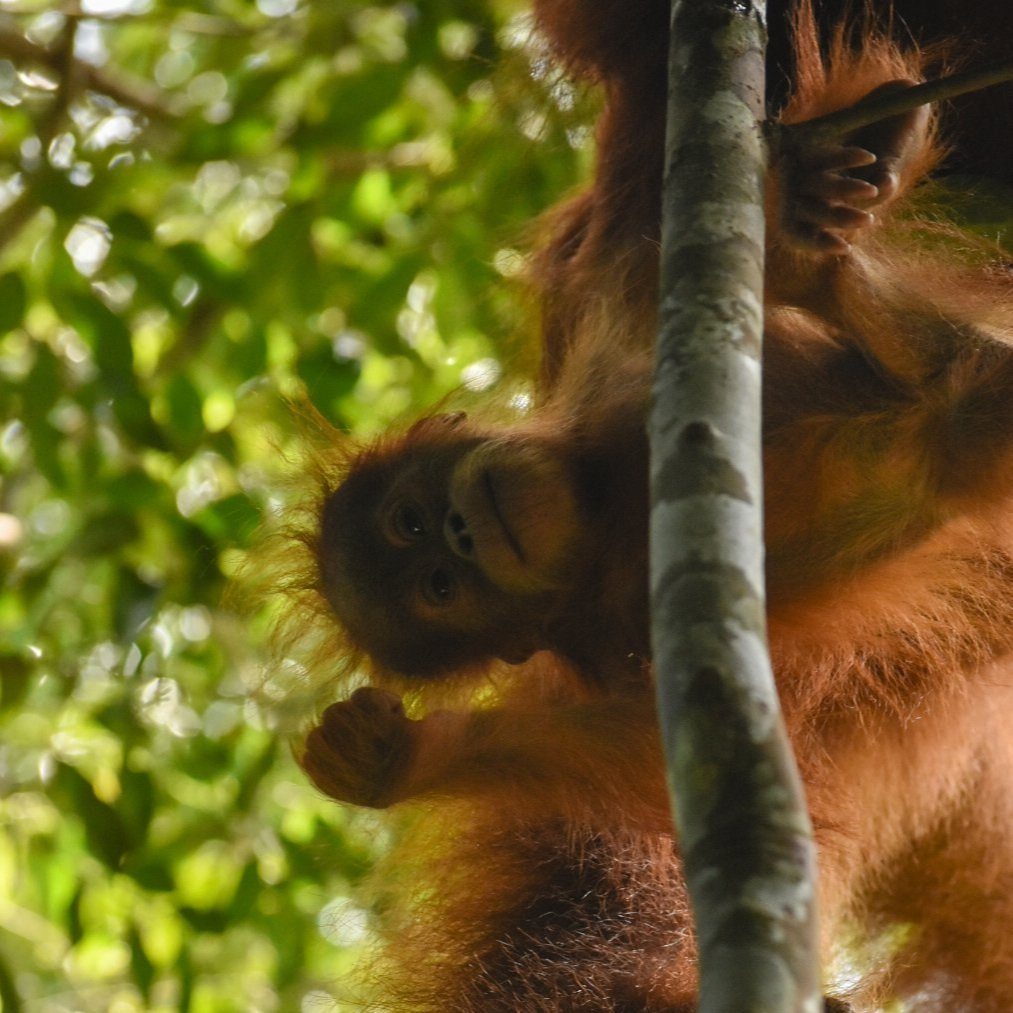
In the jungle above Bukit Lawang, a mother orangutan and her baby once looked straight at me. I had trekked for two days through Gunung Leuser National Park in North Sumatra for that moment.
Those few seconds left me with more questions than answers. How many orangutans are left? Why do some males grow enormous cheek pads? And why does that baby need eight years with its mother?
As a field biologist, I went looking for answers in the science. These 12 facts about orangutan apes cover their species, record-long childhoods, voices, minds and the threats they face.
For the trek itself, read my guide to seeing orangutans in Bukit Lawang. This post focuses on the animal.
How well do you know the person of the forest? Ten questions test what you learned about orangutans. Read on, then take the quiz at the end and see if you’re a Canopy King or a Branch Newbie. Jump to the quiz ↓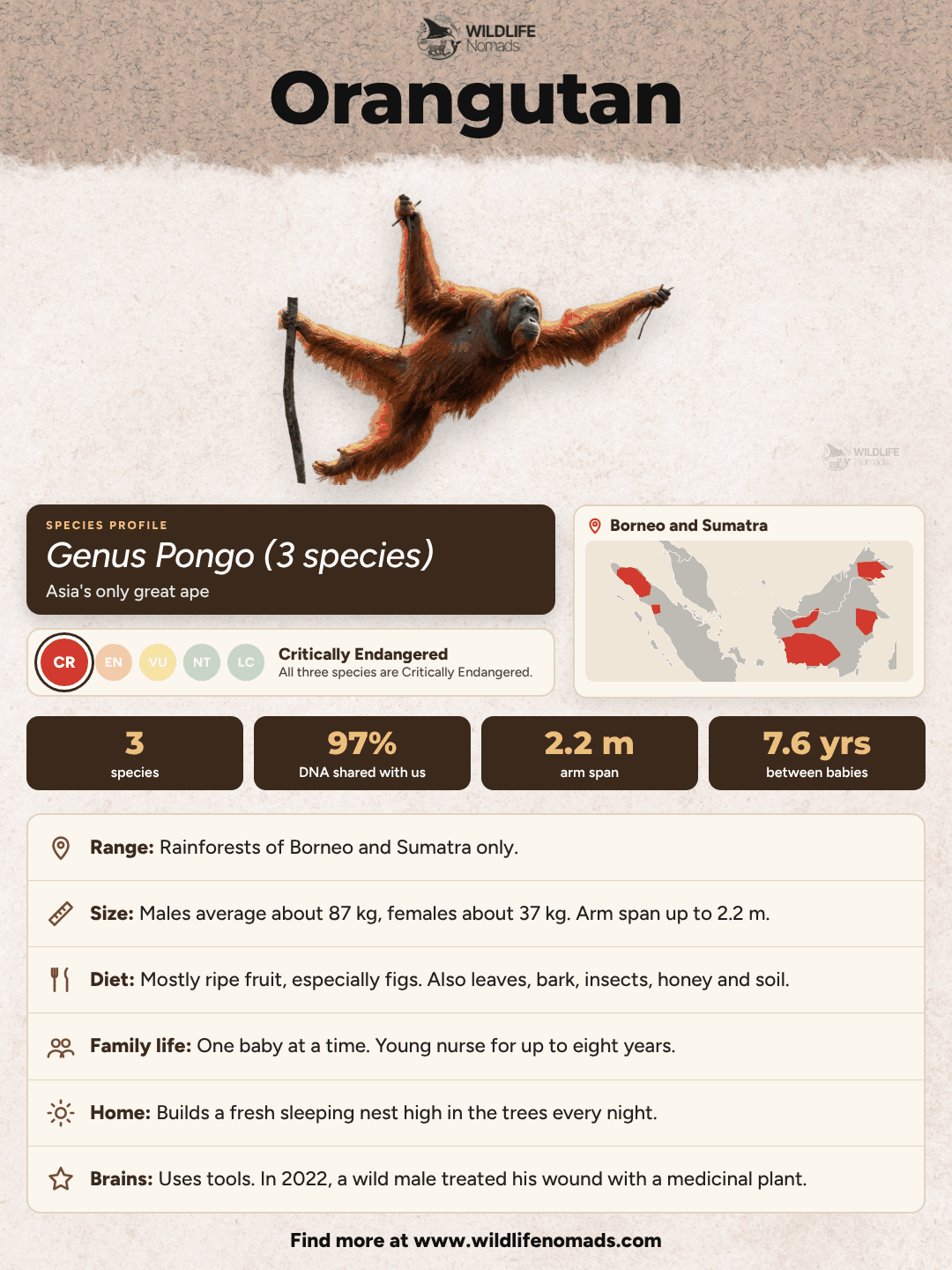
1. Orangutan Apes Are Asia’s Only Great Apes
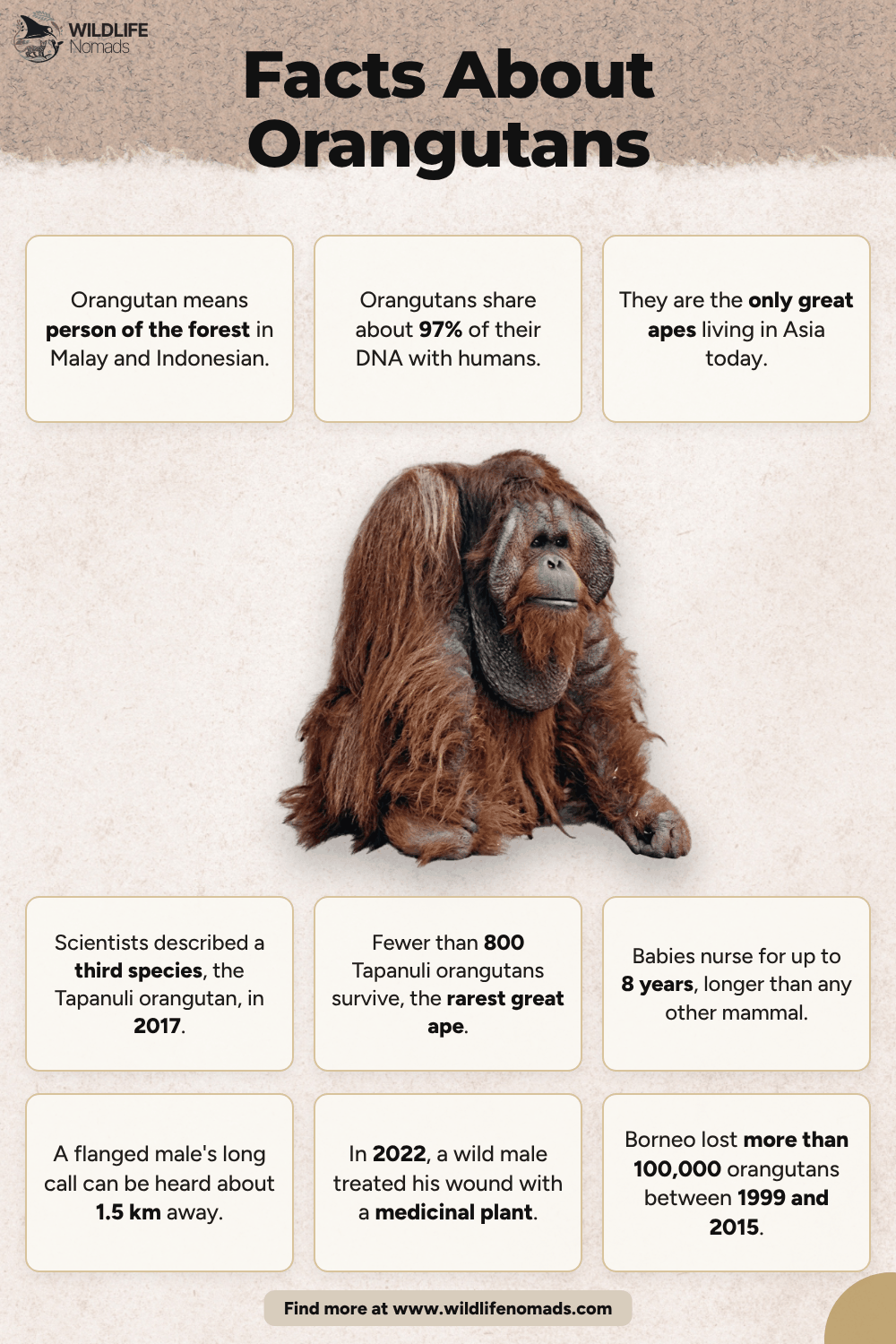
Orang utan means “person of the forest” in Malay and Indonesian. The name suits an animal that shares roughly 97% of its DNA with humans.
Scientists place orangutans in the class Mammalia, order Primates and family Hominidae, inside the genus Pongo. That family also includes gorillas, chimpanzees, bonobos and humans. Compare them all in my guide to types of primates.
Gorillas, chimpanzees and bonobos are all African apes. By contrast, orangutans are the only great apes in Asia today. Gibbons live there too, but they are “small apes” in a separate family.
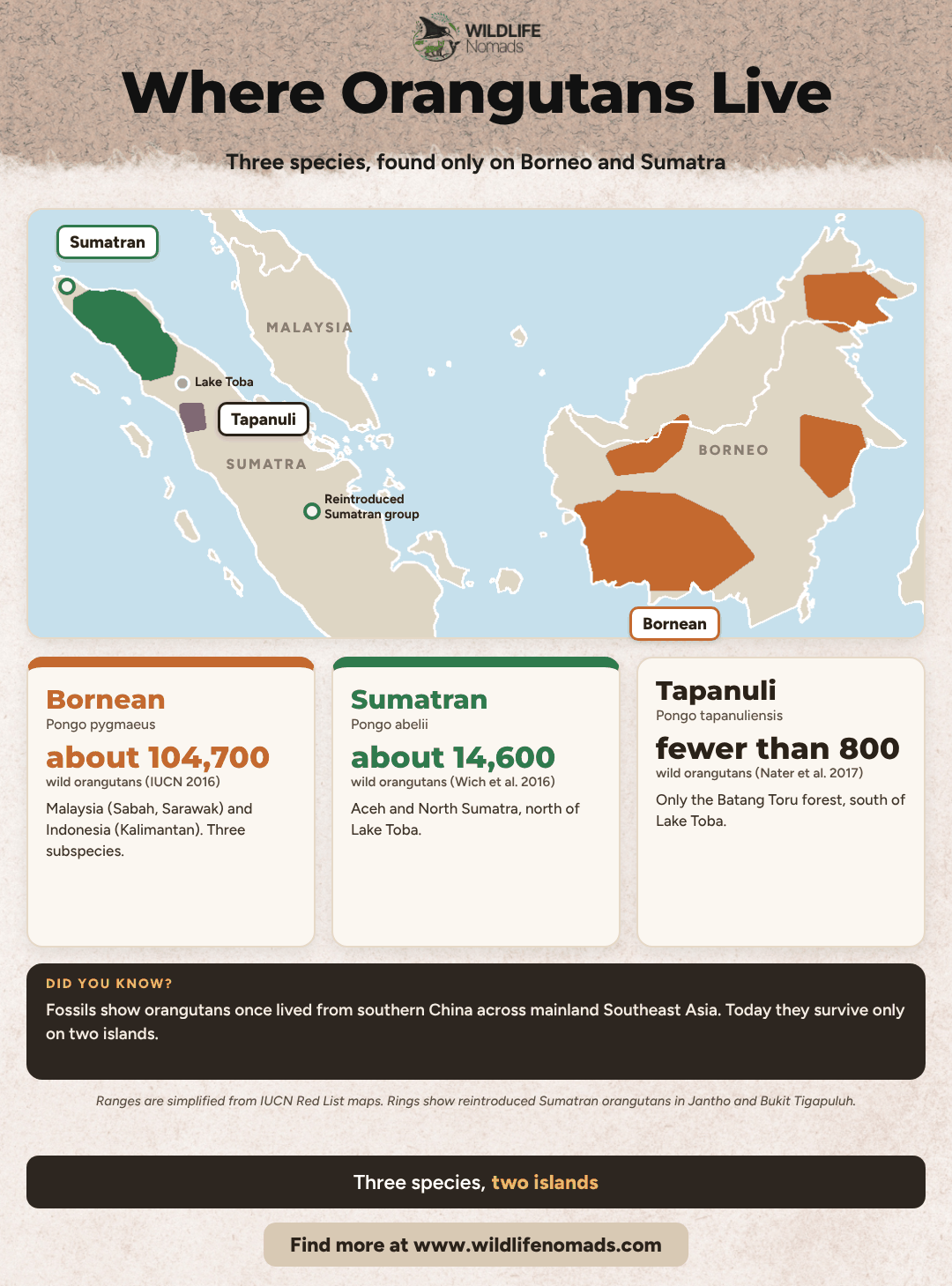
Fossils show orangutans once ranged from southern China across mainland Southeast Asia. Today, they survive only in the rainforests of Borneo and Sumatra.
2. There Are Three Orangutan Species
For decades, textbooks listed two orangutan species. Then, in 2017, scientists described the Tapanuli orangutan, Pongo tapanuliensis, using skull, behaviour and genome evidence.
Today, the three species are the Bornean (Pongo pygmaeus), Sumatran (Pongo abelii) and Tapanuli orangutans. The Bornean species splits into three subspecies. P. p. pygmaeus lives in the northwest, P. p. morio in the northeast, and P. p. wurmbii in the southwest.
On Sumatra, Lake Toba helps divide the island’s two species. Sumatran orangutans live to the north of this giant volcanic lake. Tapanuli orangutans live south of it, in the Batang Toru forest.
Here’s the twist. The Tapanuli orangutan is more closely related to Bornean orangutans than to its Sumatran neighbours. Meanwhile, Bornean orangutans live in Sabah and Sarawak in Malaysia, and in Indonesian Kalimantan.
3. You Can Tell Each Species by Its Hair
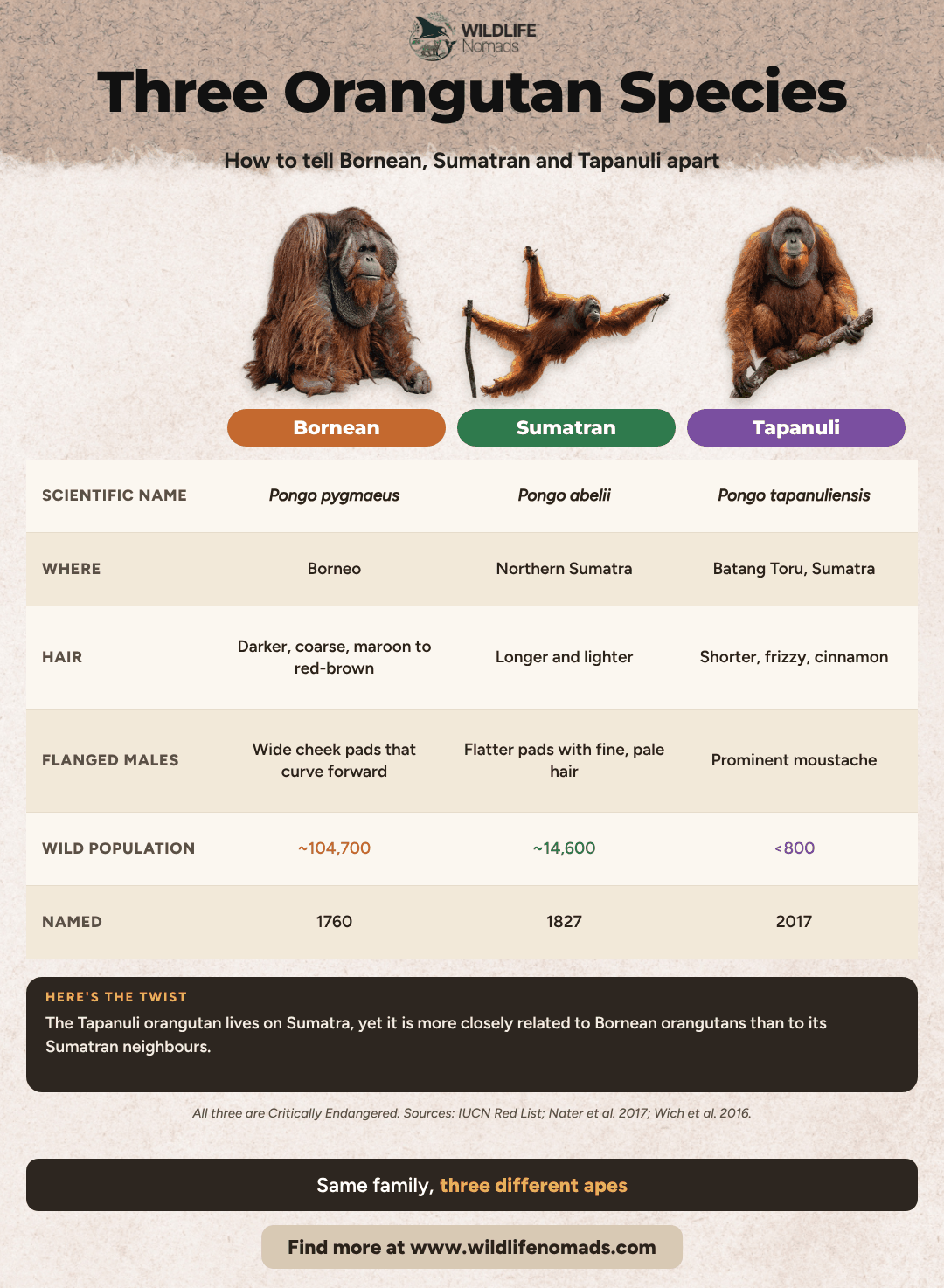
Sumatran orangutans have longer, lighter hair than Bornean orangutans. Bornean orangutans tend to look darker, with coarse maroon to deep red-brown coats.
Tapanuli orangutans stand out with shorter, frizzier, cinnamon-coloured hair. Their males grow a prominent moustache, and adult females often have a beard.
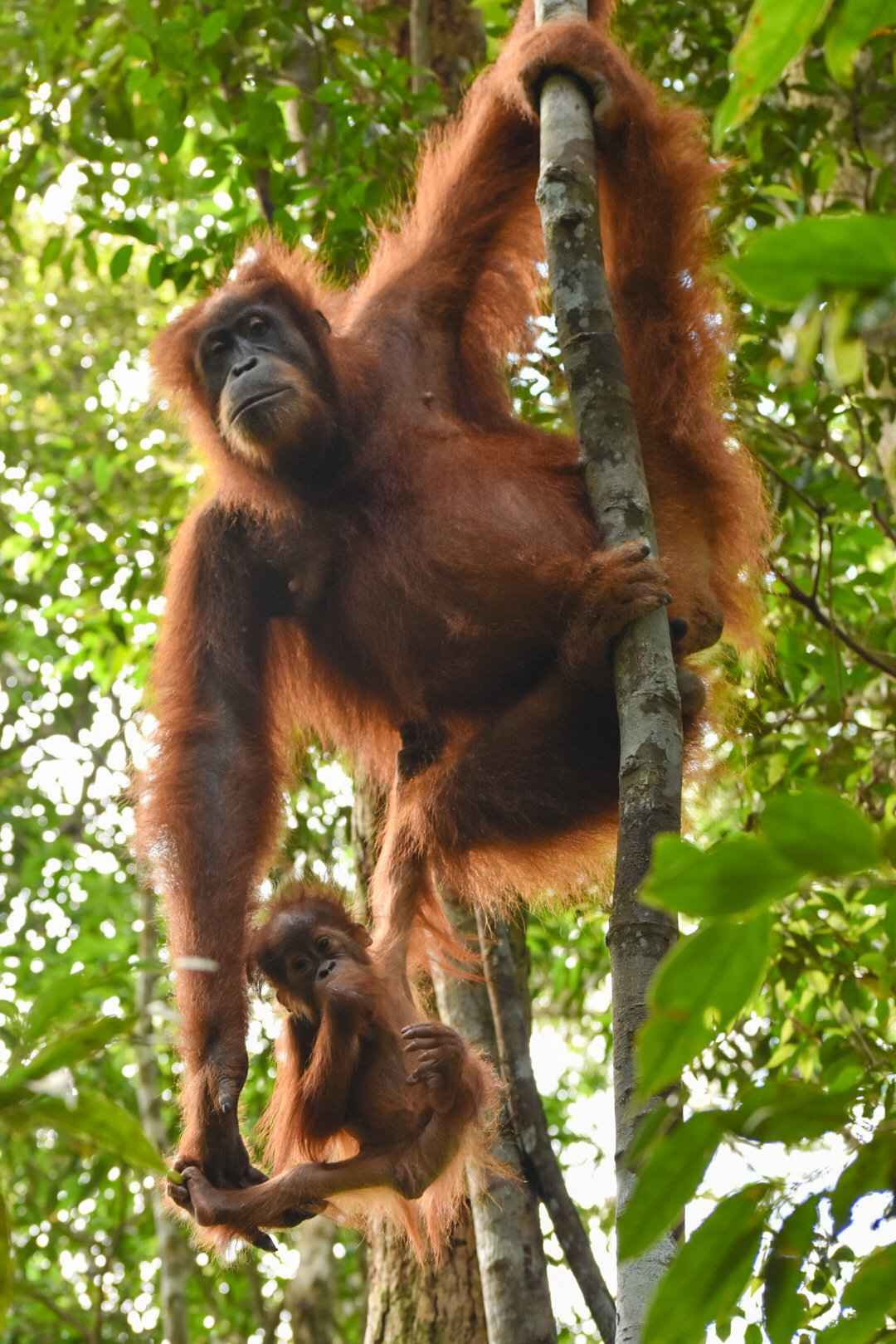
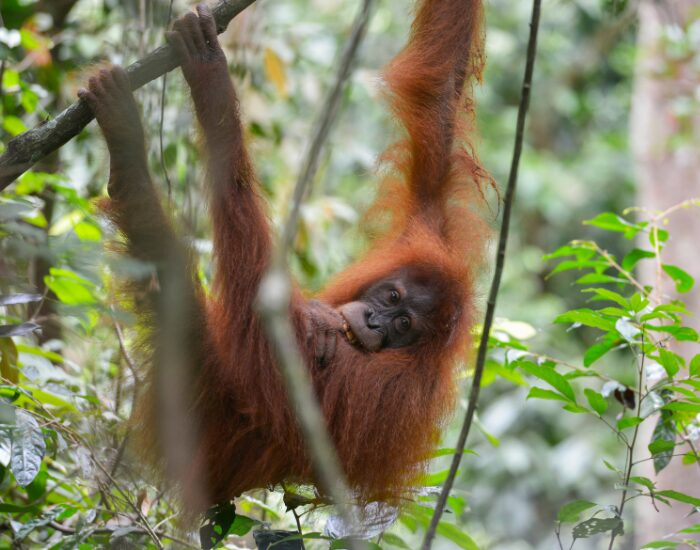
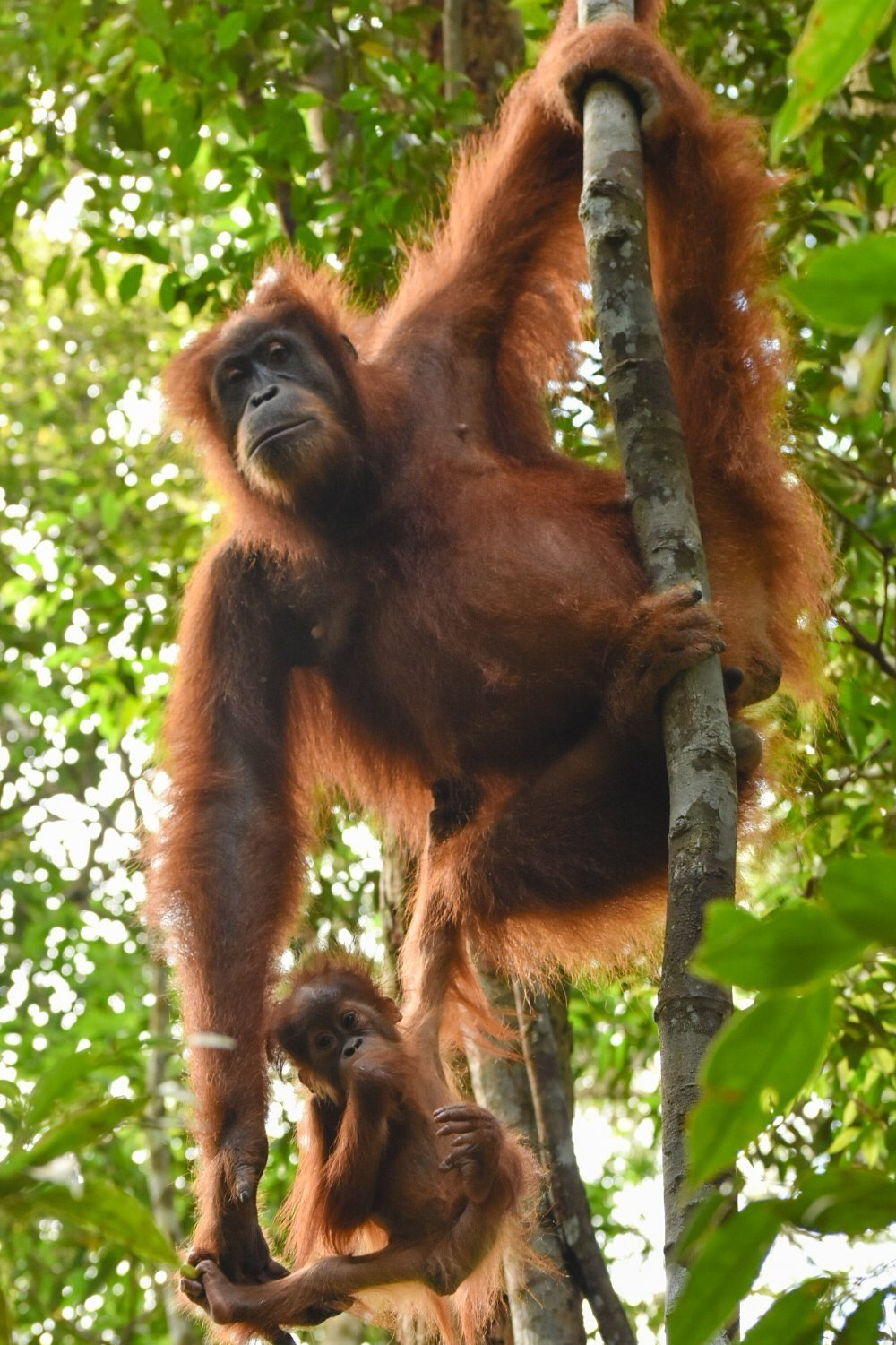
Faces differ too. Bornean males grow wide cheek pads that curve forward. Sumatran males have flatter pads covered in fine, pale hair. You can see that long Sumatran coat in the photo below, which I took on my trek.
4. Orangutans Are the Largest Tree-Dwelling Mammals
No mammal heavier than an orangutan lives mainly in the trees. Wild orangutans spend almost their entire lives in the canopy. Bornean males come down to the ground more often than Sumatran ones, which share their forest with tigers.
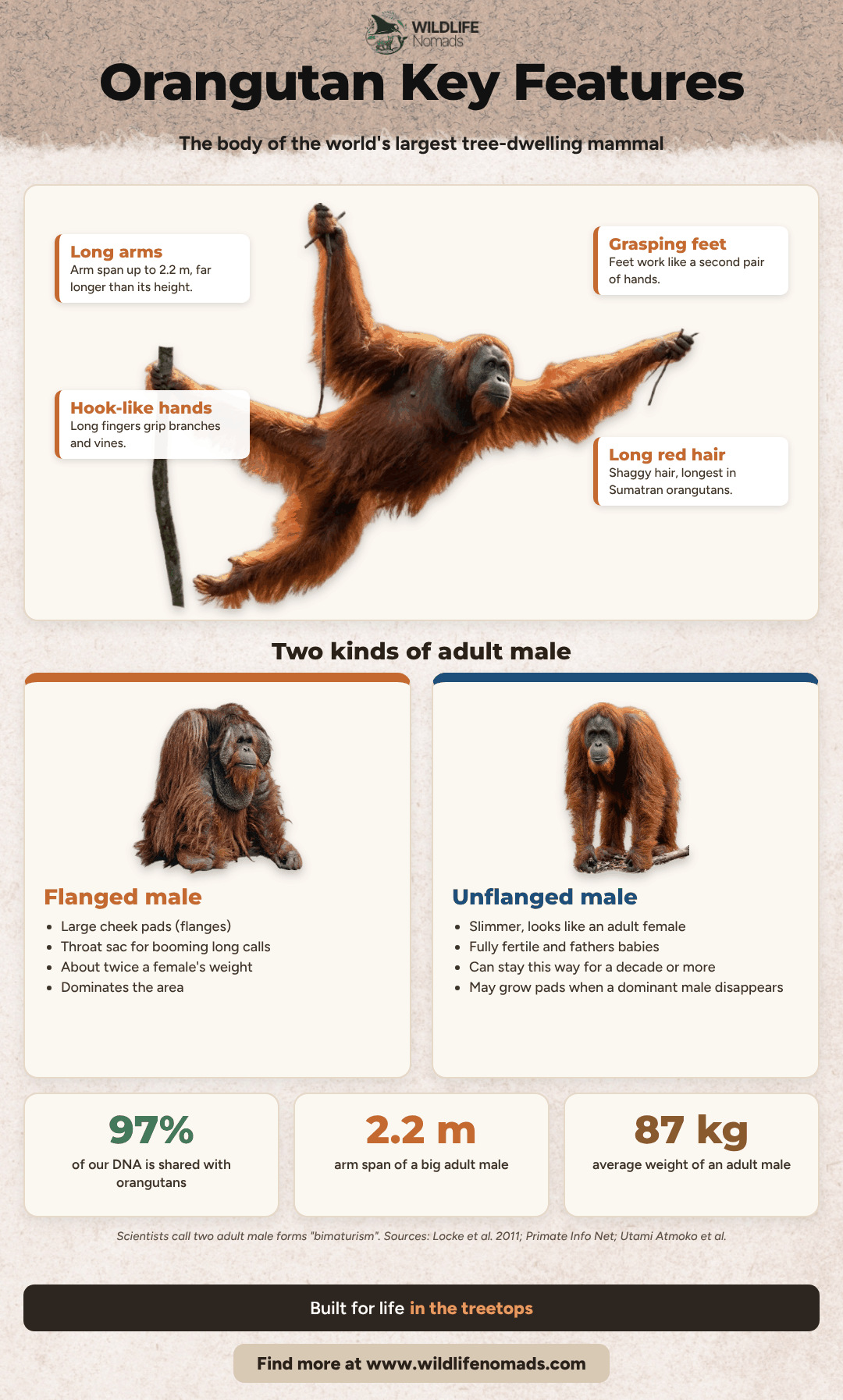
Their bodies suit this life. An adult male’s arm span can reach about 2.2 metres (7 feet), far beyond his standing height. In addition, long fingers and curved toes work like hooks on branches and vines.
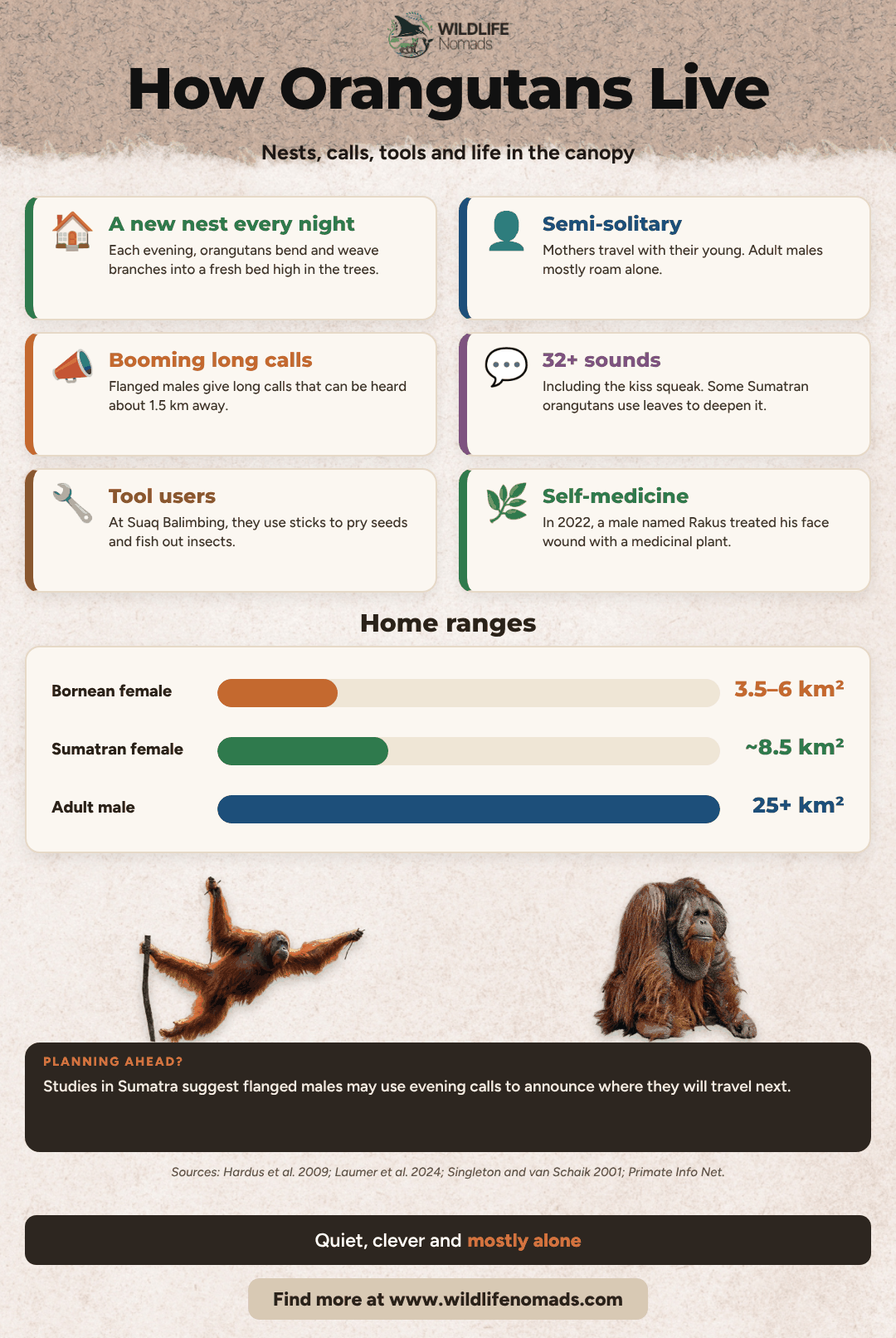
Every evening, each orangutan bends and weaves branches into a fresh sleeping nest. Young orangutans learn this skill by watching their mothers for years.
On my trek, I spent most of the time with my neck craned back. Our guide read movement in the canopy long before I spotted a red shape between the tree trunks.
5. Fruit Fills Most of an Orangutan’s Day
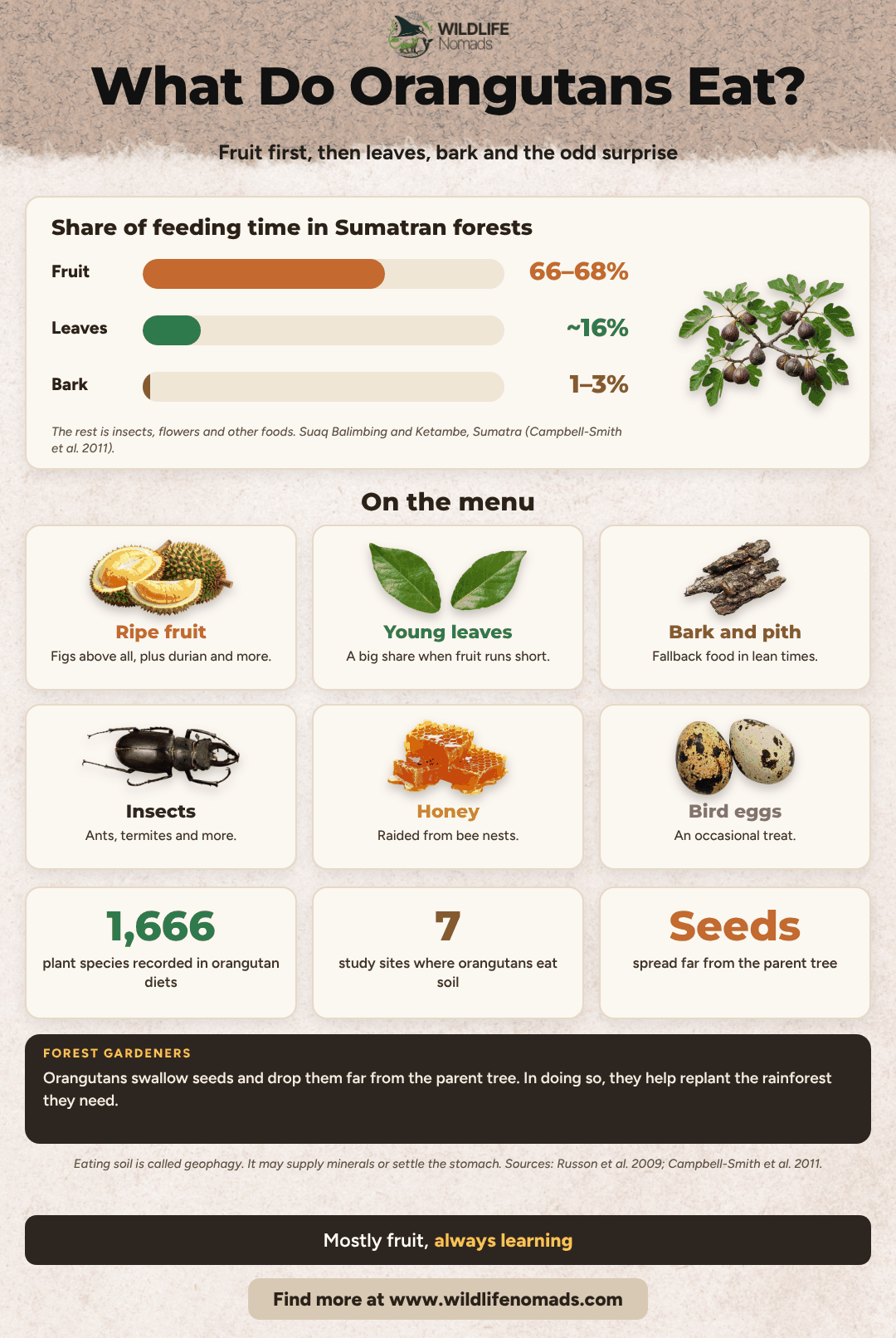
Fruit takes up 57–80% of orangutans’ feeding time, depending on the forest and season. They favour ripe, fleshy fruit, especially figs, and eat from hundreds of plant species.
Leaves account for about a quarter of their foraging time. When fruit runs short, they switch to bark, pith, honey, insects and other vegetation. Some will even raid bird eggs.
Orangutans also practise geophagy, which means eating soil. Researchers think it may supply minerals or neutralise toxins in some food items.
Their appetite matters for the whole forest. Orangutans swallow seeds and drop them far from the parent tree, so they help replant the rainforests they depend on.
6. Adult Males Come in Two Forms
Male orangutans show a rare trait called bimaturism. Some adult males grow large cheek pads, a throat sac and long hair. Others stay slimmer and look much like adult females.
Flanged males are the big, dominant ones, and they often weigh about twice as much as females. However, unflanged males are fully fertile and father offspring too. Males reach sexual maturity at around age 15.
Some unflanged male orangutans stay that way for a decade or more, often while a flanged male dominates the area. When that dominant male disappears, a nearby unflanged male may start growing his own cheek pads.
In Bukit Lawang, most orangutans I saw were females with young. Flanged males appear less often on the trails, because they roam widely and alone.
7. Long Calls Travel More Than a Kilometre
Flanged males give long calls, booming sequences that start as grumbles and swell into roars. The throat sac works like a resonator, so these calls can carry more than a kilometre through the forest.
The calls do two jobs. They attract females and warn other males to keep their distance. Females often move towards a preferred male’s call, while rival males tend to avoid it.
Interestingly, studies in Sumatra suggest flanged males may use evening calls to announce where they plan to travel next. That hints at real forward planning.
8. Orangutans Talk With Squeaks, Gestures and Faces
Researchers have catalogued at least 32 different orangutan vocalisations. The best known is the kiss squeak, a sharp sucking sound they make when annoyed or uncomfortable.
Some Sumatran orangutans hold leaves to their lips during a kiss squeak, which lowers its pitch. Only some populations do this, a strong hint of local culture.
They also communicate with gestures, such as beckoning and shaking objects, plus subtle facial expressions. In a 2018 study, Sumatran mothers waited up to 20 minutes after a predator model passed before sounding an alarm. That suggests they can “talk” about past events.
9. They Have the Longest Childhood Outside Humans
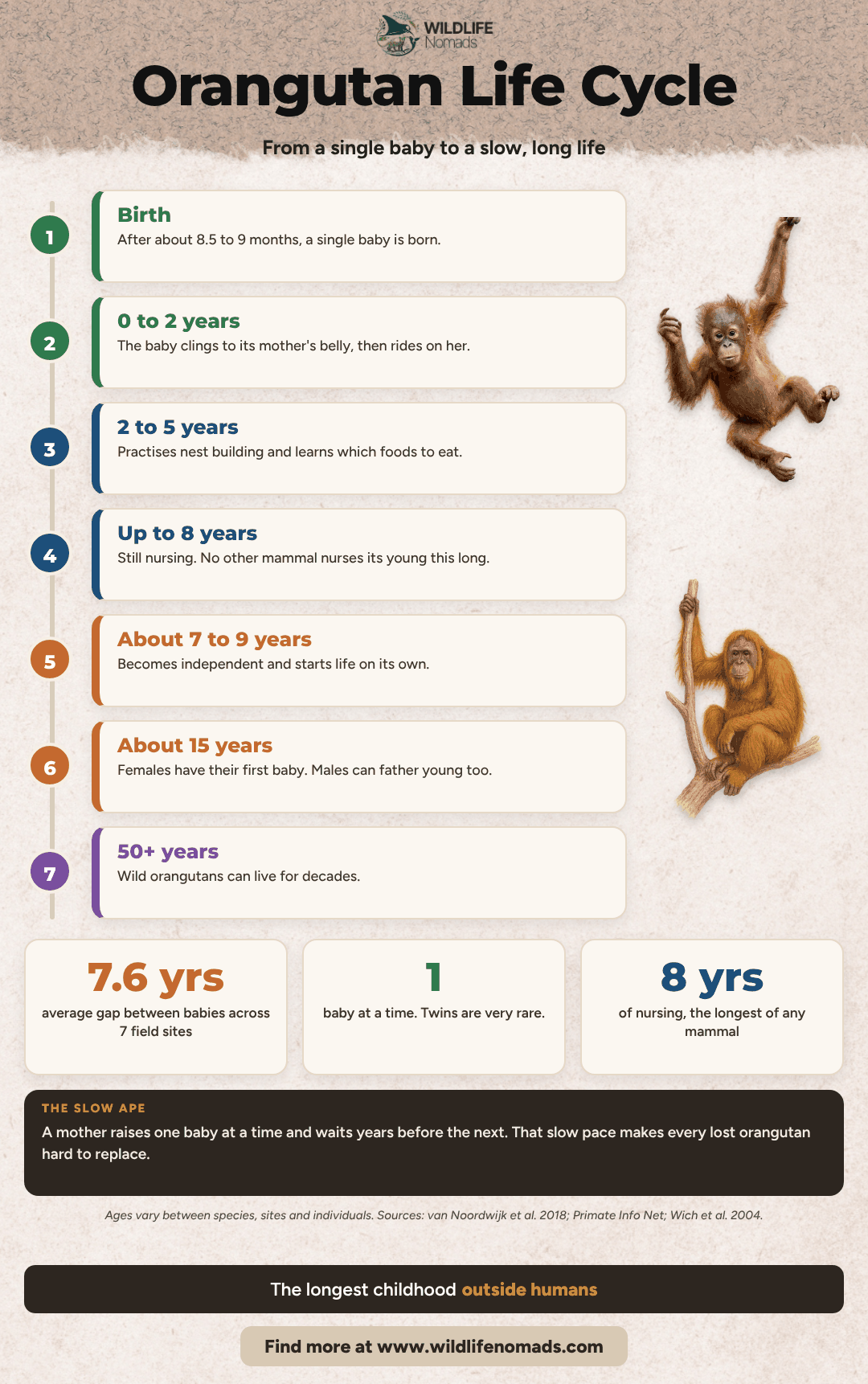
Female orangutans first give birth at around 15 years of age. After a gestation of about nine months, a single infant arrives weighing 1.5–2 kilograms.
The baby clings to its mother’s belly for months, then rides on her for years. Orangutans nurse their young for up to eight years. No other mammal outside humans depends on its mother for so long.
As a result, orangutans have a slow life history and a low reproductive rate. Gaps between births run six to nine years. Across seven field sites, the average interval was 7.6 years (van Noordwijk et al., 2018).
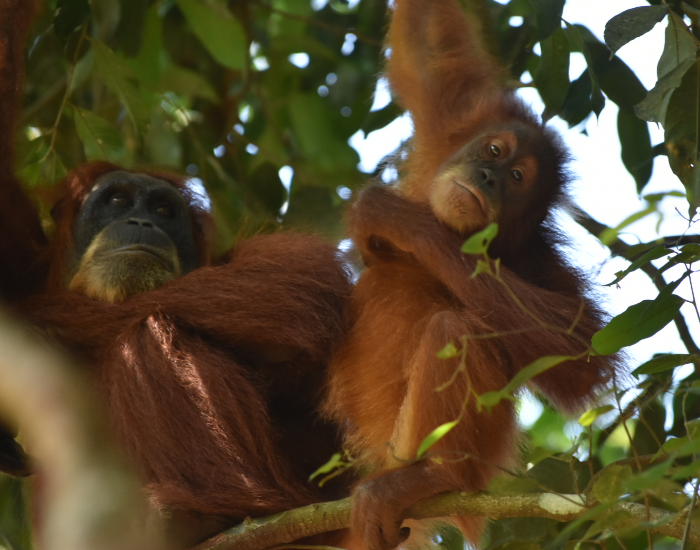
Watching that mother and baby in Bukit Lawang, I didn’t realise how long they would stay together. That infant could stay at her side for most of the next decade.
10. Orangutans Live Semi-Solitary Lives
Compared with other great apes, orangutans live largely alone. Chimpanzees and gorillas live in groups, but orangutans spread out to reach scattered fruit trees.
Adult females travel with their dependent offspring. Males usually range alone and join females mainly to mate. These pairs may form consortships that last days or even several weeks.
Bornean orangutans are generally more solitary than Sumatran orangutans. Sumatra’s richer fruit forests let other orangutans gather at big fig trees more often.
Home ranges reflect this lifestyle. Adult females keep ranges of several square kilometres, which overlap with their relatives Mmales roam far wider, often across more than 25 square kilometres.
11. Orangutans Use Tools and Even Medicine
Orangutans spend their long childhoods learning skills from their mothers. At Suaq Balimbing in Sumatra, they use sticks to pry seeds from spiky fruit and fish out insects.
In 2022, researchers at the same site watched a flanged male named Rakus treat a facial wound. He chewed leaves of the liana Fibraurea tinctoria and applied the juice to the wound. It was the first recorded case of a wild animal treating a wound with a medicinal plant.
Suaq Balimbing lies inside Gunung Leuser National Park, the same park where I trekked. It makes me wonder what behaviours we walked past without noticing.
In zoos, orangutans recognise themselves in mirrors and solve multi-step puzzles. Ken Allen, a Bornean orangutan at San Diego Zoo, famously escaped his enclosure several times in the 1980s.
12. All Three Orangutan Species Are Critically Endangered
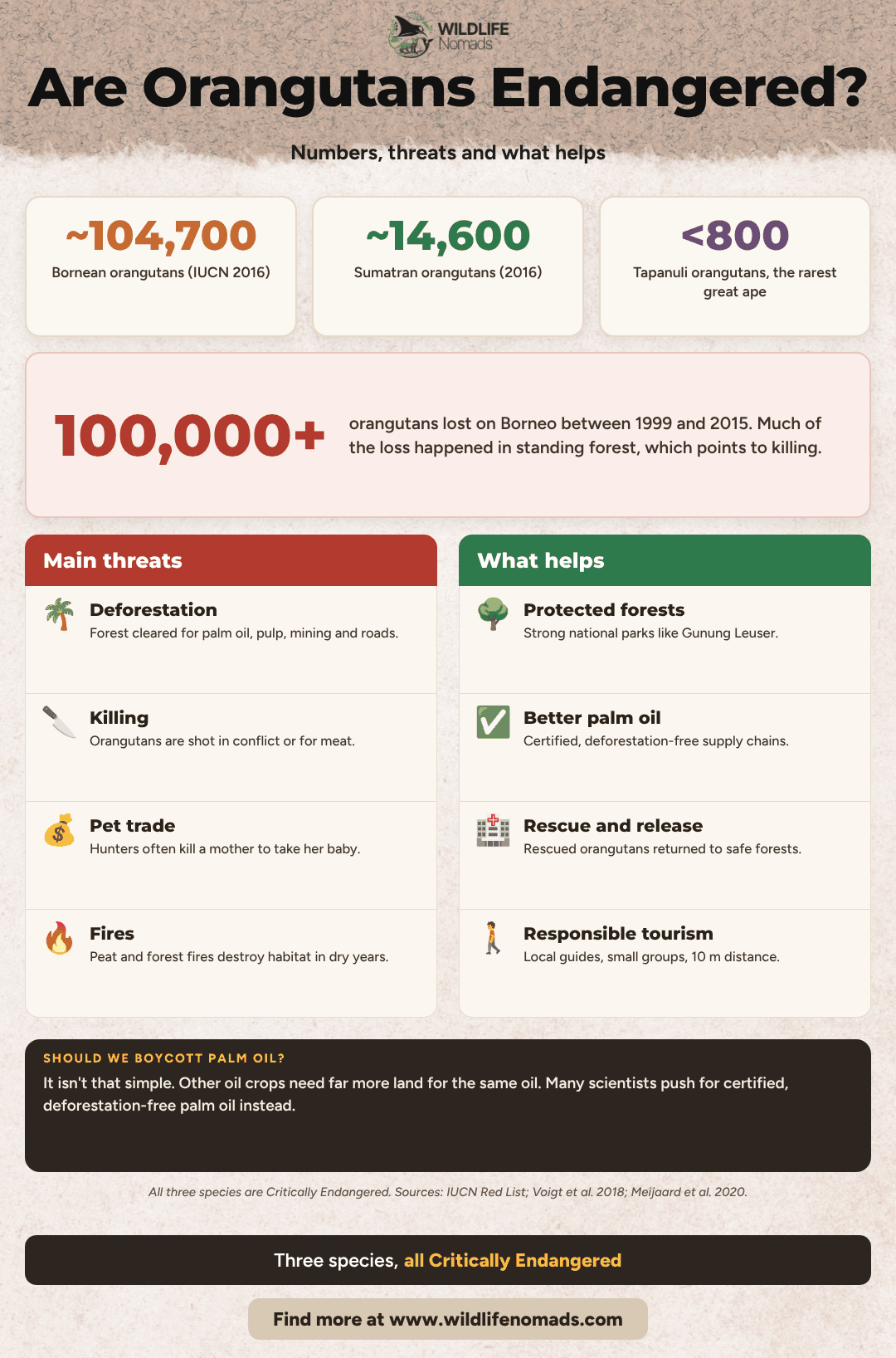
The IUCN lists all three species as Critically Endangered, one step from extinction in the wild. These are the most widely used population estimates:
- Bornean orangutan: about 104,700 (IUCN, 2016).
- Sumatran orangutan: about 14,600 (Wich et al., 2016).
- Tapanuli orangutan: fewer than 800, the rarest great ape on Earth.
Borneo alone lost more than 100,000 orangutans between 1999 and 2015 (Voigt et al., 2018). Habitat loss explains part of it. However, much of the decline happened in standing forest, which points to killing.
Deforestation for palm oil plantations, pulp, mining and roads destroys their native habitat. Meanwhile, the illegal pet trade often begins when hunters kill a mother to take her baby.
So should we boycott palm oil? The science says it isn’t that simple. Other oil crops need far more land to produce the same amount (Meijaard et al., 2020). Many scientists instead push for certified sustainable palm oil and a deforestation-free palm oil industry, backed by strong protected areas.
Tourism can help or harm too. On my trek, I watched around 15 people crowd one orangutan, and it did not feel right. With such slow breeding, every stressed mother and sick infant counts. Please follow my tips on ethical wildlife photography.
FAQs About Orangutans
The three species are the Bornean (Pongo pygmaeus), Sumatran (Pongo abelii) and Tapanuli (Pongo tapanuliensis) orangutans. Scientists described the Tapanuli orangutan in 2017. The Bornean species also has three subspecies.
There are eight living species of great apes. They are the three orangutans, two gorillas (eastern and western), chimpanzees, bonobos and humans. Gibbons add around 20 more species of small apes.
The orangutan is the largest arboreal mammal in the world. Wild orangutans spend almost their entire lives in the trees. Flanged males can weigh around twice as much as adult females.
Orangutans have no IQ score, because human IQ tests do not work for apes. Still, they use tools, plan travel routes and recognise themselves in mirrors. One wild male even treated a wound with a medicinal plant.
Orangutans are usually calmer and less aggressive than chimpanzees, which gives them a gentle reputation. However, wild orangutans are not friendly pets. Flanged males fight each other, so always keep at least 10 metres away.
All three orangutan species are critically endangered. Borneo lost more than 100,000 orangutans between 1999 and 2015. Hunters often kill mothers to sell their babies, and females breed only every six to nine years.
A Slow Ape in a Fast-Changing Forest
Orangutan apes built their success on patience: long childhoods, careful mothers and deep forest knowledge. That same slow pace now leaves them little room to recover from our speed.
If you visit, hire local guides, keep your distance and stay home when you’re sick. Then learn how to save endangered animals from your own kitchen and shopping list.
Want to meet the rest of the family? Read my chimpanzee facts, bonobo facts and silverback gorilla facts. You can also compare how long apes live.
Which orangutan fact surprised you most? Tell me in the comments.
Orang-utan Quiz: Are You Swinging Along or Just Hanging Around?
Ten questions on orangutans, the red apes of Borneo and Sumatra. Pick your answers, learn a surprising fact each time, and see how high you can climb.
Still curious? Find the types of primates, explore the how long apes live, or see how to save endangered animals.
References:
Laumer, I. B., Rahman, A., Rahmaeti, T., Azhari, U., Hermansyah, Atmoko, S. S. U., & Schuppli, C. (2024). Active self-treatment of a facial wound with a biologically active plant by a male Sumatran orangutan. Scientific Reports, 14, 8932. https://doi.org/10.1038/s41598-024-58988-7
Locke, D. P., Hillier, L. W., Warren, W. C., Worley, K. C., Nazareth, L. V., Muzny, D. M., . . . Wilson, R. K. (2011). Comparative and demographic analysis of orang-utan genomes. Nature, 469(7331), 529–533. https://doi.org/10.1038/nature09687
Meijaard, E., Brooks, T. M., Carlson, K. M., Slade, E. M., Garcia-Ulloa, J., Gaveau, D. L. A., . . . Sheil, D. (2020). The environmental impacts of palm oil in context. Nature Plants, 6(12), 1418–1426. https://doi.org/10.1038/s41477-020-00813-w
Nater, A., Mattle-Greminger, M. P., Nurcahyo, A., Nowak, M. G., de Manuel, M., Desai, T., . . . Krützen, M. (2017). Morphometric, behavioral, and genomic evidence for a new orangutan species. Current Biology, 27(22), 3487–3498. https://doi.org/10.1016/j.cub.2017.09.047
van Noordwijk, M. A., Utami Atmoko, S. S., Knott, C. D., Kuze, N., Morrogh-Bernard, H. C., Oram, F., Schuppli, C., van Schaik, C. P., & Willems, E. P. (2018). The slow ape: High infant survival and long interbirth intervals in wild orangutans. Journal of Human Evolution, 125, 38–49. https://doi.org/10.1016/j.jhevol.2018.09.004
Voigt, M., Wich, S. A., Ancrenaz, M., Meijaard, E., Abram, N., Banes, G. L., . . . Kühl, H. S. (2018). Global demand for natural resources eliminated more than 100,000 Bornean orangutans. Current Biology, 28(5), 761–769. https://doi.org/10.1016/j.cub.2018.01.053
Wich, S. A., Singleton, I., Nowak, M. G., Utami Atmoko, S. S., Nisam, G., Arif, S. M., Putra, R. H., Ardi, R., Fredriksson, G., Usher, G., Gaveau, D. L. A., & Kühl, H. S. (2016). Land-cover changes predict steep declines for the Sumatran orangutan (Pongo abelii). Science Advances, 2(3), e1500789. https://doi.org/10.1126/sciadv.1500789