The first time I cleaned a crocodile enclosure, my supervisor gave me one rule. Never turn your back on the water. I spent a few months in the reptile and amphibian house at a North American zoo, and the job rewired how I see these animals. And there was a couple of Gila monsters I used to feed pinky mice every week orr two. I served salad to Galápagos tortoises that crossed their enclosure at a crawl.
Most people lump reptiles into one blurry pile of scales. That is a mistake, because the diversity inside this group is enormous. A gecko and a saltwater crocodile share a common ancestor, but almost nothing else.
Here are the 15 types of reptiles that actually matter, sorted the way a biologist sorts them. Each comes with the field marks that make it stick, plus what I learned handling many species up close.
What Kind of Animals Are Reptiles?
Reptiles are vertebrates with scaly skin, lungs, and a shelled egg that changed life on Earth. That egg is the amniotic egg, and it carries a private pond inside the amniotic sac. As a result, the first reptiles could breed on dry land instead of returning to water like amphibians.
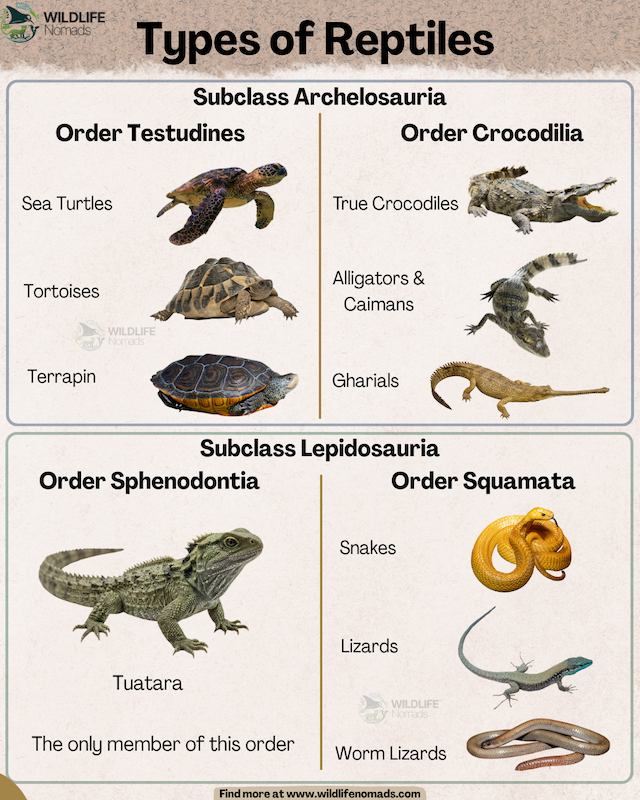
Modern reptiles fall into four main groups: turtles, crocodilians, squamates (lizards and snakes), and the tuatara. Together they form a genuinely diverse group. The Reptile Database counted around 9,300 known species barely a decade ago, passed 10,000 species in 2014, and now lists more than 12,500 living reptiles.
Most reptiles are ectothermic, or cold blooded, which means they run on external heat. They bask to raise body temperature and retreat to shade to dump body heat. By contrast, endothermic animals such as humans and other mammals burn food to stay warm. Interestingly, birds sit inside the reptile family tree too. They are warm blooded reptiles that never lost the scales on their feet.
The plumbing differs as well. Most reptiles have a three-chambered heart that mixes blood in a controlled way, a trick that helps during long dives. Crocodilians broke that pattern entirely, and you will see why in a moment.
In my phylum explorer you can see why reptiles and birds share a branch on the tree of life.
1. Crocodiles
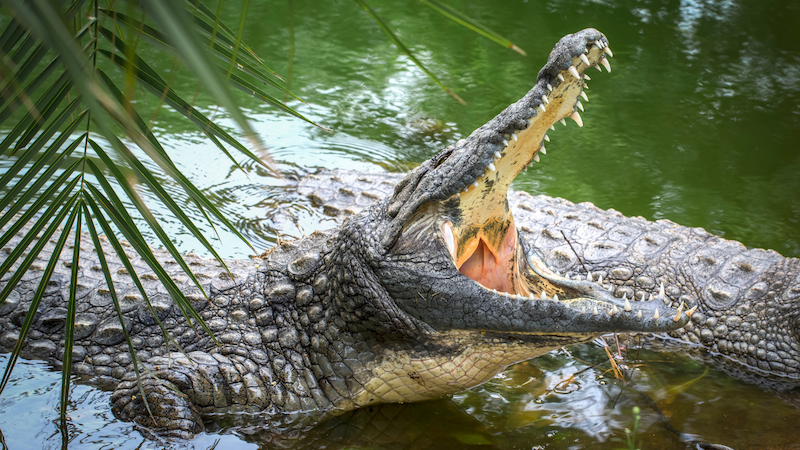
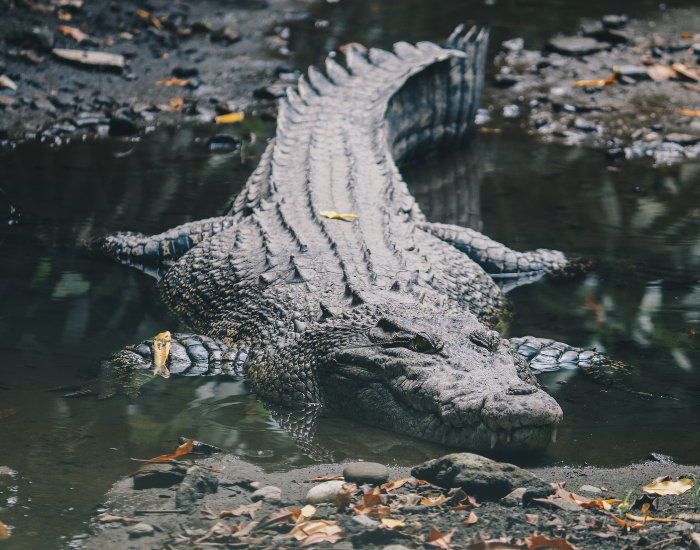
Crocodiles are the heavyweight predators of the crocodilian order, and they surprised me most at the zoo. I expected constant menace. Instead, most were placid to the point of looking bored, and only a couple were genuinely dangerous. We fed them whole chicken, and temperament varied hugely between individuals.
The saltwater crocodile (Crocodylus porosus) is the largest living reptile on the planet. Verified individuals exceed 6 metres, or over 20 feet, and one Philippine male measured 6.17 m. I now live in their range, and the crocodiles of Australia deserve every bit of the respect the warning signs demand. Unusually, crocodilians possess a four-chambered heart much like birds, the group they are most closely related to.
2. Alligators and Caimans
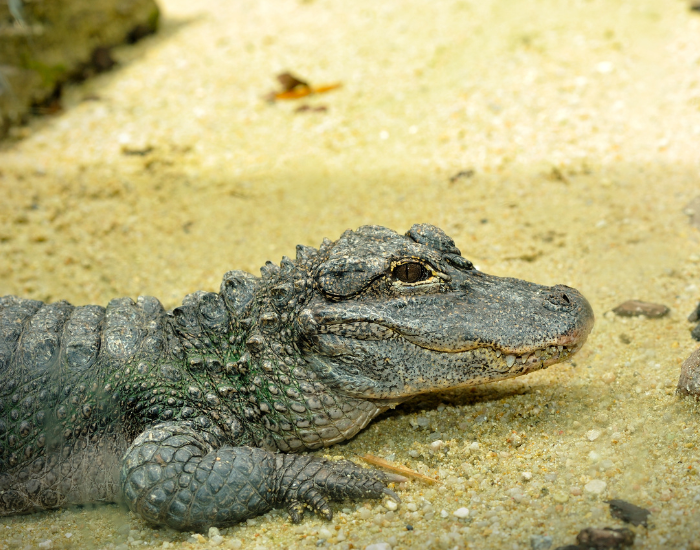
Alligators carry a broad, rounded snout, and their lower teeth tuck out of sight when the mouth closes. Crocodiles show that fourth tooth in a permanent grin. That single field mark settles most arguments at the fence line.
Only two alligator species survive, in the southeastern United States and in China. Caimans fill the same niche across Central and South America, and the black caiman (Melanosuchus niger) can pass 4 metres. American alligators are also ecosystem engineers. Their “gator holes” hold water through droughts and keep fish, turtles, small mammals and dozens of other animals alive.
3. Gharials
The gharial (Gavialis gangeticus) looks like somebody stretched a crocodile’s snout into a pair of forceps. That narrow jaw holds over a hundred interlocking teeth, and it sweeps sideways through the water to catch fish. Gharials cannot manage large prey, so they pose almost no threat to humans.
Adult males grow a bulbous nasal structure called a ghara, used to buzz and blow bubbles during courtship. Fewer than a thousand breeding adults remain in the rivers of India and Nepal. Dam construction and sand mining stripped away the sandbanks where females lay eggs, and that habitat loss drove the collapse.

4. Sea Turtles
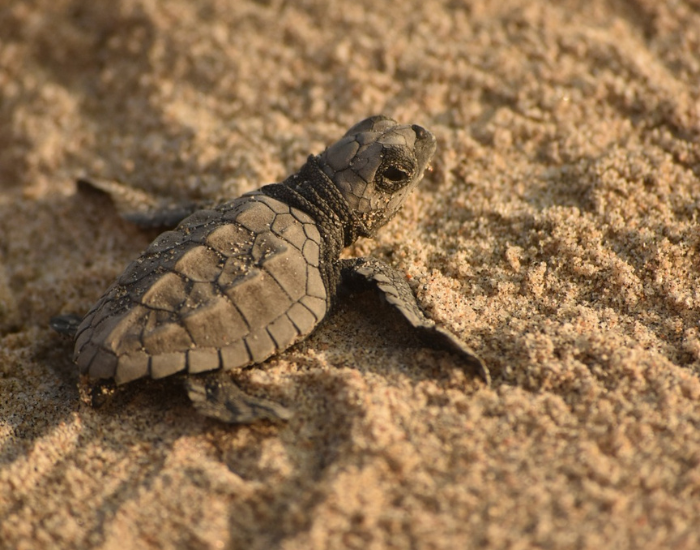
Seven species of sea turtles patrol the world’s oceans, and they are the most graceful aquatic reptiles you will ever swim beside. Their four limbs became flippers, so they cannot pull their heads into the shell like freshwater cousins. The leatherback (Dermochelys coriacea) is the giant, reaching roughly 700 kilograms with a leathery back instead of hard scutes.
Kemp’s ridley sea turtle (Lepidochelys kempii) is the smallest and the most endangered. Its mass nesting arribadas happen mainly on one stretch of beach in Tamaulipas, Mexico, which is a point of pride back home.
5. Tortoises
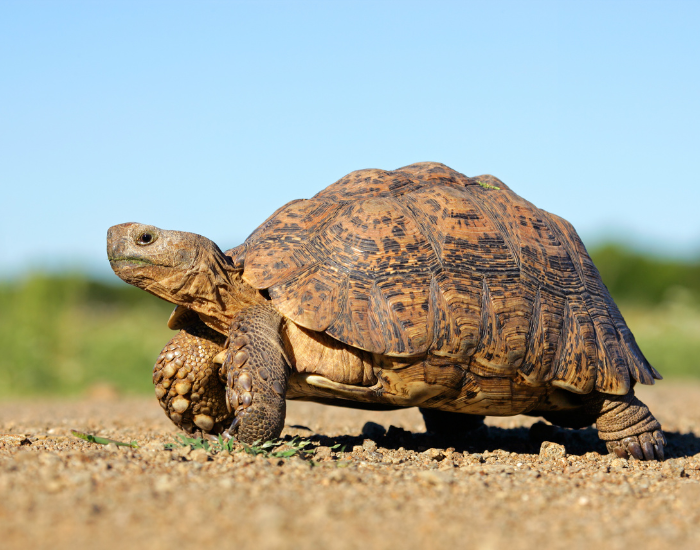
Tortoises are the land specialists of the turtle order: domed shells, elephantine feet, and a diet of plants. Feeding the giant tortoises was my favourite job of the week. We built them an enormous salad, and they ground through it with a slow, deliberate contentment.
Galápagos tortoises live well past 150 years, and Aldabra giant tortoises are credited with ages that may exceed 200. The desert tortoise (Gopherus agassizii) of the Mojave takes another route, spending up to 95% of its life in burrows. Giant tortoises survived on remote islands because no mammals were there to eat their eggs.
6. Freshwater Turtles and Terrapins
This is the largest and most varied slice of the turtle order, with several hundred species in rivers, swamps and ponds like the terrapins. The upper shell is the carapace and the lower shell is the plastron, joined by a bony bridge. Most species withdraw the head completely, folding the neck vertically or sideways depending on the family.
Snapping turtles, softshells, sliders and matamatas are the obvious other examples. Some species absorb oxygen through the lining of the cloaca, staying submerged for long periods under winter ice. I covered fifteen in my types of turtles guide.

7. Tuatara
The tuatara (Sphenodon punctatus) of New Zealand is the last survivor of an order, Rhynchocephalia, that flourished in the Mesozoic era. Every other lineage in it vanished. Calling it a lizard is wrong, even though it is broadly lizard like in shape.
Its skull keeps two complete bony arches, an ancient amniote feature squamates lost. Young tuatara carry a visible parietal eye on top of the head, a third eye that detects changes in light. They stay active at temperatures that shut down most other reptiles, and may live over a century.

8. Geckos
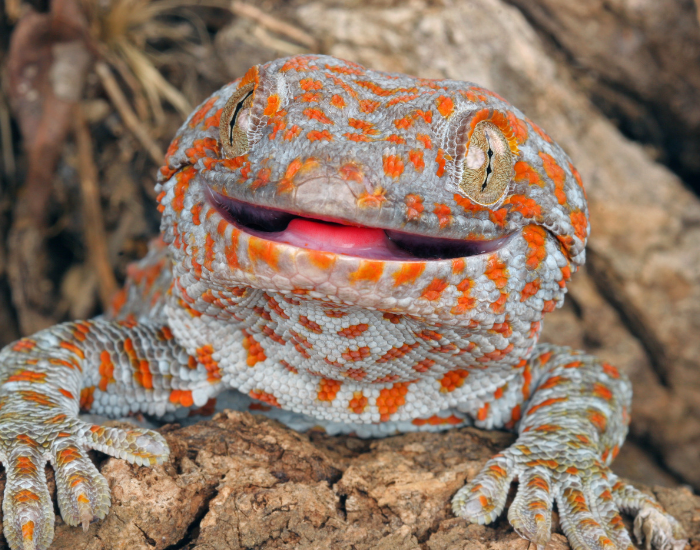
Geckos are the noisy, sticky-footed opportunists of the lizard world, with more than 2,000 species. Their toe pads carry millions of hair-like setae that grip through molecular adhesion, not suction or glue. That is why a gecko hangs from glass by one foot.
Most geckos lack eyelids, so they clean their eyes with a long tongue. On my Queensland balcony the chirping starts around dusk, and it is one of the sounds I now associate with home. Or if you have ever visisted any country in South East Asia you have probably heard the classic call of the Tokay Gecko! Geckos are among the few reptiles that vocalise regularly, and several species reproduce without males at all.
9. Iguanas, Agamas and Chameleons
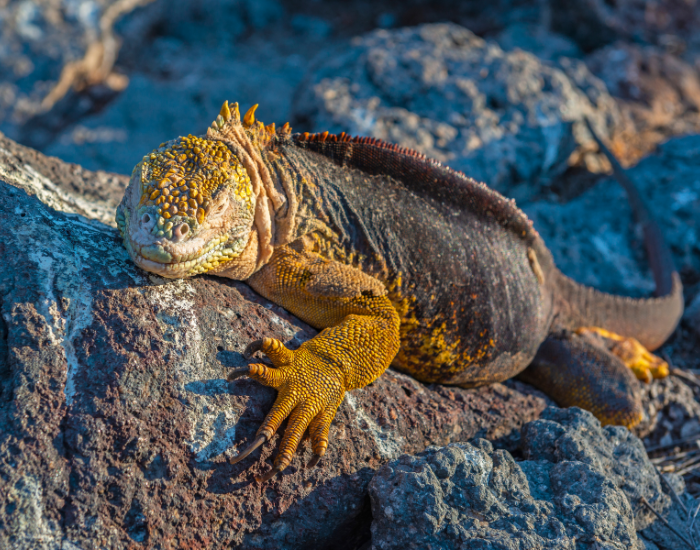
These form several groups inside one broad lizard clade, Iguania, all built around vision and display. Green iguanas (Iguana iguana) are large arboreal herbivores of the Neotropics. Agamas fill the equivalent role across Africa, Asia and Australia, including the bearded dragons half the world keeps as pets.
The marine iguana (Amblyrhynchus cristatus) of the Galápagos is the world’s only truly marine lizard. It grazes algae in cold ocean water and sneezes out the excess salt. Chameleons take display furthest, with rotating eyes, a projectile tongue and colour change driven by nanocrystals in the skin.
10. Skinks and Legless Lizards
Skinks make up one of the biggest lizard families on Earth, with well over 1,700 species. Most have smooth, overlapping scales and short limbs, and many lizards here have reduced or lost their limbs entirely. Burrowing favours a body that slides rather than walks.
That is where confusion starts. Legless lizards keep eyelids and external ear openings, while legless snakes have neither. Around 20% of squamates give birth to live young instead of eggs, and skinks include plenty of them. Australia’s blue-tongues skinks and shinglebacks deliver fully formed babies rather than a clutch.
11. Monitor Lizards
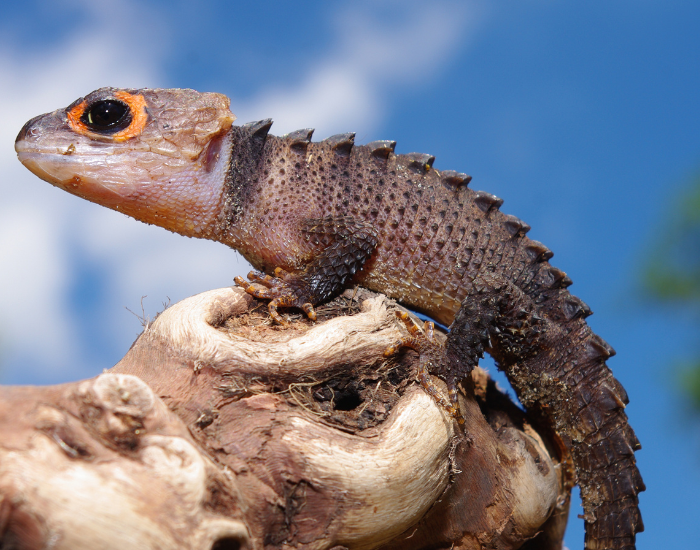
Monitors were the animals I most enjoyed working with. Everytime I spot one in Australia or Philippines is very fun! They watch you back. Other species look through you, but a monitor’s face carries an alertness that keepers everywhere notice.
The family holds around 80 species, from the tiny short-tailed monitor to the Komodo dragon (Varanus komodoensis), which reaches 3 metres. Monitors have a forked tongue like snakes and high aerobic capacity, so they run down prey rather than ambush it. My deep dives on monitor lizards and the Komodo dragon cover the rest.

12. Gila Monsters and Beaded Lizards
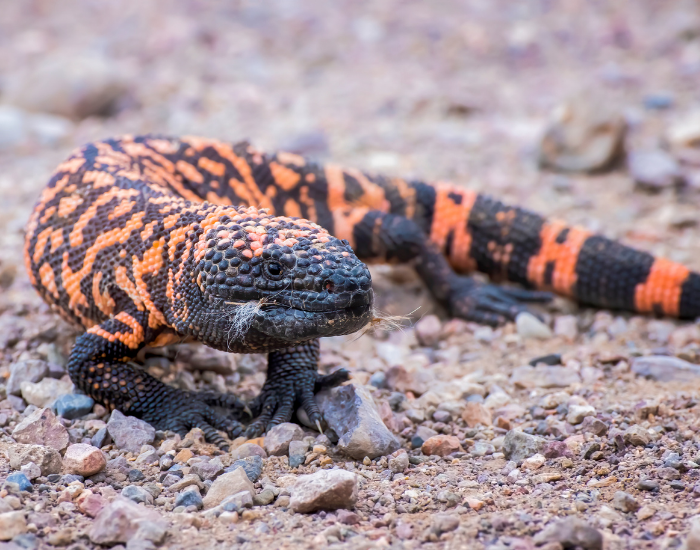
I fed our Gila monster (Heloderma suspectum) pinky mice every couple of weeks. It remains the strangest feeding job I have done. The animal moves like it has nowhere to be. Then the jaws close, and they do not open again in a hurry.
Gila monsters and Mexican beaded lizards deliver venom through grooved teeth in the lower jaw, chewing rather than injecting. Their venom yielded exendin-4, the compound behind a class of diabetes drugs. They spend most of the year underground and store enough tail fat to survive long periods without food.
13. Worm Lizards
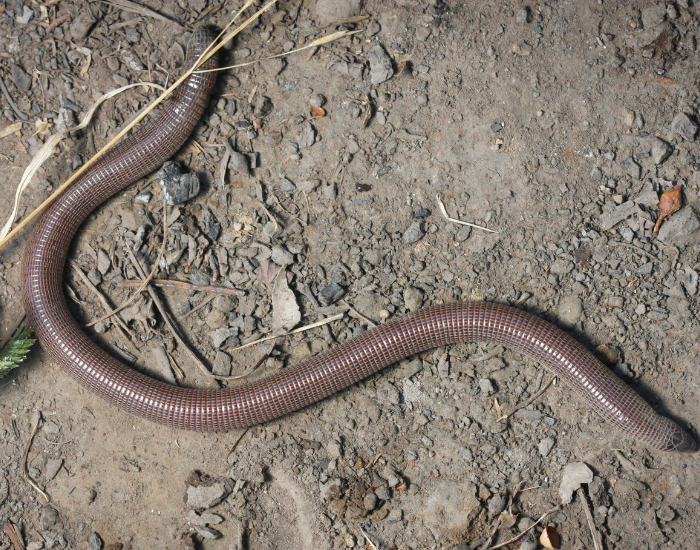
Worm lizards, or amphisbaenians, are the reptile group almost nobody knows exists. Around 200 species burrow through soil across Africa, South America and the Mediterranean. Their bodies are ringed like an earthworm, their eyes sit buried under skin, and most species have no limbs at all.
One genus, Bipes, kept its front legs and lost the back pair. The result looks like a pink worm wearing tiny mole hands, and it lives in Baja California. Amphisbaenians dig with a reinforced skull, ramming and compacting the tunnel wall, which is why head shape varies so wildly here.
14. Pythons and Boas
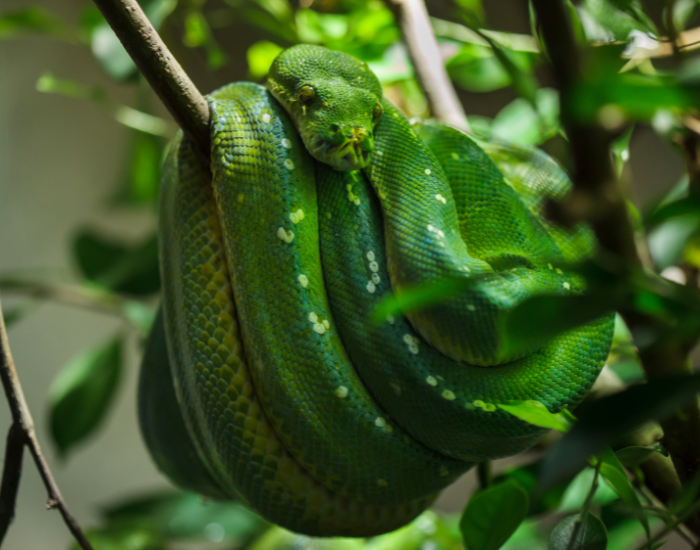
Constrictors kill by shutting down circulation, not by crushing bone or suffocating prey. I handled ball, reticulated, Burmese and other types of pythons at the zoo. A friend ran a ball python breeding facility that I visited through a full season. Ball pythons are the calmest large snake I have worked with.
The key split is simple. Most pythons lay eggs, and boas give birth to live young. Reticulated pythons (Malayopython reticulatus) are the longest snakes alive, and green anacondas are the heaviest. Both detect warm prey through heat-sensing pits along the lips, closer to thermal imaging than to sight. More in my guide to the types of snakes.
15. Vipers, Cobras and Sea Snakes
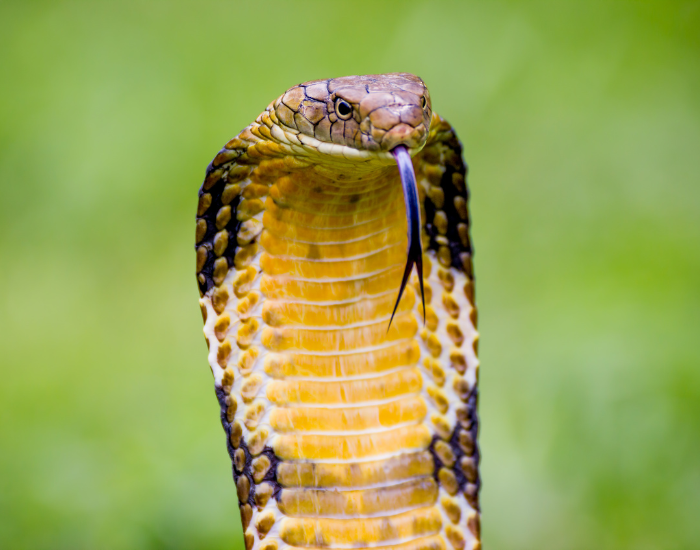
Venomous snakes fall into two main families, though most snakes on Earth are harmless to people. Vipers, including rattlesnakes, have hinged fangs that fold flat and swing forward to strike. We occasionally had to catch rattlesnakes, always with hooks and tongs, never hands. That training teaches patience faster than anything else.
Elapids have short fixed fangs and generally neurotoxic venom. This family holds cobras, mambas, taipans and every sea snake, plus the red-bellied blacks I have handled here in Australia. Sea snakes went fully aquatic, giving birth at sea and absorbing part of their oxygen through the skin. More on sea snakes and a set of snake facts worth knowing.
Frequently Asked Questions
Most reptiles are cold blooded in the everyday sense, which biologists call ectothermic. They regulate temperature behaviourally, shuttling between sun and shade. Some reptiles enter a hibernation-like state called brumation during cold months, slowing the metabolism for weeks at a time. Leatherback sea turtles are the odd ones out, holding body heat well above the surrounding water.
No. Most reptiles lay amniotic eggs with leathery shells, buried in nests dug into soil or sand. However, about 20 percent of lizards and snakes give live birth. Viviparity has evolved independently over a hundred times in the order Squamata. Many reptiles exhibit temperature-dependent sex determination, where nest heat rather than chromosomes decides sex.
Yes. Crocodilians and birds are closely related to dinosaurs inside the archosaur lineage. Extinct reptiles including dinosaurs and pterosaurs dominated dry land through the Mesozoic era, a run of roughly 186 million years. The mass extinction 66 million years ago ended that, but birds carried the lineage forward.
Reptiles inhabit deserts, rainforests, wetlands, grasslands, oceans and mountains on every continent except Antarctica. Their adaptations against water loss let them thrive where other animals struggle for food and moisture. Several species survive only on remote islands, and marine iguanas, sea turtles and sea snakes made the full return to salt water.
Why Knowing Reptile Groups Changes What You See
Once you can sort a reptile into its group, the animal stops being generic. You know roughly how it breeds, how it hunts, and what it needs from the sun before you know its name. That is the real payoff of learning the main reptile groups.
More than 21% of reptile species now face extinction, driven mostly by habitat loss and illegal trade. Go and find one this week. Then tell me in the comments which group it belonged to. If you want more, start with the types of pet reptiles or my guide to the types of amphibians.
Can You Name That Reptile Group? 🦎
A 14-photo identification challenge — the wrong answers are deliberately tricky look-alikes from a related lineage. Go back and change any answer before you score.
Which reptile group is this?
References:
Cox, N., Young, B. E., Bowles, P., Fernandez, M., Marin, J., Rapacciuolo, G., … Xie, Y. (2022). A global reptile assessment highlights shared conservation needs of tetrapods. Nature, 605(7909), 285–290. https://doi.org/10.1038/s41586-022-04664-7
Gemmell, N. J., Rutherford, K., Prost, S., Tollis, M., Winter, D., Macey, J. R., … Stone, C. (2020). The tuatara genome reveals ancient features of amniote evolution. Nature, 584(7821), 403–409. https://doi.org/10.1038/s41586-020-2561-9
Ge, C., Ye, J., Weber, C., Sun, W., Zhang, H., Zhou, Y., … Capel, B. (2018). The histone demethylase KDM6B regulates temperature-dependent sex determination in a turtle species. Science, 360(6389), 645–648. https://doi.org/10.1126/science.aap8328
Meiri, S., Feldman, A., Schwarz, R., & Shine, R. (2020). Viviparity does not affect the numbers and sizes of reptile offspring. Journal of Animal Ecology, 89(2), 360–369. https://doi.org/10.1111/1365-2656.13125
Santidrián Tomillo, P., & Spotila, J. R. (2020). Temperature-dependent sex determination in sea turtles in the context of climate change: Uncovering the adaptive significance. BioEssays, 42(11), 2000146. https://doi.org/10.1002/bies.202000146
Laloë, J.-O., Tedeschi, J. N., Booth, D. T., Bell, I., Dunstan, A., Reina, R. D., & Hays, G. C. (2021). Extreme rainfall events and cooling of sea turtle clutches: Implications in the face of climate warming. Ecology and Evolution, 11(1), 560–565. https://doi.org/10.1002/ece3.7076
Shaver, D. J., Walker, J. S., & Backof, T. F. (2023). Climate-mediated population dynamics for the world’s most endangered sea turtle species. Scientific Reports, 13, 14563. https://doi.org/10.1038/s41598-023-41647-8