
I was three hours into a humid trek near Bukit Lawang, Sumatra, in search for orangutans and othe primates. We had already logged gibbons calling across the valley, a troop of macaques, and a Prevost’s squirrel flashing orange down a trunk. Then something low and chestnut-brown crossed the trail ahead. My guide froze. It was a collared mongoose, a species so rarely photographed in Sumatra that researchers still argue about its status there.
When a mongoose comes to mind. Most people picture one animal: a cobra-fighting blur from a Kipling story. In reality, the mongoose family spans roughly 34 to 36 species across three continents, with wildly different bodies, diets, and social lives.
Below I walk through 15 types of mongooses worth knowing, plus what they eat, where they live, why some countries ban them outright, and how they survive bites that kill other mammals.

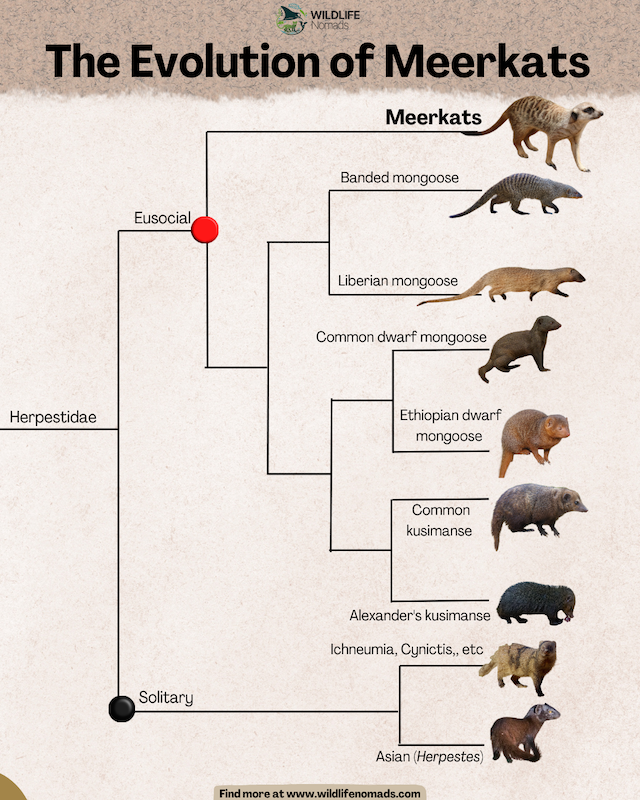
What Is a Mongoose? Meet the Family Herpestidae
Mongooses belong to the family Herpestidae, a group of small, agile carnivores. Taxonomists currently recognise about 34 living species, split between African and Eurasian lineages. Meerkats and kusimanses sit inside this family too, even though nobody calls them mongooses.
They are not weasels. They are not rodents. Their closest relatives are civets, genets, and hyenas, all part of the cat-side branch of the carnivore tree.
Mongooses typically have long slender bodies, short legs, and pointed faces. Small ears sit flat against the skull. Most species carry grizzled gray to brown fur, a bushy tail, and five toes on each foot tipped with curved claws built for digging.
I spent an afternoon at the Natural History Museum in London comparing mounted specimens side by side. Seeing a dwarf mongoose next to an Egyptian mongoose makes the size range obvious in a way photographs never do.
Speaking of range: dwarf mongooses measure about 7 to 10 inches long. The Egyptian mongoose can grow up to 2 feet. The white-tailed mongoose stretches even further, reaching 19 to 28 inches before you count the tail.
15 Types of Mongooses You Should Know
1. Banded Mongoose (Mungos mungo)
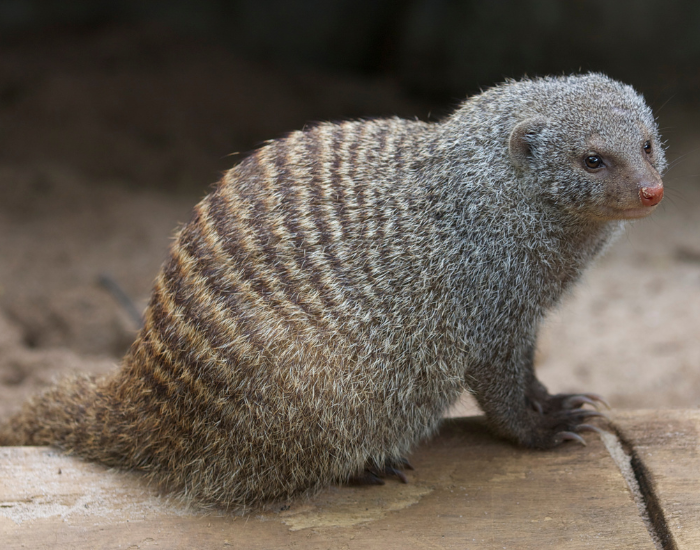
The banded mongoose is the poster child for mongoose sociality. These animals live in large groups, or mobs, that can consist of up to 40 individuals. Dark bands across the rump give the species its name.
Females in a mob give birth on the same night, then raise the litters communally. A long-running Ugandan study at Queen Elizabeth National Park has tracked this system for decades.
2. Dwarf Mongoose (Helogale parvula)
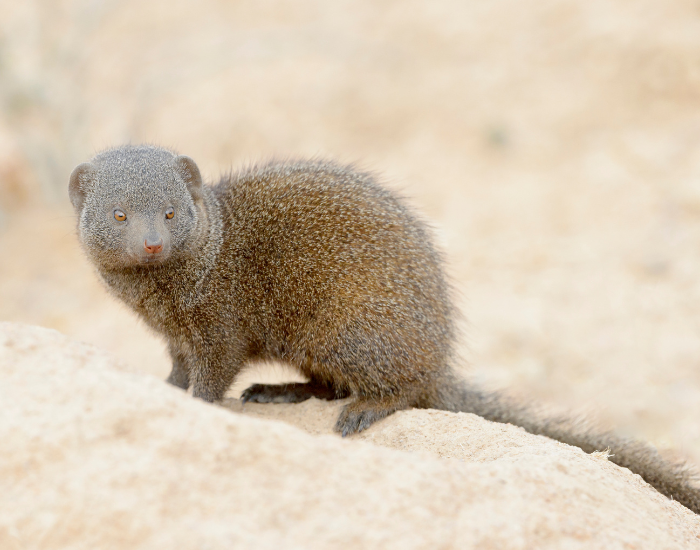
Africa’s smallest carnivore, the dwarf mongoose lives in packs of up to 20 individuals. Each pack has one dominant pair that monopolises breeding, while subordinates babysit and stand guard.
Kern and Radford showed that sentries adjust their vigilance based on wind speed and alarm calls from neighbours. That is real-time risk assessment in an animal weighing less than a can of soda.
3. Meerkat (Suricata suricatta)
Meerkats form social groups of 20 to 30 in the arid zones of southern Africa. They dig sprawling burrows and post sentries on termite mounds.
I watched a meerkat group at a zoo in Australia trade sentry duty in near-perfect rotation. One animal climbed, scanned, called softly, then dropped back to forage as another took its place.

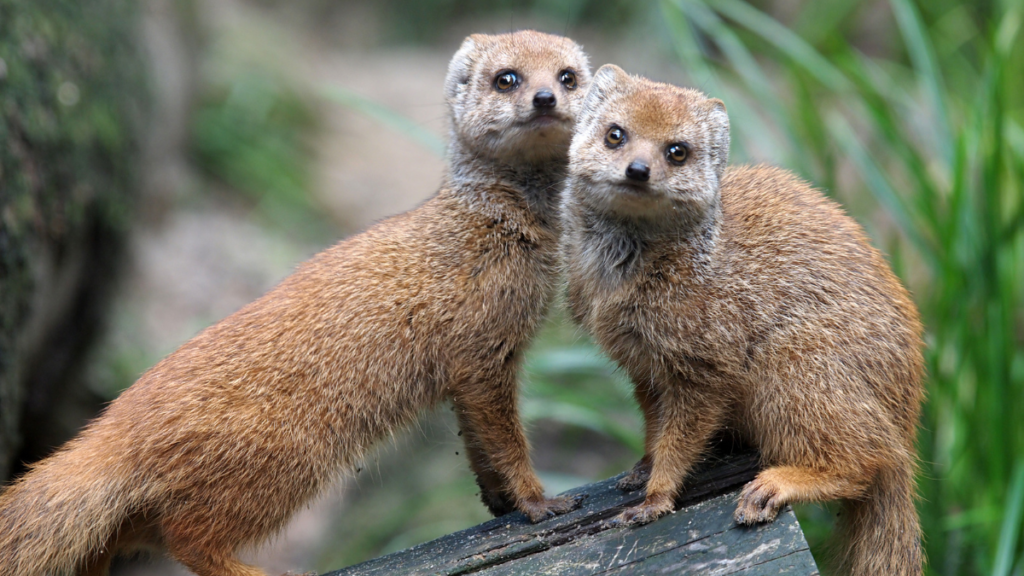
4. Yellow Mongoose (Cynictis penicillata)
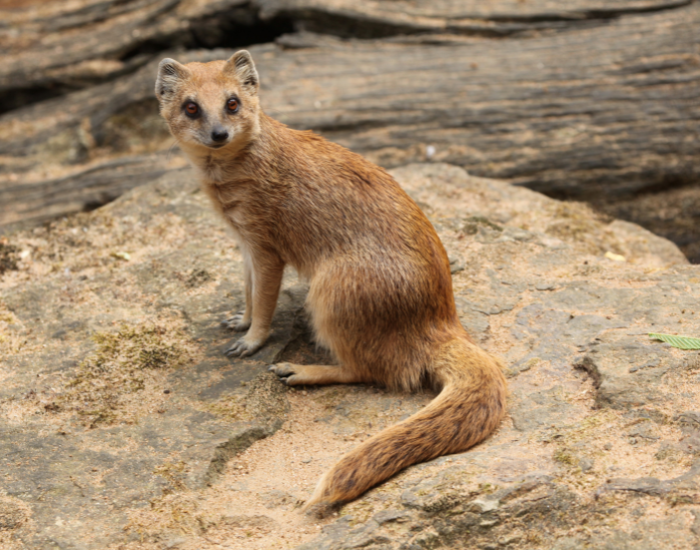
Rusty-gold fur and a white tail tip make this one unmistakable. The yellow mongoose occupies dry grassland across southwestern Africa and often shares burrow systems with meerkats and ground squirrels.
Unlike its neighbours, it forages alone. Sharing a bedroom does not mean sharing a hunt.
5. Egyptian Mongoose (Herpestes ichneumon)
Herpestes ichneumon is the largest African species and the only mongoose that breeds in southern Europe. A relict population persists on the Iberian Peninsula, likely introduced centuries ago.
Ancient Egyptians mummified them. Modern Portuguese farmers mostly complain about them.
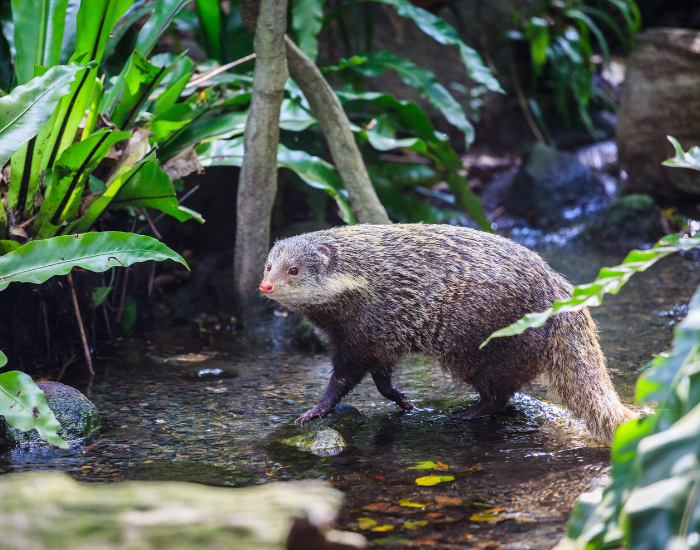
6. Indian Gray Mongoose (Urva edwardsii)
This is Rikki-Tikki-Tavi. Rudyard Kipling built his famous story around the Indian gray mongoose, and the species does genuinely kill cobras.
It ranges across southern Asia from Iran to Bangladesh, thriving in farmland and city edges alike.
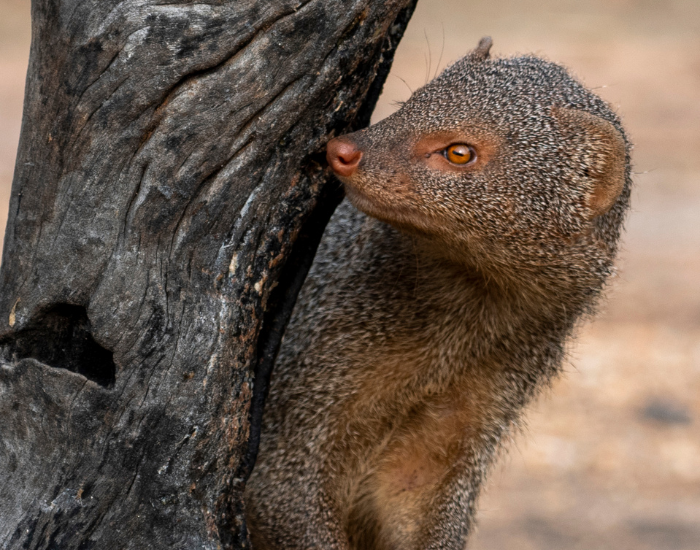
7. Small Indian Mongoose (Urva auropunctata)
Compact, quick, and catastrophic outside its native range. Sugar planters shipped this species to Jamaica, then to Hawaii in 1883, hoping it would suppress rodent populations in sugarcane plantations.
It ate ground-nesting birds and reptiles instead. Populations now persist across the West Indies, Hawaii, Fiji, and Okinawa.
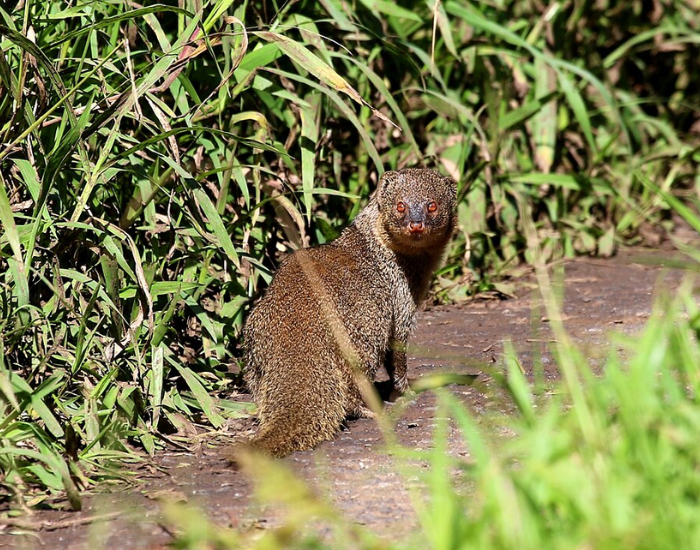
8. Javan Mongoose (Urva javanica)
Long lumped with the small Indian mongoose under the name Herpestes javanicus, the Javan mongoose is now treated as a separate species. Genetic work in the 2010s split the two.
Native to Southeast Asia, it favours scrub, riverbanks, and disturbed farmland.
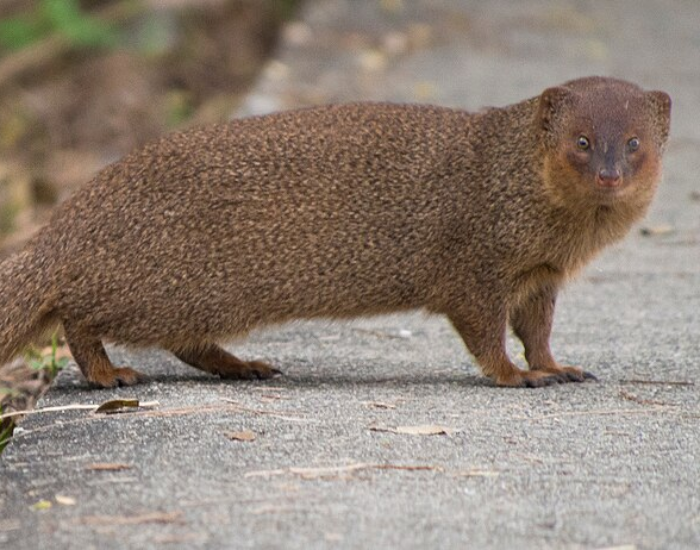
9. Marsh Mongoose (Atilax paludinosus)
Atilax paludinosus is Africa’s swimmer. Coarse dark fur, no webbing between the toes, and a genuine talent for underwater foraging.
The marsh mongoose can dive for roughly 15 seconds while hunting crabs and frogs. It also uses bare, dexterous forepaws to feel under rocks, closer to a raccoon than a meerkat.
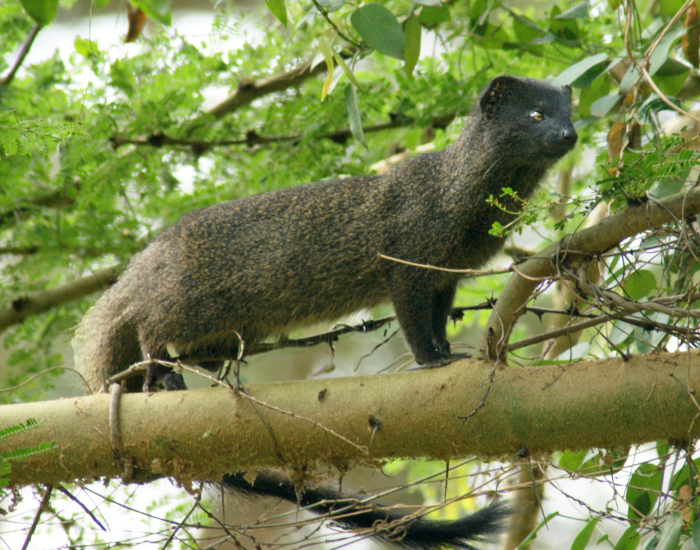
10. White-Tailed Mongoose (Ichneumia albicauda)
Big, shaggy, and nocturnal. The white tailed mongoose has dark legs, a pale bushy tail, and a shoulder height that surprises people expecting something ferret-sized.
Solitary by habit, it patrols savanna and woodland edges across sub-Saharan Africa hunting insects and small animals.
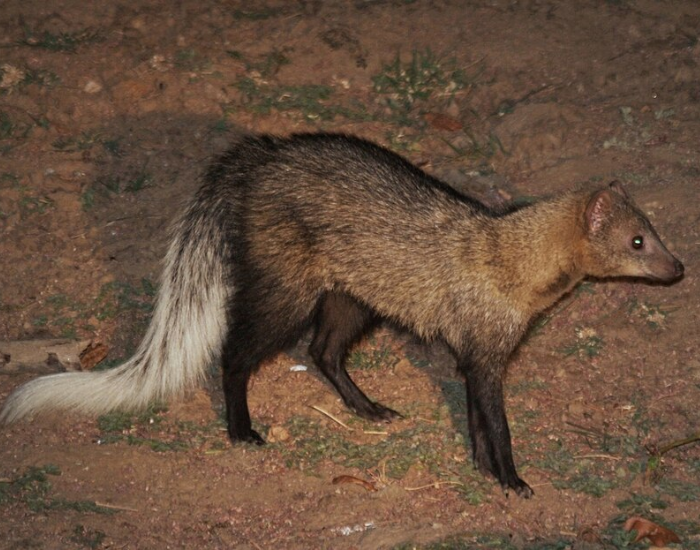
11. Slender Mongoose (Herpestes sanguineus)
Among the most commonly seen Herpestes species on safari. A slender mongoose sprinting across a track with its black-tipped tail held high is a familiar sight in East Africa.
Males sometimes form loose coalitions. Females hunt alone.

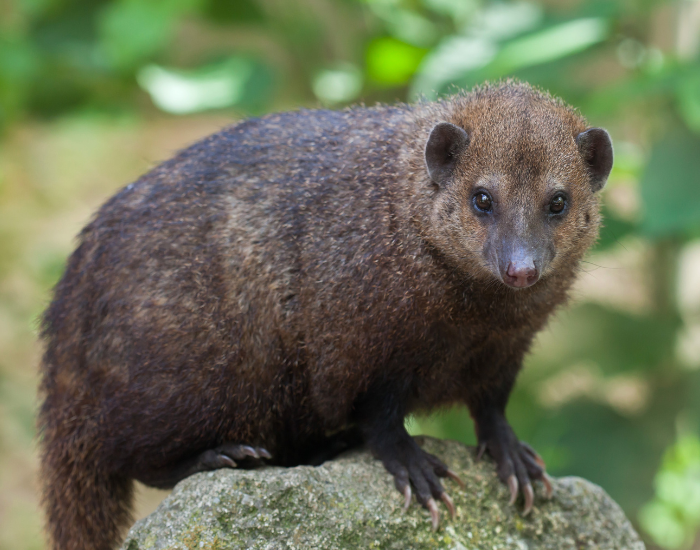
12. Collared Mongoose (Urva semitorquata)
My Sumatra animal. Rich reddish-brown with a faint dark collar, this species inhabits lowland tropical forests in Borneo and Sumatra.
The International Union for Conservation of Nature lists it as Near Threatened. Camera-trap records remain scarce, which is exactly why that trail crossing still feels like luck rather than skill.
13. Liberian Mongoose (Liberiictis kuhni)
Perhaps the least-known member of the mongoose family. Scientists described the Liberian mongoose in 1958 from skulls bought at a bushmeat market.
It has an elongated snout and long claws suited to digging earthworms from forest soil in Liberia and Côte d’Ivoire.
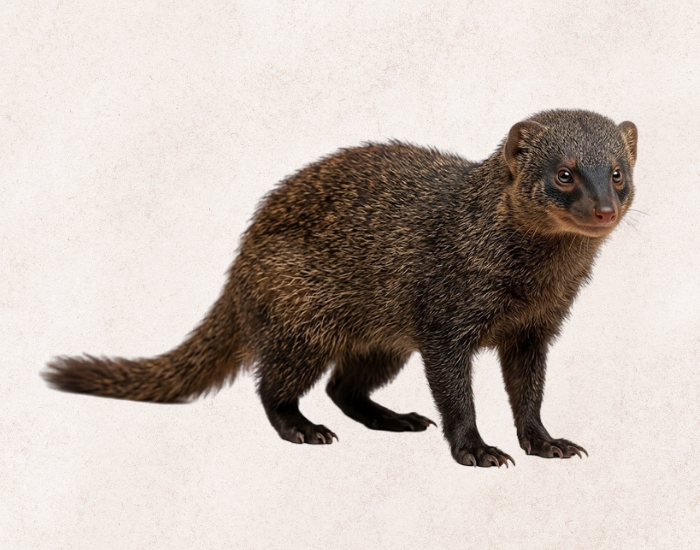
14. Crab-Eating Mongoose (Urva urva)
Despite the name, crabs form only part of the menu. This large, grizzled species ranges from northern India through southern China and Taiwan.
It hunts along streams, taking fish, frogs, snails, and rodents. Handlers describe it as one of the most aggressive species of mongoose in captivity.
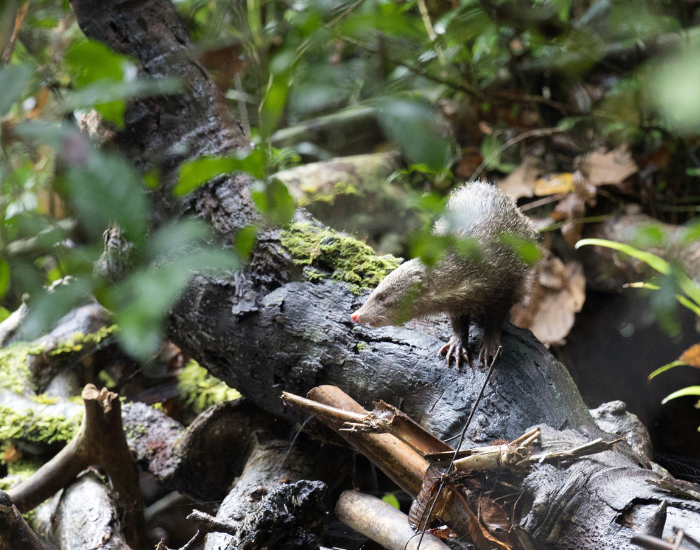
15. Common Kusimanse (Crossarchus obscurus)
A West African forest specialist that never got the mongoose name, despite belonging to the same family. Kusimanses travel in noisy family parties of 10 to 20, rooting through leaf litter.
Two other species deserve a mention. Selous’s mongoose hunts alone across southern Africa’s sandy plains, while the Malagasy mongooses, several of which sport boldly ringed tails, like Galidia elegans — sit in a separate family entirely. Those Madagascar animals evolved from a single carnivore ancestor and only look closely related.
Mongoose Habitat Facts: Where Does a Mongoose Live?
Mongooses are native to Africa, southern Asia, and parts of southern Europe. Within that range, mongooses live in deserts, tropical forests, savanna, mangroves, and wetlands. African mongooses inhabit the widest spread of those environments.
Habitat drives body plan. Marsh species stay near permanent water. Desert species dig deep burrows and rely on hind legs for the upright sentry posture that makes meerkats famous.
Most mongoose species are social and active during the day, though several — the white-tailed mongoose among them — flip to night shifts. Social structure varies significantly between species. Some are solitary, some live in colonies, and their societies combine discrete units rather than forming one shapeless crowd.
What Mongooses Eat, and How They Survive Cobras
Mongooses are opportunistic omnivores. They primarily eat insects, rodents, and reptiles, plus crabs, lizards, birds, and eggs. When animal prey runs short, their diet mongooses fall back on includes fruit, nuts, seeds, and other plant material.
Excellent sight and sharp hearing drive the hunt. Some mongooses crack open eggs or snails by hurling them backwards between the hind legs against a rock. Others simply use their forepaws to break open bird eggs.
Then there are the snakes. Many mongoose species can kill venomous snakes, and cobras top the list. Two things make it possible.
First, speed. Mongooses use agility and timing to stay outside the strike arc, and thick coarse fur adds a small margin. Second, biochemistry. Mutations in the nicotinic acetylcholine receptor stop alpha-neurotoxins from binding, so a mongoose can keep fighting after receiving a snake bite.
Mongooses are prey too. Raptors take a heavy toll, which is why sentries scan the sky as much as the ground. Eagles, hawks, and owls all feature in mongoose alarm-call studies, and leopards, jackals, and hyenas hunt them on the ground.
Why Mongooses Are Illegal in the United States
Some mongoose species were introduced to islands for rodent control, and the results were disastrous. The Javan and small Indian mongooses decimated native species across Hawaii, the Caribbean, and Japan.
Ground-nesting birds suffered worst. On Okinawa, mongooses drove the endangered Okinawa rail toward collapse until sustained trapping reversed the trend.
The United States listed mongooses as injurious wildlife under the Lacey Act in 1900. Importing or keeping one without a federal permit remains illegal today.
FAQs About Mongooses
No. Mongooses are wild carnivores, not pets. Some individuals tolerate people in villages and tourist camps, and a few cultures keep them semi-tame for snake control. That said, they bite readily when handled and become destructive indoors.
Direct attacks are rare. The real risk is disease: mongooses are a significant rabies reservoir in Puerto Rico, Grenada, and parts of southern Africa. Bites should always receive medical attention. They also raid poultry runs, which is the usual source of conflict.
Killing venomous snakes, mostly. National Geographic footage of mongoose-versus-cobra duels shaped the animal’s reputation worldwide. Biologists know them better for cooperative breeding, sentry systems, and one of the most complex social lives among small carnivores.
Look for a slender body, short legs, small rounded ears, a tapered face, and a bushy tail. Fur is usually grizzled gray or brown. Sizes range from the 7-inch dwarf mongoose to the 28-inch white-tailed mongoose.
Go Find One Yourself
The lesson from that Sumatran trail is simple. Mongooses reward patience far more than they reward expectation, and the interesting story was never the cobra fight, it was the babysitting, the sentry rotation, and the scent-marked rock.
A study in the Proceedings of the National Academy of Sciences even showed dwarf mongooses repaying grooming debts hours after the favour was earned. That is bookkeeping in a nine-inch carnivore.
If you are heading to East or southern Africa, skip past the lions for twenty minutes and park beside a termite mound instead. Watch which animal climbs, which one calls, and which one keeps digging.
Can You Name That Mongoose? 🐾
A 14-photo identification challenge — the wrong answers are deliberately tricky look-alikes from a similar group. Go back and change any answer before you score.
Which mongoose is this?
References:
Drabeck, D. H., Holt, J., & McGaugh, S. E. (2022). Widespread convergent evolution of alpha-neurotoxin resistance in African mammals. Biology Letters, 18(11), 20220361. https://doi.org/10.1098/rsbl.2022.0361
Kern, J. M., & Radford, A. N. (2018). Experimental evidence for delayed contingent cooperation among wild dwarf mongooses. Proceedings of the National Academy of Sciences, 115(24), 6255–6260. https://doi.org/10.1073/pnas.1801000115
Louppe, V., Leroy, B., Herrel, A., & Veron, G. (2020). The globally invasive small Indian mongoose Urva auropunctata is likely to spread with climate change. Scientific Reports, 10, 7461. https://doi.org/10.1038/s41598-020-64502-6
Mitchell, J., Kyabulima, S., Businge, R., Cant, M. A., & Nichols, H. J. (2018). Kin discrimination via odour in the cooperatively breeding banded mongoose. Royal Society Open Science, 5(3), 171798. https://doi.org/10.1098/rsos.171798
Yagihashi, T., Seki, S.-I., Nakaya, T., Nakata, K., & Kotaka, N. (2021). Eradication of the mongoose is crucial for the conservation of three endemic bird species in Yambaru, Okinawa Island, Japan. Biological Invasions, 23(9), 2761–2773. https://doi.org/10.1007/s10530-021-02503-w
Veron, G., Patou, M.-L., & Jennings, A. P. (2015). Systematics and evolution of the mongooses (Herpestidae, Carnivora). In E. Do Linh San, J. J. Sato, J. L. Belant, & M. J. Somers (Eds.), Small Carnivores: Evolution, Ecology, Behaviour and Conservation. Wiley. https://doi.org/10.1002/9781118943274.ch3