The first time I locked eyes with a common raccoon in the wild, I was in coastal Mexico, watching a small, masked face peer out from a tangle of mangrove roots. I have found raccoons far less often than people assume. In tropical areas like the Yucatán, I have seen many more coatimundis trotting through the forest than raccoons. The few times I watched them up close, it was actually at a friend’s house, silently working a latch on a trash can, exactly like the movies.
I recently wrote a long post about the tanuki of Japan, and that rabbit hole pulled me into a related question: how well do I actually know the raccoon? This article is the long answer. Here are ten things I have come to love, study, and respect about the common raccoon, backed by science, field notes, and a few rare encounters from the road.

1. The Common Raccoon Is Not a Rodent: It’s a Procyonid
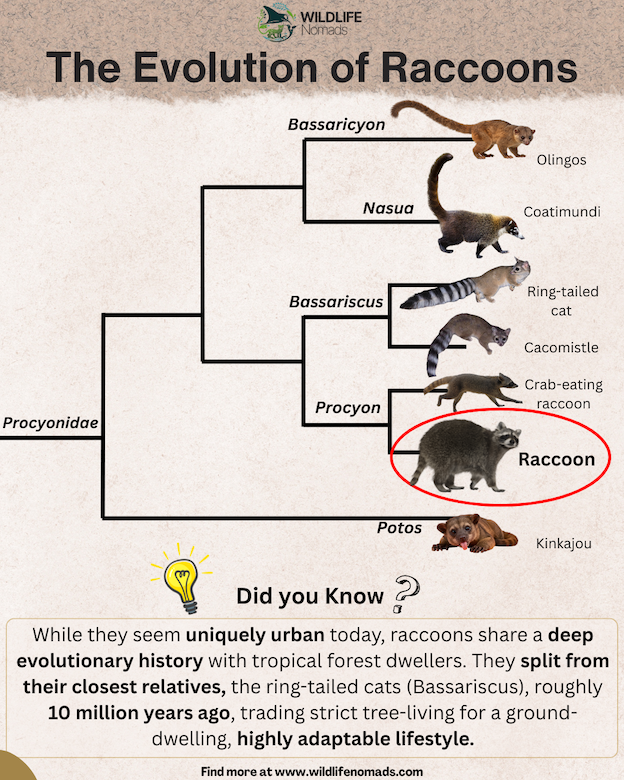
People often ask me, somewhat shyly, “Are raccoons rodents?” The answer is no, and I love that the question keeps coming up. Raccoons belong to the family Procyonidae, a small but charismatic group of New World carnivores. Their closest relatives are not rats or squirrels but coatis, kinkajous, ringtails, and the cacomistle. As a result, the common raccoon shares more DNA with a coatimundi than with any rodent, badger, bear or canid species you can name.
That distinction matters in the field. When you watch a raccoon move, you must see the same shoulder-rolling gait I see in coatis , short legs, a flexible spine, and a low center of gravity built for climbing trees and balancing on narrow branches. The long, bushy tail, banded with rings, is another procyonid signature, and the ringed tail is one of the most universally recognized symbols of the raccoon. The dark mask and the ringed tail together form the visual logo that most people use to identify a raccoon at a glance. Raccoons are, in every sense, the most successful procyonid on Earth. Acknowledge that lineage and you start to see the raccoon in a richer light.
2. The Black Mask Is More Than a Costume
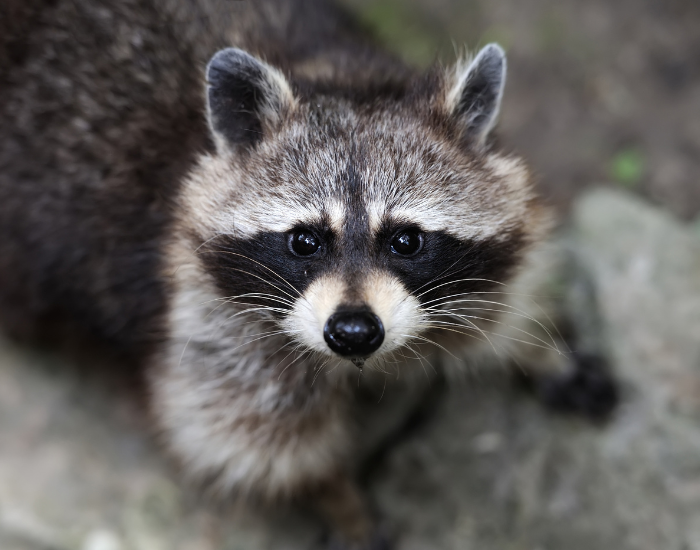
That iconic black mask across the eyes is one of the most recognized symbols in North American wildlife. Few animal symbols are as instantly readable in a field guide, and the raccoon mask appears on countless brand logos, mascots, and folk symbols across the continent. Even kids who have never seen a raccoon in person can draw the mask from memory. It looks like a Halloween costume, but it has function. The dark fur absorbs incoming light and reduces glare, which gives the raccoon sharper contrast vision at night. For a nocturnal forager that hunts shoreline shallows and rummages in shadowed areas, that small evolutionary trick is a long-term advantage.
The mask may also play a social role. Some researchers suggest the bold pattern helps raccoons recognize one another at a distance, especially when adults must read the body language of other raccoons in dim light. I have watched two raccoons agree on a feeding pecking order at dusk simply by facing each other and freezing. Over time, you learn to read those small exchanges. Among the symbols of North American wildlife, the raccoon mask remains one of the most functionally elegant.
3. Those “Hands” Are a Superpower
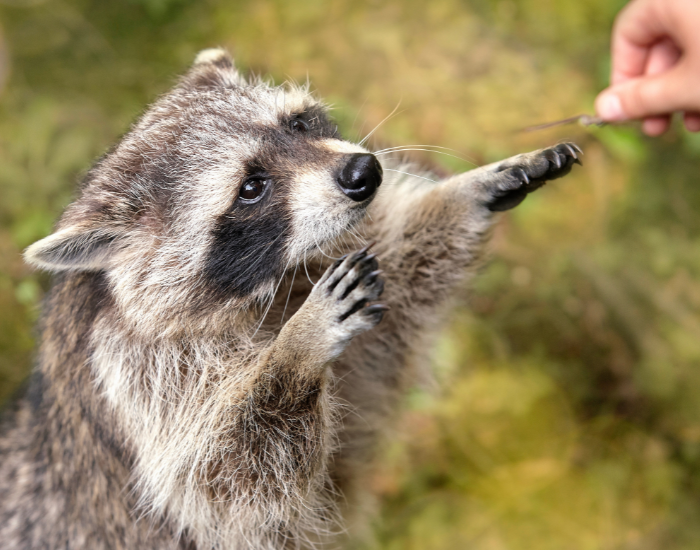
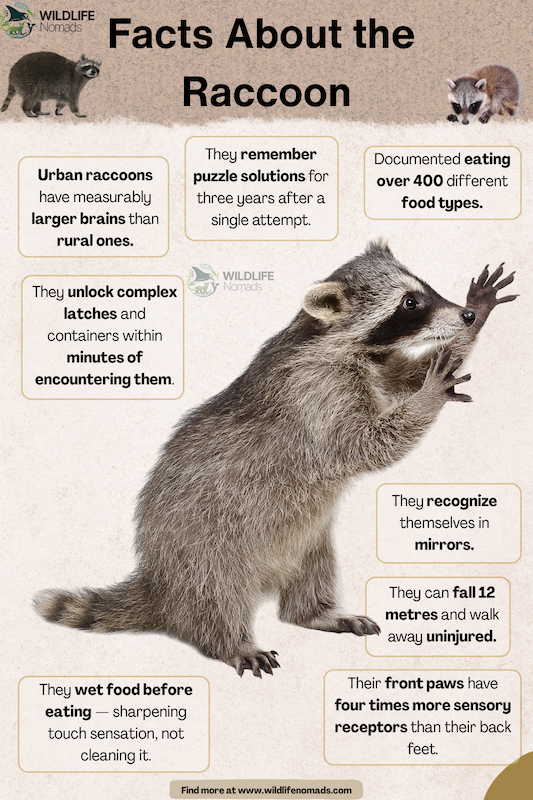
If the mask is the raccoon’s logo, the front paws are its superpower. Raccoons have roughly four to five times more mechanoreceptors in their forepaws than most carnivores, and they devote an unusually long stretch of their somatosensory cortex to processing touch. In practical terms, they “see” food with their hands, especially in murky water, where their eyes are nearly useless and their fingers do the work.
I have watched a raccoon stand belly-deep in a Mexican lagoon, eyes pointed straight ahead at nothing, while its hands moved like independent animals beneath the surface. Within seconds, it produced a crayfish for food. That sensory feedback explains the famous “dousing” behavior, too. Wetting food appears to soften the skin on the paws and amplify tactile information, not wash the meal. Few mammals in the world process food and the world around them through their hands the way raccoons do.
4. Red Raccoons Are a Stunning Color Variation
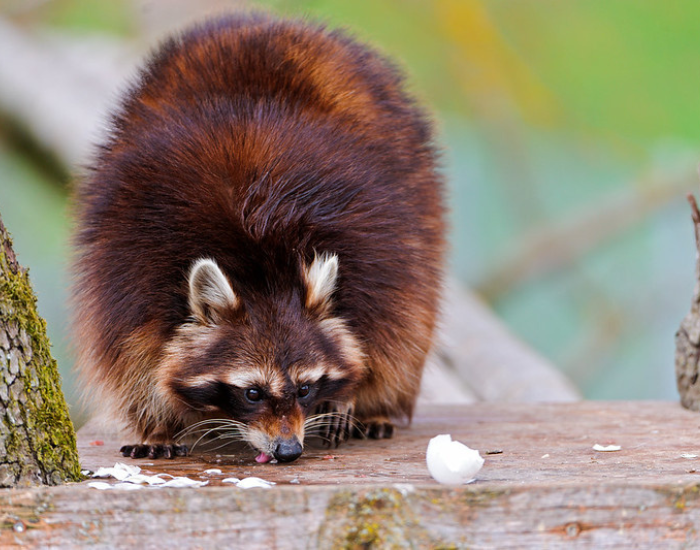
This is the part of the article that surprises most readers, because they have never heard the term “red raccoon” before. A red raccoon is not a separate species — it is a color phase of the common raccoon, marked by rich cinnamon, auburn, or rust-colored fur instead of the familiar gray. They appear across the species’ range, but they show up more often in certain regions of the southeastern United States, especially in lowland areas of Florida, Louisiana, and east Texas. Some hunters call any reddish individual a red raccoon; others reserve the term for the deepest cinnamon morphs.
Red raccoons are not particularly rare in a biological sense, but they are rare enough that most field biologists remember every one they have ever seen. If you live in a region where they occur, set a wildlife camera near water and you may capture a red raccoon. Hunters and trappers in the southern United States have long acknowledged them as a distinct color form, and modern field guides increasingly mention red raccoons by name. The fur trade once paid a premium for red raccoon pelts, which is part of why the term “red raccoon” survives in regional vocabulary today.
5. They’re Remarkably Intelligent
Raccoons routinely outperform dogs and cats on puzzle tasks. The classic 1907 study by H.B. Davis, and the long line of cognitive research that followed it, found that raccoons could remember the solution to complex locks for at least three years. In more recent work, raccoons were given the classic Aesop’s fable test (dropping stones into a tube to raise the water level and reach food). While some dropped stones, others simply used their dexterous paws to hack the system, tipping the tubes over entirel, proving their problem-solving is entirely practical.
I have never trusted a latch on a trash can since I started watching raccoons in the wild. Their problem-solving is not random fumbling. It is methodical, patient, and frequently social. A juvenile raccoon will spend long minutes watching its mother manipulate a clasp, then try variations. That kind of observational learning is the cognitive signature of animals we usually consider “smart” — primates, corvids (like crows or ravens), elephants. The raccoon belongs on that short list, and the more time you spend around them, the more obvious it becomes.
6. Their Range Has Quietly Conquered the Continent
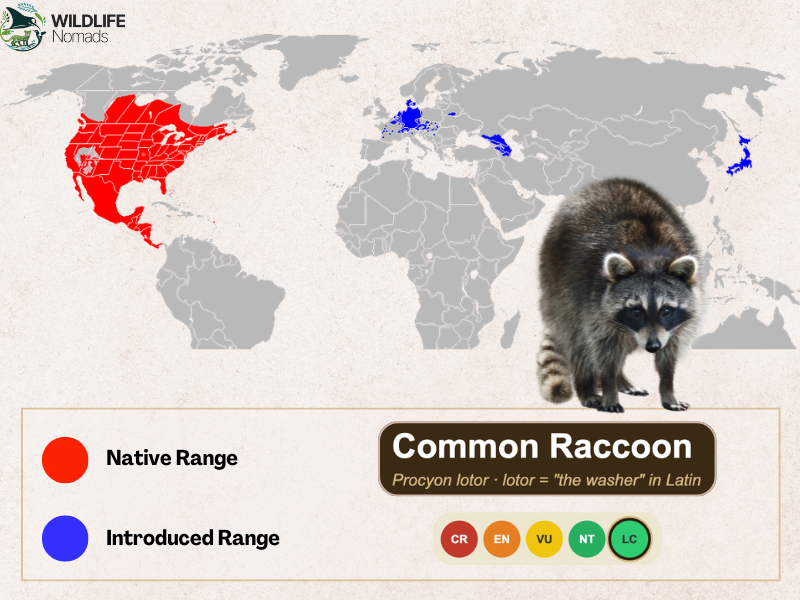
The common raccoon is native from southern Canada down to Panama, and it is the dominant procyonid across most of that range. In the United States, raccoons are found in every state except Hawaii. In Texas, raccoons thrive from the Piney Woods to the Gulf coast, often outnumbering coyotes and gray foxes in suburban surveys. Raccoons are also found around lakes, rivers, and farmland wherever humans have built reliable food sources for them. Wherever humans build, raccoons usually follow. Their adaptability is the reason, and few wild mammals match a raccoon for sheer ecological range.
That same adaptability has made the raccoon an invasive species elsewhere. Raccoons released or escaped from fur farms in the mid-twentieth century established wild populations in Germany, Japan, and parts of the former Soviet Union. In Japan, where I researched the tanuki, I saw firsthand how the raccoon is now displacing native species in some areas. It is a sobering reminder that a charismatic North American mammal can become an ecological problem when shipped overseas. The world is smaller than it looks, and raccoons travel well. The expansion across Europe is one of the most dramatic range stories of any modern mammal across the world.
7. They’ve Mastered Human Spaces, The Trash Panda Truth
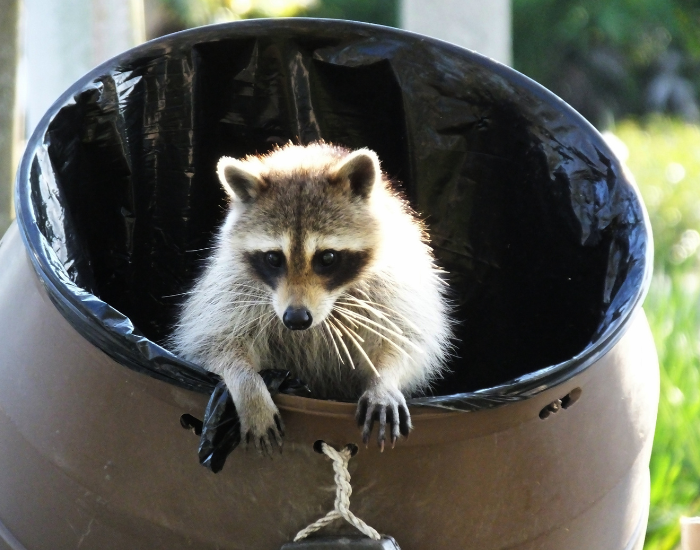
The “trash panda” nickname is funny, but it sells the animal short. Raccoons did not stumble into human garbage by accident. They were pre-adapted for it — omnivorous, dexterous, intelligent, comfortable in trees and on the ground, active at night when most predators sleep. Human neighborhoods are essentially raccoon paradise, and a raccoon that learns one house can pay regular nightly visits for years.
The two times I watched raccoons at a friend’s house in Mexico, they moved like cat burglars. No noise, no rush. One raccoon worked the lid of the trash can with both hands while the other stood watch, eyes shining in the porch light. It took less than a minute. That kind of coordinated foraging is common in urban areas, where raccoons learn to exploit predictable food sources and quickly acknowledge which houses around them leave the easiest meal. In studies of urban populations, raccoons living near humans have shown larger brain regions associated with behavioral flexibility than rural raccoons. We are, accidentally, breeding a smarter raccoon. Every time we post a new garbage schedule, the raccoons appear to read it.
8. Raccoon Family Life Is More Complex Than You Think
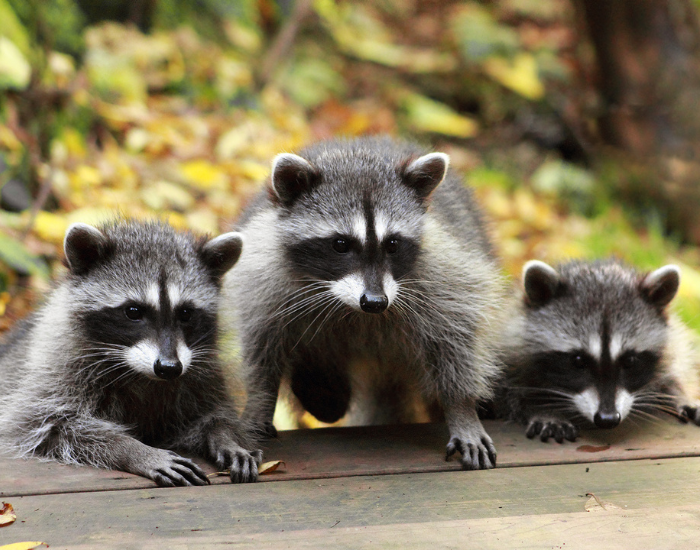
Raccoons typically breed in late winter, with mating season peaking from January through March across much of their range. After about a 63-day gestation, females give birth in a sheltered den — often a hollow tree, an abandoned burrow, or, increasingly, a quiet attic. Raccoon dens vary by region; in colder areas, dens are insulated rock crevices, while in southern areas dens are often hollow trees. Litters average three to five raccoon kits, born blind and helpless. Their eyes open at around three weeks of age.
Mothers raise their raccoon kits alone. Males play no role after mating. The kits stay with their mother through the summer and are weaned by mid to late summer, though many continue traveling with her into the fall. Sexual maturity arrives at about one year for females and two for males. I have found raccoon dens in surprising places, once inside the rafters of an old barn in central Mexico, where a female raccoon and her four kits regarded me with the kind of calm that only raccoon mothers of small, hungry kits can summon.
9. The Raccoon Diet: Truly Omnivorous
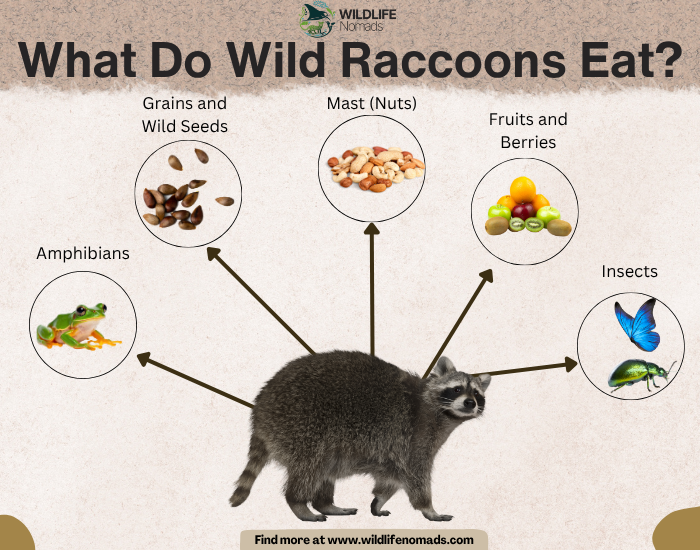
If you want to understand why raccoons survive almost everywhere, look at the diet. Raccoons eat insects, crayfish, frogs, small fish, bird eggs, nestlings, fruits, nuts, acorns, corn, berries, carrion, and an unsettling variety of human garbage. In coastal areas, raccoons forage along lakes and tidal flats for crabs and mollusks. In oak forests, they pack on weight in late summer eating fallen acorns and other forest food.
That flexibility is the foundation of their success. Raccoons do not depend on a single food source, which means a bad year for fruits is offset by a good year for insects, and a dry season is offset by a productive shoreline. In one long-term study in Illinois, researchers found that the diet of urban raccoons overlapped only about thirty percent with the diet of rural raccoons in the same county. Same species, different menu. Few mammals on the planet are that plastic with food choices, and that plasticity is why we keep finding raccoons in places they “should not” be.
10. Rabies, Conservation, and the Ethics of Coexistence
Raccoons are a primary reservoir of the raccoon rabies virus variant in eastern North America. That is the uncomfortable fact behind every “do not feed the raccoons” sign. Rabies in raccoons is real, and humans who are scratched or bitten should seek medical care immediately. Scratches from a raccoon’s claws can transmit other pathogens too, so even minor scratches from a wild raccoon deserve attention. Rabies cases in raccoons are still rare relative to the millions of raccoons alive across North America, but rare does not mean impossible. Fewer than five human deaths from raccoon rabies have ever been documented in the United States. The risk is small but not zero.
The IUCN lists the common raccoon as Least Concern, and the global raccoon population is increasing. Threats remain — vehicle collisions, predation by coyotes and large dogs, distemper outbreaks, and persecution as a nuisance species. Many raccoons are killed each year on highways, and kits are sometimes abandoned when mothers are struck. If you find a raccoon kit that looks abandoned, leave it for several hours before intervening. Mothers often return. Coexistence with raccoons means securing trash, sealing attic gaps, and resisting the urge to feed them. The animal does not need our help. It needs our restraint, and a little long-term patience from the humans who share its world.
Frequently Asked Questions
No, raccoons are not rodents. The common raccoon belongs to the family Procyonidae, a group of small New World carnivores that includes coatis, kinkajous, and ringtails. Their closest living relatives are other procyonids, not rats, mice, or squirrels.
A red raccoon is a color variation of the common raccoon, with cinnamon or auburn fur instead of the typical gray. Red raccoons occur naturally across the species’ range and are most often reported in the southeastern United States. They are not a separate species.
The common raccoon is native to North and Central America, from southern Canada through Panama. Raccoons are found in every U.S. state except Hawaii, with strong populations in Texas, the Midwest, and the Southeast. Raccoons have also become invasive across parts of Europe and Japan, where humans accidentally released them long ago.
No. Raccoons are intelligent, curious, and remarkably destructive. They do not stay tame as adults, and many areas prohibit keeping them. They also carry diseases including rabies and roundworm, and their scratches and bites are a real risk. Wild raccoons should remain wild.
Coexisting with the Cleverest Neighbor
The common raccoon is one of those animals we walk past in our suburbs, dismiss as trash bandits, and never quite see for what it is — a brilliant, hand-eyed procyonid that has outsmarted nearly every predator we know, including us. If you have a moment of curiosity left after this raccoon deep-dive, take it outside. Watch the treeline at dusk. Listen for the soft scratches on a fence post, and look for the long ringed tail of a passing raccoon.
If you enjoyed this raccoon post, you will love my long write-up on the tanuki of Japan, the convergent story of raccoon dogs, and the cousins I keep meeting in the field — the coatimundi. Leave a comment with the strangest raccoon encounter you have ever had — a red raccoon at the feeder, a raccoon in the attic, a raccoon staring at you from a tree. I read every comment, and the rare ones make my week.
References:
Hohmann, U., & Bartussek, I. (2011). Der Waschbär (3rd ed.). Oertel + Spörer. Summary available at https://www.iucn.org/resources
Gómez-Sánchez, A. L., Pinacho-Pinacho, C. D., Barrios-Gutierrez, J. J., Guzmán-Valdivieso, I., Gonzalez-Romero, A., Fonseca-Leal, T., & López-Pérez, A. M. (2025). Baylisascaris procyonis Roundworm in Common Raccoon (Procyon lotor), Mexico. Emerging infectious diseases, 31(6), 1266–1269. https://doi.org/10.3201/eid3106.241672
Louppe, V., Leroy, B., Herrel, A., & Veron, G. (2019). Current and future climatic regions favourable for a globally introduced wild carnivore, the raccoon Procyon lotor. Scientific Reports, 9, 9174. https://doi.org/10.1038/s41598-019-45713-y
MacDonald, S. E., & Ritvo, S. (2016). Comparative cognition outside the laboratory. Comparative Cognition & Behavior Reviews, 11, 49–61. https://doi.org/10.3819/ccbr.2016.110003
PETTIT, M. (2010). The problem of raccoon intelligence in behaviourist America. The British Journal for the History of Science, 43(3), 391–421. https://doi.org/10.1017/S0007087409990677