I need to admit something upfront. I have never watched meerkats in the wild. Africa is the one continent I still haven’t properly worked in (Egypt aside) and the Kalahari sits stubbornly near the top of my list. So my time with these animals has been the same as yours: zoo glass, documentary footage, and one very catchy song about no worries.
That’s exactly why I wanted to write this. Almost everyone has met a meerkat through Timon, and almost nobody knows what the real animal does all day. The gap between the cartoon and the biology is enormous, and the biology is better.
Here’s what you’ll get. How their underground burrows actually work. Why one mob member always stands upright while the others eat. How they shrug off scorpion stings, and why a dominant female runs the whole operation. Some of it will change how you look at the next zoo meerkat you meet.
What Exactly Are Meerkats?
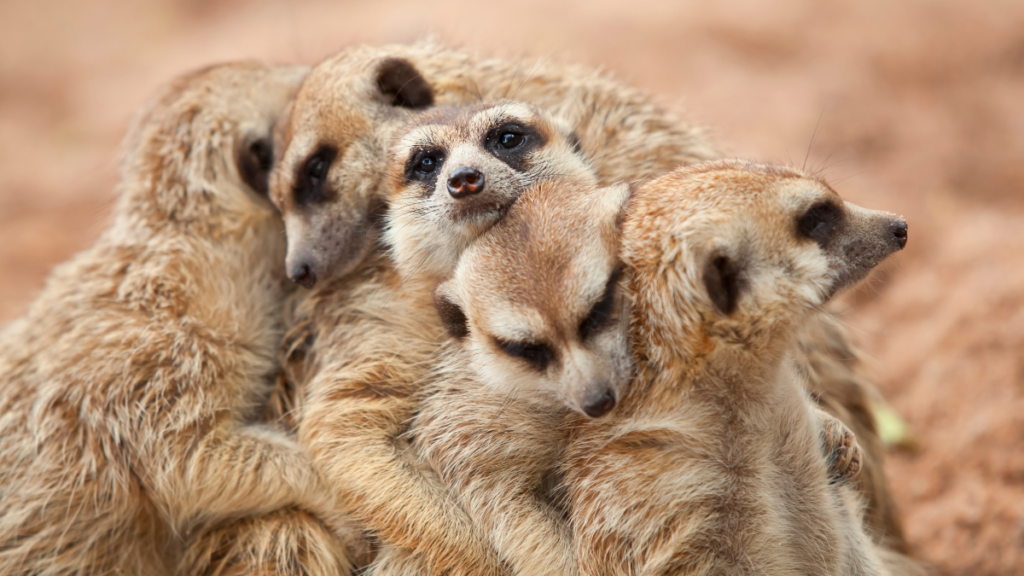
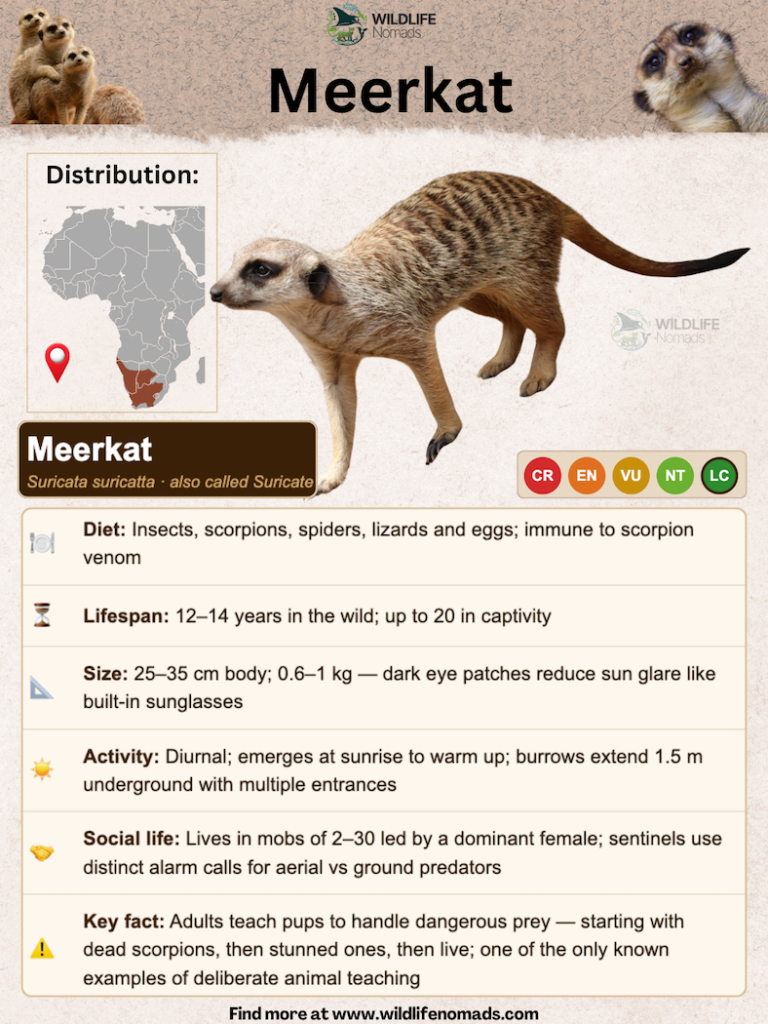
Meerkats (Suricata suricatta) are small carnivorans native to southern Africa but they avoid moist coastal regions and fynbos at the southern tip. They belong to the mongoose family, Herpestidae, alongside relatives like the Liberian mongoose and the yellow mongoose. Despite the “kat” in the name, they share no close kinship with cats.
Physically, they’re unremarkable at first glance. Adults measure around 9 to 11.5 inches long and weigh roughly 1.4 to 2.1 pounds. Picture squirrel size members of a family group, with brown striped fur, a pointed face, and a permanently alert posture.
Their range covers the southern tip of the continent, the Kalahari Desert, parts of the Namib, and the dry scrub between them. That’s harsh country. Everything interesting about meerkats traces back to solving that problem together.
1. Meerkats Are Mongooses, Not Cats
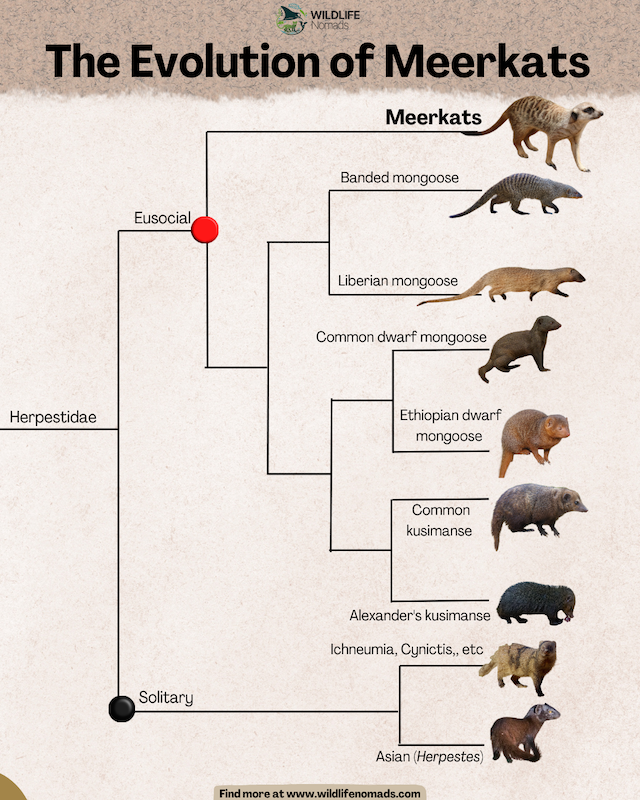
The mongoose family contains roughly 34 mongoose species, and meerkats are the only member of the genus Suricata. Their skeletal structure and teeth closely resemble those of the earliest carnivores, which makes them a useful window into carnivore evolution.
However, they broke the family mold in one big way. Most mongoose species live alone or in pairs. Meerkats went all-in on group living, and that single decision shaped everything else about them.
2. They Survive the African Desert Without Drinking Water
Meerkats live in the Kalahari Desert and the Namib Desert, two of the driest landscapes on the planet. Rainfall is unpredictable, summer surface temperatures roast, and winter nights drop near freezing.
They handle it without a water source. Moisture comes from roots, tubers, and fruit such as tsama melons. In addition, they own a home territory of about 4 square miles and rotate through it, hunting a different section each day before returning roughly a week later. That rotation prevents them from stripping any one foraging area bare.
3. Their Burrows Are Underground Cities
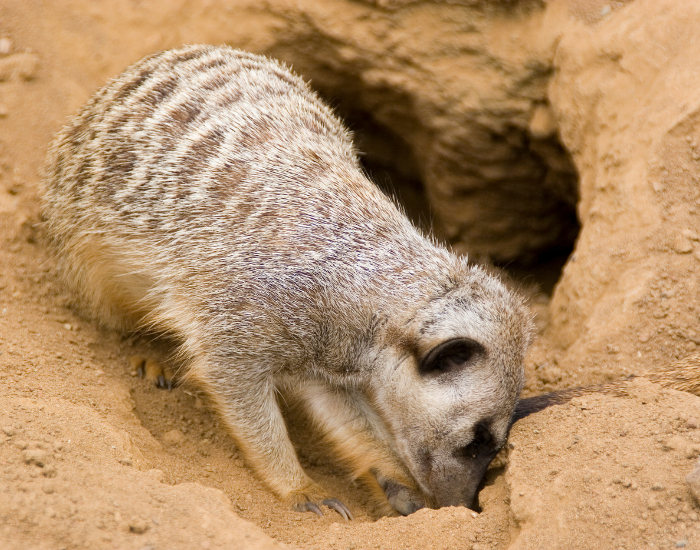
Meerkats living underground isn’t a detail, it’s the foundation of their entire strategy. Burrow systems run about 16 feet (5 meters) long, with chambers dropping as deep as 6.5 feet (2 meters). Multiple entrances, often around 15 of them, allow a fast exit in any direction.
Deep tunnels hold a steady temperature regardless of the harsh African heat above. Each mob maintains several separate burrows across its territory and relocates every few months. Interestingly, they usually don’t build from scratch, they move into and expand systems dug by ground squirrels.
4. Four Toes and Sharp Claws Make Them Elite Diggers
Here’s a small anatomical oddity with big consequences. Meerkats have four toes on each foot, while most mongoose species have five. Those four toes carry long, non-retractable sharp claws built purely for excavation.
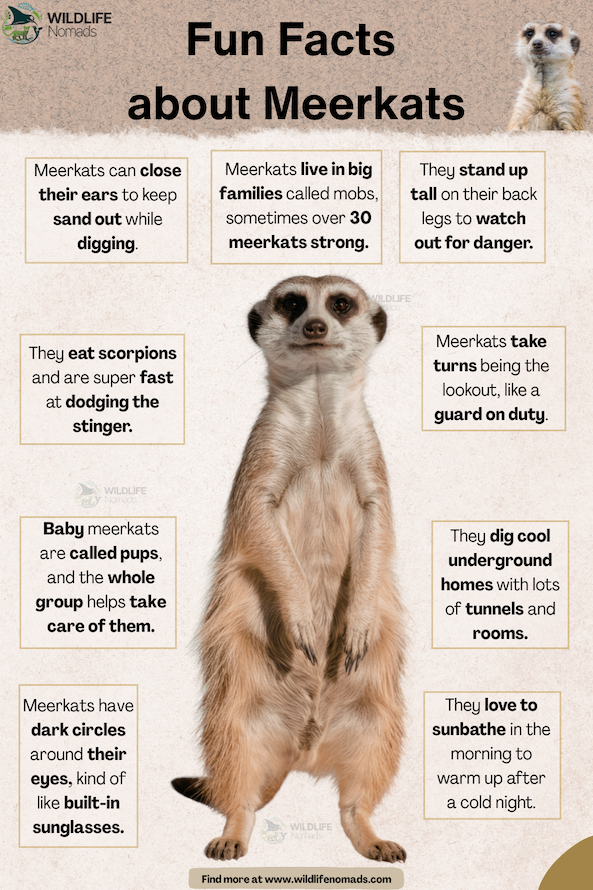
The result is genuinely hard to believe. A meerkat can shift sand equal to its own body weight in a matter of seconds. To keep the debris out, they can seal their ears shut while digging, and a protective membrane slides across each eye.

5. Those Dark Patches Around Their Eyes Are Built-In Sunglasses
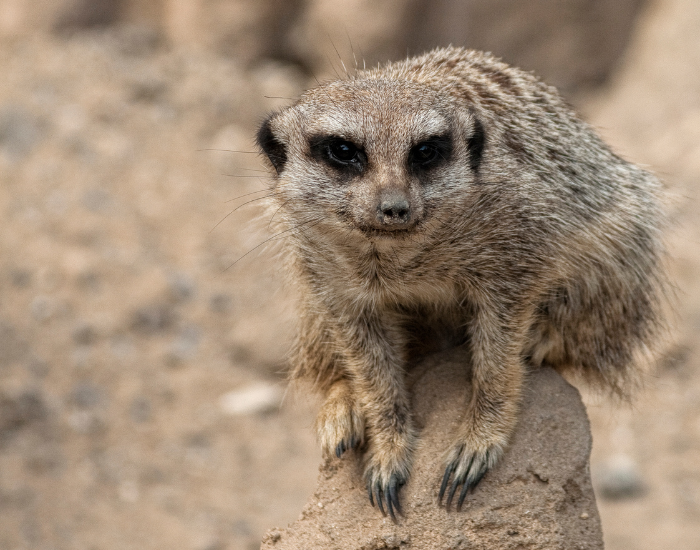
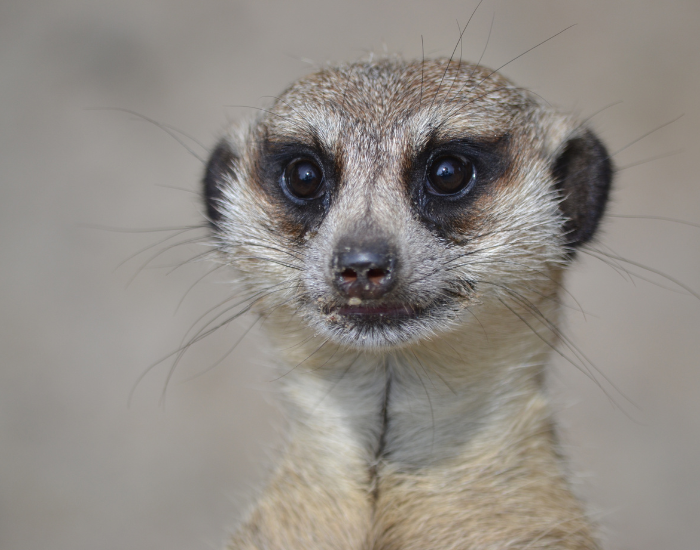
The dark patches around a meerkat’s eyes aren’t decoration. They absorb light and cut the sun’s glare bouncing off pale Kalahari sand, functioning much like the eye black athletes wear.
Their pupils add another layer. Long and horizontal, they deliver a wide field of vision, useful when hungry predators can arrive from any direction. Dark skin on their thin-furred bellies completes the toolkit, letting them absorb heat quickly on cold mornings.
6. A Dominant Female Runs Everything
Meerkats have a matriarchal society. Each mob is led by a dominant alpha female and her alpha male partner, and that dominant pair produces most of the offspring in the group. Subordinate females rarely breed successfully.
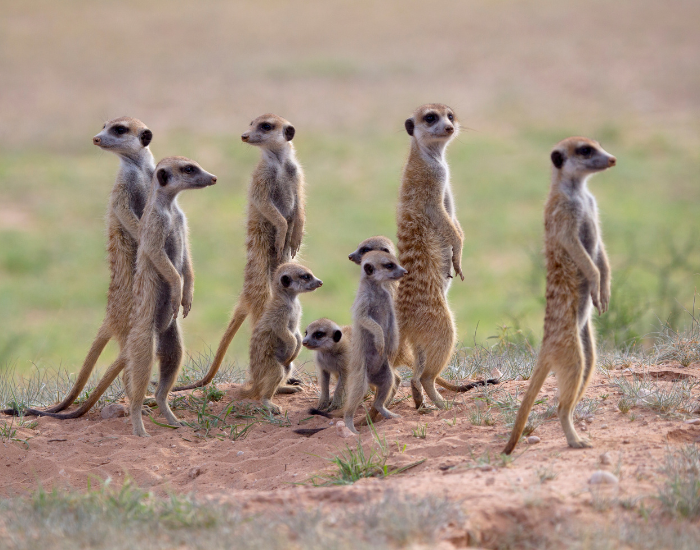
Mob size ranges widely. Most groups hold 10 to 20 individuals, though meerkat mobs can consist of up to 50 members. Large groups mean more helpers, and more helpers means better odds for every animal in those family groups, a pattern documented across three decades at the Kalahari Meerkat Project.
7. Guard Duty Rotates, and the Sentry Speaks in Code
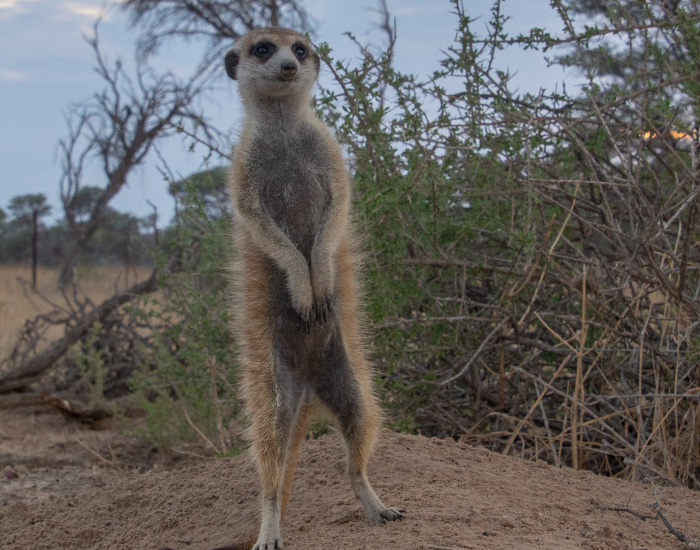
One meerkat acts as a sentry while the rest of the mob forages. The guard climbs the highest rock, termite mound, or bush available, stands upright on two legs, and announces the shift with a specific call. While all is calm, it produces a low, constant peeping known as the “watchman’s song.”
The alarm system gets more sophisticated from there. Meerkats communicate with different calls for various predators, distinguishing threats from the sky from threats on the ground, and encoding urgency in the call structure. Research published in Scientific Reports found these discrete call types measurably improve how efficiently the sentinel system works. Duty rotates constantly, so no single animal starves while keeping mob members safe.
8. They Eat Scorpions, and Can Kill Venomous Snakes
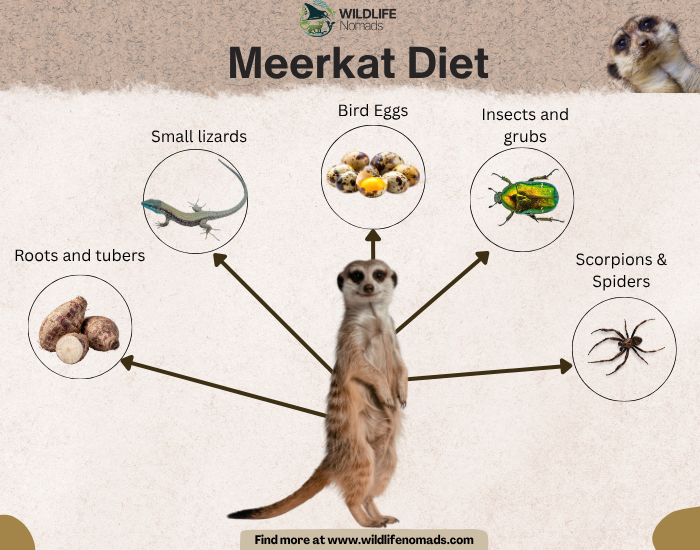
Insects dominate the meerkat diet, especially beetles. The menu runs broader than that, though. They eat small reptiles, spiders, snails, rodents, birds, and eggs. A keen sense of smell locates prey buried under sand, and they dig it out fast.
Scorpions are the showstopper. Meerkatspossess high physiological tolerance/resistance to specific Kalahari scorpion venoms (such as Parabuthus species), so a sting that would drop a similar-sized mammal barely slows them down. That said, a scorpion’s pincers still cause real damage, so technique matters. Mobs also eat venomous snakes, but never solo, the mob participates as a unit, attacking together until the snake tires.
Nobody looks at a meerkat and sees a vicious animal. By contrast, a Kalahari scorpion probably disagrees.
9. Adults Actively Teach Meerkat Pups to Hunt
This is my favorite meerkat fact, and it’s one of the cleanest examples of teaching known outside primates. Adults don’t just feed pups. They deliberately scale the difficulty of the prey.
Young meerkats first receive dead scorpions. Next come live ones with the stinger removed, then live intact prey once the pup can handle it. Alex Thornton and Katherine McAuliffe demonstrated in Science that adults adjust this sequence based on the pup’s begging calls, a high pitched squeal signals a younger, less capable learner. Very few animals teach this explicitly.
10. Babysitters Stay Home While Mom Forages
Newborn pups arrive hairless, with eyes and ears shut. Their eyes open around two weeks, they start eating solid food at three weeks, and they first emerge from the burrow at four weeks.
Meanwhile, the mother needs to forage to produce milk. Therefore several babysitters: both males and females, stay behind to protect pups. These different members of the mob also defend the young against rival meerkats, since rival mobs will kill pups they find. Other members of the group rejoin the foraging party once their shift ends. Babysitting duties rotate, and the more babysitters present, the higher the pup survival rate climbs.
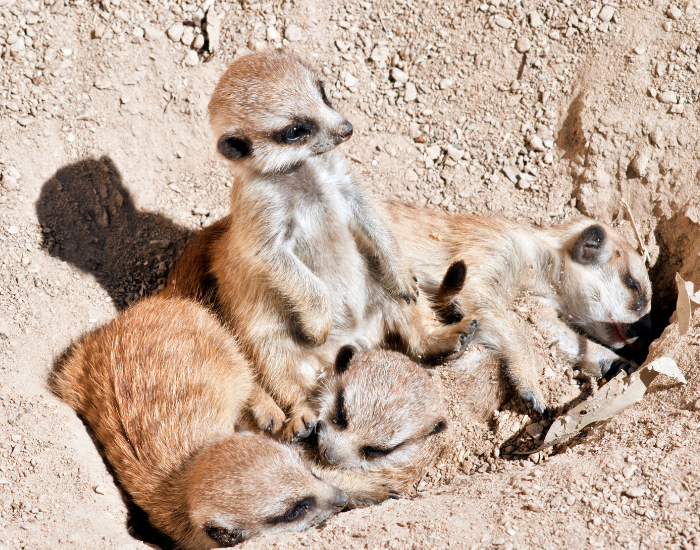
11. Cooperation Is the Entire Survival Strategy
Meerkats are extremely social animals, and the science backs up why. Clutton-Brock and colleagues showed in Science that cooperative behaviors in meerkats increase the survival of the entire group, with helper numbers driving pup growth rates and first-year survival.
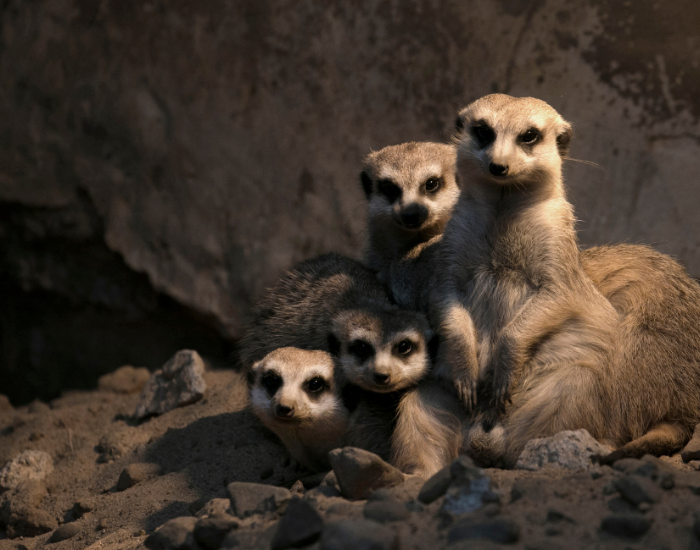
The daily rhythm reflects it. The mob emerges shortly after sunrise to warm up in the sun, then heads out to forage as a coordinated unit. At night, meerkats often huddle together to conserve warmth. Even bolt holes (emergency escape tunnels scattered across the territory) are shared knowledge, and every meerkat memorizes thousands of them.
12. They’re Least Concern, but Life Is Still Difficult
Meerkats are classified as Least Concern by the IUCN. They are not considered threatened or endangered, and their populations across southern Africa remain stable.
Stable is not the same as easy, though. Wild meerkats live a very difficult life, typically surviving six to eight years. Predation accounts for roughly a quarter of deaths. Furthermore, a species-specific tuberculosis strain, Mycobacterium suricattae, spreads through mobs and kills, while rainstorms flooding burrows and losing fights with rival meerkats claim more. Meerkats are constantly threatened, which is precisely why the group system evolved.

FAQs About Meerkats
Wild meerkats live only in southern Africa — South Africa, Botswana, Namibia, and southwestern Angola. Kgalagadi Transfrontier Park and Botswana’s Makgadikgadi Pans offer the most reliable wild sightings. Otherwise, zoo meerkat exhibits are common worldwide; the San Diego Zoo meerkats are among the best-known. Watching a captive mob rotate guard duty is a legitimate way to see real behavior.
Predation is the leading cause, at roughly 25% of deaths. Tuberculosis caused by Mycobacterium suricattae is a major second factor in studied Kalahari populations. Starvation during drought, pup killing by rival mobs, and burrow flooding during heavy rainstorms account for much of the rest.
Martial eagles and tawny eagles are the most dangerous, striking from above with almost no warning. On the ground, jackals, caracals, and large snakes hunt them. Rival meerkats count too, territorial fights between mobs turn lethal surprisingly often.
Yes, though they frequently expand burrows started by ground squirrels rather than digging from zero. A mature burrow system runs about 5 meters long with multiple entrances, dedicated sleeping chambers, and separate toilet chambers. Each mob maintains several separate burrows and rotates between them every few months.
Why Meerkats Deserve a Second Look
Strip away the Timon voice, and you find something better than a comic sidekick: a small carnivore that solved the African desert by refusing to face it alone. Rotating guards, shared babysitters, taught hunting lessons, meerkats built a society because a single meerkat in the Kalahari simply doesn’t make it.
I’m still waiting on my first wild sighting. Until then, I’ll take the zoo glass and the long-term data from the Kalahari.
If a meerkat mob is your kind of animal, you’ll like the neighbors too, the savanna next door runs on the same logic at a much larger scale. And the next time you’re at a zoo, skip the photo for two minutes. Find the one standing upright on its hind legs, and watch how long it holds the post. Tell me in the comments what you noticed.
Meerkats: Fact or Fiction? 🦫
Twelve statements about the Kalahari’s tiniest team players — six true, six myths. Can you tell them apart?
Fact or Fiction?
Find Incredible Experiences with Meerkats!
This blog is reader-supported. When you buy experiences through links listed on this site, we may earn an affiliate commission.
References:
Clutton-Brock, T. H., Russell, A. F., Sharpe, L. L., Brotherton, P. N. M., McIlrath, G. M., White, S., & Cameron, E. Z. (2001). Effects of helpers on juvenile development and survival in meerkats. Science, 293(5539), 2446–2449. https://doi.org/10.1126/science.1061274
Jordan, N. R., & Do Linh San, E. (2015). Suricata suricatta. The IUCN Red List of Threatened Species 2015, e.T41624A45209377. https://doi.org/10.2305/IUCN.UK.2015-4.RLTS.T41624A45209377.en
Patterson, S., Drewe, J. A., Pfeiffer, D. U., & Clutton-Brock, T. H. (2017). Social and environmental factors affect tuberculosis related mortality in wild meerkats. Journal of Animal Ecology, 86(3), 442–450. https://doi.org/10.1111/1365-2656.12649
Rauber, R., & Manser, M. B. (2017). Discrete call types referring to predation risk enhance the efficiency of the meerkat sentinel system. Scientific Reports, 7, 44436. https://doi.org/10.1038/srep44436
Russell, A. F., Clutton-Brock, T. H., Brotherton, P. N. M., Sharpe, L. L., McIlrath, G. M., Dalerum, F. D., Cameron, E. Z., & Barnard, J. A. (2002). Factors affecting pup growth and survival in co-operatively breeding meerkats Suricata suricatta. Journal of Animal Ecology, 71(4), 700–709. https://doi.org/10.1046/j.1365-2656.2002.00636.x
Thornton, A., & McAuliffe, K. (2006). Teaching in wild meerkats. Science, 313(5784), 227–229. https://doi.org/10.1126/science.1128727