
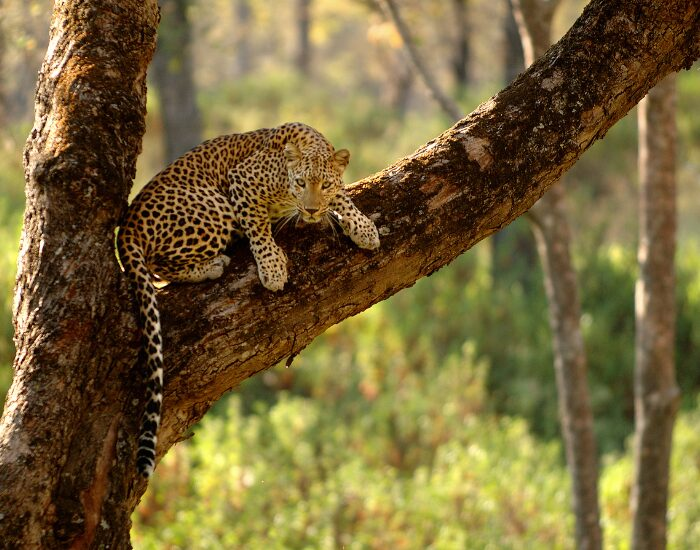
A few years back, I was sitting around a bush camp in Australia, swapping notes with a guide who used to work in Botswana. He told me this story of how he watched a female leopard drag a young giraffe carcass up a leadwood tree at dusk. He called it a “black panther” because the light was fading and her coat looked almost ink-dark against the bark. I smiled, poured another cup of coffee, and realized this confusion, even among seasoned guides, is exactly why I wanted to write about leopards species in the first place.
I have written about clouded leopards, how tourism could help the snow leopard, and how people confuse jaguars, cheetahs, and leopards. But the question I hear most often is simple: how many leopards are there, really? The answer is messier, and far more interesting, than most documentaries suggest. Here are 12 things I think every nature lover should know.
1. There Is Only One True Leopard Species: Panthera pardus
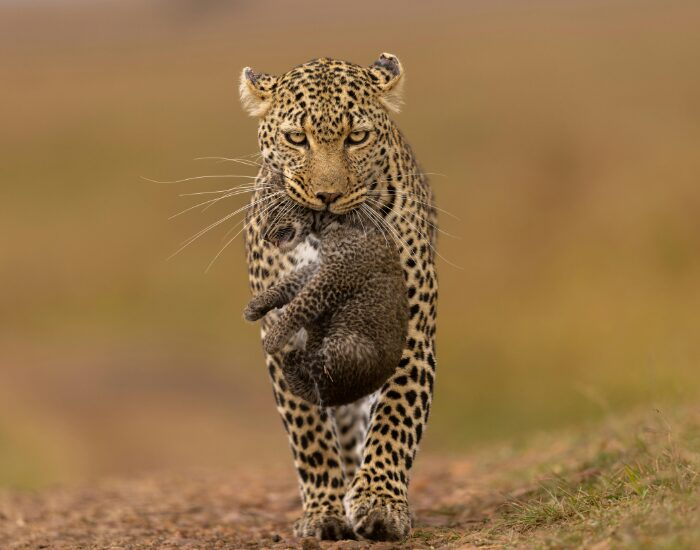
When biologists talk about leopards species in the strict sense, we are talking about one animal: Panthera pardus. Every rosette-covered cat you see from Cape Town to Vladivostok belongs to the same species. The “different leopards” people describe across africa and asia are actually geographic variants, not separate species. That single fact unlocks almost everything else about leopard biology.
What makes panthera pardus so remarkable is its range. No other big cat on Earth covers such varied leopard habitats, from dry habitats in the Namib to dense forests in the Western Ghats. Among all the big cats, leopards are the ultimate generalists.
2. Nine Subspecies, One Incredibly Adaptable Cat
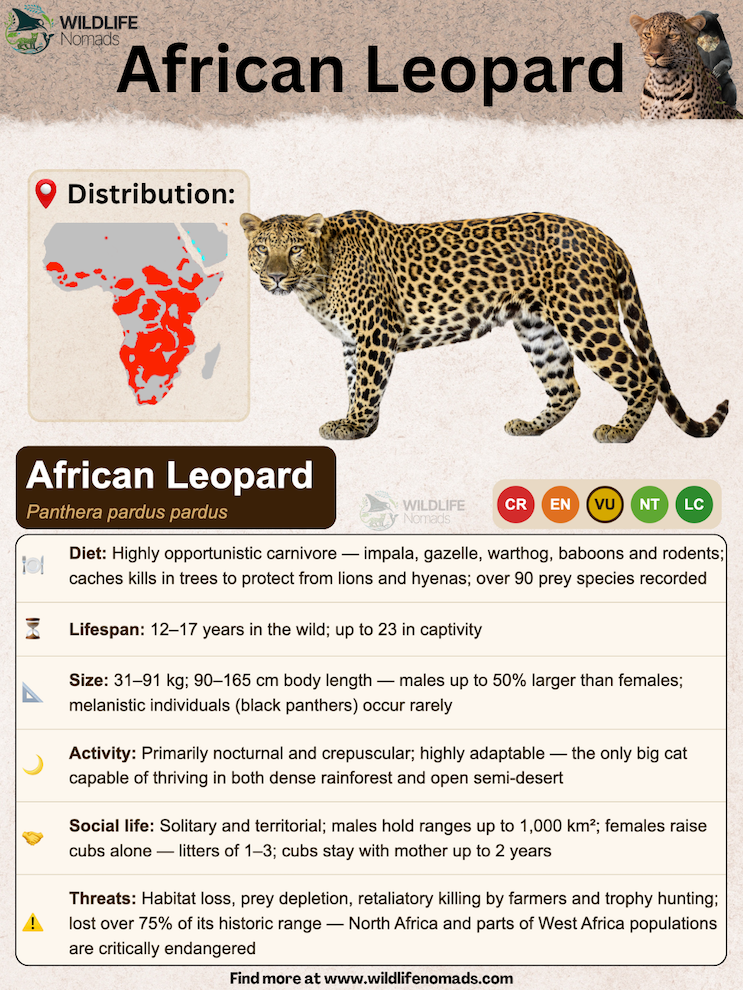
Conservation scientists currently recognize nine subspecies of leopard, each adapted to a specific region. The African leopard (P. p. pardus) roams sub saharan africa. The Indian leopard dominates the subcontinent. The Arabian leopard clings to cliffs in the Middle East. The Persian, Javan, Sri Lankan, Indochinese, North Chinese, and Amur leopards round out the list.
These nine subspecies are not separate species, but they are genetically distinct enough to matter for conservation. An African Journal of Ecology paper I return to often shows that southern african leopards and Amur leopards diverged hundreds of thousands of years ago. Same species, wildly different worlds.
3. The Black Panther Is Not a Species At All
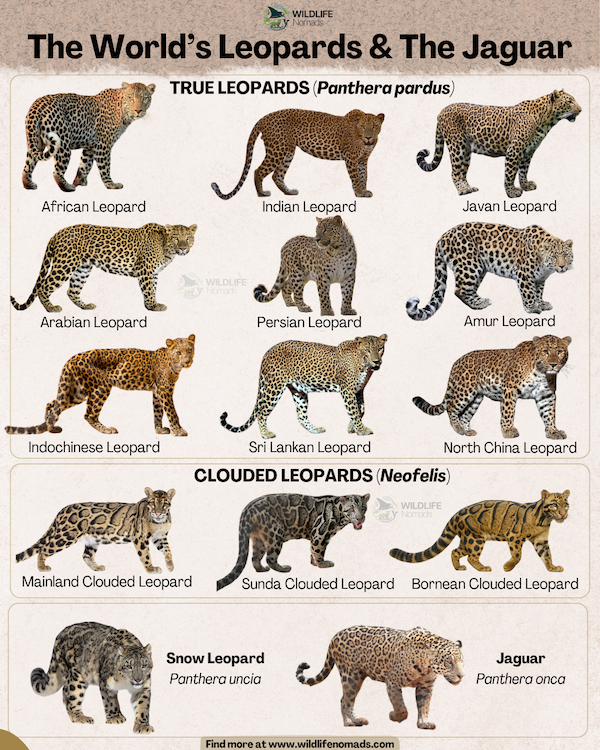
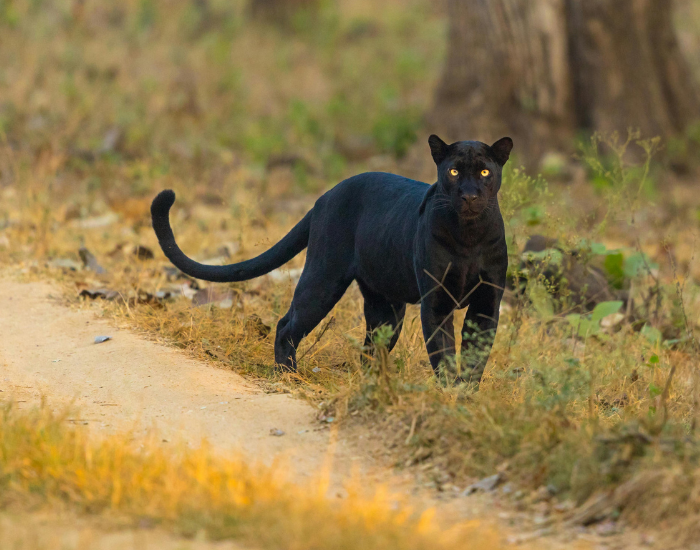
Here is the myth I bust most often: a black panther is not a species. It is a color morph. Black leopards (in Asia) and black jaguars (in south america) carry a recessive gene that produces excess melanin, giving them that inky coat. When people search “panthera pardus black” or ask about black panther animal predators, they are almost always looking at a melanistic leopard or jaguar.
If you shine a flashlight on a black leopard at the right angle, the spotted pattern is still there, ghosted beneath the dark fur. Melanism is more common in dense vegetation, where a dark coat helps with stalking prey in low light.
4. Those Spots Have a Name, and a Purpose
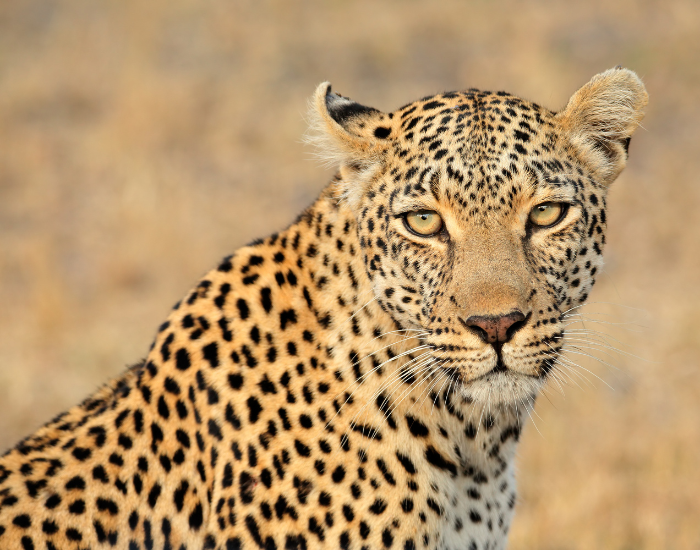
Leopards wear irregular spots called rosettes, clustered shapes that look like paw prints pressed into light yellow fur. The spotted pattern is unique to each cat, which lets researchers identify individual leopards from camera-trap images the same way we identify humans by fingerprints.
In open savanna grasslands, rosettes break up the body’s outline at dawn and dusk. In dense bush, they mimic dappled light. It is a dream to walk within twenty meters of a resting leopard in the Okavango and never seen her until she blinked.
5. Leopards Are the Most Successful Big Cat Hunters
Leopards hunt more prey species than any other big cat, full stop. Their diet leopards studies from east africa list over 90 different prey species, from dung beetles to a young giraffe. They are opportunistic hunters in the purest sense, which is why leopard populations persist where lions and cheetahs have vanished.
Leopards prey on whatever the landscape offers. In central africa, that means forest antelope and primates. In the Caucasus, wild goats. And in Mumbai’s outskirts, feral dogs. Prey availability, not habitat preference, drives where leopards live.

6. The Leopard Family Tree Is Full of Surprises
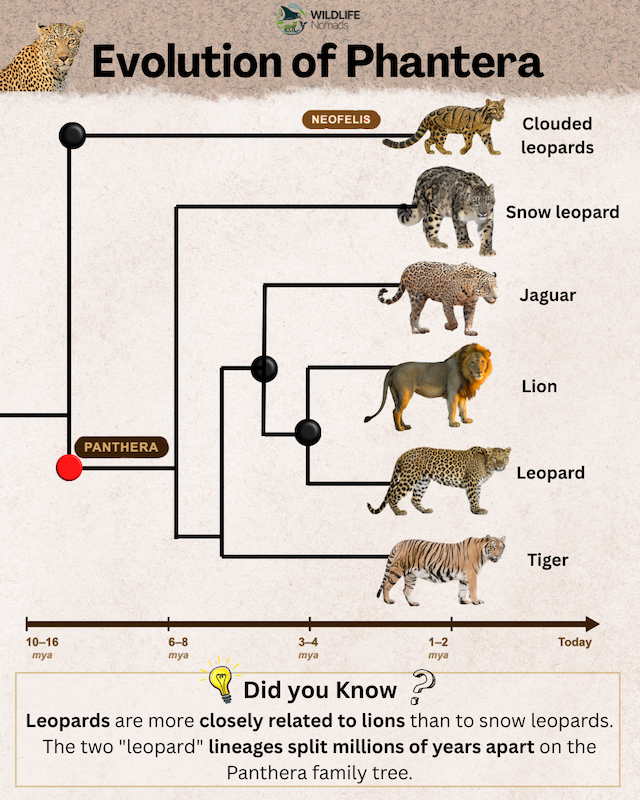
Most people assume all cats with “leopard” in the name are close relatives. The phylogenetic evidence tells a different story. The genus Panthera split from Neofelis (the clouded leopards) roughly 10 to 16 million years ago. Within Panthera, the snow leopard diverged early, somewhere around 3 to 4 million years ago, and ended up on a completely different branch from the true leopard.
The infographic below shows this clearly. The snow leopard sits closer to the tiger lineage than to the leopard. The true leopard (Panthera pardus) shares its immediate clade with the lion, not the snow leopard. And the clouded leopard? It belongs to a separate genus entirely, Neofelis, which branched off before any of the large cats we know today had evolved.
7. They Are the Ultimate Solitary Animals
Leopards are solitary animals, unlike the social lions of southern africa. Adult males patrol large territories marked with scent, scrapes, and claw marks on tree trunks. Female leopard territories overlap with one or two males. Outside the breeding season, contact between adults is brief and often tense.
This solitude is why so few cats are as hard to study. Unlike painted dogs or spotted hyenas, which advertise themselves constantly, leopards tend to disappear into dense bush at the first sign of a vehicle. Most of what we know comes from collar data and patient camera-trap work.
8. Leopards Are Among the Few Roaring Cats
Only four species in the panthera species group can truly roar: lions, tigers, jaguars, and leopards. A leopard’s roar is not the deep rumble of a lion. It sounds like someone sawing through hardwood, a rasping “prusten-saw” that carries for kilometers across savanna grasslands.
9. Life Cycle: From Hidden Cubs to Adult Males
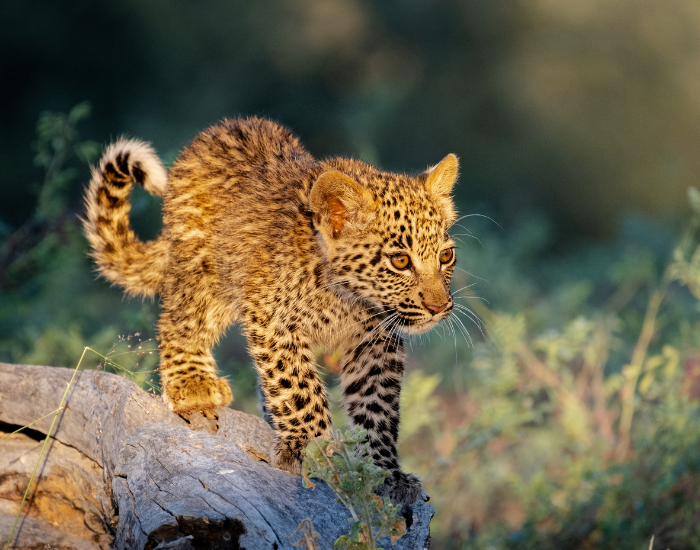
A female leopard gives birth to two or three leopard cubs after a roughly 96-day gestation. She hides them in rock crevices or hollow logs for the first six weeks. When the cubs venture out, they shadow their mother for up to two years before dispersing.
Young leopards face brutal odds. Lions, spotted hyenas, and even other predators like baboons kill leopards cubs when they find them. Only about half survive to independence. Adult leopards, by contrast, have few cats or other predators that can challenge them once full-grown.
10. Leopard Life Span in the Wild and Captivity
In the wild, leopards live 12 to 15 years on average. In captivity at places like San Diego Zoo, leopard life span can stretch past 20. Male leopards carry a broad head and heavier build, often 50 to 70 kilograms of lean muscle. Female leopards are lighter, faster, and often better hunters.
I visited Kolmården Wildlife Park as a student and watched an old Amur leopard pacing his enclosure. He was nineteen. He had outlived every wild cousin of his generation.
11. Habitat Loss and Illegal Hunting Are the Real Killers
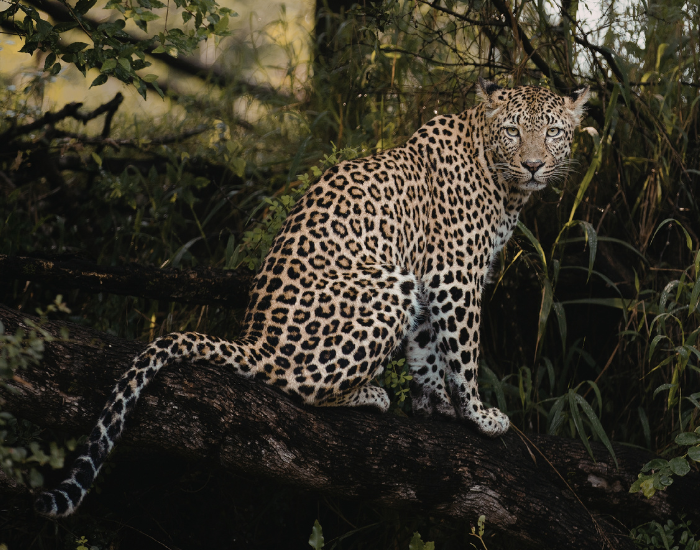
People kill leopards for three main reasons: retaliation for livestock, illegal hunting for leopard skins, and the bushmeat bycatch. Habitat loss compounds all of it. The African Wildlife Foundation estimates leopard range has contracted by more than 60 percent across africa and asia.
The U.S. Endangered Species Act lists several subspecies, and CITES regulates the skin trade. But enforcement is patchy. Namibian leopards are relatively stable thanks to conservancy programs, while the Amur leopard hovers near 100 individuals in the wild.
12. Leopards and People Live Closer Than You Think
Leopards are the only big cat that regularly thrives on the edges of cities. Mumbai’s Sanjay Gandhi National Park holds around 40 leopards inside a metro area of 20 million people. They hunt feral dogs, pigs, and the occasional goat. Attacks are rare given the density.
That is the reality of modern leopard conservation: it is not only about remote wilderness. It is about coexistence.
13. They have a Varied Diet!
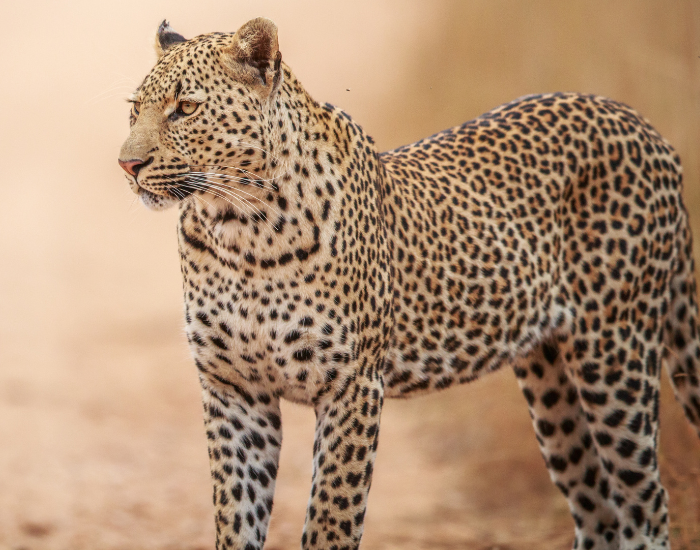
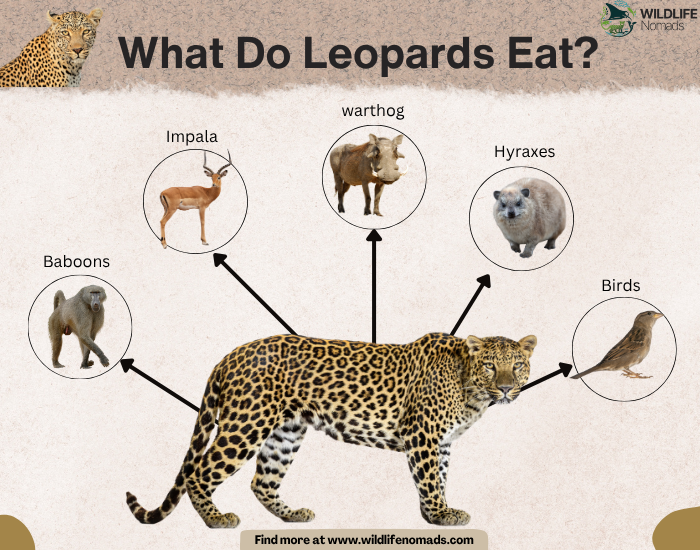
Leopards eat impala, bushbuck, warthog, primates such as baboons, and smaller prey including hyrax, hares, and birds. In urban fringes, they take feral dogs and livestock. Their broad diet is the secret to their survival.
FAQ about Leopards you May Have
In the wild, the main predators of leopards are lions and tigers, which kill both cubs and adults when ranges overlap. In south africa and east africa, lions are responsible for most documented leopard deaths outside human causes. Humans, through illegal hunting and retaliation, kill far more leopards each year than any natural predator.
Leopards actively avoid lions and tigers. They also give wide berth to large packs of spotted hyenas, which can drive a leopard off a carcass within minutes. Interestingly, leopards tend to avoid elephants and buffalo herds, not out of fear, but because these animals can injure a cat during a panicked trampling.
No. A black panther is simply a melanistic leopard (in Africa or Asia) or a melanistic jaguar (in South America). They are the same species as their spotted relatives, carrying a recessive gene for excess melanin. Shine a light on one, and the spotted pattern is still visible.

Final Thoughts
One species, nine subspecies, and a dozen misconceptions, that is the leopard in a sentence. Understanding that every rosette-covered cat from southern africa to southern china belongs to Panthera pardus changes how we think about conservation, coexistence, and the quiet cats walking through our collective imagination. Protect leopards in one region, and you protect the genetic thread that runs through all of them.
Next time you are in a national park at dusk, listen. That sawing rasp in the dark is a leopard announcing itself. Go find it. And when you do, tell me about it in the comments.
Where to See Leopards?
Here is a list of 3 tours where you can go on safari and see leopards. There are many safaris in Africa to spot them. As a biologist, I only recommend tours that follow strict ethical guidelines to ensure we don’t disturb wildlife. These are the three tours/ partners I trust most based on their conservation records:
This website is reader-supported. When you buy experiences through links listed on this site, we may earn an affiliate commission.
References:
Balme, G. A., Batchelor, A., de Woronin Britz, N., Seymour, G., Grover, M., Hes, L., … & Hunter, L. T. B. (2013). Reproductive success of female leopards Panthera pardus: the importance of top-down processes. Mammal Review, 43(3), 221–237. https://doi.org/10.1111/j.1365-2907.2012.00219.x
Braczkowski, A. R., O’Bryan, C. J., Stringer, M. J., Watson, J. E., Possingham, H. P., & Beyer, H. L. (2018). Leopards provide public health benefits in Mumbai, India. Frontiers in Ecology and the Environment, 16(3), 176–182. https://doi.org/10.1002/fee.1776
Davis, B. W., Li, G., & Murphy, W. J. (2010). Supermatrix and species tree methods resolve phylogenetic relationships within the big cats, Panthera (Carnivora: Felidae). Molecular Phylogenetics and Evolution, 56(1), 64–76. https://doi.org/10.1016/j.ympev.2010.01.036
Havmøller, R.W., Jacobsen, N.S., Scharff, N., Rovero, F. and Zimmermann, F. (2020), Assessing the activity pattern overlap among leopards (Panthera pardus), potential prey and competitors in a complex landscape in Tanzania. J Zool, 311: 175-182. https://doi.org/10.1111/jzo.12774
Jacobson, A. P., Gerngross, P., Lemeris, J. R., Schoonover, R. F., Anco, C., Breitenmoser-Würsten, C., … & Dollar, L. (2016). Leopard (Panthera pardus) status, distribution, and the research efforts across its range. PeerJ, 4, e1974. https://doi.org/10.7717/peerj.1974
Stein, A. B., Athreya, V., Gerngross, P., Balme, G., Henschel, P., Karanth, U., … & Ghoddousi, A. (2020). Panthera pardus (amended version of 2019 assessment). The IUCN Red List of Threatened Species. https://doi.org/10.2305/IUCN.UK.2020-1.RLTS.T15954A163991139.en
Miththapala, S., Seidensticker, J., & O’Brien, S. J. (1996). Phylogeographic subspecies recognition in leopards (Panthera pardus): molecular genetic variation. Conservation Biology, 10(4), 1115–1132. https://doi.org/10.1046/j.1523-1739.1996.10041115.x
Farhadinia, M. S., Johnson, P. J., Macdonald, D. W., & Hunter, L. T. B. (2018). Anchoring and adjusting amidst humans: Ranging behavior of Persian leopards along the Iran-Turkmenistan borderland. PLoS ONE, 13(5), e0196602. https://doi.org/10.1371/journal.pone.0196602