During my master’s in conservation biology in Australia, I became close friends with a fellow biologist who had spent years studying chimpanzees in the forests of Africa. He also worked with drills deep in the Nigerian rainforest. Every time he left that dense canopy and crossed into open savanna, the same encounter awaited him, baboons. Troops of them, scattered across the grasslands, watching him with an unnerving intelligence. His stories stuck with me. Baboons are not the background characters of the African wilderness. They are some of the most adaptable, socially complex, and misunderstood primates on the planet.
So what is a baboon, exactly? And why should you care about these loud, dog-faced monkeys? Here are 12 facts about baboons that reveal just how remarkable these animals truly are.
1. Baboons Are Monkeys, Not Apes
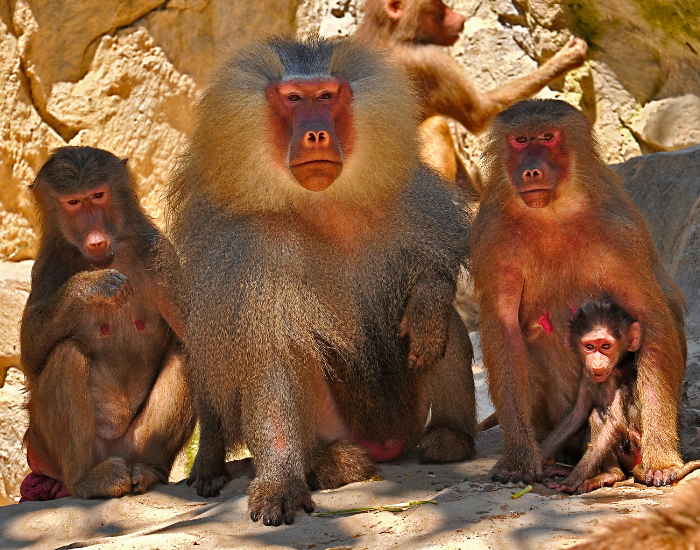
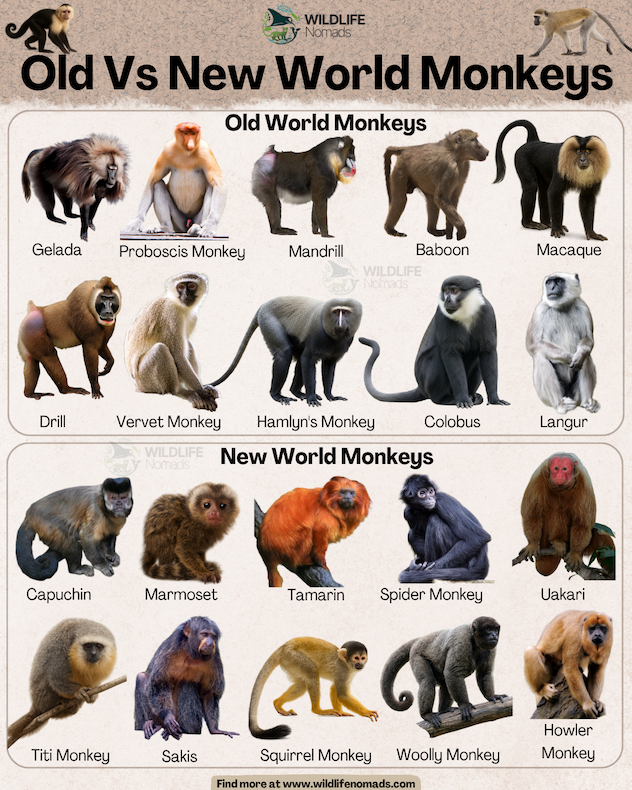
Let’s clear this up right away. Are baboons monkeys? Yes. Baboons belong to the family Cercopithecidae, making them Old World monkeys. They are not apes. The confusion pops up surprisingly often, probably because baboons are large, ground-dwelling, and sometimes walk with a posture that looks vaguely ape-like. However, baboons have tails, a key anatomical difference. Apes like chimpanzees, gorillas, and bonobos do not.
The baboon Latin name falls under the genus Papio. Six species currently occupy this genus, though some researchers debate whether certain populations qualify as full species or subspecies. That genetic similarity between baboon species makes classification tricky. Regardless, baboons are firmly primates and firmly Old World monkeys, closely related to macaques and mandrills, not to the great apes.

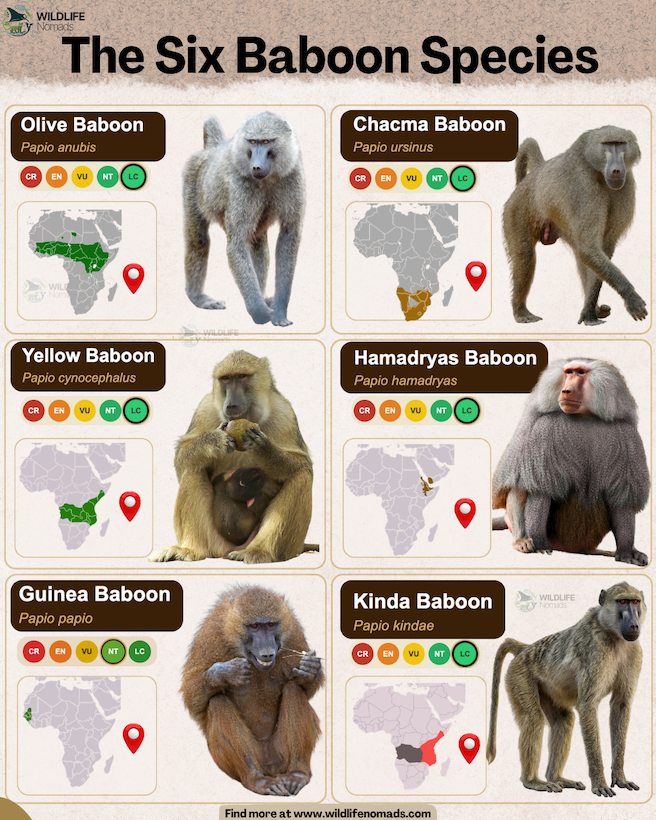
2. There Are Six Baboon Species Across Africa and Arabia
Six recognized baboon species exist today, each adapted to different regions and habitats. They range across sub-Saharan Africa and into parts of the Arabian Peninsula.
The olive baboon (Papio anubis) holds the widest range. Also called the anubis baboon, this species stretches across 25 countries in equatorial Africa, from west Africa through the southern Democratic Republic of the Congo and into eastern Africa.
The yellow baboon (Papio cynocephalus) inhabits eastern Africa and parts of southern Africa. Papio cynocephalus gets its common name from its yellowish-brown fur. Yellow baboons are classic savanna baboons, favoring open woodland and semi arid habitats across a broad swath of eastern Africa. Some yellow baboon populations overlap with olive baboon ranges, and hybridization between these two species is well documented.
The chacma baboon (Papio ursinus) is one of the largest baboon species and lives primarily in southern Africa. Papio ursinus populations occupy diverse habitats from rocky cliffs and mountainous terrain to semi arid habitats and coastal scrubland.
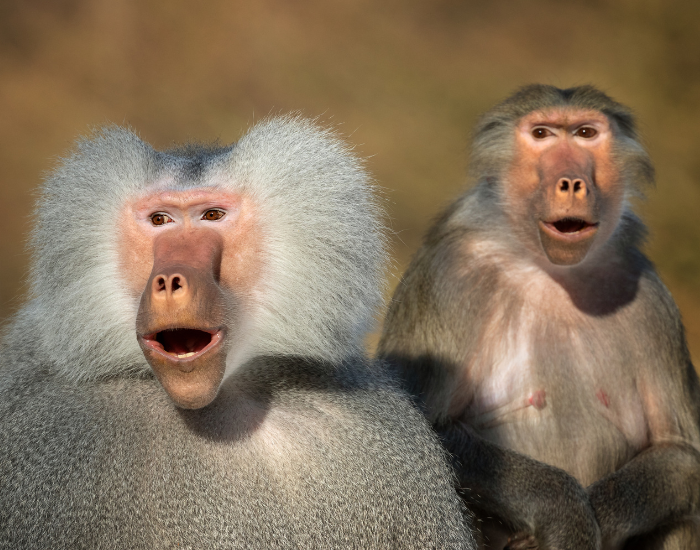
The hamadryas baboon (Papio hamadryas) is the only baboon species found outside Africa. Hamadryas baboons live in the Horn of Africa and across the Red Sea in Arabia, making baboons one of the few primate species found in both Africa and Arabia.
The Guinea baboon (Papio papio) is the smallest species. Guinea baboons occupy a narrow range in west Africa, from Senegal to Sierra Leone. Guinea baboon populations face increasing pressure from habitat loss. Among all Papio species, the Guinea baboon is the most range-restricted and the only one classified as Near Threatened.
The Kinda baboon (Papio kindae) is the most recently recognized species. Kinda baboon populations are found in equatorial Africa, primarily in Zambia, the southern Democratic Republic of the Congo, and Angola.
3. Baboons Are Among the World’s Largest Monkeys
Baboons characteristics include a powerful, muscular build that sets them apart from most other monkeys. These are some of the world’s largest monkeys, rivaled only by mandrills and a few other heavy-bodied species.
Baboons weight varies significantly by species and sex. Adult males of the chacma baboon (Papio ursinus) can weigh up to 45 kg (nearly 100 lbs), while adult females typically weigh between 12 and 20 kg. Olive baboon males (Papio anubis) average around 24 kg, with female baboons closer to 14.7 kg. Guinea baboons, the smallest species, range from 13 to 26 kg. That sexual dimorphism — the size gap between males and females — is pronounced across all baboon species.
Beyond sheer weight, baboons have long, dog-like muzzles with powerful jaws and impressive canine teeth. Adult males sport canines that can rival those of a leopard. These teeth serve primarily as weapons in social disputes and defense against natural predators, not for tearing meat.
4. Baboons Live in Complex Social Groups Called Troops
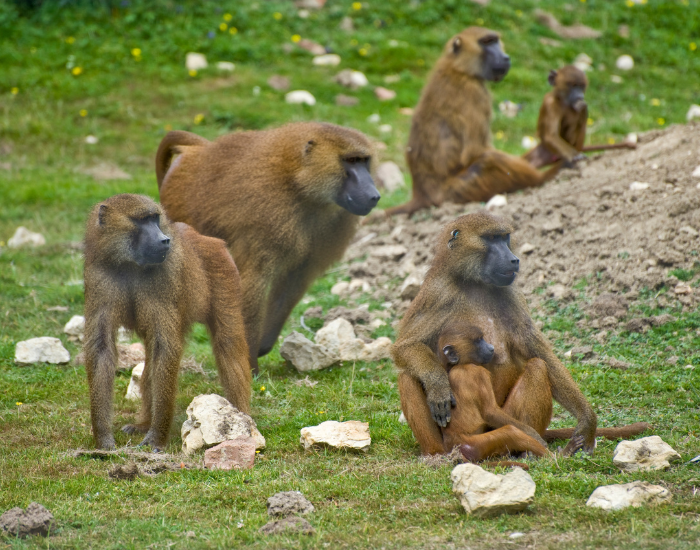
Baboons live in social groups called troops, and these troops are anything but simple. A single troop can contain anywhere from 20 to over 200 individuals, depending on the species and available resources. Troop members rely on each other for protection, foraging efficiency, and raising offspring.
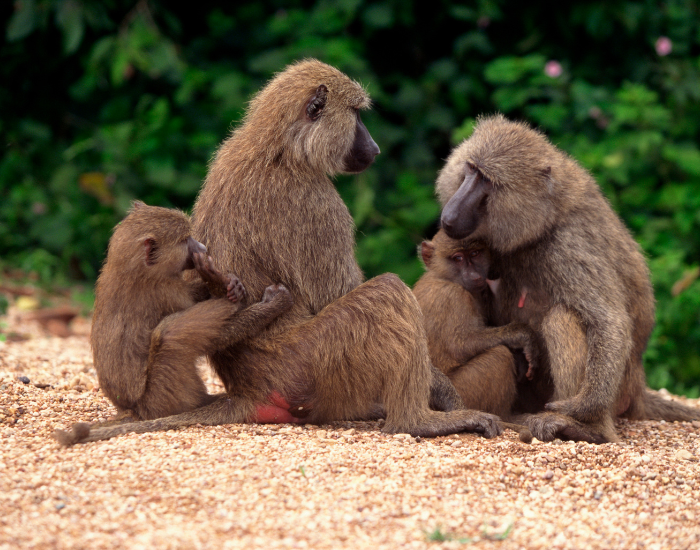
The social structure within baboon troops varies by species. Savanna baboons — including olive baboons, yellow baboons, chacma baboons, and Kinda baboons — organize around a dominance hierarchy among both males and females. Female baboons in these savanna baboon troops typically remain in their natal group for life. Their rank often passes from mother to daughter. Males disperse from their natal group upon reaching maturity. Young males leave to join new troops, where they must fight or strategically navigate their way into the dominance hierarchy.
In all baboon species, social bonds between female baboons form the backbone of troop stability. Research demonstrated that female baboons with stronger grooming networks had offspring with higher survival rates. This pattern holds across olive baboon, yellow baboon, and chacma baboon populations studied in eastern Africa and southern Africa. Reproductive success, it turns out, depends as much on social connections as it does on food or territory.
5. Baboons Are Opportunistic Eaters with a Surprisingly Diverse Diet
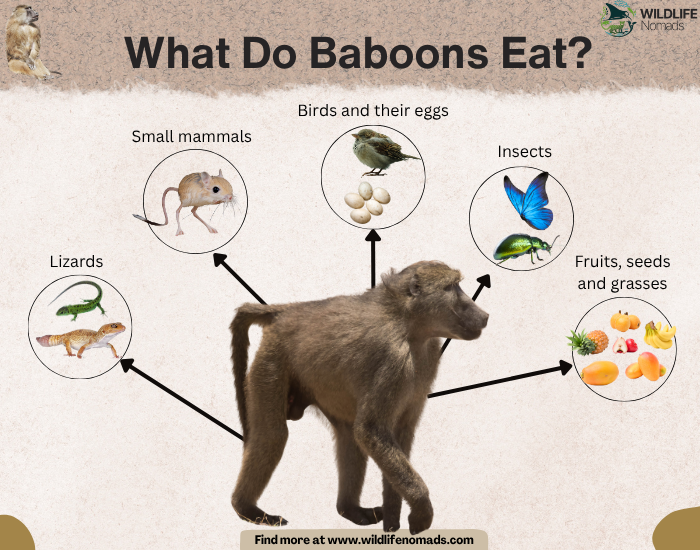
What do baboons eat? The short answer: almost everything. Baboons are opportunistic eaters and true omnivores. Their diet includes fruits, seeds, grasses, roots, tubers, bark, flowers, insects, bird eggs, lizards, and small mammals. Olive baboons and chacma baboons have even been documented hunting small antelope and other monkeys. In fact, olive baboon troops in eastern Africa regularly pursue young vervet monkeys, making the olive baboon one of the most predatory of all baboon species.
This dietary flexibility makes baboons extraordinarily adaptable. In savannas, they dig for underground corms and tubers. In gallery forests, they feast on figs and other fruit. Near human settlements, baboons exploit agricultural fields, raiding crops like maize, wheat, and sugarcane.
6. Baboons Inhabit Some of the Most Diverse Habitats of Any Primate
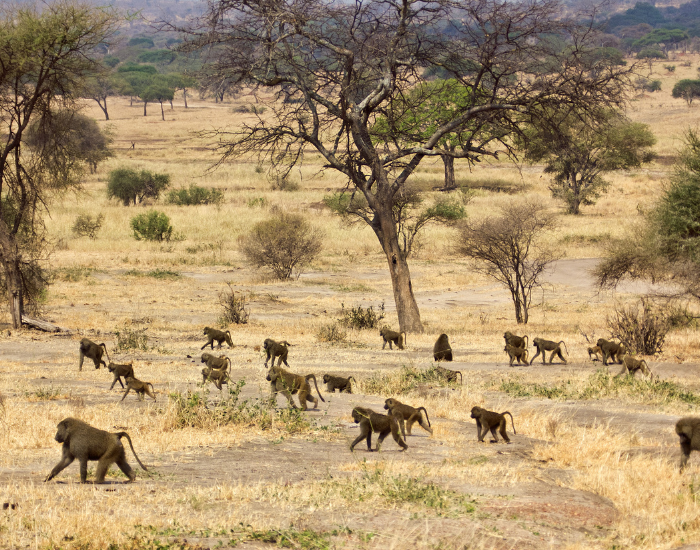
Few primate species match the habitat range of baboons. These animals occupy savannas, semi arid habitats, other semi arid habitats at higher elevations, tropical rainforests, gallery forests, rocky cliffs, grasslands, and even the fringes of deserts. Baboons live in diverse habitats across nearly every ecosystem type in sub-Saharan Africa.
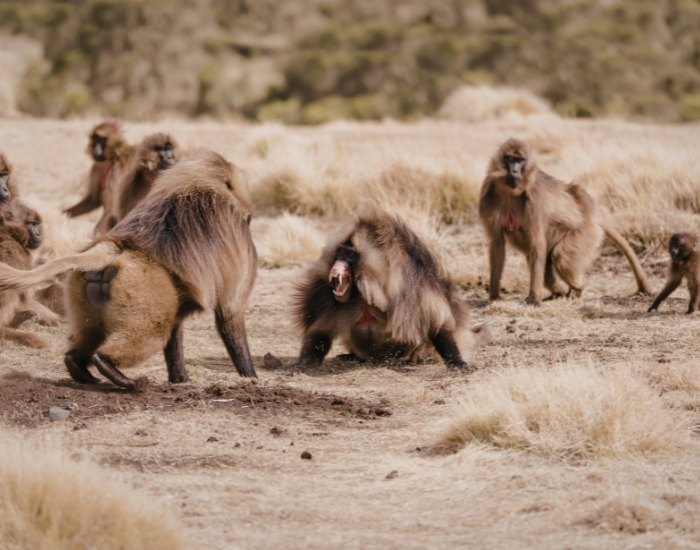
Hamadryas baboons live on the rocky cliffs and arid plateaus of Ethiopia, Eritrea, and the Arabian Peninsula. Hamadryas baboon troops select sleeping sites on sheer cliff faces that other baboons and most predators cannot access. Chacma baboons survive in the cold mountains of southern Africa, where Papio ursinus forages across altitudes that would challenge most other baboons. Olive baboons range from dense equatorial Africa rainforests to open Sahel grasslands. Kinda baboon populations have been documented in miombo woodland and marshy floodplains.
7. Males Disperse, Females Stay, and That Shapes Everything
One of the most important facts about baboon social dynamics: in most baboon species, males disperse from their natal group while females remain. Males leave their birth troop as they approach and reach sexual maturity, typically between ages four and eight. Males begin a dangerous journey to integrate into a new troop, where they must establish rank among other males. In some areas, farmers view these roaming male baboons as a pest species because solitary males raiding crops are bolder than troop-associated individuals.
This pattern means that females form the stable core of baboon society. Among savanna baboons, adult females who grew up together maintain lifelong bonds. Their daughters inherit their social rank. A high-ranking mother produces high-ranking daughters, and this matrilineal hierarchy influences access to food, sleeping sites, and mates.
Males, by contrast, face a volatile social landscape. When males disperse to a new group, they start at the bottom. A younger male must challenge other males — including the dominant male — through displays, chases, and sometimes brutal fights. Over time, males can rise in rank, but they also face being displaced by the next wave of incoming males. This constant male turnover prevents inbreeding and maintains genetic diversity across baboon populations.

8. Baboons Face Real Threats from Humans… and Vice Versa
The relationship between baboons and humans is complicated. Baboons raiding crops is one of the most persistent sources of human-wildlife conflict across sub-Saharan Africa. Farmers in eastern Africa, west Africa, and southern Africa lose significant portions of their harvests to baboon troops. In some regions, crop damage from baboons raiding crops reduces yields by 30 to 50 percent. That kind of loss hits smallholder farmers hardest.
Humans retaliate. Baboons are shot, poisoned, trapped, and beaten. In South Africa, urban baboon populations that venture into towns face particularly harsh treatment. The conflict creates negative attitudes toward baboons, which undermines conservation efforts.
At the same time, baboons are not typically aggressive toward humans without provocation. Are baboons aggressive to humans? They can be — especially habituated baboons in tourist areas or urban fringes who have learned to associate humans with food. Adult males, with their large canines, are genuinely dangerous when cornered or defending their troop. However, most wild baboons prefer to avoid humans entirely. The aggression narrative is overblown compared to the reality.
9. The Conservation Status of Baboons Is More Complicated Than It Looks
The conservation status of baboons is often misunderstood. The IUCN Red List currently classifies five of the six baboon species as Least Concern. Only the Guinea baboon carries a Near Threatened conservation status due to its restricted range in west Africa and ongoing habitat loss.
The Guinea baboon stands apart. Its Near Threatened conservation status reflects a genuinely restricted range and declining population. Guinea baboon habitat across west Africa continues to shrink. Without intervention, the Guinea baboon conservation status could worsen in coming decades.
The conservation status label can create complacency. Baboons are not currently among the most threatened species, but regional declines deserve attention. Other primates that once seemed abundant — like certain types of primates across Southeast Asia — slid toward endangerment faster than anyone expected. Baboons could follow that trajectory if habitat loss accelerates. Monitoring the conservation status of each baboon species independently matters far more than treating the genus as a single story.
10. Baboons Have Predators, and They Fight Back
Despite their size and fierce reputation, baboons face serious natural predators. Leopards are the primary threat across most of their range. Lions, hyenas, African wild dogs, large birds of prey like eagles, and crocodiles also prey on baboons. Infant baboons, young baboons, and smaller females are especially vulnerable to predation. Savanna baboons face the highest predation pressure because open habitats offer fewer escape routes than forests.
What makes baboons unusual among other monkeys is their willingness to fight back. Adult males will confront predators directly, sometimes forming coalitions to drive off leopards. Troop members cooperate in alarm-calling systems that alert the entire group to danger. Baboons sleeping on rocky cliffs or in tall trees at their sleeping sites is itself a predator-avoidance strategy, high ground makes it harder for leopards to launch a surprise attack.
11. Baboons Communicate with a Sophisticated Vocal and Gestural Repertoire
Baboons do not just grunt and scream. Their communication system includes over 30 distinct vocalizations, each carrying specific meaning. Alarm calls differ depending on the predator, a different call for a leopard versus an eagle. Contact calls help troop members stay connected while foraging across wide areas. Among olive baboon troops, Papio anubis males use greeting rituals involving elaborate gestures that signal intent and submission.
Female baboons use soft grunts to signal friendly approach. Males produce loud wahoo calls that broadcast their strength and stamina to both females and other baboons nearby. Research from the Amboseli Baboon Research Project in eastern Africa has shown that these calls encode information about the caller’s age, rank, and physical condition. The Amboseli project, which tracks yellow baboon and anubis baboon populations, remains one of the longest-running primate field studies in the world.
12. Baboons Share More with Humans Than Most People Realize
Here is a fact that often catches people off guard. Baboons share approximately 94% of their DNA with humans. They are not our closest relatives — chimpanzees and bonobos hold that distinction. But that genetic similarity still places baboons remarkably close to us on the evolutionary tree.
This closeness is why baboons have been extensively studied in biomedical research. Their physiology mirrors ours in ways that few other mammals can match. Olive baboon and hamadryas baboon populations have both been used extensively in medical studies. Baboons experience stress, form complex social alliances, hold grudges, reconcile after conflicts, and even show behaviors that researchers describe as empathy.

Frequently Asked Questions
Baboons can show aggression toward humans, but this typically happens when they have become habituated to people, especially near tourist areas or urban edges where they associate humans with food. Wild baboons in natural habitats generally avoid humans. Adult males are the most dangerous when provoked, given their large canines and powerful build. Females with infant baboons may also act defensively. Unprovoked attacks on humans are rare.
Baboons are monkeys, not apes. They belong to the Old World monkeys family (Cercopithecidae) within the genus Papio. Unlike apes such as chimpanzees, gorillas, and orangutans, baboons have tails. The seven great apes in order are: humans, chimpanzees, bonobos, gorillas (eastern and western), and orangutans (Bornean, Sumatran, and Tapanuli). Baboons are not on that list.
No. Baboons cannot live 300 years. That claim has no scientific basis. In the wild, baboons live approximately 20 to 30 years. In captivity, some baboons live up to 45 years. Their lifespan depends on species, predation pressure, and environmental conditions. Females generally outlive males because males face higher mortality from fights and dispersal.

Why Baboons Deserve More Respect
Baboons are not the aggressive pests that headlines make them out to be. They are intelligent, socially sophisticated primates navigating a world that is shrinking around them. Every troop that raids a cornfield is a troop that lost its original foraging ground to habitat loss. Every baboon that bares its teeth at a tourist is one that learned humans carry food.
Understanding baboons means understanding adaptation, resilience, and the complicated space where wildlife and humans collide. If you want to dig deeper into the world of primates, check out my guides on types of primates and types of monkeys. For a look at another fascinating Old World primate, do not miss the mandrill species guide.
References:
Fischer, J., Noser, R., & Hammerschmidt, K. (2013). Bioacoustic field research: A primer to acoustic analyses and playback experiments with primates. American Journal of Primatology, 75(7), 643–663. https://doi.org/10.1002/ajp.22153
Jolly, C. J. (2020). Philopatry at the frontier: A demographically driven scenario for the evolution of multilevel societies in baboons (Papio). Journal of Human Evolution, 146, 102819. https://doi.org/10.1016/j.jhevol.2020.102819
Onyango, P. O., Gesquiere, L. R., Altmann, J., & Alberts, S. C. (2013). Puberty and dispersal in a wild primate population. Hormones and behavior, 64(2), 240–249. https://doi.org/10.1016/j.yhbeh.2013.02.014
Rogers, J., & Gibbs, R. A. (2014). Comparative primate genomics: Emerging patterns of genome content and dynamics. Nature Reviews Genetics, 15(5), 347–359. https://doi.org/10.1038/nrg3707
Silk, J. B., Beehner, J. C., Bergman, T. J., Crockford, C., Engh, A. L., Moscovice, L. R., Wittig, R. M., Seyfarth, R. M., & Cheney, D. L. (2010). Strong and consistent social bonds enhance the longevity of female baboons. Current Biology, 20(15), 1359–1361. https://doi.org/10.1016/j.cub.2010.05.067
Taylor, A. B., Goldsmith, M. L., & Shapiro, L. J. (2016). Hunting, food subsidies, and mesopredator release: The dynamics of crop-raiding baboons in a managed landscape. Ecology, 97(4), 951–960. https://doi.org/10.1890/15-0885.1
Zinner, D., Wertheimer, J., Liber, R., Kappeler, P. M., & Roos, C. (2013). Baboon phylogeny as inferred from complete mitochondrial genomes. American Journal of Physical Anthropology, 150(1), 133–140. https://doi.org/10.1002/ajpa.22185