I lived in Kingscliff for a stretch, ten minutes’ walk from the creek mouth. An Eastern Osprey pair nested on a tall pole right there on the parade. Half the town knew that nest. After a cyclone tore it apart, the local police helped rebuild the platform, and the birds came back.
That pole taught me something about Australian eagles and their relatives. These birds are not remote wilderness creatures. They live above our car parks, our telegraph poles, our beach tracks.
Five years of housesitting and camping along the east coast changed how I look up. I have watched White-bellied Sea-Eagles hunt on both our first two step on the lap around Australia at Woody Head, and Evans Head, and finally pinned down a Little Eagle in the Gold Coast hinterland. Here are twelve things I wish someone had told me earlier. You will learn which species actually live here and how to separate an eagle from a hawk in seconds. You will also learn what they really eat, and why one subspecies is in trouble.
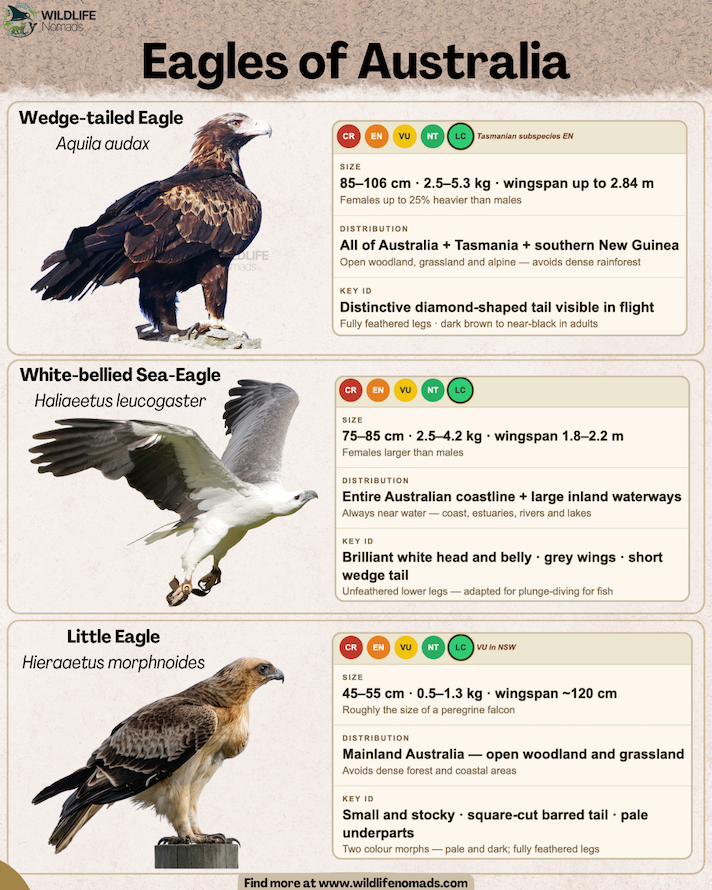
1. Australia Has Only Three True Eagles
That surprises people. Australia is home to three primary species of true eagles. They are the Wedge-tailed Eagle (Aquila audax), the White-bellied Sea-Eagle (Haliaeetus leucogaster), and the Little Eagle (Hieraaetus morphnoides).
Everything else with a hooked bill belongs to a different group. The Eastern Osprey (Pandion cristatus) sits in its own family entirely, despite the sea-eagle look. Other species people call eagles, kites, goshawks, harriers, are not eagles at all. That distinction matters when you log a sighting correctly.
All three are native species found nowhere else in quite this combination. Australia’s eagles occupy different ecological niches: one patrols open country inland, one works coastal regions and water bodies, one hunts open woodlands. They rarely compete head-on.
2. The Wedge-tailed Eagle Is Australia’s Largest Raptor
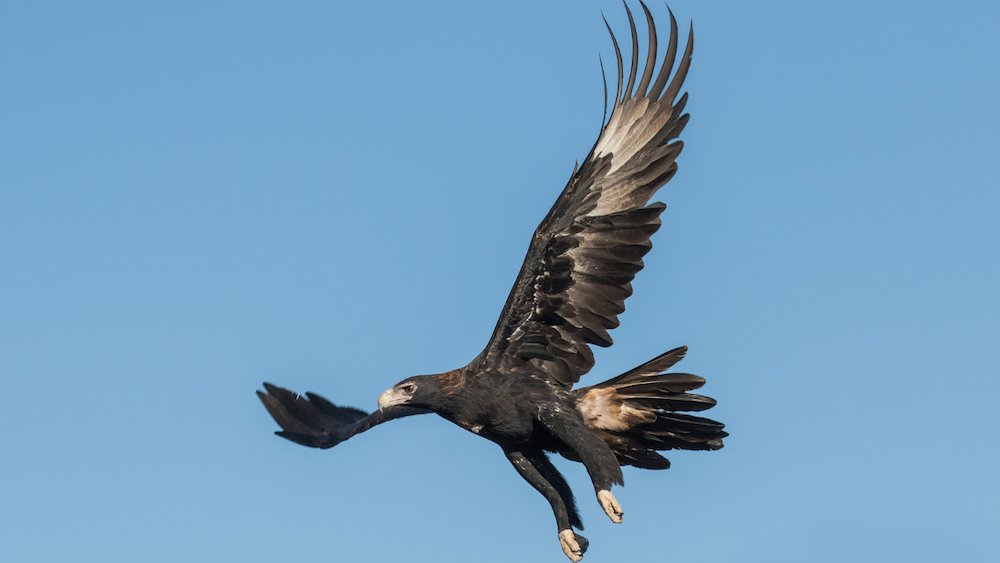
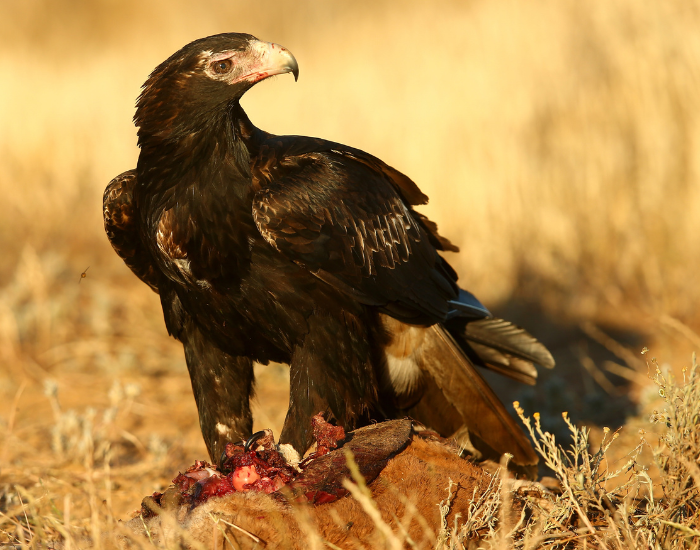
Wedge tails are enormous. Their wingspan ranges from 185 to 230 cm. Females outweigh males considerably, at roughly 3 to 5.8 kg against 2 to 4 kg. That makes this species one of the largest eagles anywhere on Earth.
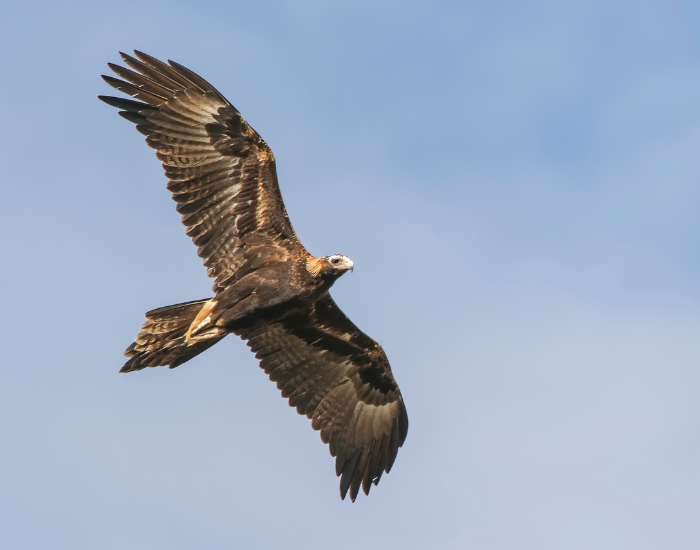
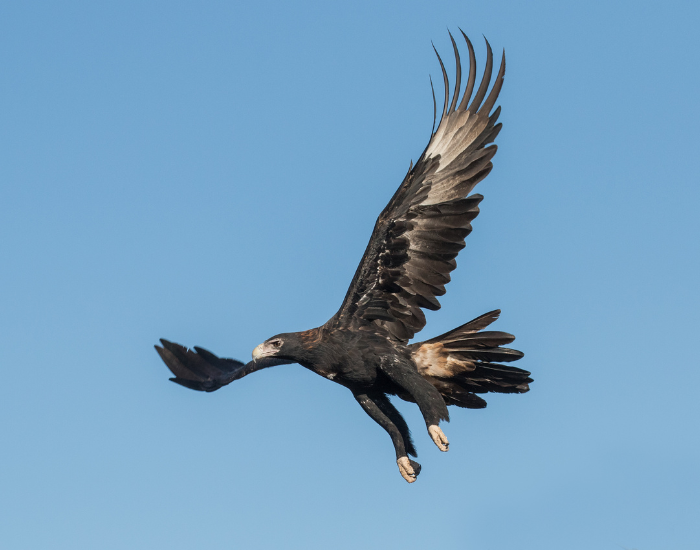
Adults look near-black at distance, but good light reveals warm reddish brown hackles across the neck and pale wing coverts. Immature wedge-tailed eagles are paler overall, with a golden nape and light reddish brown edging. Full adult plumage takes seven or eight years.
You will find them across mainland Australia, Tasmania and southern New Guinea. Two subspecies exist: mainland A. a. audax and the Tasmanian A. a. fleayi. Unlike many other eagles worldwide, this one thrives in arid country as readily as in forest.
3. The Tail Is the Fastest ID in the Sky
Forget size when a bird is soaring high, distance destroys your sense of scale. Look at the tail instead. Adults have a distinctive wedge-shaped tail that no other Australian raptor shows.
Once you know that shape, wedge-tails become easily identified from a great distance. A Black Kite shows a forked tail and a twisting, restless flight. A Whistling Kite carries a plain, slightly rounded tail and looks scruffy by comparison.
I use this constantly on the road. Broad wings held in a shallow V, fingered tips, that unmistakable diamond behind, that is a wedge-tail, every time.
4. Farmers Once Treated Them as Vermin
This is the ugly part of the story. Wedge-tailed Eagles were historically viewed as a pest by graziers who blamed them for lamb losses, and governments paid bounties accordingly.
The numbers are hard to read. The Australian Museum records more than 147,000 birds shot or poisoned in Western Australia between 1928 and 1968. Queensland accounted for another 162,430 between 1951 and 1966. Bounty schemes ran hardest through the 1950s and 1960s.
Modern research shows the blame was largely misplaced. Eagles scavenge dead lambs far more often than they kill healthy ones.
5. They Are Protected Now, But Threats Remain
Every state and territory protects this species. In Western Australia, the old Wildlife Conservation Act 1950 governed that protection for decades before the Biodiversity Conservation Act 2016 replaced it.
BirdLife International estimates roughly 100,000 mature individuals nationally, and the species sits at Least Concern. Numbers have recovered well since the bounty era. That said, main threats include habitat destruction, illegal shootings, and collisions with energy infrastructure.
Protection on paper is not protection in practice. Poisoning cases involving dozens of large birds still make the news, and prosecutions remain rare.
6. Their Diet Is Mostly Rabbits, Roos and Roadkill
Wedge-tailed eagles primarily hunt rabbits and kangaroos, particularly young macropods. Their diet consists of far more than that, though. They take reptiles, native marsupial mammals, small mammals and other birds, plus a steady supply of carrion including road-killed animals.
A 2022 study either side of the dingo fence in the Strzelecki Desert showed how flexible they are. Where dingoes were common, rabbits dominated nest remains. Where dingoes were absent and kangaroos irrupted, eagle diets shifted accordingly. Reptiles such as bearded dragons turned up throughout.
Watch the roadside verges at dawn. Most of my best wedge-tail views have come from birds feeding on dead marsupials beside the highway.
7. Their Nests Can Weigh 400 Kilograms
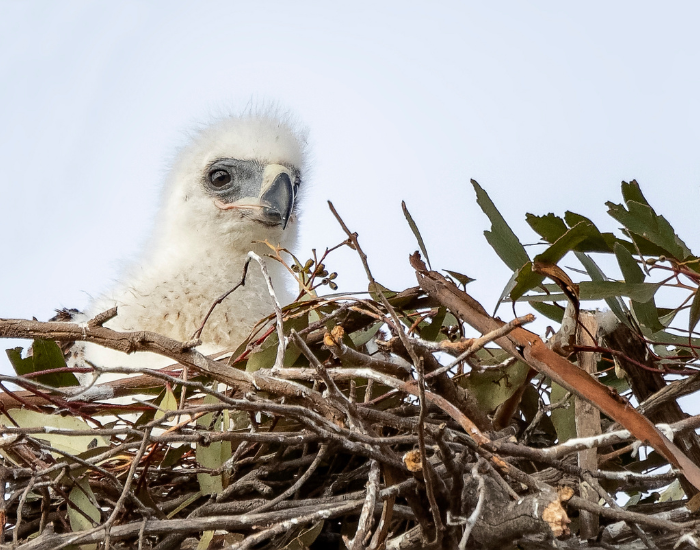
Wedge-tailed Eagles require large undisturbed territories, and they build accordingly. Established nests reach close to 2 m across and 3 m deep, weighing around 400 kg after years of additions. Active nests usually sit 2.5 to 4 km apart.
Pairs choose the tallest tree available. On the Nullarbor Plain and other treeless open spaces, they will use cliff ledges or simply nest on the ground.
Breeding season runs from roughly April to September in most of the range, with laying concentrated in winter. Females lay one to two eggs, incubate for about 45 days, and chicks fledge after ten to thirteen weeks.
8. The White-bellied Sea-Eagle Is Australia’s Second-Largest Raptor
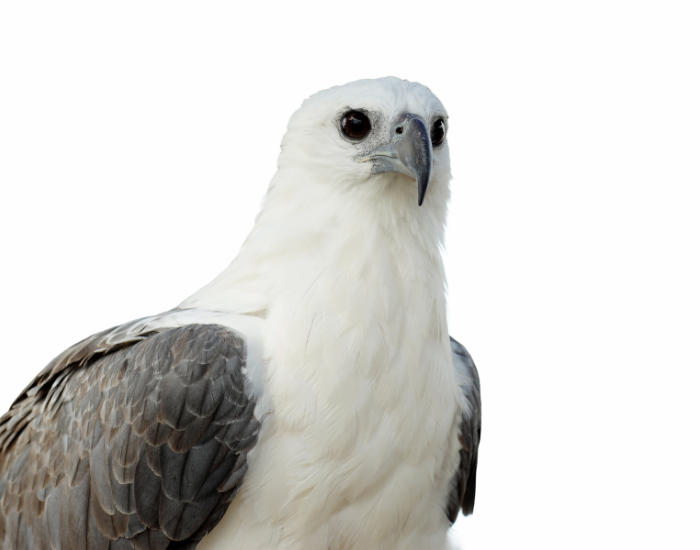
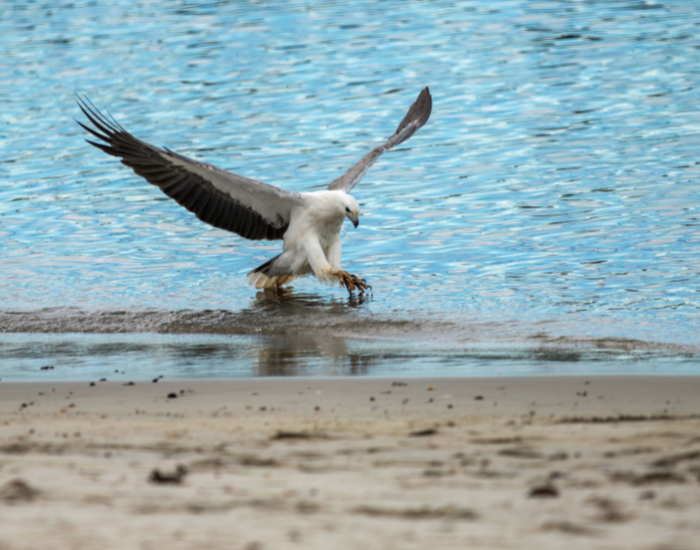
Slightly smaller than a wedge-tail, and utterly different in character. Adults show a white head, clean white underparts and dark grey wings and back, with black tips visible when they bank.
I have watched them on the coastal trail at Woody Head in the NSW Northern Rivers. Another pair appeared during a sunset cruise through the creeks near Noosa. Three birds in one walk at Woody Head remains my best day. The dive is the thing, a long, unhurried glide, then sudden speed.
Sea eagles occupy coastal regions, large water bodies and offshore islands right around mainland Australia. They are common in eastern Australia and across northern Australia, and the range extends into New Guinea and Asia. White-bellied Sea-Eagles build massive stick nests in tall trees, sometimes 30 m up, and reuse them for years.
9. Sea-Eagles Fish, Scavenge and Steal
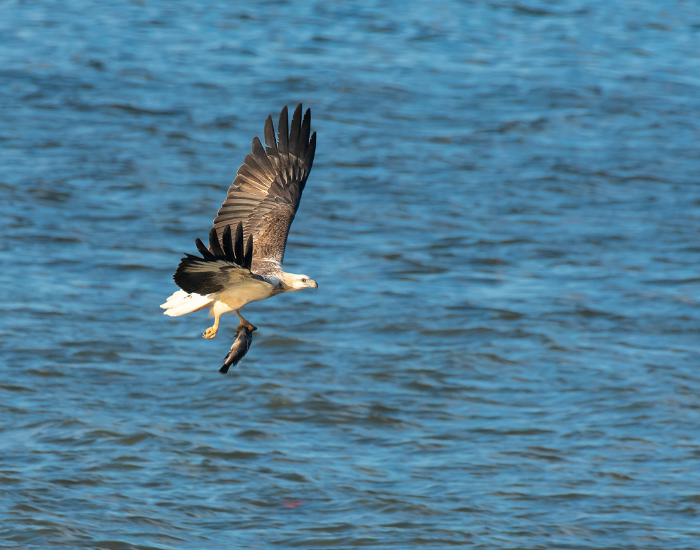
Their diet is genuinely broad. White-bellied Sea-Eagles primarily hunt fish and aquatic prey, including sea snakes and turtles. They will also attack birds as large as swans, and they scavenge along the waterline without hesitation.
They rob other raptors too. I have seen one harass an osprey until it dropped a mullet, then collect the fish mid-fall.
Disturbance hurts them badly. Research on Kangaroo Island found sea-eagles at high-disturbance sites fledged about 0.5 young per year, against 1.1 at isolated sites. Nest failure rates tripled.
10. The Little Eagle Is the Smallest, and the Trickiest to Call
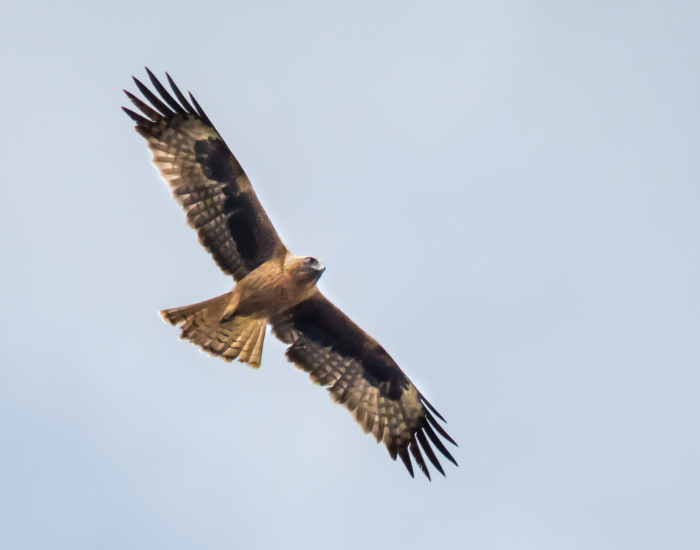
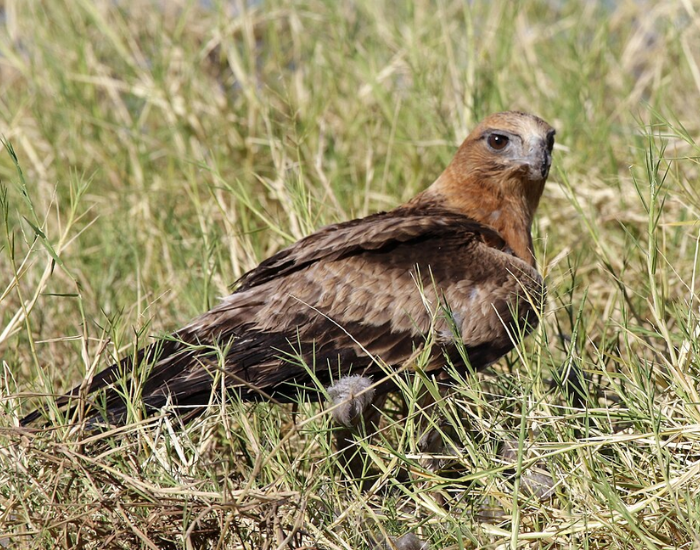
I hiked Springbrook and Lamington national parks for months before I confidently identified one. The bird sat there in plain sight. Once it clicked, it was obvious: a compact, medium sized raptor with a rounded head, a short crest and a squared-off tail.
Little Eagles come in light and dark morphs. The pale form shows warm reddish brown streaking below, with black tips to the wings. They prefer open woodlands, forested areas and agricultural land. Little Eagles hunt small mammals such as rodents and rabbits, plus small birds and reptiles. Unlike their giant cousin, they largely ignore macropods.
That last point matters. A Canberra study analysing 1,421 wedge-tail prey items and 192 Little Eagle items found almost no dietary overlap. The researchers concluded competition with wedge-tails probably was not driving the Little Eagle decline. The species is listed as Vulnerable in the ACT and NSW, and habitat loss looks like the real culprit.
11. Eagle or Hawk? Check the Legs
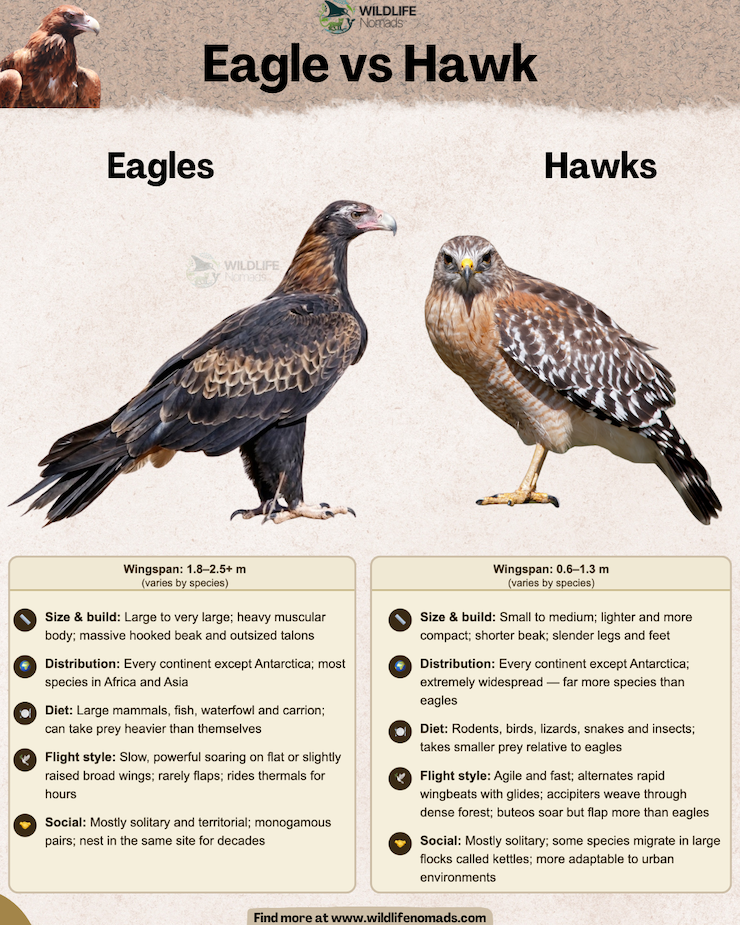
Here is the trick that ends most arguments. True eagles in the Aquila and Hieraaetus groups have feathered legs right down to the toes. Hawks, kites and falcons show bare, scaly legs.
Australia has plenty of the latter, and they cause endless confusion. Plenty of them share airspace with our eagles. The list includes the Brown Goshawk, Brown Falcon, Black Falcon, Peregrine Falcon and Nankeen Kestrel. Add the Australian Hobby, Black-shouldered Kite, Black Kite and Pacific Baza. Peregrines now nest on tall buildings in several capital cities. After dark, a different shift clocks on, the Southern Boobook and the Barn Owl.
Size helps too, but only with a reference. A Brown Falcon looks big alone and tiny beside a wedge-tail.
Ospreys add their own wrinkle. Slightly larger than a Little Eagle and built for fishing, they increasingly nest on human structures. A 2019 survey of coastal south-east Queensland compared urbanised Moreton Bay with quieter waters further north. Researchers found far more osprey nests on artificial structures in the developed zone: communication towers, navigation beacons, poles. My Kingscliff pair fit that pattern exactly.
12. Eagles Are Ecological Indicators, and Cultural Icons
Raptors sit at the top of the food chain, so their breeding success reflects ecosystem health below them. Wedge-tailed Eagles help regulate populations of medium-sized mammals and invasive species such as rabbits, foxes and feral cats. Watching eagle numbers is a cheap way to read a landscape.
Their cultural weight runs far deeper than their ecology. For the Kulin Nation in Victoria, the wedge-tailed eagle is Bunjil, the creator. Names and stories for this bird exist across many First Nations across the continent.
Tasmania shows what happens when we get it wrong. The endangered A. a. fleayi holds only a few hundred breeding adults across roughly 220 known territories. One 2023 review documented 321 eagle deaths and injuries in Tasmania between 2010 and 2022, linked largely to powerlines and wind farms.
Go and Find One Yourself
Australian eagles reward patience more than luck. Learn one silhouette — that wedge-shaped tail — and a bird you previously ignored becomes unmistakable from a kilometre away. Learn the leg rule, and you stop guessing entirely.
Start where I did. Try coastal creek mouths and estuaries for sea eagles and ospreys. Try highway verges at dawn for wedge-tails, and open woodland ridgelines for the Little Eagle. Bring binoculars and give it an hour.
For more, I have written about the world’s types of eagles and the wider group of birds of prey. There is also a full guide to Australian native birds.
Eagles of Australia Challenge
Eight questions on Australia’s native raptors. How many can you get right after reading?
References:
Brun, M., Oliver, A. S., Alves, J., Nankivell, A., & Letnic, M. (2022). Irrupting prey populations in the absence of a mammalian apex predator drive shifts in prey selection by eagles. The Science of Nature, 109, 32. https://doi.org/10.1007/s00114-022-01804-x
Dennis, T. E., McIntosh, R. R., & Shaughnessy, P. D. (2011). Effects of human disturbance on productivity of White-bellied Sea-Eagles (Haliaeetus leucogaster). Emu, 111(2), 179–185. https://doi.org/10.1071/MU10044
Olsen, J., Judge, D., Fuentes, E., Rose, A. B., & Debus, S. J. S. (2010). Diets of Wedge-tailed Eagles (Aquila audax) and Little Eagles (Hieraaetus morphnoides) breeding near Canberra, Australia. Journal of Raptor Research, 44(1), 50–61. https://doi.org/10.3356/JRR-09-28.1
Pullen, G. D. (2023). Eagle deaths in Tasmania attributed to energy assets, with a precautionary appeal to future development. Australian Field Ornithology, 40, 214–219. https://doi.org/10.20938/afo40214219
Thomson, V. K., Jones, D. N., & Stevens, T. (2019). Nest-site selection by Eastern Osprey Pandion haliaetus cristatus in coastal south-eastern Queensland. Australian Field Ornithology, 36, 142–147. https://afo.birdlife.org.au/afo/index.php/afo/article/view/2168