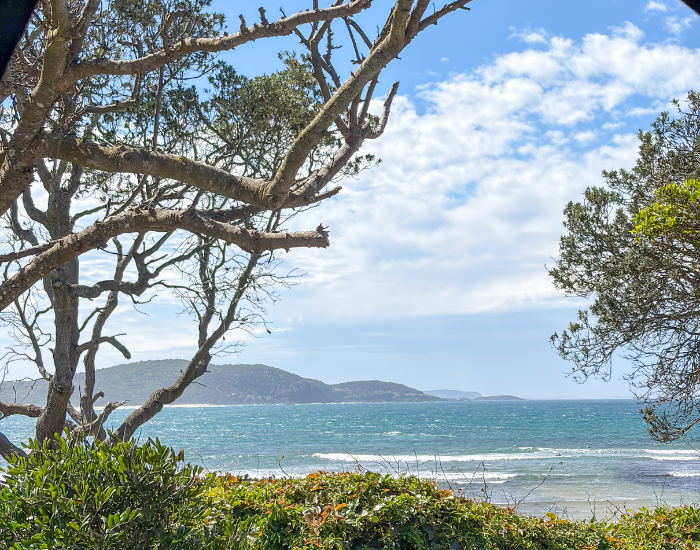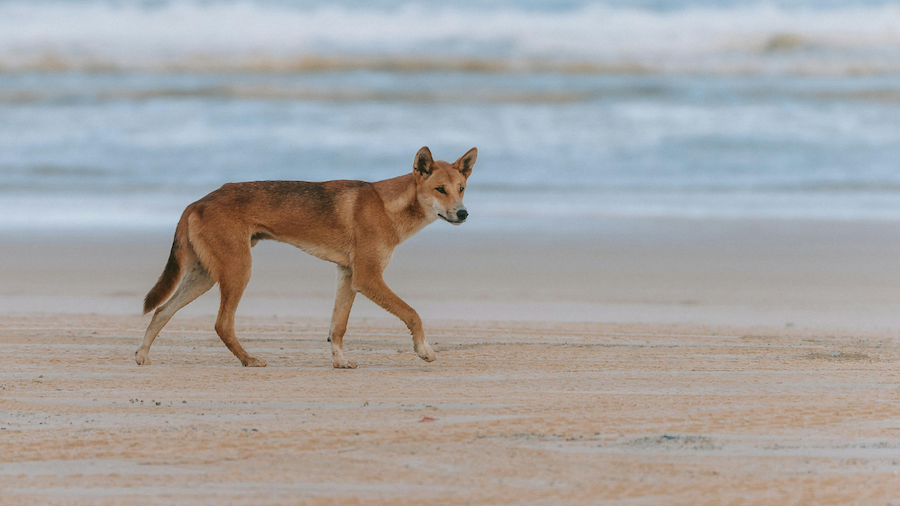
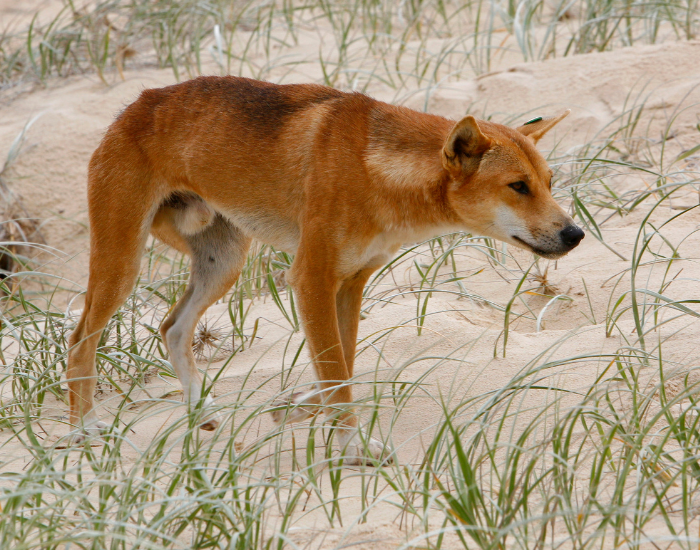
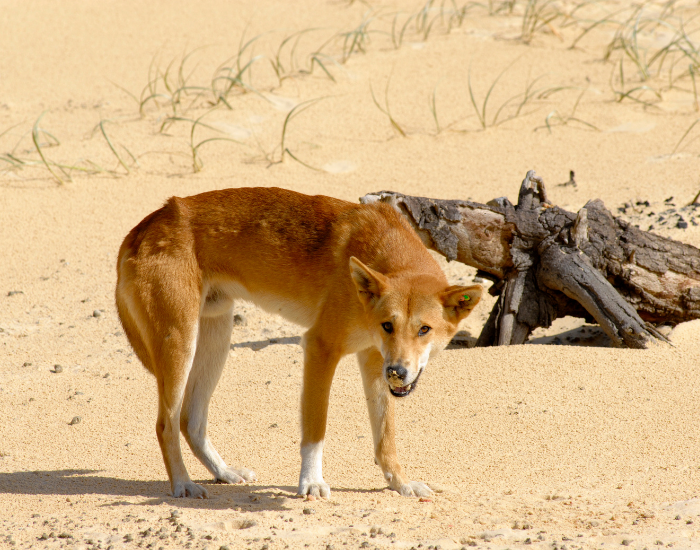
The beach on K’gari runs for kilometres without a break. I was driving a 4×4 along that hard sand, windows down, the north-east Queensland heat pouring in. A shape appeared ahead on the empty white stretch. My brain said dog. Then it corrected itself, because no dog walks a wild beach alone, kilometres from the nearest township. I was looking at a dingo.
I stopped well short and stayed put. Rangers and locals had already given us the briefing that morning. Never walk alone on this island. Never let a child wander ahead. I took my photographs from a distance and drove on.
That animal sent me back into the literature, and what I found reshaped how I think about Australia’s wild dog. Below are the ten things that stuck. The biology, the fight over what a dingo even is, and the 5,600-kilometre fence built to shield sheep grazing areas. Some of it contradicts what you have probably read.
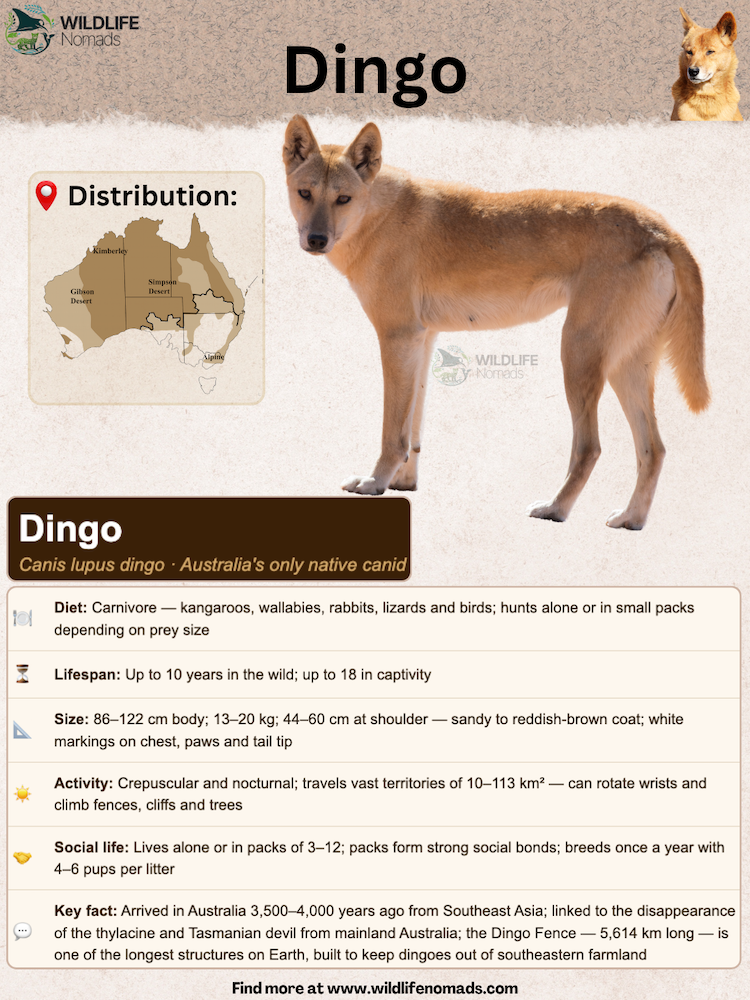
1. The Dingo Is Not Simply a Feral Dog
Ask three biologists what a dingo is and you may get three answers. Some classify it as Canis dingo, a species in its own right. Others use Canis familiaris dingo or Canis lupus dingo, folding it into the dog or wolf lineage. The Australian Museum has covered this argument at length, and it remains genuinely unresolved.
The evidence, however, keeps pointing one way. A 2025 review in Australian Mammalogy argued that the current naming is a mess and needs an evidence-based overhaul. Genome-wide work shows dingoes descend from an ancient eastern dog lineage. They sit further from modern breeds than those breeds sit from each other.
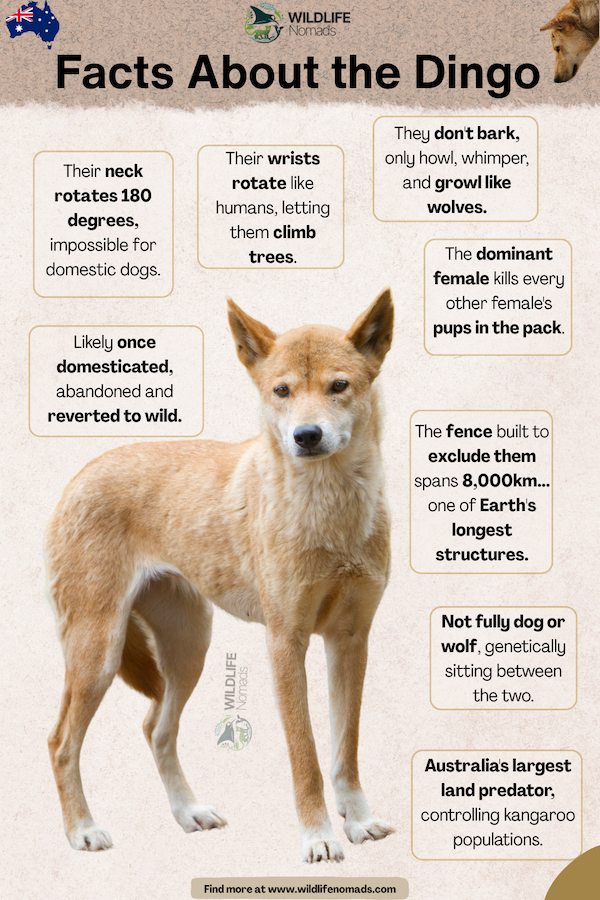
That distance shows up in the body, too. Australia’s wild dog has a broader skull, hyper-flexible joints and a wrist capable of rotating far beyond that of domestic dogs.. Natural selection shaped those features, not a breeder.
2. What a Dingo Actually Looks Like Up Close
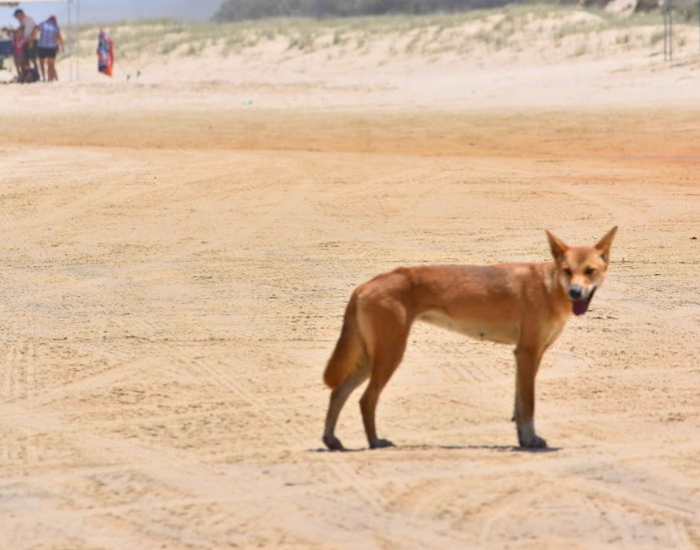
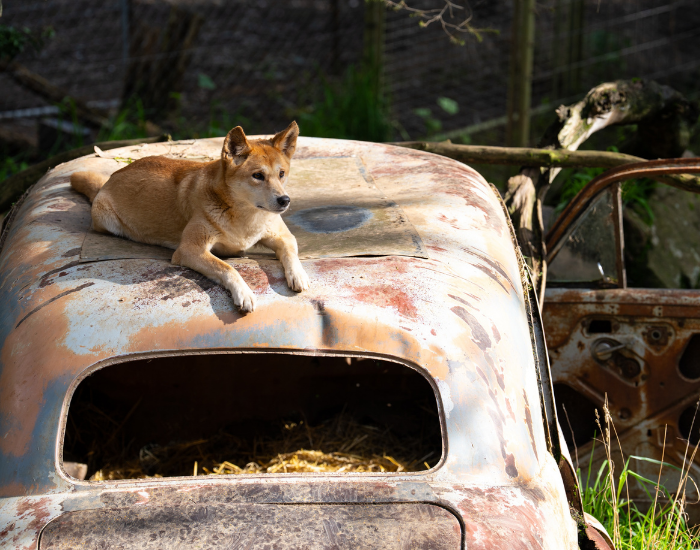
Get near one and the differences from a domestic dog land immediately. A dingo stands 44 to 62 centimetres at the shoulder and weighs 12 to 24 kilograms. The head looks broad, the muzzle long and tapered, and the ears sit permanently erect. Its canine teeth run noticeably longer than a domestic dog’s.
The bushy tail is the field mark I rely on most. Coat colour then shifts with country. Desert animals lean golden-yellow and forest animals run darker tan to black. The classic ginger coat with white feet turns up almost everywhere.
Those regional differences run deeper than colour. Genetic work published in 2025 splits Australian dingoes into distinct populations. Alpine dingoes hold southeast Australia, and desert animals hold the inland. A small, isolated Mallee population clings on in western Victoria. The Queensland dingoes I watched on K’gari were sandy and rangy, built for sand and heat.
3. They Arrived Around 4,000 Years Ago, and Kept to Themselves
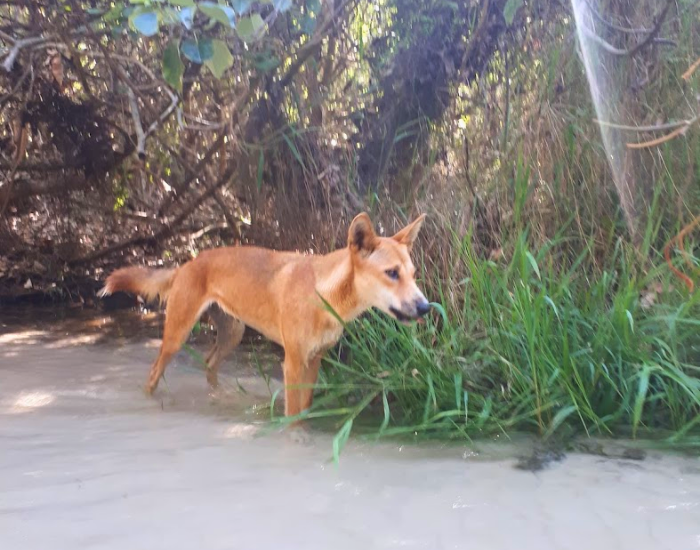
Dingoes reached this continent roughly 4,000 to 5,000 years ago. They most likely arrived by boat, with seafaring people moving out of mainland Southeast Asia and the islands beyond. The same maritime dispersal carried Polynesian domestic dogs deep into the Pacific. That makes the dingo an introduced species by any strict definition.
The earliest undisputed archaeological finding sets a firm floor under that date. Bones from Madura Cave, a rock shelter on the Nullarbor Plain in Western Australia, date to roughly 3,100 to 3,350 years old. Earlier mitochondrial DNA data pointed to a deeper arrival, closer to 5,000 years. Archaeology and genetics still disagree by a couple of millennia.
Ancient DNA has sharpened the rest of the picture beautifully. In 2024, researchers sequenced nine dingo genomes aged 400 to 2,746 years, all predating European arrival. The continent-wide genetic split between north-western and south-eastern Australian dingoes already existed thousands of years ago. Ancient animals from coastal New South Wales also showed closer ties to New Guinea singing dogs.
Here is the part that surprised me. Those same genomes show modern dingoes carry very little ancestry from post-colonial dogs. The pure-versus-hybrid panic may be older and softer than the headlines suggest.
4. Their Hunting Behaviour Spans 177 Prey Species
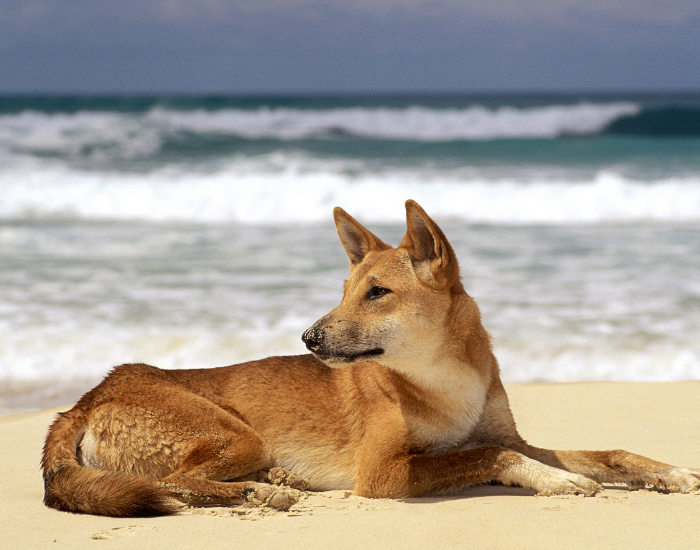
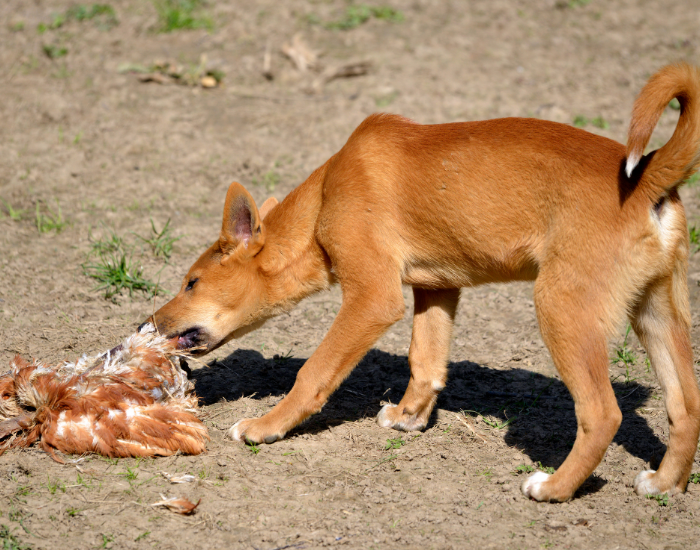
A widely cited tally credits them with preying on 177 species across Australia. Mammals dominate at roughly 72 per cent and birds account for about 19 per cent. Reptiles, insects, fish, crabs and frogs fill out the rest. A 2019 continental review in Mammal Review pushed the figure higher still, to 229 vertebrate species.
That range explains the flexible hunting behaviour I have watched in the field. Dingoes are opportunistic carnivores, not specialists. Dingoes tend to hunt alone for small prey and pack up for large. A lone animal takes a bandicoot, a rat or a goanna, while a pack brings down adult kangaroos. Diet swings by region, too, kangaroos and bandicoots in the east, rabbits and reptiles in the arid centre.
5. As an Apex Predator, the Dingo Rewrites Whole Landscapes
The dingo plays a structural role in the Australian landscape, sitting at the top of the mainland food chain. Apex predators do more than kill things. They change how prey behave, where prey feed, and how much vegetation survives. Ecologists call that flow-on effect a trophic cascade. It is what a natural ecological system looks like with its top tier intact.
A prominent trial on Pelorus Island in Queensland sought to use dingoes to control feral goats, though the controversial project was halted early due to animal welfare and non-target wildlife concerns. Despite the trial’s truncation, field data and ecological modeling from the project underscored how rapidly apex predators disrupt feral herd dynamics and relieve grazing pressure on native vegetation.
The fox and cat question is messier, and I want to be straight about that. Several studies show dingoes reduce red fox and feral cat numbers through direct killing and fear. Yet a large 2019 analysis found no consistent suppression of cats at broad scales. Therefore treat “dingoes fix feral cats” as a promising hypothesis, not settled fact.
6. Dingoes Howl. They Barely Bark
Barking makes up roughly five per cent of their vocalisations. Domestic dogs bark constantly because we bred them to. Dingoes never went through that filter. Dingoes communicate instead by howling, whimpering and a rolling growl-howl that carries for kilometres.
Howling does real work. A single call gathers scattered pack mates and warns a rival dingo pack off a territory. Lost animals howl to attract pack members across thick bush. Hearing one at dusk in the Queensland scrub is a genuinely eerie experience.
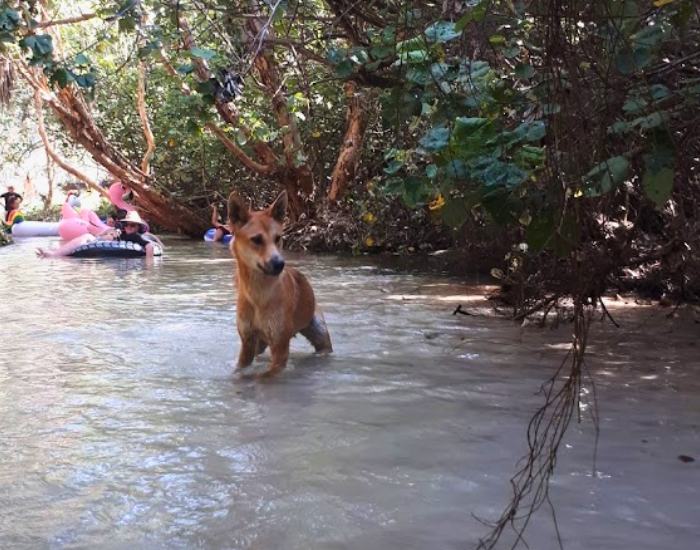
I learnt this the practical way. On my second day I was heading down the island’s famous freshwater creek. Everyone floats along that narrow channel. Something moved in the bush beside me. No bark, no growl, just rustle.
7. Family Groups Run on an Alpha Pair
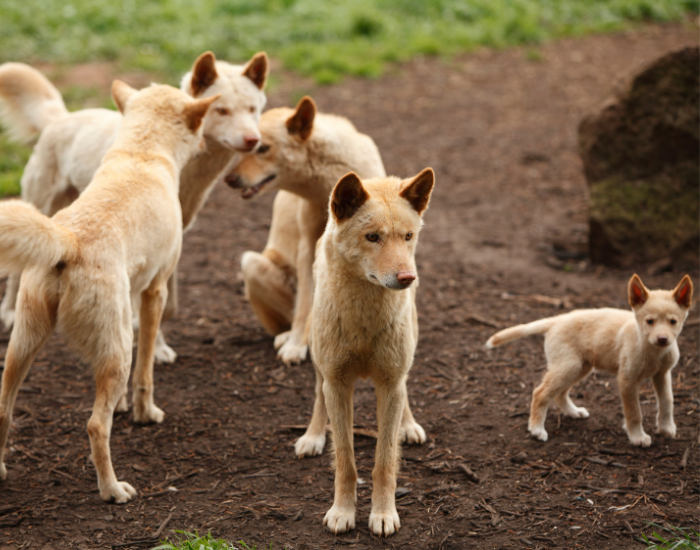
Dingoes live in family groups governed by a dominant alpha pair. A pack is usually that mated couple plus the year’s offspring. Only the alpha female typically raises a litter. Subordinates help feed and guard the dingo pups. Young males disperse first, which is why lone animals turn up on empty beaches.
The breeding season is rigid, and it matters for the hybrid debate. Dingoes breed once annually between March and June, unlike domestic dogs, which cycle twice a year. Gestation lasts 61 to 69 days. Litters typically hold four to six pups, weaned at about two months. Sexual maturity arrives between one and two years.
Back at that creek, the rustling resolved into an animal. I expected a kangaroo or a possum, given how many tourists were splashing around. Out stepped a young dingo instead, loose-limbed and openly playful, all puppy energy. Nothing about him read as threatening, and that, I realised later, is exactly the problem.
8. Most of the Mainland, but Not Everywhere
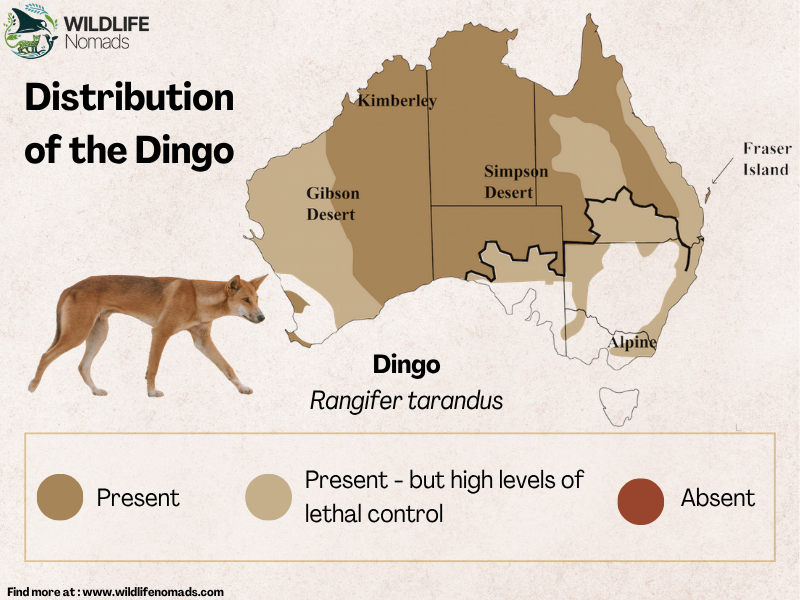
Dingoes inhabit most of the Australian mainland. They never reached Tasmania. Australian dingoes are also largely absent from settled south eastern Australia and the far south-western corner. Northern Australia holds the densest and least fragmented populations. Woodland and grassland suit them best, though they persist in desert, alpine country and tropical forest.
Dingo populations remain common across most of the country today. Their distribution has still contracted sharply because of agriculture, poison baiting and fencing. Western Australia and the Northern Territory hold the strongest populations. New South Wales and Victoria hold fragmented ones. In parts of New South Wales, landholders must legally control dingoes. The same animal is protected in adjoining national parks.
9. The Dingo Fence Is One of the Largest Structures on Earth
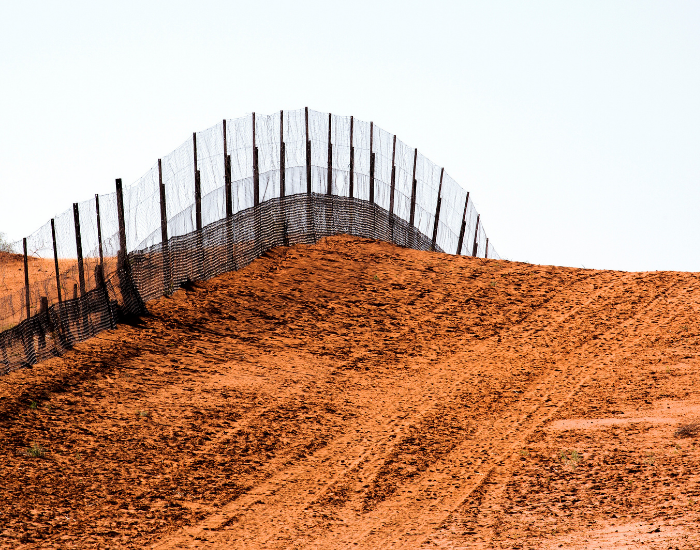
The dingo fence stretches more than 5,600 kilometres, from southern Queensland across New South Wales and into South Australia. Crews built it in the late 1800s and early 1900s to protect sheep country. Workers still patrol and repair it daily.
The barrier walls off northern cattle country from the southern sheep grazing areas. It also created an accidental continental experiment. On the sheep side, kangaroo and emu numbers explode, vegetation gets hammered, and foxes and cats flourish. On the dingo side, kangaroo densities drop and small mammals do better. Researchers have even measured differences in soil and vegetation visible from satellites.
10. Livestock Losses Turned a Predator into a “Pest”
European colonisation changed the relationship overnight. Early European settlers brought sheep, and dingoes began preying on livestock in the early 19th century. That collision defined the next two centuries of policy. Livestock owners consider dingoes pests, and the label sticks hard.
The financial figures are substantial. Queensland alone attributes around $30 million in annual losses to wild dog predation and control. In 2006, some Northern Territory cattle operations reported calf losses estimated at up to 30 per cent.
However, the economics cut both ways. A growing number of graziers now retain dingoes deliberately. They argue that stable packs suppress kangaroos competing for pasture and keep feral pigs off calves. Killing the alpha pair often fractures a pack and worsens livestock attacks. As a result, “control” can create the problem it was meant to solve.
11. Native Species or Invasive Species? The Dingo Debate
This argument decides how the animal gets managed, so it repays a little attention. Purists note that dingoes came here with people, which technically makes them an introduced species. Some agricultural bodies push harder and group them with foxes and cats as an invasive species.
Most ecologists reject that framing now. Four thousand years of natural selection produced a wild canid filling the niche the thylacine left empty. In the current scientific literature the dingo is considered native wildlife, and several states legislate on that basis.
Victoria shows how tangled the result gets. The Wildlife Act 1975 protects dingoes there, and the Flora and Fauna Guarantee Act lists them as vulnerable. Yet an Order in Council still permits lethal control on private land across eastern Victoria until 2028.
12. The Conservation Status Is Genuinely Confusing
The IUCN officially lists the dingo’s conservation status as “Not Evaluated”. Assessors have treated it as a feral domestic dog rather than a wild taxon. Meanwhile, a 2008 assessment classified the species as vulnerable, and Victoria lists it as threatened.
The result is a species protected in some national parks and reserves while being baited a fence-line away. Hybridisation with domestic dogs remains the most cited biological threat. A 2023 study using new DNA methods found most wild dingoes were far purer than expected. By contrast, a 2026 analysis of 300 animals found roughly 12 per cent dog ancestry on average. Western Australia and K’gari sat under 3 per cent. Victoria reached 28 per cent.
Both results can be true. Purity varies enormously by region, and where you sample decides the headline you write.
13. K’gari Holds Around 120 to 200 Dingoes, and Every Eye in Australia
The island holds the most studied of all dingo populations. A 2025 population viability analysis in Australian Mammalogy settled on about 123 animals. That figure sits close to an earlier estimate of 130. Queensland Parks cites a working figure nearer 200, which tells you how hard these animals are to count.
That analysis carried a warning. Under high-mortality scenarios, or when few females successfully breed, extinction risk climbs steeply. A population of roughly 120 to 200 on a single island has little margin.
I followed the ranger guidance closely, and you should too. Walk in groups of at least two and stay within arm’s reach of children. Never feed an animal or photograph one at close range. An animal that links people with food loses its wariness. A fed dingo eventually becomes a dead dingo.
14. Indigenous Australians Have Lived Alongside Dingoes for Millennia
Long before graziers arrived, dingoes shared camps with Aboriginal people across the continent. Families took pups from dens, raised them, and let them return to the bush at maturity. Dingoes can be tamed with frequent human contact, though taming is not domestication. They never became domestic animals in the European sense, because the animal still leaves.
The name dingo itself carries that history. It comes from dingu, a Dharug word from the Sydney region. That word described the tame camp dogs of Aboriginal people. British colonists heard the word and then applied it to every wild dog they met.
Frequently Asked Questions About Dingoes
Dingoes are not generally aggressive toward people, and most encounters end with the animal walking away. Serious incidents are rare but real. They concentrate where the animals have been fed or habituated. Children and lone walkers face the highest risk because of their size and body language. On K’gari, rangers advise walking in groups and staying within arm’s reach of children.
No, and I would discourage anyone from trying. Dingoes need constant stimulation, climb and dig extraordinarily well, and rarely settle into domestic routines. Ownership is illegal or tightly permitted in most Australian states, including New South Wales and Western Australia. Escaped or released animals also worsen hybridisation, the main biological threat to wild populations.
Both descriptions have defenders, which is why the conservation status stays unresolved. Dingoes arrived with people roughly 4,000 to 5,000 years ago, so they are technically introduced. The International Union for Conservation of Nature has never formally assessed them as a wild taxon. Ecologically, though, they now function as a native species and most researchers treat them that way.
What That Beach Encounter Actually Taught Me
Australia’s iconic wild canid is the clearest case I know of an animal punished for an argument about labels. Call it a wild dog and you bait it. Call it a native apex predator and you manage around it. The science increasingly supports the second reading, and the fence-line data makes that hard to dodge.
Go and see one properly. Visit K’gari, or the arid country west of the fence, and keep your distance and your food locked away. If you want more Australian animals to chase, start with my guide to the animals of Australia. For comparison across continents, my coyote subspecies guide shows a canid solving similar problems in North America. These facts about jackals round out the picture.
Dingo Challenge 🐕
Ten questions on Australia’s wild dog, first a fact-or-fiction round, then multiple choice. How many can you get?
References:
Allen, B. L., Allen, L. R., Graham, M., & Buckman, M. (2020). Elucidating dingo’s ecological roles: Contributions from the Pelorus Island feral goat biocontrol project. Australian Zoologist, 41(3), 374–387. https://doi.org/10.7882/AZ.2020.018
Appleby, R., Smith, B. P., Jones, D., Conroy, G., & Behrendorff, L. (2025). A population viability analysis of K’gari (Fraser Island) wongari (dingoes). Australian Mammalogy, 47(1), AM23009. https://doi.org/10.1071/AM23009
Cairns, K. M., et al., (2025). Taxonomic tangles posed by human association: The urgent need for an evidence-based review of dingo and domestic dog taxonomy and nomenclature. Australian Mammalogy, 47(3), AM24052. https://doi.org/10.1071/AM24052
Doherty, T. S., et al., (2019). Continental patterns in the diet of a top predator: Australia’s dingo. Mammal Review, 49(1), 31–44. https://doi.org/10.1111/mam.12139
Fancourt, B. A., Cremasco, P., Wilson, C., & Gentle, M. N. (2019). Do introduced apex predators suppress introduced mesopredators? A multiscale spatiotemporal study of dingoes and feral cats in Australia suggests not. Journal of Applied Ecology, 56(12), 2584–2595. https://doi.org/10.1111/1365-2664.13514
Souilmi, Y., et al., (2024). Ancient genomes reveal over two thousand years of dingo population structure. Proceedings of the National Academy of Sciences, 121(30), e2407584121. https://doi.org/10.1073/pnas.2407584121
Weeks, A. R., Kriesner, P., Bartonicek, N., van Rooyen, A., Cairns, K. M., & Ahrens, C. W. (2025). Genetic structure and common ancestry expose the dingo-dog hybrid myth. Evolution Letters, 9(1), 1–12. https://doi.org/10.1093/evlett/qrae057