
The first time I fed a green anaconda, I was standing inside its enclosure. I worked the reptile and amphibian section at a zoo for years, and that giant was part of my rounds. She wrapped a loop around my forearm, gently, just testing, and I felt how easily she could have squeezed. That moment taught me more than any textbook. Many types of snakes are not monsters. They are some of the most refined predators on Earth.
In this article, I want to share 15 types of snakes, each with pictures, biology, and a few stories from my own fieldwork. Snakes are limbless, carnivorous reptiles, and they’ve adapted to almost every environment on the planet. There are more than 4,000 known species, and counting. Some could crush a deer; others are smaller than a pencil. By the end, you’ll tell a harmless garter from a venomous viper, and understand why both matter.
How Snakes Are Classified
Scientists group snakes by family, based on shared evolutionary history. A handful of families hold most of the diversity you’ll meet.
Colubridae is the largest snake family, with over 2,000 mostly non-venomous species. Pythonidae includes the heavyweight constrictors and the world’s longest snake. Boidae are constrictors too, but they give birth to live young. Elapidae contains front-fanged venomous snakes like cobras and mambas. Viperidae rounds it out with the rattlesnakes and vipers.
Here’s a fact that surprises most people. Fewer than a few hundred snake species are venomous at all, roughly 600 by current counts. Of those, only about half can deliver a bite that’s lethal to a human. Most venomous snakes belong to just two families, Elapidae and Viperidae. Everything else is, broadly speaking, harmless to you.
A quick word on the senses, because it shapes everything they do. Snakes use their forked tongues to collect scent particles from the air. They lack external ear openings and have highly elongated, asymmetrical internal organs packed tightly into that narrow body, including a single functioning lung in most species. They also shed their skin periodically to grow and scrape off parasites.
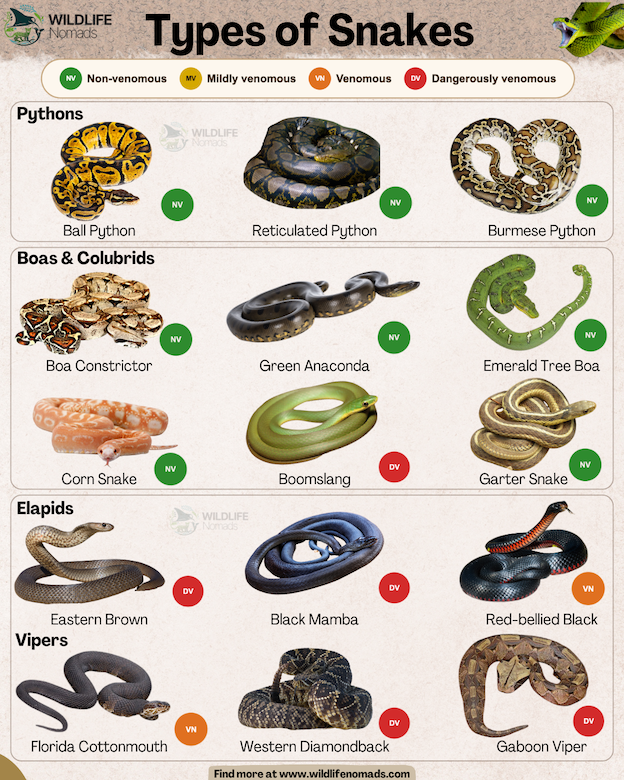
1. Ball Python (Python regius)
The ball python is the snake I’d hand to a nervous first-timer. It’s calm, slow, and rarely bites. When stressed, it curls into a tight ball, hence the name. I handled dozens at the zoo, and the temperament is remarkably consistent.
Native to the grasslands of West and Central Africa, this python rarely tops five feet. Its docile nature made it a pet-trade giant. Over 100,000 ball pythons are imported into the US most years, and millions have been exported from Togo, Benin, and Ghana since the 1970s. That trade raises real conservation questions. If you want the full story, our royal ball python facts piece goes deep.

2. Reticulated Python (Malayopython reticulatus)
The Pythonidae family includes the world’s longest snake, and this is it. Reticulated pythons in Southeast Asia have been measured past 20 feet, with reliable records pushing well beyond. The diamond-shaped “reticulated” pattern is stunning camouflage on a forest floor.
These are powerful, non-venomous constrictors. They ambush mammals and birds, then subdue prey with relentless coils. For all their size, they’re shy, and most want nothing to do with people.
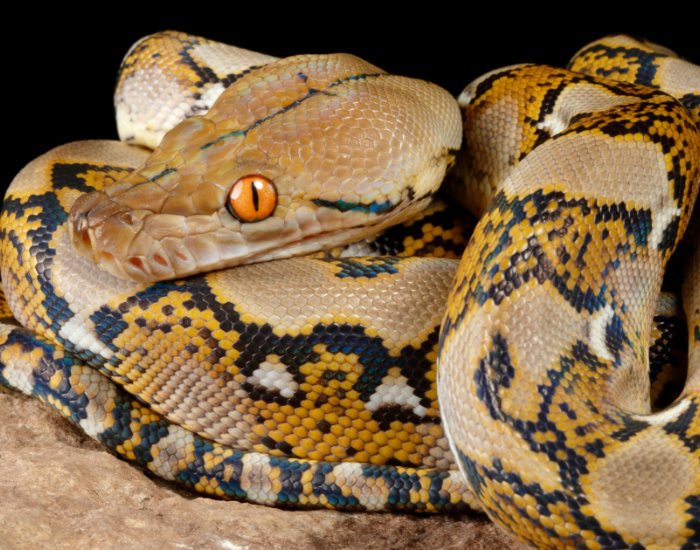
3. Green Anaconda (Eunectes murinus)
This is the snake from my opening story. The green anaconda isn’t the longest, but it’s the heaviest snake on the planet, built with the stocky body of a true aquatic ambush predator. In the swamps of South America, it hunts capybara, caiman, and fish from the water’s edge.
Feeding one taught me respect fast. The muscle under that skin is astonishing, and a single coil can immobilize an arm. As a member of Boidae, the anaconda gives birth to live young rather than laying eggs. That’s the main split between boas and pythons, reproduction.
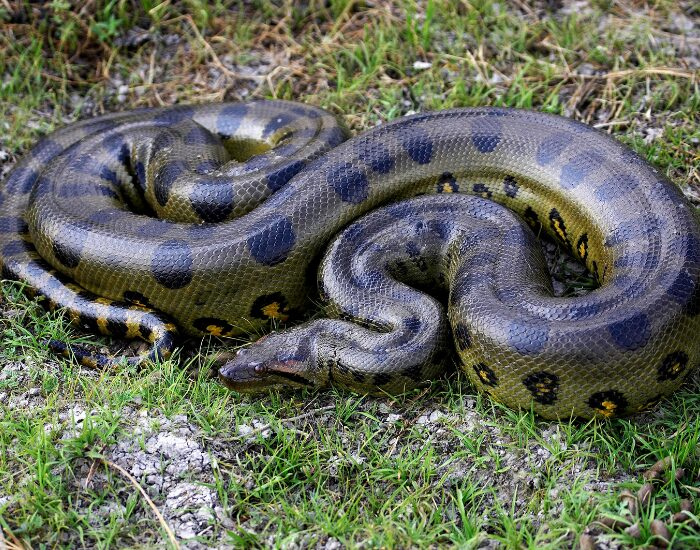
4. Boa Constrictor (Boa constrictor)
The boa constrictor is the species that made “constriction” a household word. I fed boas regularly at the zoo, and watching one strike, coil, and tighten in seconds never got old. They don’t crush bones; they cut off blood flow, which is faster and more efficient.
Boas range from Mexico through South America, thriving in deserts and rainforests alike. Non-venomous snakes like this one subdue prey entirely by constriction. Adults stay manageable in size, which is partly why they remain popular. Our boa constrictor facts guide covers their range and care.
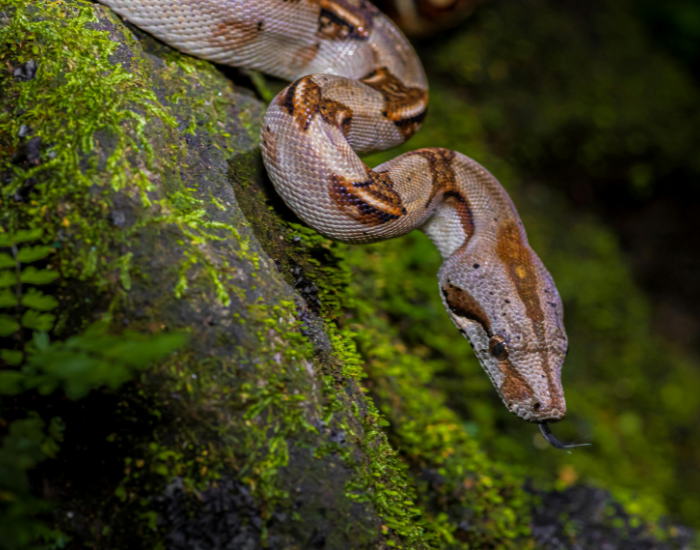
5. Burmese Python (Python bivittatus)
Burmese pythons are powerful constrictors of Southeast Asian wetlands, and an ecological cautionary tale. Released pets established a breeding population in Florida’s Everglades, and the consequences were severe. Road surveys documented raccoon sightings down 99% and bobcats down nearly 88% in python-heavy areas.
I’ve watched removal crews work in Florida, and the scale is humbling. One animal, in the wrong habitat, can unravel a food web. It’s a good reminder that no snake belongs everywhere. So think twice before getting a pet you do not know if you can commit.

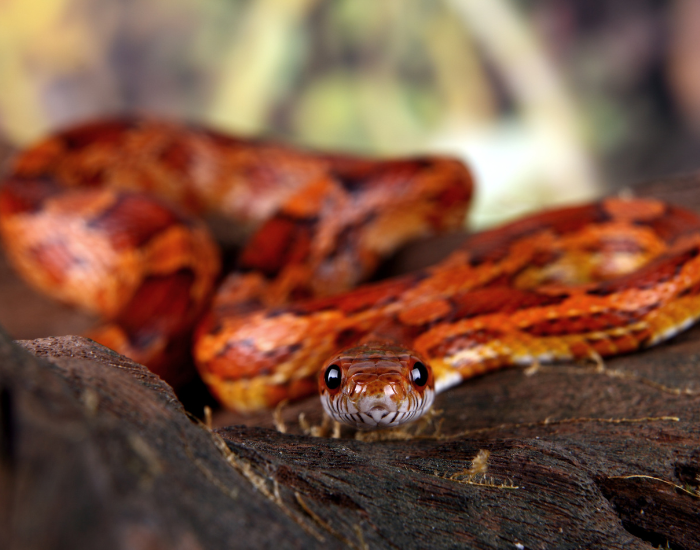
6. Corn Snake (Pantherophis guttatus)
If the ball python is the beginner’s python, the corn snake is the beginner’s colubrid, a member of the Colubridae family. These eastern United States natives are hardy, easy to feed, and gorgeously patterned in orange and red. New keepers love them for good reason.
In the wild, corn snakes are farmland heroes. They hunt rodents around grain stores, the “corn” connection, and pose zero threat to humans. They’re harmless, nonvenomous, and endlessly photogenic, which is why they fill so many photo galleries.
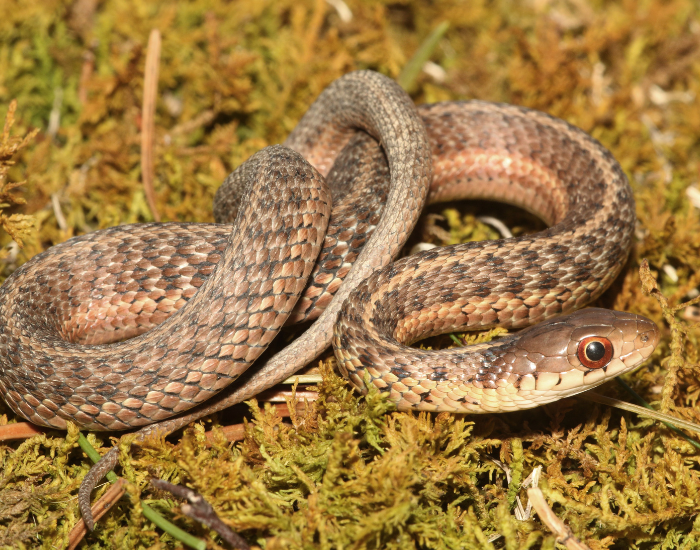
7. Garter Snake (Thamnophis sirtalis)
The garter snake is probably the first snake most Americans ever see. Adaptable and widespread, it thrives in backyards, wetlands, and city parks across North America. That adaptability makes it a favorite among beginner keepers.
Garter snakes eat amphibians, fish, worms, and the occasional small rodent. They’re small, fast, and essentially harmless, though a nervous one may release a musky smell. I still grin when I flip a log and find one, childhood fieldwork, basically.
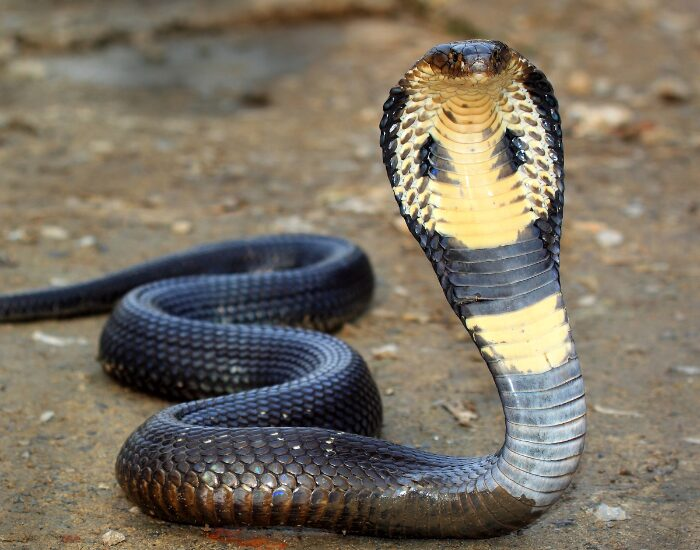
8. King Cobra (Ophiophagus hannah)
Now we enter the Elapidae family, the front-fanged venomous snakes. The king cobra is the longest venomous snake in the world, reaching 18 feet in Southeast Asia’s forests. Its name fits its diet: it eats other snakes.
The venom is potently neurotoxic, attacking the nervous system rather than the tissue. Yet king cobras are shy and would rather flee than fight. For all the fear they inspire, recorded bites on humans are rare.
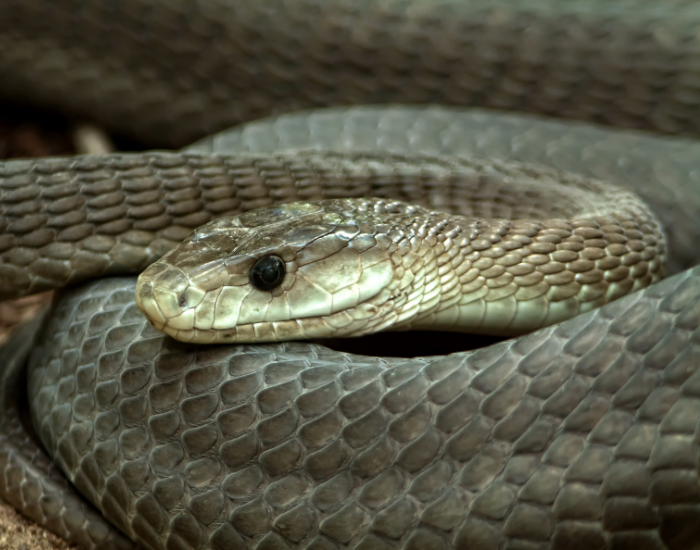
9. Black Mamba (Dendroaspis polylepis)
Few African snakes carry a bigger reputation than the black mamba. It’s fast, alert, and armed with fast-acting neurotoxic venom. The “black” refers to the inky inside of its mouth, flashed as a warning, not its skin, which is gray-brown.
I’ve never worked a mamba hands-on, and I’m fine with that. In the field, the rule is simple: give it space and it gives you space. Most bites happen when people corner the animal. Read more in our black mamba facts feature.
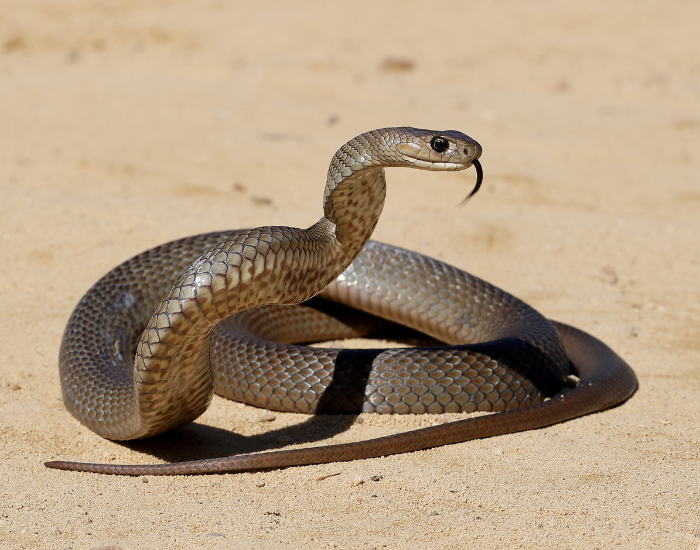
10. Eastern Brown Snake (Pseudonaja textilis)
Australia is snake country, and the eastern brown is one of its most significant venomous snakes. It’s an elapid with extremely potent venom, and it lives close to people across the continent’s east. Despite that, it’s nervous by nature and bites mostly in self-defense.
Now that I live in Australia I give browns a wide, respectful berth. They move fast through dry paddocks and farmland, hunting rodents that follow human settlement. Our eastern brown snake facts post explains why context matters more than fear.
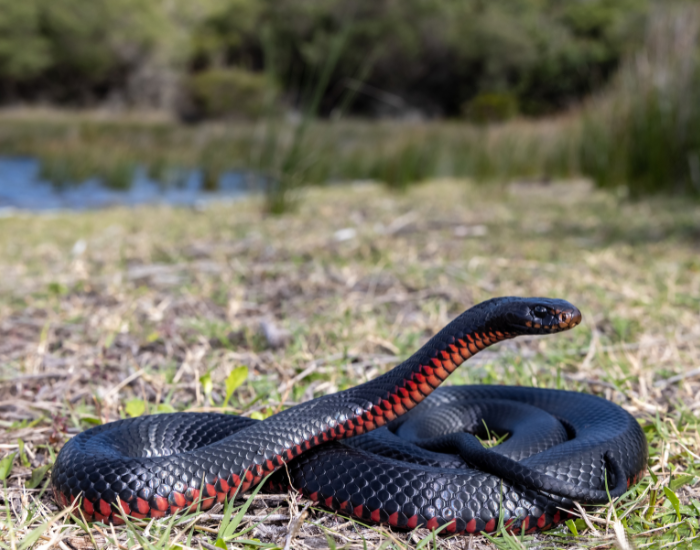
11. Red-bellied Black Snake (Pseudechis porphyriacus)
This is the Australian snake I saw most often myself. Glossy black above, with a vivid red belly, it’s unmistakable near creeks and wetlands. It’s venomous (an elapid) but its bite has never been reliably linked to a human death.
I watched one glide across a trail and slip into a pond, calm as anything. Red-bellied blacks even help control more dangerous snakes by competing with them. It’s a beautiful argument against judging a species by its venom alone.
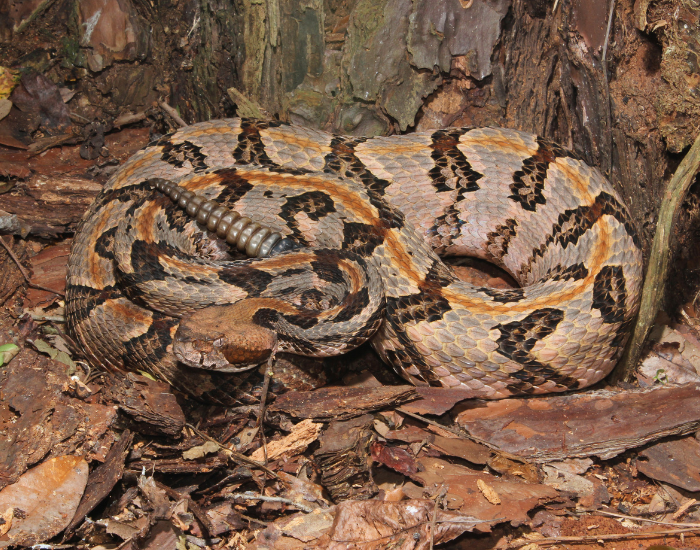
12. Western Diamondback Rattlesnake (Crotalus atrox)
With the rattlesnakes, we reach the Viperidae family and the pit vipers. The western diamondback is the classic American rattler, common across the southwestern deserts. Heat-sensing pits between eye and nostril let it strike prey in total darkness.
At the zoo, I was trained to handle rattlesnakes with hooks and tongs, never hands. That training drills patience into you. Vipers produce hemotoxic venom that destroys tissue, and these snakes carry long, hinged fangs to deliver it. The rattle, by the way, is an honest warning, heed it. More in our western diamondback rattlesnake facts guide.

13. Timber Rattlesnake (Crotalus horridus)
The timber rattlesnake is the diamondback’s eastern cousin, ranging across the forests of the eastern United States. It’s larger and remarkably docile, often holding still rather than rattling. That restraint, sadly, hasn’t spared it.
Habitat loss and persecution have left the timber rattlesnake threatened or protected across much of its range. It’s a pit viper that asks for very little , a den, some rodents, and to be left alone.
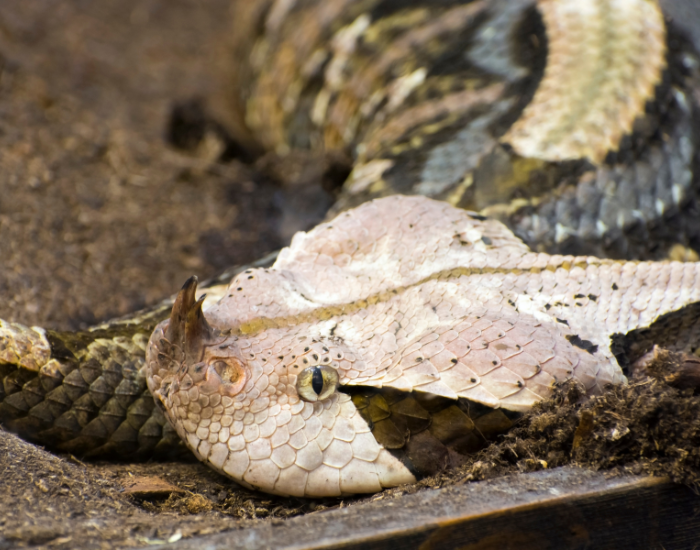
14. Gaboon Viper (Bitis gabonica)
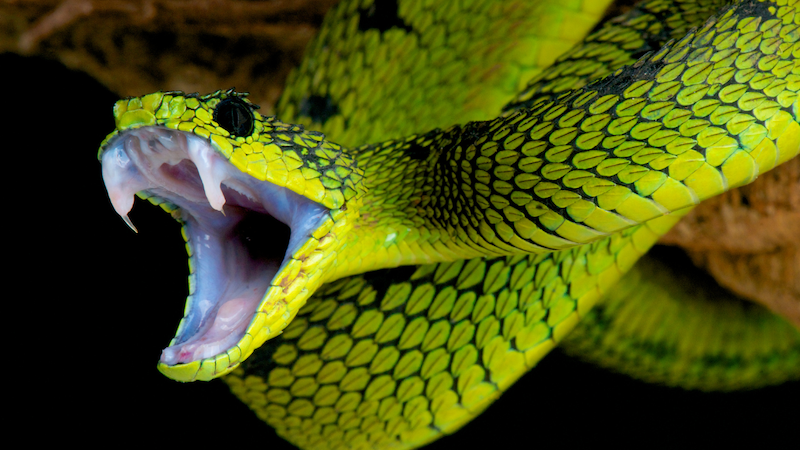
If you want a viper that looks unreal, meet the Gaboon. This stocky African snake wears a leaf-litter pattern so perfect it nearly vanishes on the forest floor. It also has the longest fangs of any venomous snake, up to two inches.
I fed vipers during my zoo years, and the Gaboon’s slow, deliberate strike stays with me. Its hemotoxic venom is no joke, yet it’s famously placid and reluctant to bite. It waits, motionless, for prey to wander too close, a great examples of patience to be honest!
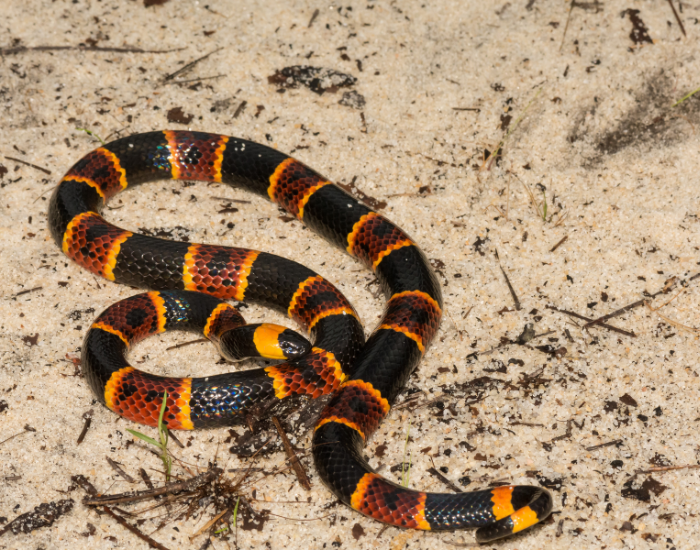
15. Eastern Coral Snake (Micrurus fulvius)
We finish with one of North America’s most misunderstood snakes. Coral snakes are small, secretive members of the elapid family, banded in red, yellow, and black. The old rhyme helps: “red touches yellow, kills a fellow.” On harmless mimics like the scarlet king snake, red touches black instead.
Coral snakes carry strong neurotoxic venom but rarely bite, and their small mouths make defensive strikes difficult. In years of fieldwork I’ve seen only a handful. They spend most of their lives underground, hunting other small snakes and lizards.
Frequently Asked Questions
Start with the head, body shape, and pattern, then check your region — location narrows the options fast. Triangular heads, vertical pupils, and a rattle suggest a pit viper, while round pupils and slender bodies often mean a harmless colubrid. Pattern matters too: banding order separates a venomous coral snake from its mimics. When unsure, never handle it; photograph from a safe distance and ask a local herpetologist.
That’s Ilha da Queimada Grande, or “Snake Island,” off the coast of Brazil. It holds one of the densest snake populations on Earth, dominated by the golden lancehead, a pit viper found nowhere else. Rising seas isolated the island long ago, and the snakes evolved in place. Brazil bans public visits, both to protect people and the critically endangered snakes.
Alaska is the only US state with no native snakes. Its long, deep-freezing winters simply don’t suit cold-blooded reptiles, which rely on external warmth. Hawaii also has no native snakes and works hard to keep introduced ones out. Everywhere else in the country, snakes are part of the natural world.
Yes, but not the way you do. Snakes lack external ears, so they “hear” mostly through vibration carried in their jaw and skull. A study on royal pythons showed they detect low-frequency sound best, around 80–160 Hz. So a snake feels your footsteps approaching more than it hears your voice.
By family, the big five are Colubridae, Pythonidae, Boidae, Elapidae, and Viperidae. Colubrids are the largest, mostly non-venomous group. Pythons and boas are constrictors, while elapids and vipers hold most of the world’s dangerous, venomous species.
Why These Snakes Are Worth Knowing
Spend enough time with snakes and the fear gives way to fascination. The same family logic that links a corn snake to a king cobra reveals a 100-million-year story of adaptation, from constriction to venom to perfect camouflage. Knowing the difference between a harmless garter and a venomous viper keeps both you and the snake safe.
So next time you spot one on a trail, pause and look closer instead of reaching for a stick. Notice the head, the pattern, the way it moves. If you want to keep exploring, dig into our guides on grass snakes, adders, Egyptian snakes, and sea snakes. Have you met any of these species in the wild?
Can You Name That Snake? 🐍
A 14-photo identification challenge — the wrong answers are deliberately tricky look-alikes. Go back and change any answer before you score.
Which snake is this?
References:
D’Cruze, N., Harrington, L. A., Assou, D., Green, J., Macdonald, D. W., Ronfot, D., Segniagbeto, G. H., & Auliya, M. (2020). Betting the farm: A review of ball python and other reptile trade from Togo, West Africa. Nature Conservation, 40, 65–91. https://doi.org/10.3897/natureconservation.40.48046
Christensen, C. B., Christensen-Dalsgaard, J., Brandt, C., & Madsen, P. T. (2012). Hearing with an atympanic ear: Good vibration and poor sound-pressure detection in the royal python, Python regius. Journal of Experimental Biology, 215(2), 331–342. https://doi.org/10.1242/jeb.062539
Dorcas, M. E., Willson, J. D., Reed, R. N., Snow, R. W., Rochford, M. R., Miller, M. A., Meshaka, W. E., Andreadis, P. T., Mazzotti, F. J., Romagosa, C. M., & Hart, K. M. (2012). Severe mammal declines coincide with proliferation of invasive Burmese pythons in Everglades National Park. Proceedings of the National Academy of Sciences, 109(7), 2418–2422. https://doi.org/10.1073/pnas.1115226109
Gutiérrez, J. M., Calvete, J. J., Habib, A. G., Harrison, R. A., Williams, D. J., & Warrell, D. A. (2017). Snakebite envenoming. Nature Reviews Disease Primers, 3, 17063. https://doi.org/10.1038/nrdp.2017.63
Willson, J. D. (2017). Indirect effects of invasive Burmese pythons on ecosystems in southern Florida. Journal of Applied Ecology, 54(4), 1251–1258. https://doi.org/10.1111/1365-2664.12844
Zaher, H., Murphy, R. W., Arredondo, J. C., Graboski, R., Machado-Filho, P. R., Mahlow, K., Montingelli, G. G., Quadros, A. B., Orlov, N. L., Wilkinson, M., Zhang, Y.-P., & Grazziotin, F. G. (2019). Large-scale molecular phylogeny, morphology, divergence-time estimation, and the fossil record of advanced caenophidian snakes (Squamata: Serpentes). PLoS ONE, 14(5), e0216148. https://doi.org/10.1371/journal.pone.0216148
Uetz, P., Freed, P., Aguilar, R., Reyes, F., & Hošek, J. (2024). The Reptile Database. http://www.reptile-database.org