There is a specific silence that falls over the Australian bush just before something happens. I remember working in a reserve near Western Sydney, the sun beating down on the dry sclerophyll forest, when the atmosphere shifted. My team was a few metres ahead. Then a startled bird let out a frantic “cluck,” and a shimmering bronze ribbon vanished into the scrub. An eastern brown snake (Pseudonaja textilis) had just made its exit.
In Australia, these snakes are far more common than most people expect and one of the most dangerous snakes. The eastern brown snake occupies a wide range of habitats, from forests and savannahs to farmland and urban outskirts, showing remarkable adaptability. It is often cited as one of the deadliest animals in Australia, and for good reason. But beyond the fear, there is a fascinating, highly evolved predator. The eastern brown snake also plays a significant role in controlling rodent populations, particularly in agricultural areas.
Here are 12 weird facts about the eastern brown snake that every Australian — and every nature lover — should know.
1. The “Common Brown Snake” Name Is a Bit of a Misnomer
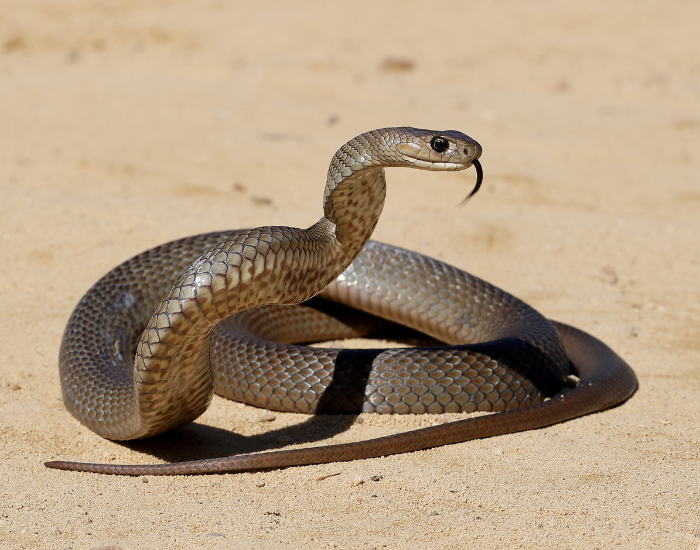
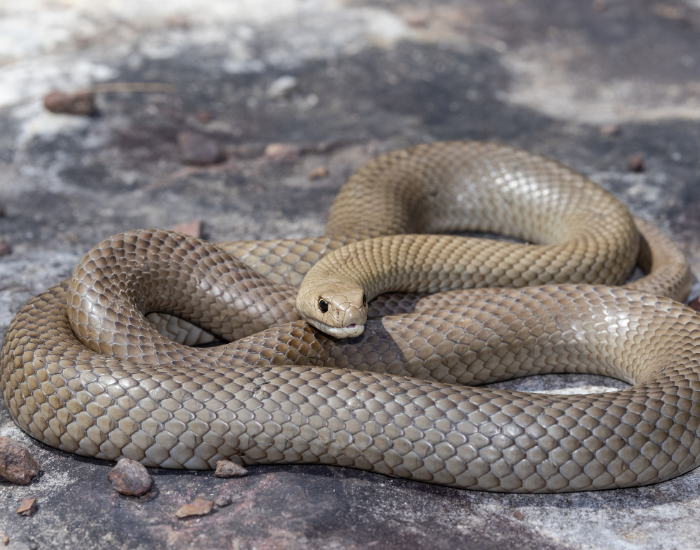
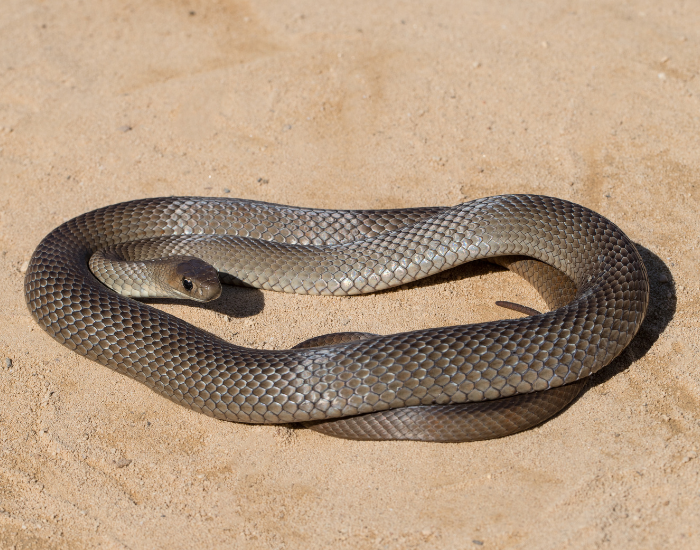
While we call it the common brown snake, its appearance is anything but uniform. You might expect a “brown” snake to be, well, brown. However, the eastern brown ranges from pale fawn to almost pitch black. I’ve personally seen specimens with a rich burnt orange hue and others with a smoky grey-brown tone.
This colour variability makes identification a nightmare for newcomers. People often confuse eastern browns with the brown tree snake or the western brown snake (Pseudonaja nuchalis). The key isn’t just the colour — it’s the slender build and the small, inconspicuous head that blends almost seamlessly into the body.
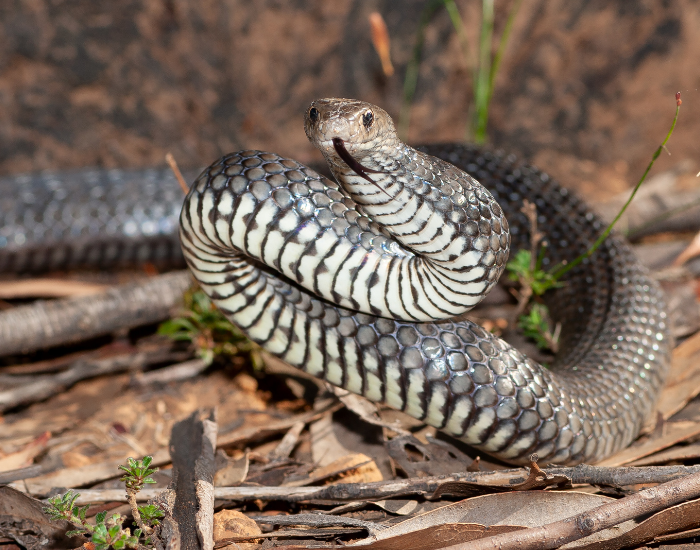
2. It’s the World’s Second Most Venomous Land Snake
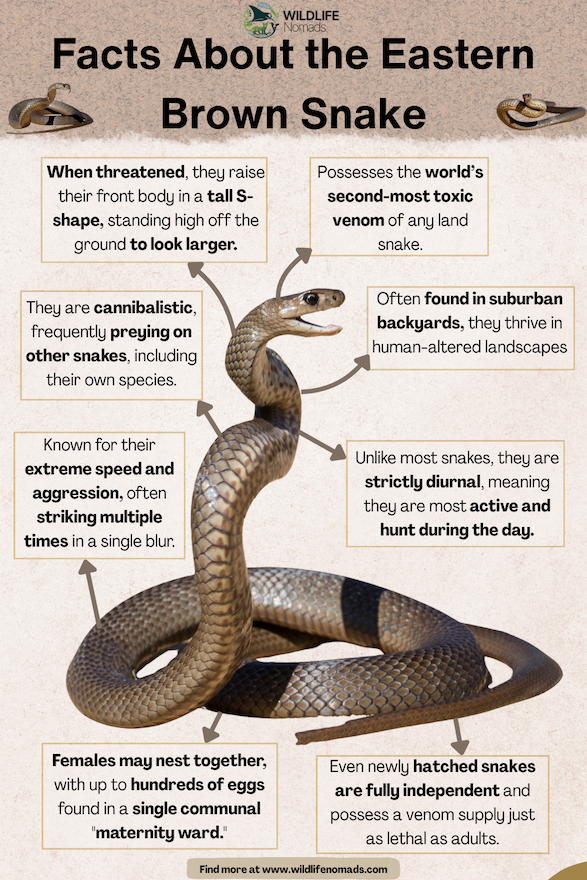
When people ask, “How venomous is an eastern brown snake?” the answer is: statistically terrifying. Based on LD₅₀ testing (the dose required to kill half a tested population of mice), the eastern brown sits firmly at number two on the global list. Only the inland taipan surpasses it.
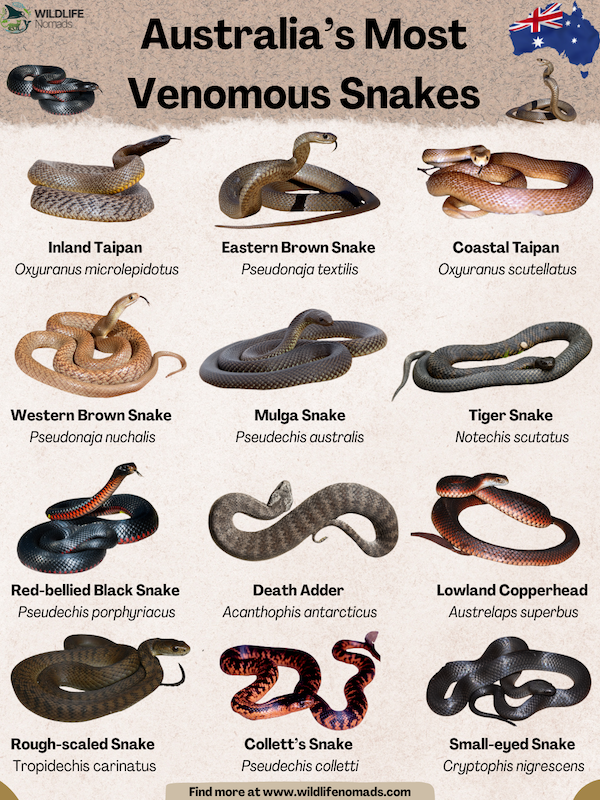
Because they thrive in disturbed habitats — farms, suburban gardens, city fringes — eastern browns are responsible for more snakebite fatalities in Australia than any other species. The inland taipan lives in remote outback crevices. The eastern brown, however, is the most venomous snake in Australia that you are actually likely to encounter.

3. Juvenile Eastern Browns Are Master Imposters
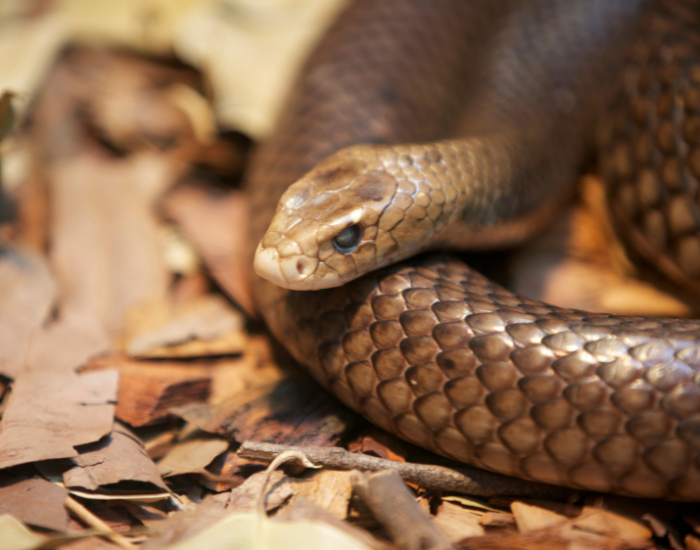
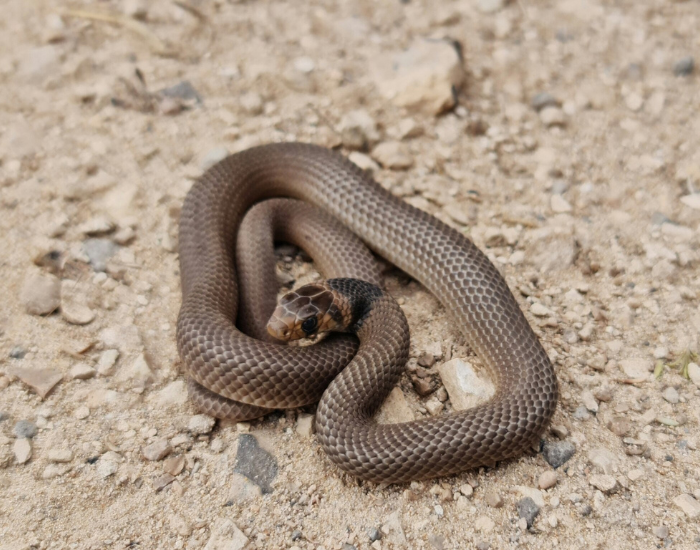
If you spot a small snake with a distinct dark band around its neck and a series of orange or grey splotches, you might not think “brown snake.” However, juvenile eastern brown snakes often have a black head with a lighter brown snout and a black nuchal band. These distinct markings, including the black head mark and black band across the neck, are typical in young snakes. As they mature, these markings fade—young snakes’ faded patterns are a key identification feature for this species.
These markings act as disruptive camouflage in juvenile eastern brown snakes. As they grow, they typically lose these patterns and develop a uniform brown or dark brown colouring. Importantly, don’t assume a hatchling is harmless — even a baby eastern brown carries enough venom to cause a serious medical emergency.
4. The Famous “S-Curve” Warning
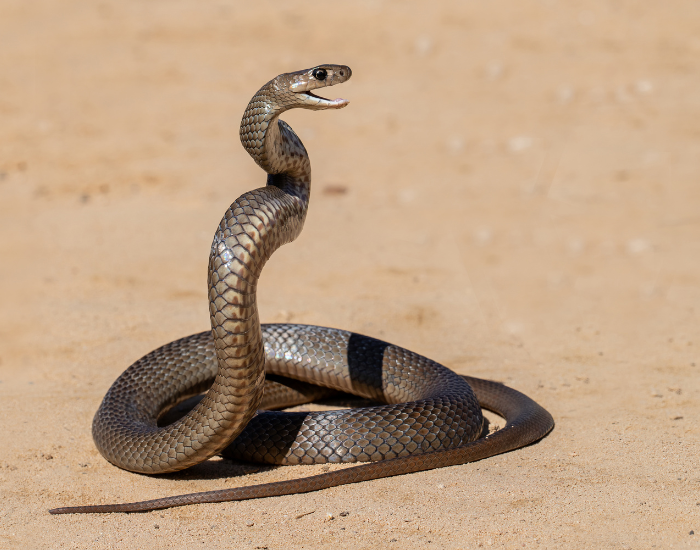
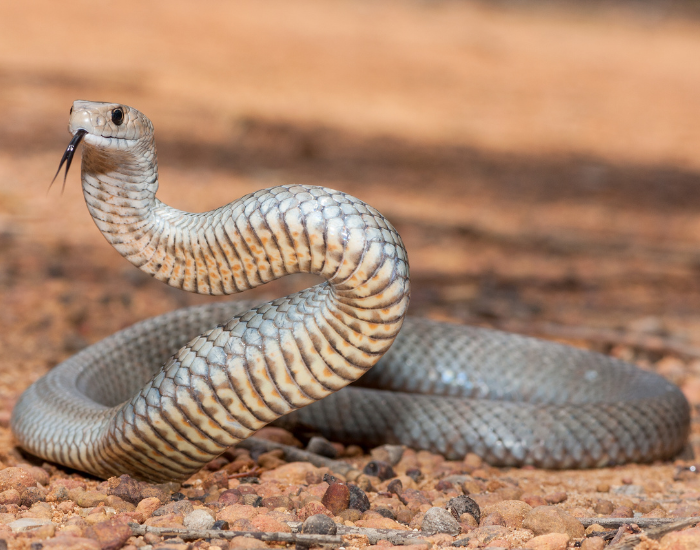
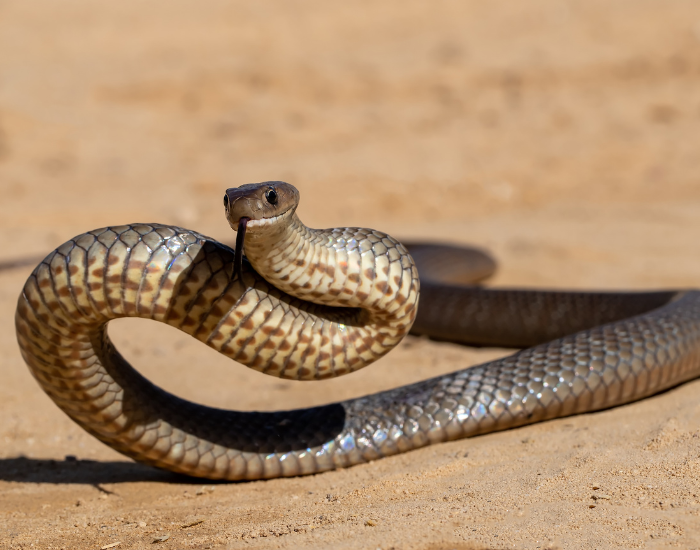
When threatened, they raise its forebody high off the ground, forming a tight S-curve with its neck—a classic defensive display. This behavior, often called a “snake raises,” is also seen when a foraging snake raises its head like a periscope to survey its surroundings for prey or threats, highlighting its alertness and sight-based hunting strategy. The eastern brown snake is also known for its speed, incredibly fast for snakes to be honest (reaching speeds of about 8–10 km/h)
It’s a bluff — but a very effective one. The snake doesn’t want to waste its venom on something it can’t eat. Therefore, it will only strike repeatedly if it truly has no escape route. This behaviour is often what leads people to label them as “aggressive.” In reality, “defensive” is the more accurate biological term. Most bites happen when people try to kill or handle them.
5. They Love a Good Mouse House
Unlike many Australian animal species that retreat as human settlement expands, the eastern brown snake population has actually benefited from it. The reason? We brought mice.
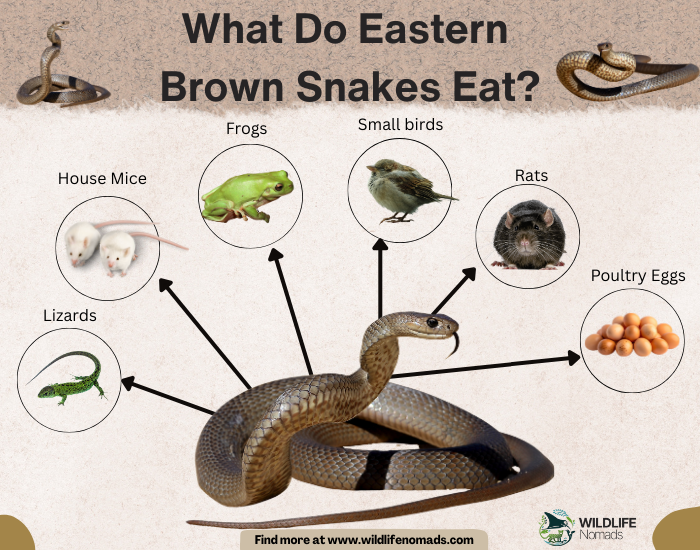
The eastern brown snake’s diet consists almost entirely of vertebrates, with mammals, especially the introduced house mouse, predominating. As the snake grows, it consumes more warm-blooded prey, such as small mammals and birds. Our barns, suburban gardens, and national park picnic areas are essentially all-you-can-eat buffets. In addition, they also eat lizards, small birds, and frogs. Like many wild snakes, the eastern brown snake plays a significant role in controlling rodent populations, particularly in agricultural areas. This dietary flexibility explains why they are the most commonly encountered dangerous snake in the country — they simply go where the food is.
6. The Peninsula Brown Snake Is a Distinct Relative
When identifying brown snakes, geography is your best friend. While the eastern brown dominates the east coast, the peninsula brown snake is a separate species found in South Australia, around the Eyre and Yorke Peninsulas.
You can often distinguish them by their venter pattern (the belly). The eastern brown typically has a creamy yellow belly with orange or grey splotches, while the peninsula variety has its own distinct markings. If you’re ever in South Australia, the Australian Reptile Online Database is a useful resource for local identification, since reptile species differ markedly across regions.
7. Its Name Literally Means “False Cobra”
The genus name Pseudonaja comes from the Greek pseudis (false) and naja (the cobra genus). The species is not a true cobra, but when threatened, it raises its forebody and slightly flattens its neck — very much like a cobra would.
The Pseudonaja genus contains several species, including the strap-snouted brown snake and the northern brown snake. One way to tell eastern browns from their northern cousins is the interior of the mouth: the northern brown often has a blackish mouth lining, while the eastern brown’s is flesh-coloured.
8. They Are Diurnal Sun-Worshippers
Most people picture snakes as nocturnal, but the eastern brown actively hunts during the day. They are primarily diurnal and generally solitary. However, on extremely hot days, they may retire during the hottest part of the day and become active again in the late afternoon, shifting to become crepuscular — active at dawn and dusk instead.
During winter, eastern brown snakes enter a state called brumation (the reptile equivalent of hibernation). Hibernating eastern brown snakes are often found in groups, with up to six eastern brown snakes sometimes sharing a winter retreat under slabs or in burrows. Eastern brown snakes hibernating may use deep crevices, hollow logs, rodent burrows, or — a favourite — sheets of old corrugated iron on farms. That rusty iron sheet is a perfect thermal conductor for a cold-blooded predator trying to warm up quickly.
Eastern brown snakes generally mate from early October onwards during the Southern Hemisphere spring.
9. Eastern Brown Snake Venom Is a Cocktail of Chaos
First, a quick clarification: brown snakes are venomous, not poisonous. If it bites you and you get sick, it’s venomous. Poisonous means you get sick from touching or eating it (like poison dart frogs in South America). Eastern brown snake venom is a complex mix of procoagulants, neurotoxins, and nephrotoxins.
The procoagulants are particularly dangerous. They activate the blood’s clotting cascade in a way that exhausts all clotting factors — a condition called Venom-Induced Consumption Coagulopathy (VICC). In plain terms, your blood loses its ability to clot, which can lead to severe bleeding and cardiovascular collapse in cases of brown snake envenomation.
The snake’s venom also contains neurotoxins that can paralyze the heart and lungs, but interestingly, despite this potency, eastern brown snake bites rarely cause neurotoxic symptoms—a phenomenon known as the brown snake paradox. The average venom yield of the eastern brown snake is under 5 mg per milking, which is less than other dangerous Australian snakes.
10. They Have Surprisingly Tiny Fangs
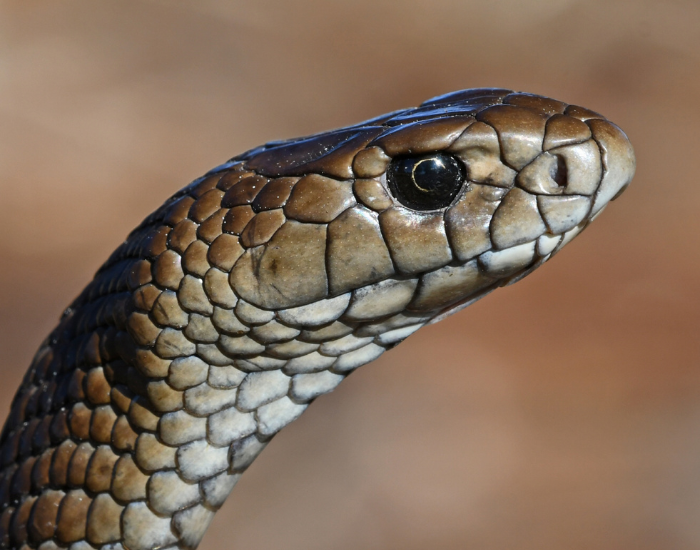
Given their fearsome reputation, you might expect the eastern brown snake’s fangs to resemble sabers. In reality, the eastern brown snake’s fangs are quite small compared to those of other Australian venomous snakes, averaging just 2.8 mm in length.
The arrangement of scales and the slender, streamlined structure of the snake’s body help distinguish the eastern brown snake from similar species, with scale patterns and coloration aiding in identification.
Because of these short fangs, thick clothing or sturdy boots can sometimes prevent full envenomation. However, never rely on denim to save you. Their strike is lightning-fast, and they don’t need a deep puncture wound to deliver a lethal dose of Australian animal toxins. The snake’s venom yields under 5mg per milking on average — but only 3mg is lethal to an adult human.
11. Males Engage in Wrestling Matches
During breeding season, you might spot two male eastern browns intertwined and rising up together — seemingly “dancing.” This is actually a form of ritual combat called plaiting or courtship combat.
The males are not trying to envenomate each other. Instead, each tries to press the other’s head to the ground to prove dominance. Encountering male snakes locked in this display is a fascinating sight. It can last for hours, and the winner earns the right to mate with the nearby female.
12. They Are a Protected Species
Despite being one of the deadliest animals in Australia, the eastern brown is protected under Australian law. In places like NSW National Parks, their presence indicates a healthy, functioning ecosystem. If you find one in your home, do not reach for a shovel. Call a licensed snake remover — only experienced snake keepers and professional handlers should ever attempt relocation. It’s safer for you, and it’s better for the snake.
13. Their Map is Massive (But Specific)
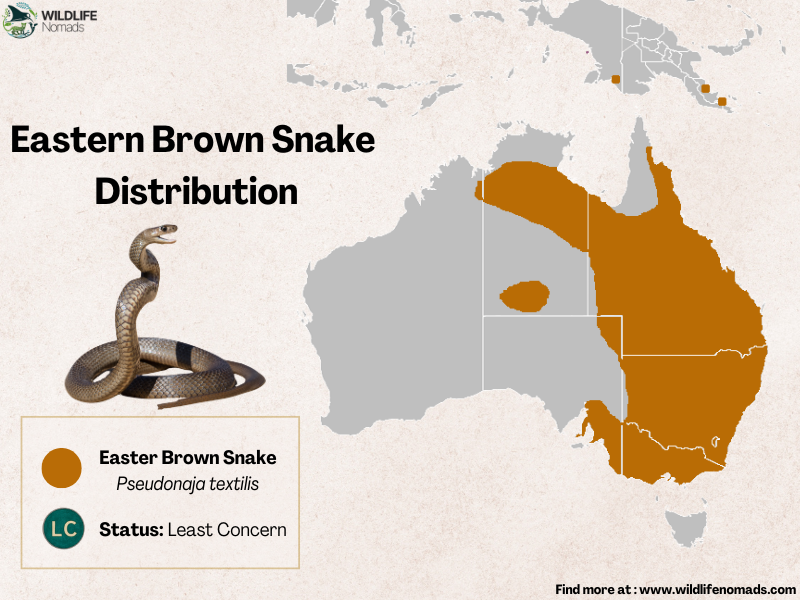
While the name suggests they are strictly “Eastern,” their reach is much broader. The eastern brown snake is found throughout the entire eastern half of mainland Australia, stretching from the tip of Cape York in Queensland, down through New South Wales and Victoria, and into the eastern parts of South Australia.
They aren’t just limited to the mainland, either; they have been recorded on several offshore islands. Interestingly, there is also a disjunct population found in parts of southern New Guinea. They are highly successful because they don’t mind a “disturbed” landscape, where humans clear forest for crops or houses, the eastern brown moves right in, whereas other more sensitive snake species tend to disappear.
Reproduction: What Happens After the Wrestling Match?
Eastern brown snakes are oviparous, meaning they lay eggs rather than giving birth to live young. After mating in spring, a female lays a clutch of around 10–35 eggs. She deposits them in soil or leaf litter and then leaves. Unlike some reptiles, she provides no parental care.
The eggs incubate for around 65–95 days depending on temperature, and the hatchlings emerge fully independent — and already venomous.
Conservation Status
The International Union for Conservation of Nature (IUCN) currently classifies the eastern brown snake as a species of least concern. Their populations remain stable across eastern and central Australia, largely because human activity has actually expanded their habitat rather than reduced it. However, their status in southern New Guinea, where they also occur, is less well understood.
Road mortality and illegal killing remain genuine threats. Education — articles like this one — helps change the public’s perception of these misunderstood reptiles.
Quick FAQ you may have
The eastern brown is the second most venomous land snake in the world by LD₅₀ testing. Its venom contains procoagulants and neurotoxins. It is responsible for more snake bite deaths in Australia than any other species.
A king brown (Mulga snake, Pseudechis australis) belongs to the black snake genus, not the brown snake family. King browns are much larger with a broader head. They produce higher volumes of venom, but the eastern brown’s venom is far more concentrated and potent per milligram.
In Australia, there is no official “brown house snake.” However, people often discover eastern browns inside homes. If you find a brown snake indoors in Australia, treat it as dangerous and call a licensed remover. In Africa, the “brown house snake” (Boaedon capensis) is a non-venomous constrictor — a completely different animal.
In the event of a snake bite, call 000 immediately. Apply a pressure immobilisation bandage starting at the bite site and wrapping up the limb. Keep the patient still and calm. Do not cut or suck the wound. Tetanus toxoid is given to snake bite victims, but the mainstay of treatment is the administration of the appropriate antivenom. Brown snake antivenom has been available since 1956 and is widely available in Australian hospitals.
Respecting the Bronze Bolt
The eastern brown snake is a masterpiece of evolution. It is fast, efficient, and perfectly adapted to the Australian landscape — from NSW National Parks to the suburban backyard. While it earns its place among the deadliest animals in Australia, it isn’t hunting you. It’s simply looking for a meal and a bit of sunshine.
The next time you’re hiking or exploring Australia’s wildlife, keep an eye on the long grass. If you spot a flash of bronze, give it a wide berth and a nod of respect. You’re looking at one of the most extraordinary predators on the planet.