You hear a rustle in the heather, a dry, papery sound that stops the moment you freeze. If you’re lucky, you might catch a glimpse of a bold, dark zig-zag retreating into the gorse. Most people panic, but for me, that sound is a pulse-check for the health of the British countryside.
The adder is the UK’s only venomous snake, found mainly in heathlands, woodland edges, and coastal dunes. Although often feared, dangerous bites to humans and dogs are extremely rare. The adder is now a protected species due to its declining numbers, making its conservation increasingly important. This guide brings together everything I’ve learned from the field and the lab: identification, diet, reproduction, and the survival tricks that make the Vipera berus genuinely remarkable.
1. It is the UK’s Only Venomous Snake
Let’s address the elephant (or the viper) in the room: yes, the uk adder snake is venomous. One of the iconic animals of the UK. It is the only native venomous snake we have. However, “venomous” does not mean “deadly.” In the UK, adder bites are rarely fatal. In fact, since 1876, there have only been 14 recorded human fatalities in the UK, not a single one in the last 50 years. You are statistically more likely to have a severe reaction to wasp stings than to an adder.

2. They Don’t Actually Lay Eggs
If you find a clutch of leathery, white eggs in your compost heap, I can tell you right now: those are not adder eggs. One of the coolest biological facts about adders is that they are ovoviviparous. This means they live young, the eggs internally develop and “hatch” inside the mother.
Why? Because the UK is cold! By keeping the young inside her, a female adder can move to a warm rock or a patch of sunlight to regulate the temperature of her developing offspring. This is a brilliant adaptation for surviving as far north as the Arctic Circle.
3. The “Zig-Zag” is Their Fingerprint
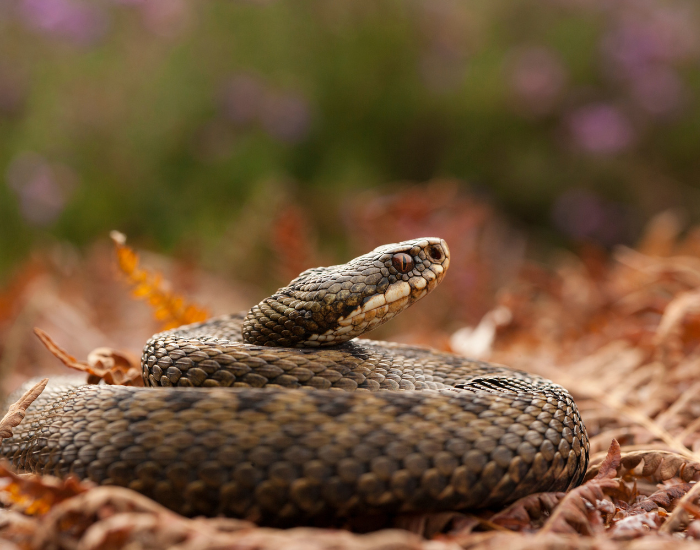
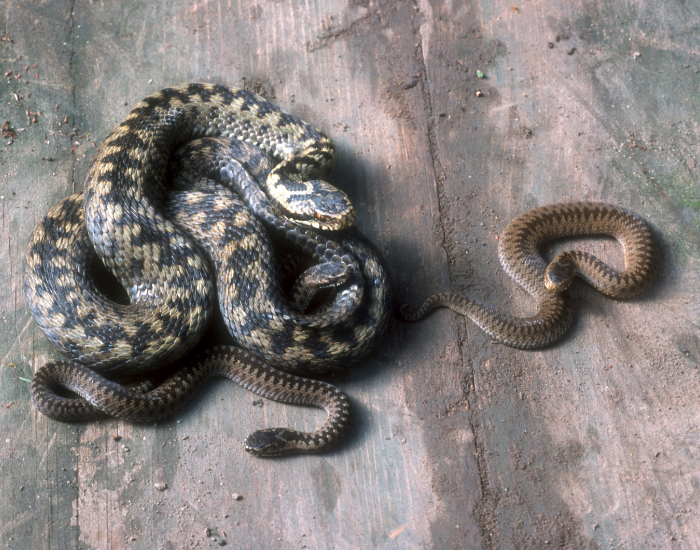
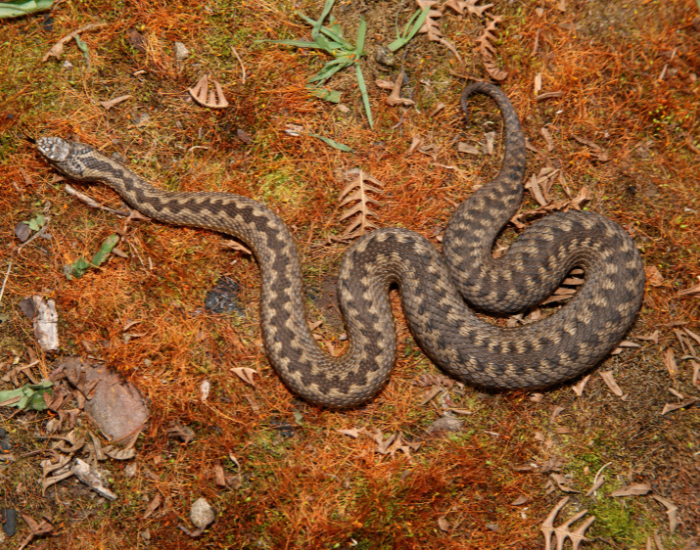
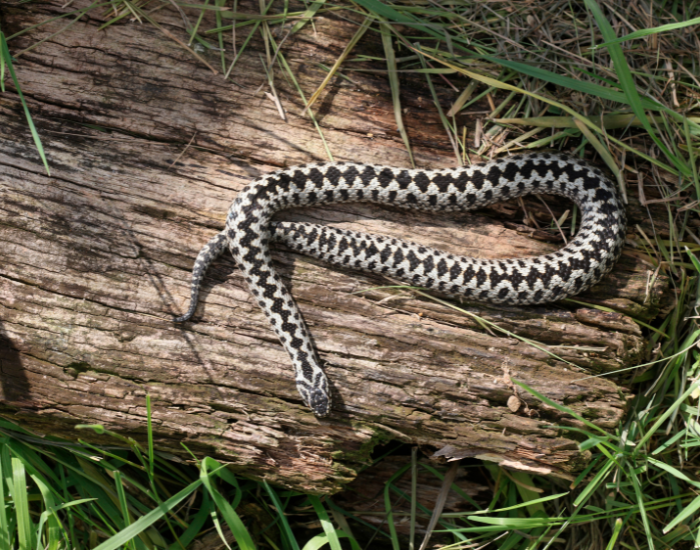
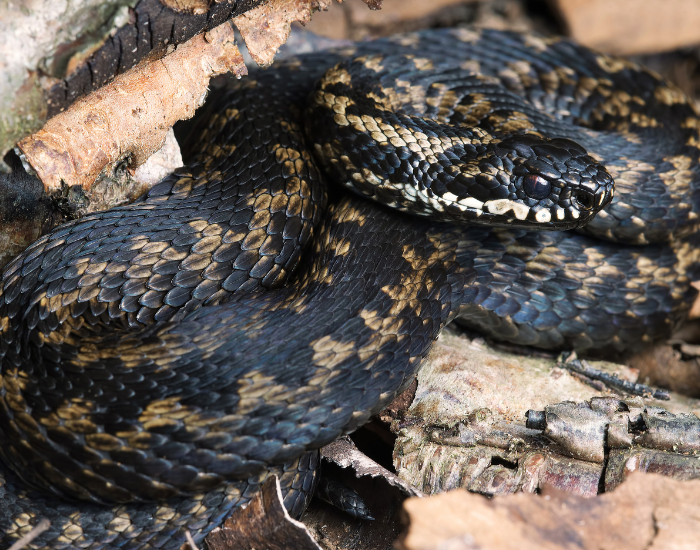
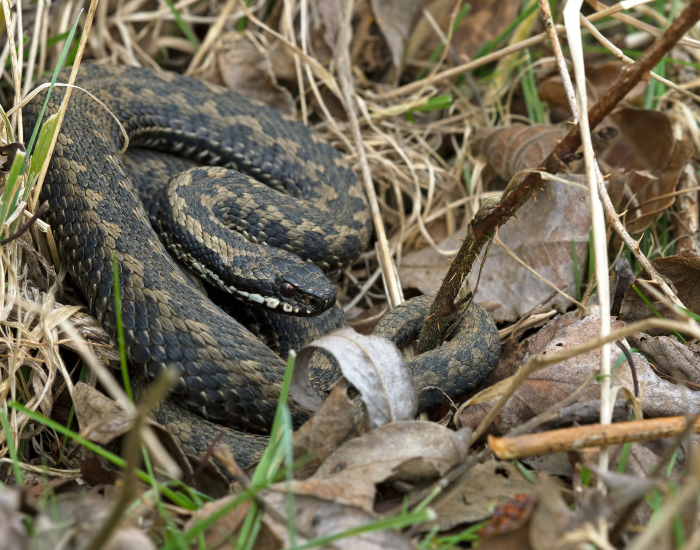
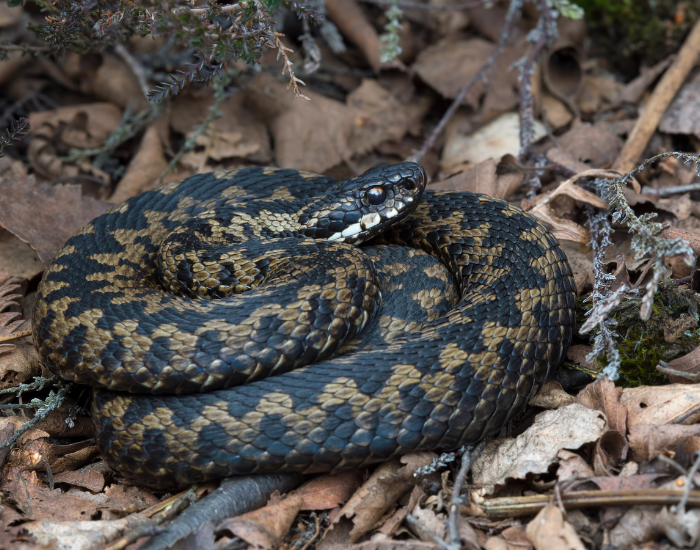
When people ask me, “what does an adder look like?“ I always point to the back. The distinct zig zag pattern (or zig-zag pattern) running down their spine is their most iconic feature. The average length of adders is around 60 cm, making them relatively small, stocky snakes.
- Male adder: Usually a striking silvery-grey with high-contrast black markings.
- Female adders: Typically a reddish brown or light brown with dark brown markings.
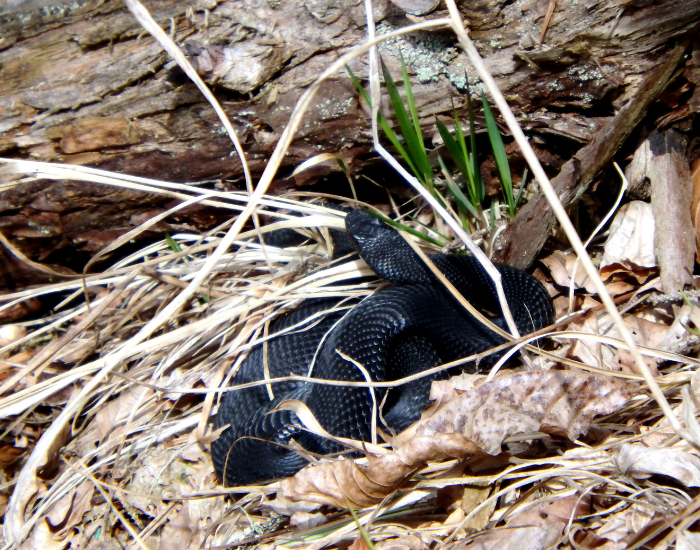
- Melanistic adders: Occasionally, you’ll find a completely black adder. These are stunning but rare, often seen in smaller populations.
4. They Have “Cat Eyes”
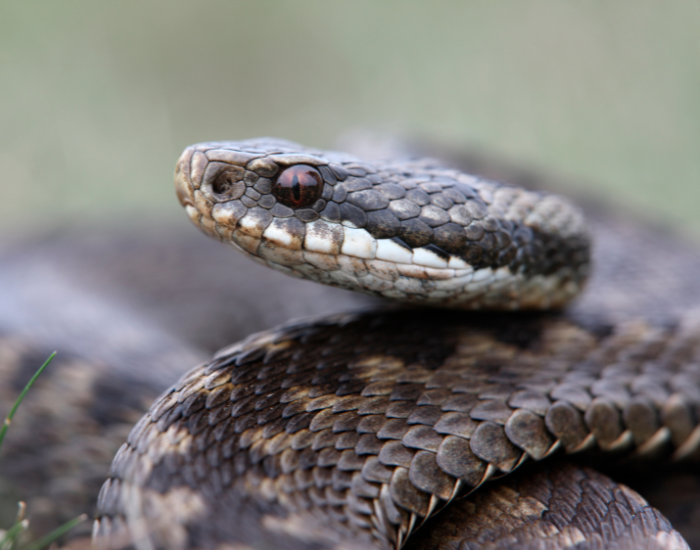
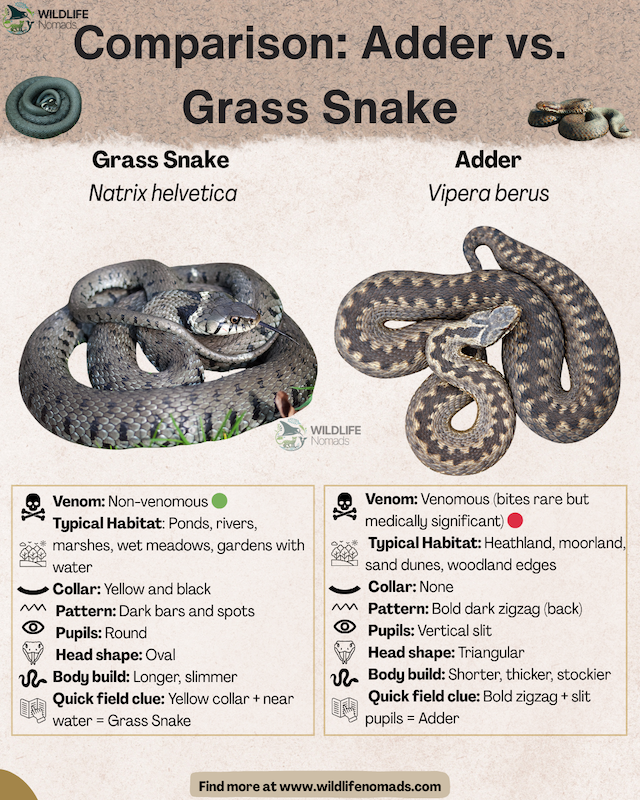
Unlike the grass snake, which has round pupils, the snake uk adder has vertical, slit-like pupils. This is the hallmark of a viper. They also have a flat, somewhat triangular head and a dark “V” or “X” marking on the crown.
5. Their Diet is Surprisingly Diverse
Adders eat a variety of prey, but their diet consists primarily of small mammals, such as voles and mice, as well as lizards and ground-nesting birds. For example, the meadow pipit is a ground-nesting bird that adders hunt. However, they are opportunistic. They will take lizards, amphibians like frogs, and even ground nesting birds or their young adders (although cannibalism is extremely rare but documented). They use their venom to subdue prey quickly, tracking the scent trails of the envenomated animal until it collapses.

6. The “Dance of the Adders”
If you’re in open woodland or woodland edges in early spring, you might witness the “Dance of the Adders.” This isn’t a mating ritual between a male and female, but a wrestling match between two males. They intertwine and try to push each other’s heads to the ground to win breeding rights. It’s a non-violent show of strength that looks like a living braid.
7. They are Masters of the “Bask”
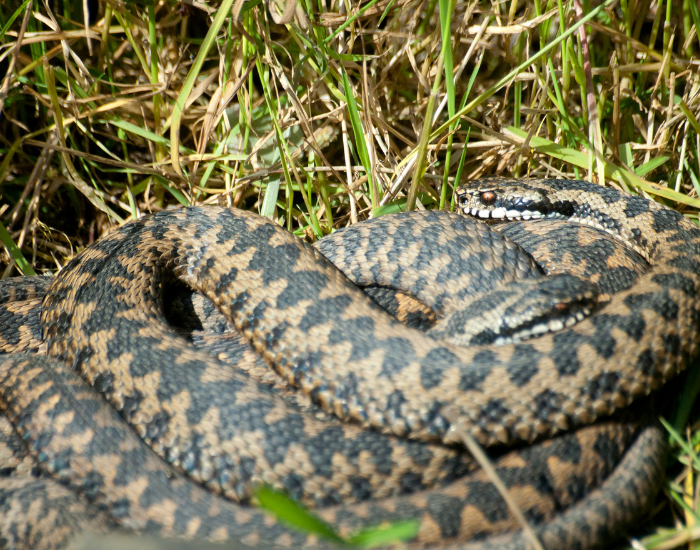
Because they are cold blooded animals, or ectothermic, adders live for the sun. Their suitable habitat includes heathlands, coastal dunes, rocky hillsides, and chalky downs. They love open habitats where they can find a warm rock to sit on during warm days. If you want to see one, look for woodland edges where they can quickly slip into cover.
8. Hibernation is a Social Event
When the temperature drops, adders hibernate. They often use communal “hibernacula”, deep crevices in stone quarries, old rabbit burrows, or root systems. They’ll stay underground from October until early spring (usually March), sometimes huddling together to conserve what little heat they have.
On mild winter days, adders may briefly emerge from hibernation to bask if the weather is warm enough.
Dive deeper into our article about animals that hibernate!
9. They are Not Aggressive
In my professional opinion, the term “aggressive” is misused in herpetology. The adder is secretive and shy. They view humans as giant predators. Most bites occur when someone accidentally steps on one or tries to pick it up. To an adder, you are a mountain that just tried to crush it. They provide little danger if you give them a respectful two-meter berth.
10. They are Missing from Ireland
Legend says St. Patrick chased the snakes out of Ireland, but the geological truth is that northern ireland and the Republic of Ireland were separated from mainland Great Britain by rising sea levels before the snakes could migrate back after the last ice age. So, if you see a snake in Belfast, it’s definitely not a native venomous snake. They are also absent from the Isle of Man and most Scottish islands (except for a few like Islay or Jura).
11. They are Under Serious Threat
Despite being a species of least concern globally, UK adder populations are in a nose-dive, listen as vulnerable within the UK. Habitat loss, fragmentation, and human disturbance are the main culprits. They are protected under the Wildlife and Countryside Act 1981, making it illegal to kill, injure, or sell them. We are seeing smaller populations become “extinction prone” because they can’t travel between safe patches of heathland.
12. Medical Attention is Key
If you are bitten by an adder, the advice is simple: medical attention should be sought immediately. While it is rarely fatal, the venom can cause significant swelling, bruising, and nausea.
- Do not try to suck out the venom (this isn’t a movie).
- Do not apply a tourniquet.
- Do stay calm and keep the affected limb still.
Comparison: Adder vs. Grass Snake
| Feature | The Adder (Vipera berus) | Grass Snake |
| Venom | Venomous (Viper) | Non-venomous |
| Pattern | Zig zag pattern | Dark bars/spots |
| Eye | Vertical slit | Round pupil |
| Birth | Live young | Lay eggs |
| Habitat | Dry heath, open woodland | Wetlands, garden ponds |
FAQ: Your Top Adder Questions Answered
No. They are secretive animals that prefer flight over fight. They only bite when they feel cornered or threatened.
In the Bible, the word “adder” is often used generally to describe any venomous snake. It’s frequently used as a metaphor for treachery or danger, which unfortunately contributed to their bad reputation over the centuries.
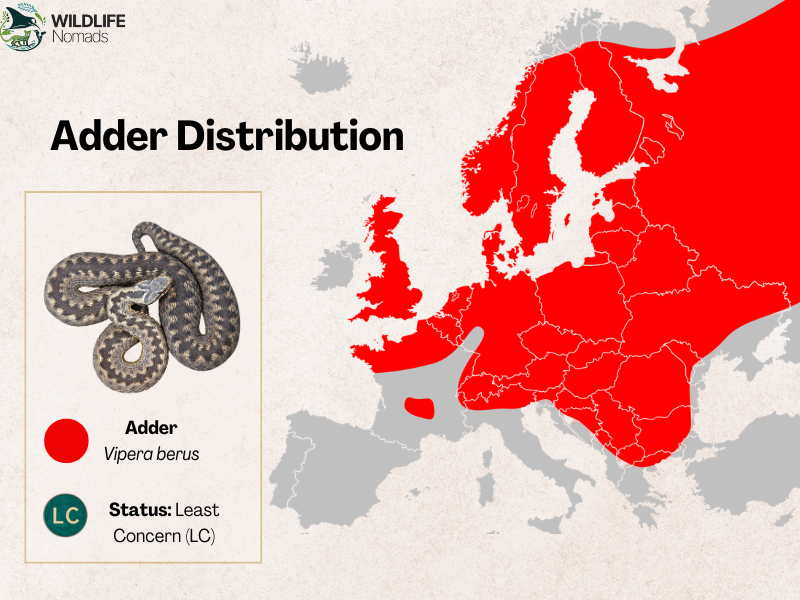
They are found across Great Britain, with uk adder locations concentrated in the South of England, parts of Wales, and the Scottish Highlands. They are notably absent from the Isles of Scilly, the Channel Islands, and Ireland
Technically, they are venomous (they inject it) rather than poisonous (you eat it). While their venom is potent enough to kill their prey, it is generally not strong enough to kill a healthy adult human, though it requires a trip to the hospital.

The Quiet Importance of Adders
Seeing an adder in the wild is a privilege. It means you’ve found a pocket of the UK that is still wild enough to support a specialized predator. As a biologist, I’ve seen how these snakes act as a “canary in the coal mine” for our ecosystems. If the adders disappear, the slow worms, lizards, and small mammals they balance out will follow.
Next time you’re out on the moors, keep your eyes on the ground, not out of fear, but out of curiosity. You might just see one of nature’s most beautiful patterns looking back at you.