I few years ago, I was hiking in Queensland, when I saw a large Emu male, when he turned his head, I was struck, not for the first time, but with fresh intensity, by just how massive those eyes are. They are like polished amber marbles, roughly the size of a billiard ball, staring right through you. The eyes in the animal world have evolved in remarkable ways, with different species developing unique eye structures to enhance survival in their specific environments.
It got me thinking about all the times I’ve been face-to-face with an animal with big eyes in the field. I remember sitting perfectly still in a rainforest in Southeast Asia, watching a dragonfly perched on a leaf. Its compound eyes took up nearly its entire head. Dragonflies are also known for their exceptional colour vision, which allows them to distinguish a wide range of colours and has played a significant role in their evolutionary success. I wondered then, as I often do, what it must be like to experience the world through that perspective—where “vision” isn’t just a sense, but a survival superpower. In the animal kingdom, eye size isn’t just about aesthetics; it’s an evolutionary arms race.
Why Do Some Animals Have Such Big Eyes?
Eye size in the animal kingdom is directly tied to the light environment an animal lives in and the threats it faces. Nocturnal animals need large pupils and retinas to capture low-light information. Deep-sea species need enormous eyes to detect the faintest bioluminescence. Prey species need wide fields of view to spot threats early. Some animals with large eyes have evolved the best night vision in the animal kingdom, allowing them to thrive in extremely low-light environments.
However, big eyes are metabolically expensive. They take up space in the skull and require significant energy to maintain. Therefore, evolution only produces them when the visual benefit clearly outweighs the cost. Every animal on this list has a compelling survival reason for the eyes it has.
Visual acuity — the sharpness of what an animal sees — does not always correlate with eye size. An eagle, for example, has smaller eyes than a human, but possesses far keener eyesight due to an extremely dense concentration of photoreceptors. Big eyes are about gathering light, not necessarily about resolution.
Below, I rank the top 15 animals with the biggest eyes, using a mix of absolute size, eye-to-body ratio, and visual specialisation.
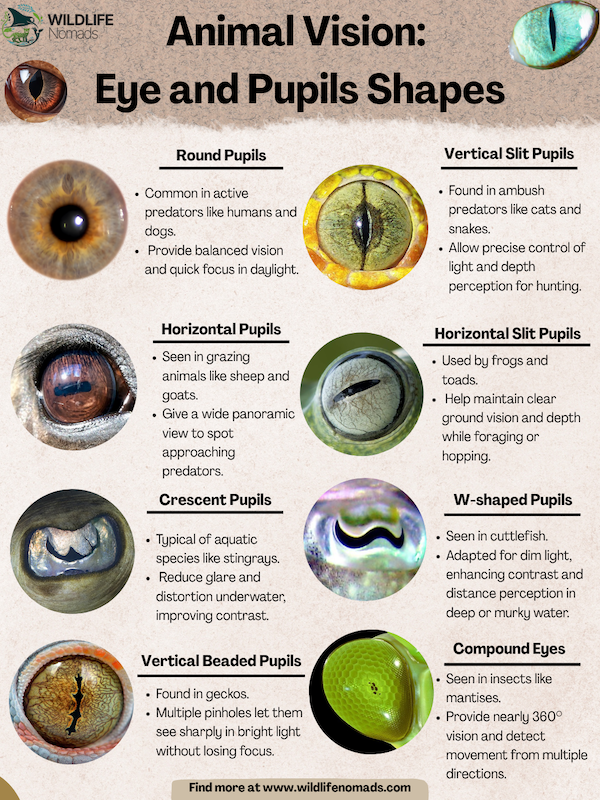
Animals With the Biggest Eyes in the World
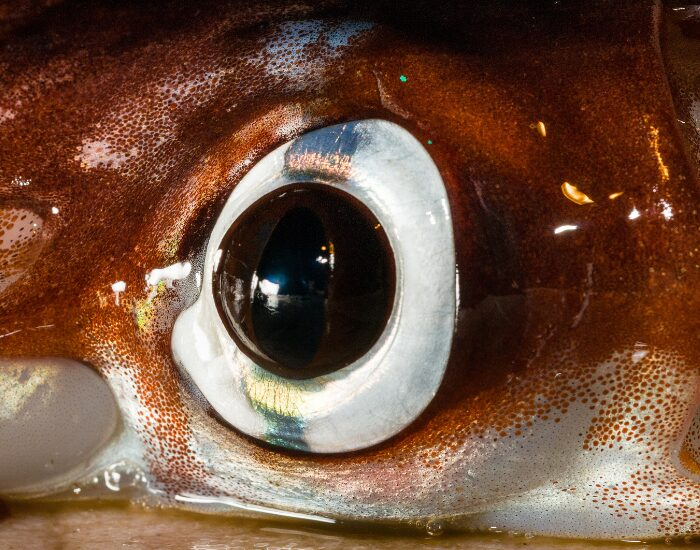
1. The Colossal Squid (Mesonychoteuthis hamiltoni)
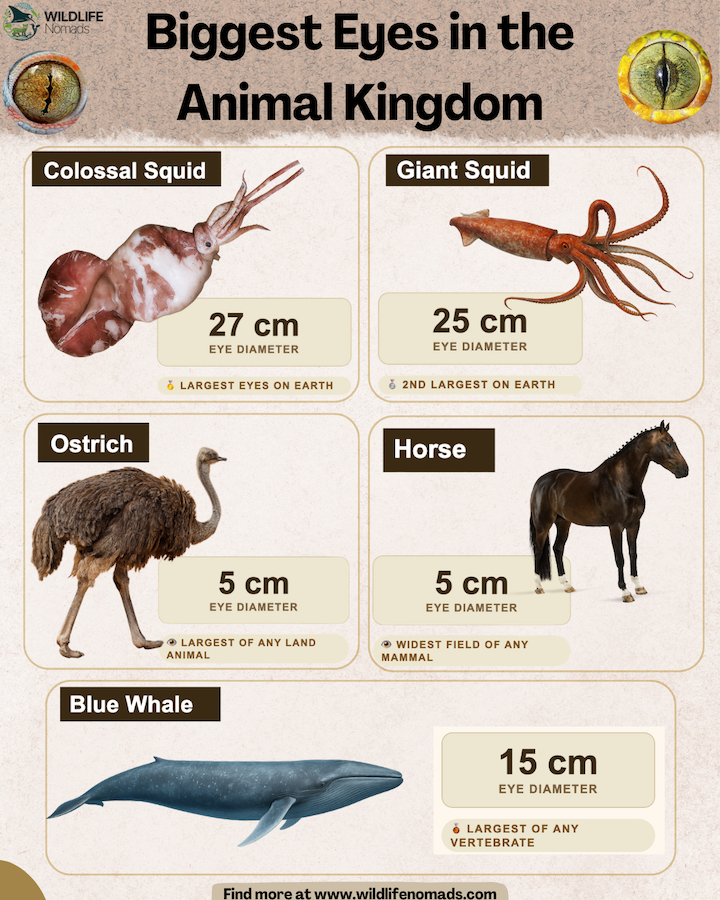
When we talk about the animal with the biggest eyes in the absolute sense, the colossal squid wears the crown. Their eyes are roughly the size of a basketball ball (about 27cm or 11 inches across).
Why so big? In the murky depths of the deep ocean, there is almost no daylight. These enormous eyes are designed to detect the bioluminescent wake of sperm whales, their primary predators. It’s a specialized night vision system that allows them to “see” a predator coming before the predator even knows they are there.
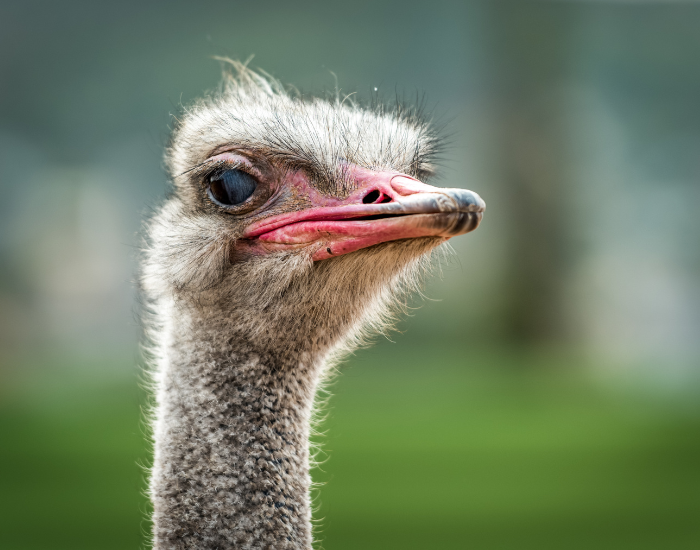
2. The Ostrich (Struthio camelus)
Ostriches not only compete for one of the biggest birds in the world. They also compete for the record-holder for the biggest eyes on land. An ostrich’s brain is actually smaller than one of its eyes. Their eyes are about 5cm (2 inches) in diameter, larger than those of any other land animal. This gives them excellent vision to spot predators like lions from a great distance across the savannah. Ostriches can see as far as 3.5 kilometers away, thanks to their large eyes.
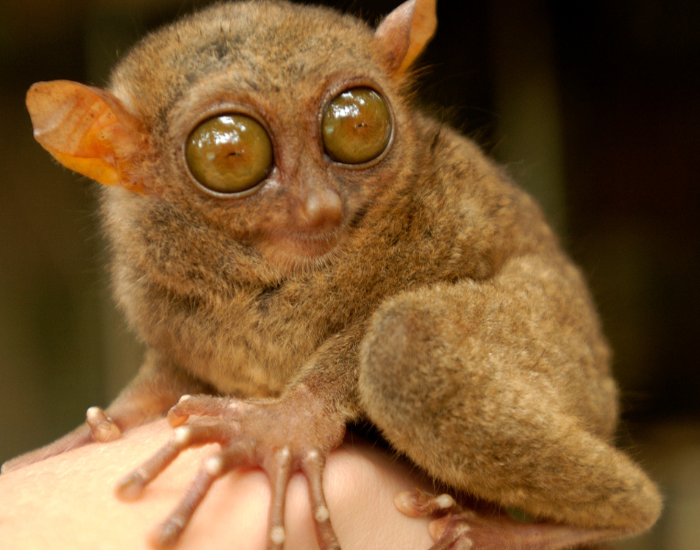
3. The Tarsier (Family Tarsiidae)
If we look at the largest eyes relative to body size, the tiny primates of Southeast Asia known as tarsiers take the prize. Each of a tarsier’s eyes is as heavy as its brain. If human eyes were proportionally as large, they would be the size of grapefruits. Because they are nocturnal hunters, they need every bit of low light they can get. Interestingly, their eyes are so big they can’t move them in their sockets; instead, they rotate their whole head 180 degrees to both sides like an owl.
4. The Giant Squid (Architeuthis dux)
Slightly smaller than its colossal cousin, the giant squid still boasts eyes up to 25 cm across. These light-sensitive organs allow it to use monocular vision to scan the water column independently, scanning for prey and threats at the same time. Deep-sea researchers consider this one of the most impressive eye adaptations ever recorded.

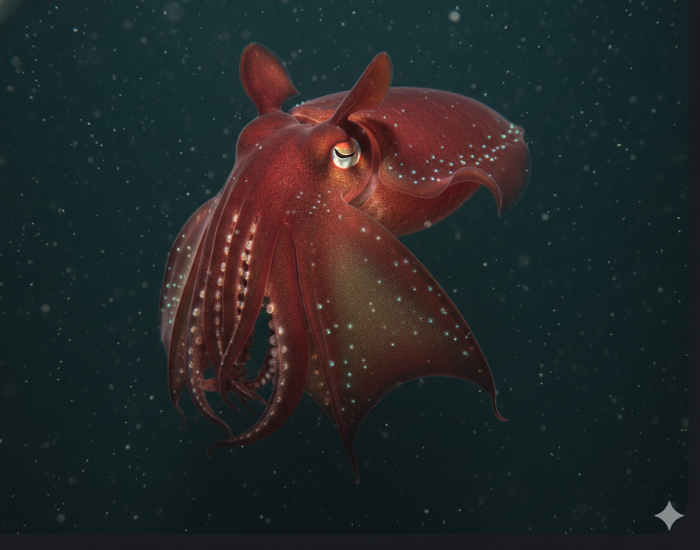
5. The Vampire Squid (Vampyroteuthis infernalis)
Don’t let the name scare you; these are small, fascinating cephalopods. I’ve always found them captivating because they have the largest eye-to-body width ratio of any known animal. Living in the depths of the ocean where oxygen is low and light is non-existent, their blue eyes are incredibly light sensitive, helping them navigate the dark “Oxygen Minimum Zone.”
6. The Mantis Shrimp
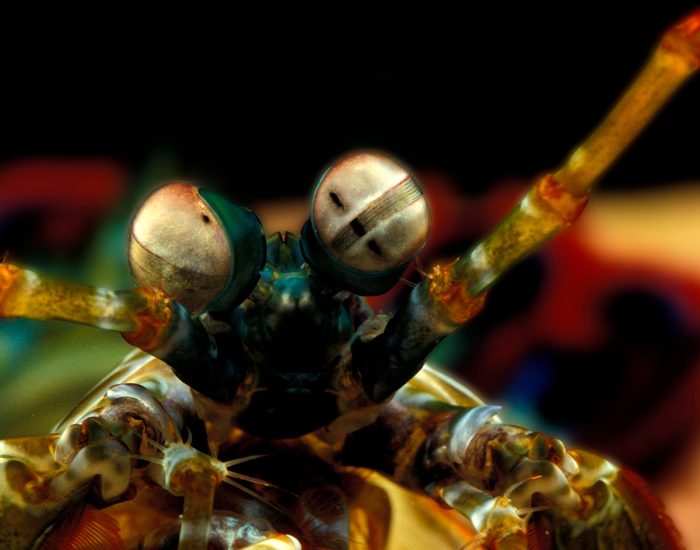
When we talk about vision complexity, the mantis shrimp is the undisputed heavyweight champion. While we humans make do with three types of color-receptive cells (photoreceptors), some mantis shrimp species have 12 to 16. They can see a world of ultraviolet and polarized light that is literally invisible to us.
However, there’s a catch. Recent research suggests that despite having more “hardware,” they aren’t actually better than us at telling similar colors apart. Instead of their brains doing the heavy lifting to compare colors like we do, their eyes do the work for them. They use a “scanning” system that allows them to identify colors instantly without much brain power—an essential adaptation when you need to decide in a split second whether to punch a predator or a snack.
7. The Owl
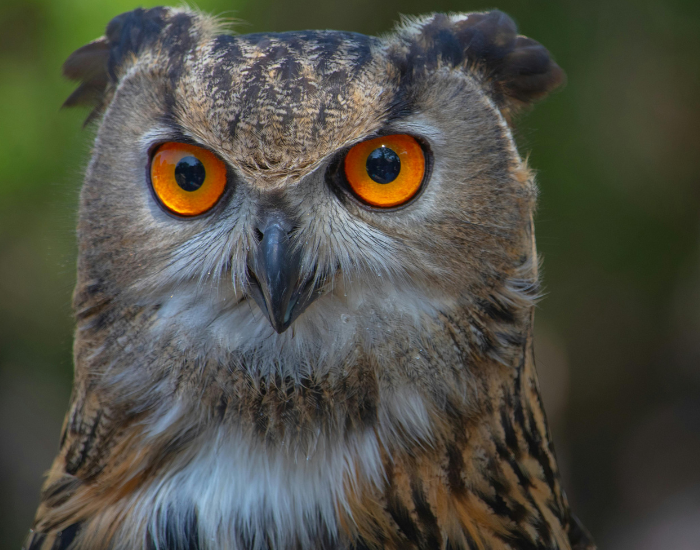
Many birds of prey have spectacular vision. But owls have tubular eyes held in place by bony structures called sclerotic rings. This shape accommodates a large lens and retina, capturing far more light than spherical eyes of the same volume. Their binocular vision provides superb depth perception, allowing them to strike prey with precision in near-total darkness. Night vision in owls is among the most studied and admired in nature.
8. The Blue Whale
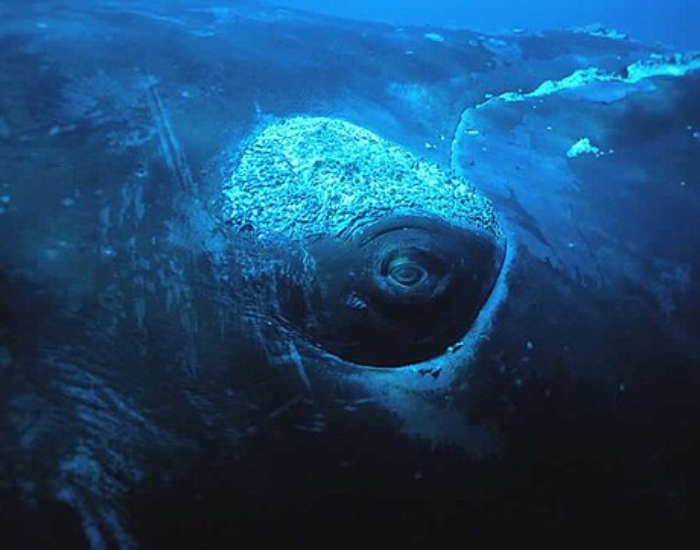
As the largest animal to ever live, you’d expect the blue whale to have the biggest eyes. Surprisingly, they don’t. Their eyes are about the size of a large grapefruit. Compared to their long body, their eyes are quite small, but they are perfectly adapted for the light levels of the upper ocean.
9. The Swordfish
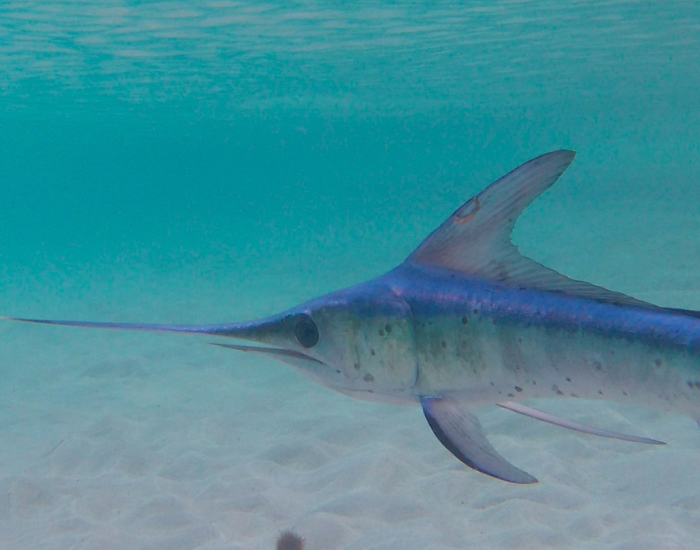
Swordfish have a unique biological heater organ that warms their eyes and brain. This thermal boost accelerates visual processing in cold, dim deep water, allowing them to track fast-moving prey at speed. It is a classic evolutionary trade-off: if you cannot have more light, make your eyes work faster.
10. The Horse
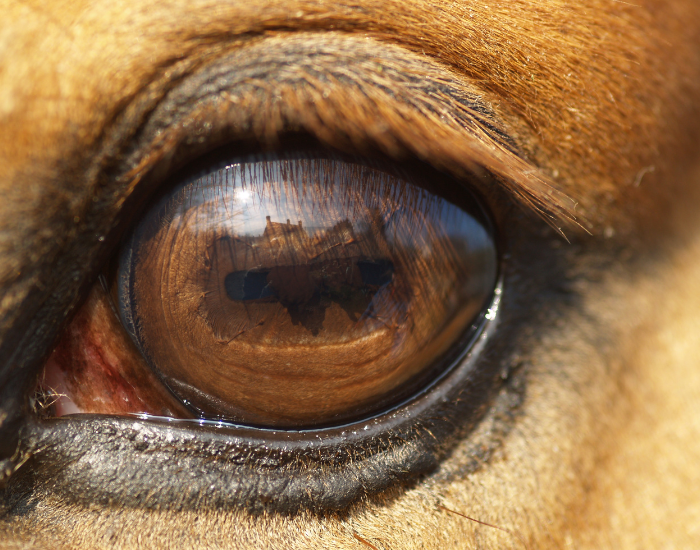
A horse’s eyes are some of the largest of all land mammals, measuring about 5 centimeters (2 inches) in diameter. Their eyes are positioned on the sides of the head, granting nearly 360-degree vision across open terrain. However, horses have a notable blind spot directly in front of their nose, something every field researcher learns the hard way. Their large eyes are an adaptation for detecting predators across grasslands, not for depth perception.
11. The Panther Chameleon
This reptile is such an incredible creature. Chameleon’s eyes move independently, allowing them to look at two different things at once. This visual acuity is paired with a unique “telephoto” lens effect, which helps them calculate the exact distance to a cricket before launching their tongue.

12. The Dragonfly
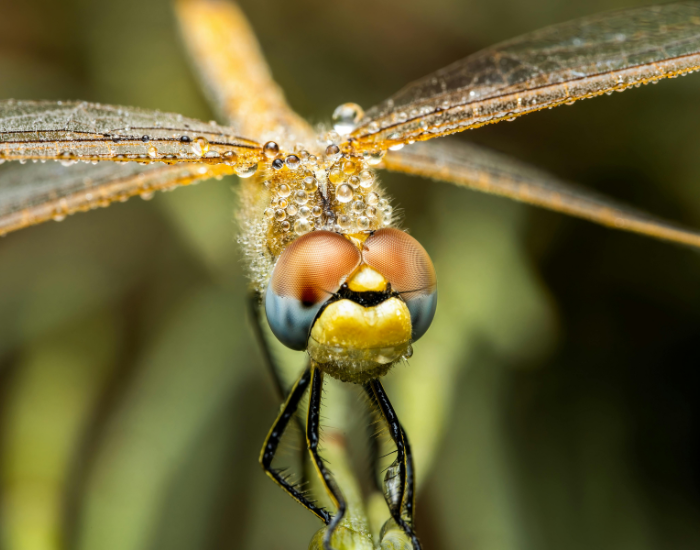
Dragonflies are the fighter jets of the insect world. Their two large compound eyes and three simple eyes called ocelli, give them nearly 360-degree vision. They can process visual information so fast that the world appears to move in slow motion to them, allowing them to spot predators and mid-air prey with a 95% success rate.
13. The Slow Loris
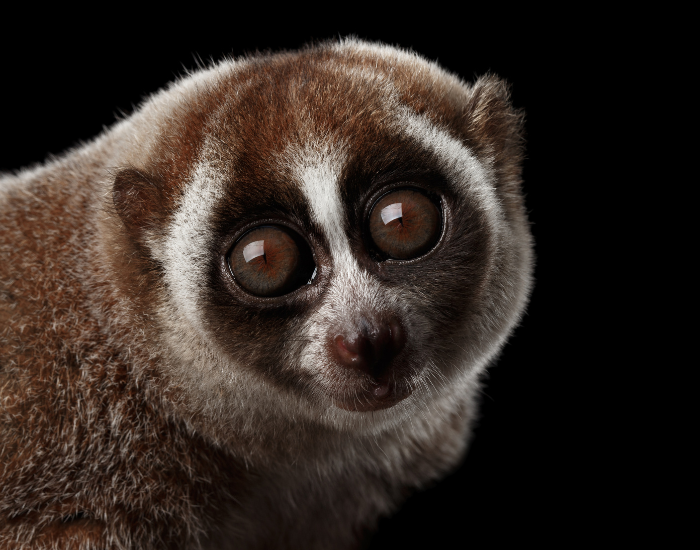
The slow loris and other slow lorises are famous for those “sad,” big eyes. These nocturnal animals have a tapetum lucidum, a reflective layer behind the retina that reflects light back through the eye, giving them a second chance to see in low light. This is what causes “eye shine” when you hit them with a headlamp in the field.
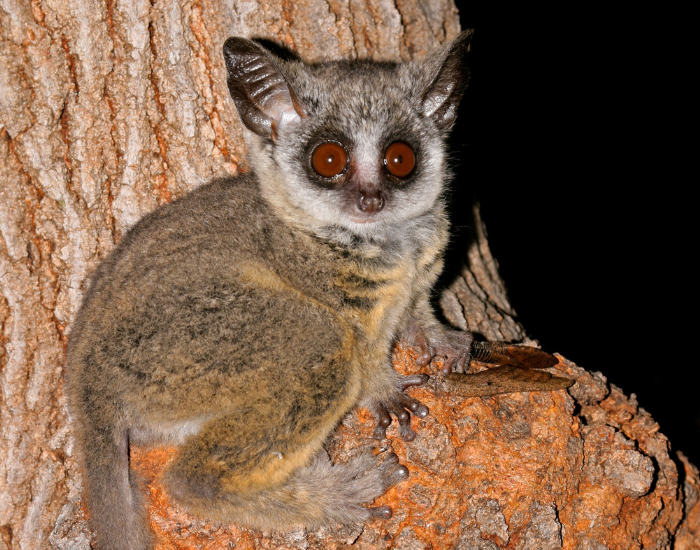
14. The Bushbaby (Galago)
If you’ve ever done a night drive in the African bush, you’ve likely seen a pair of glowing orange orbs bouncing through the acacia trees. These belong to the bushbaby. Much like the tarsiers I mentioned earlier, these nocturnal animals have enormous eyes that are far too large to move in their sockets.
To compensate for this “fixed” gaze, they have a neck that can rotate 180 degrees, allowing them to track the movement of a beetle or a moth with terrifying efficiency. Their night vision is powered by a high concentration of light sensitive cells and a very large lens, which helps them gather every bit of low light available under the canopy. Whenever I see them, I’m reminded of just how much of the animal kingdom relies on visual acuity to survive the “graveyard shift” in the wild.
15. The Tree Frog
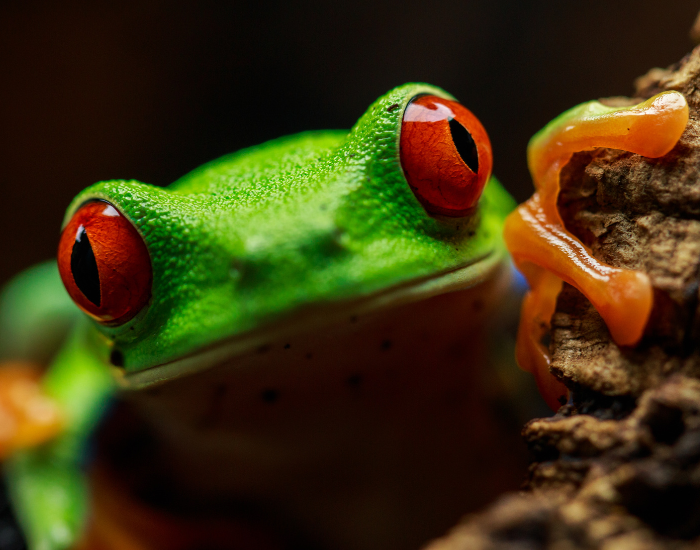
Tree frogs use their protruding eyes for more than just seeing. When these amphibians swallows prey, its eyes actually sink into its skull to help push the food down its throat. Their wide-set eyes provide a broad field of view, which is critical for detecting movement in dense vegetation. In addition, the red-eyed tree frog’s vivid eye colour may serve as a startle response to deter predators.
16. The Woodcock
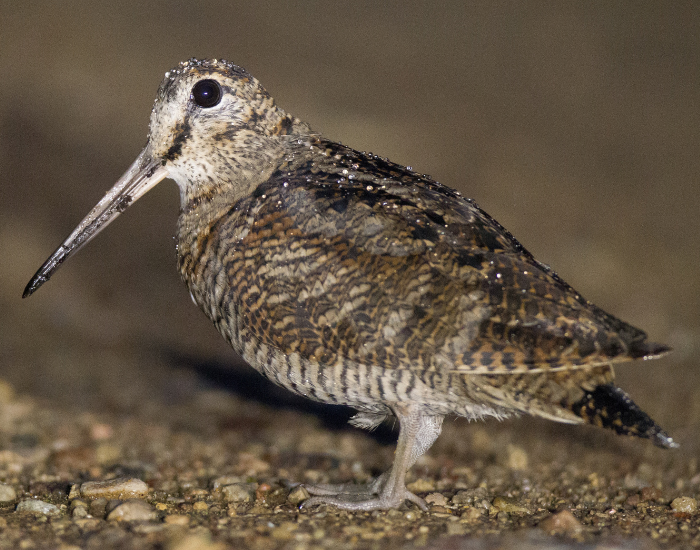
The woodcock has eyes positioned so far back on its head that it achieves a full 360-degree field of view. It can literally monitor what is happening behind it while probing the mud for earthworms. This is one of the most extreme examples of monocular vision adapted for predator detection in a ground-foraging bird.
FAQ: Your Questions Answered
The colossal squid holds the record for the animal with the biggest eyes, with specimens measuring up to 27cm (11 inches) in diameter.
Not necessarily. While enormous eyes help in low light, visual acuity (clarity) depends on the density of photoreceptors. An eagle has smaller eyes than a human but much keen eyesight.
The ostrich has the largest eyes of any land animal, measuring about 5cm across.
In the deep sea, light is incredibly scarce. Huge eyes allow these animals to capture the maximum amount of dim light and bioluminescence to find prey and avoid predators.
Binocular vision involves both eyes looking at the same object (like humans or owls), which is great for depth perception. Monocular vision involves eyes on the side of the head (like horses) for a wider field of view.
Nature Built These Eyes for a Reason
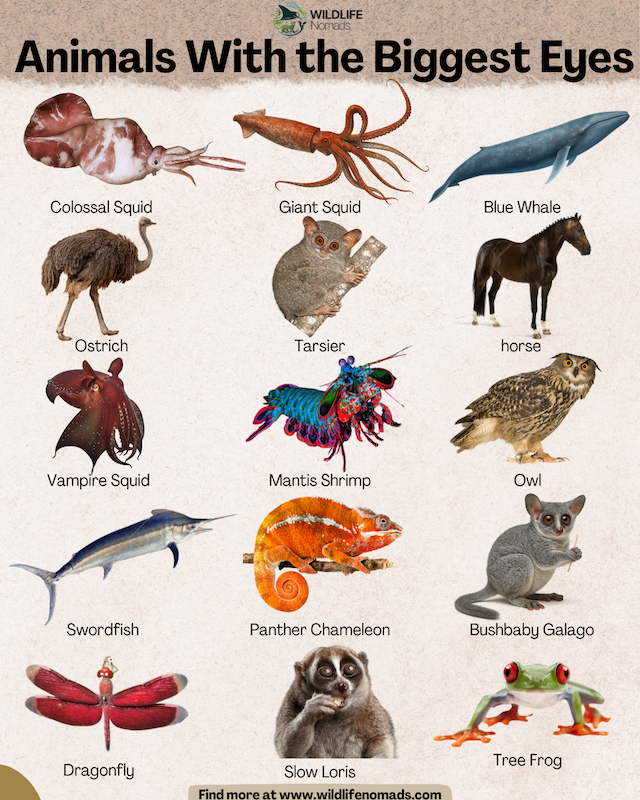
From the Southern Ocean to the Australian Outback, nature has engineered some truly impressive eyes. Whether it’s the mesonychoteuthis hamiltoni peering through the dark or a panther chameleon scanning the trees, these adaptations are a testament to the incredible diversity of life.
Comparison of Land vs. Sea Eye Sizes
References
Cronin, T. W., & Marshall, J. (2001). Parallel processing and image analysis in the eyes of mantis shrimps. The Biological Bulletin, 200(2), 177–183. https://doi.org/10.2307/1543312
Hall, M. I., & Ross, C. F. (2007). Eye shape and activity pattern in birds. Journal of Zoology, 271(4), 437–444. https://doi.org/10.1111/j.1469-7998.2006.00227.x
Kirk, E. C. (2006). Effects of activity pattern on eye size and orbital aperture size in primates. Journal of Human Evolution, 51(2), 159–170. https://doi.org/10.1016/j.jhevol.2006.02.004
Moran, D., Softley, R., & Warrant, E. J. (2015). The energetic cost of vision and the evolution of eyeless Mexican cavefish. Science Advances, 1(8), e1500363. https://doi.org/10.1126/sciadv.1500363
Morris, P. (2012). [Review of the book Animal eyes (Oxford Animal Biology Series), by M. F. Land & D.-E. Nilsson]. Zoological Journal of the Linnean Society, 166(4), 912. https://doi.org/10.1111/j.1096-3642.2012.00849.x
Nilsson, D. E., Warrant, E. J., Johnsen, S., Hanlon, R., & Shashar, N. (2012). A unique advantage for giant eyes in giant squid. Current Biology, 22(8), 683–688. https://doi.org/10.1016/j.cub.2012.02.031
Thoen, H. H., How, M. J., Chiou, T. H., & Marshall, J. (2014). A different form of color vision in mantis shrimp. Science, 343(6169), 411–413. https://doi.org/10.1126/science.1245824
Warrant, E. J. (2004). Vision in the dimmest habitats on Earth. Journal of Comparative Physiology A, 190(10), 765–789. https://doi.org/10.1007/s00359-004-0546-z