
I’ll be honest with you: my first real encounter with a peacock mantis shrimp was less “National Geographic” and more “Survival Horror.” It was 2024, and I was on my way to the islands of Indonesia to track Komodo dragons. Before hitting the islands, we did several snorkeling stops in the local coral reefs.
The water was crystal clear,coral fish flickered around me in every direction — parrotfish grinding at the reef, a nervous puffer fish hovering near the seagrass, even a moray eel coiled like a sentry in the rocks. As a field biologist, I’m usually the one keeping my cool while tracking predators, but underwater? I was still getting my “sea legs.” I was so busy obsessing over my mask and making sure I wasn’t swallowing half the ocean that the actual wildlife felt like a secondary concern.
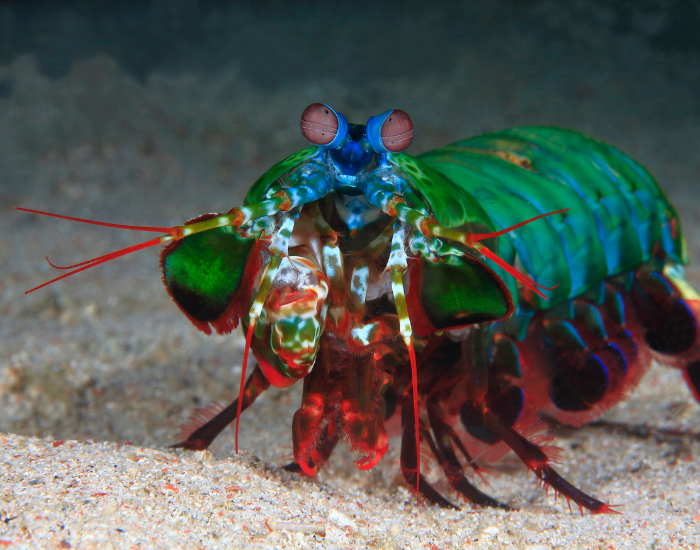
Then, near a patch of sandy and gravelly areas, I saw it for the second time in my life. A flash of neon green and electric blue—the legendary rainbow peacock mantis shrimp. It moved with a jittery, calculated precision before vanishing into a u shaped burrow. Even in my distracted state, I realized I was looking at one of the most sophisticated predators on the planet.
If you’ve ever wondered what would happen if you crossed a butterfly with a heavyweight boxer and a NASA satellite, keep reading. Here are the 12 weirdest facts about the peacock mantis shrimp.

1. It Isn’t Actually a Shrimp
Despite the common name, the peacock mantis shrimp is a stomatopod. While they are crustaceans, they are only distantly related to the shrimp you’d find in a cocktail. They branched off from other malacostracans about 340 million years ago. If a shrimp is a domestic cat, a stomatopod is a tiger. They are very aggressive hunters that have spent millions of years perfecting the art of the kill.
2. They Possess the Fastest Punch in the Animal Kingdom
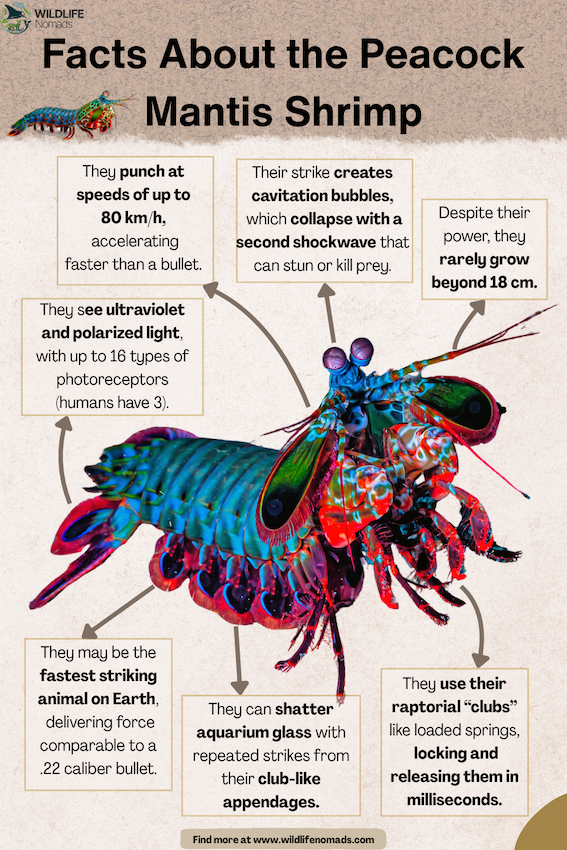
When people ask, “How hard is a peacock mantis shrimp punch?“ I tell them to imagine a .22 caliber bullet. Their raptorial appendages—specifically the smashing species type—accelerate at the same speed as a bullet leaving a gun.
They use a “saddle” mechanism in their limbs to store elastic forces, acting like a biological crossbow. When they release that energy, the club like front claws strike with a powerful punch that can reach speeds of 50 mph (23 meters per second). It’s the fastest recorded movement of any animal. The peacock mantis shrimp’s punch is so powerful it can break glass, and smashing mantis shrimp use their powerful appendages to stun and break the shells of snails, crabs, and clams.

3. They Create “Star Wars” Level Physics (Cavitation Bubbles)
The strike is so fast that it actually boils the water around it. This phenomenon is called a cavitation bubble. When the bubble collapses, it creates a second shockwave and generates a small flash of light and heat. Even if the peacock mantis misses its prey (like crabs or mollusks), the pressure wave alone is often enough to kill prey larger than itself or at least stun it into submission.
4. Their Eyes Are More Advanced Than Any Human Tech
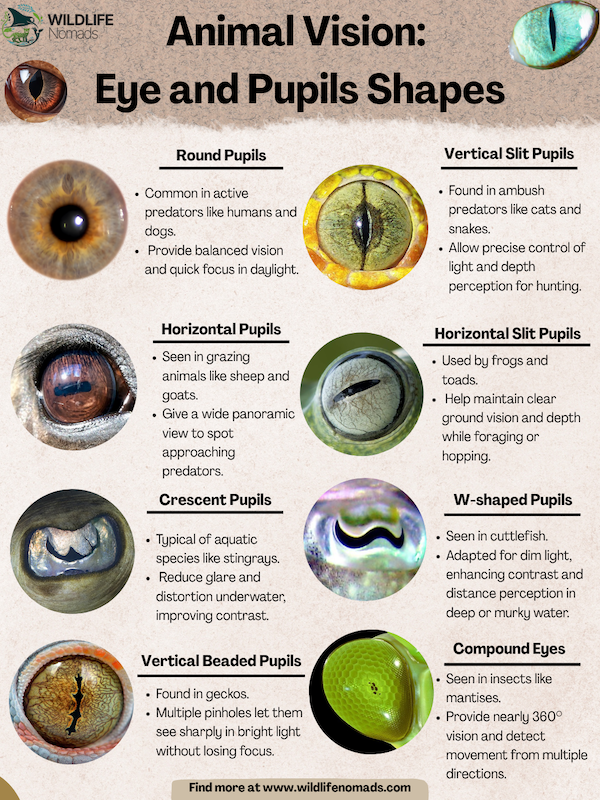
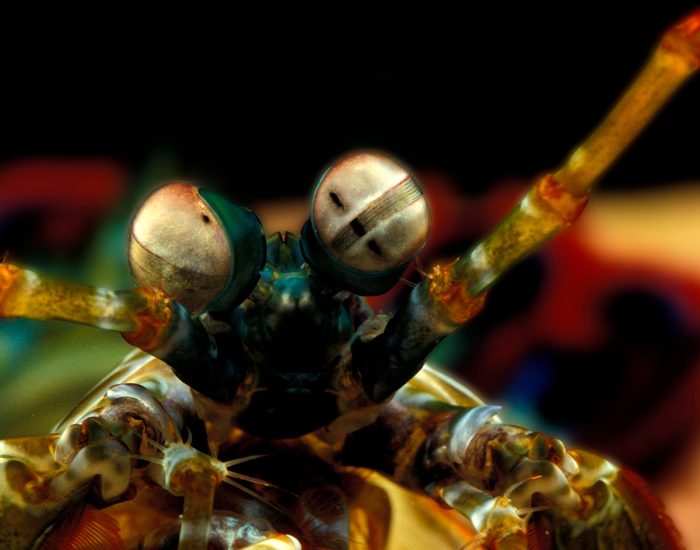
They are among the animals with the best sense of sight in the world. The visual system of the mantis shrimp is, quite frankly, insulting to human biology. While human eyes have three types of photoreceptors (red, green, and blue), the peacock mantis shrimp eyes have at least twelve photoreceptors (some species have up to 16). This means that mantis shrimps eyes possess advanced color vision, allowing them to perceive and distinguish a wide range of colors far beyond human capability. Their extraordinary color vision plays a crucial role in hunting, communication, and territorial behaviors, making their eyesight one of the most sophisticated in the animal kingdom.
They don’t just see “more” colors; they see uv light and can identify colors in the deep sea that we can’t even name. Their complex eyes are mounted on stalks and move independently, giving them a 360-degree view of their tropical and subtropical waters.
5. They Are the Only Animals That See Circularly Polarized Light
Beyond just color, they can detect linearly polarized light and, most incredibly, circularly polarized light. Research published in Current Biology suggests they use this for a secret communication channel. Because circularly polarized light is rare in nature, they use it to signal to mates or warning potential predators without being spotted by the “low-tech” eyes of fish.
6. Their “Clubs” Are Virtually Indestructible
If you hit a rock at the speed of a bullet, your hand would shatter. So how do they do it? The most heavily armored part of their body is the dactyl club. It has a layered microstructure of hydroxyapatite (the stuff in your bones) and chitin. This “periodic” structure stops cracks from spreading. Scientists are actually studying their hard shelled bodies and clubs to develop better protective sports gear and vehicle armor.
7. They Are the Colorful Samurais of the Indo-Pacific
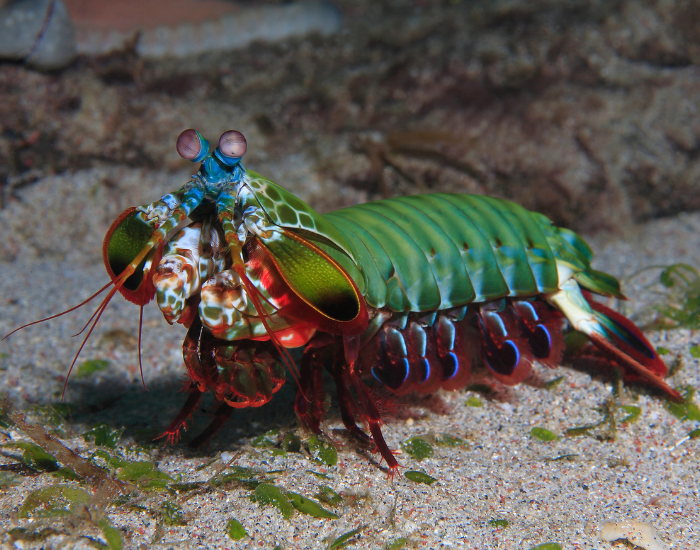
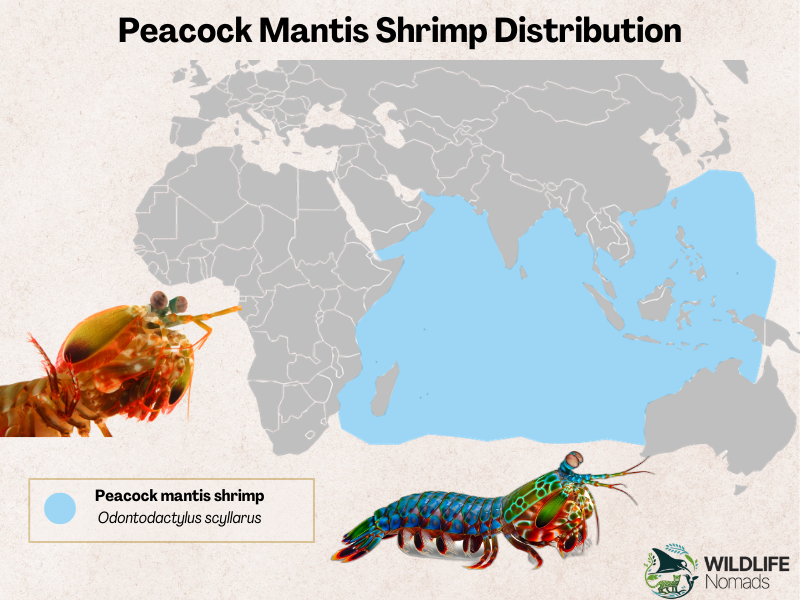
Their peacock mantis shrimp habitat spans from Eastern Africa to the Indian and Pacific oceans. This species lives in the warm waters of the Indian and Pacific Oceans and can be found at depths of up to 130 feet. You’ll typically find them in coral reefs, sandy and gravelly areas, or sand flats. They are a colorful species, usually primarily green with orange legs and a leopard-print pattern on their face. This isn’t just for show; in the high-stakes world of the reef, being a rainbow mantis is a way of signaling dominance.
8. They Are Masters of the “U-Shaped Burrow”
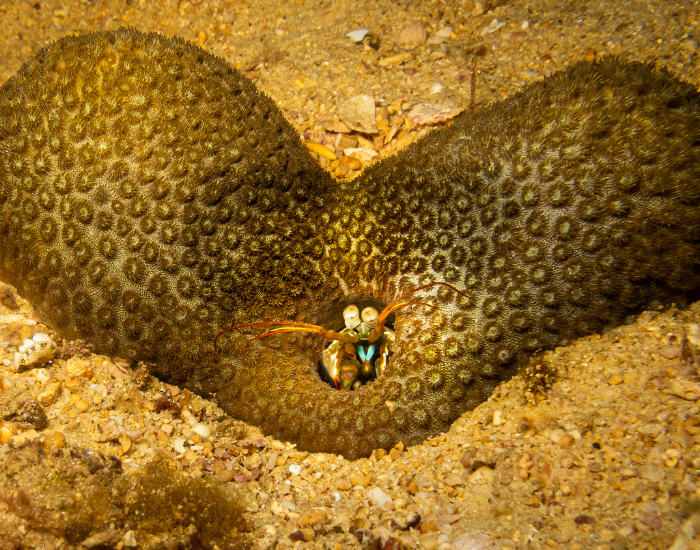
The rainbow peacock shrimp is typically solitary and highly territorial. They spend most of their lives in u shaped burrows they’ve dug into the seabed or coral rubble. They are very aggressive hunters that guard these homes with their lives. Peacock mantis shrimp create vibrations within their burrows and use low-frequency vibrations and visual displays to communicate and maintain territoriality. They also prefer to dig U-shaped burrows near the reef’s edge. If another mantis shrimp tries to move in, it usually results in a high-speed boxing match that would make Mike Tyson nervous.
9. They Are “Smashers,” Not “Spearers”
In the world of stomatopods, you are either a “spearer” or a “smasher.” Mantis shrimp engage in two styles of hunting—spearing or smashing—depending on the type of front legs they possess. These specialized raptorial front legs are adapted for hunting and are reminiscent of the front legs of a praying mantis, both in appearance and function. The peacock mantis is a smasher. While spearing species have barbed wire-like front legs to snatch soft fish, the peacock uses its club like appendages to crack the shells of other shrimp, crabs, and snails. They are the “tank” class of the ocean floor.
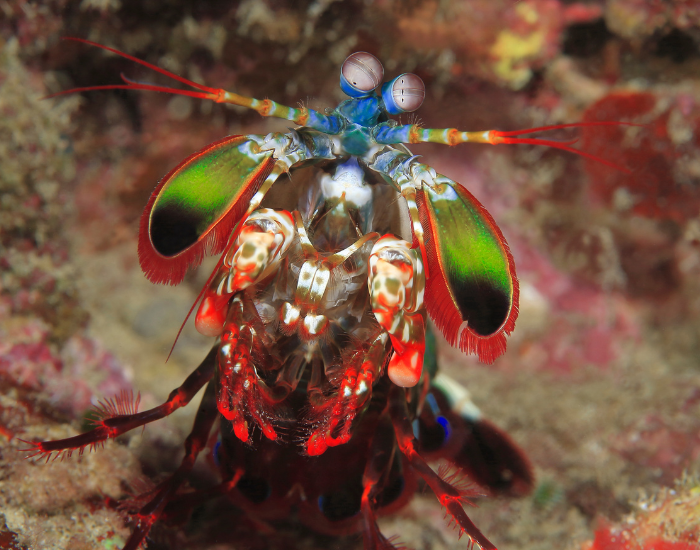
10. Their Courtship Involves Glowing “Love Signs”
Because they are so aggressive, reproduction is a high-stakes game. Courtship begins when the male peacock mantis shrimp performs an elaborate dance to catch the eye of a female. To clarify, they don’t “glow” like bioluminescent animals such as glow worms; they use fluorescent signaling—their shells actually absorb and reflect light in specific wavelengths that only other mantis shrimp can truly appreciate.
To avoid being punched to death, they use their unique visual system to identify mates. They exhibit internal fertilization, and some studies suggest they show a level of parental investment that is rare in crustaceans, with the female (and sometimes male) brooding the fertilized eggs to keep them safe from other inhabitants of the reef.
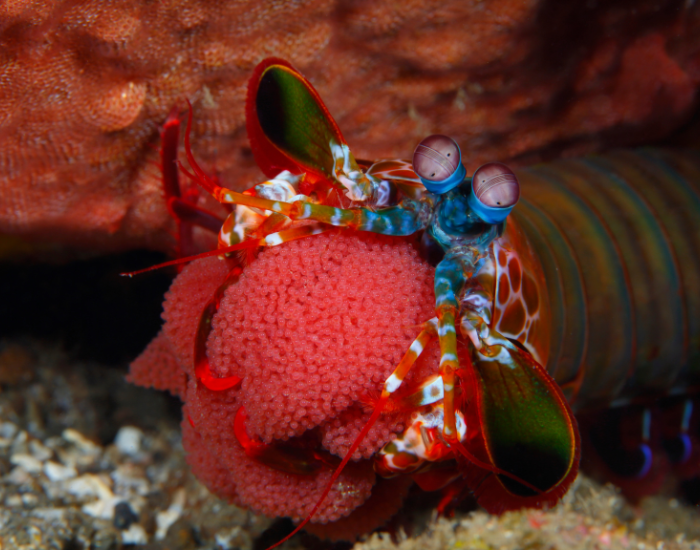
11. They Are Not Your Average “Pico” Pet
People often ask, “Are peacock mantis shrimp good pets?” The answer is: only if you’re a professional. They are known as “thumb splitters” for a reason. Furthermore, a giant mantis shrimp (which can grow up to 7 inches) has been known to crack the glass of a standard aquarium. If you want a rainbow mantis shrimp, you need thick, acrylic tanks and a lot of respect for their personal space.
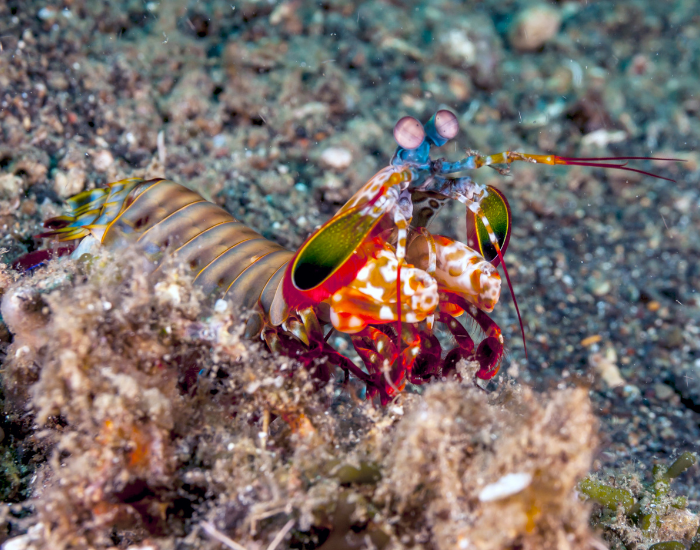
12. They Play a Vital Role in Reef Health
Despite being very aggressive hunters, they are an essential part of the ecosystem. They keep the population of gastropods and crustaceans in check. Currently, they are not considered endangered, but like all reef dwellers, they are threatened by the loss of coral reefs due to climate change. They prefer water temperatures that are stable, and as warm waters shift, so does the mantis shrimp range.
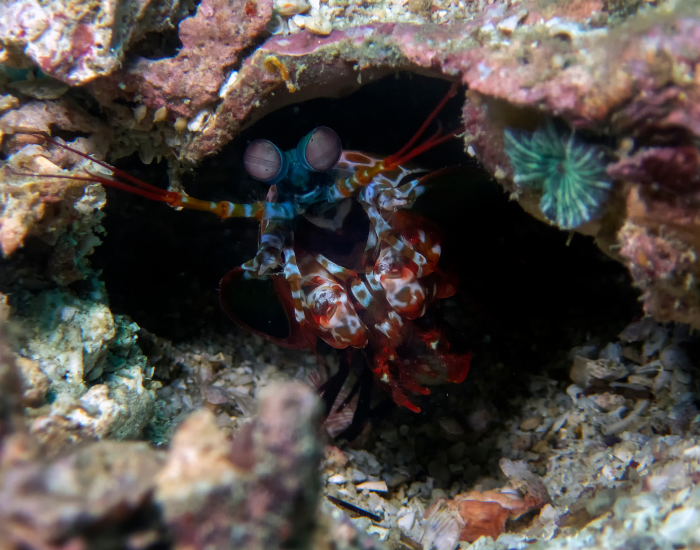
Quick Facts Table: Peacock Mantis Shrimp
| Feature | Detail |
| Scientific Name | Odontodactylus scyllarus |
| Common Names | Peacock Mantis, Harlequin Mantis, Rainbow Shrimp |
| Max Size | Up to 18 cm (approx. 7 inches) |
| Diet | Crabs, gastropods, bivalves, small fish |
| Location | Indo Pacific ocean, Guam, Eastern Africa |
| Strike Acceleration | 10,000 times the force of gravity ($10,000g$) |
FAQ: Everything You Wanted to Know About the “Rainbow Samurai”
The punch travels at roughly 23 meters per second. To put that in perspective, if a human could move their arm that fast, we could throw a baseball into orbit.
They live in the tropical and subtropical waters of the Indian and Pacific oceans, usually at depths between 3 to 40 meters.
Most mantis shrimp hatchlings go through several distinct stages of development before reaching adulthood in about three months.
A Six-Inch Revolution in Marine Evolution
Watching a peacock mantis shrimp in the wild (even when you’re struggling to stay upright in your scuba gear) is a humbling reminder that nature is far more creative than we are. These “shrimp” have evolved a visual system that puts our best cameras to shame and a weapon that defies the laws of fluid dynamics.
Whether you call them a rainbow peacock mantis shrimp or a giant mantis shrimp, there is no denying they are the undisputed kings of their u shaped burrows.
Where to See Peacock Mantis Shrimps in the Wild?
Here is a list of 6 scuba or snorkelling tours where you can see these types of mantis shrimps in the wild. As a biologist, I only recommend tours that follow strict ethical guidelines to ensure we don’t disturb wildlife. These are the six tours/ partners I trust most based on their conservation records
This blog is reader-supported. When you buy experiences through links listed on this site, we may earn an affiliate commission.