
The first venomous animal I ever fed was a Gila monster. Pinky mice, every couple of days, in a zoo reptile house in Mexico
It moved like it had nowhere to be. No rattle, no hood, no warning display either. Just a fat orange-and-black lizard walking slowly toward dinner while I stood there with the tongs.
That job taught me something the lists never do. The most dangerous animals are almost never the most venomous ones. I worked with crocodiles, monitor lizards, tegus, tarantulas and a room of snakes. There was one cobra, and I was only ever cleared to feed it.
Since then I have spent five years in Australia. I drove Melbourne to Cairns. Now I am doing a lap of the country, documenting species at Australia Big Lap. I still go looking for these animals on purpose, and I have still never been bitten.
One thing first, before we start. This is not a pure LD50 ranking, and I explain exactly how I built it further down. Anyone claiming a single clean ranking of the most venomous animals in the world is selling something.
So here are the 12 most venomous species on Earth, and the honest numbers on how many humans they kill.
Venom Is Not Poison, and the Difference Matters
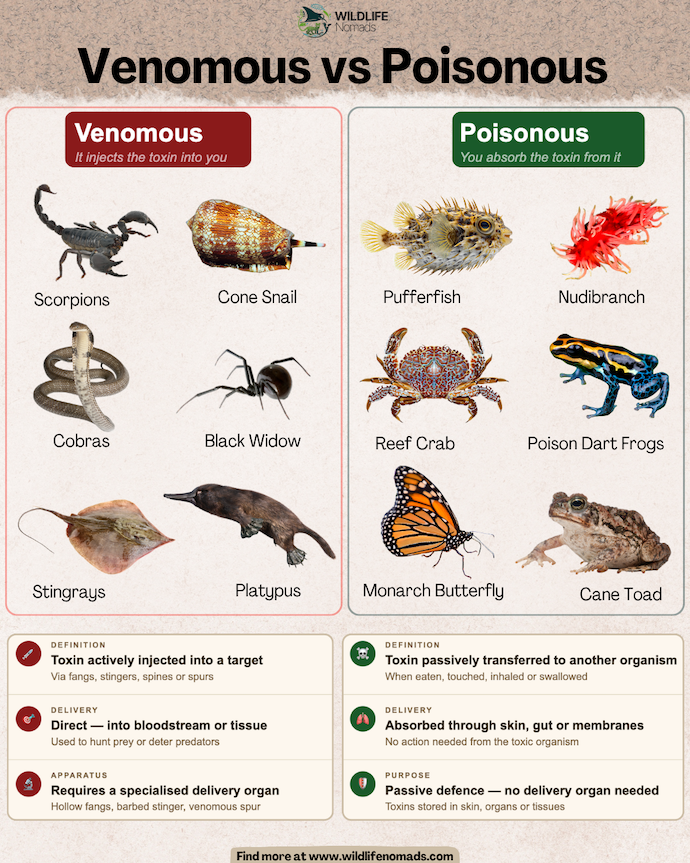
Venomous animals inject venom using fangs, stingers, harpoons or spines. Poisonous animals secrete toxins passively, so you only get hurt if you eat or touch them.
Snakes are venomous. Poison dart frogs, by contrast, are poisonous. Most articles get this wrong, and it is worth fixing. The delivery system is half of what makes an animal dangerous.
Venom has also evolved independently at least 104 times, across eight animal phyla. That is not one lucky invention. It is the same weapon rediscovered over and over.
The 12 Most Venomous Animals in the World
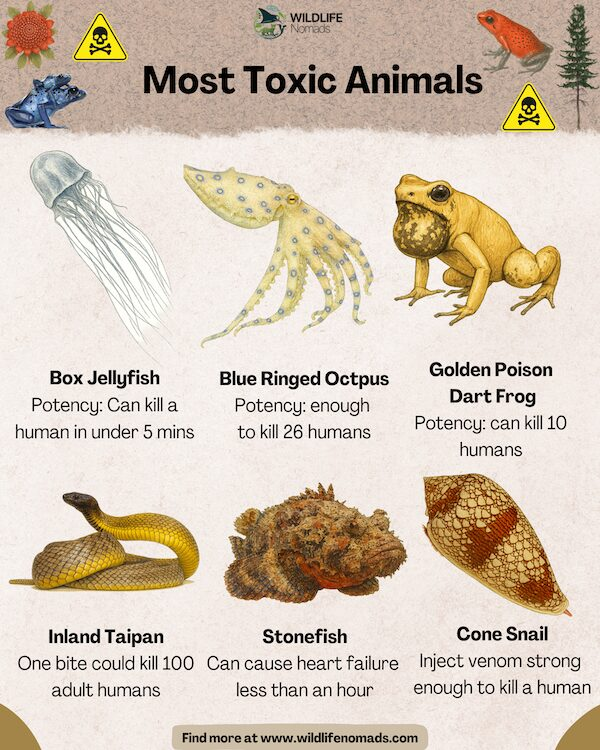
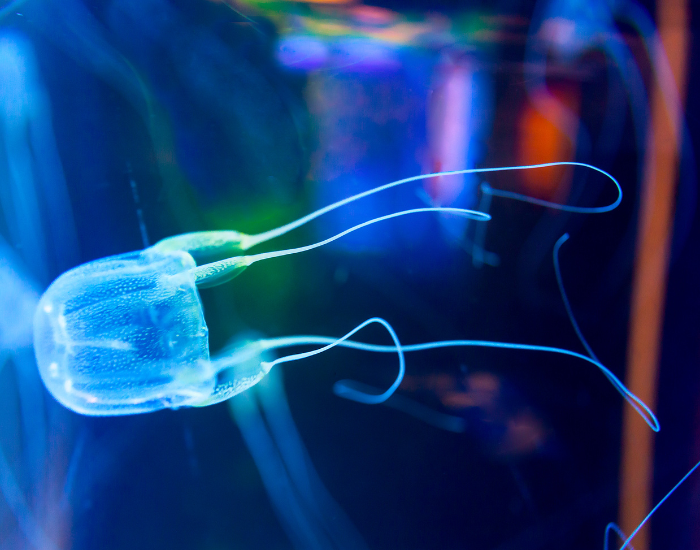
1. Australian Box Jellyfish (Chironex fleckeri)
Sixty tentacles, each up to three metres long. The bell is so clear you will not see it until it touches you. Still, one animal carries enough venom to kill 60 adults.
The venom punches holes in cell membranes, so potassium floods the blood. Then that hyperkalaemia causes cardiovascular collapse. An untreated sting can induce cardiac arrest and death within two to five minutes.
At least 64 people have died in Australia since 1883. Almost all of those deaths came before stinger nets and vinegar protocols. More in my box jellyfish guide and my roundup of the biggest jellyfish in the world.
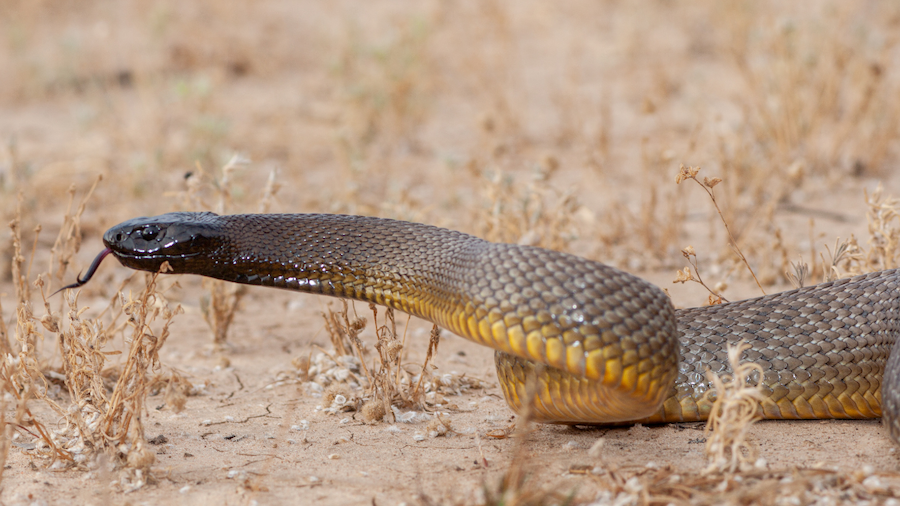
2. Inland Taipan (Oxyuranus microlepidotus)
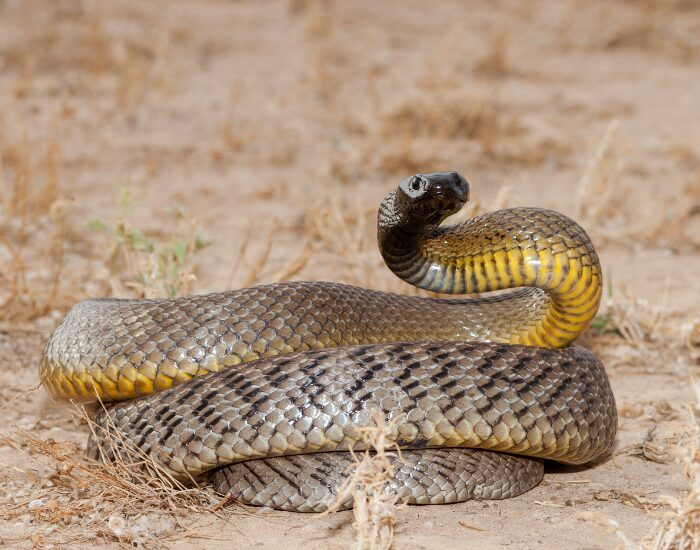
It is definitely not the biggest snake, but it for sure it is ranked as the most venomous snake on Earth, by a wide margin. One bite carries enough venom to kill 100 adult humans, or 250,000 mice.
Its lethal venom stacks neurotoxins that paralyse with procoagulants that wreck blood clotting. Prey dies fast, which matters when you hunt rats in cracked clay at 40°C.
Recorded human deaths: zero. Not one, ever, since taipan antivenom arrived. So the world’s most potent venom has never killed anybody. This snake lives in remote inland Australia, and it retreats rather than fights. See where it sits among Australia’s most dangerous snakes.
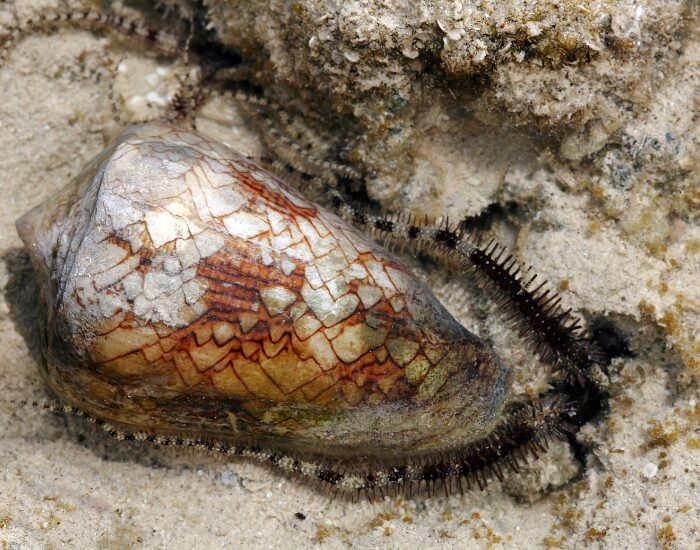
3. Geography Cone Snail (Conus geographus)
Of course it looks like a shell you would put on a windowsill. Instead, it fires a harpoon-like tooth loaded with conotoxins.
Those conotoxins shut down the nervous system, so a fish stops swimming almost instantly. In humans, cone snail stings cause paralysis and respiratory failure, and there is no antivenom.
Roughly 36 deaths have been recorded over 300 years, mostly in the Indo-Pacific. Even so, cone snails take one to five hours to kill a healthy adult. Hospital access decides the outcome.
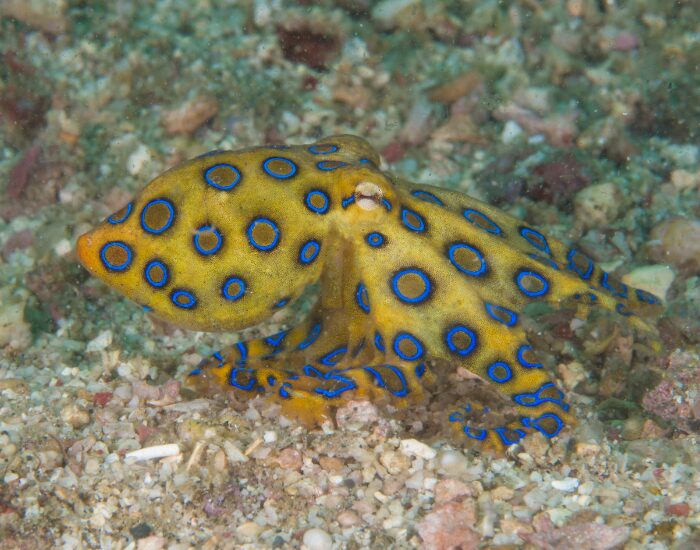
4. Blue-Ringed Octopus (Hapalochlaena spp.)
Golf-ball sized, and carrying enough tetrodotoxin to kill 26 adults within minutes. The blue ringed octopus flashes iridescent rings first, which is the only warning you get.
Tetrodotoxin blocks sodium channels, so nerve signals stop. Then breathing stops with them. The victim stays fully conscious, which is the detail people find hardest to hear.
There is no antidote. Still, rescue breathing keeps someone alive until hospital, and most survivors recover completely. Never lift a small octopus out of a rock pool.
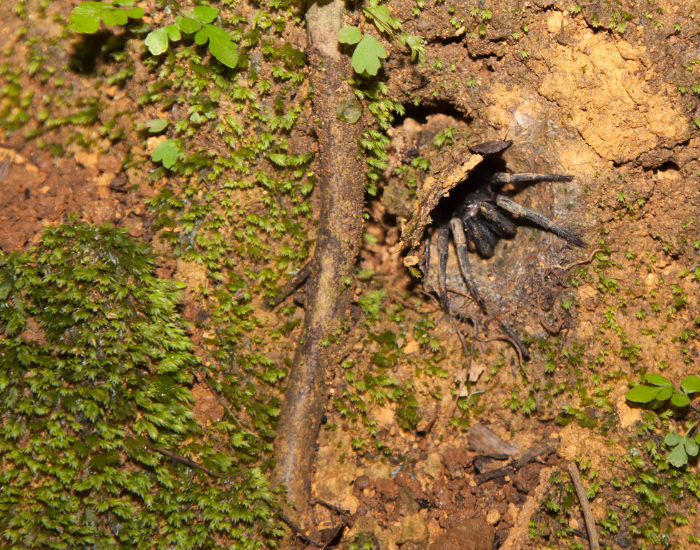
5. Sydney Funnel-Web Spider (Atrax robustus)
My first Sydney funnel-web spider was a hole in a bank. I was doing field work in Sydney, new to the country. Then a coworker asked whether I had ever seen one, and I said no.
So he walked me over and crouched. He pointed at the entrance, silk trip lines fanning out from it. No drama, no fangs. Still, I have never forgotten how ordinary it looked.
The deadly venom works fast. Untreated, a bite can kill a child in as little as 15 minutes. Males also carry fangs that pierce a fingernail. Thirteen deaths were recorded before antivenom arrived in 1981, and none since. In 2025 researchers split this spider into three separate species.
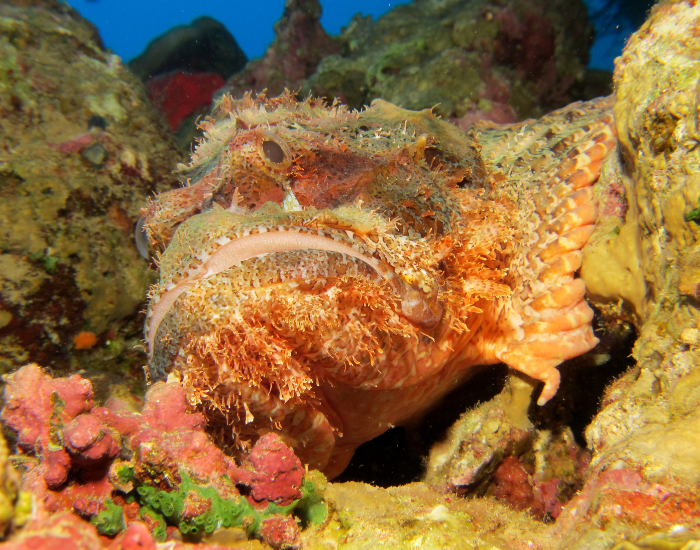
6. Stonefish (Synanceia spp.)
The stonefish is the most venomous fish in the world. It also looks exactly like an algae-covered rock, so people stand on it.
Thirteen venomous dorsal spines drive venom up through a bare foot or a thin sole. Survivors describe extreme pain, and severe cases bring tissue death and cardiovascular effects. Untreated, a bad sting can kill within about six hours.
Still, deaths are vanishingly rare, because antivenom has existed since 1959.
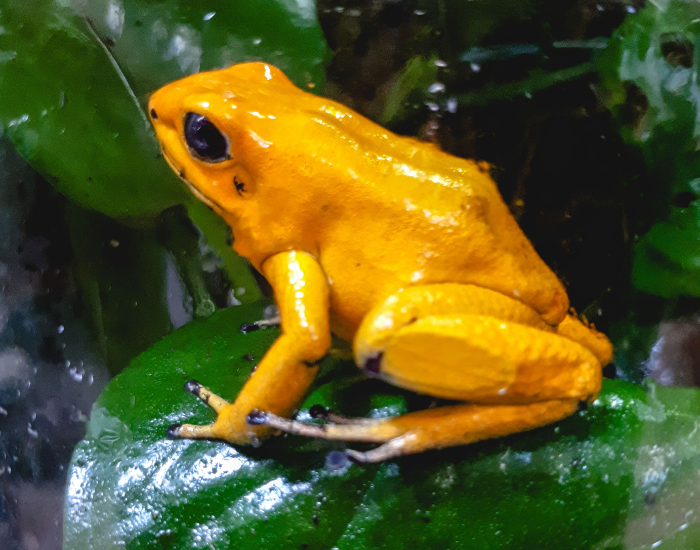
7. Golden Poison Frog (Phyllobates terribilis)
Here is the one I have to correct. This frog is not venomous. It is poisonous, and among poisonous animals nothing on land beats it.
One wild frog carries about a milligram of batrachotoxin on its skin. That is enough to kill 10 to 20 adults, or two African bull elephants. The toxin jams sodium channels open, and the nervous system fails.
I looked after dart frogs in that same collection, though, and captive ones are harmless. They cannot make batrachotoxin themselves. Wild frogs build it from arthropods they eat in South America. So a frog raised on crickets loses its toxicity entirely. More in my guides to toxic frog species and the blue poison dart frog.
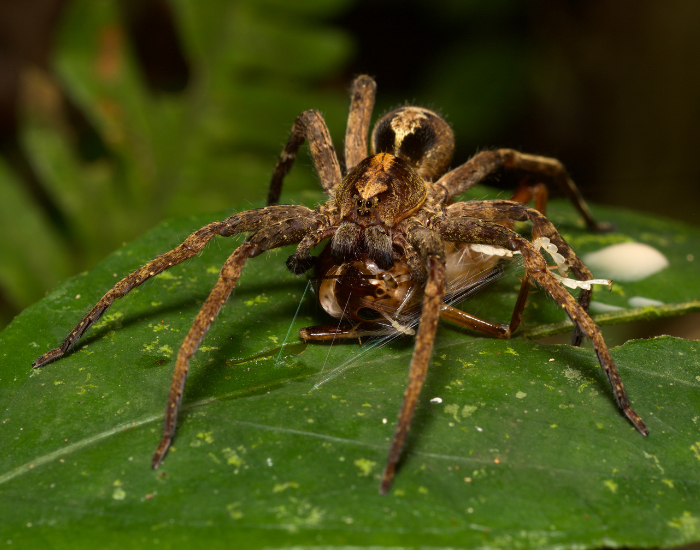
8. Brazilian Wandering Spider (Phoneutria spp.)
Found across northern South America, and it builds no web. Instead, this spider species hunts on the ground at night, which is how it ends up in houses, boots and banana crates.
This venomous spider causes extreme pain, sweating and dangerous blood pressure swings. Severe cases progress to respiratory arrest within two to six hours. Most victims are fine, though. Only about 2.3% of bites need antivenom, and nearly all of those are children.
I kept tarantulas at the zoo and they were harmless by comparison. Size tells you almost nothing, as my roundup of the biggest spiders in the world makes clear.
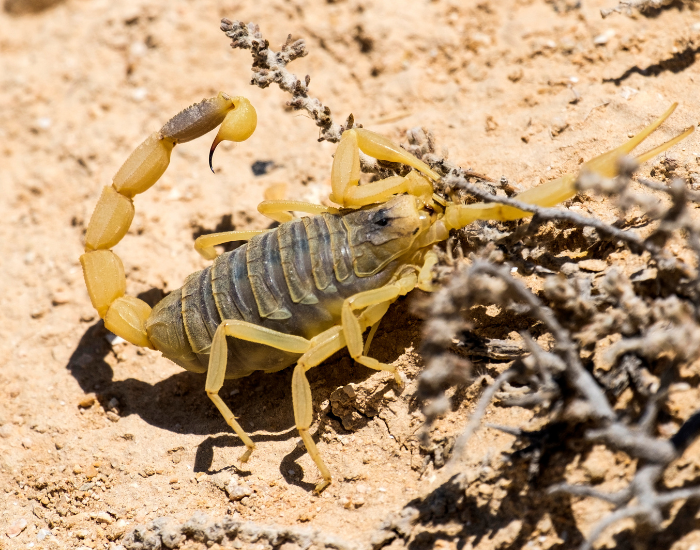
9. Deathstalker Scorpion (Leiurus quinquestriatus)
Pale yellow, palm-sized, and living across North Africa and the Middle East. It carries the most potent venom of any scorpion.
That venom is a cocktail of neurotoxins causing excruciating pain, then a racing heart and, in bad cases, pulmonary oedema. Even so, a sting normally will not kill a healthy adult. Children and the elderly are the ones at real risk.
Meanwhile, chlorotoxin from this scorpion now makes tumour margins glow during brain surgery. For a milder relative, see the Arizona bark scorpion.
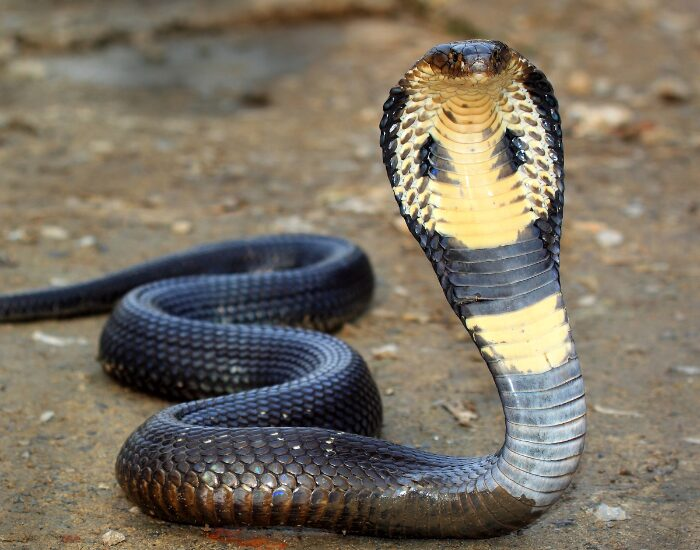
10. King Cobra (Ophiophagus hannah)
There was one cobra in the collection I worked in. I was allowed to feed it and nothing else, and that rule made complete sense to me.
The king cobra is not the most toxic snake. It does, however, deliver more venom than almost anything alive: up to 420 mg dry weight per bite. Untreated, death can come in as little as 30 minutes.
The black mamba is the other contender. It averages 100 to 120 mg per bite and can drop a person inside 45 minutes. Together, these two kill humans far more often than every animal above combined.
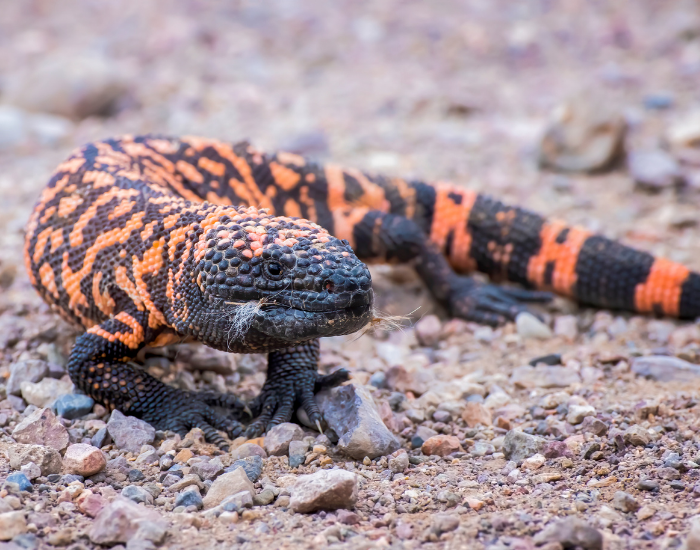
11. Gila Monster (Heloderma suspectum)
The one I fed. Venomous lizards are rare. This is the famous one, alongside the Mexican beaded lizard from my own part of the world.
Neither injects venom the way a snake does. Venom glands sit in the lower jaw, and venom runs along grooved teeth while the lizard chews. That is why they hang on. A Gila monster bite causes severe pain, swelling, vomiting and a drop in blood pressure.
Deaths from Gila monsters are almost unheard of. One fatality has been confirmed since 1930, in February 2024, involving a pet animal and a four-minute bite. The Mexican beaded lizard has about eight documented bites in a century, nearly all from people prodding captives.
Then comes the twist. A hormone in Gila monster venom, exendin-4, became exenatide, a mainstream type 2 diabetes drug.
12. Duck-Billed Platypus (Ornithorhynchus anatinus)
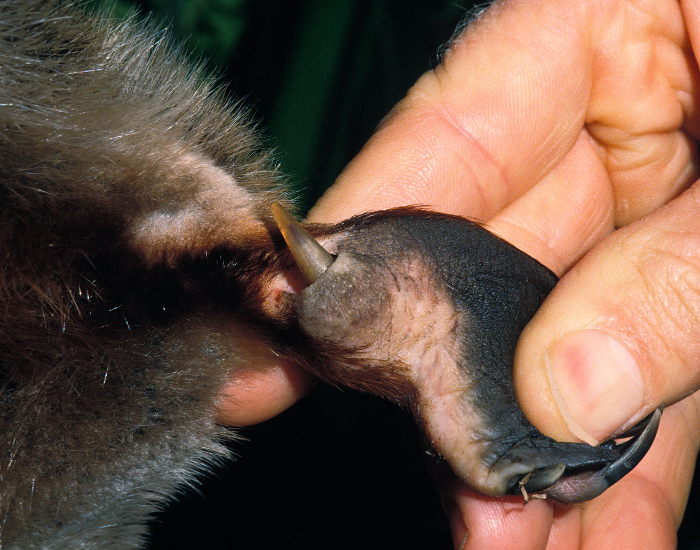
Few mammals are venomous, and the platypus is the strangest of them. Males carry a spur on each of their hind legs, fed by a gland in the thigh.
Venom production spikes during the breeding season, which tells you what it is for. This is a weapon for fighting other males, not for killing prey.
It will not kill you. It will, though, cause pain described as excruciating, pain that morphine does not touch, followed by hyperalgesia lasting months. One Australian veteran said it was worse than shrapnel.
Types of Venom and How They Work
Venom potency comes down to two things: toxicity, and speed of action.
| Type | What it does | Found in |
|---|---|---|
| Neurotoxins | Target the nervous system, causing rapid paralysis | Cone snails, blue-ringed octopus, taipans, funnel-webs |
| Hemotoxins | Destroy red blood cells and cause internal bleeding | Vipers, brown snakes, beaded lizards |
| Cytotoxins | Destroy tissue and cells around the bite area | Cobras, some scorpions, stonefish |
Most real venoms mix all three. Venom works as a biological weapon on the human body because it hits several systems at once. No single antidote handles everything.
Animal Humans Killed: The Numbers That Matter
Venom potency and body count are two different rankings. Here is where they diverge.
| Species | Recorded human deaths |
|---|---|
| Venomous snakes worldwide | 80,000–130,000 per year |
| Australian box jellyfish | 64+ in Australia since 1883 |
| Geography cone snail | ~36 in 300 years |
| Blue-ringed octopus | Around 11 confirmed worldwide |
| Sydney funnel-web spider | 13, none since 1981 |
| Gila monster | 1 since 1930 |
| Inland taipan | 0 |
Snakebite is the only genuine public health emergency on that list. Everything else is a rounding error, and usually an accident rather than an attack.
The pattern matches what I found writing about Australia’s deadliest animals. Exposure drives human deaths, not toxicity. Farmers walking barefoot at dusk meet far more snakes than tourists ever will.
Venom Is Also a Pharmacy
Every one of these dangerous animals is worth more alive than the fear it generates.
Cone snail venom gave us ziconotide, a non-opioid painkiller stronger than morphine. Similarly, Gila monster venom gave us exenatide. Funnel-web venom holds a peptide now being tested to protect heart muscle after a heart attack.
Even the obscure ones pay off. Venom from the northern short-tailed shrew is being studied for ovarian cancer. It blocks a calcium channel that tumour cells over-express. Meanwhile, slow loris venom, the only toxic bite among primates, mostly causes severe allergic reactions.
What Handling Them Actually Taught Me
Five years in Australia, and a few before that with tongs in my hand.
The dangerous moments were never the animals being aggressive. They were people being careless. Every serious incident I know of started the same way. Someone reached, lifted or prodded an animal that was perfectly happy where it was.
At Coombabah Lakelands I have walked the same tracks seven times without a close call. At Woody Head goannas walked through camp daily and ignored us. My worst day was five red-bellied black snakes on one hike at Springbrook. I stopped, watched, and they left.
So the rule is simple. Look hard, keep your hands to yourself, wear proper shoes.
Frequently Asked Questions
By venom potency, the inland taipan. By human deaths, venomous snakes kill 80,000 to 130,000 people a year. Most are vipers, cobras and kraits in South Asia and Africa. By total deaths from any cause, though, the mosquito wins, because it spreads malaria rather than injecting venom.
The golden poison frog. One wild frog carries about a milligram of batrachotoxin, enough to kill 10 to 20 adults. Still, it is poisonous rather than venomous, because it cannot inject anything. Captive frogs raised on crickets lose their toxicity completely.
The inland taipan, whose bite carries enough venom to kill 100 adult humans. Its subcutaneous LD50 sits near 0.025 mg/kg. For sheer volume, though, the king cobra wins. It delivers up to 420 mg of dry venom per bite.
No mammal is truly poisonous, but several are venomous. The male duck billed platypus carries a spur on each hind leg. Its venom causes excruciating, morphine-resistant pain, but it is never fatal to humans. The slow loris, meanwhile, is the only venomous primate, and its bite can trigger fatal anaphylaxis.
Yes. Geography cone snails can inject enough conotoxin to paralyse and kill an adult, and there is no antivenom. Once fired, the harpoon pierces a wetsuit glove. Never handle a live cone shell, and if you must move one, hold the broad end.
Most Venomous Animals Challenge
Eight questions on global venom toxicity, delivery mechanisms, and medical breakthroughs. How many can you get right?
Look, Don’t Touch
Not long ago, a video became viral about a man grabbing a dangerous stonefish in Australia. He is fine. The fish seems to be fine. But please, do not do it. The most venomous animals in the world are not waiting for you. Almost every one would rather you walked past.
Habitat loss and climate change threaten them far more than they threaten us. Several already sit on my list of Australia’s most threatened animals. We are losing venomous species faster than we can screen their venom for drugs.
So keep your hands to yourself and your eyes open. Then tell me in the comments which one you have
References:
Hayes, W. K., Gren, E. C. K., Nelsen, D. R., Corbit, A. G., Cooper, A. M., Fox, G. A., & Streit, M. B. (2025). It’s a small world after all: The remarkable but overlooked diversity of venomous organisms. Toxins, 17(3), Article 99. https://doi.org/10.3390/toxins17030099
Loria, S. F., Frank, S.-C., Dupérré, N., Smith, H. M., Jones, B., Buzatto, B. A., & Harms, D. (2025). The world’s most venomous spider is a species complex: Systematics of the Sydney funnel-web spider (Atracidae: Atrax robustus). BMC Ecology and Evolution, 25(1), Article 7. https://doi.org/10.1186/s12862-024-02332-0
Yamate, Y., Takatani, T., & Takegaki, T. (2025). Verification of tetrodotoxin utilisation against predators in Japanese blue-lined octopus Hapalochlaena cf. fasciata. Molluscan Research, 45(1), 1–8. https://doi.org/10.1080/13235818.2024.2441955
Geffeney, S. L., Williams, B. L., Rosenthal, J. J. C., Birk, M. A., Felkins, J., Wisell, C. M., Curry, E. R., & Hanifin, C. T. (2019). Convergent and parallel evolution in a voltage-gated sodium channel underlies TTX-resistance in the greater blue-ringed octopus. Toxicon, 170, 77–84. https://doi.org/10.1016/j.toxicon.2019.09.013
Safavi-Hemami, H., Gajewiak, J., Karanth, S., Robinson, S. D., Ueberheide, B., Douglass, A. D., Schlegel, A., Imperial, J. S., Watkins, M., Bandyopadhyay, P. K., Yandell, M., Li, Q., Purcell, A. W., Norton, R. S., Ellgaard, L., & Olivera, B. M. (2015). Specialized insulin is used for chemical warfare by fish-hunting cone snails. PNAS, 112(6), 1743–1748. https://doi.org/10.1073/pnas.1423857112
Bowen, C. V., DeBay, D., Ewart, H. S., Gallant, P., Gormley, S., Ilenchuk, T. T., Iqbal, U., Lutes, T., Martina, M., Mealing, G., Merkley, N., Sperker, S., Moreno, M. J., Rice, C., Syvitski, R. T., & Stewart, J. M. (2013). In vivo detection of human TRPV6-rich tumors with anti-cancer peptides derived from soricidin. PLOS ONE, 8(3), e58866. https://doi.org/10.1371/journal.pone.0058866
Yanagihara, A. A., & Shohet, R. V. (2012). Cubozoan venom-induced cardiovascular collapse is caused by hyperkalemia and prevented by zinc gluconate in mice. PLOS ONE, 7(12), e51368. https://doi.org/10.1371/journal.pone.0051368