
The name alone sends a shiver down the spine of many Australians: the Australian funnel web spider. It’s an animal draped in folklore, fear, and a fearsome reputation that spans the globe. Having worked in ecosystem restoration, particularly in the sprawling reserves and national parks around Sydney, I can tell you firsthand that their reputation is well-earned, yet often misunderstood.
Among the most toxic animals in the world, this spider stands alongside other notorious creatures like the saltwater crocodile, stone fish and the most dangerous snakes in Australia as one of the continent’s deadliest inhabitants.
We’re going to peel back the layers of myth and find the scientific truth about this iconic, genuinely dangerous spider. From its unique web structure to the life-saving science of its antivenom, this is your expert guide to one of the most feared animals in Australia.
My Journey: Seeking the Shadow in the Bush
When I first started my field work, traipsing through the bushland in New South Wales, my co-workers were quick to brief me on the local hazards. Snakes, tick bites, and, of course, the Australian funnel web spider. They told me about the male spiders wandering during the warmer months, the speed of their attack, and the necessity of wearing thick pants and gaiters.
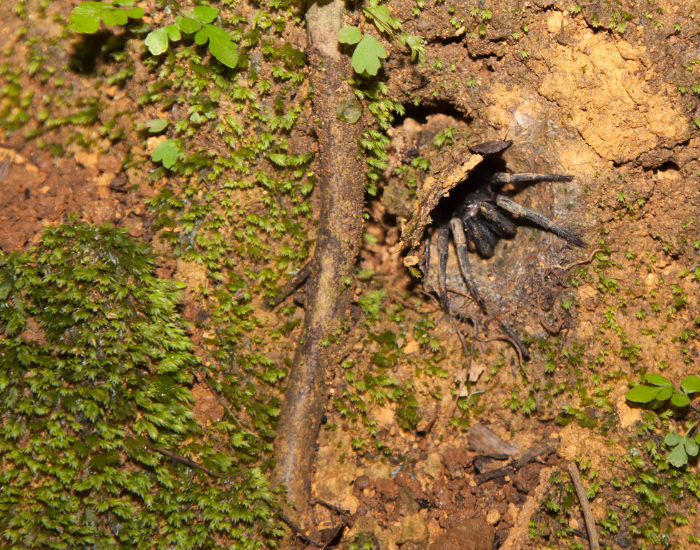
Despite their fearsome reputation and the numerous warnings, finding one was actually quite hard! These aren’t spiders that bask in the sun. They are creatures of the deep, sheltered habitats, dark, moist burrows under rocks, inside rotting logs, or beneath dense shrubs. We’d walk through countless reserves, pointing out harmless wolf spiders and orb-weavers, but the infamous funnel web remained elusive.
Then, one day in a particularly bushy area of North Sydney, I saw it.
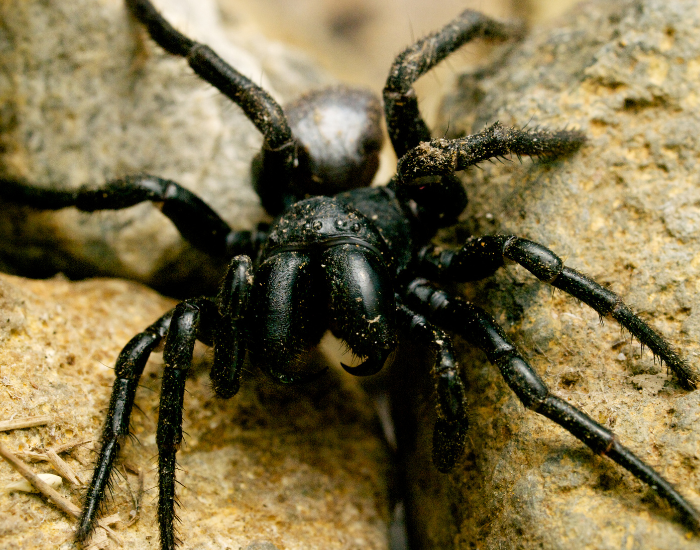
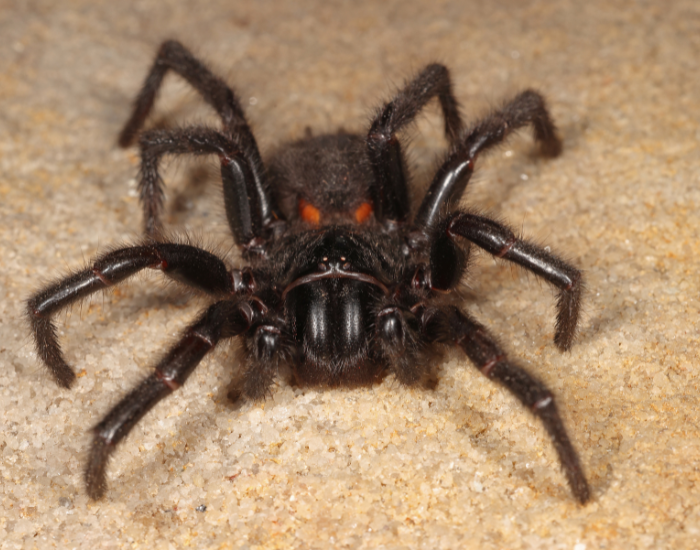
It wasn’t a casual sighting. It was a dark, humid morning, and I almost stepped on a patch of irregular silk trip lines fanning out from a deep, silk-lined crevice in the ground, the hallmark of the funnel web. Peering closely (but not too closely!), I saw a large, black spider, its carapace gleaming like polished obsidian. It was big, imposing, and undeniably beautiful in a primal, terrifying way. Though I didn’t have a camera ready, the image of that substantial, intimidating creature guarding its territory is still vivid in my memory.
That’s the critical lens we need to bring to this animal: a profound respect informed by science, not just fear.
The Core Facts: Understanding the Funnel Web Spiders
The term “funnel web spider” encompasses several species, primarily belonging to the genera Atrax and Hadronyche species. The genus Atrax is significant in taxonomy and arachnology, as it includes multiple distinct atrax species with notable morphological and genetic differences.
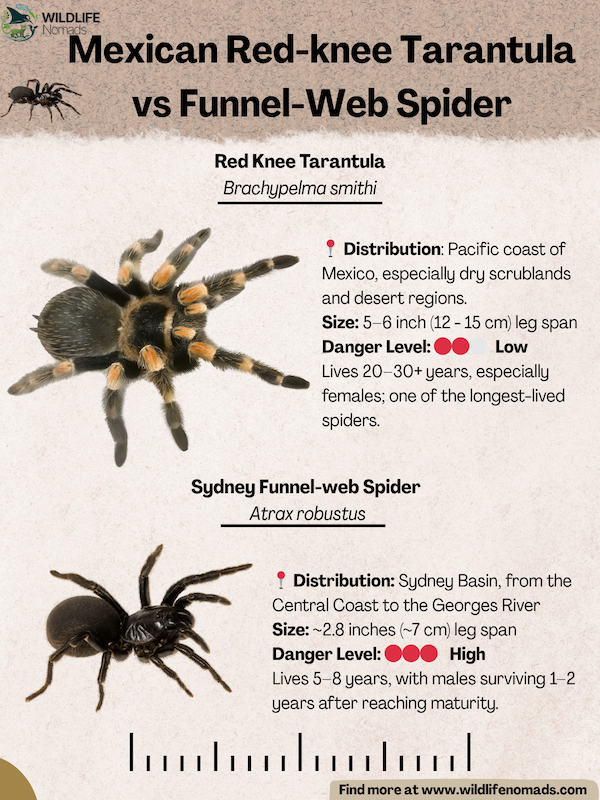
The most infamous, and the one we’ll focus on, is the Sydney funnel web spider (Atrax robustus). The genus Atrax includes several other species, and historically, six species were recognized within this genus, but recent research has expanded this number as our understanding of atrax species diversity has grown.

1. The Sydney Funnel Web is the Deadliest, But Only the Male is a Major Threat
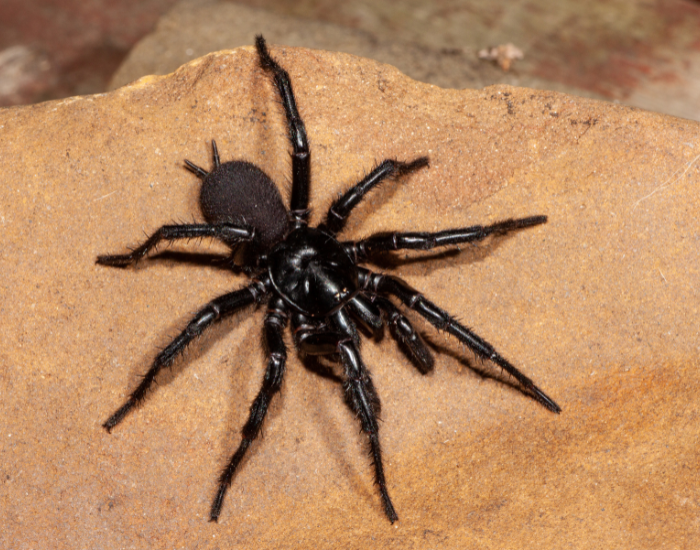
While all funnel-web spiders are venomous, the male of the species Atrax robustus (the Sydney funnel web spider) is responsible for all recorded fatalities. This is because only male spiders possess the highly toxic venom that is dangerous to humans. The venom toxicity of the male is estimated to be six times more potent to primates (including humans) than the female’s.
Why the difference? Scientists believe the highly toxic peptide in the male’s venom, δ-atracotoxin, evolved to quickly incapacitate insect and other small prey, but it unfortunately cross-reacts dangerously with the human nervous system. Adult males can be distinguished from females by specific morphological features, such as longer embolus and differences in leg measurements, which are important for identification.
2. Their Range is Surprisingly Small and Specific
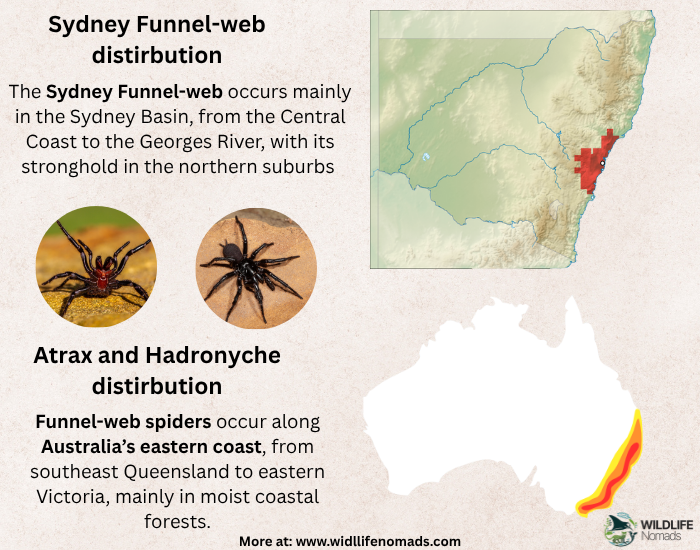
The primary range of the Australian funnel-web spiders is the eastern coast of Australia. Specimens are found in New South Wales, South Australia, Victoria, Tasmania, and Queensland. The only Australian states or territories without members of this family are Western Australia and the Northern Territory.
The Sydney area remains the epicenter of Atrax robustus sightings. The main range of the Sydney Funnel-web is from the Central Coast south to the Georges River, extending as far west as Baulkham Hills near the southern end of its distribution. Some records are also known from the Blue Mountains and Wollongong.
3. Their “Web” is Not for Catching Air-borne Prey
Unlike the classic orb-weaver webs, the funnel web webs are not sticky. They’re typically build webs close to the ground.
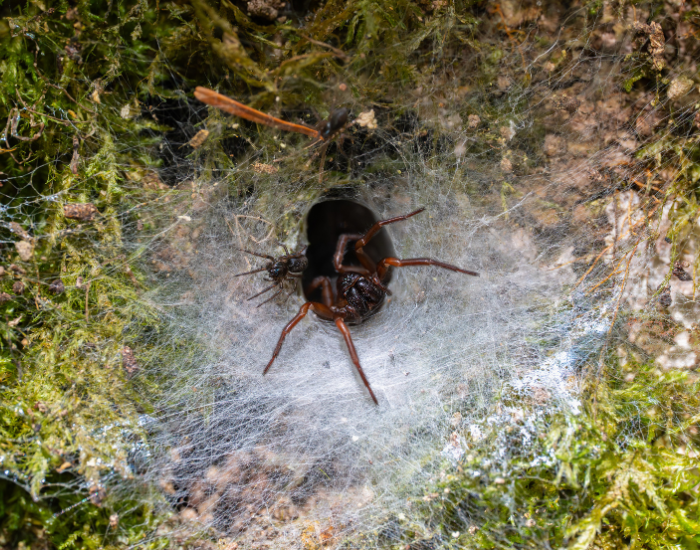
They construct a silk-lined burrow, and radiating out from the entrance are messy, irregular silk trip lines. The spider uses its four spinnerets to produce the silk for these webs, a key anatomical feature that helps distinguish it from other species.
When an insect, beetle, or other small prey (including other mammals) trips one of these lines, the funnel web spider bursts out of its burrow to grab its meal.
4. Size and Appearance: A Big, Black, and Glossy Spider
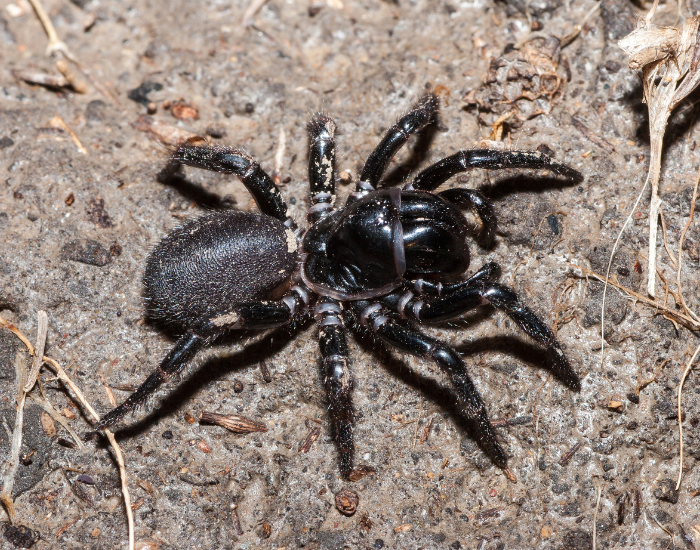
Funnel web spiders are considered large, black spiders. Their body length can range from 1 to 5 cm. They are characterized by a dark, glossy, sparsely haired carapace (the top of the cephalothorax), powerful, downward-pointing fangs, and distinctive features. The male is generally more slender than the female, with longer legs, allowing them to become wandering males in search of a mate.
5. They are Nocturnal and Hate the Heat
Funnel web spiders are most active at night, when they emerge to hunt or, in the case of males, to roam. They are highly susceptible to dehydration. This is a critical insight.
During heavy rain or when burrows flood, they are often forced to move and seek sheltered habitats. This is why they are often found in garages, laundry rooms, or swimming pools (where they can survive for hours!).
6. The Antivenom is a Modern Australian Hero
The fearsome reputation is rooted in the tragic history of 13 fatalities before the 1980s. However, the development of the antivenom in 1981 by the Commonwealth Serum Laboratories (CSL) completely changed the narrative.
Research into spider venoms, including the work of Raftos J on the synthesis and biochemical analysis of neurotoxins like δ-Atracotoxin-Ar1a, has greatly advanced our understanding of the molecular and structural properties of funnel-web toxins. This scientific progress has been crucial for the creation of effective antivenom treatments.
Since 1981, there have been NO recorded deaths from a funnel web spider bite. This is a massive conservation and medical success story.
The venom is ‘milked’ from specimens housed at the Australian Reptile Park, a vital conservation initiative that literally saves lives. One dose of antivenom requires around 70 milkings from a Sydney funnel-web spider.
7. The Male Spiders are the Wanderers
During the warmer months (especially from November to March), mature male spiders leave the safety of their burrow to search for females. During the breeding season, these males leave their burrows specifically to find mates. This is when they are most likely to enter human dwellings, fall into shoes, or be encountered by people. This wandering males behaviour is the primary cause of bites.
8. They Can Be Highly Aggressive When Cornered
While no spider wants to bite something larger than itself, funnel web spiders will defend themselves fiercely if they feel threatened. When provoked, they will rear up on their hind legs, displaying their fangs and often dripping venom. This posture is an unmistakable sign of a spider ready to strike, a true dangerous spiders warning.
9. 3. The “Sydney Funnel-Web” is Actually Three Distinct Species
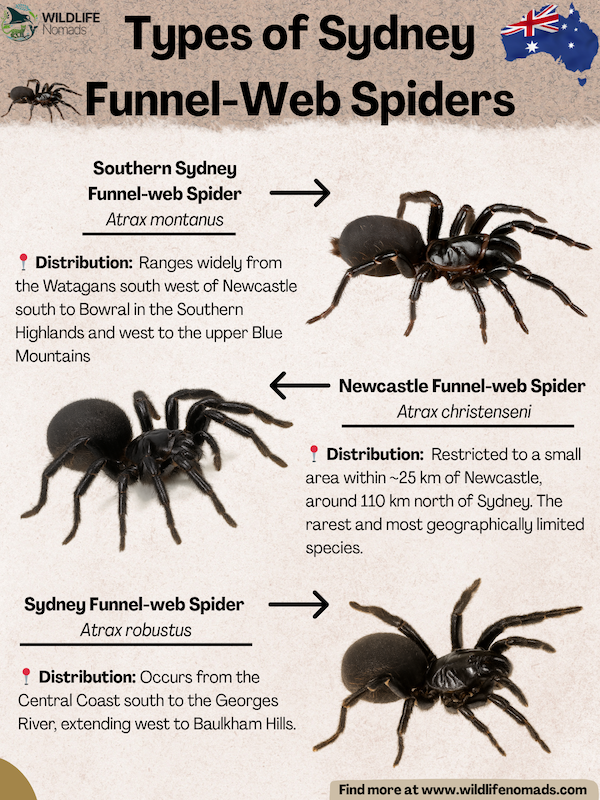
Recent research revealed that the Sydney funnel-web spider is actually three species: the original Atrax robustus found throughout metropolitan Sydney, the Southern Sydney funnel-web (Atrax montanus) extending to the Blue Mountains region, and the Newcastle funnel-web (Atrax christenseni), nicknamed “Big Boy,” found further north in Newcastle.
The ‘original’ Sydney funnel-web (Atrax robustus) is found throughout metropolitan Sydney. The Southern Sydney funnel-web (Atrax montanus) has a distribution that overlaps with A. robustus and extends to the Blue Mountains region south and west of Sydney. The Newcastle funnel-web (Atrax christenseni) is found further north in Newcastle. In taxonomy, genus Atrax and genus Hadronyche are distinguished by specific morphological traits, and hadronyche sp. refers to species within the Hadronyche genus, which are also medically significant and require careful identification due to their associated danger levels.
Male Newcastle funnel-webs are the largest, earning them the playful nickname “Big Boy.” They have a much longer and thinner mating organ called the pedipalp compared to the other two species.
10. Funnel Web Spiders and Water
Because they can survive for hours by trapping a small air bubble against their abdomen, it’s not uncommon to find a funnel web spider in a swimming pool or a bucket of water. Do not assume it is dead. Use a scoop or net to remove it carefully.

11. They are Often Confused with Mouse Spiders and Trap-Door Spiders
Many large black spider specimens found in Australia are mistaken for the funnel web. Mouse spiders (Missulena genus) are often confused with them due to their size and coloration. While mouse spiders are also venomous, the toxicity to humans is generally much lower, though caution is always advised. The key is to look for that shiny, black carapace and the distinct funnel web webs.
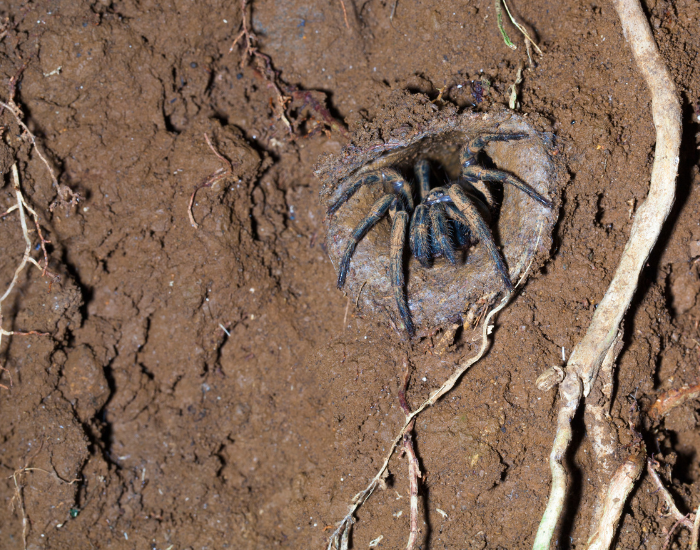
12. Funnel Webs Are Not Found in the United States (or Anywhere Outside Australia)
To answer one of the most common questions: Does the USA have funnel-web spiders? No. Are there funnel-web spiders in the United States? Absolutely not. The Australian funnel-web spider is endemic to Australia and is not found anywhere else in the world. Their relatives are restricted to this continent’s unique ecological zones. The Sydney funnel-web spider, in particular, is considered one of the world’s most dangerous spiders, highlighting its global significance.
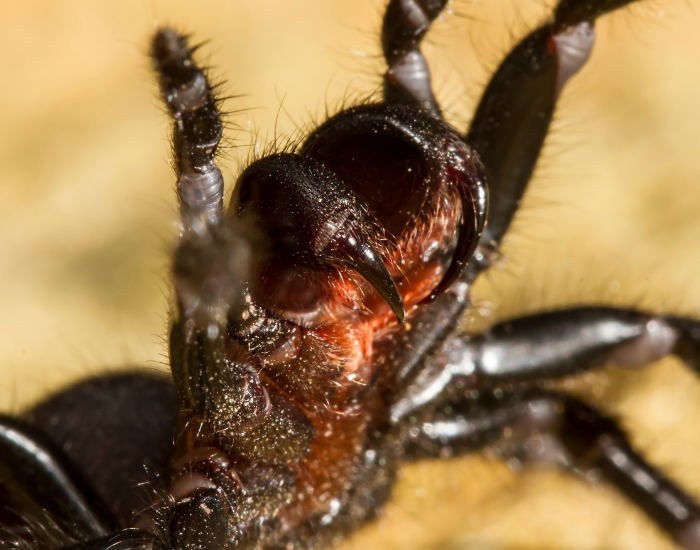
Funnel-Web Spider Venom: What Makes It So Dangerous?
The venom delivered by a funnel-web bite contains Delta atracotoxin. It’s much more potent in the male funnel-webs. Scientists think this is because the males are the ones who have to leave the safety of their burrows during the breeding season in search of a female.
This is treacherous business. Therefore, they likely evolved a stronger version of the venom that not only incapacitates the insects they eat but also acts as a defence against predators.
In most animals, sodium channels are shaped just differently enough that the venom can’t stick to them very well. However, humans and other primates, by bad evolutionary luck, happen to have sodium channels that funnel-web venom can grip onto very tightly. The spider didn’t evolve this weapon with us in mind, but our nerves happen to be a perfect target.
When envenomation occurs, venom appears in clinical symptoms such as rapid onset of sweating, muscle spasms, high blood pressure, and other signs of neurotoxicity, especially in humans and other primates.
Interestingly, certain mammals appear to have a natural resistance to funnel-web venom. Cats, dogs, and rabbits barely react to funnel-web spider bites. This natural resistance of rabbits to funnel-web venom is actually what makes antivenom production possible.
Funnel-Web Spider Reproduction and Life Cycle
Female funnel-web spiders can live for many years, sometimes up to 20 years in their burrows. In contrast, male spiders typically live only a few years. Males reach sexual maturity at about four years of age and the females take just a little bit longer.
Reproduction usually occurs towards the end of summer or early fall. Males locate females by sensing the female’s pheromones. Successful mating occurs when the female accepts the male onto her web or allows copulation. Females lay from 90 to 120 yellow-green eggs within their silk-lined burrows.
The male’s wandering behavior during mating season is what brings them into contact with humans most frequently. During the warmer months, mature male spiders leave their safe burrows and actively search for receptive females. This is when most human encounters and bites occur.
Conservation Status of Funnel-Web Spiders
The conservation status of funnel web spiders is becoming an increasingly important topic as Australia’s landscapes change. The Sydney funnel web spider (Atrax robustus), in particular, is now listed as vulnerable on the International Union for Conservation of Nature (IUCN) Red List. This status highlights the growing pressures faced by these iconic spiders, especially in and around Sydney.
The main threats to Australian funnel web spiders stem from habitat destruction and urban expansion. As forests and woodlands are cleared for housing, roads, and agriculture, the delicate burrows that funnel web spiders depend on are often destroyed or degraded. Construction activities can collapse burrows, while changes in land use can dry out the moist environments these spiders need to survive. Climate change adds another layer of risk, altering rainfall patterns and temperatures, which can further impact funnel web populations.
Invasive species also pose a threat, competing for food or directly disturbing the burrows of native web spiders. The combined effects of these pressures mean that some species of funnel web spiders are under serious threat, even as others are still being assessed for their conservation status.
FAQ Section
Without treatment, the venom can cause severe envenomation. Symptoms include profuse sweating, tears, muscle spasms, hypertension, and respiratory distress, leading to cardiac arrest. However, with immediate first aid (Pressure Immobilisation Bandage) and administration of antivenom, the symptoms are reversed, and full recovery is expected.
Look for a large, robust, black funnel web spider with a glossy, hairless carapace. The web is typically a messy, sock-like tunnel leading into a burrow, with silk trip lines radiating outwards on the ground or in leaf litter.
The antivenom is highly effective. Current antivenom successfully treats all funnel-web bites. It’s not only effective against Sydney species, it’s effective against all other funnel-webs and even against mouse spiders, which are a completely different family.
Do not attempt to handle the spider directly. Keep children and pets away from the area. Contact local wildlife authorities or a professional pest control service experienced with dangerous spiders. If you’re trained in safe collection methods, you can carefully capture it and deliver it to a designated collection point for the Australian Reptile Park’s venom program.
Respect, Not Recklessness
The Australian funnel-web spider is a marvel of evolution, a highly adapted predator that plays a key role in controlling insect populations across its restricted range. Its story is a powerful testament to the critical thinking required in conservation. Understanding and respecting an animal, even a dangerous one, is essential.
My time spent in New South Wales, navigating habitats shared with this creature, instilled in me a deep respect for the sheer potency of nature.
They are not out to get us. They are simply defending themselves when their solitary world is invaded by a gigantic, clumsy human. By knowing the facts, the size of funnel web spider, the importance of first aid, and the power of antivenom, we can coexist safely with this incredible and important member of Australia’s wildlife.
The venom that makes them so dangerous is also being studied for potential medical applications. This links this tiny toxin with future human health—a beautiful irony of science. The most important thing to remember is to stay aware, stay calm, and always prioritize immediate medical help.
Further Reading
- Why Everyone Falls in Love With the Quokka
- 12 Stunning Kingfishers of Australia
- iscover the Fascinating World of the Seadragon