

The other day I was writing a piece about the roseate spoonbill, and I went down a rabbit hole that genuinely fascinated me. These wading birds aren’t born pink. Their feathers carry no natural pigment of that hue. They get their pink coloring the same way flamingos do, straight from their diet. Eat enough carotenoid-rich crustaceans, and your feathers slowly turn pink.
That fact made me wonder: how many pink animals out there actually owe their color to diet? And how many are pink for entirely different reasons — genetic mutation, mimicry, thin skin revealing the tissue below, or a chemical warning?
This list of pink animals is the result of that rabbit hole. As a field biologist, I’ve encountered rosy creatures across continents, from the Amazon river to tropical reefs. I’m leaving out honourable mentions like the galah, Anna’s hummingbird, and the scarlet ibis, beautiful animals that wear pink in patches rather than across most of the body.
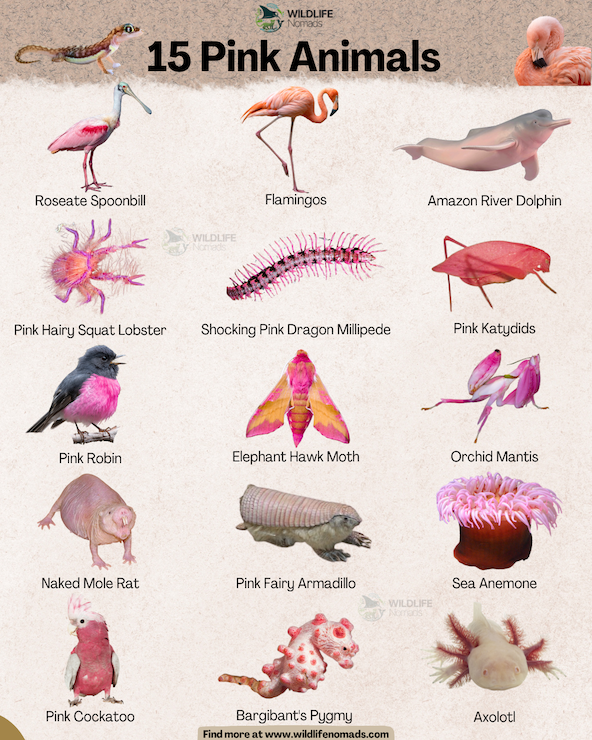
1. Roseate Spoonbill
The roseate spoonbill is the bird that started this whole article. These wading birds patrol the shallow water of coastal marshes from the southern United States through Central America and South America. Their spoon shaped bills sweep side to side, sifting out brine shrimp and small crustaceans loaded with carotenoids.
The pink hue intensifies with age. Adult males in peak breeding season blaze with deep rose shoulders. Juveniles look almost white. The roseate spoonbill is living proof that “you are what you eat” applies to feathers as much as flesh.
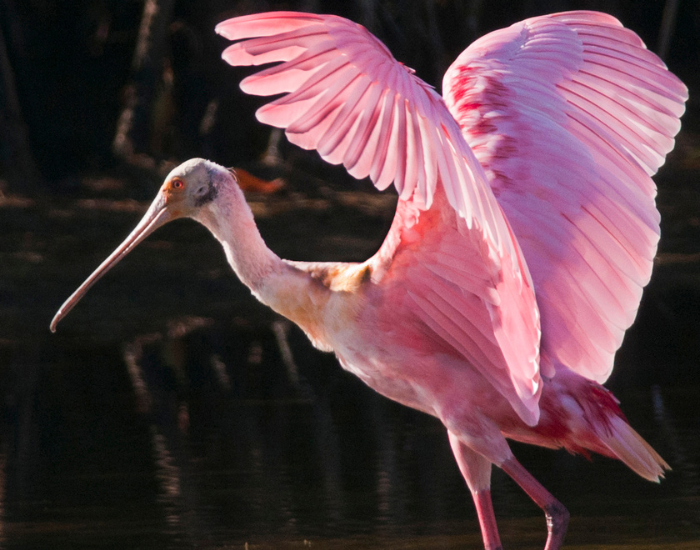
2. Amazon River Dolphin (Pink River Dolphin)
The Amazon river dolphin, or boto, is one of only a handful of freshwater dolphins on Earth, and easily the most famous pink dolphin. Unlike the spoonbill, the pink coloring here is structural. Calves are born dark gray. As they age and accumulate scar tissue from sparring, the surface skin thins and reveals the blood vessels beneath.
Adult males end up the pinkest, beaten up by years of jockeying with rivals. For deeper context, see my full guide to dolphins of the Amazon river and the broader rundown of types of dolphins.
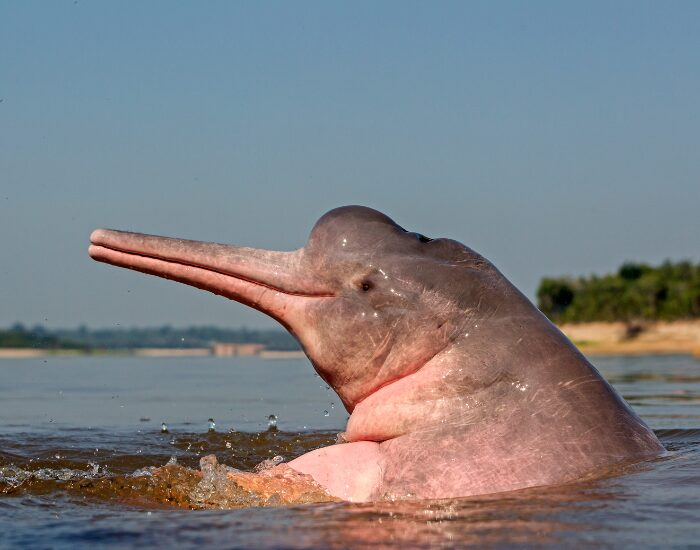
3. Pink Hairy Squat Lobster
If you’ve never heard of the pink hairy squat lobster, you’re not alone. This tiny squat lobster lives almost exclusively on bright pink fan corals across Southeast Asia. The hairy squat lobster is so well camouflaged most divers swim right past it.
Its body is covered in fine pink hairs that trap drifting food particles. I once watched one on a reef in Indonesia for twenty minutes before I could pick out its outline. The pink one in this case is no flashy display, it’s a survival advantage.
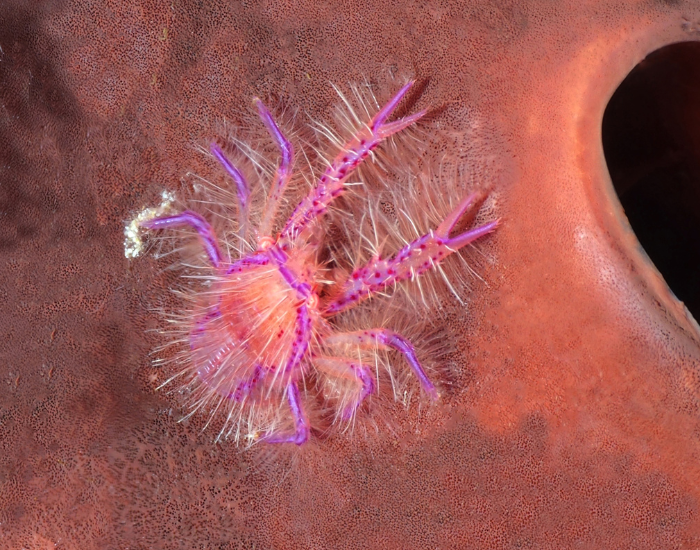
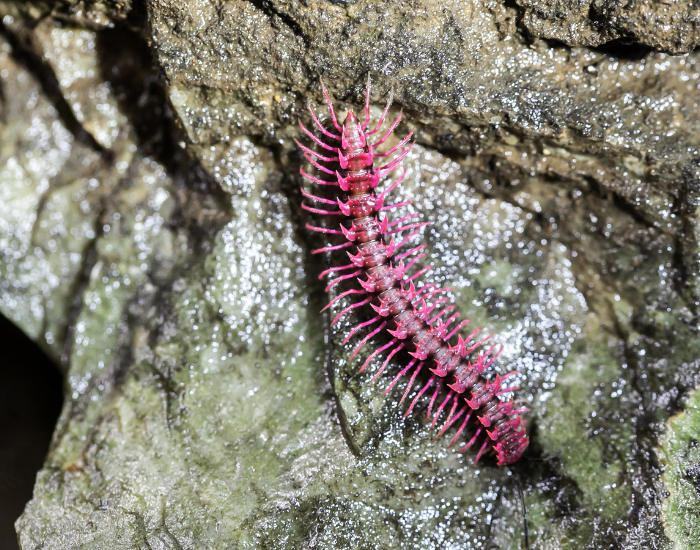
4. Shocking Pink Dragon Millipede
The shocking pink dragon millipede looks like it crawled out of a video game. This invertebrate, described from limestone caves in tropical Asia, is colored a shocking pink so saturated it almost glows. The color isn’t decoration, it’s a chemical warning.
Like many bright pink creatures, the pink dragon millipede uses color to warn predators it’s toxic. Glands along its body release hydrogen cyanide when threatened. Every entomologist I know would crawl through a cave for one.
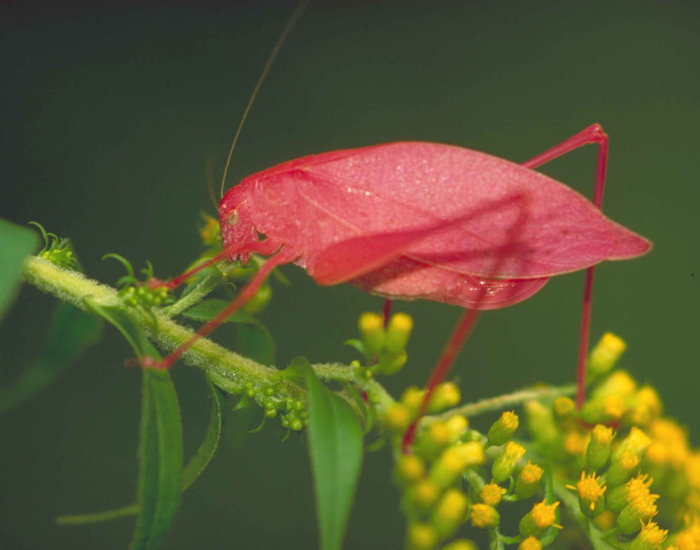
5. Pink Katydids
Pink katydids are one of the most beautiful animals you’ll ever meet by accident. Most katydids are green, exactly what you’d expect from an insect that spends its life on leaves. Pink katydids exist because of a genetic mutation called erythrism, where red pigment dominates over green.
That genetic mutation usually doesn’t help a pink katydid survive, bright pink on a green leaf is a dinner sign for birds. Yet pink katydids keep showing up in collections across the Americas. Other animals carry similar mutations, but pink katydids remain my favorite. In the right pink flower, ironically, pink katydids might even disappear.
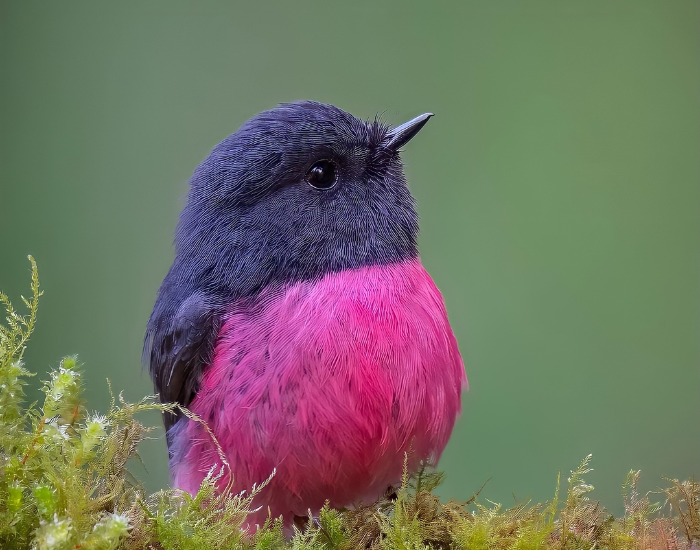
6. Pink Robin
The pink robin is one of those Australian secrets I put on any visiting birder’s must-see list. Males of this small forest bird wear a rich, soft pink across the belly that looks almost airbrushed. Females are far more muted.
The pink robin lives in the wet, mossy forests of southern Australia and Tasmania. I’ve watched them flit through tree-fern gullies where the light barely reaches the ground. Against the dark green understory, that pink coloring almost seems to float.
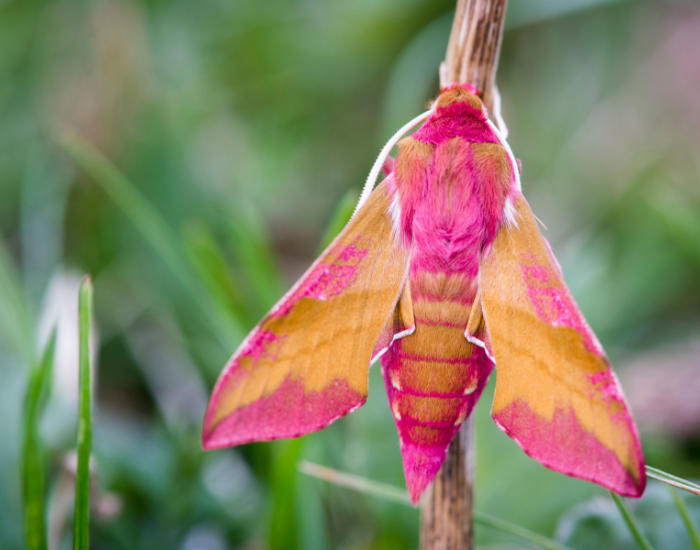
7. Elephant Hawk Moth
Few moths announce themselves like the elephant hawk moth. This large nocturnal insect, common across Europe and north Africa, wears bright pink and olive markings that belong on a tropical reef fish, not on something flying through your garden at night. The small elephant hawk moth is its close cousin, smaller but every bit as pink.
The caterpillars look like little gray elephants, hence the name. The adults undergo metamorphosis into one of the pinkest insects alive. The small elephant hawk moth holds its own with equally vivid rose markings.
8. Orchid Mantis
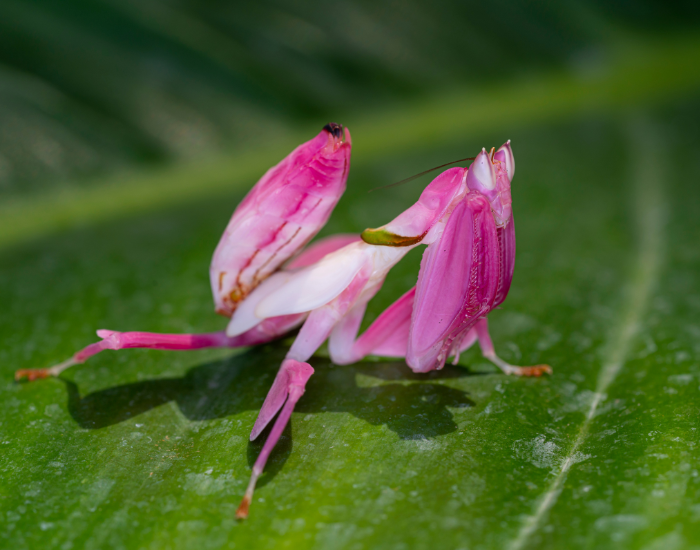
The orchid mantis is a masterclass in mimicry. This Southeast Asian predator is shaped and colored to resemble the petals of an orchid flower. Adult females, in particular, glow in pink and white tones that fool both prey and predators.
What makes the orchid mantis especially interesting is that it can attract pollinators better than many real blooms. Insects come to investigate the pink hue. The orchid mantis catches prey mid-approach. I think about that the next time someone calls insects “simple.”
9. Naked Mole Rat
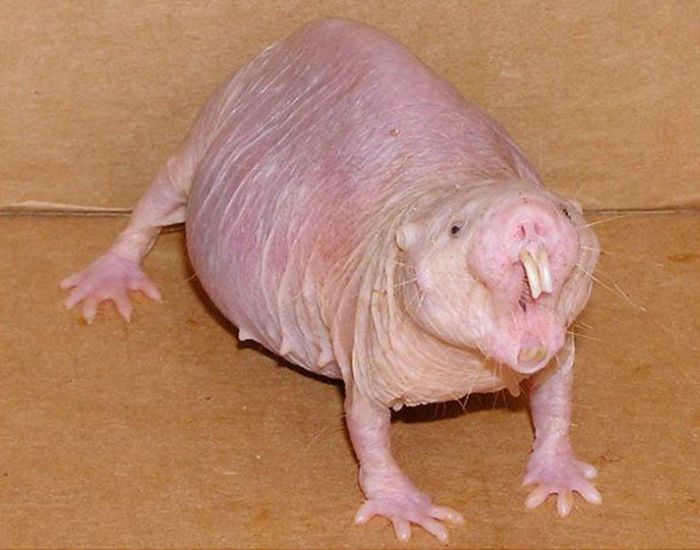
Naked mole rats are not what most people picture when they think of pink creatures, but biologically they’re hard to leave off. These naked mole rats live in vast underground colonies in the Horn of Africa, and they’re some of the longest living rodents known to science.
The pink color isn’t pigment — it’s exposed skin. With almost no fur, fine capillaries near the surface give the naked mole a uniform pink tone. They are nearly blind, eusocial like ants, and remarkably resistant to cancer — a remarkable ability that has biomedical researchers paying attention. These rats are one of the strangest small mammals in the animal kingdom.
10. Pink Fairy Armadillo
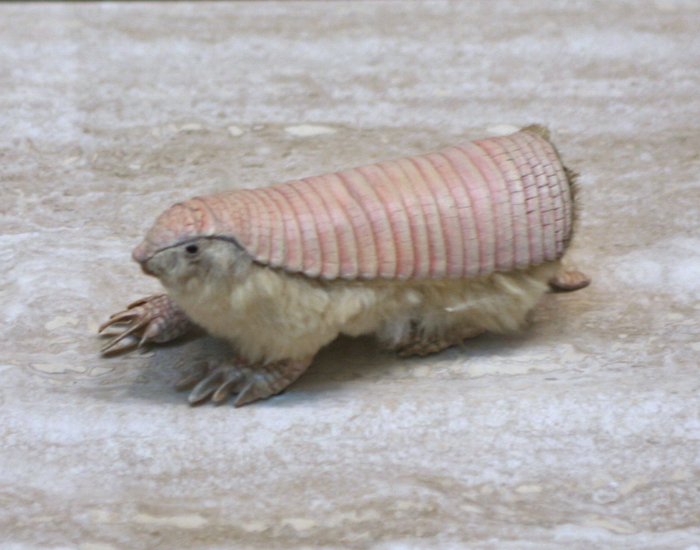
The pink fairy armadillo is the smallest member of the armadillo family and one of the most elusive mammals in South America. Its shell is a soft, pale pink, and its body is covered in fine white fur. It spends its entire life burrowing through the sandy soils of central Argentina, deep in southern South America.
I dive into the family in my guide to types of armadillos, but the pink fairy deserves its own mention. The pink coloration comes from a thin, translucent shell that also doubles as a thermoregulation organ. It’s a rare species, almost never seen even by locals.
11. Sea Anemone
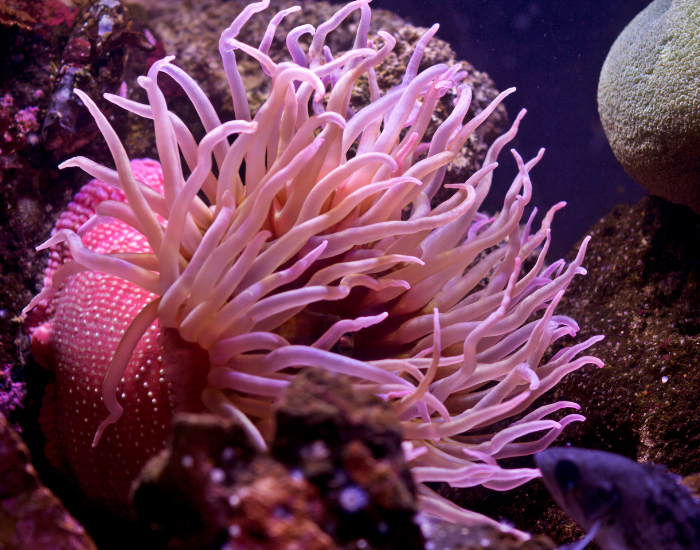
A sea anemone might not be the first creature you think of as pink, but spend a low tide on a temperate coast and you’ll see why it belongs here. Many sea anemone species sport vivid pink, reddish pink, or magenta hues in various shades. The strawberry anemone of the Pacific Northwest is a textbook example.
Their pink tones come from a mix of pigments and symbiotic algae living in their tissue, including some blue green algae relatives. They use stinging cells to catch prey drifting past. I’ve spent more time than I should admit poking at anemones in tidepools — gently — to watch them retract. Among the other invertebrates of the shore, they are pure spectacle.
12. Pink Cockatoo (Major Mitchell’s Cockatoo)
The Pink cockatoo, is a type of parrot also known as the pink cockatoo, is the most flamboyant parrot in arid Australia. Its body is washed in soft pink, and its crest opens into a fan of red, yellow, and white , old field guides called them ladies fans for a reason.
Unlike the more common galah, this pink cockatoo is rare, slow to breed, and threatened by habitat loss. I’ve only seen them a handful of times, all in remote inland scrub. Each sighting feels like an event.

13. Hopkins Rose Nudibranch
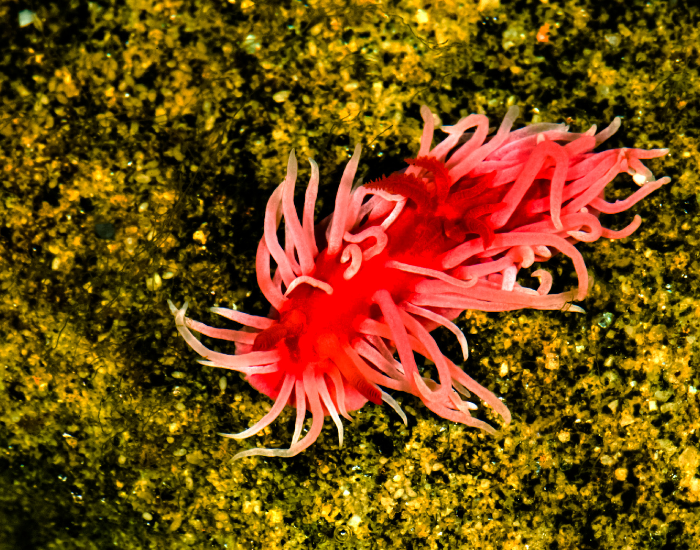
If you ever needed proof that pink creatures come in every shape and size, look no further than the Hopkins rose nudibranch. This bright pink sea slug lives in cold coastal waters along the Pacific coast of North America. Among local sea slugs, few are this saturated. It feeds on bryozoans and stores their pigments, which is how it ends up that iconic hot pink color.
The Hopkins rose nudibranch was once considered a southern rarity. With warming oceans, it has surged northward, and ecologists now use it as an indicator species. I cover more sea slugs in my piece on nudibranch molluscs. For pure pink intensity, the Hopkins rose is hard to beat.
14. Pygmy Seahorse (Bargibant’s Seahorse)
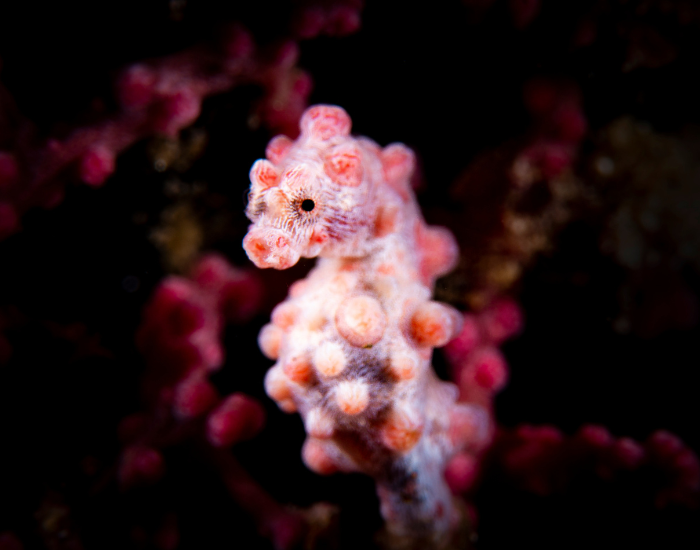
Bargibant’s seahorse is so small and so well camouflaged that divers stumbled on it by accident on a piece of fan coral. The pygmy seahorse is barely two centimeters long. Its body is studded with tubercles in pink and red that match the polyps of its host coral.
Several species of pygmy seahorse exist, but this one is the most famous and arguably the most pink. The match is so specific that individuals mirror the exact shade of the coral they were born on. I get into the wider group in my seahorses guide. It is a true marvel of animal pink camouflage.
Honourable Mentions
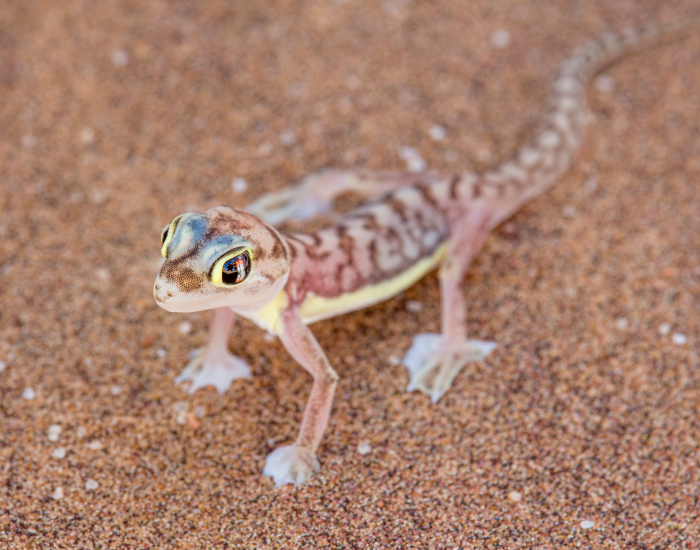
A quick nod to rosy creatures that didn’t make the main cut. The fairy crab is a small pink crustacean of southern Africa. The web footed gecko of the Namib desert has pale pink, translucent skin that reveals organs beneath. The web footed gecko hunts at night, its webbed toes built for loose sand.
Spotting a web footed gecko on a dune at midnight is genuinely magical. Domestic pigs and pink pigs in farms are pink because selective breeding favored lighter pigmentation. The scarlet ibis of northern South America leans red, but in fading light it glows a deep reddish pink.
FAQ: Pink Animals in Nature
Pink animals in nature include the roseate spoonbill, Amazon river dolphin, pink hairy squat lobster, shocking pink dragon millipede, pink katydids, pink robin, elephant hawk moth, orchid mantis, naked mole rat, pink fairy armadillo, sea anemone, Major Mitchell’s cockatoo, Hopkins rose nudibranch, pygmy seahorse, and roseate skimmer.
Some pink species are common, while others are critically endangered. The roseate spoonbill, elephant hawk moth, and Major Mitchell’s cockatoo are widespread within their ranges. Other pink species like the pink fairy armadillo and shocking pink dragon millipede are genuinely rare, especially those that depend on tropical forests. Pink wildlife in dense canopy is often harder to spot than open-habitat counterparts.
For pure intensity, the Hopkins rose nudibranch and pink dragon millipede are tough to beat — both saturated, almost neon shades. The pink hairy squat lobster and pink katydid are close behind. Among vertebrates, the adult male boto holds the title for largest species that is consistently and obviously pink.
Pink wildlife lives everywhere from the Amazon basin and tropical forests of Asia to the Namib desert and the cold coasts of North America. Some thrive in shallow water reefs, others in caves, and a few — including domestic pigs — live alongside us. Every continent except Antarctica hosts at least one charismatic pink species, and the list grows as endangered species are rediscovered.
Decoding Pink in the Animal Kingdom
The pattern across these fifteen species is the most interesting part for me. Pink in the animal kingdom is almost never just decoration. It’s diet, defense, deception, or biology showing through skin. Once you start looking for pink animals in nature, the color tells a story every time.
If you’ve seen a pink creature I missed, drop a comment below. To go deeper on any of the species above, I’ve written longer pieces on the roseate spoonbill, the Amazon river dolphin, the orchid mantis, and the galah. Better yet, go find a pink one in the wild yourself.
References:
Arbuckle, K., & Speed, M. P. (2015). Antipredator defenses predict diversification rates. Proceedings of the National Academy of Sciences, 112(44), 13597–13602. https://doi.org/10.1073/pnas.1509811112
Buffenstein, R., Amoroso, V., Andziak, B., et al. (2022). The naked truth: a comprehensive clarification and classification of current ‘myths’ in naked mole-rat biology. Biological Reviews, 97(1), 115–140. https://doi.org/10.1111/brv.12791
O’Hanlon, J. C., Holwell, G. I., & Herberstein, M. E. (2014). Pollinator deception in the orchid mantis. The American Naturalist, 183(1), 126–132. https://doi.org/10.1086/673858
Schulte-Hostedde, A. I., & Mastromonaco, G. F. (2015). Integrating evolution in the management of captive zoo populations. Evolutionary Applications, 8(5), 413–422. https://doi.org/10.1111/eva.12258
Sherratt T. N. (2002). The coevolution of warning signals. Proceedings. Biological sciences, 269(1492), 741–746. https://doi.org/10.1098/rspb.2001.1944
Mosquera-Guerra F, et al., (2022) Strategy to Identify Areas of Use of Amazon River dolphins. Front. Mar. Sci. 9:838988. https://doi.org/10.3389/fmars.2022.838988




.jpg)