It is common to find people fascinated about ocean creatures, such as whales, sharks, dolphins or even playful sea lions. But honestly, few animals on the planet are stranger, more surprising, or more misunderstood than these tiny, upright swimmers.
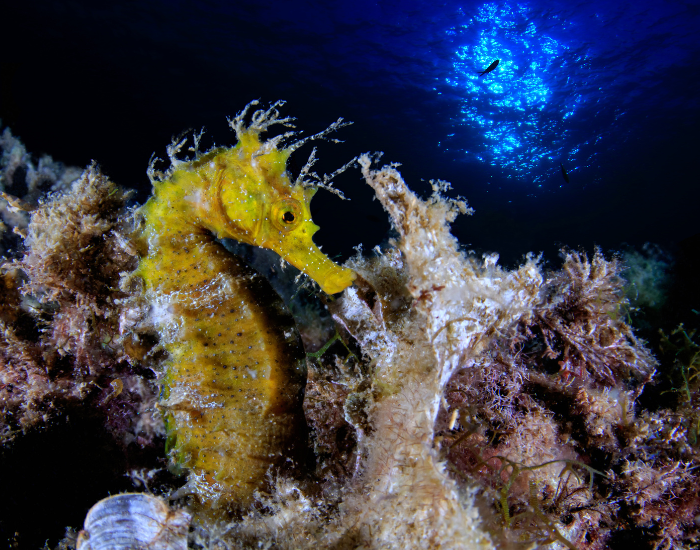
I had my first encounter with a sea horse off the coast of Koh Lipe in Thailand (One of the best reefs I have seen by the way). The current was dragging me south, and I was gripping a piece of dead coral trying to steady my camera. Then I saw it, a yellow creature no bigger than my thumb, curled around a blade of seagrass by its prehensile tail, staring at me as if I were the odd one.
That moment hooked me. If you want genuinely fascinating seahorse facts about one of the ocean’s most unusual fish, keep reading. We cover seahorse biology, their extraordinary reproductive cycle, their role in coastal waters, and why these animals are in serious trouble.
What Are Seahorses? The Biology Behind the Myth
Seahorses are bony fishes belonging to the genus Hippocampus, within the family Syngnathidae, close relatives of pipefish and sea dragons. These tiny fish are instantly recognizable by their distinctive shape, which resembles a tiny horse. The genus name comes from the Greek hippos (horse) and kampos (sea monster), which feels about right.
They inhabit shallow waters such as coastal areas, coral reefs, seagrass beds, mangroves, and estuaries across tropical and temperate regions. Seahorses are mainly found in shallow tropical and temperate salt water throughout the world, from about 45°S to 45°N. From the Pacific seahorse (Hippocampus ingens) patrolling the eastern Pacific to the Knysna seahorse (Hippocampus capensis) clinging to a single estuary in South Africa, and Hippocampus guttulatus found in European waters like the Thames Estuary, every seahorse species has carved out its own niche.
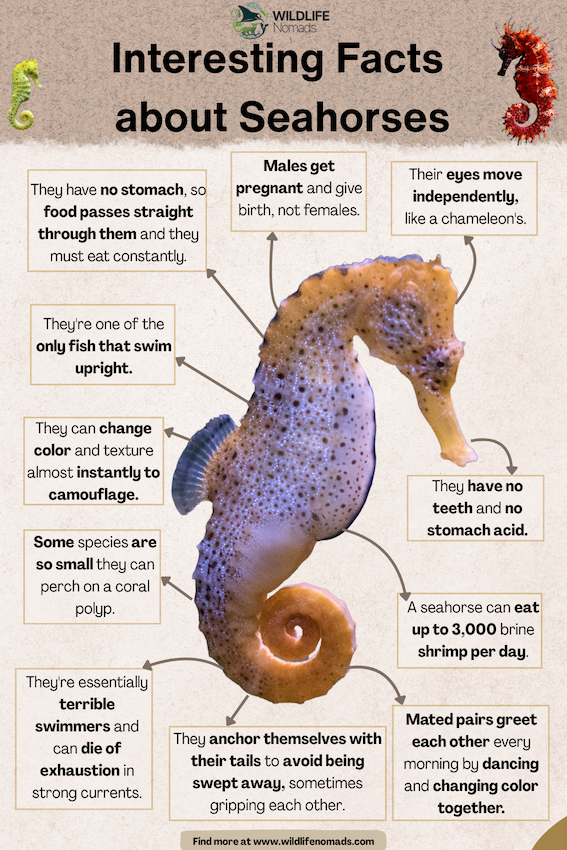
Unlike most fish, seahorses swim upright. They are also the only species of vertebrate where the male carries and delivers the young, but more on that shortly.
1. Seahorses Are Fish — Just Very Weird Ones
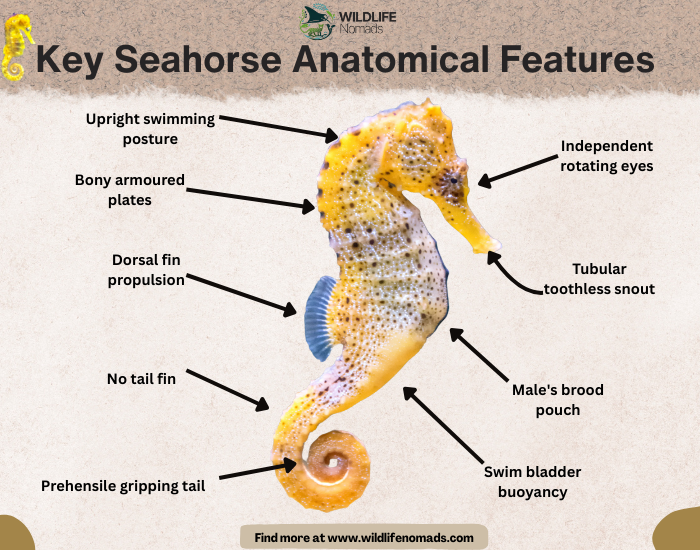
This surprises almost everyone. Seahorses are teleost bony fishes. They breathe through gills, use swim bladders for buoyancy, and have a backbone. However, they have no traditional scales. Instead, a thin layer of skin is stretched over a series of hard bony plates, giving them a rigid, armoured body.
They swim upright using a tiny dorsal fin that beats up to 35 times per second, plus small pectoral fins near their long-snouted heads for steering. They are the only fish species that swims this way, and it makes them fascinating to watch, even if it makes them spectacularly poor swimmers.
2. They Are Chimeras of the Animal Kingdom
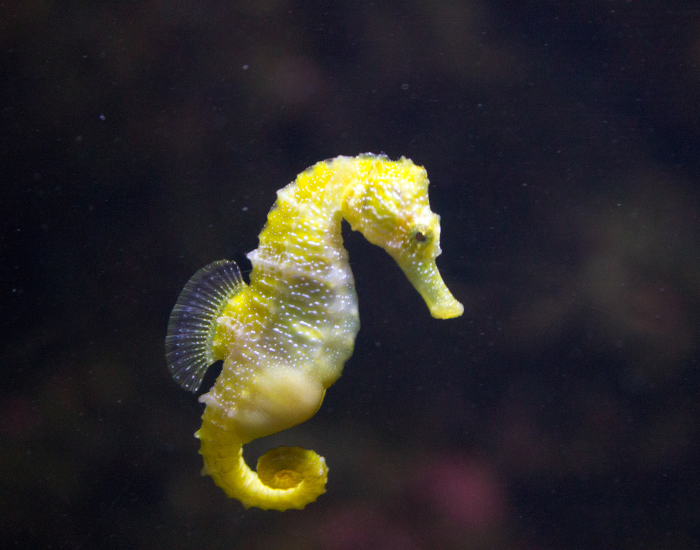
Here are some interesting facts about seahorse anatomy that always get a reaction. Seahorses have the head of a horse, the eyes of a chameleon, a prehensile tail like a monkey that can grasp objects with surprising strength, the bony plates of an armadillo, and a snout like an anteater.
Each feature exists for a reason. The prehensile tail lets seahorses anchor themselves to coral or seagrass rather than fight the current. The independent eyes give them near-360-degree vision. The long-snouted head conceals a feeding mechanism that is, frankly, terrifying at microscale.
3. Male Seahorses Carry the Young
This is the seahorse fact that makes every biology student do a double-take. In all 46 seahorse species, it is the male seahorse — not the female — who carries the eggs, nurtures the embryos, and gives birth to the young. The male seahorse is unique among fish for carrying young in a specialized pouch on its belly.
During mating season, a male and female seahorse perform an elaborate courtship dance that can last up to 8 hours and may continue over several days. They change colour, mirror each other’s movements, and entwine their tails. The male seahorse has a brood pouch on its belly where the female deposits her eggs during mating. The female seahorse uses a tube called an ovipositor to transfer her eggs into the male’s brood pouch, sometimes dozens to hundreds, depending on the species.
The male’s brood pouch is more than a pocket. It provides the embryos with oxygen, regulates salinity, and delivers nutrients and immune support throughout the 2–4 week gestation period. This makes the male seahorse’s abdomen a genuinely complex reproductive organ. Research shows that genes involved in placenta-like nutrient transfer are active in the male’s pouch — a parallel evolution to mammalian pregnancy found in no other vertebrate group.
When birth arrives, the male undergoes muscular contractions to expel the newborn seahorses into the water. The number of young released by the male can range from 100 to 2,500, depending on the species. These newborn seahorses, called fry, are immediately independent and receive no further parental care.
4. Seahorses Are Faster Than They Look — at Killing
Seahorses are widely known as poor swimmers. The dwarf seahorse (Hippocampus zosterae) is officially the world’s slowest fish, reaching just 1.5 metres per hour. However, do not mistake slow movement for slow reflexes.
Seahorses are ambush predators that find food by waiting for small crustaceans to drift within range. They have no teeth and no real stomach. Therefore, they must stay alive by eating almost constantly, consuming up to 3,000 small crustaceans, copepods, or brine shrimp per day.
When prey gets close enough, the seahorse snaps. It rapidly expands its long snout to create a sudden pressure vacuum, sucking in the small crustaceans before the prey can react. This strike is one of the fastest feeding events recorded in any vertebrate, completed in under a millisecond.
5. Their Eyes Work Completely Independently
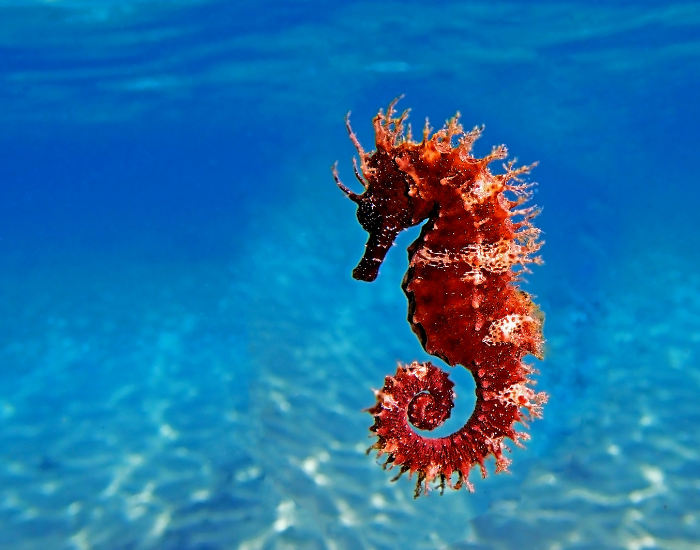
Like chameleons, seahorses can move each eye in a different direction simultaneously. One eye scans ahead to find food while the other monitors threats from behind. This gives seahorses an extraordinarily wide field of view, essential for an animal whose escape strategy is ‘stay very still and hope nobody notices.’
National Geographic has featured the seahorse’s vision as one of the more remarkable adaptations in the fish world, noting that this chameleon-like ability is unique among bony fishes.
6. The Prehensile Tail Is Their Secret Weapon
Unlike other fish, seahorses have no tail fin. Instead, they have a long, flexible, prehensile tail built from interlocking bony plates arranged in a square cross-section — a structure engineers have studied for its ability to absorb and distribute impact. Seahorses use this tail to grasp objects: coral branches, seagrass blades, mangrove roots, other plants, or even the tails of their mates.
This anchoring ability is critical. Because seahorses are such poor swimmers, strong currents can be fatal. By hitching to seagrass beds or coral reefs and remaining still, they conserve energy and position themselves perfectly for ambush feeding.
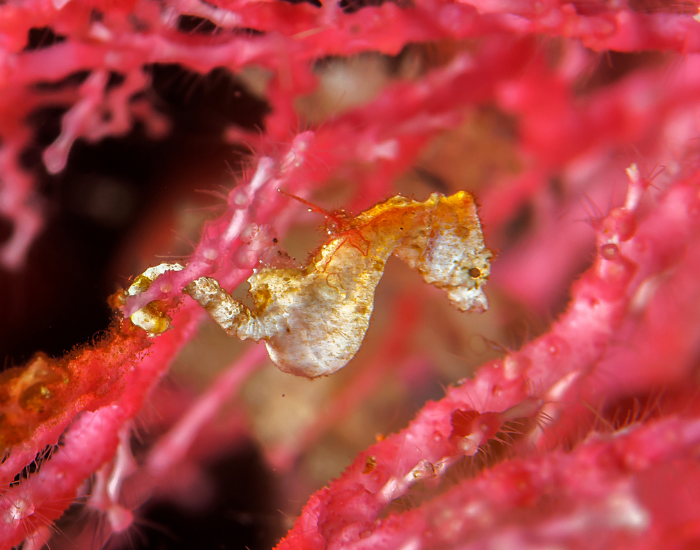
7. Many Seahorses Are Monogamous
Several seahorse species are famously monogamous, bonding with a single mate for an entire mating season or longer. Pairs reinforce their bond each morning with a greeting ritual, changing colour, swimming side by side, and entwining their tails.
However, recent research has shown this picture is more nuanced than the popular narrative suggests. The strength of monogamy varies significantly between species and populations. Some species, such as Hippocampus erectus, show strong pair fidelity; others are more opportunistic, particularly when population density is low.
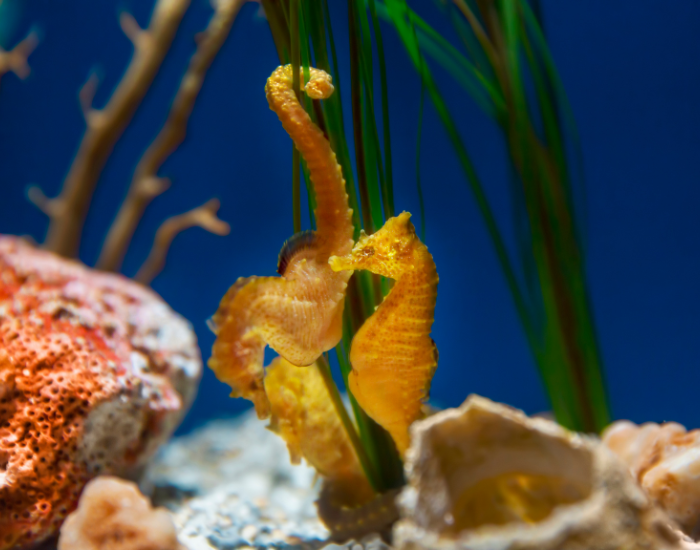
8. Seahorses Are Masters of Camouflage
Seahorses can alter their skin cells to change colour rapidly, matching their surroundings to avoid predators. Some species grow filaments of skin tissue that mimic algae fronds or coral polyps. The result is near-perfect camouflage.
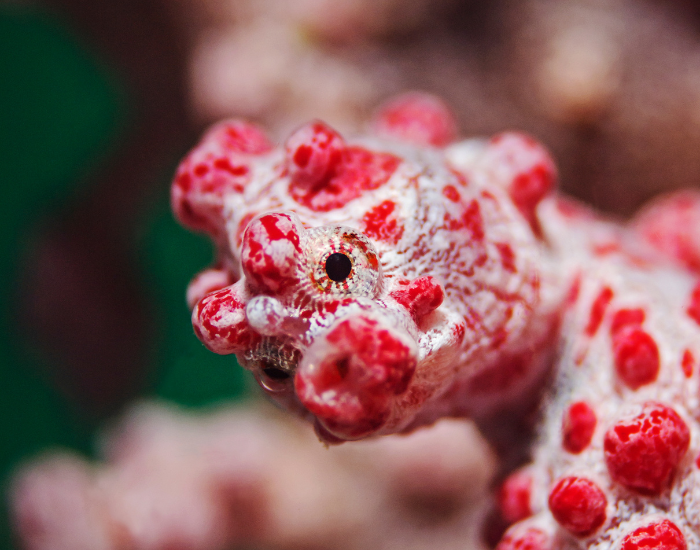
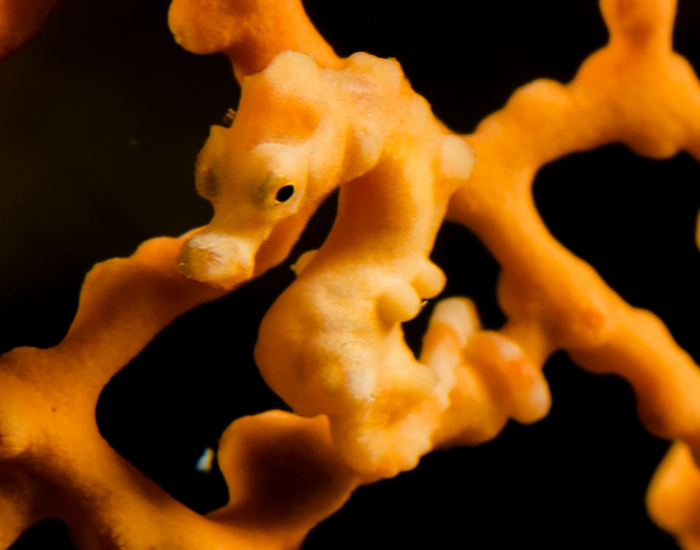
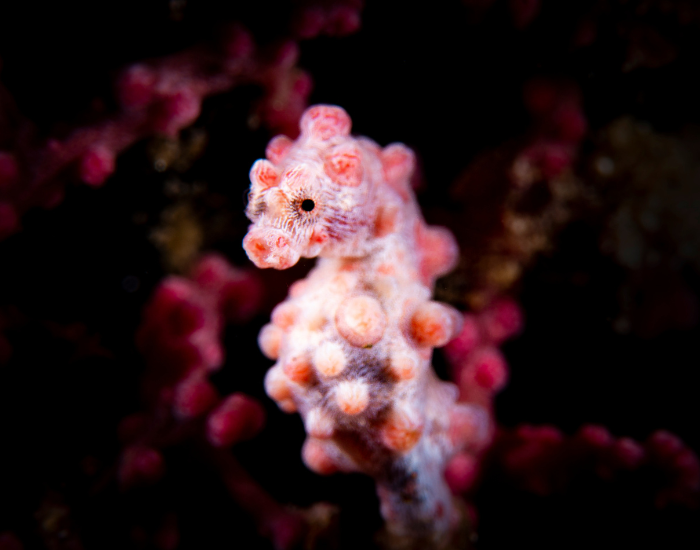
The most extreme example is the Pygmy seahorse. Several pygmy species, including Hippocampus bargibanti, live exclusively on specific gorgonian fan corals and match them so precisely, in both colour and texture, that they were only discovered when a scientist brought a coral specimen back to the lab and noticed the seahorses on it. Other pygmy species live on seagrass and algae, their skin cells producing colours and textures that make them effectively invisible.
9. Your Brain Contains a Seahorse-Shaped Structure
The region of the human brain responsible for memory formation and spatial navigation is called the hippocampus because its shape resembles a seahorse. The anatomist Giulio Cesare Aranzi made this observation in the 16th century, using the genus Hippocampus as inspiration.
Therefore, every time you remember where you parked the car, you can thank your inner seahorse.
10. There Are 46 (or 48) Seahorse Species — Each Radically Different
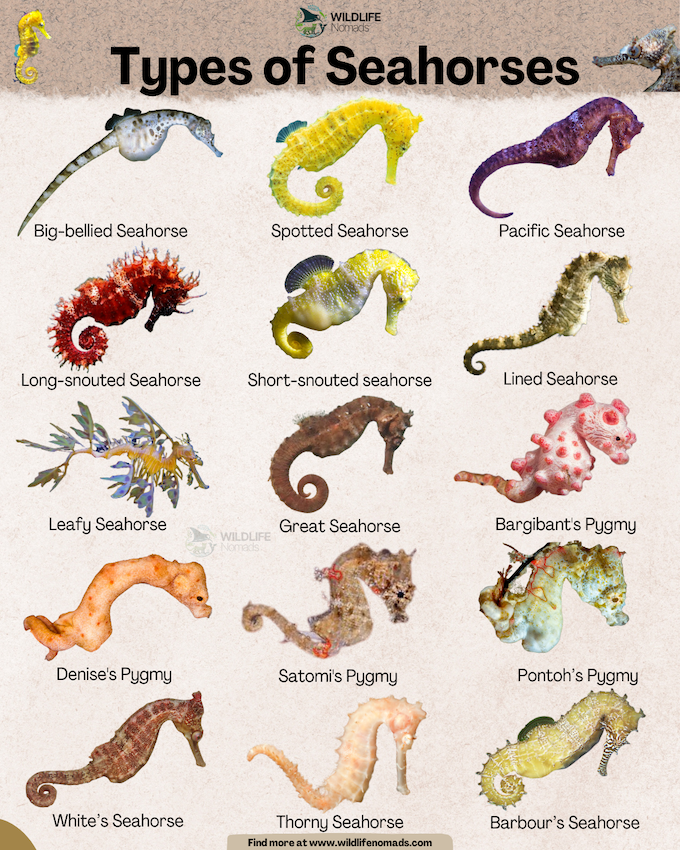
Most people picture a single generic seahorse. In reality, there are 46 recognised seahorse species spanning an enormous range of sizes, shapes, and habitats. Here are some of the most fascinating:
- Pygmy seahorses (e.g., Hippocampus bargibanti, H. denise): Found in the Coral Triangle, they rarely exceed 2 cm and live their entire lives on a single coral fan, alongside many coral fish.
- Dwarf seahorse (Hippocampus zosterae): The world’s slowest fish. Found in seagrass beds of the Gulf of Mexico and Caribbean.
- Pacific seahorse (Hippocampus ingens): One of the largest species, found along the Pacific coast of the Americas from California to Peru.
- Knysna seahorse (Hippocampus capensis): A critically endangered species found only in three estuaries in South Africa, one of the rarest seahorse species on Earth.
- Hippocampus erectus (lined seahorse): Common along the Atlantic coast of the Americas, from Nova Scotia to Venezuela.
- Hippocampus kuda (common seahorse): Widespread across the Indo-Pacific, from India to Japan and Australia.
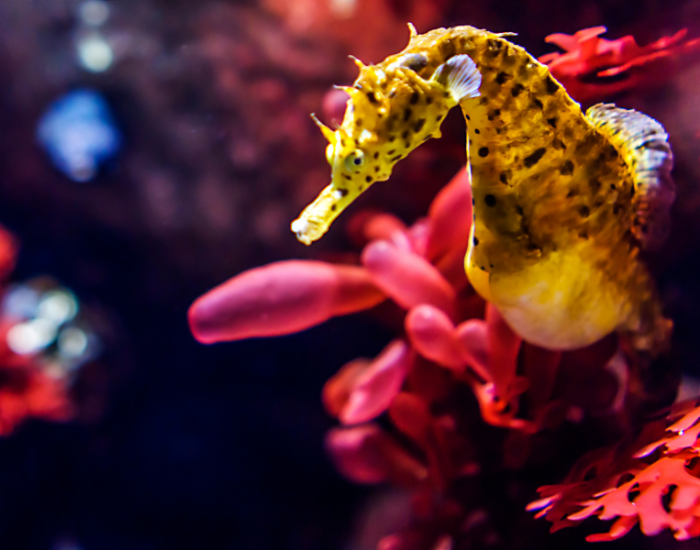
- Big-belly seahorse (Hippocampus abdominalis): One of the largest seahorse species, reaching over 35 cm, native to southern Australian and New Zealand coastal waters.
11. No Teeth, No Stomach, No Problem
Seahorses have no teeth. Their long snout is a fused tube, and they have no conventional jaw. They also lack a true stomach — food passes directly from the mouth into the intestine. This means the seahorse life cycle requires constant eating just to stay alive, since almost no nutrition is stored.
In captivity, this makes seahorses notoriously difficult to keep. They are captive bred seahorses that perform better in aquarium settings than wild-caught individuals — but even captive bred seahorses require live or frozen food multiple times daily to thrive.
12. Seahorses Are in Serious Trouble
Here is the seahorse fact that matters most. These animals are under threat from multiple directions. Coral reef degradation, seagrass bed destruction, and pollution are shrinking the shallow coastal waters and seagrass beds where seahorses live.
Overharvesting is equally severe. The IUCN estimates that over 37 million seahorses are removed from the wild annually, primarily for use in traditional medicine across Asia and for the global aquarium trade. The short-snouted seahorse, the spiny seahorse, and the Knysna seahorse are among the most vulnerable.
Most seahorse species are now listed as Vulnerable or Data Deficient on the IUCN Red List. Project Seahorse, a research and conservation organisation based at the University of British Columbia, has pioneered the use of marine protected areas to support population recovery, particularly in the Philippines and other parts of the Coral Triangle. Their work with local fishing communities has produced measurable improvements in seahorse populations in protected zones.
Frequently Asked Questions About Seahorses
No. All seahorse species require saltwater or brackish water. They are entirely marine animals. They are most commonly found in seagrass beds, coral reefs, mangroves, and estuaries.
Many seahorse species are threatened. The IUCN Red List classifies multiple species as Vulnerable or Endangered, with the Knysna seahorse listed as Endangered. Overfishing, habitat loss, and bycatch are the primary threats.
Seahorses live in shallow coastal waters in temperate and tropical regions across the globe. They prefer seagrass beds, coral reefs, mangroves, and sheltered estuaries. The Pacific seahorse ranges from California down to Peru along the eastern Pacific, while species like Hippocampus kuda are found throughout the Indo-Pacific.
Male seahorses experience muscular contractions similar to labour. They pump and convulse to expel newborn seahorses — called fry — out through an opening in the brood pouch. A single birth event can produce dozens to over one thousand baby seahorses, depending on the species.
The seahorse life cycle begins when eggs are transferred from the female to the male’s brood pouch. The male carries the eggs for 2–4 weeks during gestation. Newborn seahorses are fully formed miniature adults. They mature sexually within months, with the reproductive cycle then repeating. Most wild seahorses have relatively short lifespans of 1–5 years.
Deserve Our Attention
The interesting facts about seahorses keep stacking up the more closely you look. They are bony fishes that swim upright, fathers that give birth through a specialised brood pouch, and hunters with a strike faster than the human eye can follow. They live in the shallowest, most accessible coastal waters on Earth — and yet most people have never seen one in the wild.
Protecting seahorses means protecting the coral reefs, seagrass beds, and coastal waters that countless other marine species depend on. The next time you are near the sea, look carefully at the seagrass. You might be staring at a seahorse and not even know it.
References:
Kloc M. (2023). Seahorse Male Pregnancy as a Model System to Study Pregnancy, Immune Adaptations, and Environmental Effects. International journal of molecular sciences, 24(11), 9712. https://doi.org/10.3390/ijms24119712
Lin, Q., Zhu, L., Zhong, J., et al. (2016). The seahorse genome and the evolution of its specialized morphology. Nature, 540, 395–399. https://doi.org/10.1038/nature20595
Stölting, K. N., & Wilson, A. B. (2007). Male pregnancy in seahorses and pipefish: Beyond the mammalian model. BioEssays, 29(9), 884–896. https://doi.org/10.1002/bies.20626
Foster, S. J., & Vincent, A. C. J. (2004). Life history and ecology of seahorses: Implications for conservation and management. Journal of Fish Biology, 65(1), 1–61. https://doi.org/10.1111/j.0022-1112.2004.00429.x
Vincent, A. C., Foster, S. J., & Koldewey, H. J. (2011). Conservation and management of seahorses and other Syngnathidae. Journal of fish biology, 78(6), 1681–1724. https://doi.org/10.1111/j.1095-8649.2011.03003.x
Harasti D, Brennan M and Booth DJ (2022) Assessing the Effectiveness of Conservation Stocking for the Endangered White’s Seahorse Hippocampus whitei. Front. Mar. Sci. 9:867352. https://doi: 10.3389/fmars.2022.867352
Masonjones, H. D., & Rose, E. (2019). When more is not merrier: Using wild population dynamics to understand the effect of density on ex situ seahorse mating behaviors. PloS one, 14(7), e0218069. https://doi.org/10.1371/journal.pone.0218069