

Scientists usually find new species with nets, cameras or a lucky dive. However, this new fish species turned up inside another fish’s stomach. Then it waited in a museum jar for 42 years.
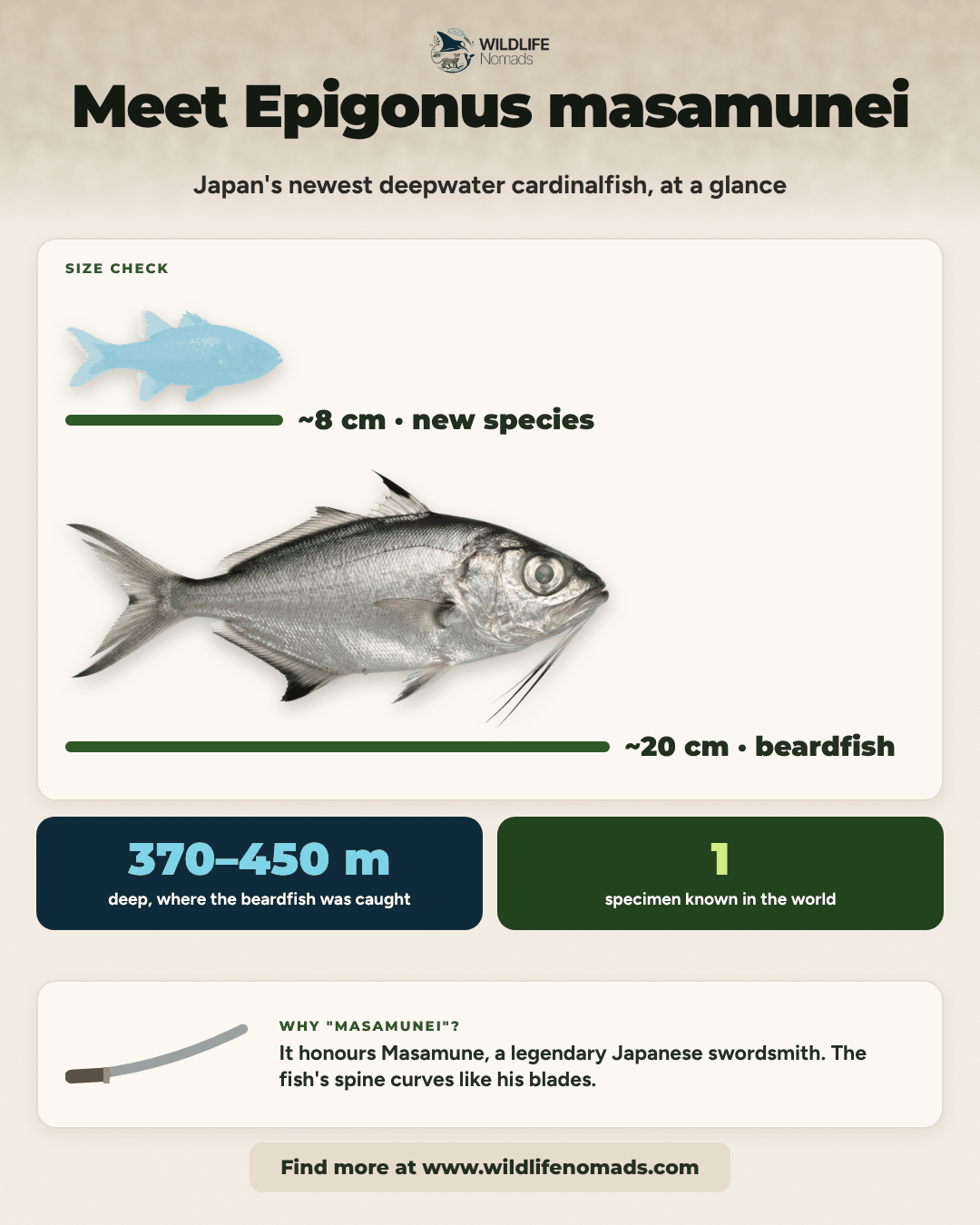
Meet Epigonus masamunei, a tiny deepwater cardinalfish from Japan. So far, nobody has ever seen it alive. We don’t even know its colour. Yet it’s now officially a new species.
A Fish Inside a Fish
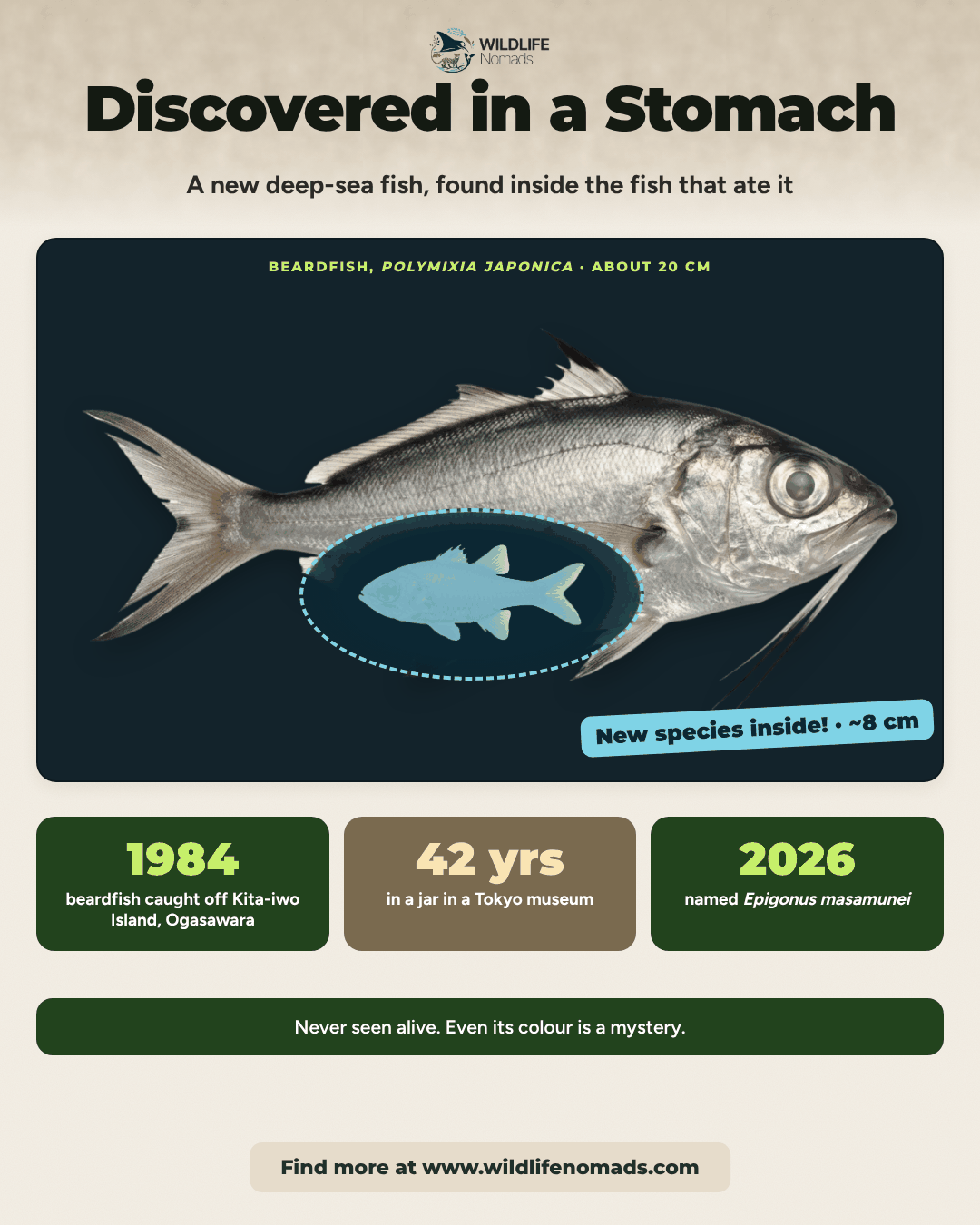
Rewind to July 1984. A research vessel was fishing off Kita-iwo Island, in Japan’s remote Ogasawara Islands. The net came up from roughly 370 to 450 metres deep.
The Ogasawara Islands sit about 1,000 km south of Tokyo. They never connected to a continent, so many of their species live nowhere else. UNESCO listed them as a World Heritage Site in 2011.
Among the catch was a beardfish (Polymixia japonica). Beardfish are deep-sea fish with two whisker-like barbels under the chin. This one grows to about 20 cm.
Inside its stomach, however, was a smaller fish. Someone preserved it and filed it in a museum collection in Tokyo. After that, it sat there for 42 years.
Sadly, the specimen wasn’t pretty. In fact, its belly, skin and some fin-spine tips showed damage. Perhaps the beardfish spat it back up as the crew hauled it to the surface.
42 Years on a Shelf
Of course, museum collections are full of surprises like this. For example, most specimens never go on display. Instead, they sit in jars in back rooms, waiting for an expert to take a closer look.
That expert was Makoto Okamoto, a fish taxonomist at the Japan Fisheries Research and Education Agency. Meanwhile, museum staff and volunteers had been working through the old material. When Okamoto examined the little fish, he realised it didn’t match any known species.
In his words, the moment of finding a new species is always fresh and thrilling. Just imagine opening a 1984 jar and finding something nobody has named.
A New Fish Species Named After a Swordsmith
Here’s my favourite detail. Specifically, the name masamunei honours Masamune, a famous medieval Japanese swordsmith.
Why a swordsmith? It’s because a spine on this fish curves gently, like one of Masamune’s blades. It’s a lovely nod to Japanese history, hidden in a deep-sea fish.
Also, the fish has the huge eyes typical of deep-sea animals. After all, big eyes help catch the faint light that reaches those depths. Some deep-sea animals also make their own light, as you’ll see in our guide to animals in the deep sea.
Where Does This New Fish Species Fit?
Deepwater cardinalfishes belong to the genus Epigonus, in their own family, Epigonidae. They are not the colourful cardinalfish you see on coral reefs.
Today, the genus has 45 known species. Of those, eight live in Japanese waters. Before this study, nobody had recorded an Epigonus fish around the Ogasawara Islands at all.
These fish live in the twilight zone and below, where sunlight fades to nothing. As a result, they are hard to study. Usually, researchers only meet them as dead specimens in nets.
Or, in this case, inside a predator. Indeed, scientists study stomach contents to learn what predators eat. Every so often, that diet list includes something brand new.
Can One Damaged Fish Be a New Fish Species?
Can you really describe a species from one battered specimen? Yes, if the key features are clear.
First, taxonomists compare counts and shapes, such as fin spines, scales and bone structure. Then, if the combination matches no known species, the fish gets a new name. Finally, the single specimen becomes the holotype, the official reference for the species forever.
However, many questions remain. What colour is it? How does it live? Is it rare, or just rarely caught? So somebody will need to find a living one to answer those.
My Take: Treasure in Old Jars
I’ve visited natural history museums in Sydney, Melbourne and London. The displays are amazing, but they’re only a fraction of what these places hold.
This story shows why those hidden collections matter. A fish that a beardfish swallowed before I was born just became a new species. You can explore more recent finds in our list of newly discovered species, including the walking shark that scientists described this year.
And if you love strange ocean creatures, the weirdest fish in the world is a fun next stop.
FAQs About Epigonus masamunei
It is a newly described deepwater cardinalfish from Japan’s Ogasawara Islands. It is about 8 cm long and known from a single specimen.
It was found in the stomach of a beardfish caught in July 1984. The catch came from roughly 370 to 450 metres deep off Kita-iwo Island.
The name honours Masamune, a famous medieval Japanese swordsmith. A curved spine on the fish resembles one of his swords.
No. It is known only from one preserved specimen, so its colour and behaviour are still unknown.
The genus now has 45 known species, and eight of them live in Japanese waters.
Look Inside the Jar
New species don’t always come from expeditions. Sometimes they hide on a shelf, inside a fish, for four decades. Dive deeper with our food web explorer and see who eats whom in the ocean.
References:
Okamoto, M. (2026). A new species of deepwater cardinalfish, Epigonus masamunei, from the Ogasawara Islands, Japan. Ichthyological Research. https://doi.org/10.1007/s10228-026-01088-5
Hanbury, S. (2026, November). A tiny deep-sea fish eaten 42 years ago has now been named a new species. Mongabay. news.mongabay.com