Wildlife Nomads



Some Shark Bay dolphins live past 50. A new study suggests dolphin friendships may be part of the secret. Dolphins with steady, predictable social lives tended to live longer.
I find this one moving. On our Australia lap, I watched seven or eight dolphins from the shore at Evans Head. They moved together like a crew that knew each other well. It turns out that sense of crew may matter a lot.
40 Years of Dolphin Friendships
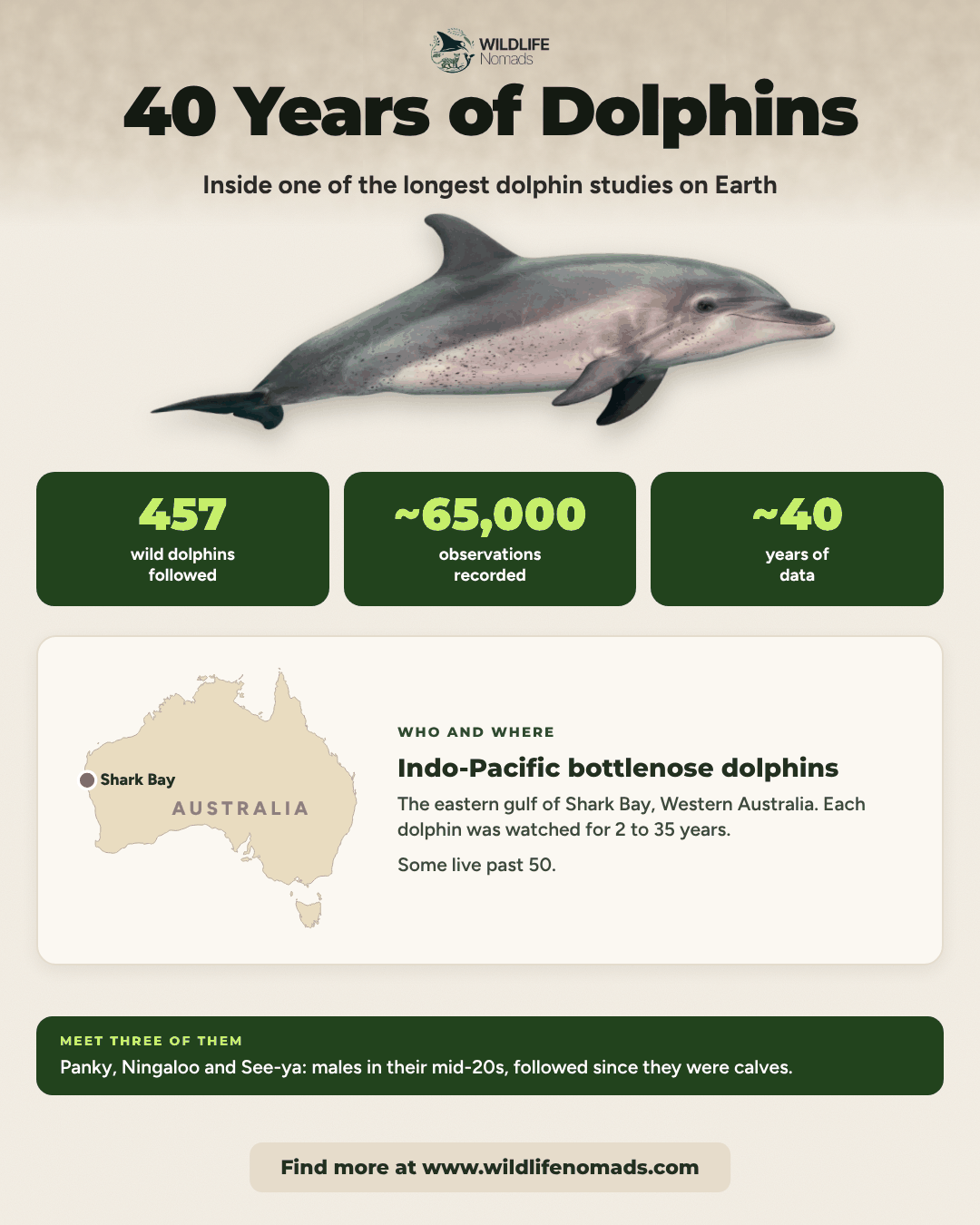
Researchers at the University of Queensland led the work. They used nearly 40 years of records from the Shark Bay Dolphin Research Project in Western Australia. The paper came out in PLOS Biology on 24 November 2026.
The team followed 457 wild Indo-Pacific bottlenose dolphins (Tursiops aduncus). Each dolphin was watched for between 2 and 35 years. Altogether, the dataset holds close to 65,000 observations.
Some of these dolphins are local celebrities. Panky, Ningaloo and See-ya are three males in their mid-twenties. Researchers have followed them since they were calves in the early 2000s.
What the Study Found
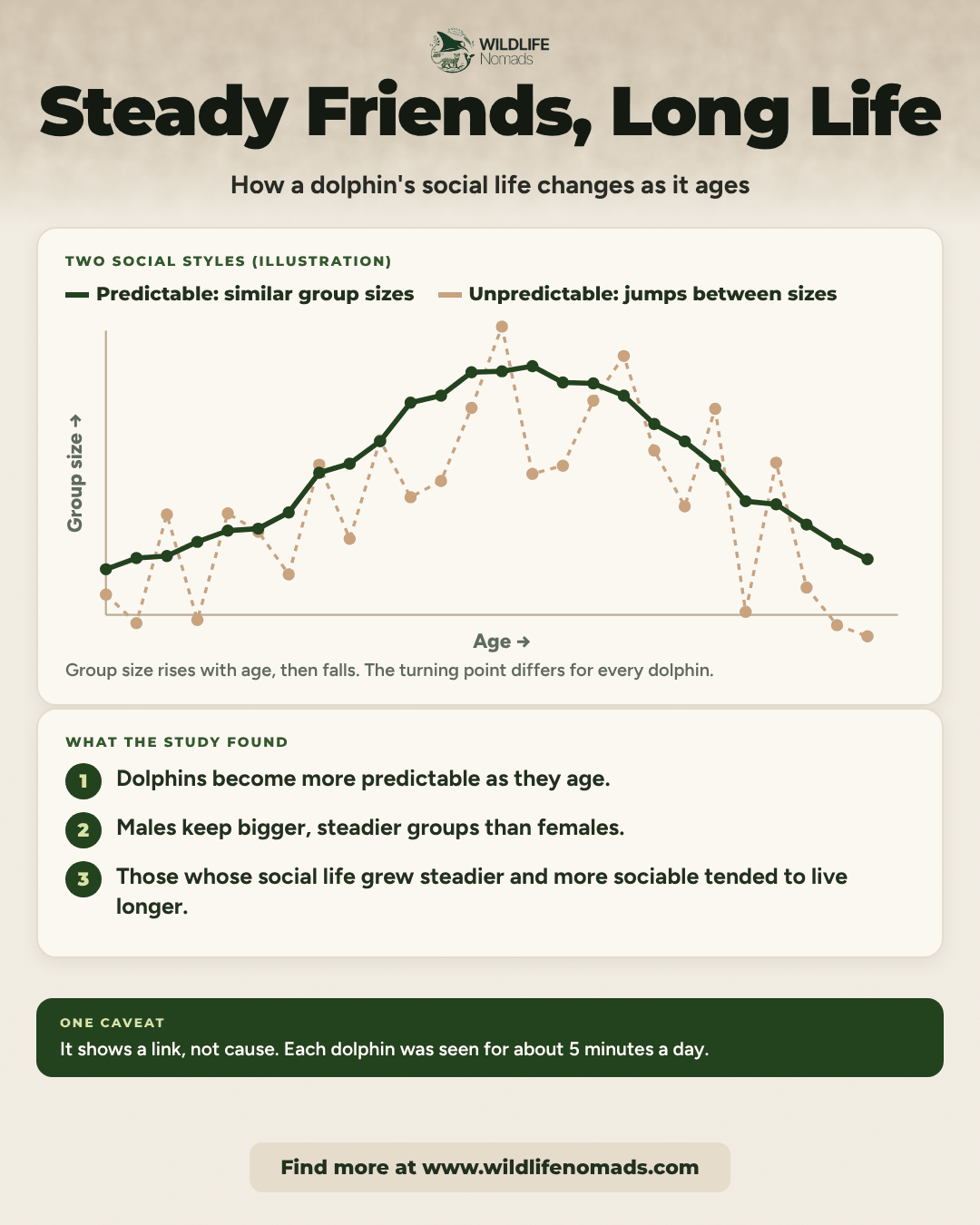
First, a dolphin’s average group size rises as it gets older, then falls again. The turning point is different for every individual.
Second, dolphins become more predictable with age. Predictable here means they keep spending time in groups of a similar size. A less predictable dolphin hops between big and small groups.
Third, males had larger average groups than females. They were also more predictable. Their group sizes also dropped more sharply in old age.
Finally, the key result. Dolphins whose group size and predictability rose most with age tended to live longer. Consistency mattered more than any single ideal group size.
Why Would Steady Friends Help?
Groups bring clear benefits. Dolphins find friends, share information and meet mates in groups. A crowd also helps against predators. As lead author Kelley Meehan puts it, ten dolphins facing one predator have far better odds.
However, groups that are too big carry costs. Disease spreads more easily, and competition for food and mates rises. So each dolphin seems to settle on a size that works for it.
Males and females also live different social lives. Females can find food without other females, so their bonds are less essential. Males, by contrast, must team up to guard females, which only breed every three to four years.
The authors see a parallel with us. Older people often keep fewer, closer friends. A stable social world may buffer some effects of ageing, in dolphins and maybe in people.

What the Study Can’t Tell Us Yet
This is an observational study, so it shows a link, not proof of cause. Healthier dolphins may simply find it easier to keep a steady social life.
Observation time is also limited. Researchers saw each dolphin for about five minutes a day on average. Yet dolphin groups can change several times an hour.
Finally, it covers one population in one bay. The authors say more work is needed to find what links ageing and social life.
A Near Threatened Species
The IUCN lists the Indo-Pacific bottlenose dolphin as Near Threatened. It lives in shallow coastal waters, where fishing nets and habitat damage take a toll. It is smaller than the common bottlenose dolphin, with a longer beak and spots on its belly.
Long-term projects like Shark Bay’s are rare. They take decades of patient boat days. Yet only that kind of patience can reveal how a dolphin’s whole life unfolds.
FAQs About Dolphin Friendships
Yes. Indo-Pacific bottlenose dolphins in Shark Bay form lasting social bonds. Males in particular build alliances that can last for years. The new study shows each dolphin also develops its own social style.
Not exactly. The study found that consistency mattered more than group size. Dolphins whose social habits became more stable and sociable with age tended to live longer.
In Shark Bay, the oldest known dolphins are in their fifties. Many dolphins in the long-term study have been followed from birth for decades.
Friends for the Long Haul
Forty years of patient boat work found something simple. A steady social life may help a dolphin grow old. Compare dolphin ages with other animals in our animal lifespan tool, or meet more of them in types of dolphins.
References:
Meehan, K. C., Class, B., Nakagawa, S., et al. (2026). Distinct trajectories and predictability of individual grouping patterns in dolphins link social ageing to longevity. PLOS Biology, 24(11), e3004022. https://doi.org/10.1371/journal.pbio.3004022
The University of Queensland. (2026, November 25). Making and keeping friends could help dolphins live longer. news.uq.edu.au
PLOS. (2026, November 24). Highly sociable Indo-Pacific bottlenosed dolphins with stable social groups may live longer. EurekAlert! eurekalert.org
Meehan, K., Frere, C., & Mann, J. (2026, November 26). 40 years of data on one dolphin community teaches new lessons about social circles in old age. The Conversation, via Yahoo News Australia. au.news.yahoo.com
Braulik, G., Natoli, A., Kiszka, J., Parra, G., Plön, S., & Smith, B. D. (2019). Tursiops aduncus. The IUCN Red List of Threatened Species 2019. https://dx.doi.org/10.2305/IUCN.UK.2019-3.RLTS.T41714A50381127.en