Wildlife Nomads

Nearly every beach on this part of the NSW coast has a shark sign like the one we found at Illaroo. We are now at Pebbly Beach, the sixth stop on our lap around Australia. The signs have become part of the scenery. So has the quiet decision to skip a swim on some days. Lately, the animal behind many of those warnings has been on my mind: tiger sharks.
A few days ago at Illaroo, I snorkelled over a wobbegong lying just below us. It was so well camouflaged that I nearly missed it. I told that story in my Illaroo campground post. The moment captured something true about these waters. Sharks share them with us every day, mostly unseen and mostly uninterested in us.
That is the balance I want here: know the risk, but don’t demonise the animal. After writing about great white sharks and wobbegongs, tiger sharks felt like the natural next chapter. These 12 things cover how they look, what they eat, how they breed and travel, and how they cope with us.
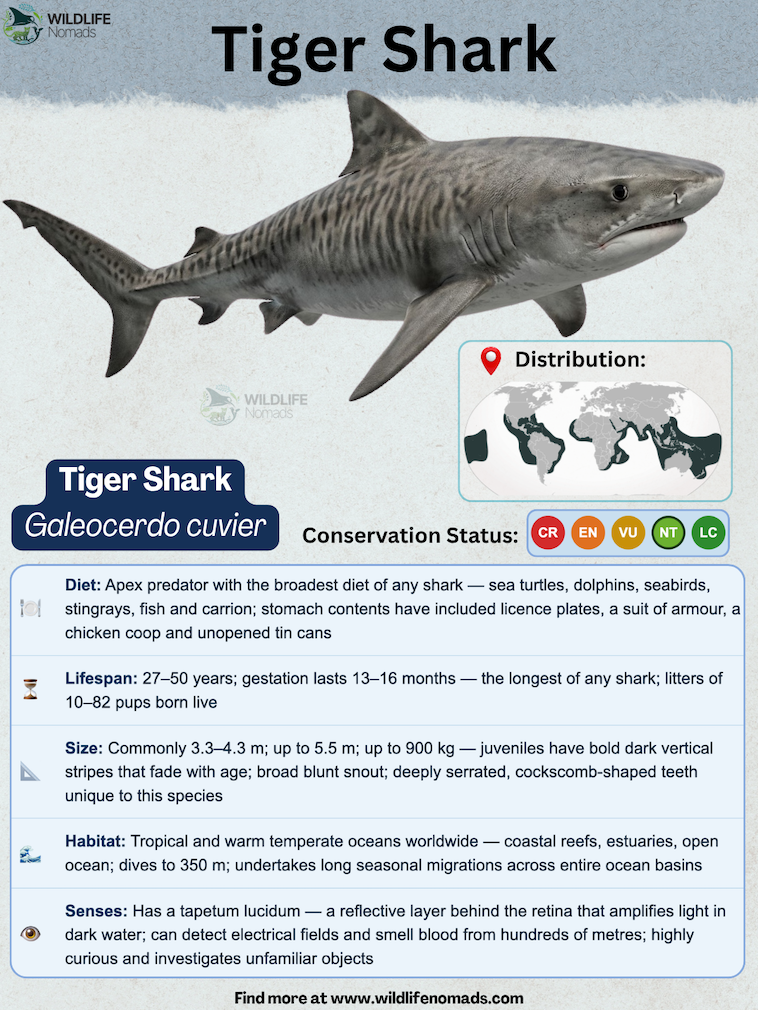
1. Tiger Sharks Are Named for Stripes That Fade
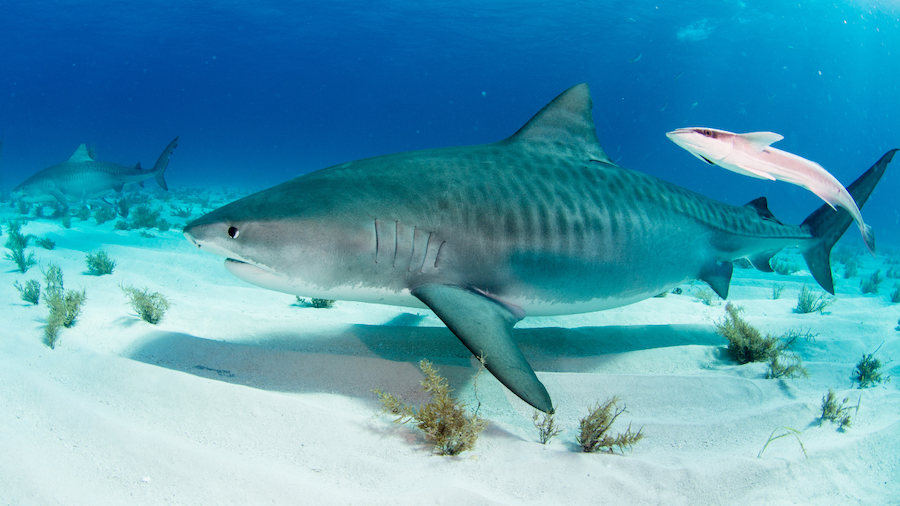
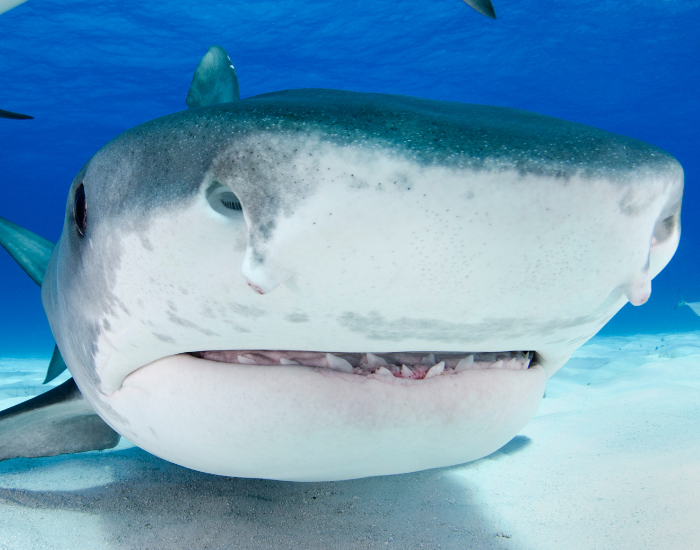
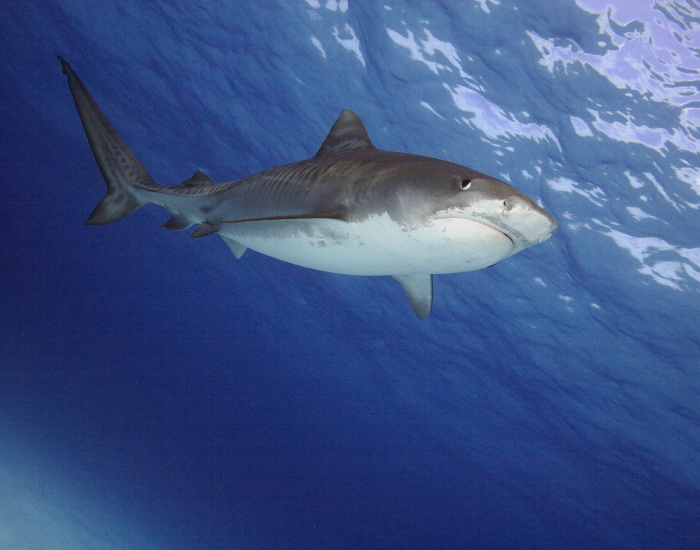
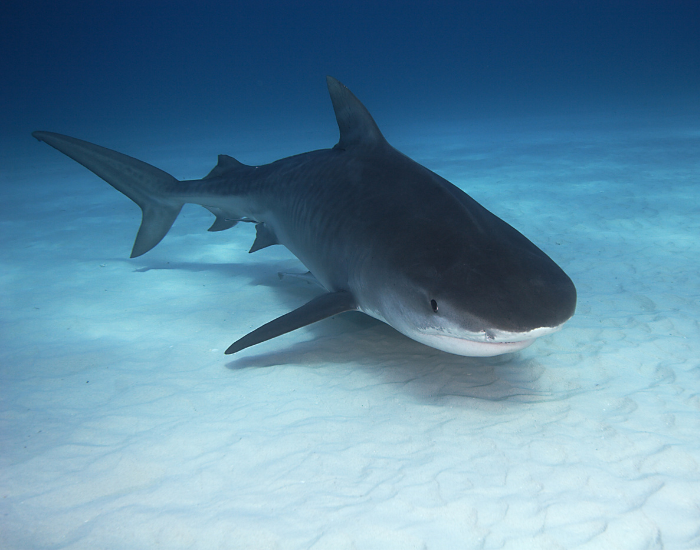
The tiger shark, Galeocerdo cuvier, gets its common name from the tiger-like stripes on its back. A juvenile tiger shark has bold vertical bars and dark spots over a grey-brown body. As the shark matures, those lines begin to fade. Large adults often look almost plain grey above, with a clean white underside.
The species was first described in 1822 as Squalus cuvier, in honour of the French anatomist Georges Cuvier. Today it is the only living member of its genus. It belongs to the ground shark order, Carcharhiniformes, alongside bull sharks and lemon sharks, but they are also placed in its own family, Galeocerdonidae. To recognise one, look for a blunt, almost square snout, two dorsal fins and a long upper tail lobe.
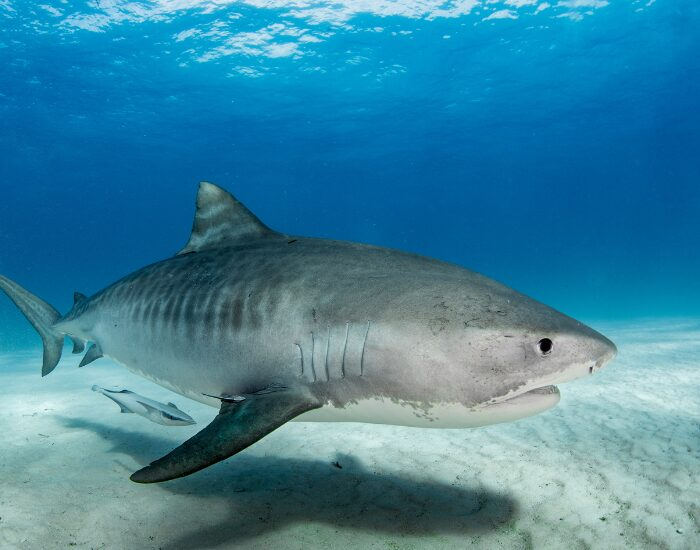
2. Adult Tiger Sharks Rank Among the Largest Sharks
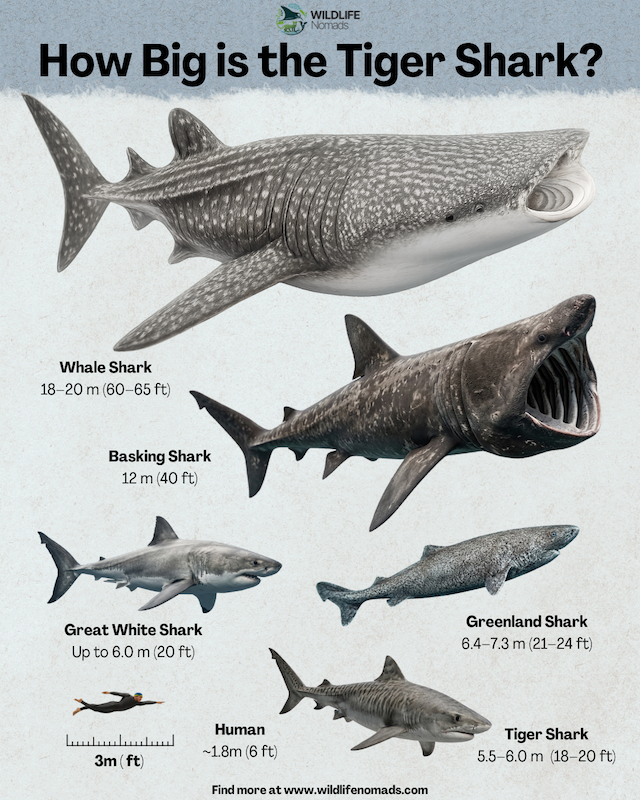
Adult tiger sharks typically reach 3.25 to 4.25 m and weigh between 385 and 635 kg. That makes them some of the largest predatory sharks alive, alongside the white shark, Carcharodon carcharias, and just below the not predatory whale shark and Greenland shark as seen in the infographic below. Females are the larger sex, and the heaviest individuals are usually pregnant females.
The maximum length can exceed 18 feet, or about 5.5 m. The biggest claims come from older fishery records, including a large female caught decades ago, and they are hard to verify. Nothing alive today comes close to the extinct megalodon. Still, a four-metre tiger shark is a thick, powerful animal.
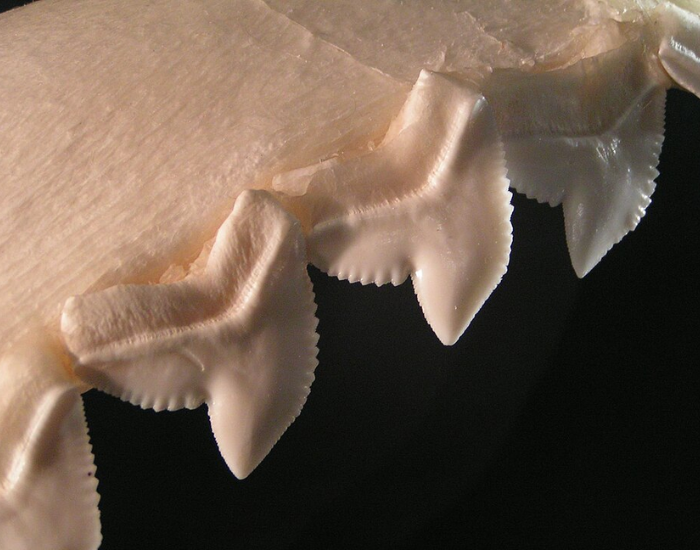
3. Their Highly Serrated Teeth Work Like Can Openers
Tiger shark teeth look unlike those of most sharks. Each tooth has a curved, cockscomb shape, a deep notch and serrated edges. Combined with powerful jaws, these teeth cut through bone, cartilage and even turtle shell.
The design tells you a lot about the species. A mako’s slender teeth are built to grip slippery fish, while tiger shark teeth slice through armoured prey. Feeding crocodiles whole chickens at the zoo where I worked showed me how much a jaw reveals about diet. The tiger shark takes that principle to an extreme.
4. Tiger Sharks Have the Widest Food Spectrum of Any Shark
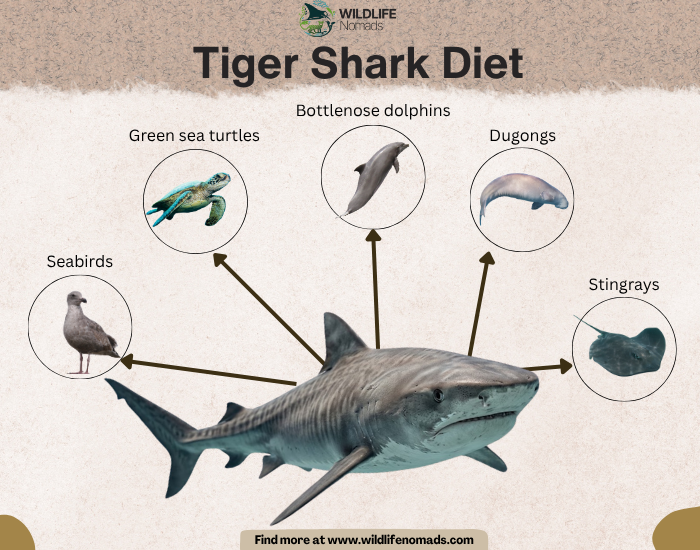
Tiger sharks will eat almost anything. Their diet includes bony fishes, rays, squid, crustaceans, sea snakes, sea birds and other sharks. They also take marine mammals such as seals and bottlenose dolphins. Many researchers describe their diet as the widest food spectrum of any shark.
Sea turtles are a key part of that menu. One Hawaiian study found adult sea turtles in 20.8% of the tiger shark stomachs it examined. I have watched sea turtles from Southeast Asia to the Red Sea and Mexico. At Puerto Escondido, I helped release olive ridley hatchlings (Lepidochelys olivacea). Knowing that tiger sharks eat some of those turtles feels bittersweet, but it is part of how a healthy ocean works.
In Hawaii, tiger sharks show up at the northwestern atolls when albatross chicks leave the nest. Young birds that land on the water become easy targets. That kind of seasonal timing shows real flexibility, not mindless hunger.
5. Why Tiger Sharks Are Called the Ocean’s Garbage Eaters
Tiger sharks are commonly called “garbage eaters,” and they earned the name. Fishers and scientists have found license plates, tin cans, tyres and plastic bags inside them. These man-made objects probably reflect a habit of investigating things by biting them.
For a scavenger, that habit makes sense. A tiger shark can’t know whether something floating is food until it tries it. Most of the time the gamble pays off with a whale carcass or a sick turtle. Sometimes it ends with plastic.
6. They Hunt Mostly at Night
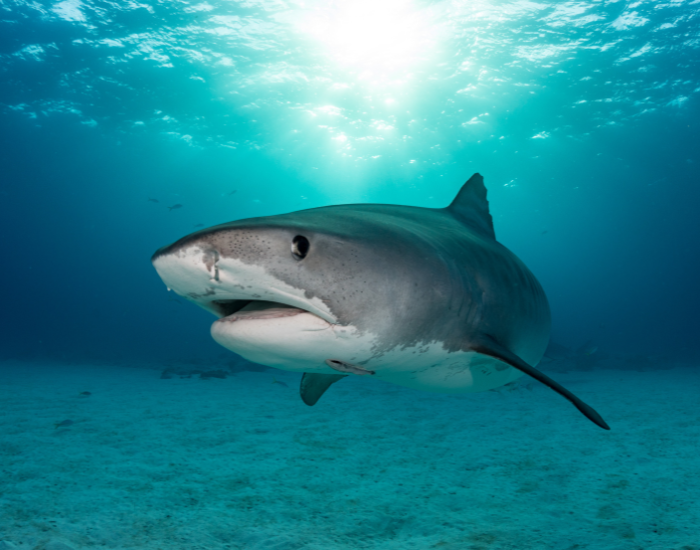
Tiger sharks do most of their feeding at night. After dark, many move inshore from deeper waters onto shallow reefs, into lagoons and toward river mouths. Tagging studies around Hawaii show individuals moving regularly between shallow reef slopes and deeper offshore waters.
Their eyes help with night hunting. Like many sharks, tiger sharks have a reflective layer called the tapetum lucidum behind the retina. It makes their eyes more sensitive in dim light, much like a cat’s eyes shining in headlights. For swimmers, that means dawn, dusk and night are the higher-risk times.
7. Where Tiger Sharks Live
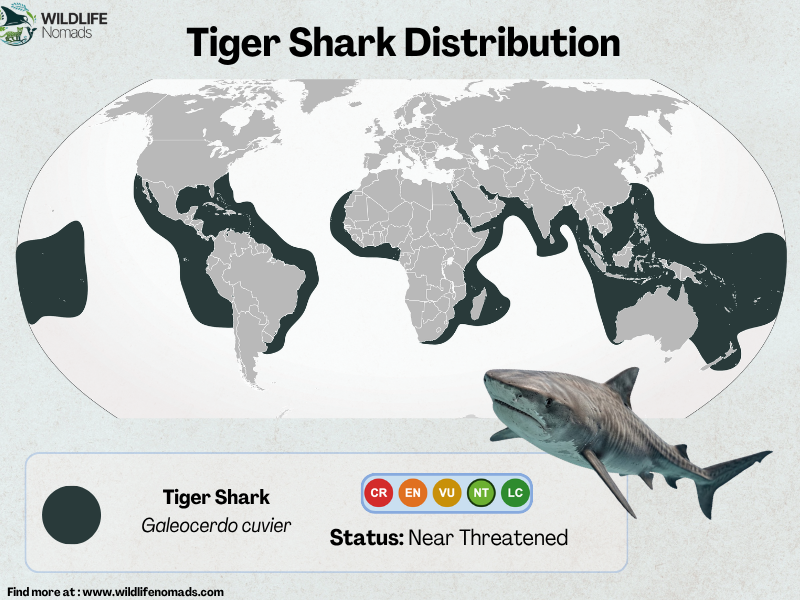
Tiger sharks live in tropical and subtropical waters worldwide. They use many marine habitats, including coastal bays, river estuaries, seagrass beds, coral atolls and the waters around oceanic islands. They also dive to depths of up to 900 m.
In summer, many travel toward the edges of the world’s temperate waters, then retreat as the water cools. Water temperature and food availability drive most of these movements. Off eastern Australia, satellite tags have followed tiger sharks along the coast and far offshore, which explains the shark signs along our route. Interestingly, tiger sharks are generally absent from the Mediterranean Sea, despite its warm summers.
8. Some Tiger Sharks Cross Entire Ocean Basins
Tiger sharks can migrate thousands of miles across ocean basins. In the western Atlantic, tagged sharks made the same long seasonal journeys year after year, between coastal winter grounds and the open ocean. Off Western Australia, other individuals travelled across many degrees of latitude.
Tiger sharks also come back to favourite places. Tiger Beach in the Bahamas hosts a gathering made up mostly of large females, many of them pregnant. Fuvahmulah in the Maldives is widely described as home to the largest tiger shark aggregation. Divers from around the world travel to both sites, which gives the sharks real economic value alive.
9. Tiger Shark Embryos Develop Inside Their Mother
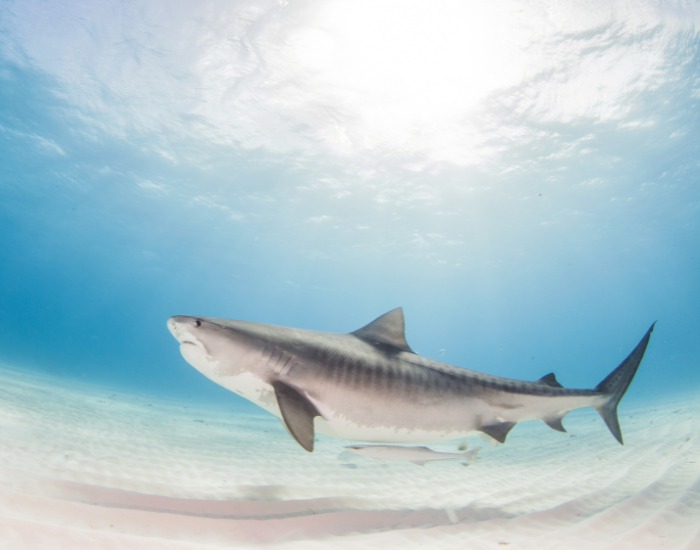
Tiger sharks are ovoviviparous, meaning they give birth to live young. Their requiem shark relatives, such as bull sharks, nourish embryos through a placenta, but tiger sharks don’t. Instead, tiger shark embryos develop inside relatively large eggs kept within the uterus, and they feed mainly on the yolk.
The gestation period lasts 13 to 16 months, among the longest of any shark. A female can give birth to 10 to 82 pups. The pups are born alive at 51 to 76 cm long and are independent from birth. In the northern hemisphere, mating happens between March and May. In the southern hemisphere, the timing shifts to roughly the opposite months.
10. Young Sharks Face a Tough Start
Pups get no care from their parents. Young sharks shelter in shallow nursery areas, but larger sharks, including adult tiger sharks, readily eat them. A striped juvenile tiger shark depends on camouflage and caution until it outgrows most threats.
Growing up takes years. Males reach sexual maturity at roughly 2.3 to 2.9 m, while females mature at larger sizes, often around 3 m or more. Scientists estimate a shark’s age by counting growth bands in its vertebrae, much like tree rings. These studies suggest tiger sharks live at least 20 to 30 years.
11. Tiger Sharks and Humans: Understanding the Real Risk
This is where honesty matters. Tiger sharks rank second in recorded bites on humans, behind the white shark. They also account for many recorded fatal attacks, partly because their size and serrated teeth cause serious wounds. On June 8, 2023, a tiger shark killed a 23-year-old man off Hurghada, Egypt, in the Red Sea.
Context changes the picture, though. Hawaii records about three to four shark bites each year, most blamed on tiger sharks, against millions of ocean visits. Research there found that islands with broad shelf habitat, such as Maui, attract more tiger sharks and see more bites. Scientists consider tiger sharks dangerous mainly because they scavenge and test objects by biting, not because they target people.
I spent several years of my childhood in Villahermosa, Tabasco, living beside a river full of crocodiles. We didn’t hate them. We learned when and where to stay out of the water. I treat tiger sharks the same way: I avoid murky river mouths, dusk swims and spots where people clean fish. Outside those high-risk situations, a bite is exceedingly rare.
12. The Conservation Status of Tiger Sharks Is Near Threatened
The IUCN lists tiger sharks as Near Threatened. Fishing pressure has caused declines since the mid-1980s. Fisheries target them for their fins, flesh and liver oil, and many more die as bycatch. Global demand for shark fins keeps that pressure high.
Large litters don’t fully protect them. Females probably breed only every three years, and sharks in general recover from losses far more slowly than bony fishes. Off Queensland, decades of shark control program records show steep drops in the number of tiger sharks caught. Greenpeace added the species to its seafood red list in 2010. New Zealand, by contrast, classified tiger sharks as “Migrant” and “Secure Overseas” in June 2018.
Protection is growing slowly. US national marine sanctuaries in Hawaii and the Florida Keys shelter tiger sharks and their prey. In Shark Bay, marine biology research shows that tiger sharks keep turtles and dugongs from overgrazing seagrass. Losing tiger sharks would affect entire ecosystems.
Frequently Asked Questions About Tiger Sharks
Tiger sharks are not aggressive toward humans in the way movies suggest. They are curious scavengers that investigate unfamiliar objects, sometimes by biting them. Most encounters pass without incident, and shark attacks remain rare. Still, their size and serrated teeth make any bite serious
Neither species hunts humans. The white shark leads global records for unprovoked bites, with tiger sharks second. Tiger sharks, however, live in warm tropical waters where more people swim. Both pose a real but small danger to humans.
Adult tiger sharks have few natural predators. Orcas have killed large sharks elsewhere, and larger tiger sharks eat smaller ones. Juveniles are also eaten by other large shark species. Today, fishing by humans is the biggest threat.
Yes. Tiger sharks regularly enter water only a few metres deep, especially at night. They hunt over reef flats, seagrass beds, lagoons and river mouths. That is why swimming near estuaries at dusk carries more risk.
Seeing Tiger Sharks for What They Are
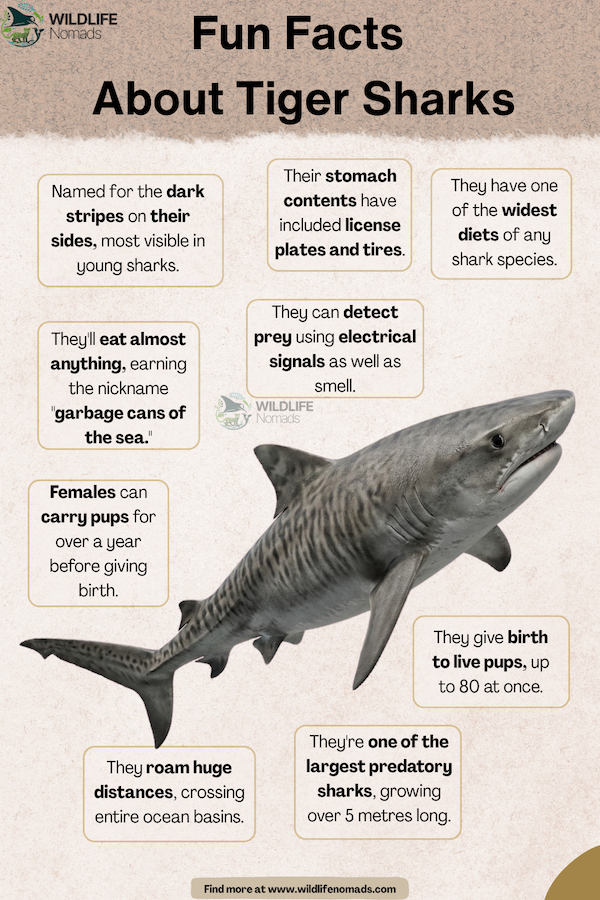
Tiger sharks are neither villains nor harmless. They are flexible, long-lived generalists that help keep turtle, seagrass and reef systems in balance. They deserve our caution and our protection at the same time.
Every time I pass another shark sign on this lap, I’ll read it, respect it, and look for a calm corner to snorkel. If you want to keep exploring, compare tiger sharks with hammerhead sharks, blacktip and whitetip reef sharks, or the wider sharks of Australia and sharks of Hawaii. Have you ever seen a tiger shark, or chosen to stay out of the water because of a shark sign? Tell me in the comments.
Tiger Shark Science & Myth-Busting Quiz
Ten fun True/False and Multiple Choice questions testing your knowledge of Tiger Shark adaptations, teeth mechanics, night senses, reproduction, and real-world conservation risks!
Multiple Choice
References
Ferreira, L. C., Thums, M., Meeuwig, J. J., Vianna, G. M. S., Stevens, J., McAuley, R., & Meekan, M. G. (2015). Crossing latitudes—Long-distance tracking of an apex predator. PLOS ONE, 10(2), e0116916. https://doi.org/10.1371/journal.pone.0116916
Holmes, B. J., Pepperell, J. G., Griffiths, S. P., Jaine, F. R. A., Tibbetts, I. R., & Bennett, M. B. (2014). Tiger shark (Galeocerdo cuvier) movement patterns and habitat use determined by satellite tagging in eastern Australian waters. Marine Biology, 161(11), 2645–2658. https://doi.org/10.1007/s00227-014-2536-1
Lea, J. S. E., Wetherbee, B. M., Queiroz, N., Burnie, N., Aming, C., Sousa, L. L., Mucientes, G. R., Humphries, N. E., Harvey, G. M., Sims, D. W., & Shivji, M. S. (2015). Repeated, long-distance migrations by a philopatric predator targeting highly contrasting ecosystems. Scientific Reports, 5, 11202. https://doi.org/10.1038/srep11202
Meyer, C. G., Anderson, J. M., Coffey, D. M., Hutchinson, M. R., Royer, M. A., & Holland, K. N. (2018). Habitat geography around Hawaii’s oceanic islands influences tiger shark (Galeocerdo cuvier) spatial behaviour and shark bite risk at ocean recreation sites. Scientific Reports, 8, 4945. https://doi.org/10.1038/s41598-018-23006-0
Roff, G., Brown, C. J., Priest, M. A., & Mumby, P. J. (2018). Decline of coastal apex shark populations over the past half century. Communications Biology, 1, 223. https://doi.org/10.1038/s42003-018-0233-1
Sulikowski, J. A., Wheeler, C. R., Gallagher, A. J., Prohaska, B. K., Langan, J. A., & Hammerschlag, N. (2016). Seasonal and life-stage variation in the reproductive ecology of a marine apex predator, the tiger shark Galeocerdo cuvier, at a protected female-dominated site. Aquatic Biology, 24(3), 175–184. https://doi.org/10.3354/ab00648
Whitney, N. M., & Crow, G. L. (2007). Reproductive biology of the tiger shark (Galeocerdo cuvier) in Hawaii. Marine Biology, 151(1), 63–70. https://doi.org/10.1007/s00227-006-0476-0