
Almost everyone my age remembers their first time watching Jaws. I remember the music more than the shark. For years, that film shaped how I pictured great white sharks: primitive killing machines lurking under every swimmer.
Then I became a biologist and got in the water. I have dived with lemon sharks, wobbegongs, whitetip reef sharks and hammerheads. Never a great white, and honestly, I’m happy to keep it that way. Still, every one of those dives taught me the same thing. Sharks are misunderstood, clever in their own way, and mostly very chill.
That lesson came back this month. Partway through our lap around Australia, a sign at Red Cliff in Yuraygir National Park advised against swimming because of white sharks. We stayed out of the surf. However, I kept wondering why a warning sign gets more attention than the animal behind it.
These 12 great white shark facts are my answer. Expect real biology, a few myths corrected, and hopefully a little less fear.
1. A White Pointer by Any Other Name
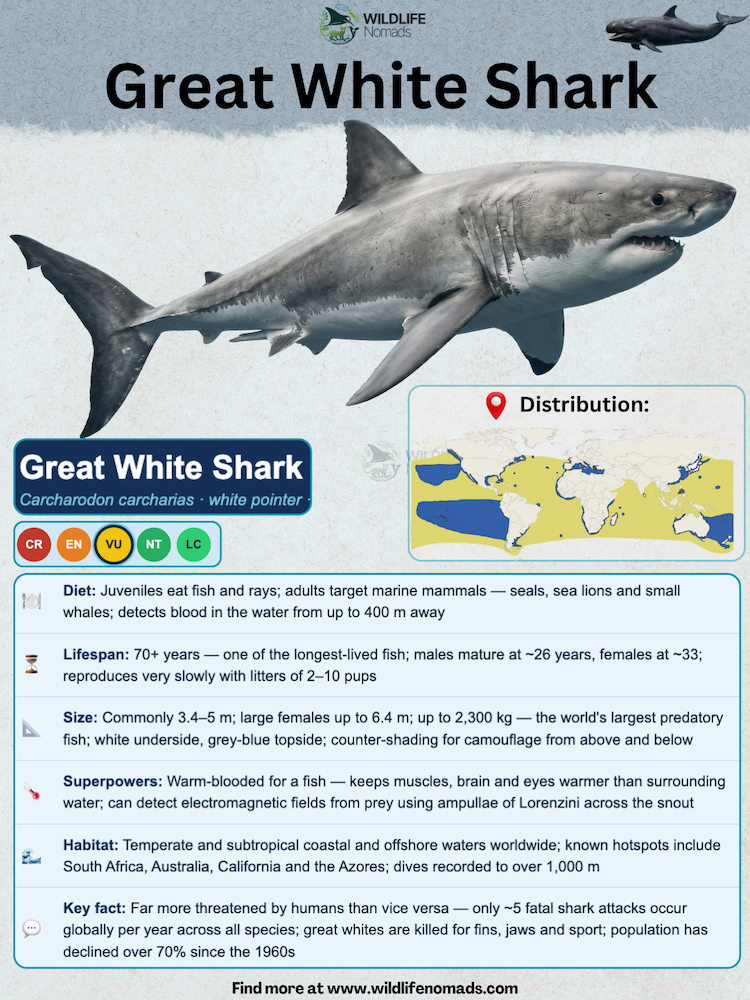
Scientists call it Carcharodon carcharias. Researchers often shorten the name to white shark, and Australians grew up calling it the white pointer. Same animal, one of more than 500 shark species alive today.
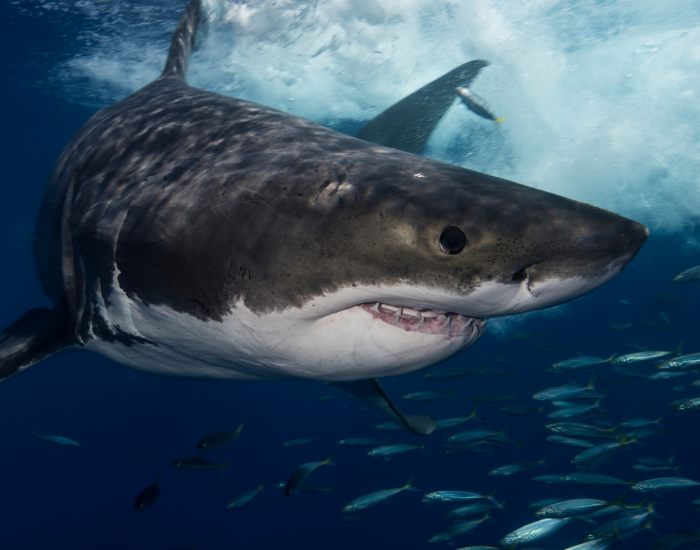
The colour pattern explains the name. The upper half of the body is slate grey, while the underside is bright white. This countershading hides the shark from prey looking down into dark water or up towards a bright surface. Add a torpedo shaped body and a crescent tail, and you get an animal built to close distance fast.
That design places great whites among the ocean’s apex predators. They sit near the top of the food chain and play an important role keeping seal and fish populations healthy and wary. Remove them, and the effects ripple down through the whole system.
2. Females Grow Bigger Than Males
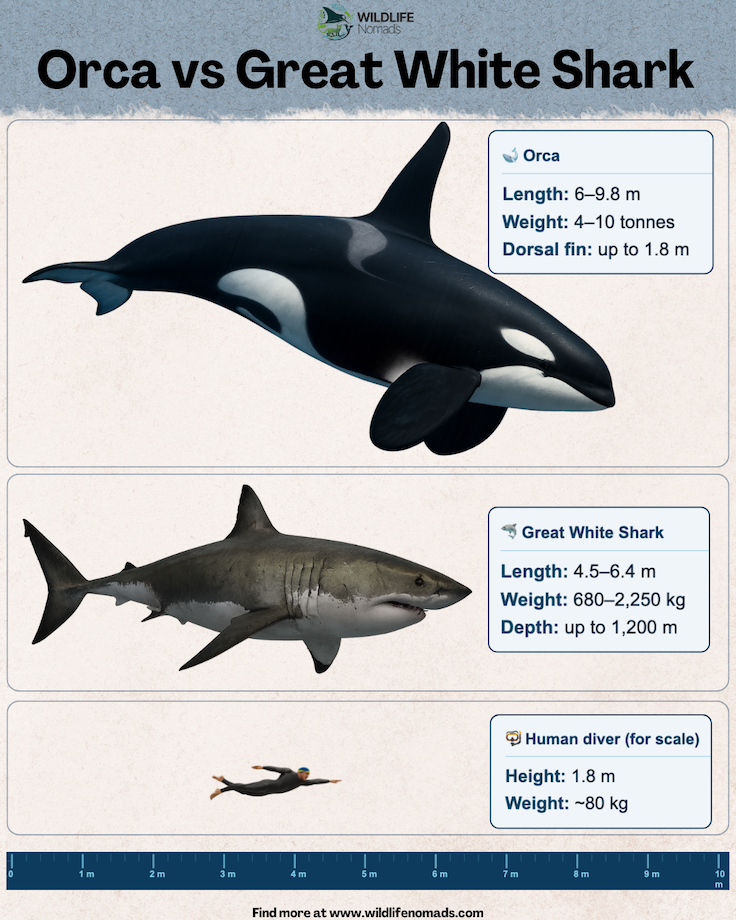
Great white sharks rank among the largest predatory sharks in the world. On average, adults measure four to five metres in length. Large females can reach 6 metres and weigh around two tonnes.
Females clearly win the size contest, while males usually stay under about four metres. Bigger mothers can carry bigger, better-developed pups. To picture that scale, drop a great white next to a human or a whale shark in our animal size comparison tool. The whale shark wins on length, yet it filters plankton through a very different mouth.
3. Around 300 Teeth, and None of Them Chew
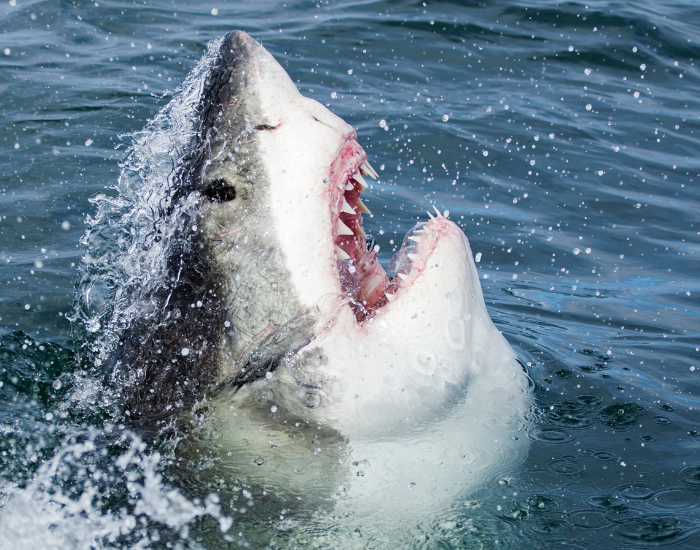
A white shark carries roughly 300 teeth arranged in up to seven rows. Only the front rows do the work. When one breaks or falls out, a replacement rotates forward like a conveyor belt.
The upper teeth are broad, triangular and serrated, perfect for slicing. By contrast, the lower teeth are narrower and pointed, built to grip struggling prey. Great whites don’t chew at all. Instead, they bite, shake their head and rip off mouth-sized pieces.
That bite carries serious force. Wroe and colleagues modelled the jaws of a very large white shark and estimated close to 18,000 newtons. Power like that lets a single shark take on seals, sea lions and other large marine animals.
4. A Nose That Reads the Water
You have probably heard that a great white can smell one drop of blood in 100 litres of water. Some sources go further and claim it can detect blood from two miles away. These facts about great white senses get repeated everywhere, so let me add some nuance.
The smell part is real. Their olfactory bulbs are enormous, and they pick up some compounds at astonishingly low concentrations. That said, distance depends on currents carrying the scent. In still water, odour barely travels, so the two-mile figure collapses.
In a steady current, though, a shark can follow a scent trail a very long way. As a field biologist, I find that version more impressive. A white shark doesn’t just smell blood; it reads a chemical map of the sea.
5. They Sense Electricity
Look closely at the snout and you’ll see dark pores dotting the skin. Each one leads to a jelly-filled canal called an ampulla of Lorenzini. Together, these ampullae of Lorenzini let great whites detect the weak electrical fields every living animal produces.
That sense matters most in the final metre of a hunt. As the shark rolls its eyes back for protection, electrical sensing guides the bite. Additionally, some researchers suspect the system helps sharks navigate using Earth’s magnetic field.
6. A Warm-Bodied Shark in a Cold Ocean
Most fish share the temperature of the water around them. Great white sharks break that rule. They are regional endotherms, keeping their swimming muscles, eyes, brain and stomach warmer than the surrounding sea.
The trick is a heat exchanger called a rete mirabile. Warm blood leaving the muscles passes cold blood arriving from the gills and heats it. Measurements have recorded stomach temperatures more than 10°C above the water. Their mako and salmon shark cousins share the same system.
Warm muscles mean fast muscles. You’ll often read that great whites swim between 35–55 km/h (22–34 mph), up to 60 kilometres per hour. I treat that as a rare burst, not a habit. Tagged white sharks usually cruise at around 3 km/h, saving energy between hunts.
7. Seals on the Menu, Plus Fish, Rays and Squids
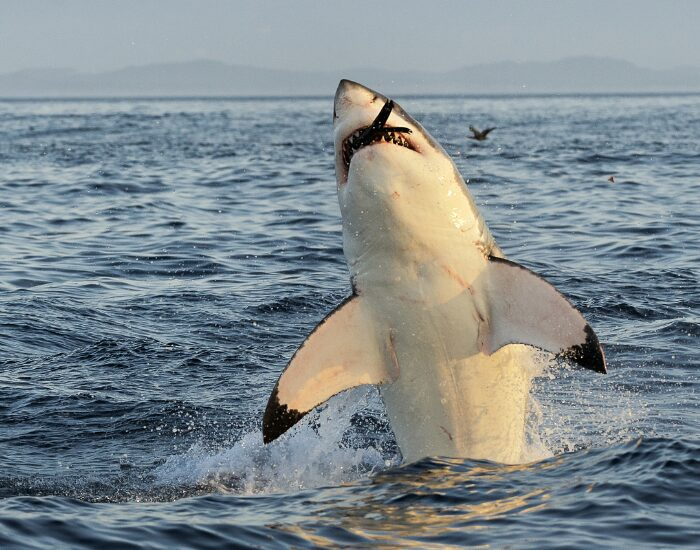
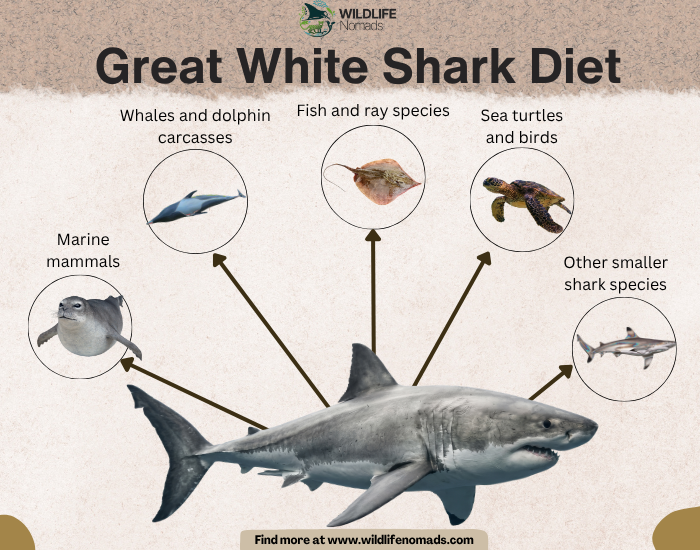
Young white sharks mostly eat fish, rays and squids. Their jaws aren’t strong enough yet for big mammals. At around three metres the diet shifts, and adults primarily feed on seals, sea lions and whale carcasses. Occasionally they take dolphins too.
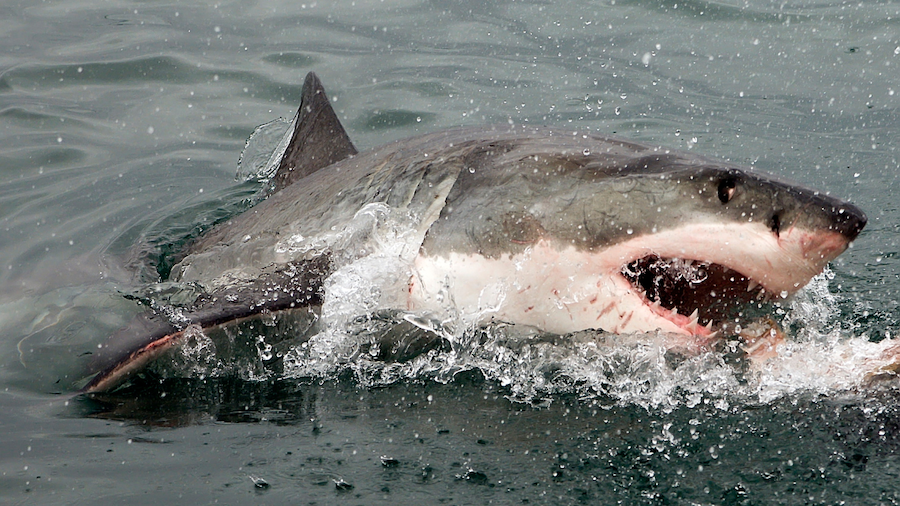
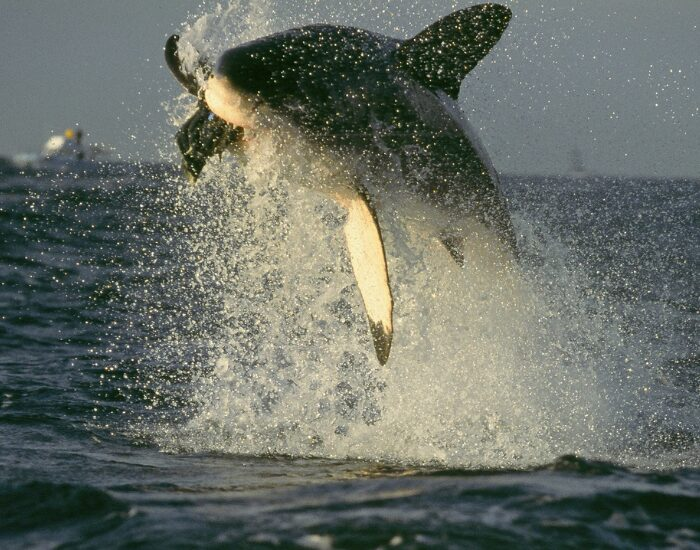
Hunting seals produced one of the great spectacles in nature. At Seal Island in South Africa’s False Bay, white sharks rush up from below and burst clean out of the water. This breaching can launch the entire shark into the air.
Off Cape Cod, in the Gulf of Maine, white sharks returned as grey seal colonies recovered. The prey came back, and the predator followed. That comeback now brings sharks close to busy beaches every summer.
8. They Migrate Across Whole Oceans
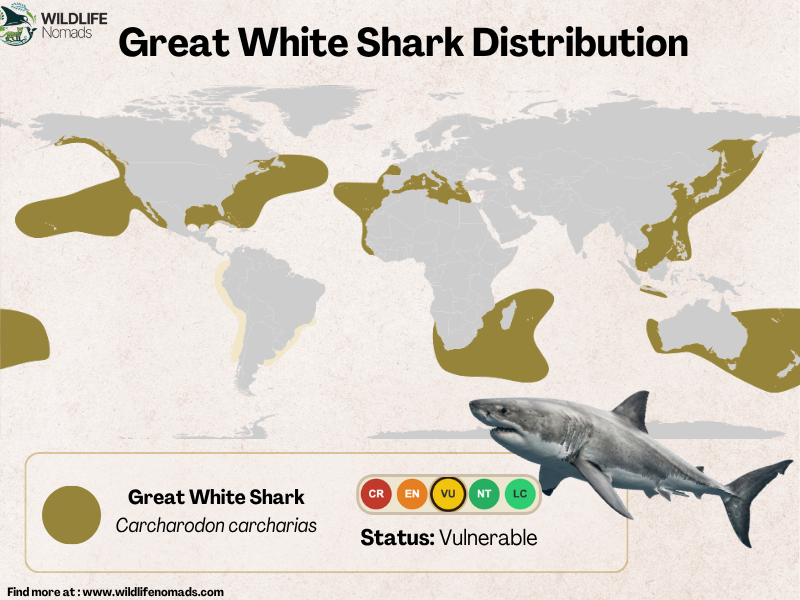
In 2003, researchers tagged a female white shark named Nicole off South Africa. Bonfil and colleagues then tracked her to Western Australia and back, a round trip of over 20,000 kilometres in under nine months. Off California, adults head offshore to a mid-Pacific area nicknamed the White Shark Café, roughly halfway to Hawaii.
Australia’s east coast has its own rhythm. Tagging research shows young white sharks spread across a broad range, from Tasmania and Bass Strait in summer up to the southern Great Barrier Reef in winter. They also spend more time off southern Queensland and northern NSW from September, then shift south to southern NSW and Victoria around March.
So that sign at Red Cliff wasn’t random. We were camping on the northern NSW coast in September, right when those movements predict young sharks nearby. For me, it turned a warning into a biology lesson.
9. Great White Sharks Live Slow, and That Makes Them Vulnerable
Great white sharks can live 70 years or more. Hamady and colleagues used radiocarbon from Cold War bomb tests, locked in vertebrae, to age one male at 73. The Greenland shark still holds the longevity record, but white sharks aren’t far behind most fish.
Maturity comes painfully late. In the western North Atlantic, males mature at around 26 years of age, and females at roughly 33. A female may give birth only every two or three years. As a result, populations recover very slowly after losses.
The IUCN Red List classifies the white shark as Vulnerable globally, and the Mediterranean population as Critically Endangered. Longline and gillnet fishermen still hook them as bycatch in commercial fisheries. Illegal hunting for jaws, teeth and fins has also cut numbers significantly. Great whites sit on CITES Appendix II, and Australia and many other countries protect them by law.
10. Pups Are Born Ready to Hunt
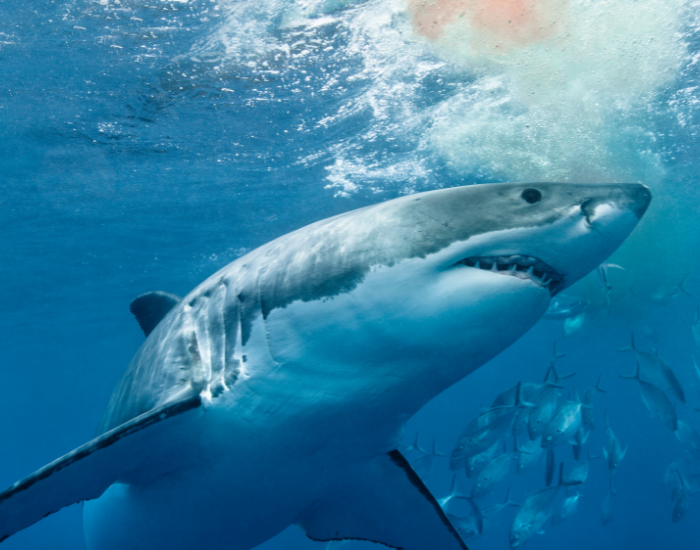
Great whites give birth to live young. Gestation is believed to last 12 to 18 months, one of the longer pregnancies among animals. Litters usually hold two to ten pups, each already more than a metre long.
Inside the mother, embryos feed on unfertilised eggs she keeps producing. After birth, the pups are fully independent and swim away immediately. No parental care, no second chances.
Mothers choose shallow, warm nursery habitat. Researchers have found nurseries off Southern California, Long Island in New York, Port Stephens in NSW, and Baja California in Mexico. That Baja coast is where I watched gray whale calves on a university field trip. Newborn whales and newborn white sharks share the same shoreline, and that still amazes me.
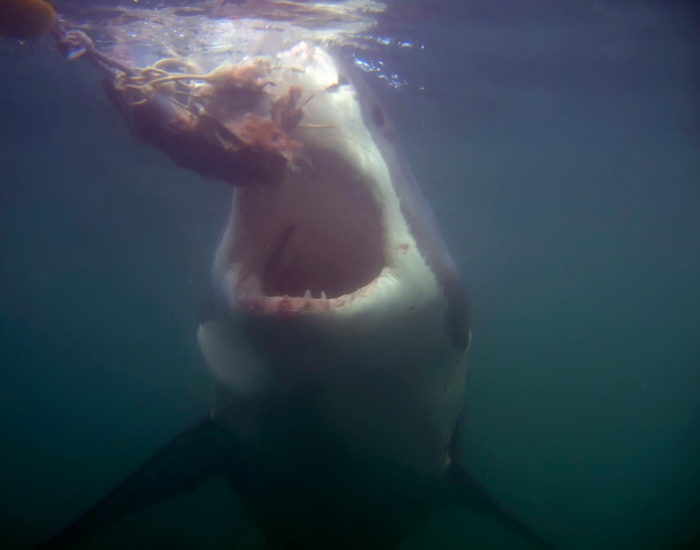
11. Orcas Are the Main Predator, and They Want the Liver
A white shark’s liver can make up about a quarter of its body weight. Packed with oil, it provides buoyancy, because sharks lack a swim bladder. It also stores energy for long migrations.
Killer whales (Orcinus orca) know exactly where that prize sits. In South Africa, a pair of orcas began killing white sharks in 2017, and locals named them Port and Starboard. Five white shark carcasses washed up at Gansbaai that year, and four were missing their livers. Tracking and sightings data then showed the sharks leaving the area.
California tells the same story. Jorgensen and colleagues found white sharks abandoned the Farallon Islands after orcas showed up, often for the rest of the season. In South Africa, bronze whaler sharks moved in once the white sharks left. Even apex predators, it turns out, respond to the presence of something bigger.
12. Curious, Social and Recognisable by Their Fins
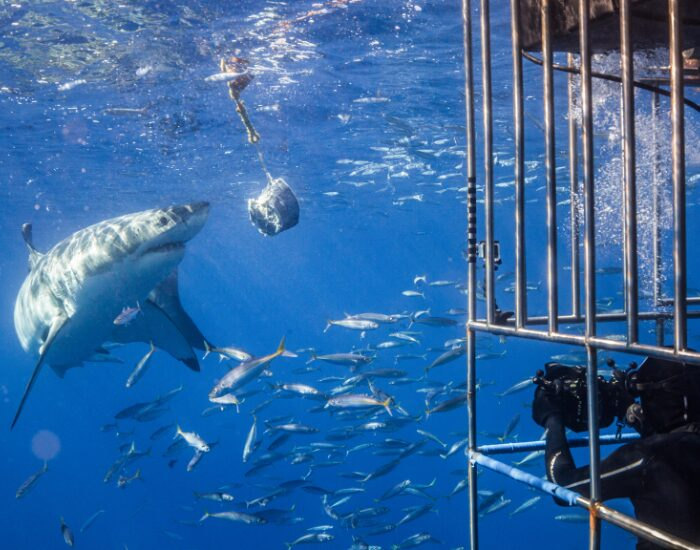
Great whites show surprisingly complex social behaviour. At gathering sites like Guadalupe Island in Mexico and the Neptune Islands in South Australia, they appear to settle disputes with posturing rather than fights. Many individuals approach boats slowly to inspect them, which matches the calm, inquisitive sharks I have met underwater. Although as 2026, you are not allowed to see the white sharks in Guadalupe, as the Mexican government permanently closed Guadalupe Island to all cage diving and tourist activity in January 2023 to protect white sharks and their habitat.
Every white shark carries a unique pattern of notches and markings along the trailing edge of its dorsal fin. Researchers photograph these fins to identify individuals across years, like fingerprints. Some projects invite divers to join in by sharing fin photos and videos. It’s also one of my favourite fun facts for kids: every shark has its own fin ID.
Great White Shark: Your Questions Answered
Probably not. The largest reliably measured great whites reach about 6 metres, close to 20 feet. Reports of 7.5-metre (25-foot) sharks exist, but none has survived a proper measurement. Most adults stay between four and five metres
Great whites regularly swim in water barely deeper than their own body. Juveniles cruise the surf zone off California and NSW in water under two metres deep. Drone surveys often film them just behind the breaking waves. They occasionally enter estuaries too.
One. Like other sharks and fish, a great white has a single S-shaped heart with two main chambers, an atrium and a ventricle. It pumps blood in one loop: heart, gills, body, and back again.
Not globally. The IUCN lists the species as Vulnerable, one step below Endangered. However, the Mediterranean population is Critically Endangered. Protection under CITES Appendix II and national laws remains essential for recovery.
What the Shark Sign Taught Me
Great white sharks are not the monsters from Jaws. They are warm-bodied, long-lived, slow-breeding apex predators, and humans threaten them far more than they threaten us. That imbalance is the real story behind every viral headline.
So next time a shark sign closes a beach, read it with respect rather than dread. Watch the water from a headland, learn the local seasons, and let the ocean keep its predators. If these great white shark facts changed how you see them, tell me in the comments. Then meet their relatives in our guide to the sharks of Australia, or read about the hammerheads and whitetip reef sharks I have swum beside.
Great White Shark Biology & Science Quiz
Ten fun study questions covering countershading, electric sensing, warm-bodied adaptation, orca predation, and lifespan. Test your retention!
Multiple Choice
References:
Bonfil, R., Meÿer, M., Scholl, M. C., Johnson, R., O’Brien, S., Oosthuizen, H., Swanson, S., Kotze, D., & Paterson, M. (2005). Transoceanic migration, spatial dynamics, and population linkages of white sharks. Science, 310(5745), 100–103. https://doi.org/10.1126/science.1114898
Bruce, B. D., Harasti, D., Lee, K., Gallen, C., & Bradford, R. (2019). Broad-scale movements of juvenile white sharks Carcharodon carcharias in eastern Australia from acoustic and satellite telemetry. Marine Ecology Progress Series, 619, 1–15. https://doi.org/10.3354/meps12969
Hamady, L. L., Natanson, L. J., Skomal, G. B., & Thorrold, S. R. (2014). Vertebral bomb radiocarbon suggests extreme longevity in white sharks. PLOS ONE, 9(1), e84006. https://doi.org/10.1371/journal.pone.0084006
Jorgensen, S. J., Anderson, S., Ferretti, F., Tietz, J. R., Chapple, T., Kanive, P., Bradley, R. W., Moxley, J. H., & Block, B. A. (2019). Killer whales redistribute white shark foraging pressure on seals. Scientific Reports, 9, 6153. https://doi.org/10.1038/s41598-019-39356-2
Natanson, L. J., & Skomal, G. B. (2015). Age and growth of the white shark, Carcharodon carcharias, in the western North Atlantic Ocean. Marine and Freshwater Research, 66(5), 387–398. https://doi.org/10.1071/MF14127
Towner, A. V., Watson, R. G. A., Kock, A. A., Papastamatiou, Y., Sturup, M., Gennari, E., Baker, K., Booth, T., Dicken, M., Chivell, W., Elwen, S., Kaschke, T., Edwards, D., & Smale, M. J. (2022). Fear at the top: Killer whale predation drives white shark absence at South Africa’s largest aggregation site. African Journal of Marine Science, 44(2), 139–152. https://doi.org/10.2989/1814232X.2022.2066723
Wroe, S., Huber, D. R., Lowry, M., McHenry, C., Moreno, K., Clausen, P., Ferrara, T. L., Cunningham, E., Dean, M. N., & Summers, A. P. (2008). Three-dimensional computer analysis of white shark jaw mechanics: How hard can a great white bite? Journal of Zoology, 276(4), 336–342. https://doi.org/10.1111/j.1469-7998.2008.00494.x