Wildlife Nomads


The first time a zebra shark drifted past me at Julian Rocks, off Byron Bay, I forgot how to breathe properly. Since then, I’ve dived with wobbegongs on our lap around Australia, lemon sharks in the Caribbean, and whitetip reef sharks in Komodo and Bali. The basking shark species is different. I have never met one, and I probably never will.
I fell for this animal while building our deep-sea species tool. Its data kept surprising me: a shark longer than a bus that eats almost nothing bigger than a grain of rice. And with that huge mouth hanging open, it looks like something a film studio invented.
Below are 12 facts about the basking shark, from its gill rakers to its record size and its troubled history with people. I also answer the questions people search most, including whether basking sharks are harmless and why they’ve become so rare.
How well do you know the ocean’s gentle giant? Twelve questions on plankton, sea monsters and sharks that leap clear of the water. Read on, then take the quiz at the end and see if you’re a Gentle Giant or still lost in the plankton. Jump to the quiz ↓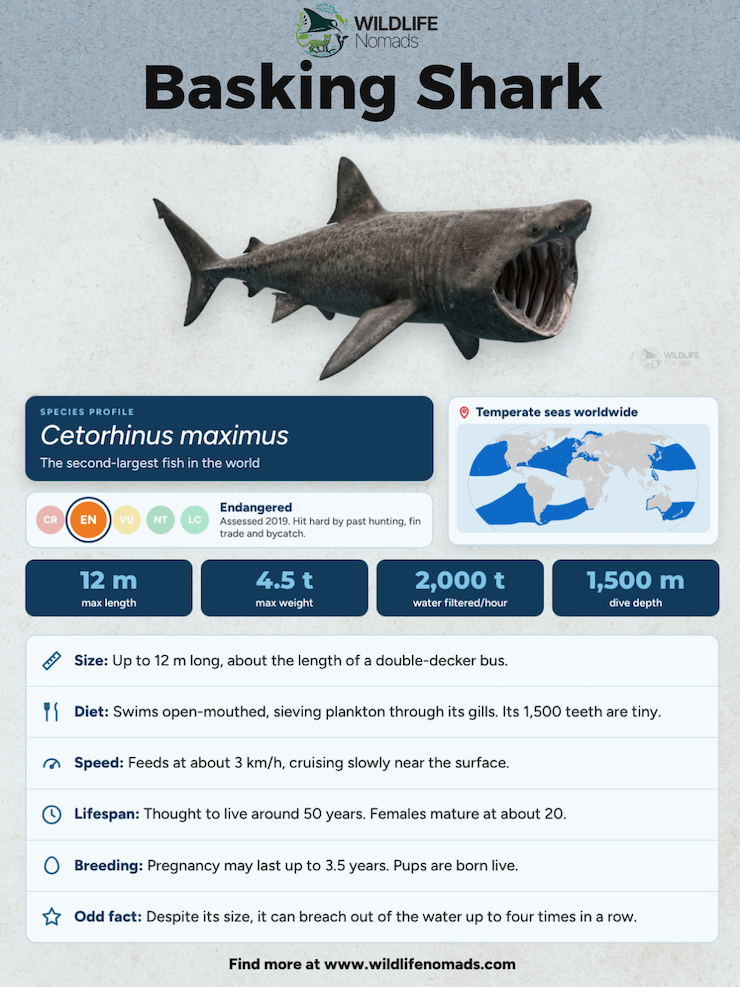
1. The Basking Shark Is the Second Largest Fish on Earth
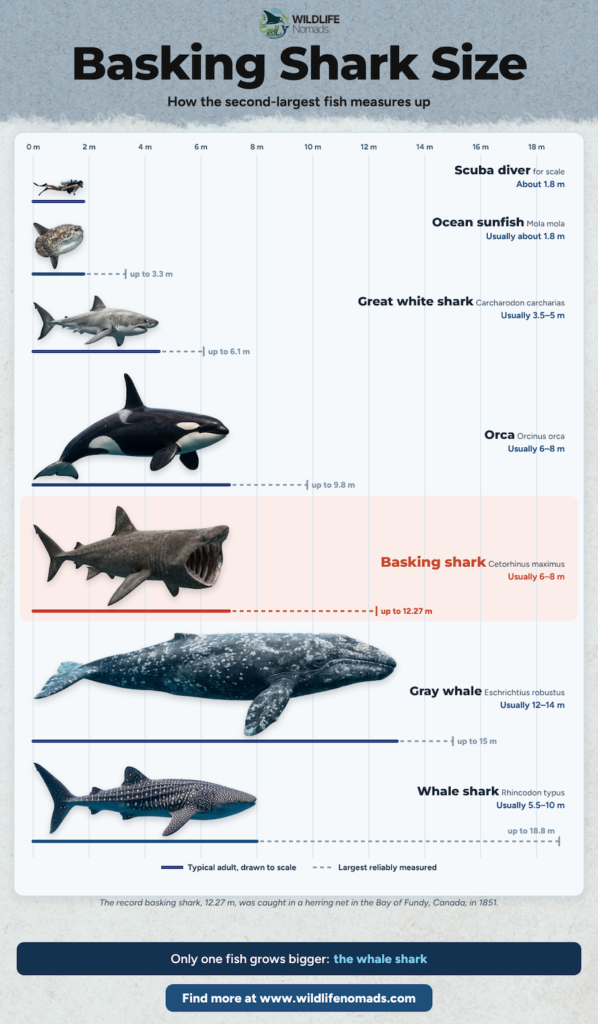
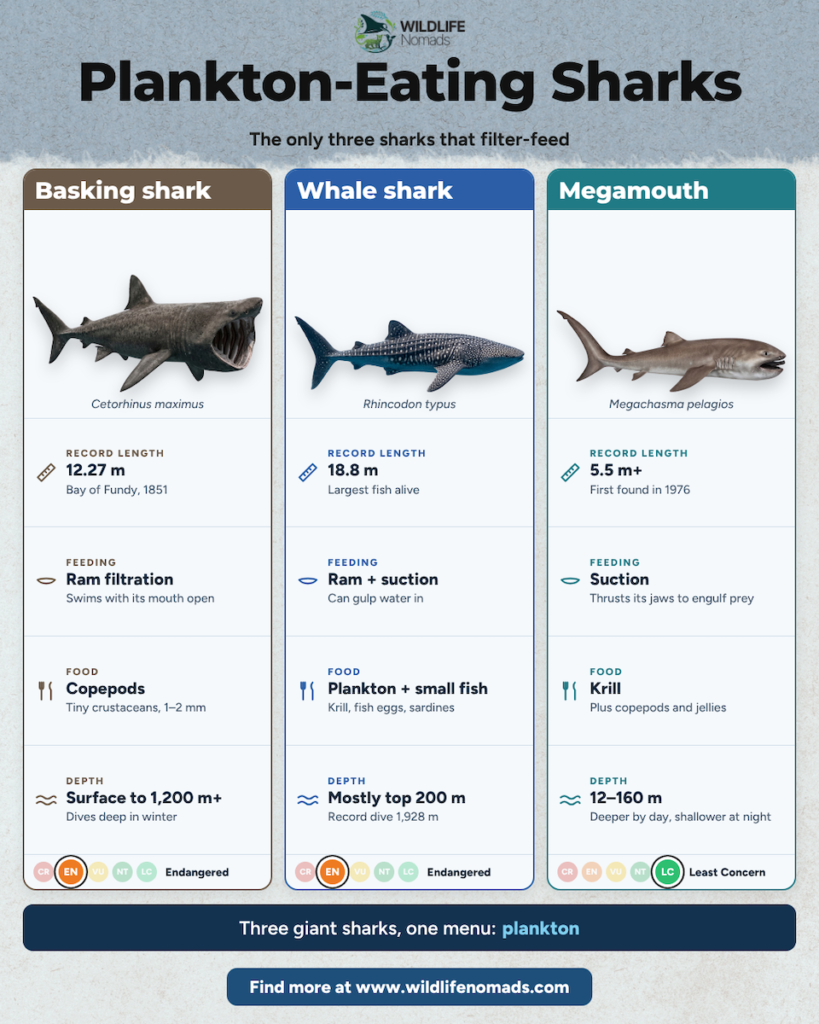
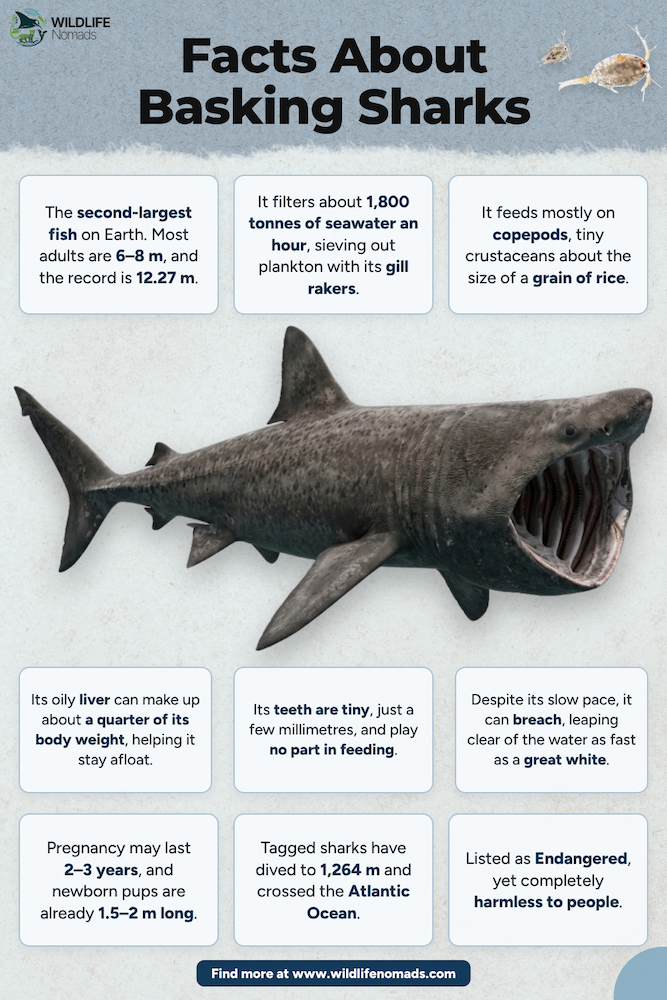
Only the whale shark grows bigger. Most adult basking sharks measure 6 to 8 meters (20 to 26 feet). Large individuals can pass 10 meters and weigh more than 5 tonnes.
The longest reliably measured basking shark tangled in a herring net in Canada’s Bay of Fundy in 1851. It stretched 12.27 meters (40.3 feet) and weighed an estimated 16 tonnes. Older reports describe even longer sharks, but nobody verified them, so I treat those claims cautiously.
Its scientific name, Cetorhinus maximus, combines Greek roots for “whale” and “shark” with the Latin for “greatest.” Naturalists named it in 1765, when it still held the title of largest fish species known to science. Today it sits comfortably on our list of the biggest fish in the world.
2. That Huge Mouth Works Like a Living Net
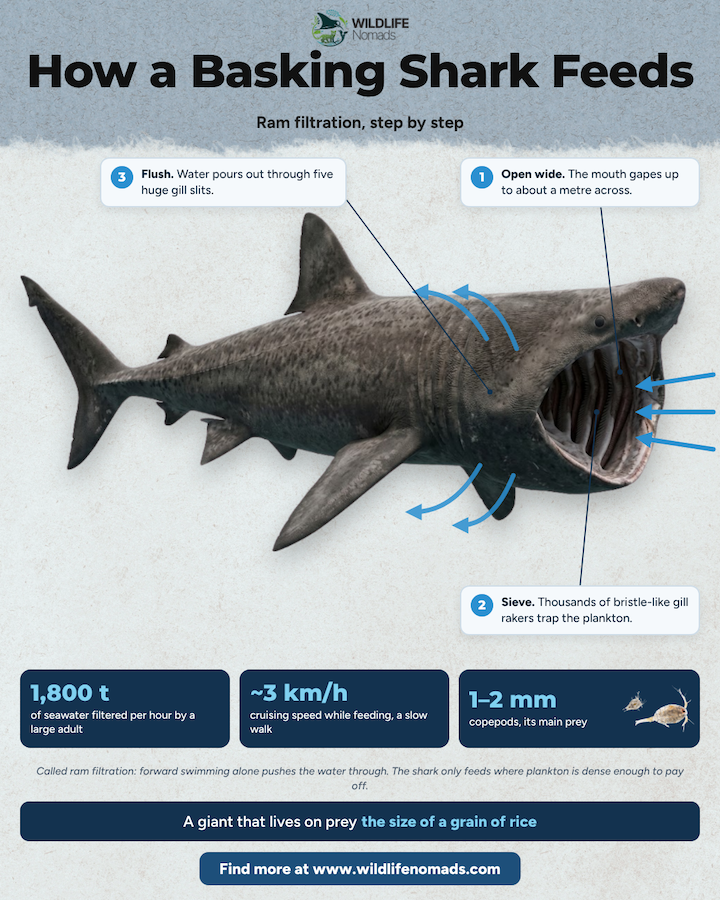
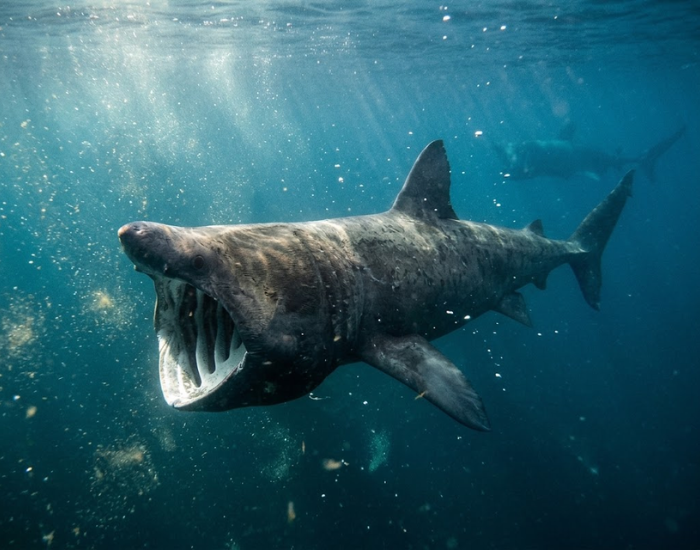
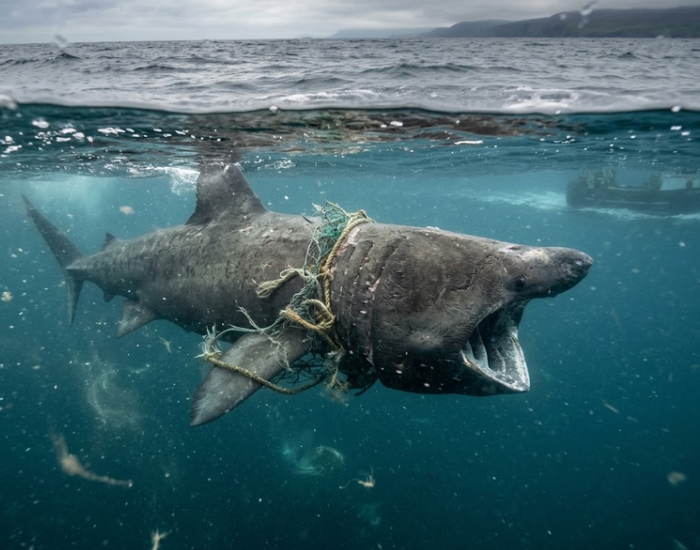
A feeding basking shark opens its mouth up to about a meter wide. The jaw drops, the gills flare, and the head balloons into a pale cavern. Honestly, that image is the reason this shark earned an article of its own.
Behind the opening sit five large gill slits. These gill slits extend so far that they almost encircle the head. Inside, thousands of bristle-like gill rakers line each arch, trapping plankton as water flows out.
3. Basking Sharks Filter Plankton by Swimming Slowly With Their Mouths Open
Unlike the whale shark, which actively gulps and sucks in water, the basking shark is a passive filter feeder. It simply swims forward with its mouth open. Forward motion alone pushes water through the gills, a method biologists call ram filtration.
The volume is staggering. A large adult can filter roughly 1,800 tonnes of seawater per hour, close to 4 million pounds. It manages this at a slow swimming speed of around 3 km/h (about 2 mph), which keeps energy costs low.
Only three sharks live on plankton: the basking shark, the whale shark and the deep-water megamouth shark. I spent hours reading about the megamouth while building the deep-sea tool. Three very different sharks arrived at the same strategy: open wide and let the ocean do the work.
4. Their Diet Is Mostly Tiny Crustaceans Called Copepods
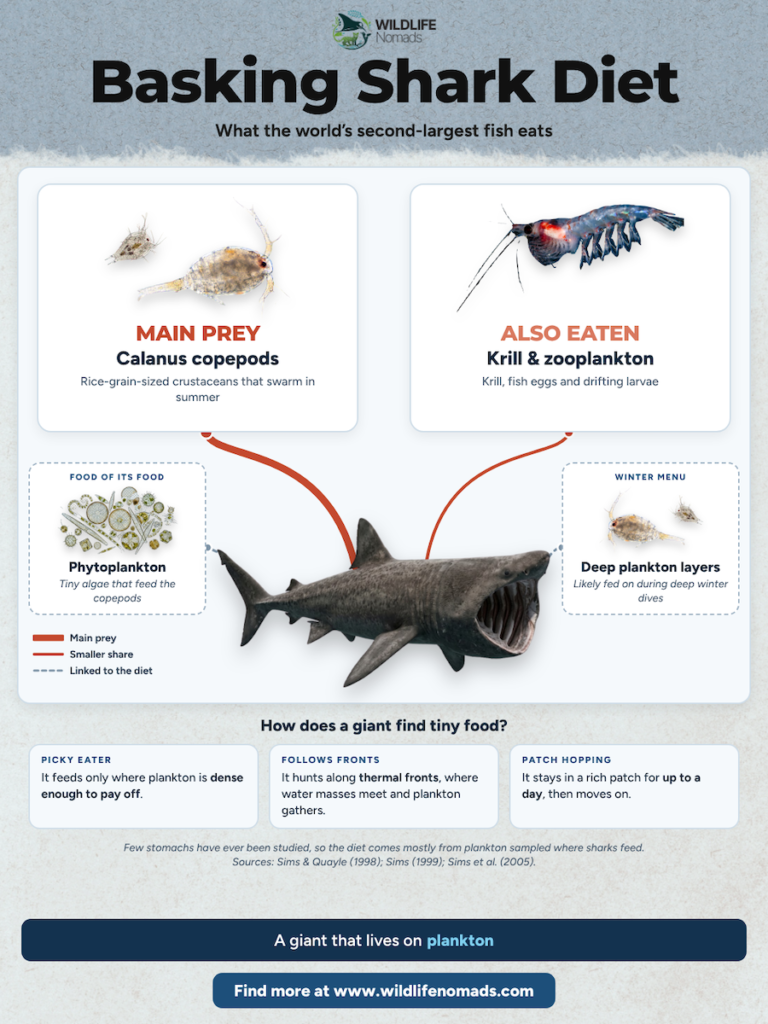
The diet of basking sharks centers on zooplankton, especially copepods. These small crustaceans often measure just one or two millimeters. The sharks also swallow fish eggs, larvae and the occasional very small fish caught in the flow.
What impresses me most is how picky they are. Off Plymouth, researcher David Sims and colleagues followed basking sharks along a plankton front. The sharks fed only in the densest patches and swam straight through thinner water.
Later work suggested a feeding threshold. Below a certain plankton density, filtering costs more energy than it returns, so the shark keeps searching. As a result, a basking shark observed feeding at the surface tells you that patch of water is unusually rich.
5. Tiny Teeth Make This Gentle Giant Harmless to People
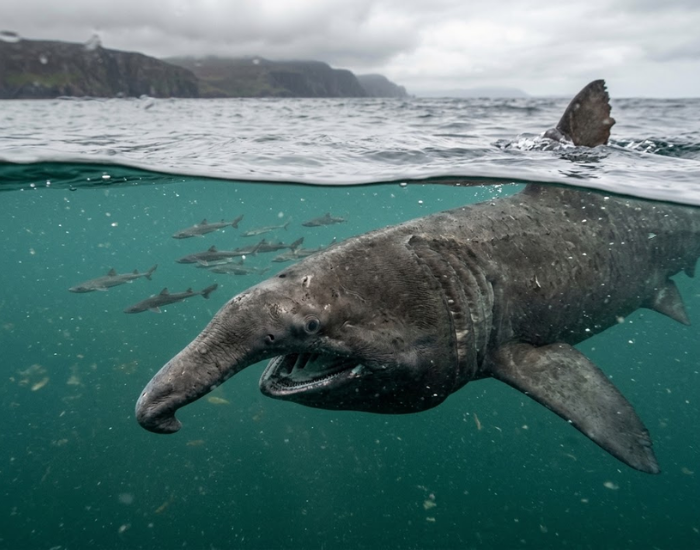
For such a big shark, the teeth look almost comical. Each one measures about 5 to 6 millimeters, with a single conical cusp curved backwards. Hundreds sit in rows along the upper and lower jaws, yet they play no real role in feeding.
Basking sharks pose no threat to swimmers. I’ve shared water with zebra sharks, wobbegongs and lemon sharks, and each one reminded me that most sharks ignore us. The basking shark takes that indifference to another level.
Size still demands respect, though. In 1937, a breaching basking shark capsized a small boat off Scotland, and three people drowned. The shark didn’t attack; it simply landed in the wrong place.
6. Old Names Like “Hoe Mother” and “Elephant Shark” Tell a Story
Sailors watched these sharks lounging at the surface on calm days and assumed they were sunbathing. Hence the name “basking.” In reality, the sharks follow plankton that concentrates near the surface.
Local names reveal even more. Orkney islanders called it the hoe mother, reportedly believing it mothered the small dogfish they called “hoes.” Other coastal communities used sunfish, sailfish and bone shark.
Some references even list elephant shark, likely because juveniles have a long, hooked snout like a small trunk. Adults keep a pointed snout, but the trunk shape fades with age. Confusingly, Australians use “elephant shark” for a completely different fish, a chimaera related to ghost sharks.
7. Basking Sharks Chase Plankton Through Temperate Waters
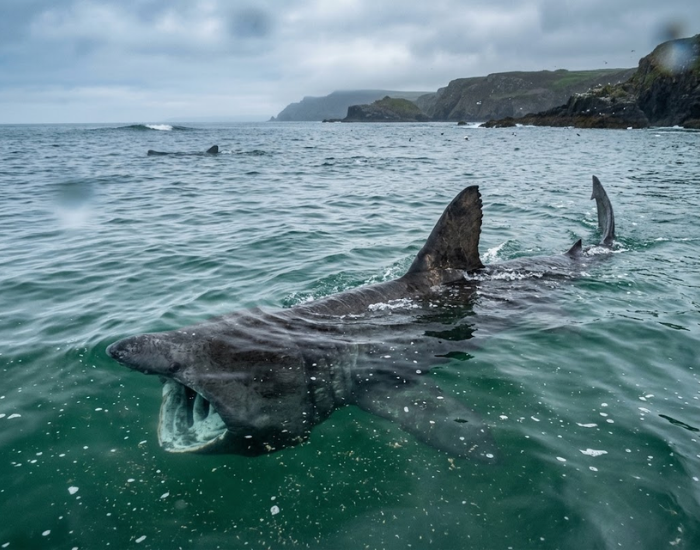
This is a cosmopolitan, migratory species found in temperate and boreal waters worldwide. Basking sharks generally prefer surface temperatures of about 8°C to 14.5°C. They favor the continental shelf and oceanic fronts, where currents collide and plankton piles up.
Most basking shark sightings happen in spring and summer, when plankton blooms near coasts. Scotland’s west coast, Cornwall, Ireland and the Isle of Man are famous hotspots. The sharks also reach southern Australia and New Zealand, though sightings there are rare.
8. Satellite Tracking Busted the Winter Hibernation Myth
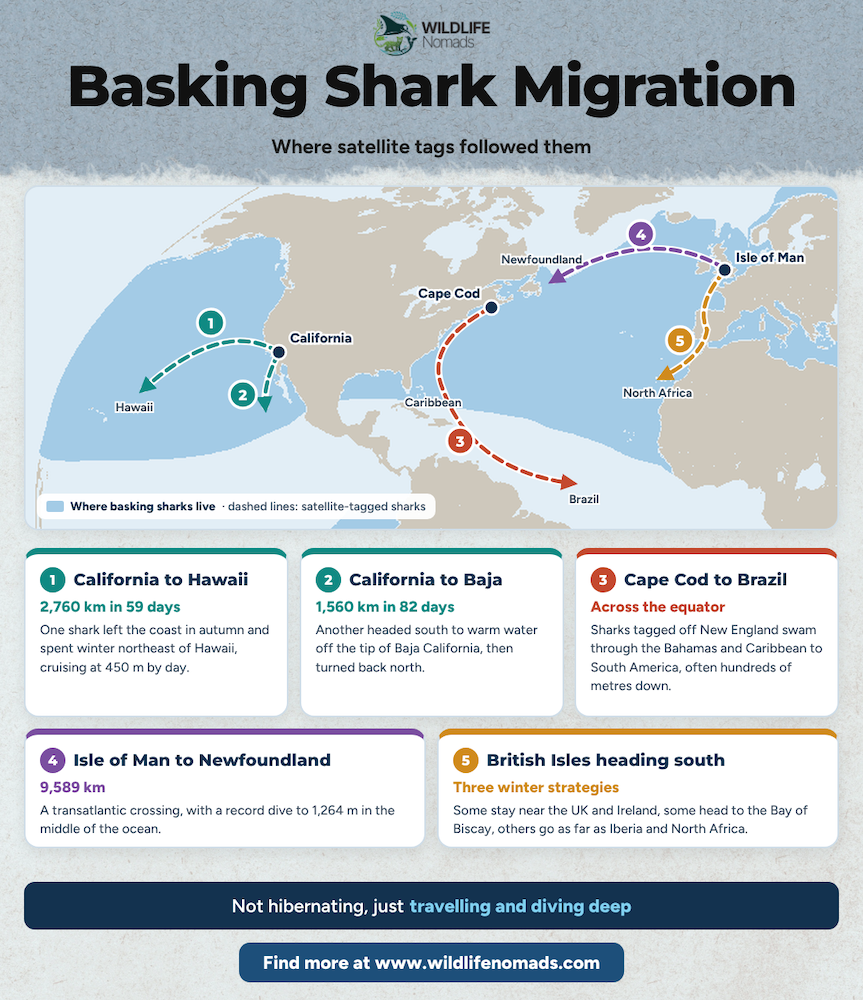
For decades, basking sharks vanished every autumn, and nobody could explain it. In the 1950s, one popular theory claimed they shed their gill rakers and rested on the seabed all winter.
Satellite tracking ended that idea. In 2003, Sims and colleagues showed that tagged sharks kept moving and feeding through winter, often in deeper waters. The sharks hadn’t stopped at all. They had simply left the surface, where we could see them.
Their seasonal movements turned out to be epic. One shark tagged off the Isle of Man swam 9,589 km to Newfoundland, nearly 6,000 miles, and dove below 1,200 meters. Sharks tagged off New England crossed the equator to Brazil, cruising at 200 to 1,000 meters deep. Having mapped dive depths for our deep-sea tool, I still find that range hard to believe.
9. Usually Solitary, Sometimes in Groups of Nearly 1,400
Most of the time, basking sharks travel alone or in small schools. However, NOAA researchers reviewing decades of aerial survey photos found something remarkable. In November 2013, at least 1,398 basking sharks gathered off southern New England.
The team documented ten large groups between 1980 and 2013. Plankton levels ran high during the biggest event, and many sharks there were juveniles. Therefore, the researchers think that record gathering was a feast rather than a courtship meeting.
10. A Plankton Eater That Can Breach Like a Great White
A 5-tonne plankton eater leaping clear of the sea sounds unlikely. Yet basking sharks breach, and a 2018 study off Ireland measured just how powerful they are. Using cameras and motion sensors, researchers recorded a shark sprinting from depth and launching itself out of the water.
Its surface speed matched that of breaching great white sharks, famous ambush predators. The tail’s crescent shape and a strong lateral keel at its base help generate that thrust. Why they breach remains unclear, though leading ideas include courtship, signaling, or efforts to dislodge parasites such as sea lampreys.
11. Reproduction in Basking Sharks Is Still a Mystery
Much of what we know about reproduction in basking sharks comes from a single pregnant female caught off Norway. She carried six pups. The species is ovoviviparous, meaning eggs hatch inside the mother before she gives birth to live young.
Pups measure about 1.5 to 2 meters at birth. That’s roughly the size of the adult whitetip reef sharks I’ve watched resting under ledges in Komodo. Researchers estimate gestation at two to three years, among the longest of any animal, though nobody has measured it directly.
Their whole life history moves at a slow rate. Mating probably happens in early summer, and females may breed only every two to four years. Males reach sexual maturity at around 12 to 16 years, while females may need 16 to 20.
12. The Basking Shark Species Is Endangered, and Humans Are the Reason
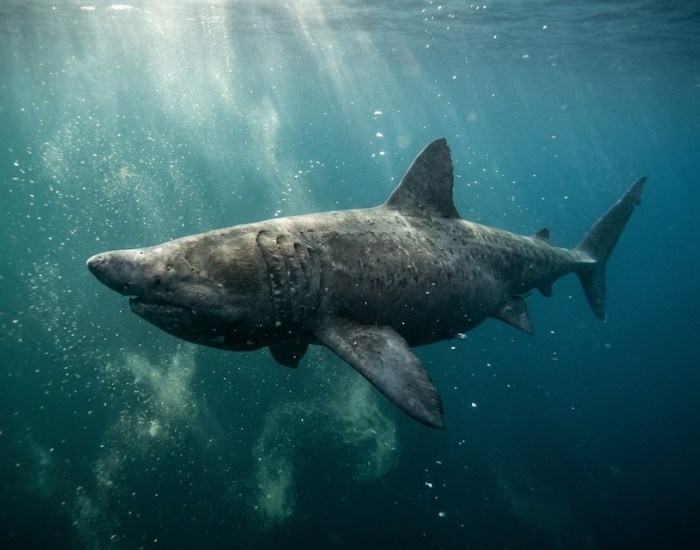
Slow, surface-feeding and enormous, basking sharks made easy targets. People hunted them for centuries, mostly for their livers, which can make up a quarter of body weight. That oil lit lamps and later supplied squalene for cosmetics.
Fins brought a newer threat. Basking shark fins became some of the most valuable in the shark fin soup trade, with a single dorsal fin worth thousands of dollars. Today, CITES Appendix II regulates international trade in basking shark products.
The darkest chapter unfolded on Canada’s west coast. From the 1950s, fisheries authorities ran an eradication program because the sharks damaged salmon nets. Officers fitted a patrol boat with a sharp blade and sliced sharks as they fed near the surface.
The damage shows across the eastern North Pacific Ocean. In 2022, McInturf and colleagues found that basking shark sightings off California collapsed after the 1980s. Groups of up to 500 once appeared there, yet surveys recorded none after the 1990s. Canada assessed its Pacific population as Endangered back in 2007.
Globally, the International Union for Conservation of Nature has listed the species as Endangered since its 2018 assessment. Boat strikes, entanglement in fishing gear and bycatch in commercial fishing remain the main threats today. Natural predators are few, although killer whales and white sharks occasionally take them. With females breeding so rarely, every lost adult takes decades to replace. It now sits alongside other sea animals on the brink.
Frequently Asked Questions About Basking Sharks
The largest reliably measured basking shark reached 12.27 meters (40.3 feet). It was caught in a herring net in the Bay of Fundy, Canada, in 1851. Scientists estimated its weight at around 16 tonnes. Reports of longer sharks exist, but none have been verified.
The same 1851 Bay of Fundy specimen holds that record. Historical fisheries landed many sharks between 9 and 10 meters, especially during the liver oil boom. Today, the species is protected in many countries, so deliberate catches are illegal across much of its range.
Yes. Basking sharks eat only plankton and have tiny teeth unsuited to biting large animals. They show no aggression toward divers or swimmers. However, their skin is rough, and their size makes them dangerous to small boats if they breach nearby.
Centuries of hunting for liver oil and fins removed huge numbers. The species reproduces slowly, with late maturity and long gestation, so populations recover over decades. Boat strikes and fishing gear entanglement add ongoing losses. They also spend much of the year in deep water, which makes them harder to spot.
Your best chance comes during the spring and summer months in the northeast Atlantic. Scotland’s west coast, Cornwall, Ireland and the Isle of Man report regular sightings. Follow local codes of conduct, slow your boat, and never chase or crowd a feeding shark.
The Gentle Giant
The basking shark proves that the ocean’s largest animals often survive on its smallest. Its open mouth, deep winter dives and slow life history make it extraordinary, and fragile in equal measure.
I may never share the water with one, but writing this made me want to try. If you’d like to plan your own encounter, start with our guide to the best places to swim with sharks. The UK coastlines in our whale watching UK guide also overlap with prime basking shark country. Curious how this giant fits into the wider shark family? See how many species of sharks exist.
Have you ever seen a basking shark? Tell me where and when in the comments. I’d love to hear your story.
The Basking Shark Quiz 🦈
Twelve questions about the world’s second-biggest fish. Build a streak, open wide, and see how you rank in the deep.
Still curious? Find the best places to swim with sharks, explore the deep-sea species tool, or see how many species of sharks exist.
References:
Crowe, L. M., O’Brien, O., Curtis, T. H., Leiter, S. M., Kenney, R. D., Duley, P., & Kraus, S. D. (2018). Characterization of large basking shark Cetorhinus maximus aggregations in the western North Atlantic Ocean. Journal of Fish Biology, 92(5), 1371–1384. https://doi.org/10.1111/jfb.13592
Doherty, P. D., Baxter, J. M., Gell, F. R., Godley, B. J., Graham, R. T., Hall, G., Hall, J., Hawkes, L. A., Henderson, S. M., Johnson, L., Speedie, C., & Witt, M. J. (2017). Long-term satellite tracking reveals variable seasonal migration strategies of basking sharks in the north-east Atlantic. Scientific Reports, 7, 42837. https://doi.org/10.1038/srep42837
Gore, M. A., Rowat, D., Hall, J., Gell, F. R., & Ormond, R. F. (2008). Transatlantic migration and deep mid-ocean diving by basking shark. Biology Letters, 4(4), 395–398. https://doi.org/10.1098/rsbl.2008.0147
Johnston, E. M., Halsey, L. G., Payne, N. L., Kock, A. A., Iosilevskii, G., Whelan, B., & Houghton, J. D. R. (2018). Latent power of basking sharks revealed by exceptional breaching events. Biology Letters, 14(9), 20180537. https://doi.org/10.1098/rsbl.2018.0537
McInturf, A. G., Muhling, B., Bizzarro, J. J., Fangue, N. A., Ebert, D. A., Caillaud, D., & Dewar, H. (2022). Spatial distribution, temporal changes, and knowledge gaps in basking shark (Cetorhinus maximus) sightings in the California Current Ecosystem. Frontiers in Marine Science, 9, 818670. https://doi.org/10.3389/fmars.2022.818670
Sims, D. W., Southall, E. J., Richardson, A. J., Reid, P. C., & Metcalfe, J. D. (2003). Seasonal movements and behaviour of basking sharks from archival tagging: No evidence of winter hibernation. Marine Ecology Progress Series, 248, 187–196. https://doi.org/10.3354/meps248187
Skomal, G. B., Zeeman, S. I., Chisholm, J. H., Summers, E. L., Walsh, H. J., McMahon, K. W., & Thorrold, S. R. (2009). Transequatorial migrations by basking sharks in the western Atlantic Ocean. Current Biology, 19(12), 1019–1022. https://doi.org/10.1016/j.cub.2009.04.019