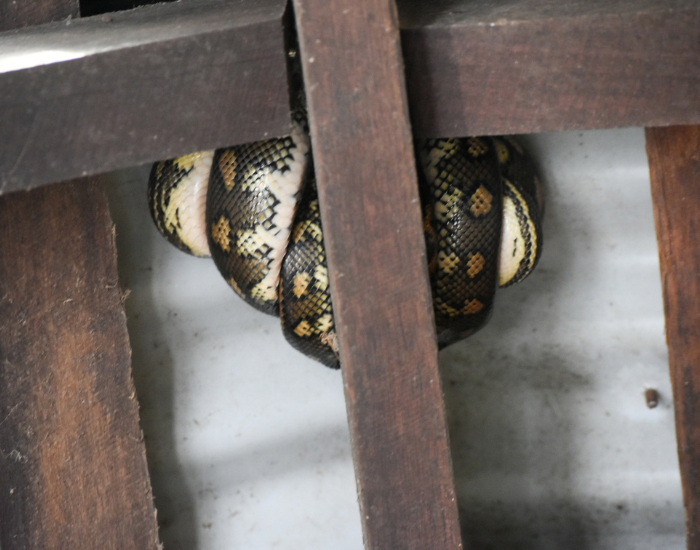
Jackie came back from the toilet block walking carefully. There was a snake on the roof, she said. I went to look and found a coastal carpet python coiled on a ceiling panel above the door, her head tucked out of sight. She was still there five days later, although sometime she would disappear, and you would find yourself hoping it would not appear at night when you had t go to the toilet.
That set the tone for Lake Arragan and Red Cliff campgrounds, our third stop on the Australia lap. We split five nights between the two camps, then added one at Sandon River just south.
In six nights I logged 26 species, most of them new for a trip that already covered Evans Head and Woody Head. Two campgrounds sit side by side here, yet their animal lists barely overlap. Moving 400 metres changed almost everything I saw.
For each species below: the biology, what I actually watched, and where to stand.
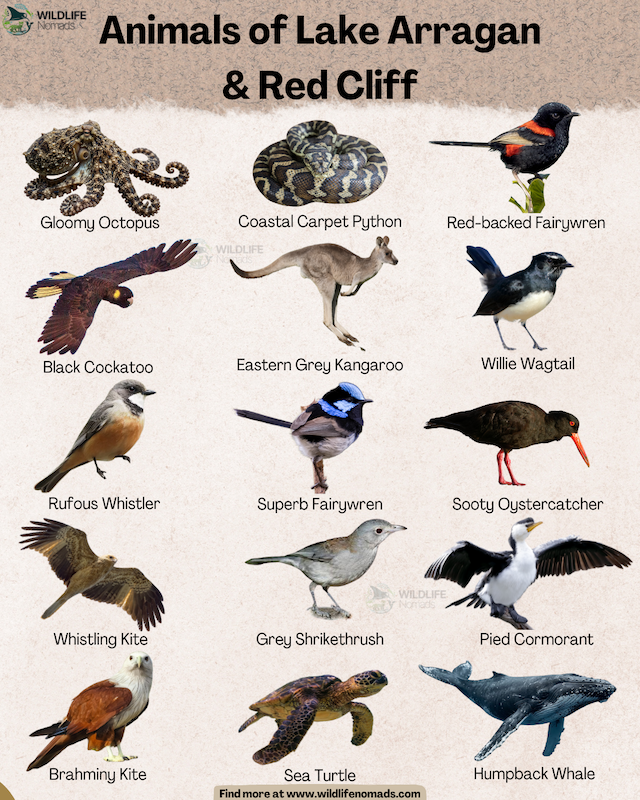
Two Campgrounds, Two Different Animal Lists
Getting There and Setting Up
Lake Arragan and Red Cliff campgrounds sit on the park’s northern coastline in Yuraygir National Park, between Coffs Harbour and Byron Bay. You turn off Brooms Head Road onto unsealed road, which a careful 2WD handles without drama. Between them sit 89 grassy campsites, many with shade, all just a short walk from the beach.
Every site is unpowered. You get drop toilets, fire pits and picnic tables, but no showers. We carried our own water and picked up 20 kg of firewood for $20 on the way in. Book early, because this place fills.
The Wind That Moved Us
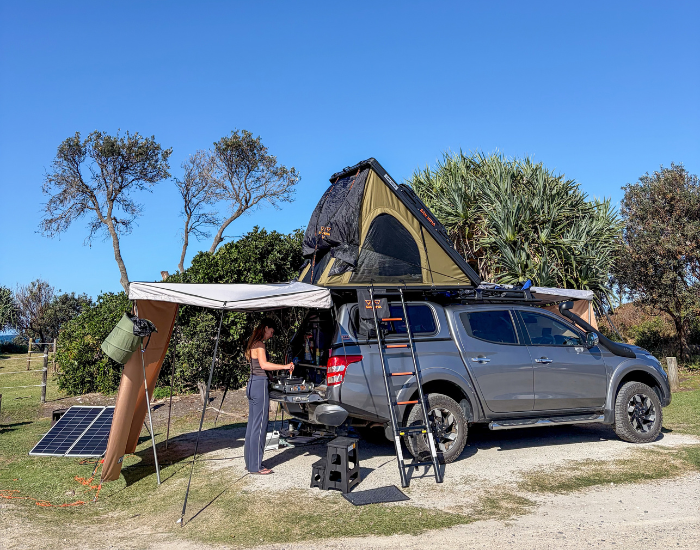
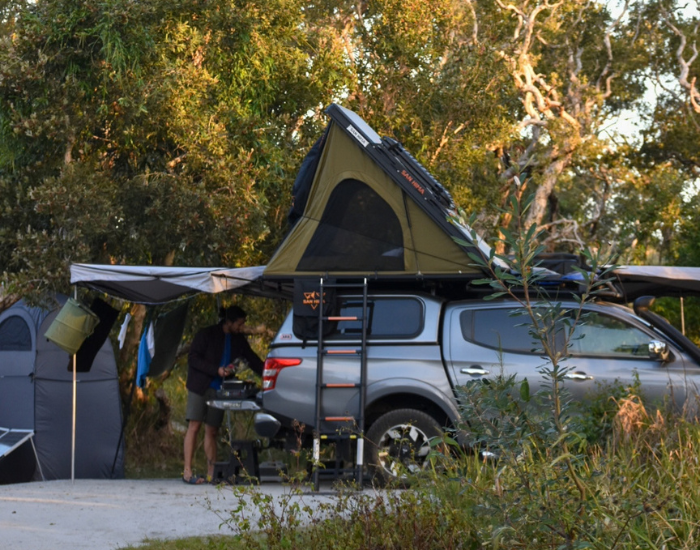
Strong winds arrived on our second night. We had already stripped the awning, and sleep was still impossible. Next morning we called National Parks and moved to site 9 at Lake Arragan, on the paperbark trail where caravans and camper trailers cannot go.
Breaking camp mid-trip annoyed us a little bit, because dismounting a roof tent eats a working morning. In hindsight it was the best thing that happened. Red Cliff is open, grassy and full of kangaroos. Lake Arragan is a small coastal lagoon system surrounded by paperbarks, beautiful swamps, quieter, denser, and far richer at dawn.
1. Coastal Carpet Python (Morelia spilota mcdowelli)
Our python held the same ceiling panel in the ecological toilets for five days. Sometimes she vanished, then reappeared in the identical coil. I never once saw her face though. If you are not a fan of snakes, you may not like this, but they are harmless, and not one of the actual dangerous snakes of Australia.
She was doing exactly what that roof invites. Amenities blocks trap heat and funnel rodents, which makes them excellent python real estate. These non-venomous ambush predators hold a position for days waiting on a single mouse. Look up before you walk in, then leave her alone.
2. Gloomy Octopus (Octopus tetricus)
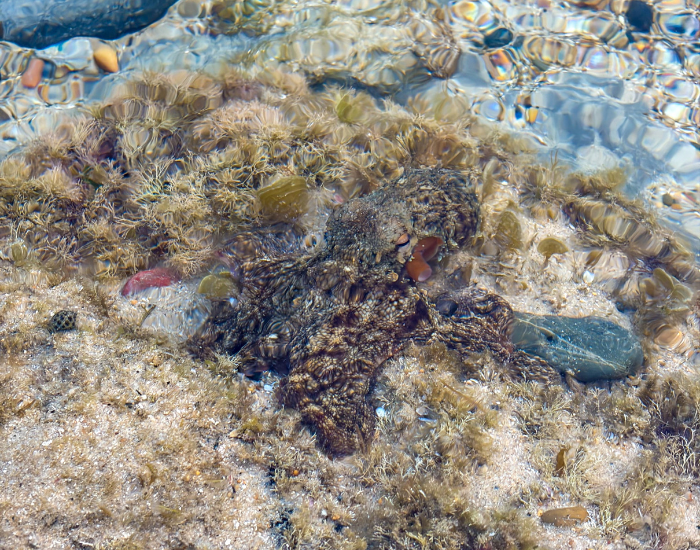
This was the sighting of the trip. We went to the rock pools specifically hunting octopus, and honestly, he found us. A splash broke the surface beside us, and he then approached, retreated, and repeated it for ten minutes.
Scheel and colleagues documented this species living at unusually high densities in Jervis Bay, chasing, posturing and changing colour at each other. Godfrey-Smith’s team later filmed wild O. tetricus propelling silt and shells with a jet from the siphon. So the water-waving may not have been a hello. It may have been a small, polite warning.
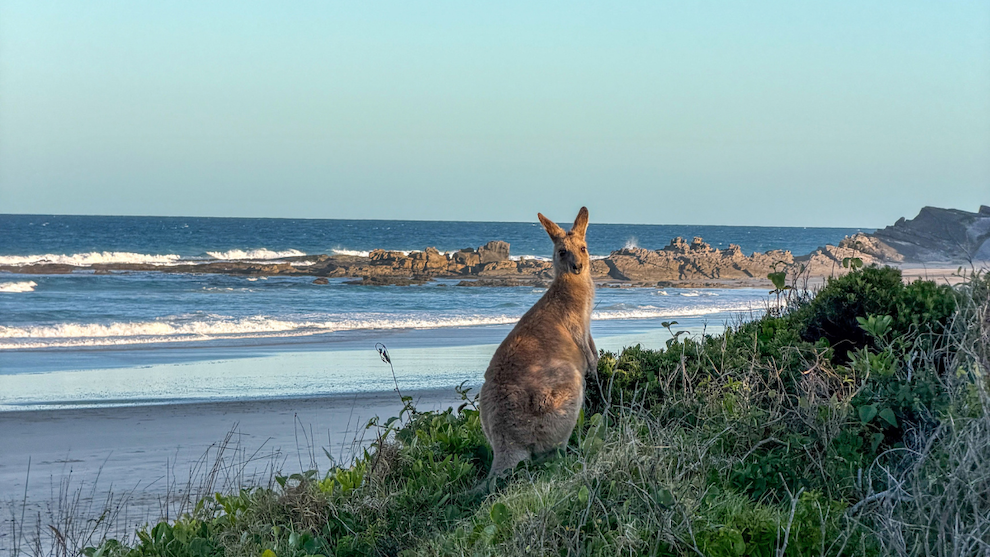
3. Eastern Grey Kangaroo (Macropus giganteus)
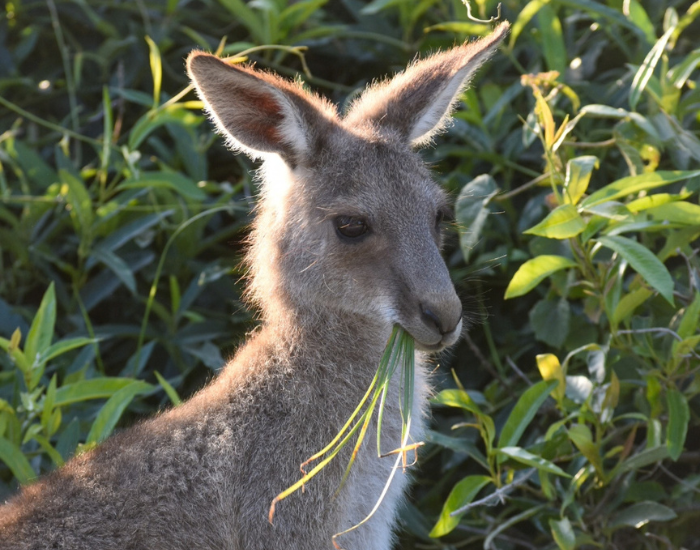
Nine animals, and the biggest mob we have seen on the lap. They grazed the open grass at Red Cliff from first light, sometimes within metres of the tent.
Cross to Lake Arragan and they mostly disappear. That is structural, not luck, because kangaroos need open lawn with clear escape lines and the paperbark side offers neither. Watching kangaroos while you listen to the surf roll over the rocks is the Red Cliff experience in one sentence.
4. Willie Wagtail (Rhipidura leucophrys)
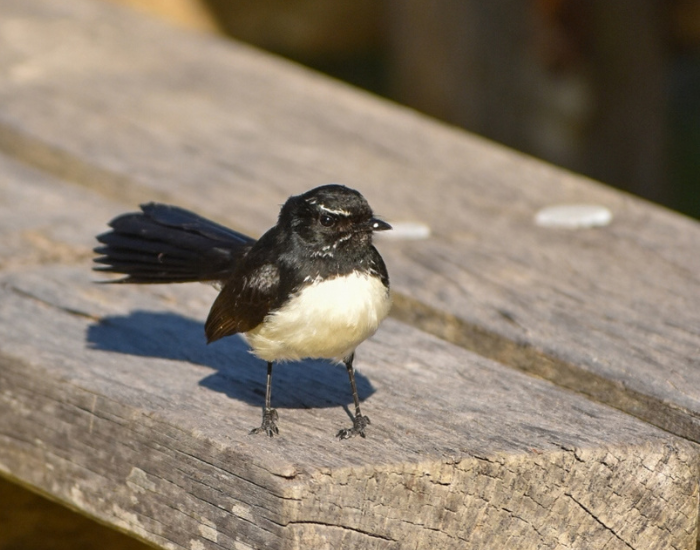
Three of them worked the campground, and one was riding a kangaroo. It perched on the animal’s back, fanned that black tail side to side, and rode along as the kangaroo moved off.
This is a beater strategy. Large grazers flush insects out of the grass, and the wagtail collects them with almost no search cost. The constant tail-fanning likely flushes prey too. They were confident birds, happy to feed a metre from our chairs.
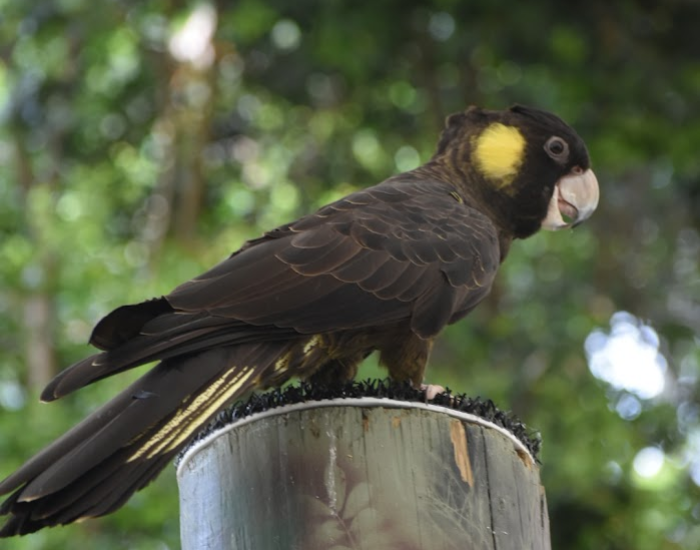
5. Black Cockatoo (Zanda funerea)
A black cockatoo flew out of the toilet doorway one morning, straight past my shoulder. Two birds in total, and far too fast for a camera.
NPWS lists the yellow-tailed black cockatoo for Yuraygir, so that is my working call. However, glossy black cockatoos also occur here feeding on she-oak seed, and the south-eastern subspecies is endangered. I never saw the tail or cheek patch, so I am flagging the uncertainty rather than dressing it up. Listen for the long wailing contact call.
6. Humpback Whale (Megaptera novaeangliae)
We watched humpbacks from the beach at Red Cliff, and again at sunset from the roof tent at Sandon River. The best view came from Brooms Head, where a group flapped their pectoral fins in unison for several minutes. Some were noticeably smaller, so I suspect calves in the group.
The east Australian population has rebounded hard. Noad and colleagues estimated growth near 11% per year and roughly 25,000 animals, effectively a recovered population. Come between June and October. Our humpback migration map shows the timing, and the whale size comparison tool puts the scale in perspective.

7. Sea Turtle
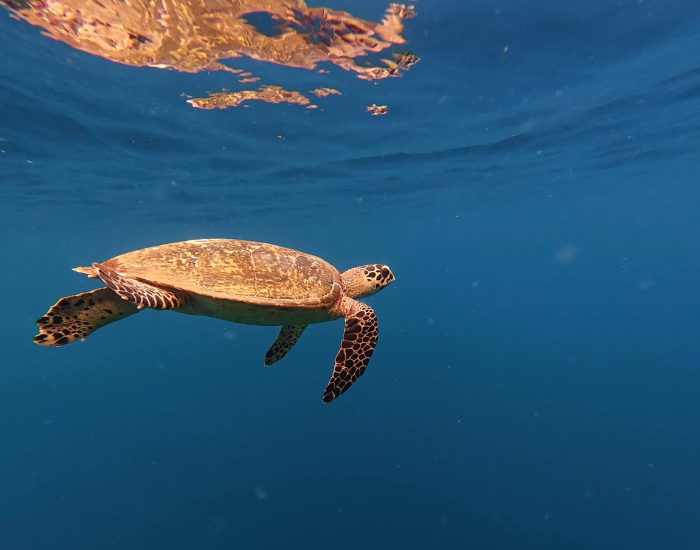
When we were walking on the beach, next to the rock pools, we found a dead sea turtle. Later, at Sandon River, we watched a live one swimming in the creek and lifting its head to breathe.
A carcass is grim, but it is still data, and the live animal confirmed the pattern. Green and loggerhead are the likeliest species on this coast, though I did not record enough detail to name either. If you find a stranded turtle, photograph it and report it rather than moving it.
8. Sooty Oystercatcher (Haematopus fuliginosus)
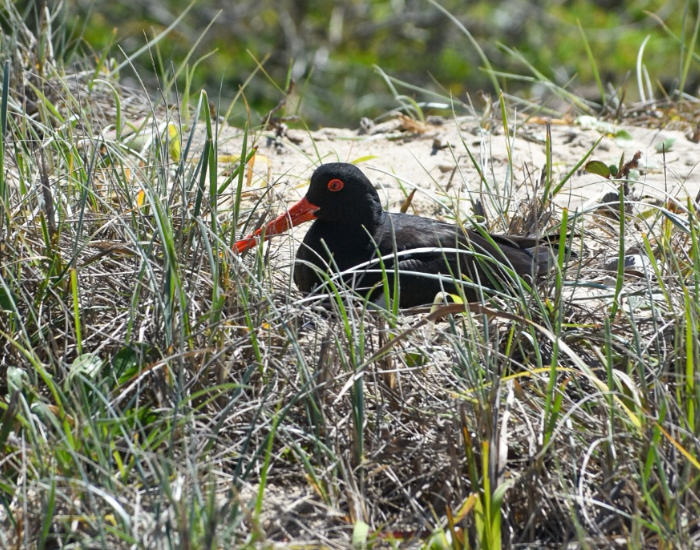
I found one on its nest near a beach access track, right beside a sign warning about breeding shorebirds. Watch your feet. On our last day two more worked the rock pools.
Those signs are not decoration. Schlacher and colleagues showed that heavy foot traffic on the upper beach halved the abundance of sand hoppers, a staple prey for beach-nesting birds. Trampling removes the food supply before it ever disturbs a bird. Therefore walking below the high-tide line is the simplest thing you can do here.
9. Whistling Kite (Haliastur sphenurus)
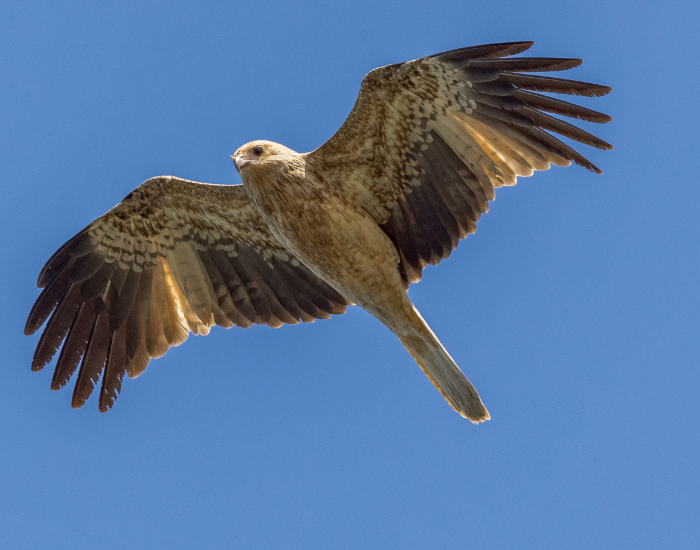
At Sandon River a whistling kite spent an entire day in a turf war with another raptor I could not identify. The two of them circled, stooped and called for hours, and the kite was genuinely loud. It is im
The Whistling Kite (Haliastur sphenurus) is neither a falcon nor a true eagle, though its relationship to eagles is a bit closer taxonomically than to falcons. That descending whistle is the field mark before you even raise binoculars. Whistling kites patrol estuaries and river mouths, taking fish, carrion and whatever the tide leaves stranded. Long aerial disputes like this usually mean a contested food source rather than a nest.
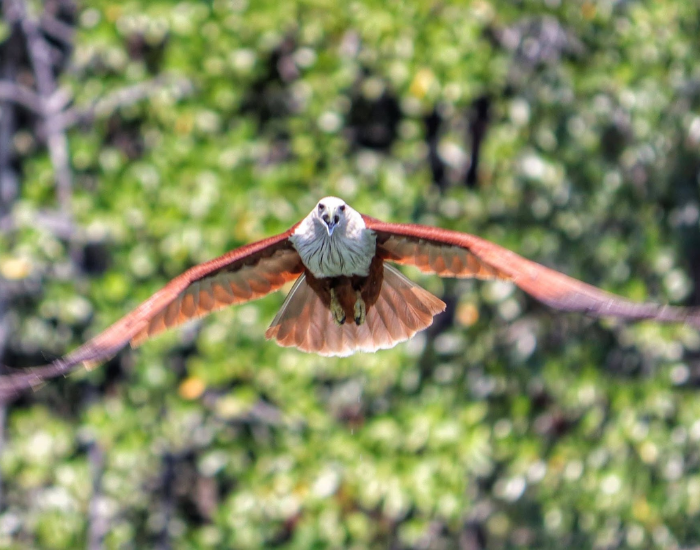
10. Brahminy Kite (Haliastur indus)
A brahminy kite quartered the air above Lake Arragan, low and slow, hunting the lagoon surface. Adults are unmistakable, with a white head and chest against rich chestnut wings.
They are coastal specialists. Estuaries, mangroves and lagoons suit them because they snatch prey off the surface rather than diving for it. A shallow, sheltered lagoon is close to ideal habitat. Scan above the lake mid-morning, once the thermals start working.
11. Superb Fairywren (Malurus cyaneus)
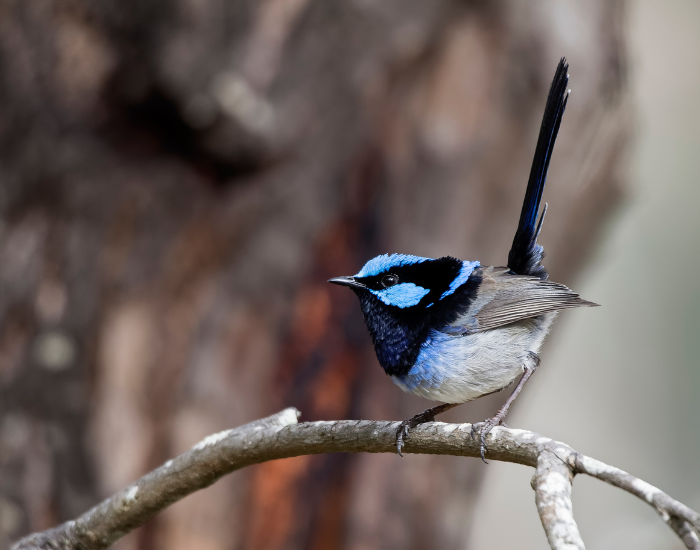
I always love seeing this type of wren. So small and loud. Three birds worked the scrub beside the toilet block, and occasionally the lake edge. Their call is a fast, high i-i-i that gives them away long before you see anything.
I always found the same pattern: one electric-blue male travelling with a plain brown bird. Those drab companions are usually females or non-breeding males, which is why colour alone makes a poor sex guide in this family. Sit still and let them come to you.
12. Red-backed Fairywren (Malurus melanocephalus)
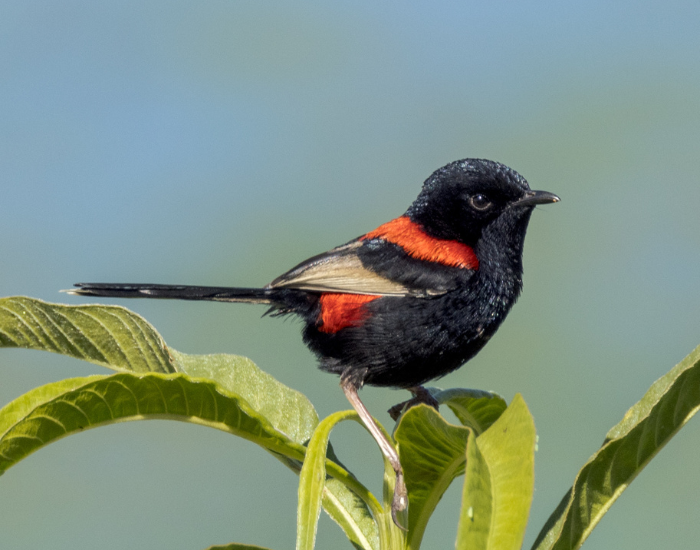
Two birds, same patch of scrub near the toilets, and the one species that genuinely beat me. I never managed a usable photo.
Males are tiny, glossy black with a scarlet saddle across the back. They forage in near-constant motion through low dense cover, so chasing them simply pushes them further in. This is the more northern of the two fairywrens here, favouring heath and rank grass over the superb fairywren’s tidier edges.
13. Eastern Whipbird (Psophodes olivaceus)
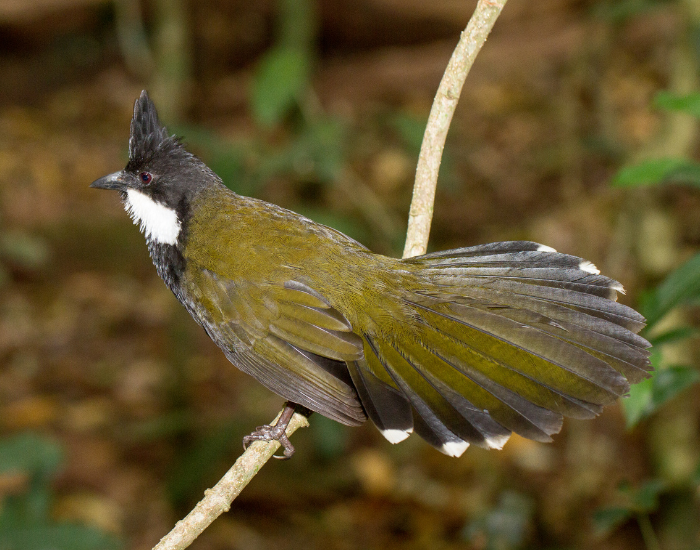
I never saw one. I heard them every single day, and that still counts.
The call is a long rising whistle followed by a crack, and nothing else in Australia sounds like it. It is a duet, not a solo: the male delivers the whip crack and the female answers with the short notes immediately after. Whipbirds skulk in dense undergrowth, which is why our birding for beginners guide puts calls before plumage.
14. Rufous Whistler (Pachycephala rufiventris)
Heard, never seen, and still one of the highlights. A rufous whistler sang at Lake Arragan one morning and stopped me mid-coffee, because it was my first for this trip.
The song is a rapid, ringing ee-chong that carries through the paperbarks. Males are grey above with a white throat, black breast band and rufous underparts. They hunt insects in the mid-storey rather than on the ground, which explains why the voice arrives long before the bird does.
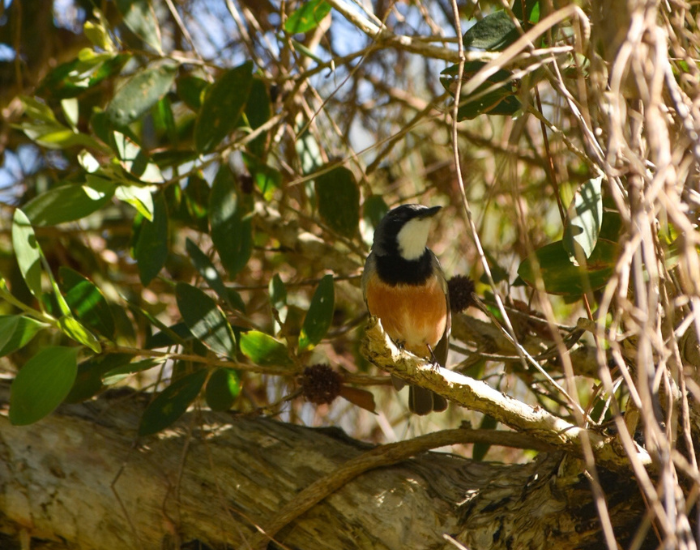
15. Grey Shrikethrush (Colluricincla harmonica)
Plain bird, extraordinary voice. This type of thrush is a repeat from the last stop: Evans head. The grey shrikethrush sang along the paperbark trail most mornings, and it is widely rated among Australia’s finest songsters.
Look for a soft grey-brown bird with a pale face and a heavy, hook-tipped bill. They glean insects from bark and branches, working methodically rather than darting. Learn this song alongside the whipbird and the rufous whistler, and the Lake Arragan dawn chorus suddenly becomes legible.
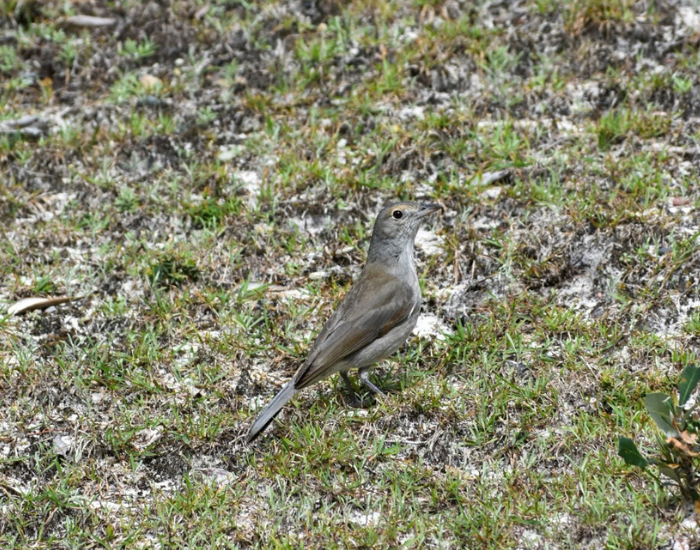
16. Laughing Kookaburra (Dacelo novaeguineae)
Four birds around the campground, mostly hunting the mown edges rather than laughing at us. They perch, tilt, then drop.
That drop is the whole design. Kookaburras are terrestrial kingfishers, and they take skinks, insects, small snakes and anything else that moves in short grass. Campground lawns concentrate exactly that prey. For more on the family, see our kookaburra facts guide.
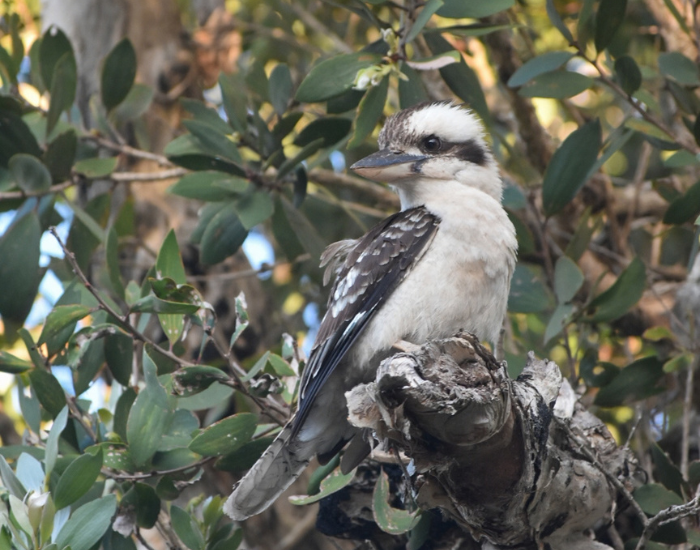
17. Crested Pigeon (Ocyphaps lophotes)
Once again, I encountered this type of pigeon. Eight of them worked the open ground at Red Cliff, and every flush came with that metallic whistle.
The whistle is not incidental noise. Murray, Zeil and Magrath showed that a modified eighth primary feather produces a distinct note on each downstroke, and that removing it destroys the alarm signal. Flee faster, and the tempo rises with the wingbeat. So a crested pigeon taking off is broadcasting genuine information about danger to the rest of the flock.
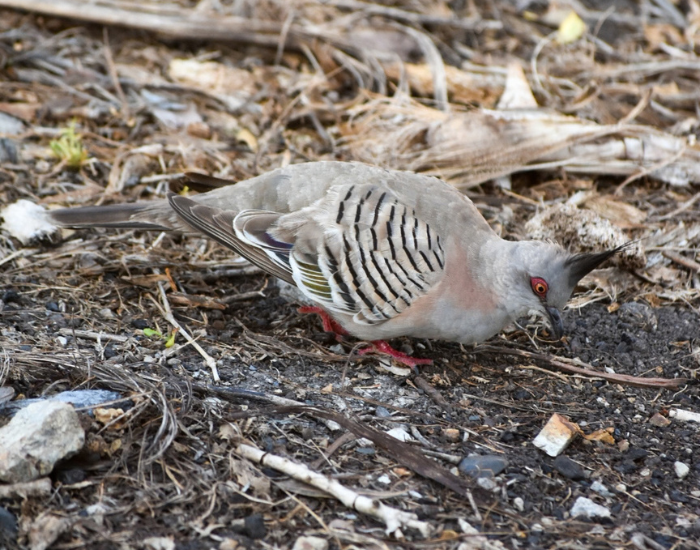
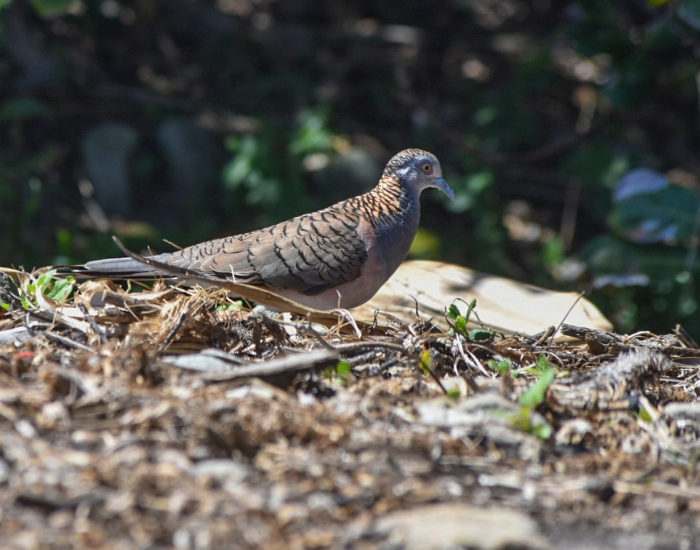
18. Bar-shouldered Dove (Geopelia humeralis)
My first bar-shouldered dove anywhere, and after missing it at two previous campgrounds I found three here.
The barred copper nape is the field mark, and the call is a rolling coo that ends like a question. It favours the damp margins between water and scrub, which is precisely what Lake Arragan supplies. Our guide to the pigeons of Australia sorts out the ones people confuse.
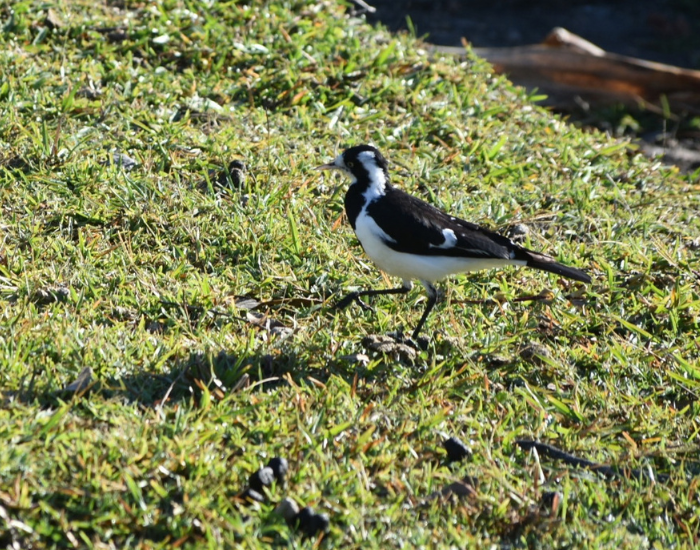
19. Magpie-lark (Grallina cyanoleuca)
One bird walked past site 33, next to the beach, and it did not show up until our final day.
Despite the name, this is not a magpie or a lark. Magpie-larks build heavy mud-cup nests and perform tight antiphonal duets, where partners alternate notes so fast the pair sounds like one bird. That duet is thought to advertise a bonded pair holding territory.
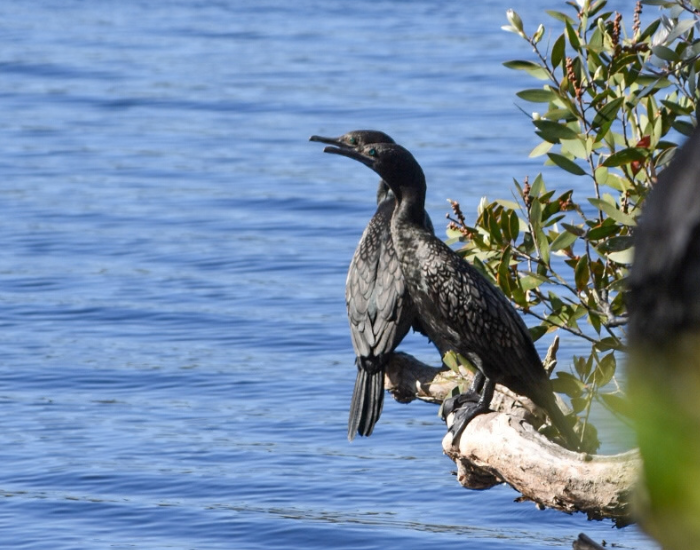
20. Little Black Cormorant (Phalacrocorax sulcirostris)
A group fished Lake Arragan together, following each other closely and flushing at the smallest movement. Skittish is the word.
The group behaviour matters. Little black cormorants often herd fish cooperatively, which works far better in a shallow lagoon than solo pursuit does. Their feathers are wettable by design, reducing buoyancy for the chase, so the spread-wing pose afterwards is drying rather than display.
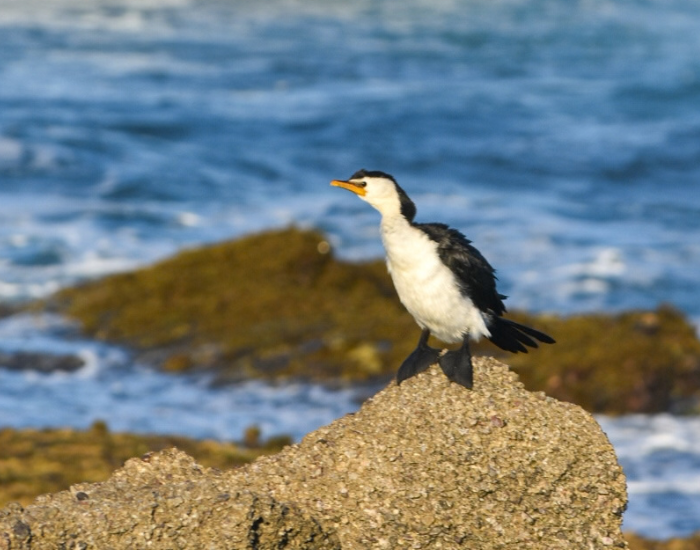
21. Pied Cormorant (Phalacrocorax varius)
Pied cormorants used both worlds here. I found them on the lake and also out on the beach, perched on a rock above the swell.
That flexibility separates them from the little black cormorant, which stuck to the lagoon. Pied cormorants are larger, boldly black-and-white, with orange-yellow facial skin at close range. They hunt alone more often, taking bigger prey in deeper water.
22. White-faced Heron (Egretta novaehollandiae)
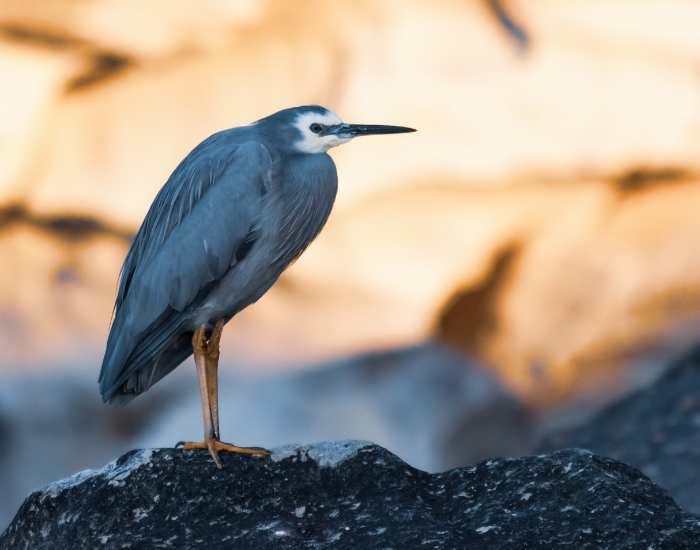
One bird hunted the lake margin most mornings, stalking slowly through the shallows on the paperbark side.
This is Australia’s most adaptable heron. Tidal flats, farm dams, roadside ditches and lagoon edges all work, which is why you see it almost everywhere. It hunts by patience, freezing for long stretches before a sudden strike. For the others on this coast, see our guide to the types of herons.
23. Australian King Parrot (Alisterus scapularis)
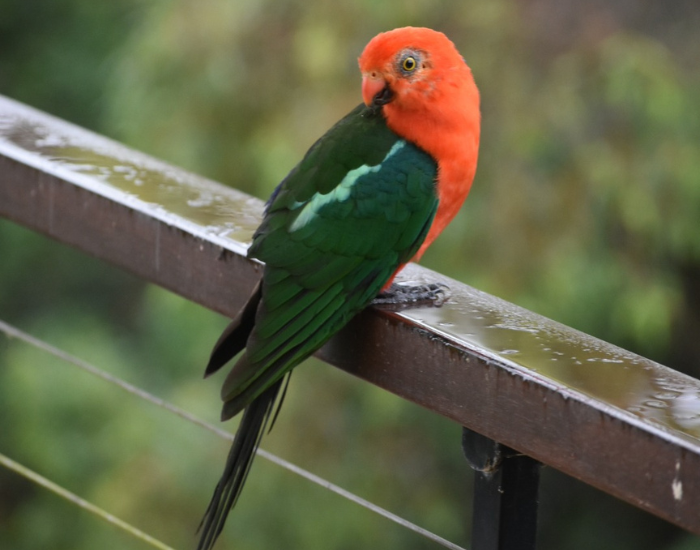
One morning on Lake Arragan I woke at 5:00 am. I was walking when I saw a male king parrot on the trail that runs to the end of the paperbark loop, early, when the bird noise peaks. My photo is a distant red and green blur, which is the honest result.
Males carry a completely scarlet head and chest. Females keep a green head with red confined to the belly, so a pair can look like two different species. They feed on seed and fruit high in the canopy, so go at first light and follow the calls upward.
24. Little Wattlebird (Anthochaera chrysoptera)
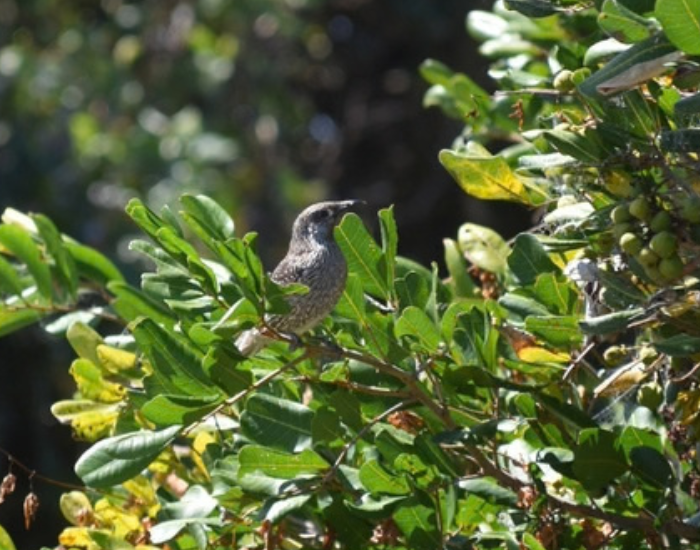
One bird, one visit, at the campground beside the beach. The rufous wing patch in flight is what clinched it for me.
Little wattlebirds are large, streaky honeyeaters with unmusical clucking calls and a fondness for banksia heath. They defend flowering shrubs aggressively against smaller honeyeaters. A single record here fits a bird passing through to check what was in bloom.
25. Brown Honeyeater (Lichmera indistincta)
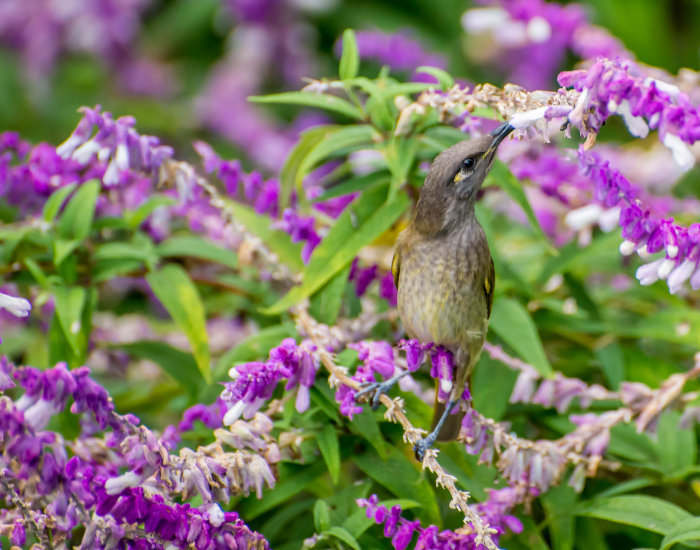
The plainest bird on this list, and one of the loudest. Brown honeyeaters worked the scrub around both camps.
Nothing about the plumage helps: small, olive-brown, with a modest yellow wing panel and a pale spot behind the eye. The song does the work instead, a rich descending series that carries much further than the bird’s size suggests. Please do not feed any of them, and our honeyeaters of Australia guide explains why sugar and dairy cause real harm.
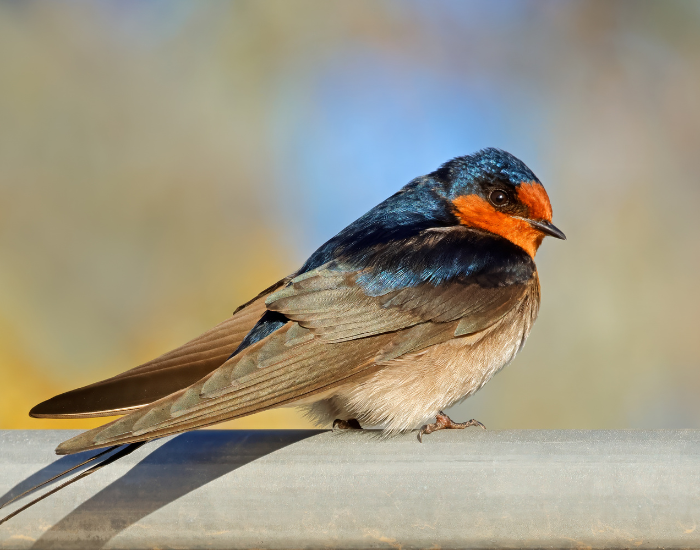
26. Welcome Swallow (Hirundo neoxena)
Welcome swallows hunted low over Santon River, cutting tight turns a few centimetres above the water and above the canopy.
They feed entirely on the wing, taking insects that rise off warm water late in the day. The forked tail and rusty throat separate them from martins at speed. They build mud-cup nests under ledges and structures, which is why campground amenities blocks often host a pair.
The Extra Night at Sandon River
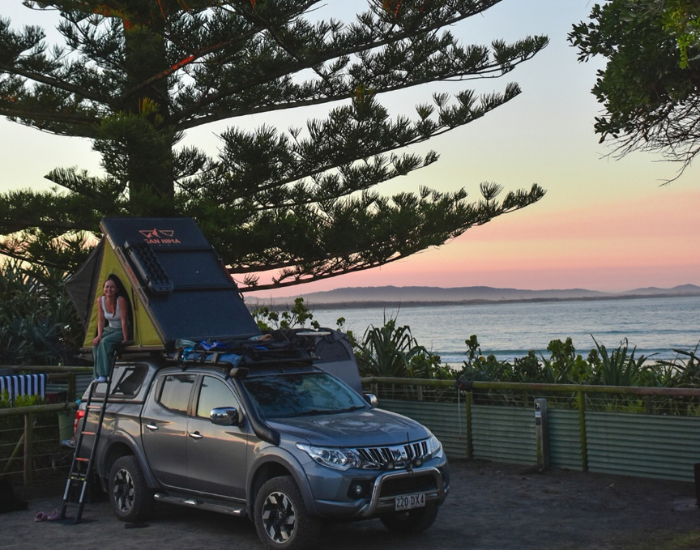
We added one night at Sandon River, 20 minutes south, and site 7 turned out to be the best pitch of the whole stop. From the roof tent you look straight out at the beach, the ocean and an island you can walk to at low tide. There is water on site, though not for drinking.
We crossed to that island and spent an hour over the rock pools. They were full of tiny fish, which is exactly what the literature predicts: White and colleagues found that pool depth and structural complexity drive how many fish a rock pool holds, and those sheltered pockets function as nurseries for newly settled juveniles. Watching it happen beats reading about it.
Where to Look Around Both Campgrounds
Dawn belongs to the paperbark trail at Lake Arragan. The whipbird, rufous whistler, grey shrikethrush, king parrot and both fairywrens all turn up within an hour of first light.
Mid-morning, switch to the lagoon for the brahminy kite, the cormorants, the heron and the swallows. Low tide sends you to the rock pools for the octopus and the oystercatchers. Head south to Red Cliff late in the day for panoramic coastal views, kangaroos on the grass, and whales offshore in season.
Frequently Asked Questions
Yes, and it is the better swim of the two. Lake Arragan is a small coastal lagoon surrounded by paperbarks, sheltered and shallow, and a great spot for canoeing, swimming, fishing and birdwatching. We swam there daily and used it for quick ecological washes. We did not swim at Red Cliff, because sharks are a genuine consideration on that open beach.
No. We showered on the lake or with our portable shower. Neither campground has showers. You get drop toilets, fire pits and picnic tables, and that is the full list of amenities. Plan for bush camping, bring a solar shower, and treat the lake as your wash-up option.
Not at the sites. There is a drinking water tap at the start of the dirt road into the park, which is roughly a 15-minute walk or a short drive. That gap matters more than it sounds, because once your awning is up and your gear is pegged down, nobody wants to break camp for a refill. We only used it because the wind forced us to move anyway. The toilets do have water for washing your hands.
Yes, in the provided fire pits, unless a fire ban applies. The manager of the parks goes aroun in his car selling wood. We bought 20 Kg for 20 AUD. Remember that collecting timber inside a national park is prohibited. Check the NSW Rural Fire Service danger rating before you travel, since total fire bans override campground rules.
Thoughts after Six Night
Twenty-six species came down to one accident. The wind pushed us 400 metres inland, and the list changed completely, because a paperbark lagoon and an exposed grassy clifftop are not the same habitat in different weather.
So book both if you can, and treat it as two trips rather than one. Two warnings before you go: the cliffs here are unstable, so stay well back from the edges and supervise children, and take the forecast seriously, because the wind is real. Pack water for the 10km coastal walk to Angourie if you are feeling energetic.
Tell me in the comments what you found, especially that second raptor at Sandon River. To go deeper, start with our guide to Australian native birds or the wider list of the best places to see wildlife in Australia.
Animals of Lake Arragan & Red Cliff Photo ID 🦘
A 15-photo identification challenge — test your ability to spot coastal birds, reptiles, and marine life from Yuraygir National Park. Go back and change any answer before you score.
Which species is this?
References:
Godfrey-Smith, P., Scheel, D., Chancellor, S., Linquist, S., & Lawrence, M. (2022). In the line of fire: Debris throwing by wild octopuses. PLOS ONE, 17(11), e0276482. https://doi.org/10.1371/journal.pone.0276482
Murray, T. G., Zeil, J., & Magrath, R. D. (2017). Sounds of modified flight feathers reliably signal danger in a pigeon. Current Biology, 27(22), 3520–3525.e4. https://doi.org/10.1016/j.cub.2017.09.068
Noad, M. J., Kniest, E., & Dunlop, R. A. (2019). Boom to bust? Implications for the continued rapid growth of the eastern Australian humpback whale population despite recovery. Population Ecology, 61(2), 198–209. https://doi.org/10.1002/1438-390X.1014
Scheel, D., Chancellor, S., Hing, M., Lawrence, M., Linquist, S., & Godfrey-Smith, P. (2017). A second site occupied by Octopus tetricus at high densities, with notes on their ecology and behavior. Marine and Freshwater Behaviour and Physiology, 50(4), 285–291. https://doi.org/10.1080/10236244.2017.1369851
Schlacher, T. A., Carracher, L. K., Porch, N., Connolly, R. M., Olds, A. D., Gilby, B. L., Ekanayake, K. B., Maslo, B., & Weston, M. A. (2016). The early shorebird will catch fewer invertebrates on trampled sandy beaches. PLOS ONE, 11(8), e0161905. https://doi.org/10.1371/journal.pone.0161905
White, G. E., Hose, G. C., & Brown, C. (2015). Influence of rock-pool characteristics on the distribution and abundance of inter-tidal fishes. Marine Ecology, 36(4), 1332–1344. https://doi.org/10.1111/maec.12232