

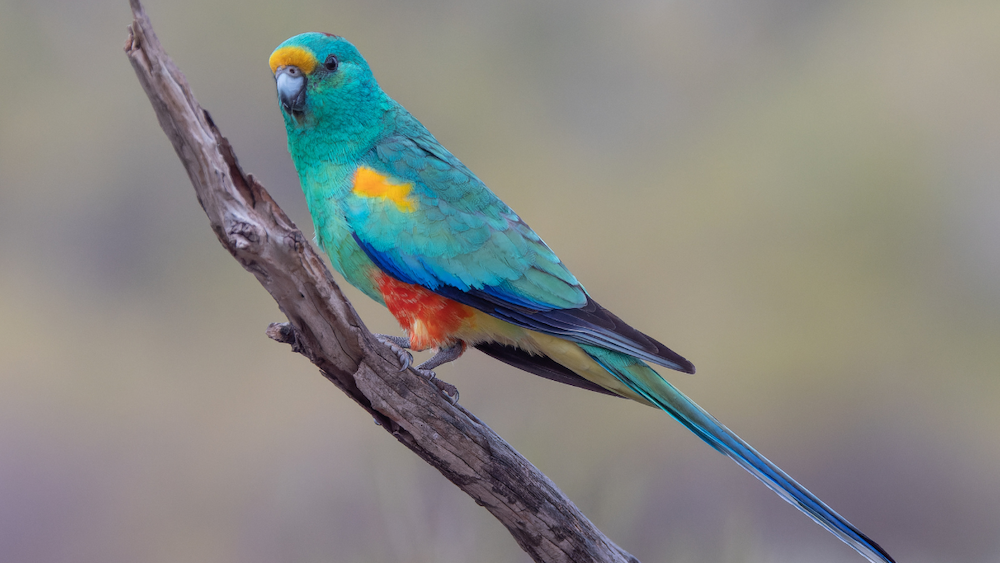
The first Australian parrots I met were white. Sulphur-crested cockatoos screamed over Sydney rooftops, and galahs turned up in pink and grey. As a biologist and a newcomer, I wanted to know what separated one white cockatoo from the next. Black cockatoos, by contrast, felt almost mystical. I spotted them only twice in nearly two years.
Then I moved to the Gold Coast, and rainbow lorikeets took over my mornings. Western Australia later showed me parrots I had never seen in the east. Now, on our lap around Australia, I’ve met my first scaly-breasted lorikeets. I’ve also watched an eastern rosella at Trial Bay Gaol and more black cockatoos than I can count.
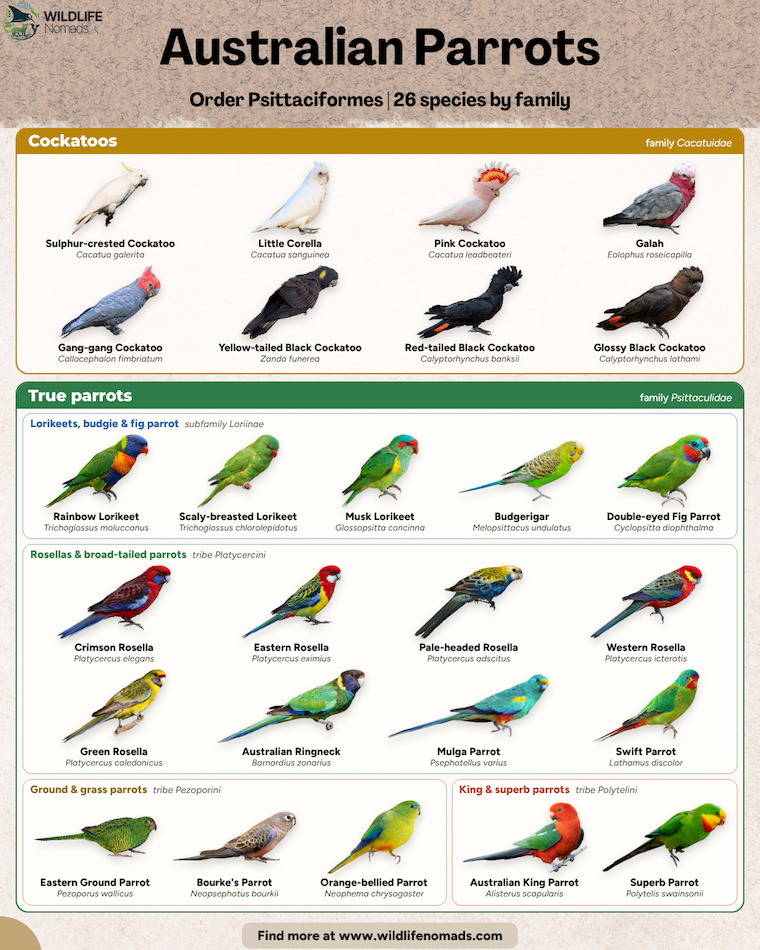
This guide sorts Australia’s parrots into five simple groups. You’ll learn what a cockatoo actually is, why lorikeets lick instead of crack, and which species need our help most.
Why Australia Is Called the Land of Parrots
Early colonists nicknamed Australia “Parrot Land”, and the name still fits. The continent holds 56 native parrot species out of roughly 330 worldwide. Even more striking, only five of those 56 also live outside Australia.
That diversity spans almost every habitat. Fig parrots work the rainforest canopy of Far North Queensland. Rosellas pick grass seeds in the open woodlands of Victoria. Meanwhile, budgerigars and cockatiels roam the semi arid regions of the interior, tracking rainfall.
Diet explains much of that variety. Australian parrots have beaks built for cracking nuts, digging roots, prising grubs from wood and licking nectar. Their zygodactyl feet, with two toes forward and two back, let them hold food like a hand.
Most species also share one critical need: tree hollows. Many lay their eggs in deep vertical hollows inside mature or dead eucalypts. Those hollows take a century or more to form. As a result, land clearing removes nesting sites far faster than forests can replace them.
Cockatoo, Parrot or Lorikeet? A Quick Family Tree
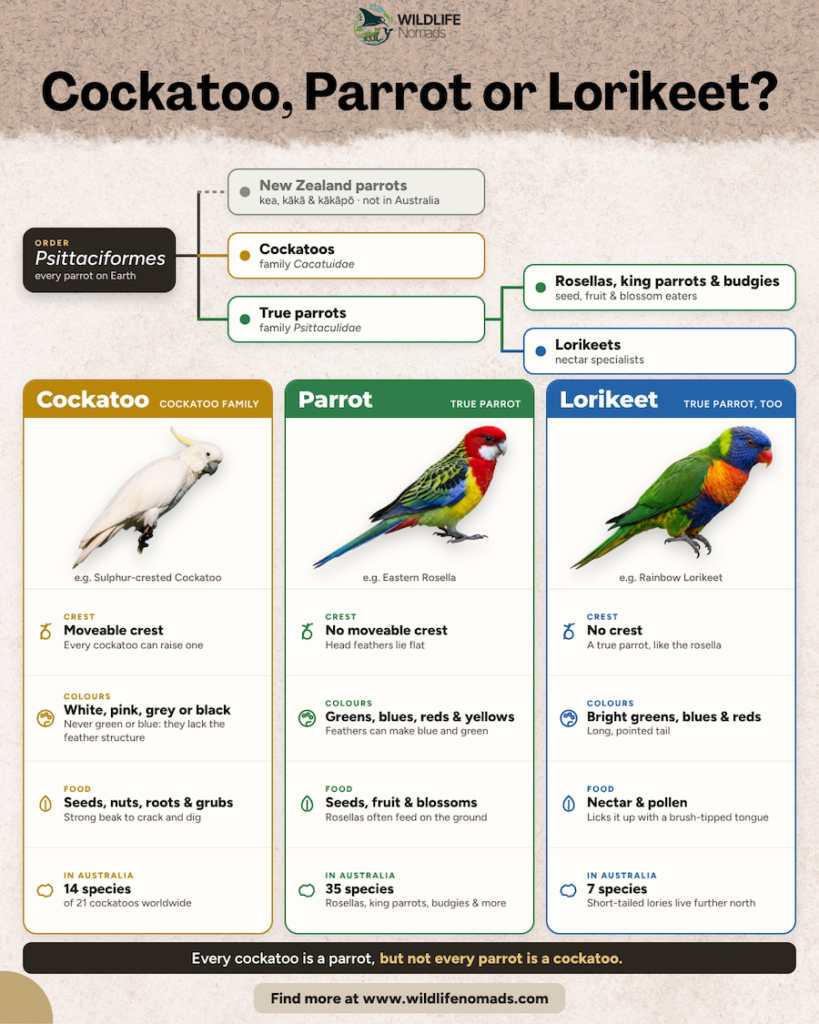
All parrots belong to the order Psittaciformes. Scientists split it into three branches. One holds New Zealand’s kea and kākāpō. The other two are the cockatoo family and the true parrots.
Cockatoos are generally larger, long-lived birds with expressive head crests and powder-down feathers. Interestingly, they lack the feather structure that creates blue and green colours. That’s why you’ll never see a green cockatoo.
Lorikeets, rosellas, budgies and king parrots are all true parrots. “Lory” versus “lorikeet” mostly comes down to the tail: lories have short, rounded tails, while lorikeets have long, pointed ones. Australia only has lorikeets, while the true lories live in Papua New Guinea and Indonesia.
Cockatoos: The Crested Parrots of Australia
Australia is home to 14 of the world’s 21 cockatoo species. They range from the little cockatiel to the palm cockatoo of Cape York, a large parrot that reaches 60 cm. Most nest in tree hollows, form lasting pair bonds and live for decades.
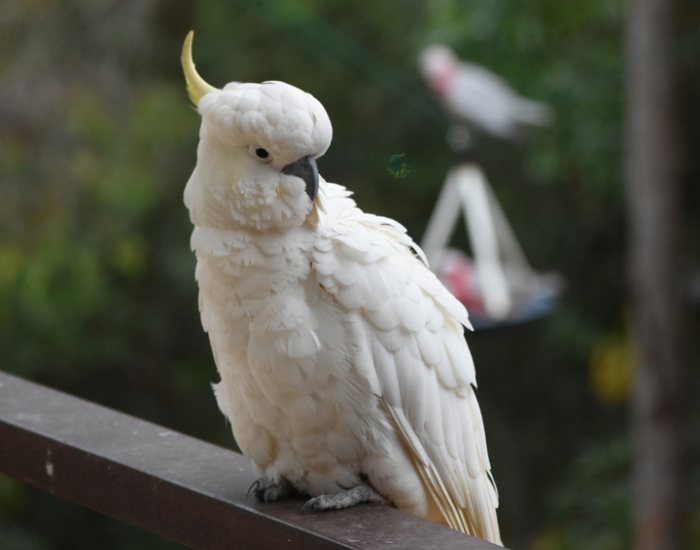
1. Sulphur-crested Cockatoo (Cacatua galerita)
The sulphur crested cockatoo is a common sight across eastern Australia, from far north Queensland to Tasmania. Its yellow crest flicks up whenever the bird gets excited, which happens often. These birds are also clever problem solvers. In Sydney, they learned to flip open wheelie bin lids, and the trick spread between suburbs.
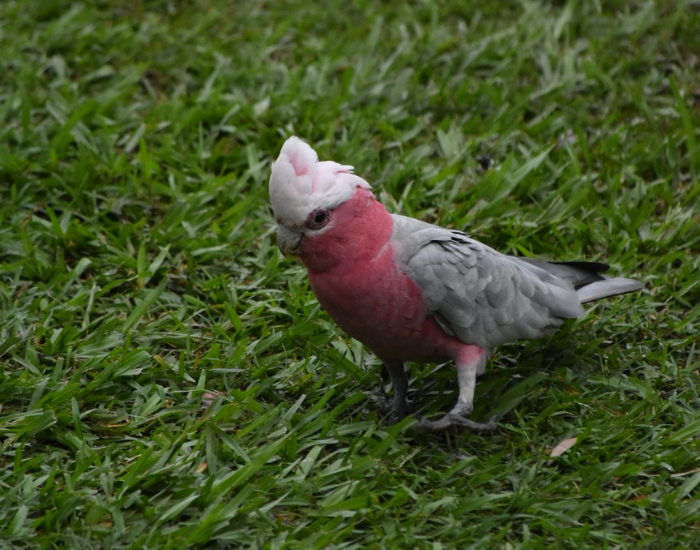
2. Galah (Eolophus roseicapilla)
Galahs were among my first Sydney parrots, and they’ve followed me up the coast to Illaroo and Pebbly Beach. Rose-pink faces and grey backs make them easily recognised. Because they feed mostly on the ground, clearing and new water points helped them spread across the continent.
3. Pink Cockatoo (Cacatua leadbeateri)
You may know this bird as Major Mitchell’s cockatoo. BirdLife Australia restored its older name, pink cockatoo, in 2023. Its crest unfolds into bands of red and yellow, the only multicoloured crest among cockatoos. It favours mulga and mallee country and is now listed as Endangered nationally.

4. Little Corella (Cacatua sanguinea) and Long-billed Corella
Little corellas are small white cockatoos with a bare blue eye ring and a short crest. They gather in noisy flocks across inland Australia and, increasingly, in towns. The long billed corella (Cacatua tenuirostris) of south eastern Australia carries a longer upper bill. It uses that bill to dig roots and bulbs from the soil.
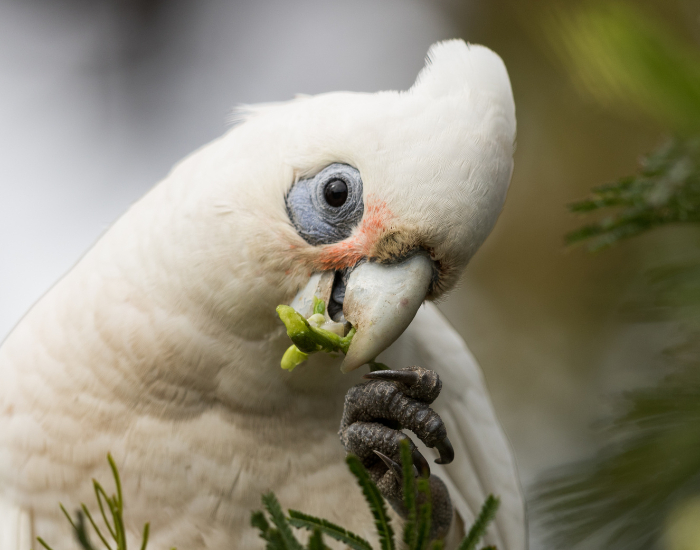
5. Yellow-tailed Black Cockatoo (Zanda funerea)
Yellow-tailed black cockatoos have ruled the lap so far. At Red Cliff they perched right outside the toilet block. At Illaroo, dozens flew over calling and feeding on banksias. Look for yellow cheek patches and yellow tail panels. They also tear open branches to reach insect larvae, so you often hear them before you see them.
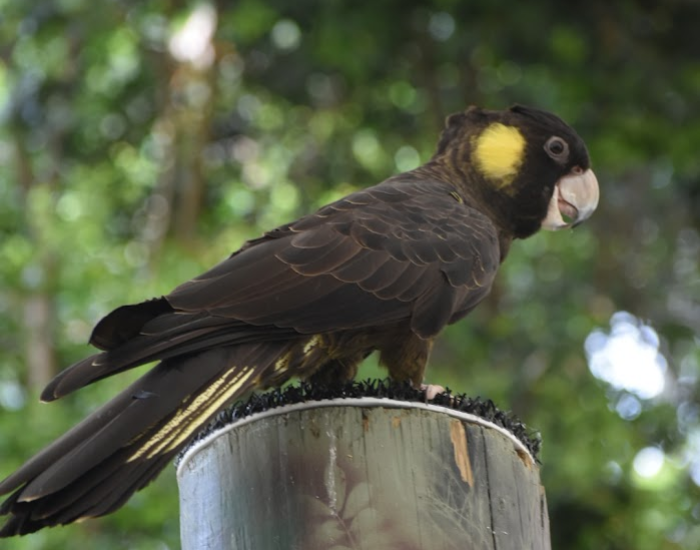
6. Glossy Black Cockatoo (Calyptorhynchus lathami)
At around 46 to 50 cm, the glossy black cockatoo is the smallest black cockatoo. It feeds almost entirely on she-oak cones, and females wear patchy yellow on the head. The south-eastern sub species is listed as Vulnerable. An isolated population also survives on Kangaroo Island in South Australia.
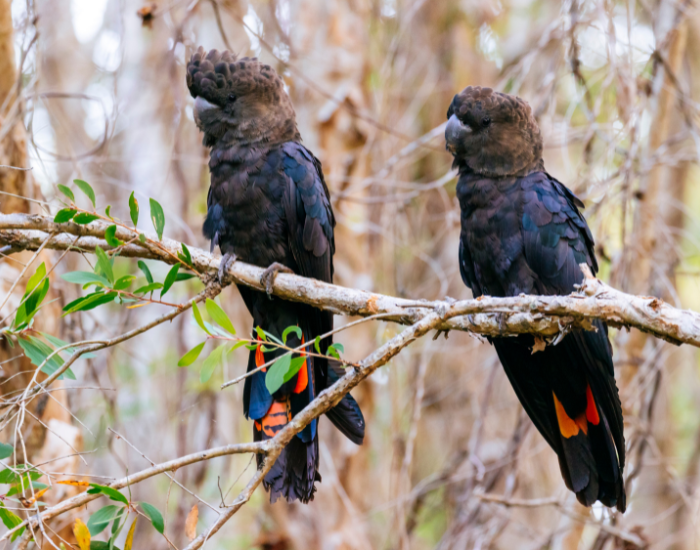
7. Red-tailed Black Cockatoo (Calyptorhynchus banksii)
Red-tailed black cockatoos reach about 60 cm. Males flash scarlet tail panels in flight, while females are barred with yellow-orange. Several races occur across the Northern Territory, northern Australia and the south west corner of Western Australia.
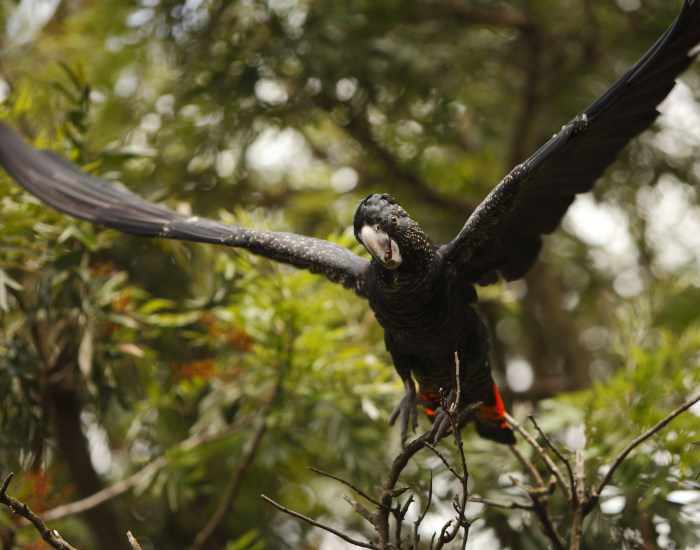
8. Carnaby’s and Baudin’s Black Cockatoos
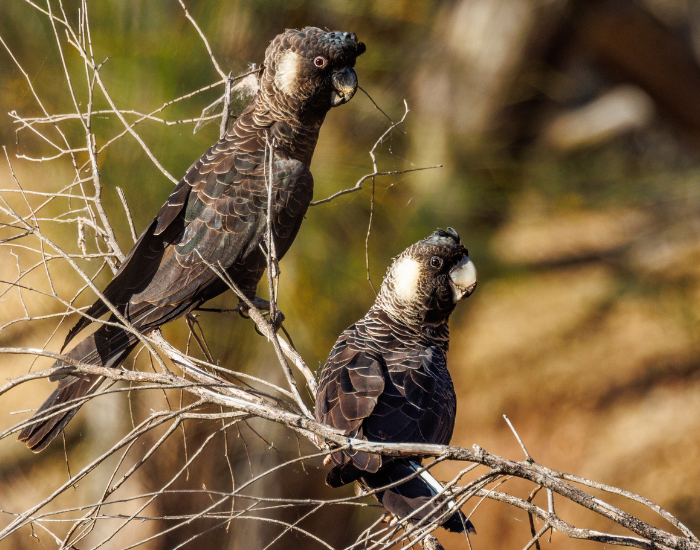
These two white-tailed black cockatoos live only in south-western Australia. Carnaby’s black cockatoo (Zanda latirostris) has a short bill and is listed as Endangered due to habitat loss. Baudin’s black cockatoo (Zanda baudinii) uses a longer bill to prise seeds from marri nuts. The IUCN lists it as Critically Endangered. Older estimates put the total at 10,000 to 15,000 birds, but BirdLife now estimates about 3,250 mature adults.
9. Gang-gang Cockatoo (Callocephalon fimbriatum)
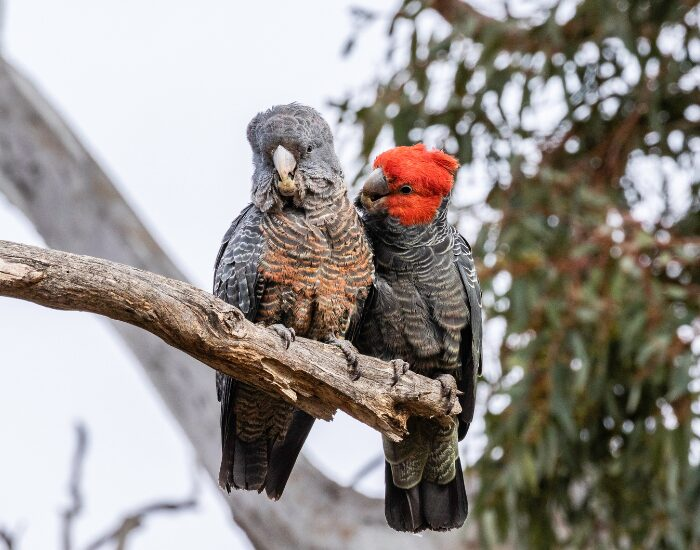
The gang gang cockatoo’s call sounds like a creaky gate. Males wear a scarlet head with a wispy crest, while females are grey. They live in the mountain forests of south eastern Australia. After the 2019–20 bushfires burned a large part of their range, the federal government listed them as Endangered in 2022.
Lorikeets: Australia’s Nectar Specialists
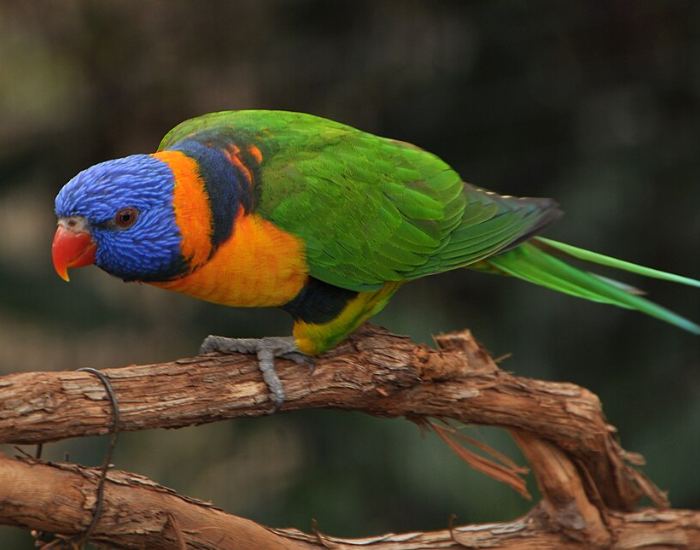
Seven lorikeet species live in Australia. Rather than cracking seeds, they lick. Each carries a brush-tipped tongue that mops up nectar and pollen. That puts them in direct competition with honeyeaters at every flowering gum.
10. Rainbow Lorikeet (Trichoglossus moluccanus)
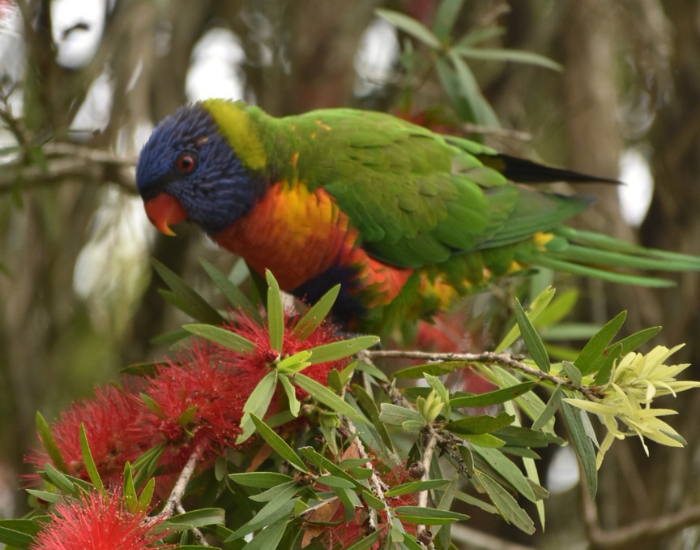
Rainbow lorikeets became my daily alarm clock on the Gold Coast. They’re common along the eastern seaboard, from Cape York to South Australia. A blue head, orange-red chest and green back make them unmistakable.
11. Scaly-breasted Lorikeet (Trichoglossus chlorolepidotus)
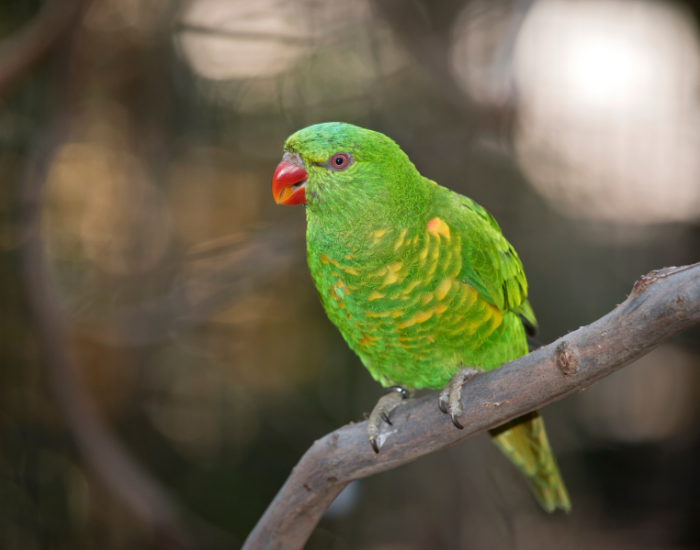
I saw my first scaly breasted lorikeets on this lap, and at a glance they look like rainbows. Look closer and the bird is all green, with yellow breast feathers edged in green. That pattern gives it a scaly appearance. They range from north Queensland through northern New South Wales. I have seen them in Bellingen and Nambucca Heads.
12. Red-collared Lorikeet (Trichoglossus rubritorquis)
Once treated as a race of the rainbow lorikeet, the red collared lorikeet is now its own species. An orange-red collar across the nape gives it away. It prefers the forests and woodlands of the Kimberley, the Top End and north-west Queensland.
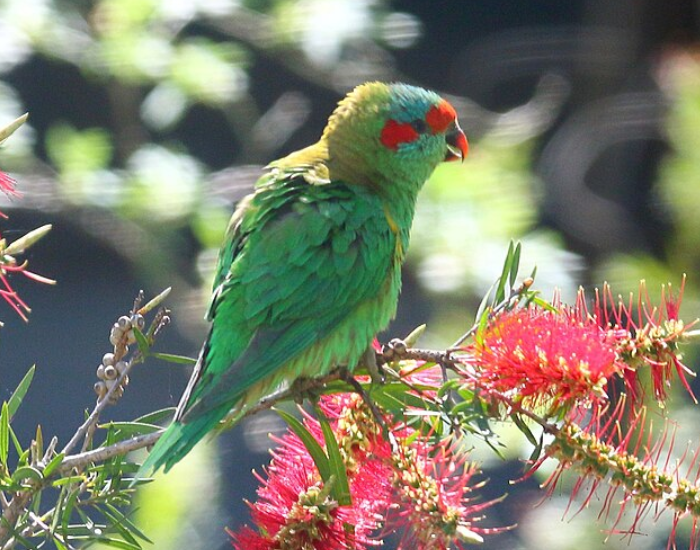
13. Musk Lorikeet (Glossopsitta concinna)
Musk lorikeets are common throughout south-eastern Australia, including Victoria, South Australia and Tasmania. Look for a red forehead and a red band through the ear coverts.
Rosellas: The Broad-tailed Parrots
Australia has six rosella species, all in the genus Platycercus. Look for coloured cheek patches and a scalloped back, where each dark feather has a paler edge. Rosellas eat grass seeds, fruit and blossoms, often on the ground.
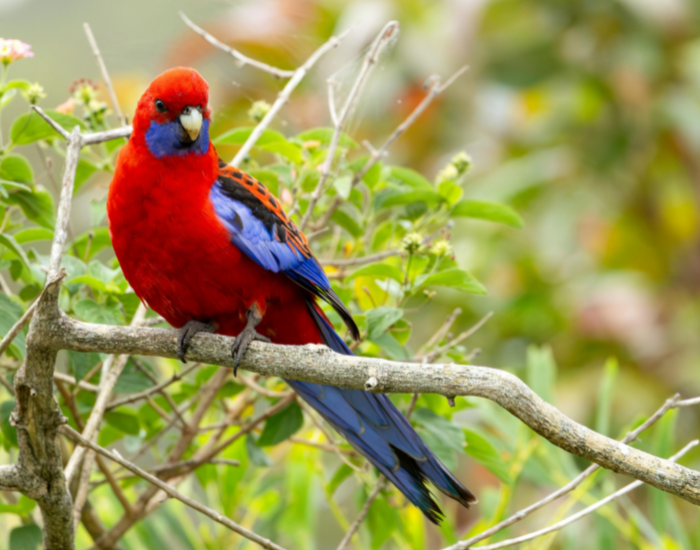
14. Crimson Rosella (Platycercus elegans)
Deep red with violet-blue cheeks, the crimson rosella brightens forests from north Queensland to South Australia. It also comes in several races that look like different birds. The yellow rosella of the Murray River and the orange-washed Adelaide rosella both belong to this one species.
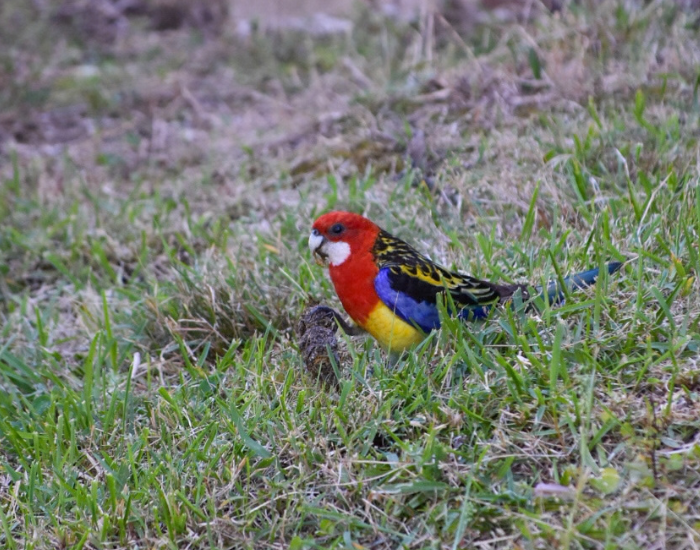
15. Eastern Rosella (Platycercus eximius)
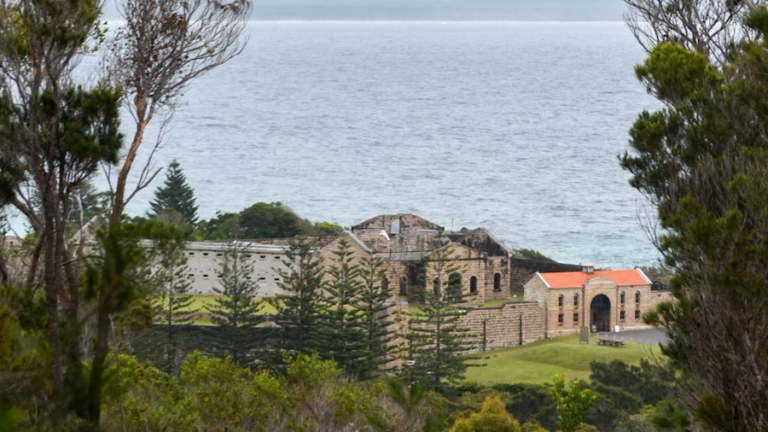
The eastern rosella I watched at Trial Bay Gaol was one of the most beautiful birds of the trip. A red head, white cheeks and a yellow belly make it the showiest rosella. It’s widespread across the eastern states and Tasmania. Settlers also introduced it to New Zealand, where it still thrives.
16. Pale-headed Rosella (Platycercus adscitus)
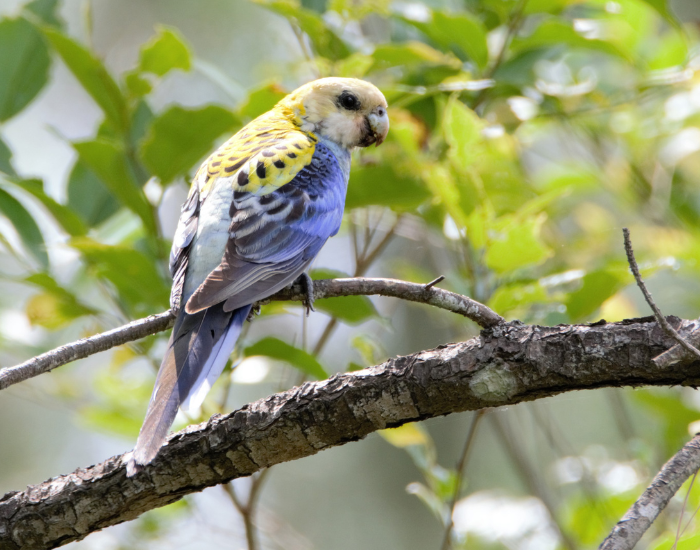
The pale headed rosella swaps the red head for pale yellow-white. Its cheeks are white above and blue below. It replaces the eastern rosella through Queensland and northern NSW, and the two hybridise where they meet.
17. Western Rosella (Platycercus icterotis)
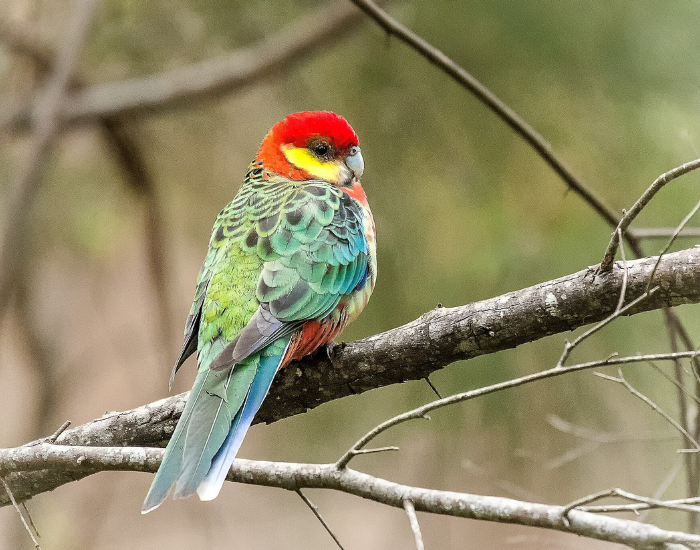
The western rosella is the smallest of the group and lives only in south-western Australia. Males show a red head and bright yellow cheeks, while females are duller and greener.
18. Green Rosella (Platycercus caledonicus)
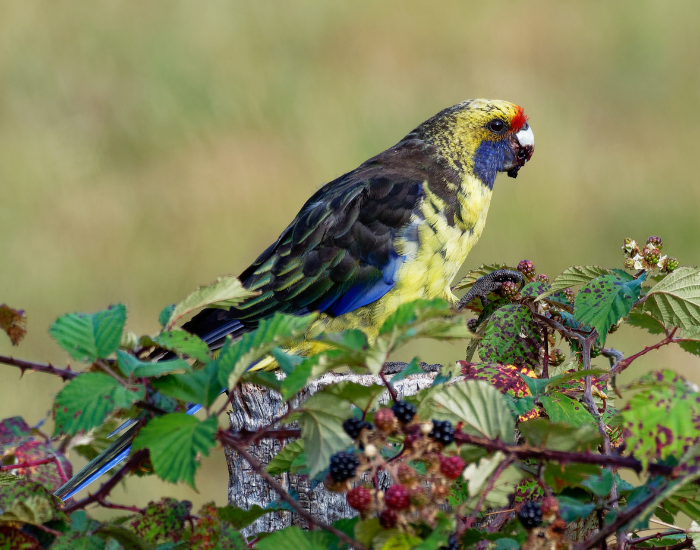
Tasmania’s endemic green rosella is the largest rosella. It’s yellow-green below, with blue cheeks and a red forehead.
Ground and Grass Parrots: The Hard Ones to Find
This group includes the ground parrots, the night parrot, Bourke’s parrot and the six Neophema grass parrots. Most feed low on seeds and rely on camouflage. It also holds some of the rarest birds on Earth.
19. Eastern Ground Parrot (Pezoporus wallicus)
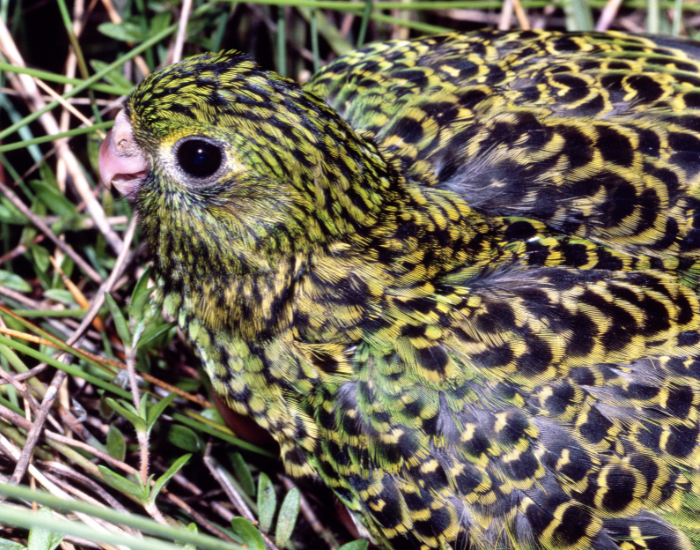
Eastern ground parrots spend almost their entire lives on the ground in coastal heath. Barred green-and-yellow plumage blends into the vegetation perfectly. Most birders only see one when it flushes from underfoot.
20. Bourke’s Parrot (Neopsephotus bourkii)
Bourke’s parrot is a soft pinkish-brown bird of the arid interior. It drinks at dawn and dusk, often in near darkness. Small flocks feed quietly on grass seeds beneath mulga and other acacias.
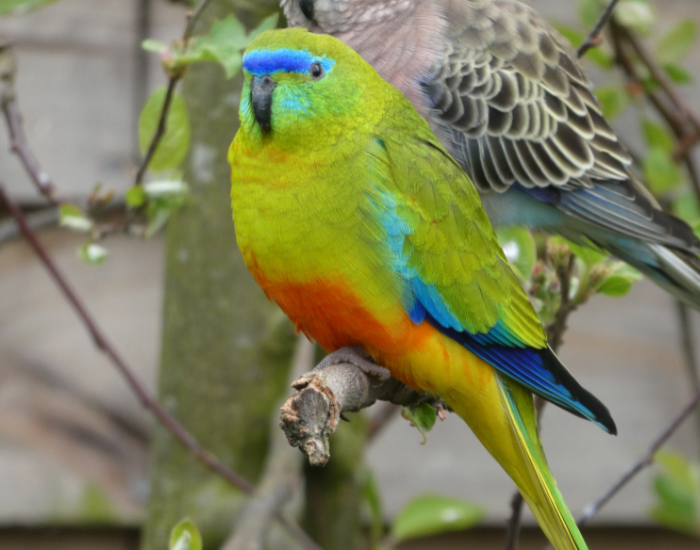
21. Orange-bellied Parrot (Neophema chrysogaster)
This tiny grass parrot breeds only at Melaleuca in south-west Tasmania. It winters on the coasts of Victoria and South Australia. In 2016, the wild population fell to just 17 birds. Captive releases have since rebuilt it, and 86 birds returned for the December 2025 census.
The paradise parrot (Psephotellus pulcherrimus) shows where that path can end. The IUCN lists it as extinct, with no confirmed sighting since 1927. Its story is why parrots feature among the most threatened animals in Australia.
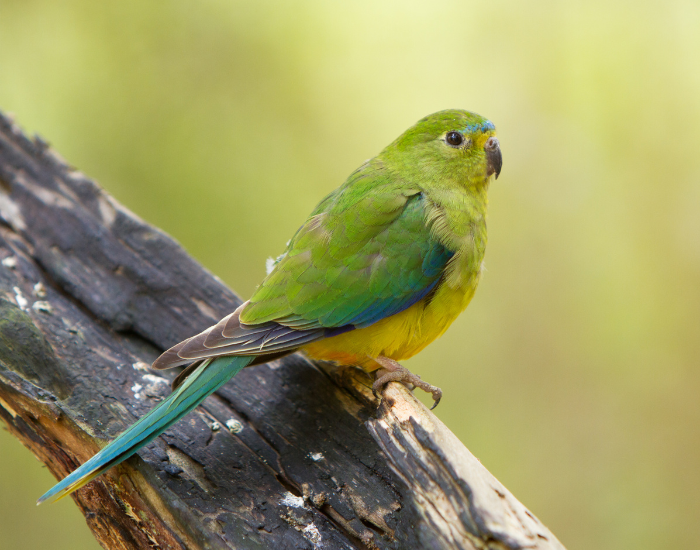
Long-tailed Parrots, King Parrots and Budgerigars
The remaining 20-odd species form a mixed group of long-tailed woodland parrots and small inland nomads. In many, the male is far brighter than the female.
22. Australian King Parrot (Alisterus scapularis)
The male king parrot is unmistakable, with a scarlet head and chest and green wings. Females are mostly green. They live in the wet forests of the east coast, from north Queensland to Victoria.
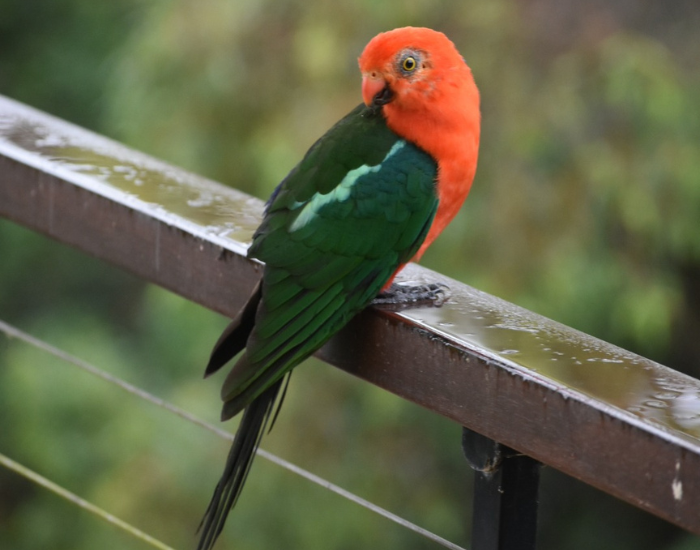
23. Superb Parrot (Polytelis swainsonii)
The male superb parrot has a yellow face and a red band across the throat. Pairs nest in river red gum hollows in inland New South Wales and northern Victoria. The species is listed as Vulnerable after clearing removed much of its woodland.
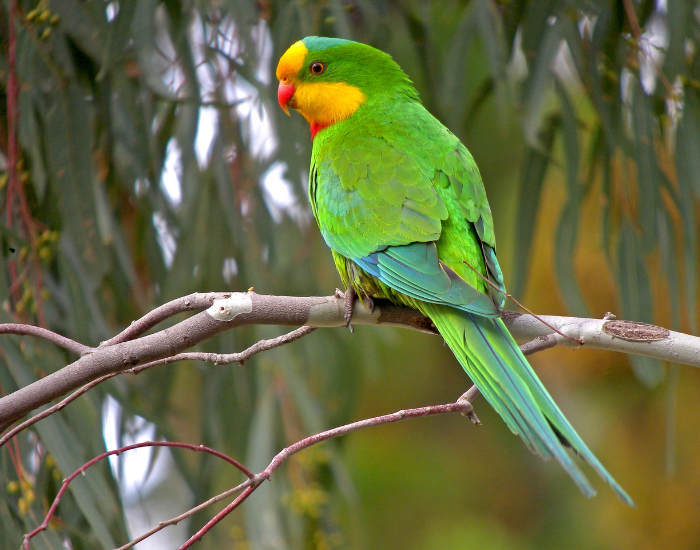
24. Budgerigar (Melopsittacus undulatus)
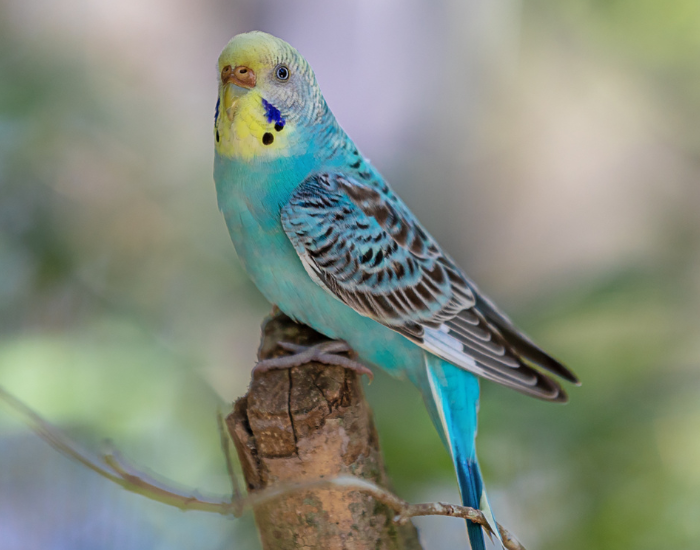
Wild budgerigars are green and yellow, not blue. Budgies are nomads, moving across the outback to wherever rain has produced grass seeds. After big rains, flocks can swell into the tens of thousands.
The cockatiel (Nymphicus hollandicus) shares that lifestyle, yet it’s actually the smallest member of the cockatoo family. Its crest is the giveaway.
25. Australian Ringneck (Barnardius zonarius)
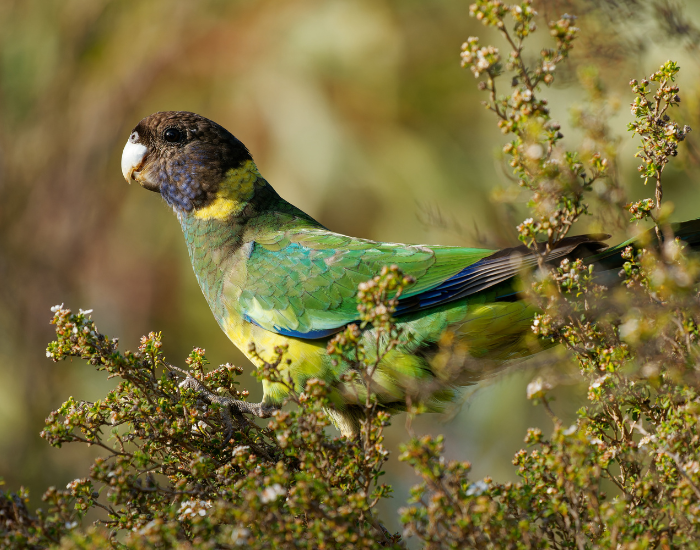
The Australian ringneck wears a yellow collar and comes in several races. The mallee ringneck lives in the inland mallee of the eastern states. Meanwhile, the twenty eight parrot of the south-west is named after its call.
26. Red-capped Parrot and Mulga Parrots
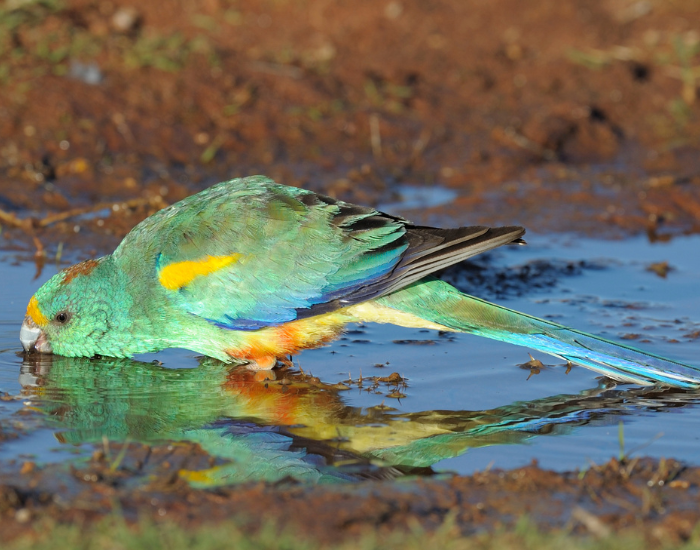
The red capped parrot (Purpureicephalus spurius) uses a long, narrow bill to extract seeds from marri nuts in the south-west. Mulga parrots (Psephotellus varius) are its inland counterpart, feeding in mulga and saltbush country.
27. Swift Parrot (Lathamus discolor)
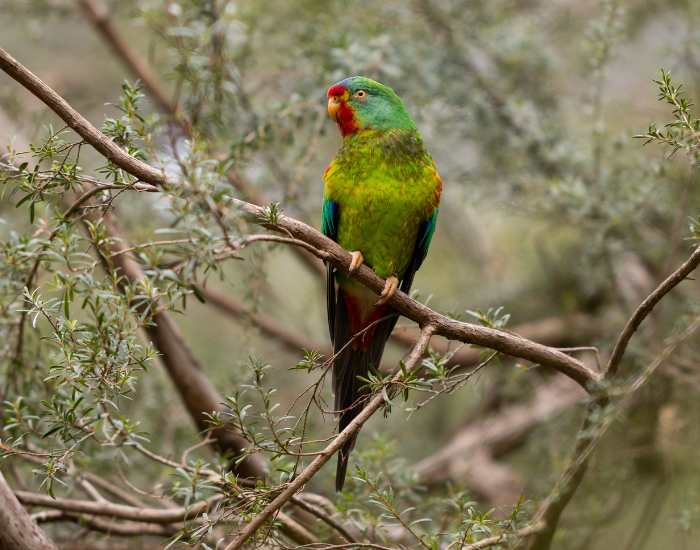
The swift parrot feeds on nectar like a lorikeet. It breeds in Tasmania and migrates to the mainland each winter. Introduced sugar gliders raid its nests, and logging removes its hollows. Genetic research now suggests only about 500 swift parrots remain. Predator-free Maria Island has become one of its safest nesting sites.
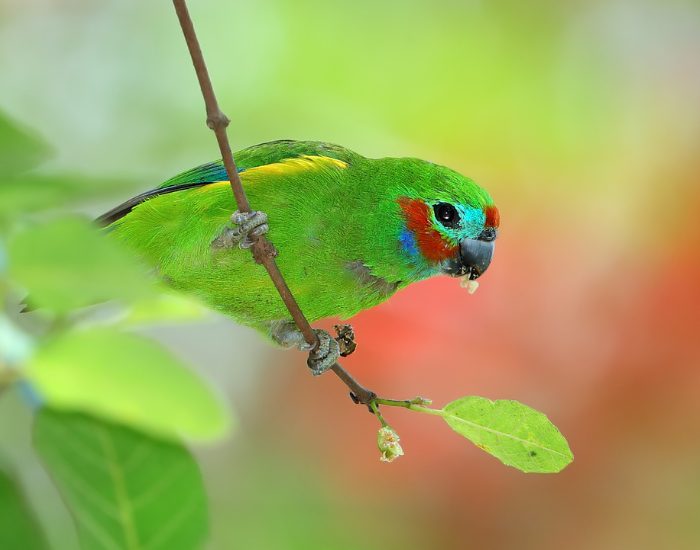
28. Double-eyed Fig Parrot (Cyclopsitta diophthalma)
At about 14 cm, the double-eyed fig parrot is Australia’s smallest parrot. It lives in the rainforests of north-eastern Australia and New Guinea. It even excavates its own nest hole in rotting wood.
Australian Parrot Groups at a Glance
| Group | Species in Australia | Main food | Key feature |
|---|---|---|---|
| Cockatoos | 14 | Seeds, nuts, bulbs, wood-boring grubs | Moveable head crest |
| Lorikeets | 7 | Nectar, pollen, fruit | Brush-tipped tongue |
| Rosellas | 6 | Grass and tree seeds, fruit | Cheek patches, scalloped back |
| Ground and grass parrots | ~9 | Low seeds, foliage | Camouflage, ground-dwelling |
| Woodland parrots, budgies and allies | ~20 | Seeds, blossoms, nectar | Long tails, brighter males |
Frequently Asked Questions
Australia has 56 native parrot species, including 14 cockatoos and seven lorikeets. That’s roughly one in six of the world’s parrots.
Every cockatoo is a parrot, but not every parrot is a cockatoo. Cockatoos form their own family, with moveable crests and no blue or green feathers. Lorikeets, rosellas and budgies are true parrots.
The night parrot, swift parrot and orange-bellied parrot are among the rarest. Researchers estimate about 500 swift parrots, and 86 orange-bellied parrots returned to Tasmania in late 2025. Nobody knows how many night parrots survive.
The double-eyed fig parrot is the smallest at about 14 cm. Among cockatoos, the cockatiel is the smallest.
No. Rainbow lorikeets are native to eastern Australia, and Perth’s population descends from escaped or released birds. Western Australia’s native equivalent is the red-collared lorikeet of the Kimberley.
Five Years In, Still Learning Their Names
Australian parrots make sense once you see the pattern. Cockatoos crack, lorikeets lick, rosellas glean and ground parrots hide. Five years ago, every white bird looked the same to me. Now a yellow cheek or a scaly breast tells me exactly who I’m watching.
That’s the joy of the lap. Nearly every stop adds a parrot to the list, and we log every species on our Australia lap page. If you’re interested in following along, the map on our website updates as we go. Tell me in the comments which parrot visits your backyard. Or grab my birding for beginners guide and start your own list of Australian native birds.
Wildlife Nomads Challenge
Name That Parrot
Ten birds, all from this guide. Each photo starts as a close-up. Answer and it zooms out, or spend a hint for half a point.
References:
Heinsohn, R., Webb, M., Lacy, R., Terauds, A., Alderman, R., & Stojanovic, D. (2015). A severe predator-induced population decline predicted for endangered, migratory swift parrots (Lathamus discolor). Biological Conservation, 186, 75–82. https://doi.org/10.1016/j.biocon.2015.03.006
Heinsohn, R., Zdenek, C. N., Cunningham, R. B., Endler, J. A., & Langmore, N. E. (2017). Tool-assisted rhythmic drumming in palm cockatoos shares key elements of human instrumental music. Science Advances, 3(6), e1602399. https://doi.org/10.1126/sciadv.1602399
Klump, B. C., Martin, J. M., Wild, S., Hörsch, J. K., Major, R. E., & Aplin, L. M. (2021). Innovation and geographic spread of a complex foraging culture in an urban parrot. Science, 373(6553), 456–460. https://doi.org/10.1126/science.abe7808
Murphy, S. A., Austin, J. J., Murphy, R. K., Silcock, J., Joseph, L., Garnett, S. T., Leseberg, N. P., Watson, J. E. M., & Burbidge, A. H. (2017). Observations on breeding Night Parrots (Pezoporus occidentalis) in western Queensland. Emu, 117(2), 107–113. https://doi.org/10.1080/01584197.2017.1292404
Provost, K. L., Joseph, L., & Smith, B. T. (2018). Resolving a phylogenetic hypothesis for parrots: Implications from systematics to conservation. Emu, 118(1), 7–21. https://doi.org/10.1080/01584197.2017.1387030
Stojanovic, D., Alves, F., Cook, H., Crates, R., Heinsohn, R., Peters, A., Rayner, L., Troy, S. N., & Webb, M. H. (2018). Further knowledge and urgent action required to save Orange-bellied Parrots from extinction. Emu, 118(1), 126–134. https://doi.org/10.1080/01584197.2017.1394165




.jpg)